

AI is about to metamorphose the media. Two worlds might emerge from this: one of slop, psyops, and fake news; another with clear information that leads to positive action.
I want the second one, and we have a once-in-a-lifetime opportunity to make it happen, creating in the process a legendary media company. So I’m building Uncharted Territories into a media company designed from the ground up with AI. But I can’t do it alone. If you want to help me build the future of media with AI, join me in working at Uncharted Territories: I’m hiring people to work on software development, research, video, social media, merchandising, and more.
In today’s article, I’ll tell you how I think AI will change media, and what we need to do to navigate that.
The AI Content Avalanche
AI has already overwhelmed us. And it’s just starting.1
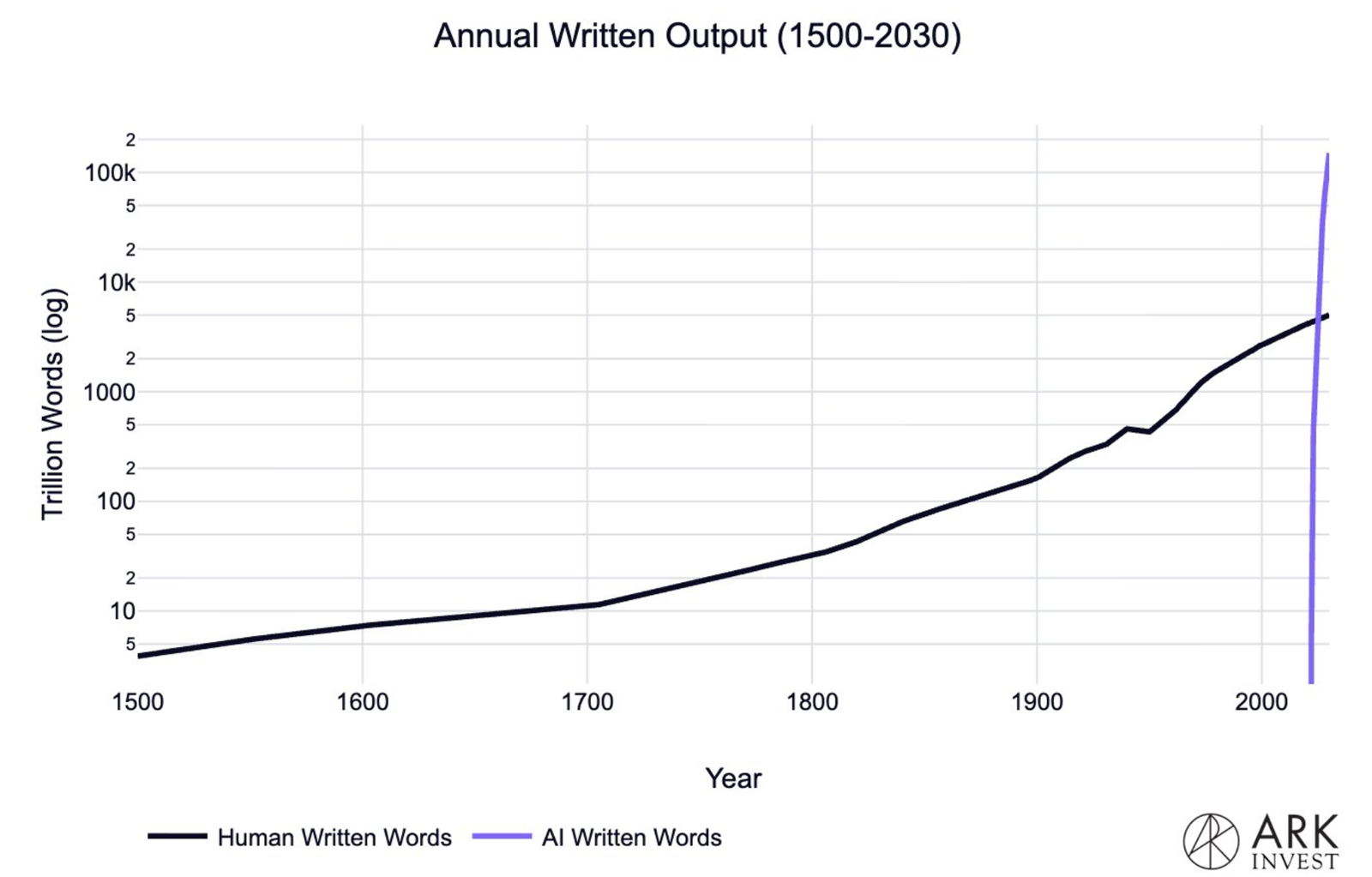
And Twitter just banned 800 million AI accounts!
Early on, it’s fun.
But it’s already getting stale. Imagine 10x more AI content. 100x. One million times more. As it submerges us and drowns us in an overload of information, fake news, morally bankrupt mass media, biased fact-checkers and shameless influencers, how will we know what is true? What to think? How can we make good decisions in a world like that?
Content Quality Before & After
This was the quality of media content before the Internet.

Good journalists—those we were most exposed to—were way more intelligent than the average human, and journalistic standards raised the bar further, so that most content was quite good.
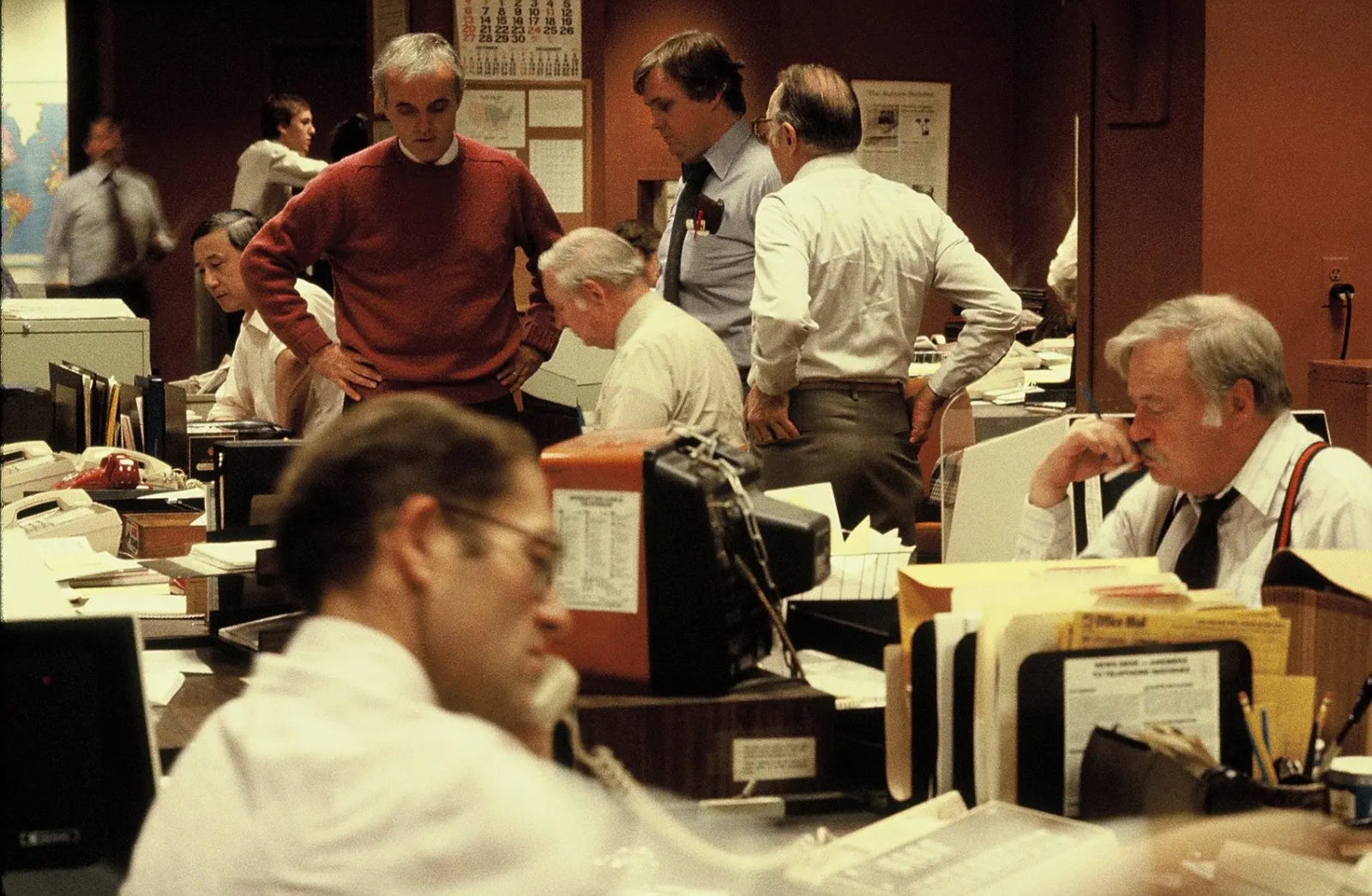
But it wasn’t perfect. The newsroom was biased, the news served the interests of those who financed it, and it was limited in creativity to what had been done and what other journos did, among other shortcomings.
When the Internet appeared, it reduced many of its costs, but it obliterated that of distribution.
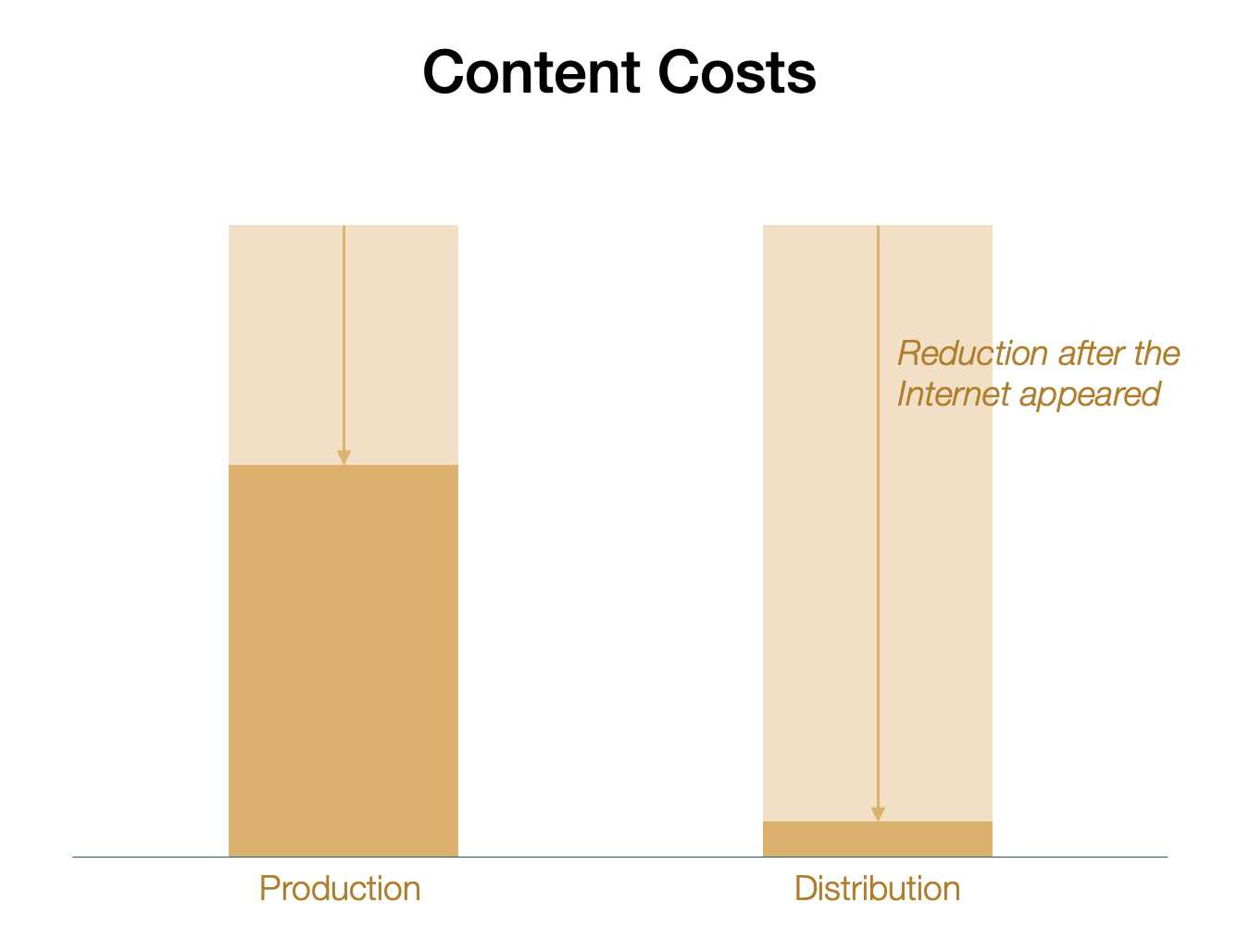
Suddenly, you could post your content on Facebook, YouTube, or Twitter for nothing, and if it was good, it reached lots of people.
Production shrunk less, but it still came down:
For written content, platforms like social media, blogging, or newsletters made it as easy as in newsrooms
For pictures or video content, mobile phones with cameras and simple editing software made it easier than before, but still quite hard to get great content
The result was a massive increase in content:
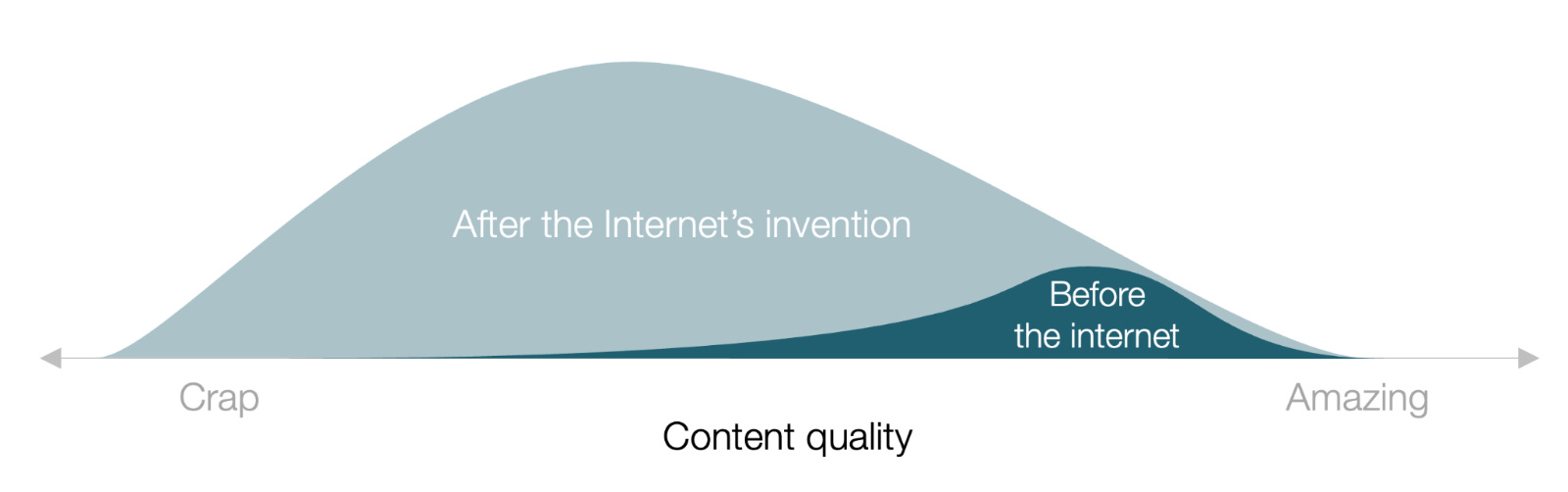
Most of which has been crap.
But there’s so much of it that some was bound to be amazing. You can see it to the right in this graph, where there is a lot of great Internet-era content, and some even better than what we had before, because it allowed hundreds of millions of people to become creators, and some of them are amazing. They would never have been able to create but for the drop in distribution costs.
AI drops production costs even further.
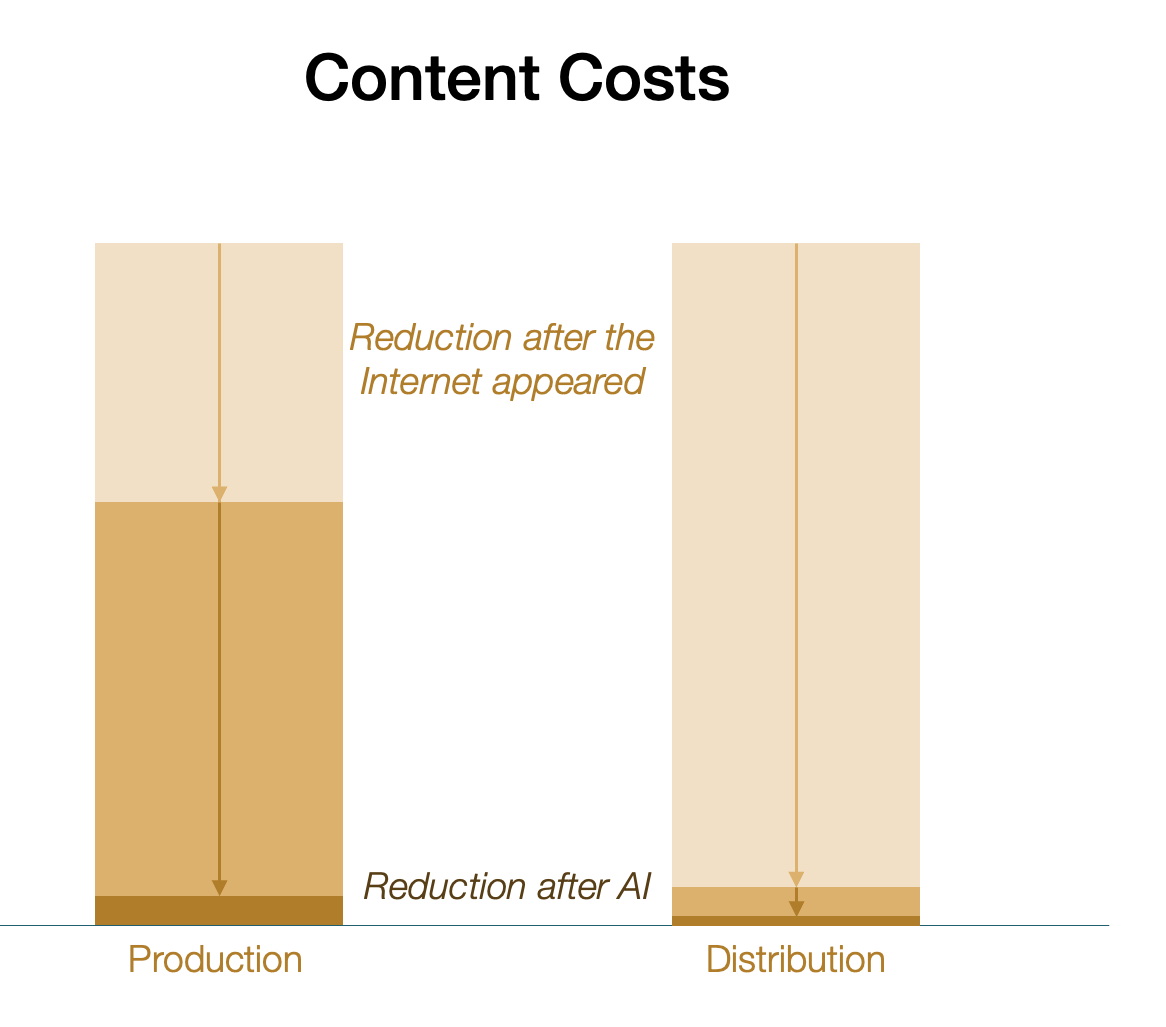
The result is this:
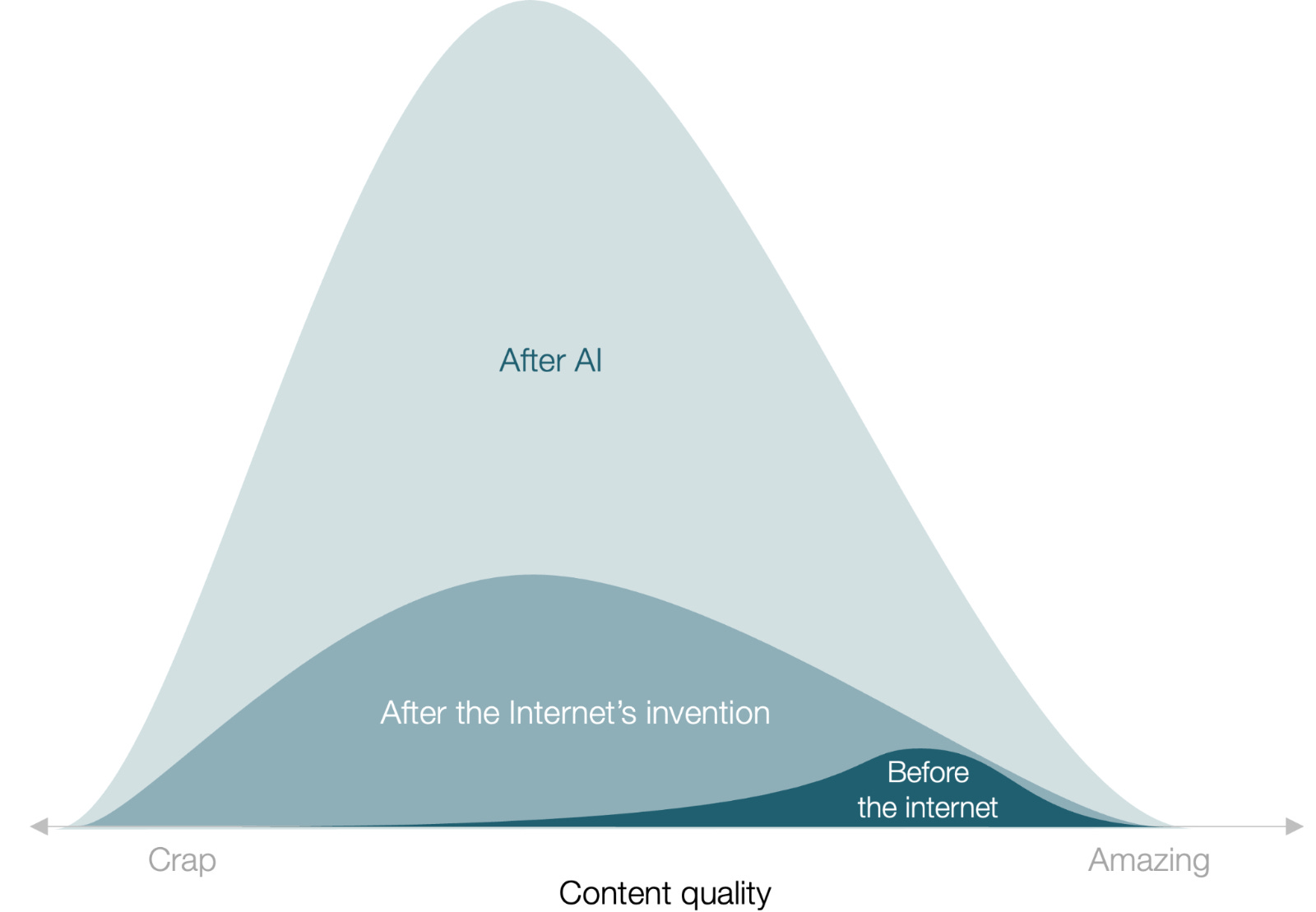
Even more content.2 Most of it, crap.
Look at the right, though.
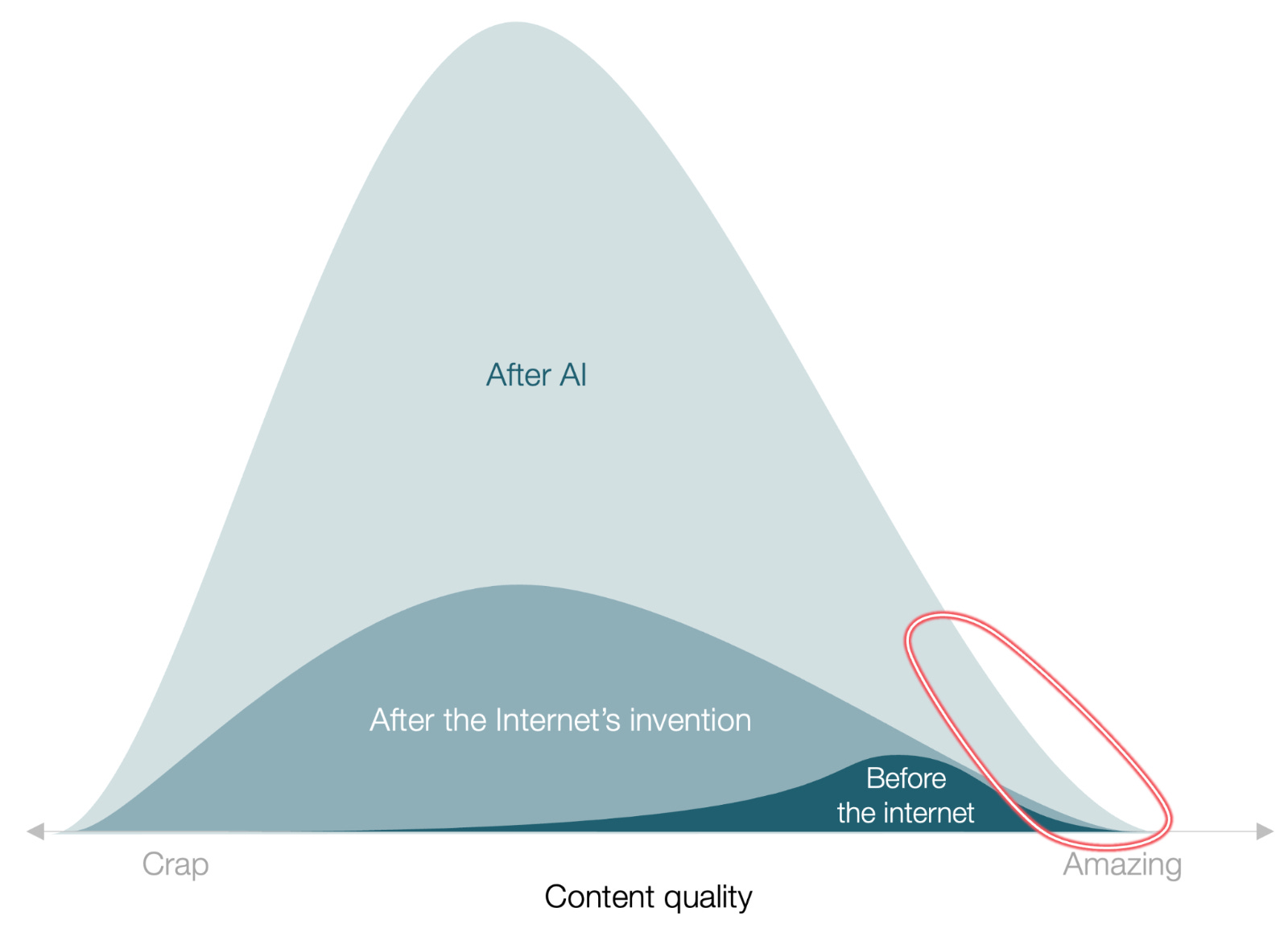
We’re approaching a golden era of content. Those who can best merge humans with AI will be able to create magical pieces. What will media companies need to make this amazing content?
What Is Quality Content in a World of AI?
The first key insight is that as supply explodes, attention is still limited so demand quantity won’t bulge. This means demand quality will go through the roof. The more content we see, the higher our expectations.
Anecdotally, I feel it every day in Uncharted Territories: When I compare old posts from five years ago from those of today, it seems to me like the quality jump is insane: So many more insights per article, illustrations, diversity of topics, depth of research… Mostly thanks to the help of AI. But the audience just gets used to it, it’s the new normal.
What will be the new bar? We can get a clue from the Streaming Wars.
The Quality of Shows in the Streaming Wars
When companies like Netflix, Disney, Apple, and Amazon started spending tens of billions in producing content for their platforms, they created a lot of TV shows.
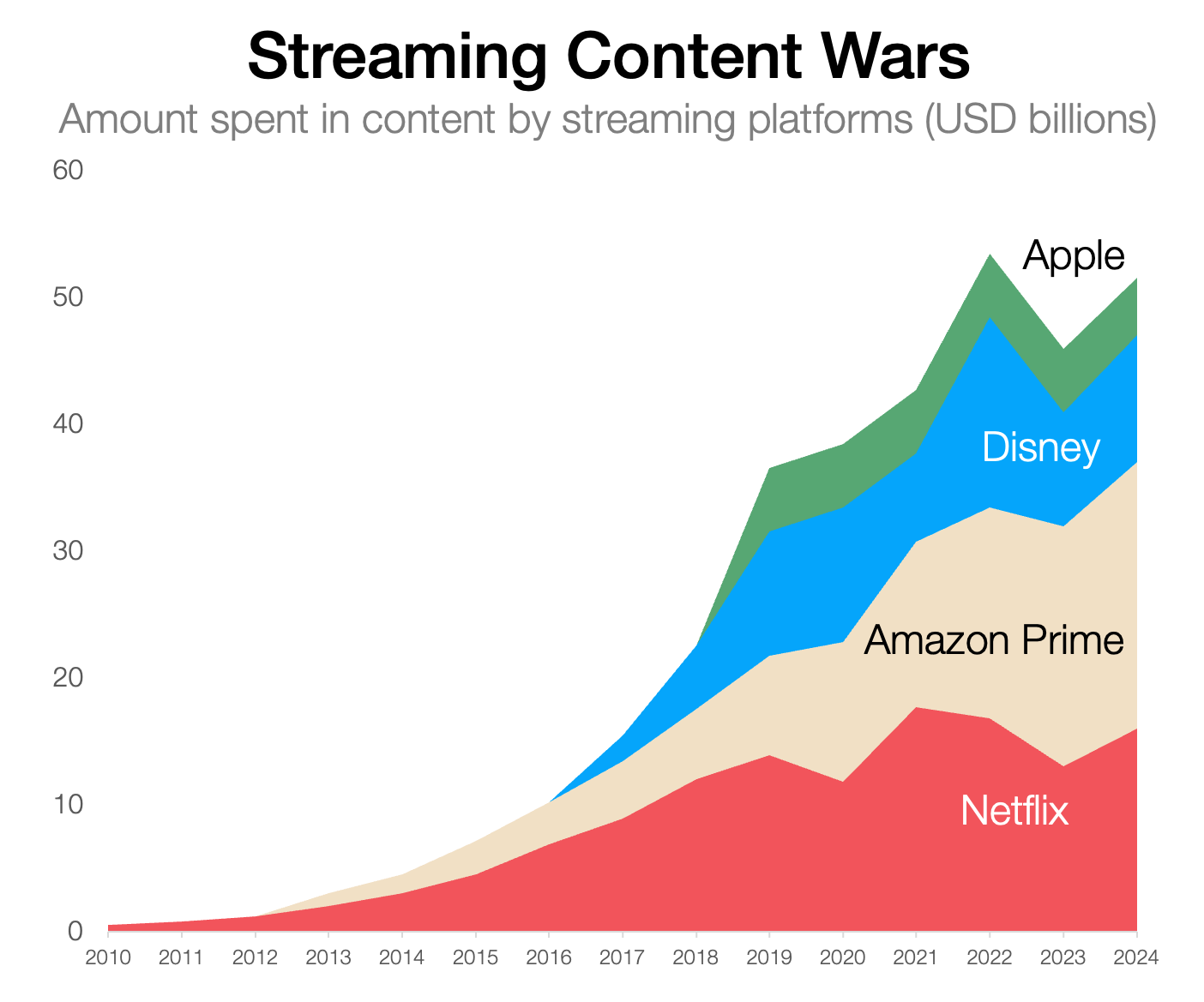
The results in terms of customers have been amazing.
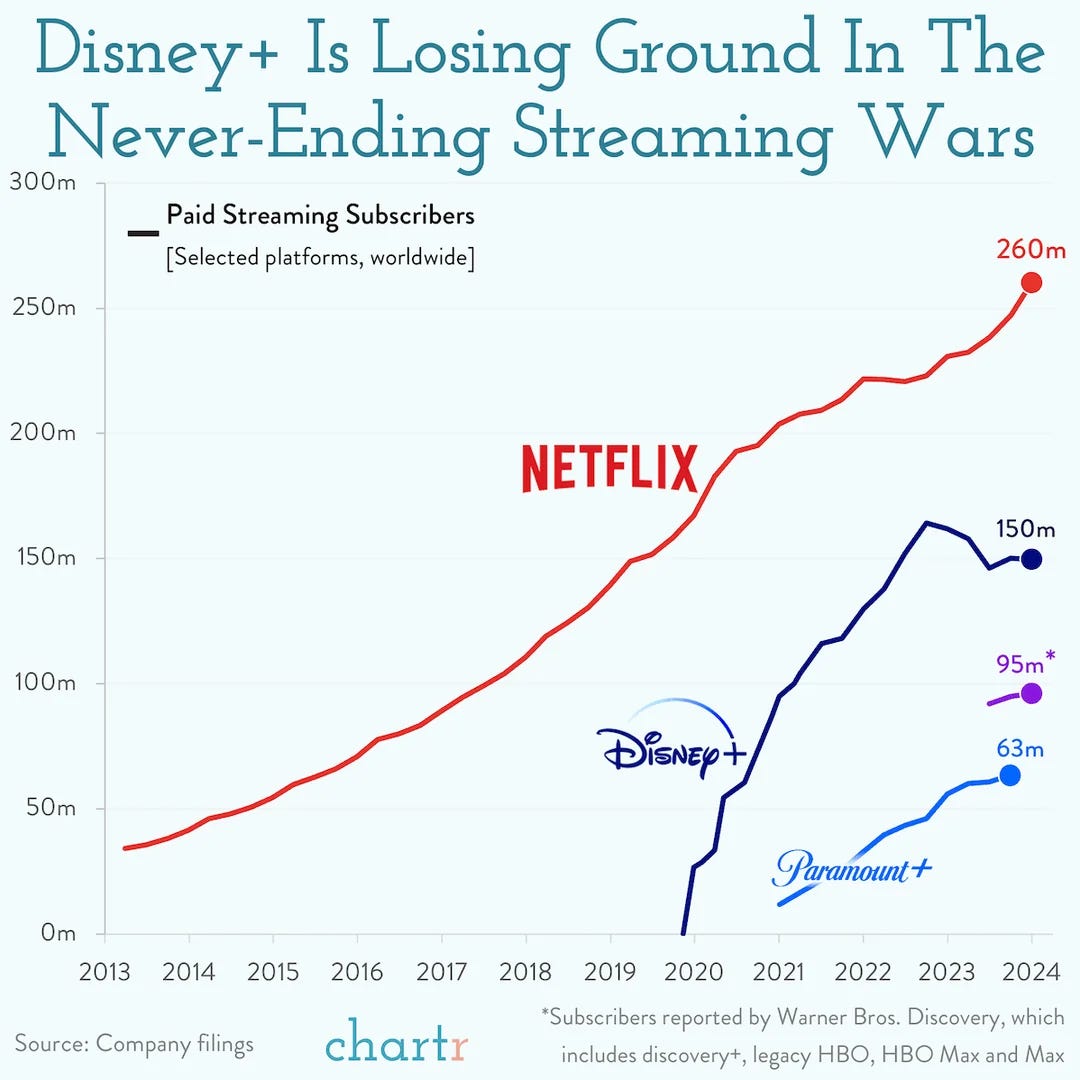
But how much did the quality of these shows increase? What are the best TV series since the Golden Era of prestige TV started? The Sopranos, The Wire, Game of Thrones, Mad Men, Breaking Bad, The Office, Lost… Nearly all predate the Streaming Wars. You’d assume with the explosion of content, we’d have an explosion of amazing content. But that hasn’t happened.
Part of it is niching out: Now you might enjoy some TV show that few other people know, because content specialized in specific niches. But that doesn’t explain it all. There are hundreds of TV shows that look amazing, Hollywood-level production values, but they’re crap. Because the stories are crap.
This shows that the limiting factor in Hollywood has been great storytellers. This became extremely obvious for those who watched Game of Thrones: The showrunners were lauded as amazing storytellers… until they ran out of material from the author of the books, George R.R. Martin. After that, they still had the biggest budgets in the world, with the biggest teams, and yet their ratings started suffering, and the last season was dismal.
So:
More quantity and quality of supply → the expectations of customers rise
The limiting factor in fiction becomes great storytellers → they define the new equilibrium
What will happen to media with AI? Will AI become an amazing storyteller? It might happen in a few years, with the singularity, but I don’t think it will come immediately, because telling a good story is incredibly hard, as we just saw. It requires a deep understanding of humans, their emotions, their drives, the world, the structure of stories, the rules of dialogue, of character arcs… To give you an example, the makers of K-Pop Demon Hunters, a seemingly simple movie, spent seven years of their lives on the project, referring to hundreds of different experts, working for 500-1000 man-years to completion. They tweaked the eyes of their characters pixel by pixel to enhance their microexpessions. AIs are not there yet.
All of that applies to fiction. What about non-fiction? What is the equivalent of great storytellers in non-fiction in the AI era? What will become a commodity, and what will be the remaining limiting factor in a world of AI?
Quality Non-Fiction after AI
To truly answer this, we need to answer a more fundamental question.
Why Do People Consume Media?
What are you trying to achieve when you’re watching the news, scrolling Twitter, reading Substacks?
Make better decisions.
Humans are prediction machines. They try to understand how the world works so that they can make the most of it. That’s why we love stories: They help us understand how others have faced challenges. It’s why we’re fascinated about visions of the future, why we love uncovering new truths about the world.
The application can be professional, like how to communicate to advance at work; it can be personal, like how to shift behavior to become more attractive; it can determine where to live, to maximize the chances of a bright future; it can help us choose who to vote for… Whatever it is, the underlying, frequently subconscious goal is to make better decisions.
When you realize this, you realize how shitty the current media experience is: We consume hundreds of thousands of dull, stupid, vacuous, imperfect pieces of content to create an image of the world that matters to us. We then have to synthesize all this data to form an accurate representation of the world, to inform our decisions. You see the problem, right?
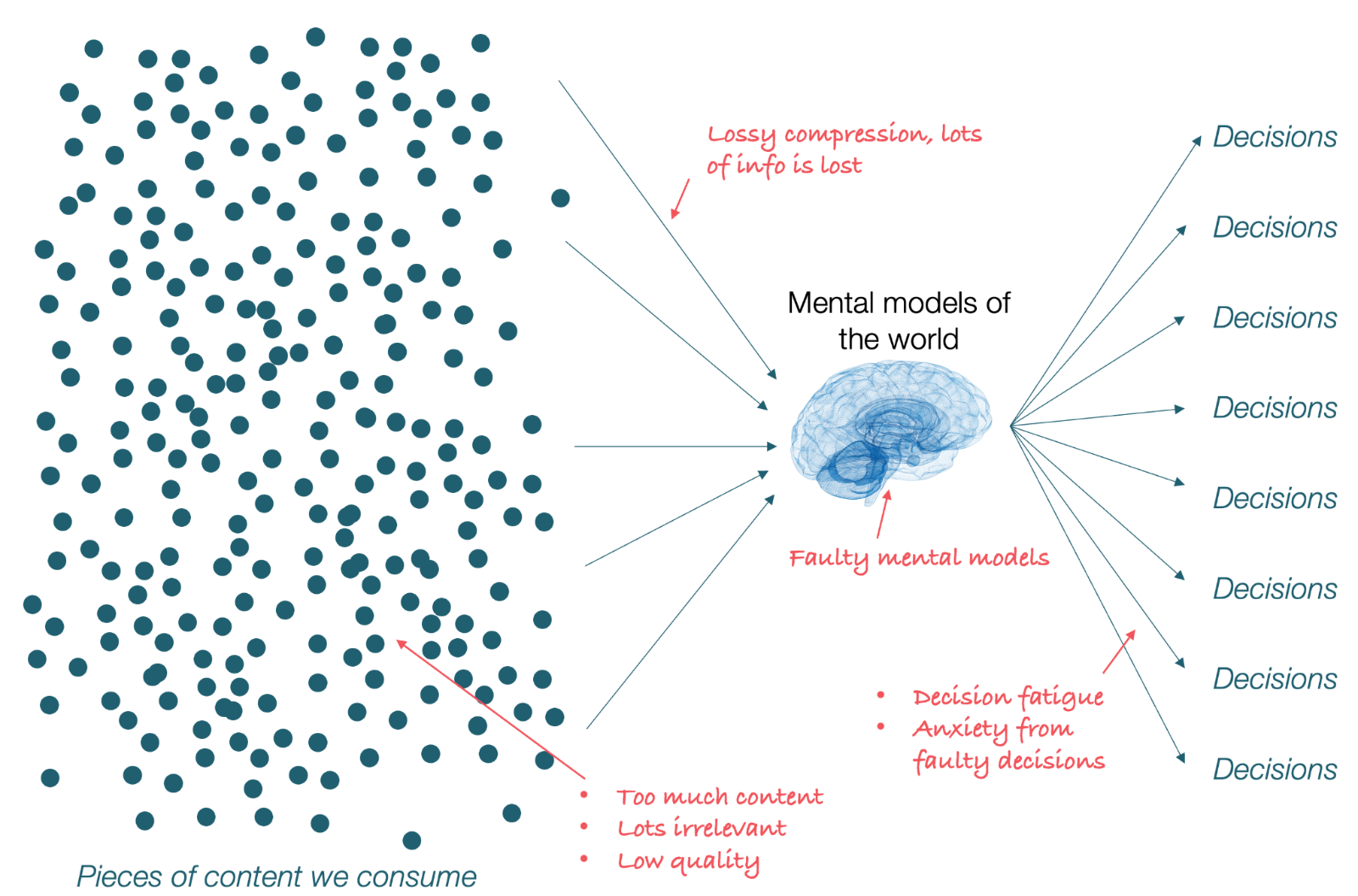
So how can we make this better? Here’s my take.
1. Insightful
The most important requirement is to help the audience understand the world better. The more new things you can share, the more they help the world understand, the more valuable your media company. This means pieces of content should not be vapid, irrelevant, rehashing known facts, limiting themselves to facts only, etc.
And insights shouldn’t come as completely independent tidbits. A single, coherent worldview is much more compelling, because it puts the insights in context, and pushes not just data points, but entire mental models to better understand the world.
2. Entertaining
If you’re boring, though, people won’t finish your content. If they do, they might forget. You must be entertaining to help people consume your content and remember its lessons. So being entertaining is at least as important as being insightful. Doing either is hard. Doing both is devilish.
3. Truthful
If a media outlet produces a million pieces of content and 5% are false, you’re quickly going to stop trusting everything. If an outlet barely gets anything wrong, the audience will learn to trust it and rely on it more and more.
4. Honest
But nobody is perfect. Every media outlet is bound to make mistakes. A company that tries to bury them will destroy its reputation. One that is honest about its truthfulness, that corrects itself when it makes a mistake, will be seen as more honest and therefore more trustworthy.
5. Unbiased
You can limit yourself to saying true facts and yet be unfaithful to the truth, by cherry-picking what you cover and choosing a narrative that fits your agenda.
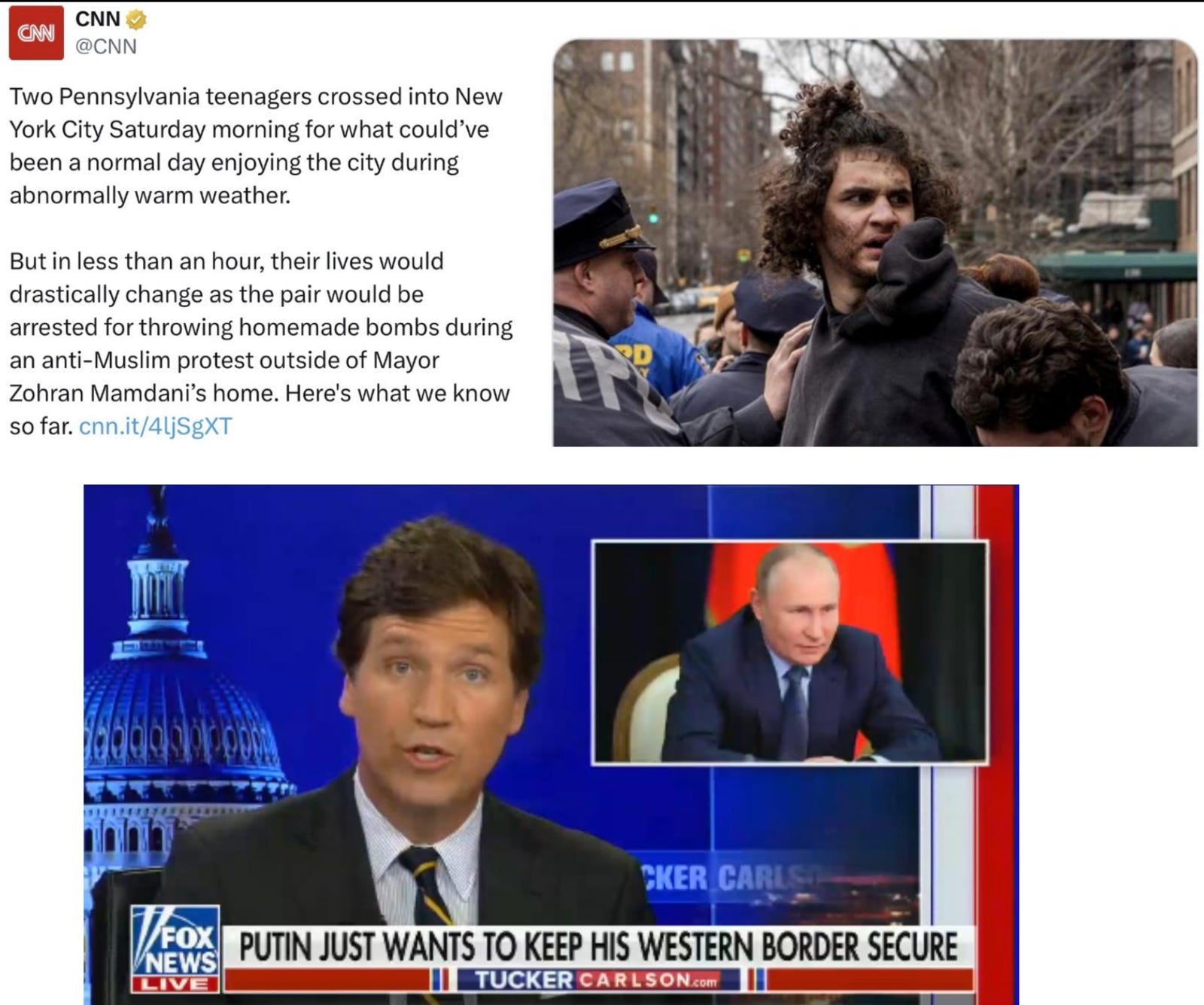
You can make money with biased media, but that will never make you a quality source, because you’ll be pushing incorrect mental models into your audience’s mind.
6. Authentic
All other things being equal, everybody prefers artisanal objects to industrial ones. The experience might be very similar, but just knowing that a human was behind them makes them more valuable, more sacred. The same will happen with content.
But artisanal objects are not usually the same quality as industrial ones. They must be functionally the same, but an artisanal object benefits from tiny flaws. Having a true person behind the content, one that is true to herself, who shows herself as she is, with her virtues and her flaws, will be more likely to reach people’s hearts. Live performances are one way to show the authenticity of artisanal humanity.
One of the areas in which authenticity will shine is courage. It’s easy to say what’s right when it’s popular; it’s much harder when it’s right but unpopular. #MeToo in 2017 was much more courageous than in 2024; saying that women and men are biologically different, and therefore psychologically different, was harder in 2023 than in 2026. Courage is exceptionally useful because it presents insights in the topics that are most likely to have failed mental models of the world, as information on these topics is limited.
7. Personalized
If your first language is Japanese, maybe you’d rather read articles in Japanese instead of English. Maybe the illustrative examples are closer to who you are. Maybe the data presented includes your country, or your region. Or the mental models you have of the world, so that you are never bored by information you already know.
Before, it was too expensive to do that, but with AI it will become so cheap as to be possible in some cases. The future of content will be personalized.
8. At Scale
If you do all this as a single creator, you’ll have a great voice, but you will remain an artisan of the media. The media companies that maximize their impact will have to do all the above at scale.
Build with Me the Future of Media + AI
So if you want to build an amazing media company that incorporates AI from the ground up, it must deliver insights, entertainment, truth, honesty, authenticity, all without bias, and personalized at scale.
I envision a new Uncharted Territories that achieves all of that:
More content, with more insights, and more formats. Imagine The New York Times, but without the bias. The Economist, but for the 21st Century. Mr Beast, but with useful content.
More video: long form and short form.
More interactivity: What if articles became software?
More audience participation: What would it look like if the audience worked articles together?
And much more
But how specifically? What else should that company build? What type of content should it create? To answer this question, we must look into how media is produced today: What are all the tasks involved? Where is AI better than humans, and where are humans going to continue shining? Which tasks should be automated to make them more scalable and better than today? This gives you a strategy of what must be built. That’s what I’ll cover in the next article (paywalled).
Once you have that strategy, how do you make it a reality? By hiring the people to build it. If you’re the type of person who loves Uncharted Territories, loves AI, and wants to use both to take a shot at making a huge AI-first media company to make the world a better place, apply. I have positions as:
Software developers
Vibe coders
Research/Writers
Video creators
Short form video creators
Editors
Cartographers
Merchandise managers
Chief of Staff
But I can’t do any of this if you, the readers, don’t back the mission. I’m taking a huge risk hiring all these people, which I can’t afford with the revenue I’m currently getting from you. So if you like Uncharted Territories and you want to see more of it in the world, if you want more articles, more topics, more formats (short articles, podcasts, videos, short videos), if you want to see great media in the world of AI (and not just slop), you should support us: Without your subscriptions, I won’t be able to do any of this.
And if you really believe in UT and want to fund our growth, you can also consider investing.
Why Uncharted Territories? Why Me?
Over the last few years, I’ve been studying and narrating these changes from Uncharted Territories, but it’s not enough. I can’t remain a bystander while the biggest change in the history of humanity is unfolding before us. Luckily, I have a background in the two key skills required to succeed in this world:
Tech: I spent 15 years building online products and growing them, starting from product management and ending as the Chief Product Officer of a billion-dollar company, with ~100 people at my charge. In the process, I grew teams from 0 to >100, and helped raise $500M. I know how to build tech companies and products.
Media: I’ve spent the last 6 years working in Uncharted Territories, where I’ve gone viral on all platforms: Medium, Substack, Twitter, YouTube, Instagram… I know how to make compelling content.3
I’ve decided to merge my two careers into one: building Uncharted Territories into a full media company, where we’ll combine the best of AI and humans to produce more, better ideas that reach more people, to help the world make better decisions and nudge it in a better direction.
Normally, you’d eye this graph, notice that AI-generated content now outpaces human content, and move on. But is this graph true? How do they know what is AI and what isn’t? Why did it slow down mid-2023? Is it simply that the algorithm can’t detect AI content anymore? Does that mean a much larger majority of content is now AI? Does it even matter how much? How will graphs and their underlying data validity evolve in a world of AI?
With the average probably better than with humans, as the average human creator is not that interesting, but AI has some minimum standards.
Other relevant experience: Before tech, I got my MBA at Stanford and two MSc in engineering. I’ve studied scriptwriting, communication, and public speaking. I wrote a book on storytelling structure.
Get a better name than "Uncharted Territories". That was ok for the curious, but if you are thinking mainstream, abet something more positive.
Hi Tomas, thanks for your article. I saw a link for hiring but not one for investing, are you planning to include one?