

I’ve been thinking about this and gathering insights for 10 years. I don’t know of another analysis that maps Christianity’s rise this systematically as a growth engine.1
Christianity is the biggest religion in the world: ~2.3B people, nearly 30% of the world’s population.
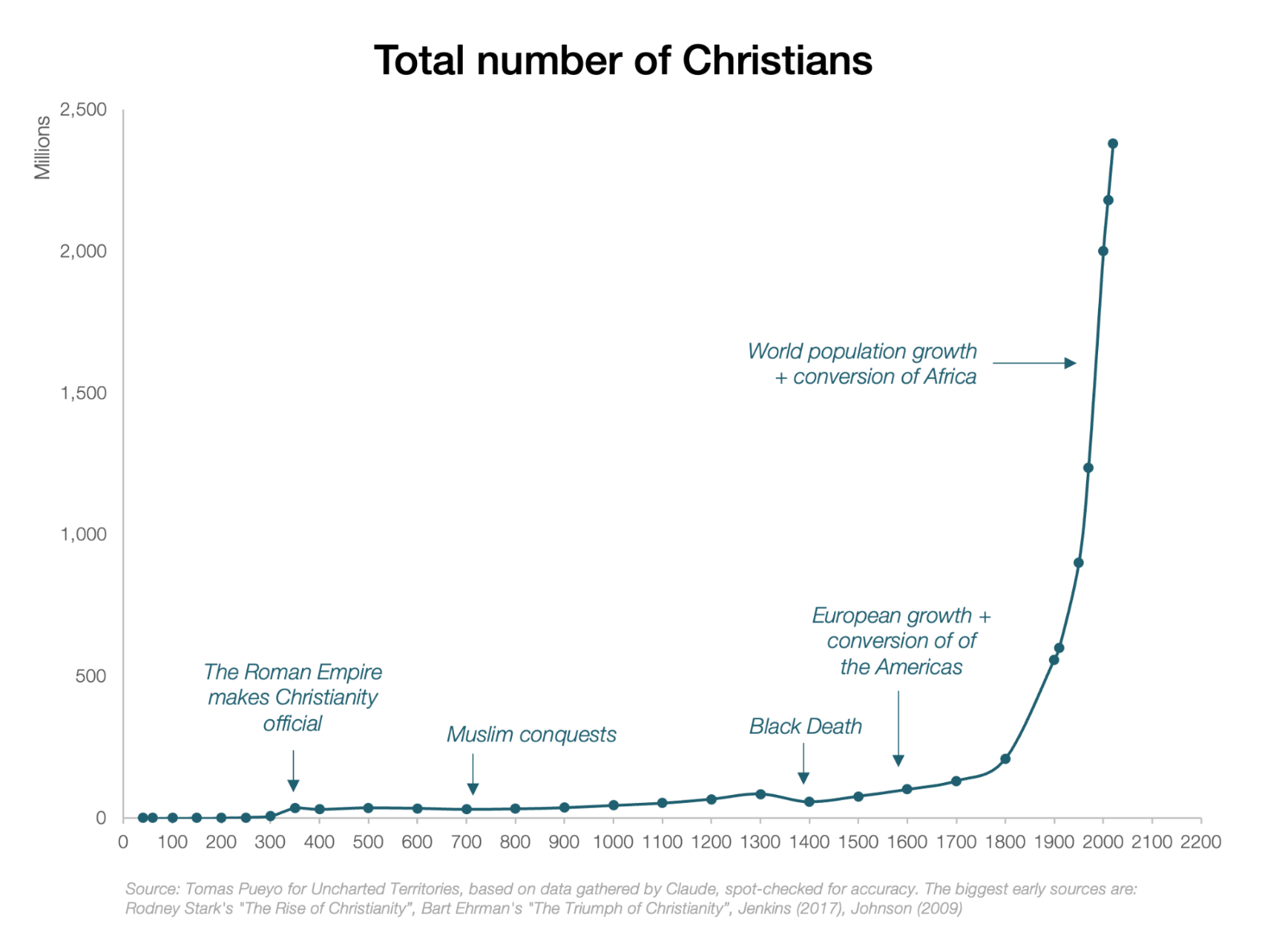
Why has it been so successful?
Based on that chart, you’d probably assume that most growth happened in the last few centuries: From the European conquest of the Americas in the 1500s onwards, to the conquest of Africa in the late 1800s, and the 20th century baby boom.2
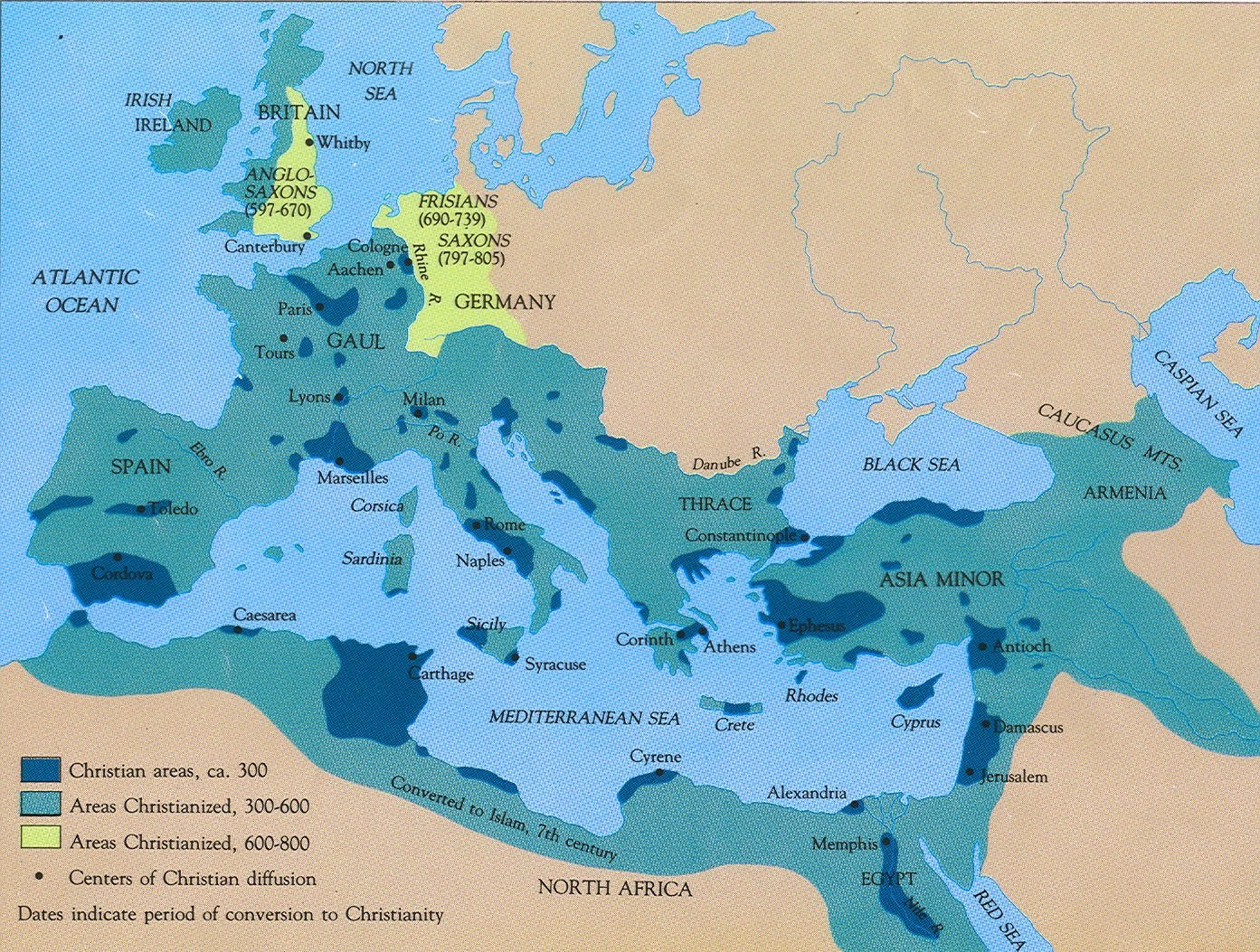
If instead you looked at this map of the early growth of Christianity, you’d suspect something different:
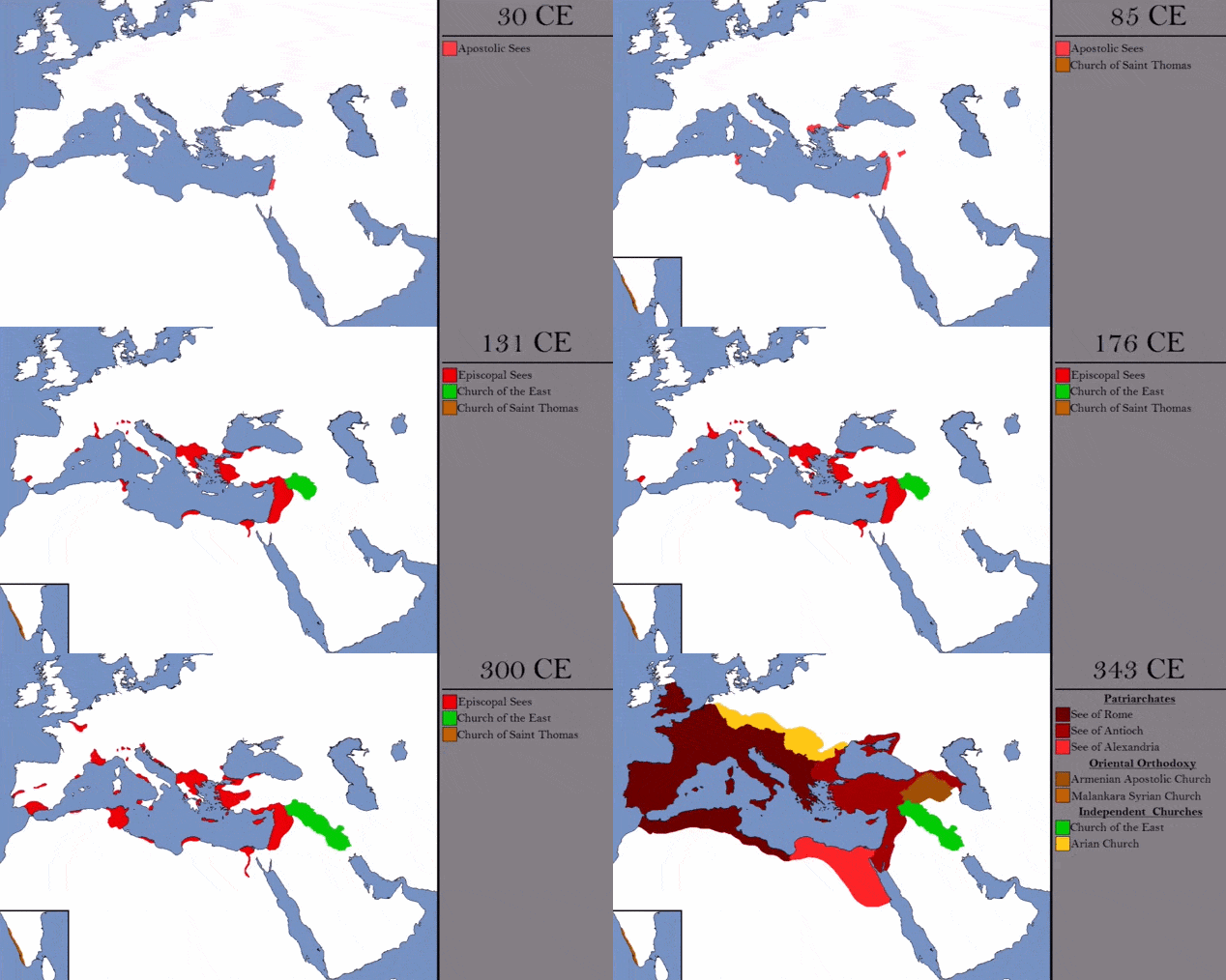
From this, you’d guess that the big milestone of Christian growth was the takeover of the Roman state in the 300s AD.3 Well, here’s the same graph as above, but logarithmic:
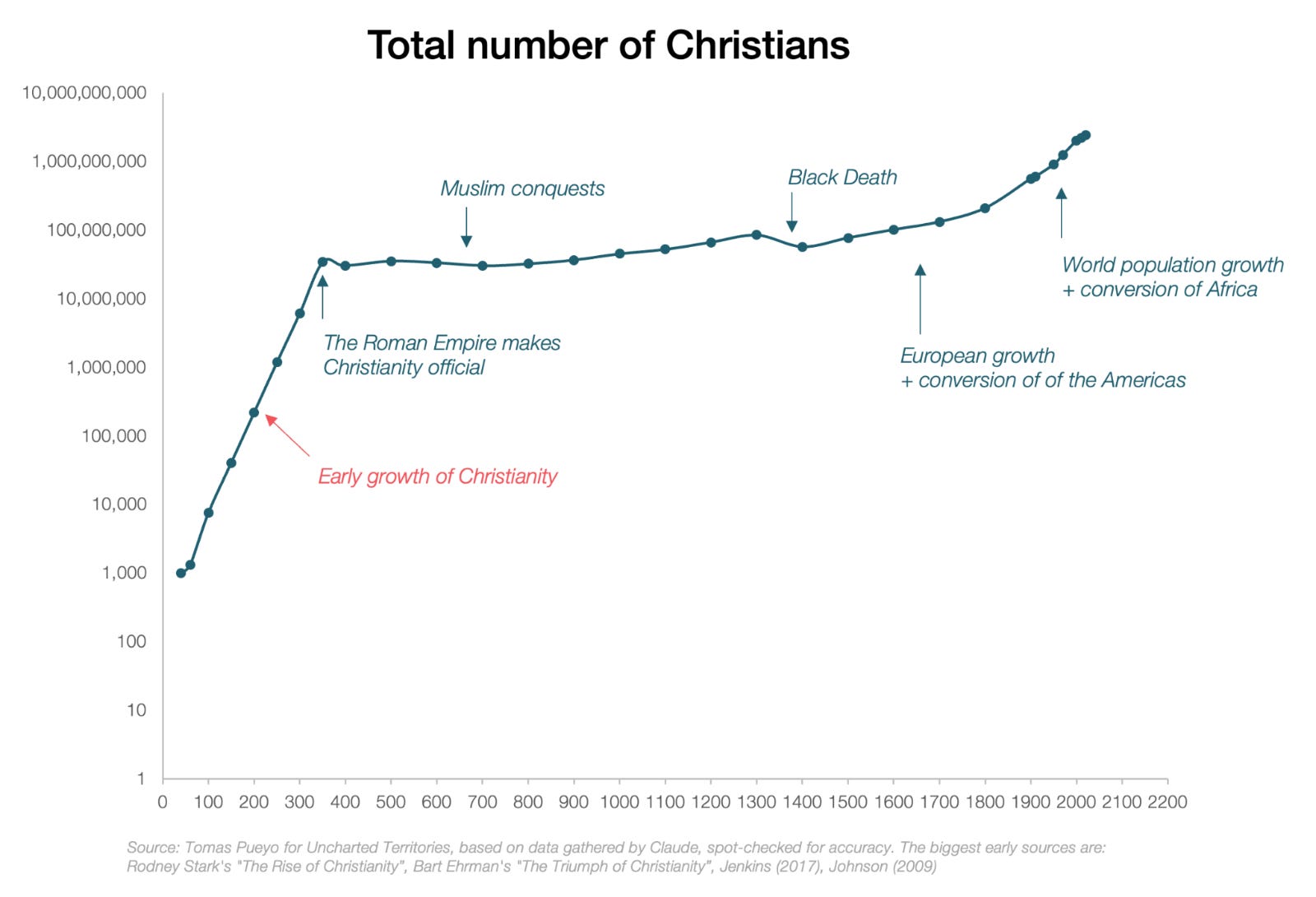
In fact, Christianity grew like crazy until it took over the Roman state! From ~1000 followers around the time of the death of Jesus, to ~35M when it became the official religion of Rome, Christianity grew by ~40% decade over decade.4 How is that possible? How did a ragtag group of Jews from a frontier colony of the Roman Empire create a new religion that took over the most powerful empire, and from there the world?
In my previous careers, I created and grew software, including viral applications. The insights on viral growth are what allowed me to quickly understand COVID, and when I look at the rise of Christianity, I see the exact same patterns: a piece of software hyperoptimized for growth.
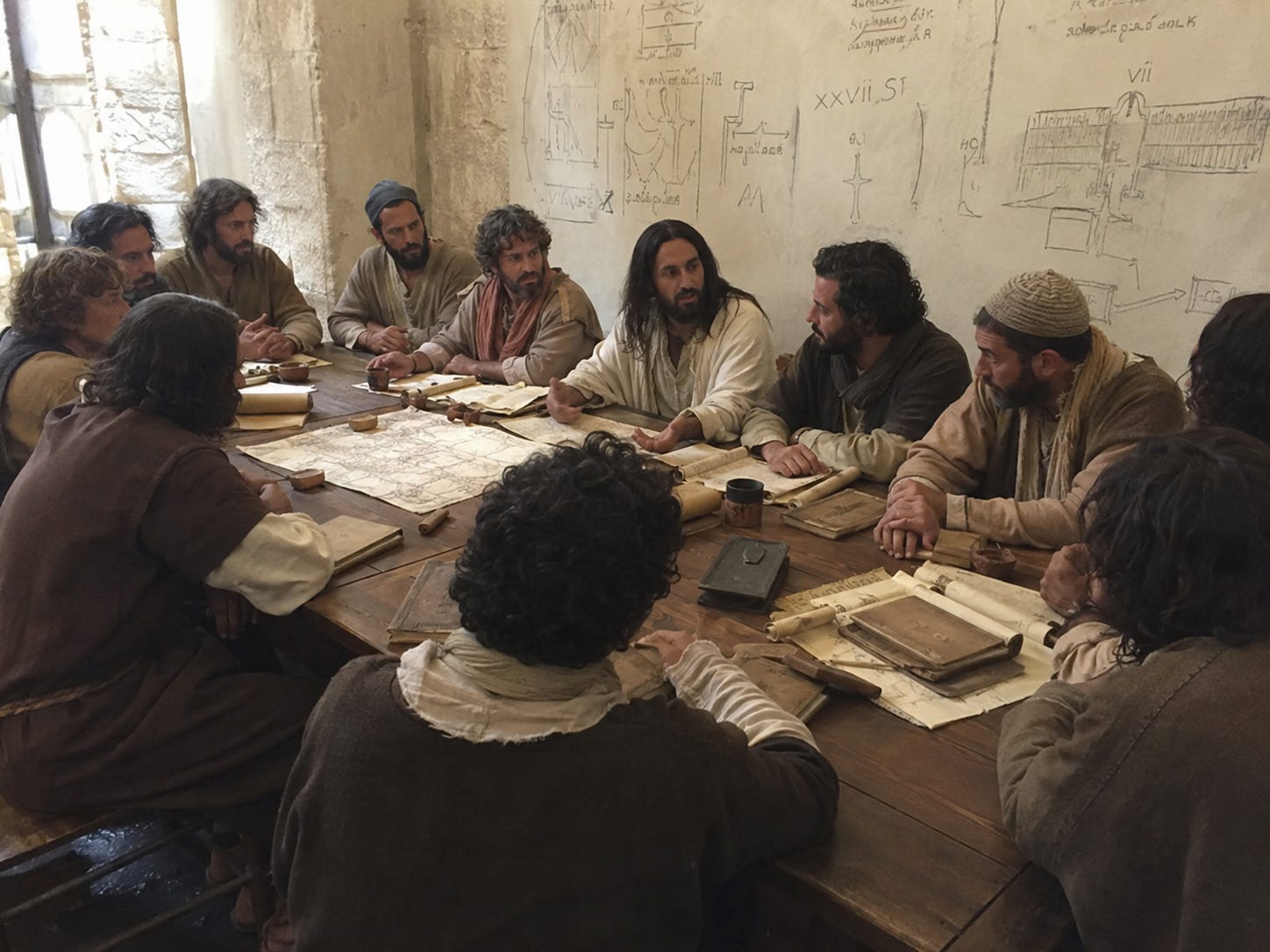
Indeed, Christianity, like all religions, is software, an operating system that guides people on what they should and shouldn’t do. And Christianity optimized every aspect of its business for growth:
Big audience
The value proposition of its product
The segmentation, to specialize in a few key audiences
Advertising, to spread the message to new audiences
The sales force
Low friction to convert customers
Viral growth: Existing customers attract new customers
“Reproduction rate” (growth within existing customers)
Retention rate: The degree to which you keep your audience
Competition suppression
Customer monetization
Today, we’re going to look at each.5
1. Big Audience
A good business has a huge TAM, or Total Addressable Market: All the people who can potentially consume the product.
Christianity comes from Judaism, but Jews think they are Chosen People: Only them have been chosen by God to receive the Torah and follow his commandments. It’s a religion mixed with an ethnicity. A private club. Back then, virtually all religions were private clubs.
Christianity killed that and declared itself open to all:
There is neither Jew nor Greek, there is neither slave nor free, there is no male and female, for you are all one in Christ Jesus.—Galatians 3:28
Religion gets disconnected from ethnicity.
Does it though? No! That’s not what Jesus said! He said to try to convert Jews only!
Go nowhere among the Gentiles, and enter no town of the Samaritans, but go rather to the lost sheep of the house of Israel.— Gospel of Matthew
I was sent only to the lost sheep of the house of Israel.— Gospel of Matthew
The ones to increase the TAM were his disciples; that first quote was from Apostle Paul. Why would the apostles change Jesus’s message? Because they had to travel across the Mediterranean to convert Jews, who lived in pretty mixed communities: Many Jews only spoke Greek, and they were surrounded by pagans. By accepting non-Jews, early Christians dramatically grew the TAM,6 and with it the scope of Christianity.7
2. Great Value Proposition
The Christian pitch was so much better than that of the competition that good missionaries could convert thousands of people. For example, after the apostle Peter preached to a multitude:
There were added that day about three thousand souls.—Acts 2:41
How was the pitch so competitive?
Love
Greek & Roman life was pretty brutish, violent, and mean. Think Roman circus.
Judaism was an improvement on that: Although the Jewish god is feared, and Judaism focuses on Jews, it does preach loving each other and thy neighbor.
Christianity went further though:
You have heard that it was said, "An eye for an eye and a tooth for a tooth." But I say to you, Do not resist the one who is evil. But if anyone slaps you on the right cheek, turn to him the other also.— Jesus Christ (Matthew 5:38–42)
When mixed with universalism (everybody can be Christian) and the mutual obligation to help each other, this message became extremely powerful. It created a community of people who were morally much more admirable than the competition, and who gathered in loving and kind community.
All of this was very counterintuitive at the time! You can imagine how compelling that pitch would have been.
Progress, Agency, and Legibility
When you design videogames, you learn that the single most important motivator to a player is actionable progress, whether through reactions to your actions (e.g. you shoot, somebody dies), level or quest completions, progress bars, points… You can act, that action brings progress, and that progress is visible.
Polytheisms tended to be terrible at this: You, the player, were subject to the whims of gods. You couldn’t really know what they wanted; you had to guess. You performed some sacred rite and hoped it worked. You didn’t know what parts worked, so you just tried to get it as close as possible to the time when somebody did something similar and ended up lucky.
Christianity changed all that. You knew exactly what you needed to do (love, respect and help others, etc.); even if you failed you could still get back on the wagon; you could comment on your progress with a priest (confession), who would tell you what you needed to do to get back on track (penance)... Based on all this, you had a pretty good sense of whether you were going to end up in heaven or hell.
Miracles
In the ancient world, the point of religion was for gods to help you, to get supernatural help… miracles. If your god couldn’t make them, she was weak. Christianity claimed that it could perform lots of miracles. A healing or exorcism was a public demo. Even when a miracle was only reported, the report itself traveled as social proof.
Social Security
That belief translated into specific benefits.
Let the strong care for the weak, and let the weak reverence the strong. Let the rich man bestow help on the poor and let the poor give thanks to God.—First Letter of Clement to the Corinthians
Christianity was a mutual-aid society. People took care of the poor, of the sick, of the neighbor in need.
This was especially valuable in the past, because the world in general, and cities in particular, were extremely dangerous: disease, fire, famine, abandonment, patronage dependence, widowhood, infant mortality, slavery, migration… The Church gave members a second family.
In this way death, waging war with these two weapons, pestilence and famine, destroyed whole families in a short time, so that one could see two or three dead bodies carried out at once… Then did the evidences of the universal zeal and piety of the Christians became manifest to all the heathen. For they alone in the midst of such ills showed their sympathy and humanity by their deeds. Every day some (Christians) continued caring for and burying the dead, for there were multitudes that had no one to care for them; others collected in one place those who were afflicted by the famine throughout the whole city, and gave bread to them all; so that this thing became noised (spoken of) abroad among all men, and they glorified the God of the Christians and, convinced by the facts themselves, confessed that they alone were truly pious and religious.—Eusebius, Historia Ecclesiastica, 324 AD8
Did this matter? So much so that the emperor Julian launched a campaign to meet the value proposition:
Julian complained in a letter to the high priest of Galatia in 362 that the pagans needed to equal the virtues of Christians, for recent Christian growth was caused by their “moral character, even if pretended,” and by their “benevolence toward strangers and care for the graves of the dead”.—The Rise of Christianity, Rodney Stark
This was even more compelling in times of crisis like famines, pests, or earthquakes, when society fell apart except for the Christians. If you lost everything and none of your pagan priests were there for you, but the Christian community was surviving together, that made for a pretty compelling sales pitch.
Role Models
Showing love, gathering together, helping each other… They were patient, disciplined, peaceful, sexually restrained, generous, willing to suffer… These are things no other religions did. The product demo was great and unique.
This was even truer of Christianity’s power users: monks, virgins, martyrs, confessors… Their costly self-denial made the product more credible, like a product’s community having power users as evangelizers, a name used to this day for this purpose in software products.
Heaven and Hell
As I’ll describe in the next article, the older religion of Zoroastrianism had invented a version of heaven and hell, which Judaism had adopted. But the process was slow, lasting centuries. Initially, people believed there was nothing after death. Then, a state of stasis. Then, that all the dead would eventually rise on the final judgment day, and the good would be rewarded and the bad punished. Then, that during the waiting period, the good would have a more pleasant experience than the bad. That last part is closest to what Jesus believed.
Early Christians made an addition: They made heaven and hell destinations you enter just after death. Why? Well, Jesus had just died and been resurrected within 3 days, so that proved it could happen fast. And where was Jesus now? The final judgment day had not arrived, so he must be somewhere. That somewhere had to be pretty cool, right?
CHRISTIAN PROSELYTIZER: Did you know there’s a life after death, and it lasts for a very long time, and if you’re good you get an amazing place to enjoy until the final judgment, and if you’re bad you suffer?
ROMAN: How do you know that’s true?
CHRISTIAN: Well, Jesus died and was resurrected. We have plenty of witnesses. How do you know it’s NOT true? Are you willing to risk suffering for what could be forever?
ROMAN: Hmm…
CHRISTIAN: Oh and by the way, the one who makes that judgment is my God. And he sees EVERYTHING and can do ANYTHING. Unlike your weak gods.
ROMAN: Sh*t… OK where do I sign?
This creation of a clearer vision of heaven and hell where your soul goes while you wait for the final judgment really gelled as Christians mixed with Greeks. Early on, Christians thought resurrection was literal (the body came back). But with Greeks, who conceptualized the duality of body and soul, the idea became sturdier: Clearly, the bodies of the dead were not coming back, and many Christian martyrs were being persecuted. There was urgency to come up with a solution for them to continue believing in Christianity. That’s how the idea of a soul leaving your body and flying to the sky to hang out with Jesus emerged.
Later on, the Church would make heaven a kick-ass place and hell the worst place ever, forever. They were basically the biggest stick and carrot you could conceive, if you wanted your flock to do as you say. Pretty convenient.
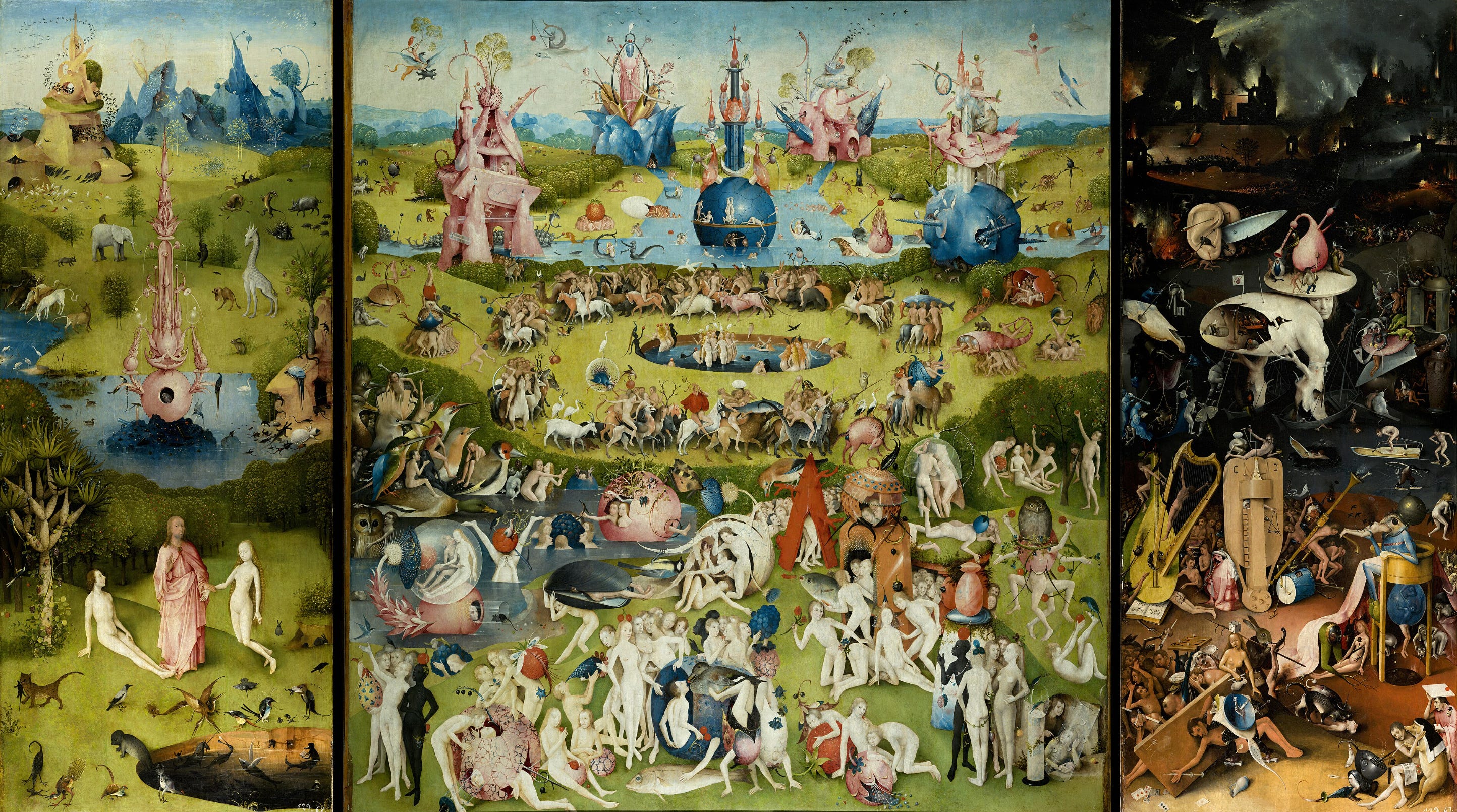
Mass = Meditation
Meditation is good for the mind, and later on in the history of the Church, everything around mass was designed to induce a meditative state:
When you enter a church (even more so a cathedral), all your senses awaken, as if you were passing the threshold into a sacred space. The temperature is different from outside due to the solidity of the walls and the height of the ceiling; light is filtered through colored glass, sound is quiet and the little noise reverberates as if everything was a murmur, the smell of incense lingers… All its architecture is designed for this.
I think most sermons are designed to be boring. It’s not a coincidence that the word litany originally refers to a prayer led by a priest, and has come to mean a long, monotonous, or repetitive catalog of complaints or issues. Boring sermons achieve two goals: Suffering them in silence displays adherence to the belief, but more importantly, they induce a meditative trance. People escape their minds for a moment, their thoughts, very much like guided meditation
The topics push the audience to reflect, to take stock of life and to project into the future.
3. Great Segmentation
At the time of Jesus Christ (JC), the main target segment to convert to Christianity was Jews.
Convert the Jews
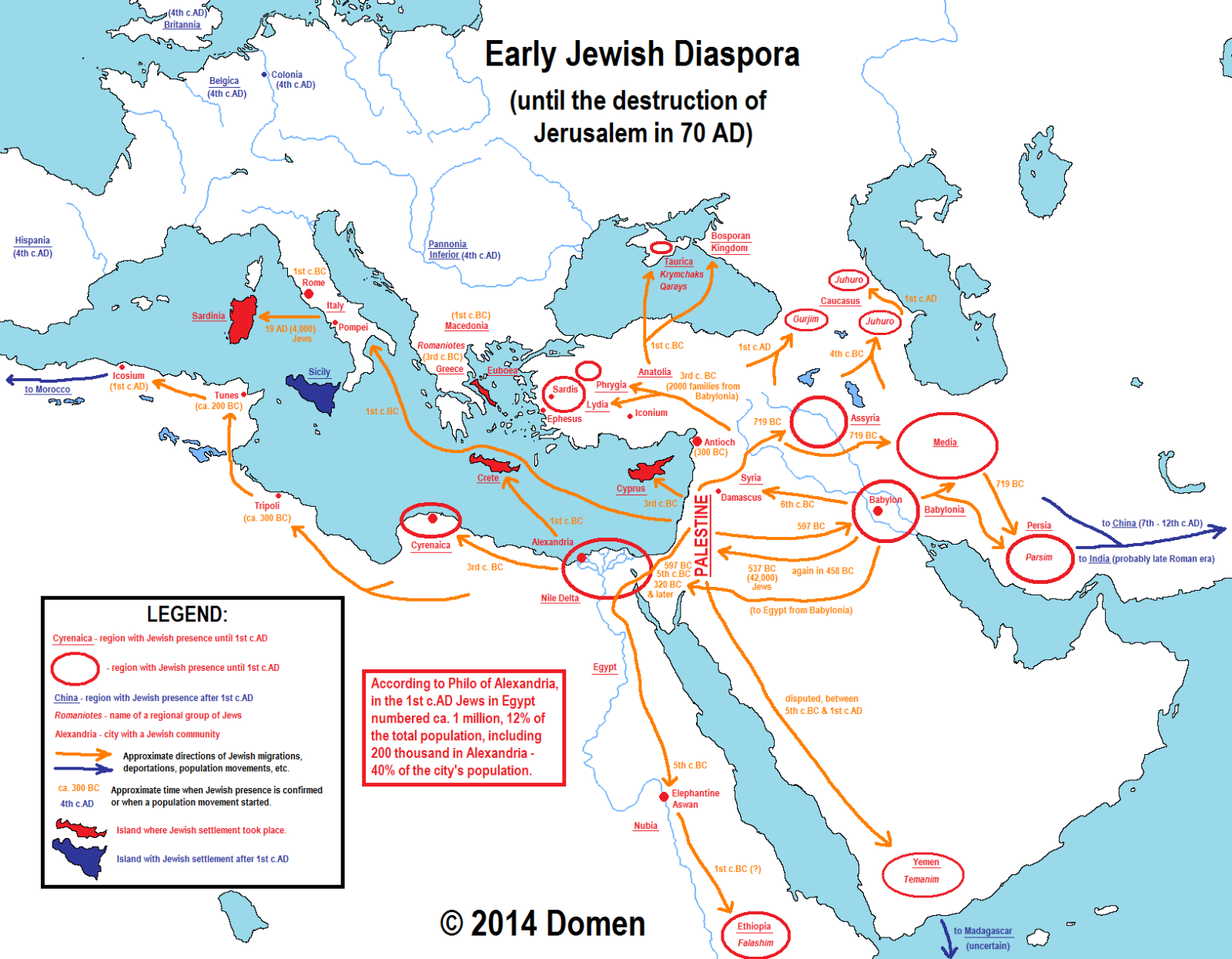
Like many other ethnicities (Greeks, Romans), Jews had spread through the Roman Empire, mostly as traders and artisans, which meant they stayed primarily in cities. Unlike other ethnicities though, they preserved their Judaism strongly, so that there were Jewish communities in cities around the Mediterranean—a perfect target for conversion. That’s why early Christian missionaries traveled so much around the Eastern Mediterranean. It’s also why most early conversions of Christians were in cities. The word “pagan” originally meant “rural”...
Being far from Israel, these Jews were likely less orthodox. Some were integrating into their host cities already, and were probably easier to convert.
Convert Jewish Adjacent
Many Gentiles would have become adjacent to Judaism, but might not have converted yet. Remember, it was a private club, not easy to join. So if a religion adjacent to Judaism appeared and made it easy to join, it would have been quite successful.
Localization
You might well say your TAM is everybody, but if you don’t speak their language, your product won't travel far. So as Christian proselytizers traveled around the Mediterranean, they adapted their texts to local languages.
Christians went beyond translation. For example, when the Church had to translate religious texts into Slavic (which didn’t have an alphabet), they created the Cyrillic Alphabet.
Women
Women in general are a better target than men for early conversion to a new religion: They tend to make up the biggest share of new members in cults, are more religious, more prone to believe in the supernatural (e.g. astrology), and in certain circumstances are more easily persuaded9.
And in the Ancient World, they were the most underserved audience.
The status of Athenian women was very low. Girls received little or no education. Typically, Athenian females were married at puberty and often before. Under Athenian law, a woman was classified as a child, regardless of age, and therefore was the legal property of some man at all stages of her life. Males could divorce by simply ordering a wife out of the household. Moreover, if a woman was seduced or raped, her husband was legally compelled to divorce her. If a woman wanted a divorce, she had to have her father or some other man bring her case before a judge. Finally, Athenian women could own property, but control of the property was always vested in the male to whom she “belonged”.—The Rise of Christianity, Rodney Stark, via Astral Codex Ten
Meanwhile, Christians thought everyone was equal under God, and that having sex created an exclusive covenant that created an eternal bond between men and women.
The two shall become one flesh.—Jesus, Matthew 19
As a result, Christianity condemned divorce, incest, marital infidelity, and polygamy, all of which are bad for women (who could lose their status and income, or have to share their husband’s wealth with other women), especially for high-status women (who had the most to lose).
Also:
No early marriage: Christian girls were two thirds less likely to be married by age 13 than pagan women.
No forced remarriage after becoming a widow: Widows were pressured to remarry under Roman law (and thus lose their inheritance, which became their husband’s), but not in Christianity.
Status: Women could also hold high-status office in the Christian Church.
The result was a lot of early conversion of women:10
The early church was so especially attractive to women that in 370 the Emperor Valentinian issued a written order to Pope Damasus I, requiring the Christian missionaries to cease calling at the homes of pagan women. Although some classical writers claimed that women were easy prey for any "foreign superstition," most recognized that Christianity was unusually appealing because within the Christian subculture women enjoyed far higher status than did women in the Greco-Roman world at large.—Reconstructing the Rise of Christianity: The Role of Women
The Downtrodden
Slaves also seem to have been a significant part of the early Church and in some cases even found themselves in leadership roles. Early Christian communities were accused of targeting the illiterate, enslaved, young, female and under-educated.—Brett Devereaux
This makes sense, as the people most likely to want to upend the system are those who are losing in the current one. The same was true for communism 1800 years later.
Has not God chosen those who are poor in the eyes of the world to be rich in faith….is it not the rich who are exploiting you? Are they not the ones who are dragging you into court?—James 2:5
Elite Overproduction
Peter Turchin has this theory that lots of revolutions are caused by secondary elites, who are close enough to power that they can see it and experience it, but for whom full access is barred. They become the angriest and tend to lead revolutionary movements. That’s indeed the segment that Christianity targeted:
The main strength of Christianity lay in the lower and middle classes of the towns, the manual workers and clerks, the shop keepers and merchants—Jones, 1963
The Rich
All of this makes a lot of sense. If you want to take over an existing power system, you have to create a coalition of the losers of the existing system. That means you must take the power away from those who currently have it.
Go, sell your possessions and give to the poor, and you will have treasure in heaven. Then come, follow me.— Matthew 19:21
This is why it was so important for the spread of Christianity that Jesus shun the rich. By telling them they won’t reach heaven through riches, and that they must give to the poor instead, he was able to get the resources needed to broaden Christianity’s reach.
It is easier for a camel to go through the eye of a needle than for someone who is rich to enter the kingdom of God.—Mark 10:25 / Matthew 19:24 / Luke 18:25.
That said, the rich are by definition more powerful, so more likely to fight back and with the resources to do it. The only way to win there was to make Christianity intellectually respectable. A religion of fishermen, slaves, widows, artisans, and urban migrants could grow from below, but to conquer the empire it also had to climb the prestige ladder. Many Christian thinkers worked to reframe Christianity as a true philosophy that had superior answers to the questions Greek philosophy had been asking for centuries.11
4. Great Advertising
Martyrs
The blood of the martyrs is the seed of the church.— Tertullian, Apologeticus 50
Normally, when you kill people for belonging to a religion, that religion weakens or disappears. But when Christians were persecuted in the Roman Empire, the religion spread. Why? A lucky combination of factors:
Rome didn’t systematically eradicate Christians, mainly because Christians were generally good: They respected the state and gathered to sing and to tell each other to be good people. The killings were sporadic, and frequently done for show.
Christians were not just killed, they were asked to convert or die. Many decided they’d rather die. What a great marketing message! See? He’s so sure this is the right religion that he’s willing to die for it.
Part of this acceptance of death was from the section above, the introduction of the concept of heaven & hell. Christians thought they were going to heaven.
This is even more true when Christians were killed because of their belief. They became like Jesus, martyrs for the belief. That was compelling. Muslim suicide bombers have also willingly died as martyrs, and today many people wish to become martyrs in Islam.
The Roman display of killing Christians was meant to inspire fear, but it backfired because Christians would endure these ordeals with unusual composure, which inspired others: They truly believe in their religion, they truly believe in an afterlife, they truly believe they should act like Jesus, because they’re willing to die for it. Therefore, Christianity must be the way to go.
This, by the way, is probably why Romans tended to avoid killing Christians, as Roman leaders knew they’d become martyrs to the cause. Christians, taking power later, no doubt tweaked the story to make it look like they had been persecuted more than they actually had been.
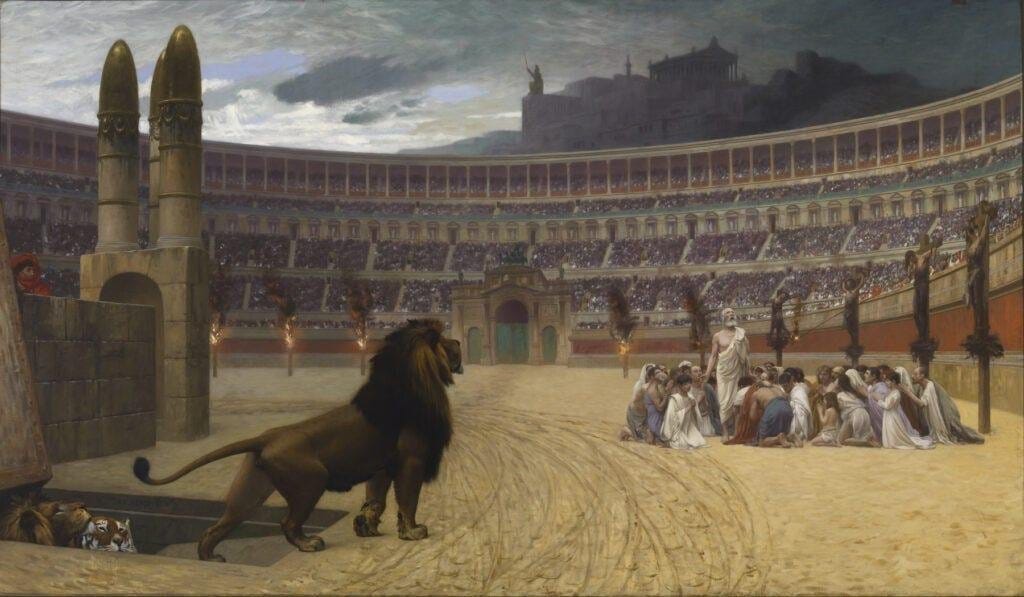
“[Martyrdom] was a glory that was open to all, regardless of rank, education, wealth or sex.—Catherine Nixey
That said, the execution of Christians for religious nonconformity was extremely rare, since most Roman rulers were smart enough to realise that there is nothing to be gained from making religious extremists into heroes. In 111 CE, Emperor Trajan insisted in a letter to Pliny, the governor of Bithynia, that he should punish only the most recalcitrant rebels; anyone willing to offer prayers to “our gods” could be pardoned, “however suspect his past conduct may be”.12
Brand Bible
Greco-Roman religion was very visual: temples, statues, processions, sacrifices, sacred objects, priestly costumes, inscriptions... Early Christianity began comparatively light on its visuals, so that’s not very competitive. So it quickly developed its visual brand: codices, crosses, fish, anchors, Good Shepherd imagery, and later basilicas, mosaics, icons, relic containers, and sacred architecture. We’ve talked in the past how much the Church pushed Gothic architecture for example as a way to inspire Christians.
5. Sales Force
If you have a great product, a big market, and plenty of effective advertising, it’s time to unleash your sales force. And Christianity had a very good one.
Missionaries
Jesus asked his disciples many times to spread the Gospel: “Follow me, and I will make you fishers of people”, “Proclaim the kingdom of God”, “The good news must first be proclaimed to all nations”, “make disciples of all nations”, “As the Father sent me, so I send you”... And they did. They traveled far and wide to spread the Gospel, especially Peter and Paul.
Traveling Healers
Traveling healers were common at the time. Christianity adapted that role for its missionaries, adding the teaching component, using that mechanism as another channel for growth.13 It was easy, since Jesus had been a traveling healer, too. So we can view part of Jesus’s life as modeling the traveling salesman role to teach his disciplines the craft.
APOSTLE JOHN: We have not been taught to be physicians. How then will we know how to heal bodies as you have told us?
JESUS: Rightly have you spoken, John, for I know that the physicians of this world heal what belongs to the world. The physicians of souls, however, heal the heart. Heal the bodies first, therefore, so that through the real powers of healing for their bodies, without medicine of the world, they may believe in you, that you have power to heal the illnesses of the heart also.—Acts of Peter
This actually allowed Christianity to differentiate itself from the competition through miracles. In Greek and Roman times, most miracles were site-based. You had to travel to a place to benefit from them. But Jesus tied them to his name, and from there, missionaries also became mobile miracle workers, allowing the stories of miracles to travel further.
Objection Handling
You’re telling me all these stories of a guy who died and then was resurrected, he walked on water, he turned water into wine… That sounds pretty preposterous to me. How do I know it’s true?
Extraordinary claims require extraordinary evidence, which could not be provided for these types of claims.14 Yet good salespeople are prepared to handle their prospects’ objections. So what did Christianity come up with? A role model.
St Thomas was the skeptic apostle15 and he didn’t believe that Jesus had died and rose again. “I’ll believe it when I see it.” So according to the Bible, St Thomas did see Jesus and did touch his wounds, at which point he believed. Then Jesus said:
Thomas, because thou hast seen me, thou hast believed. Blessed are they that have not seen, and yet have believed.
In other words, suspend your disbelief and start accepting the claims without verification.
This is reinforced elsewhere in the Bible:
We live by faith, not by sight.—2 Corinthians 5:7
Trust in the Lord with all your heart and lean not on your own understanding.—Proverbs 3:5-6
The foolishness of God is wiser than human wisdom.—1 Corinthians 1:18-25
Celibacy
One key innovation by the Medieval Church to its sales force was making its main employee base—priests—celibate:16 They’d dedicate their entire lives to the Church without diluting their efforts. More importantly, having children creates a conflict of interest, as what’s good for the children (inheritance) is not good for the Church (accumulating wealth). No children, all your efforts go toward growing the Church.
6. Low Friction Converting Customers
If you have a strong sales pipeline, but your prospects don’t convert to customers, you will be wasting your time.
Food & Penises
Judaism had what we call a high friction acquisition funnel for men: You had to cut a piece of your penis. Imagine what the end of the sales pitch sounded like: “There’s one last little detail that I haven’t mentioned yet…”.
You also had to follow plenty of complicated food requirements, along with many other rules of daily life.
The Council of Jerusalem got rid of all of that in ~50 AD. Interestingly, this was not because of Jesus, who mostly preached to Jews. His apostles changed the rules to accept gentiles (as we mentioned), and once they did, they thought, “God accepts gentiles, so we don’t need to make the followers of Christ into Jews”.17
It suddenly became much simpler to become a Christian, easing the path to conversion.18
Homes = Temples
Reducing the requirements to convert was not the only way Christians reduced the friction of the conversion funnel. Another was lifting the requirement of having temples. Every home could be a temple, so missionaries could go from home to home to spread the message, without the need to build expensive temples.
Grandfathering
When building software products, grandfathering is how you let previous users continue with a great deal they had in the past. For example, you might increase the price for all new users, but let existing ones keep the lower rate.
Christianity grandfathered Jews, basically incorporating the Torah as their Old Testament, and just adding a new one on top of it.
Feature Parity
When the competition has cool features, you want to add them to your own product to be more competitive. The Church took pagan gods, festivities, and temples, and incorporated them into Christianity.
Romans had a very convenient feature: Each god would look out for specific people and interests. Want love? Talk to Venus. Trade? Ask Mercury.
That doesn’t work with a single god. So how do you co-opt this feature? You just take the gods, lower their status (because they’re not equal to God) and change their labels. In the case of Christianity, the new label was “saints”, which I assume was good marketing because these were actual people who actually did good things in the world before ascending to heaven, so surely they must be able to help you now!
The best example is Saint Brigid of Kildare, the patron saint of Ireland, who is suspiciously similar to the pre-Christian goddess Brigid: Same name, same feast day,19 patroness of the same things (fire, fertility, livestock, smithing…). Her shrine at Kildare reportedly kept a perpetual flame tended only by women, a carry-over from pre-Christian cult practice.
The other obvious example is St Mary, who basically replaced all mother/fertility goddesses (Isis, Cybele, Demeter).20 Other examples include sailors replacing Poseidon / Neptune with St Nicholas, the cults of St Cosmas and Damian (physician-martyrs) replacing Asclepius (the Greco-Roman healing god),21 the electrical phenomenon of St Elmo’s fire that was earlier associated with Castor and Pollux…22
On festivities:
“Oh you have the winter solstice celebrations of Saturnalia and Sol Invictus around December 25th, when nights start getting shorter and the light starts growing again? Well, we’re not sure when Jesus was born, and we don’t really celebrate birthdays, but let’s switch Jesus’ likely birthday in spring to December 25th, and start celebrating Christmas!”23
Other examples include:
The Roman Robigalia became the Christian Rogation Days
The Jewish Passover became Easter. Shavuot became Pentecost. Shabbat (Saturday) was transferred to Sunday (Sun-day, the Lord’s Day)
Temples were converted into churches, festivals with sacrifices into Christian celebrations with banquets
On temples:
The temples of the idols in [Britain] ought not to be destroyed; but let the idols that are in them be destroyed [...] For if those temples are well built, it is requisite that they be converted from the worship of devils to the service of the true God; that the nation, seeing that their temples are not destroyed, may remove error from their hearts, and knowing and adoring the true God, may the more freely resort to the places to which they have been accustomed.
And because they are used to slaughter many oxen in sacrifice to devils, some solemnity must be given them in exchange for this, [...] no more offer animals to the Devil, but kill cattle and glorify God in their feast, and return thanks to the Giver of all things for their abundance; to the end that, whilst some outward gratifications are retained, they may the more easily consent to the inward joys. For there is no doubt that it is impossible to cut off every thing at once from their rude natures—Letter from Pope Gregory to the Abbot Mellitus, then going into Britain (601 AD)
7. Viral Growth
OK so we have a great product for a big market, we’ve done our advertising, our sales team has been selling to the target audience, and we’ve made it easy for prospects to convert. Now they are converting! How can we accelerate the business? By recruiting our customers as the sales force!
Software can start growing really fast when each user converts more users. That’s how Facebook or TikTok grew, or viruses like the Coronavirus. The key reason why Christianity grew so explosively is that it stumbled upon a series of hyperviral tactics—only some of which came from Jesus.
Everybody’s a Missionary
Christianity transforms every believer into a sales person, a node that can spread the software.
Go therefore and make disciples of all nations, baptizing them in the name of the Father and of the Son and of the Holy Spirit, teaching them to observe all that I have commanded you.—Jesus’s Great Commission (Matthew 28:19–20)
This is probably the most powerful way in which Christianity spread. If you think about it in terms of viral spread, that’s like getting the R (transmission rate, remember from COVID?) from near 0 to much closer to 1, and even above 1 for missionaries.
Studies of new religions show that most conversions are not between people who don’t know each other, but between those who know each other well. The better you know a person, the easier you can convert her. We’ll see an important example of that when we consider women later in this section.24
High Bandwidth Channels
The Roman Empire's network of roads and waterways facilitated travel, protected by the safety of the Pax Romana.
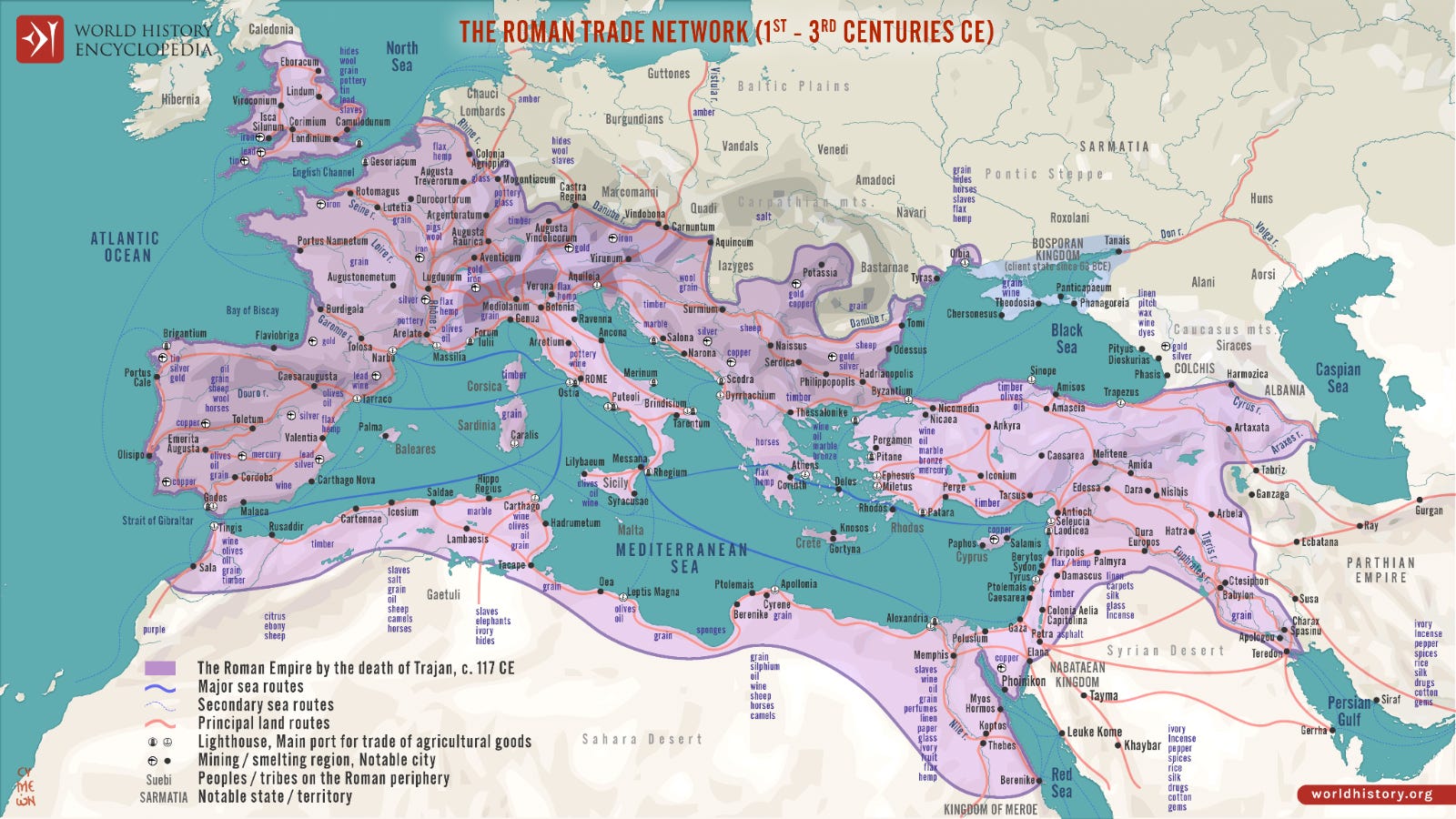
Christianity didn’t just travel contained in the brains of missionaries. They made use of the amazing Roman postal system to communicate via letters.
Superspreader Events
As we said, the Jewish diaspora was concentrated in cities across the Roman Empire, and that’s perfect for viral spread: It’s much easier to convert a lot of people if they’re all together. In a way, the Jewish diaspora enabled many “superspreader events”. This is why the map of Christianity looks like this:
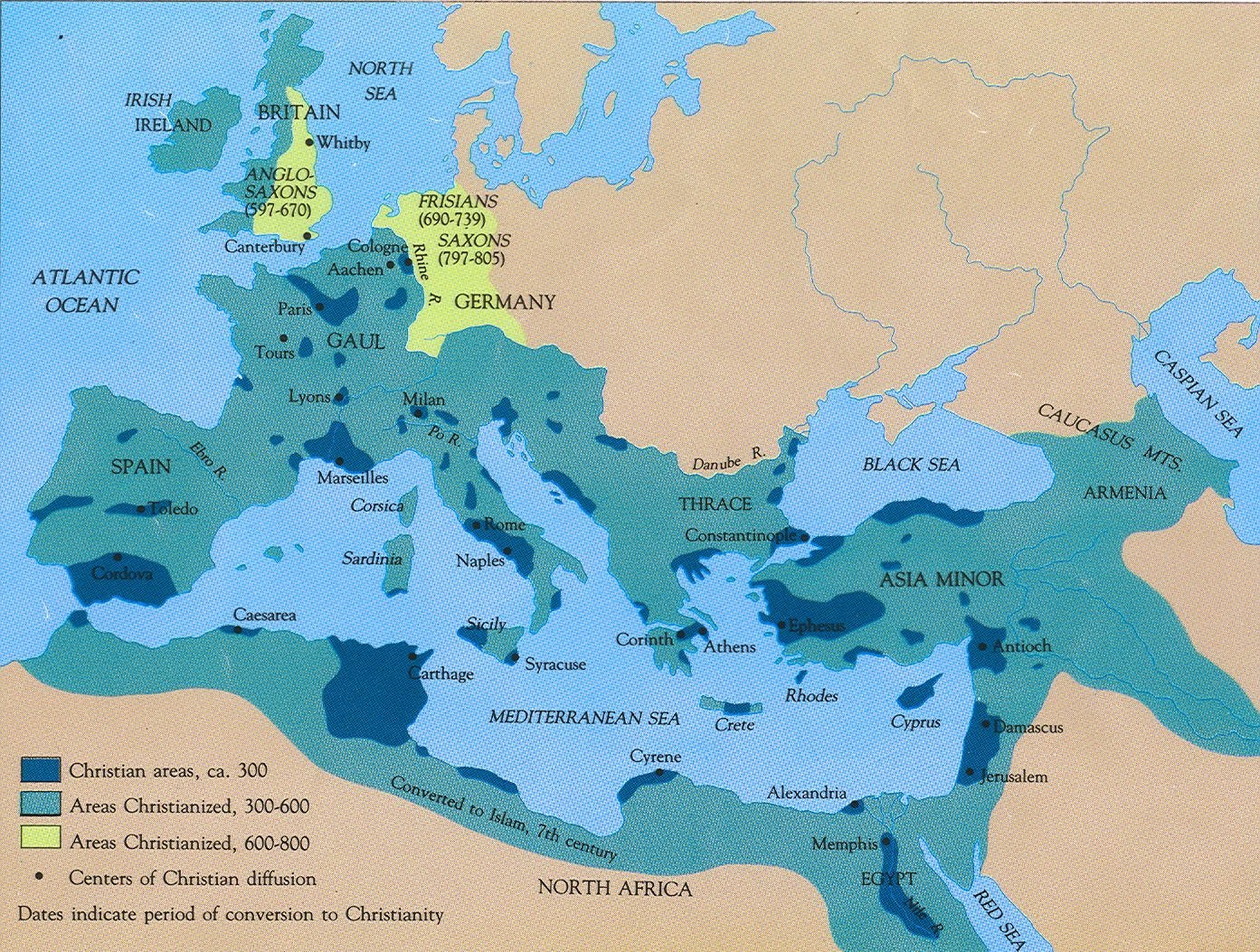
Look first at the dark blue:
Most early conversion was near Israel, where Christianity started
Within its vicinity, it spread mostly in the Eastern Mediterranean (and not Arabia or Mesopotamia) through the Roman highway that was the sea
The farther you went, the smaller the Christianized regions by 325 AD, but always concentrated in cities.
Then, once Christianity was supported by the state, it took over the rest of the empire (light teal).
Women
We saw before how early Christianity probably had many more women than men. Women then converted their husbands and their families, winning political influence for Christianity in the process.
Many women became the first converts in a family, often leading their husbands to conversion but even more so raising their children as Christians. It was often through wives that Christianity penetrated the upper classes of Roman society, with the result that Christians became increasingly influential.—The amazing growth of the early church, Dreyer (2012)
But women were not powerful in the Roman Empire, so how could they make this happen? Peter was specific on the sales pitch:
Wives [...], submit yourselves to your own husbands so that, if any of them do not believe the Word, they may be won over without words by the behavior of their wives, when they see the purity and reverence of your lives.—1 Peter 3
Community Spread through Support
We saw before how social security generated viral growth. If your Christian neighbor is always helping you, you’re more likely to open up to his religion. If your recently-converted sister has a cool group of friends who are always helping her, that’s a club you want to join, too.
8. Reproduction Rate
So far we’ve seen how Christianity could grow by converting others. But the more it grew, the more the reproduction rate of Christians mattered.
Judaism already had a mandate to be fruitful and reproduce (typical in agricultural societies), which Christianity inherited, but that mandate was not just for Jews, but for all of God’s creatures. Christianity took that to heart and dramatically optimized reproduction. The main way was with a simple philosophical change with massive repercussions: Considering life sacred (because we’re all the children of God). This optimized the reproductive funnel: find stable partner → have sex → conceive → have the baby → keep the baby alive.
Vaginal Intercourse
The Christian Church famously bans any sex that isn’t vaginal: oral, anal, masturbation. It even bans coitus interruptus, so you can’t have vaginal sex without finishing inside. And of course, any kind of contraception. Basically anything that doesn’t lead to reproduction is banned. Weird, right? It’s a bit of a stretch to go from: Life is sacred to Avoid blow jobs. How did that happen?
What happened with masturbation is an interesting example. It comes from the biblical story of Onan, who was killed by God because he wasted his seed. But the story is misinterpreted:
Onan's crime is often misinterpreted as masturbation, but it is universally agreed among biblical scholars that Onan's death is attributed to his refusal to fulfill his obligation of levirate marriage with Tamar by committing coitus interruptus.
What does that mean? Onan had an older brother, Er, who died without having procreated with his wife. That meant his male line was going to disappear, and that was bad in the patrilineal Jewish culture. So as a younger brother, Onan had a duty called levirate marriage: Have sex with the widow so that she can have children, who will be deemed to be the progeny of Onan’s older brother.
Onan did have sex with her, but he didn’t want her to have a child who would be his brother’s heir (presumably because his other children would not inherit as much), so he didn’t finish inside of his sister-in-law. The problem was in not giving children to his brother, NOT in ”wasting the seed”!
This was the proper interpretation for over 1,000 years, until Christians changed it. Through what process?
Remember that early Christianity was bathing in Greek culture. Aristotle and the Stoics had written centuries earlier that semen had a divine aspect, and that it contained most of what was needed to create a life.
The theologian Clement of Alexandria around 200 AD, and later Augustine around 400 AD,25 put it all together: If God says you have to reproduce, and God said you shouldn’t waste your seed, and semen is divine and contains everything needed for life, then surely all semen should be used for vaginal sex. And Jesus said the bond between a man and a woman is sacred, surely all sex should happen within the marriage, should be vaginal, and geared towards reproduction. Over the following centuries, non-reproductive sex would become more and more vilified.
Contraception
In the Greek and Roman world, contraception had been common, but Augustine forbade it for the same reason: Sex had to be reproductive. Roman women managed their menstrual cycle to avoid pregnancy and used plants to such an extent that the contraceptive (and abortive) silphium plant went extinct.
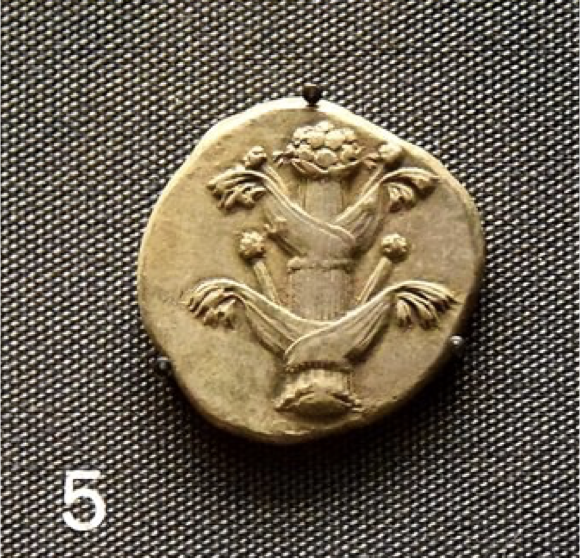
Abortion
If contraceptives failed, abortion was also an option. It was widely practiced in the Greco-Roman world, because they thought fetal development formation was a gradual biological process, not imbued with some sacred meaning. Like a plant or an animal growing. Judaism, meanwhile, discouraged it.
Christians banned it since the beginning.
Thou shalt not procure abortion, nor commit infanticide.—The Didache, ~late 1st or early 2nd century
Infanticide
“If you are delivered of a child before I return home, if it’s a boy, keep it, if it is a girl, expose it.—Hilarion, Roman citizen writing to his pregnant wife.
For Romans, men owned their wives and children, so they could do with them as they wished. That included infanticide, which was a double penalty on fertility.
First, because all the children you kill won’t procreate later.
But second, because of sexism. Romans tended to favor sons, so infanticide of girls was common. The fewer daughters you had vs sons, the fewer potential mothers.
Female infanticide was not an isolated incident: There were ~130-140 males per 100 females in Rome, which suggests about 20% of baby girls were killed!26
Even in large families, more than one daughter was practically never reared.—Lindsay (1968:16), via this
But Jews believed all humans are God’s creatures, so you can’t just kill them like that. Christianity inherited this and banned infanticide, as we just saw in the Didache quote above. That meant more Christian children survived than pagans.
Women who use drugs to bring on an abortion commit murder, and will have to give an account to God for the abortion . . . for we regard the very foetus in the womb as a created being, and therefore an object of God’s care.—Church father Athenagoras, 2nd century
Survival Rate
Finally, given the social security service of the Church, Christians received more care than pagans when they were sick. According to Rodney Stark, 30% of pagans died during the plague, but only 10% of Christians!
Adoption was only common among elite pagan classes, but widespread among Christian orphans (e.g. by godparents). That meant many more Christian children survived to adulthood (this is at a time when half of children didn’t reach adulthood).
With all these measures, it’s likely that Christians had many more children, who survived much longer than other Romans’ offspring.
9. Retention Rate
Now that we’ve been growing our Christian groups so much, we need to make sure the bucket doesn’t leak, that there aren’t more people leaving the faith than those arriving. How? Christianity didn’t have the death penalty for apostasy that Judaism (and Zoroastrianism) had, because it was not a state religion. They socially shunned it, but couldn’t forbid it until it was the state religion. So what did they do?
Writing & the Codex
Chrisitianity inherited from Judaism the writing of religious texts and doctrine. Words didn’t easily get corrupted over centuries of repetition. The fact that Christianity communicated so much in writing and had so many gospels made it much easier to bundle teachings in a codex (similar to a book) than the prevailing scrolls. The codex survived for longer and helped communicate and keep a record of all the relevant theology. It also became a symbol of Christianity (the Bible).
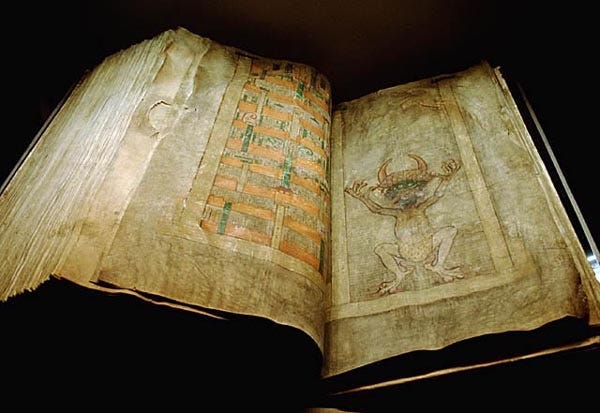
Bundling
Catholicism has many once-in-a-lifetime rites of passage:
Baptism for entry into the group
Confirmation for the passage into adulthood
Marriage for access to sex
Anointing for illness or preparation for death
Burial and mass for after death
All of these require the priest and the community, providing social pressure to stay in the religion. Think about how many people want to get married through the Church even though they’re not believers anymore.
But Christianity bundles all these services together: If you want marriage, you must be baptised, have taken the communion, and be confirmed.
This is not something fully new in Christianity: Rites of passage exist in virtually every religion, Judaism had an equivalent of baptism for men (circumcision), Zoroastrianism had priest-led funerals, etc. Christianity’s innovation was to merge all of these together and make them all social and led by priests. It took it many centuries to get there.
Lifecycle Management
All the rites follow the entire life, but Christianity colonized every year, and every week too: Sunday worship, fasts, feasts, saints’ days, Advent, Lent, Easter, Christmas… It became the rhythm that organized life, and that made it impossible to forget.
10. Suppress Competition
One of the best ways to increase retention is suppressing competition, and Christianity’s main weapon for that was…
State Takeover
I’ve mentioned before that Constantine legalized Christianity in 313 AD, when ~10% of the empire’s population was Christian. That share grew tremendously, so that in 380 CE, when Theodosius made it the state’s official religion in the Edict of Thessalonica, about half the population was already Christian.
That takeover allowed Christianity to spread everywhere the empire was present. Remember:
The state takeover brought sticks and carrots.
More Benefits
Before Constantine, becoming Christian could cost you status, safety, and opportunity. The carrot was that, after Constantine, suddenly there was a massive benefit in joining the Church. Confiscated Christian property was restored, bishops gained imperial access, churches received gifts, clergy received privileges, and Christian affiliation became increasingly useful for careers and patronage. The conversion funnel was subsidized.
Religious Coercion
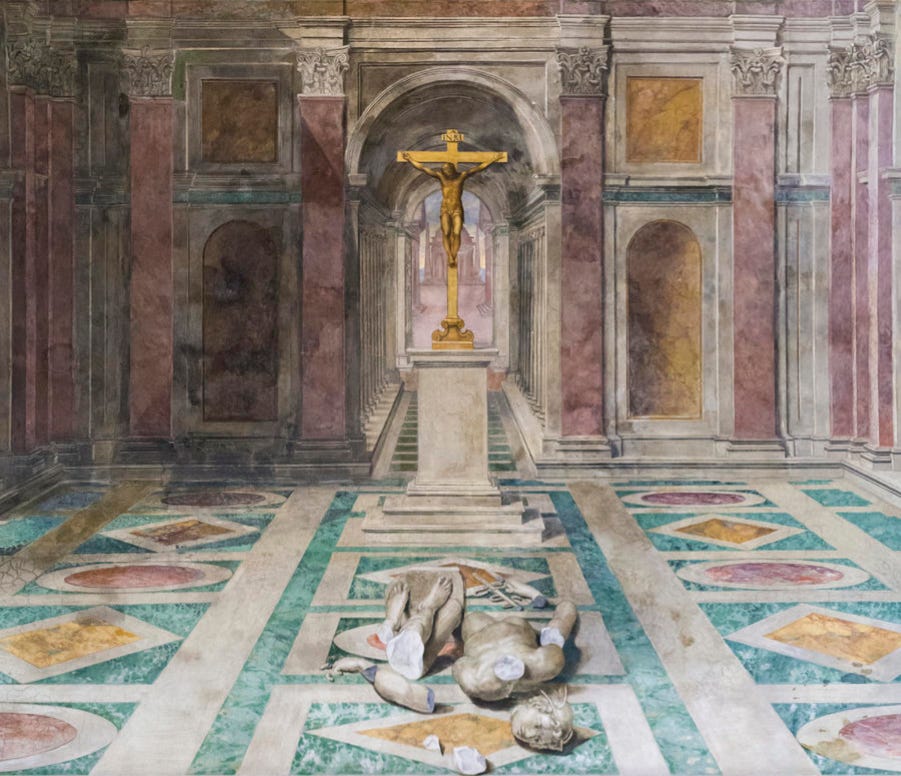
The stick is that, by co-opting the empire, Christianity became much less tolerant. It latched on to a power that had already been established for nearly a millennium, and repurposed its tools for its own benefit. Starting in the early 300s AD, Roman law gradually:
Condemned sacrifices
Ordered temples to be closed
Destroyed effigies and other sacred items, to show the gods couldn’t defend themselves and demonstrate their humiliation
Defined heresy and opened the door to its suppression
Removed testamentary rights for Christians who become pagan
Forbade public religious debate
Ordered rural temples to be destroyed
Violations of what we would now call human rights and civil liberties were allowed for the sake of religious conformity. In Alexandria in 415 CE, the philosopher and teacher Hypatia was dragged from her carriage, taken to a church, stoned, flayed, ripped to pieces and burned by a gang of Christians, who accused her of witchcraft. Classical learning, literature and philosophy were now all suspect.—Source
[Temple] roofs are uncovered, walls are pulled down, images are carried off, and altars are overturned.—source
Why this change? I don’t know, but I can venture a few guesses.
Early Christians were probably self-selected as the most virtuous people (who else would go against the world preaching love?). Their charisma would carry the crowds.
But there are only so many virtuous people, and once you convert the vast majority of a group, you won’t have only virtuous people. The average hateful guy might say they prioritize love, but might still have the instinct to hate the Others.
If you were downtrodden and suddenly you’re part of a new group where you have status, you’re going to enjoy your new status and be quite aggressive with the former system that kept you down.
Power doesn’t change people, it reveals them. Once you’re in power, you start doing things you didn’t dare to do before.
Censorship
Aside from sticks (religious coercion) and carrots (advantages for Christians), the other advantage of Constantine becoming Christian is that the religion could start advertising and selling in the open. Before 312, much Christian growth happened through households, urban networks, letters, local communities, and occasional public controversy. After legalization, Christian advocates could preach and debat publicly, build churches, perform imperial ceremonies, produce inscriptions, crosses, music, processions…
Anti-Forking Software
One of the biggest concerns of Christianity after it had become the state’s religion was quelling alternative versions—what we call in software forks in the code. There was Gnosticism, Marcionism, and especially Arianism.
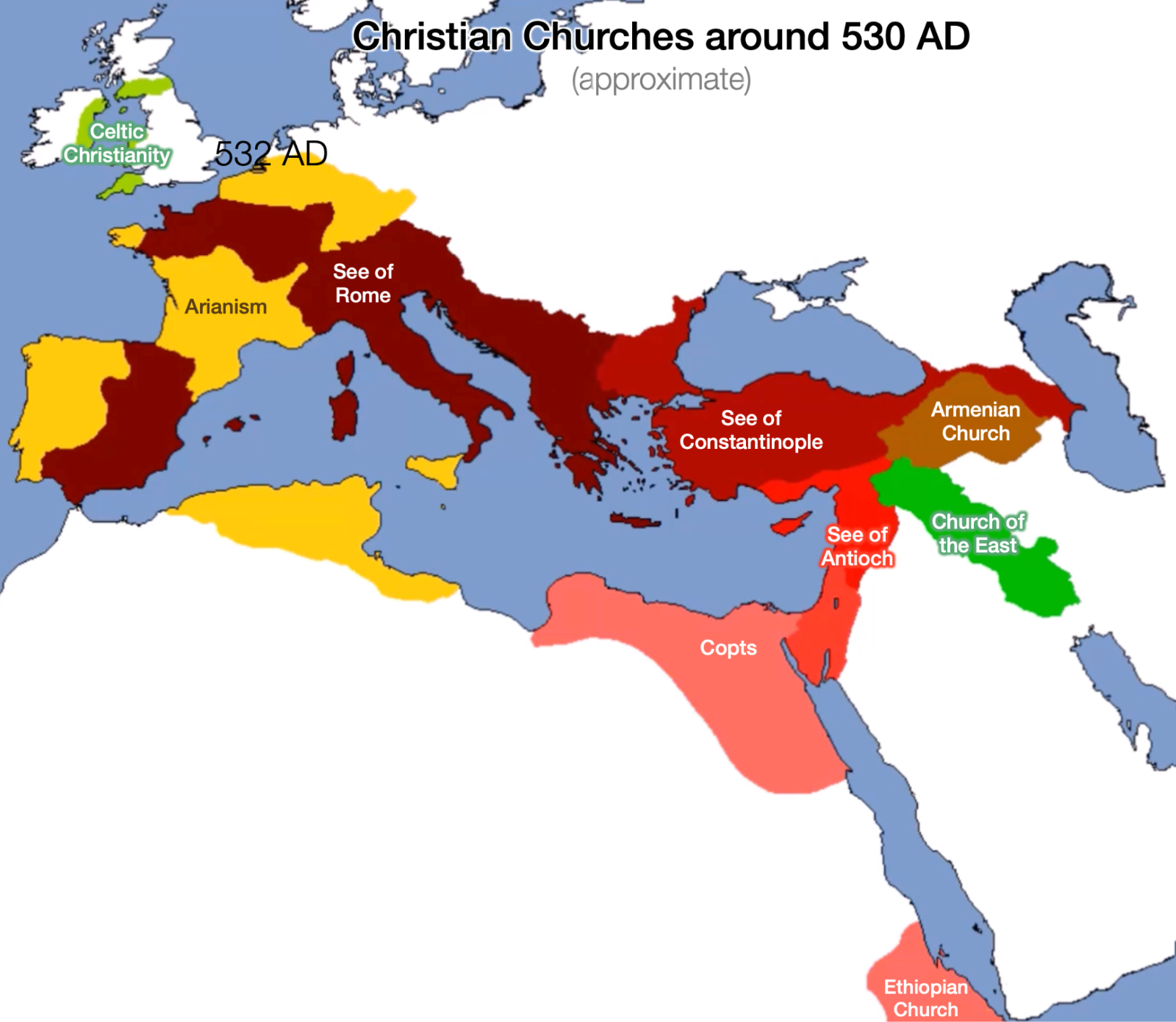


That’s one more reason the Church wanted a close cannon, and hence the ecumenical councils or the Bible. Everything that was not approved could be called heresy and quelled.
Kin Suppression
Joseph Henrich’s book The WEIRDest People in the World suggests that the Church banned cousin marriage in the Middle Ages, among other reasons to undermine clans: If you don’t put your clan first, you’re more likely to put the Church first (or second, only behind the nuclear family).
This would have had the side-effect of reducing congenital diseases and hence improving survival rates27 and reproduction of Catholics,28 bolstering the religion’s success.
11. Deterritorialization
Christianity took over the state to use it to grow. But when the state died, it moved on.
As we will see in the next article, most gods were linked to locations and states. If somebody conquered you, it was proof that your god was weak, and that god disappeared. By some unique set of circumstances, Judaism transcended that, and became independent from land and state. Christianity inherited that.
Barbarian Reverse Conversion
This was very handy when first the tribes of barbarians destroyed the Roman Empire in the west: It was not common for conquerors to completely throw their religion out the window and adopt the religion of the conquered! In fact, the timing couldn’t have been better: The Roman Empire disappeared just as Christianity was reaching its maximum power. When the Barbarians arrived, they killed the state but had no reason to do the same to the Church. Yet the Church had inherited its strong structure and hierarchy from the Roman Empire, so it remained as the most capable structure for power. The Barbarians wanted its legitimacy and efficiency, so they converted and thereby gave the Church immense power. For example, when Rome disappeared, so did its administrators, and hence all schools that taught literacy. The Church still needed literate employees, so it took over all education. And because education was valuable to kings, they employed clergymen, which put the Church at the helm of information power.
Enterprise Sales
We talked about a sales force before, but that was the normal type of sales force, the one that converts small prospects into customers. Enterprise sales tries to get massive companies (“enterprises”) as customers. These require their own elite sales force and a dedicated strategy.
Christianity did just that. It used bishops and other elite clergymen to convert kings into Christianity before the rest of the population. Once the king was Christian, missionaries had a much easier time moving around their lands, harnessing resources, and using the king as the example to follow. This happened with Clovis of the Franks, Vladimir of the Rus, Mieszko of Poland…
Control over Secular Power
It was also very handy to become a power independent from the state. Kings had to obey the Church or risk being excommunicated—something many of them might not have feared personally, but feared because their citizens believed this was terrible. The Church was able to create a system parallel to the state’s, with its own lands, its own leaders, sometimes its own soldiers, its own wars… For centuries, the Church got its own state outright—the Papal States—and they were powerful enough to delay the unity of Germany and Italy by several centuries.
Franchising
Once states were weak, it was hard for them to settle new land. But monasteries could. The Middle Ages Church would plant a new monastery at the edge of Christian territory (or in an underpopulated area), and bring with it investment: farming, schools, guesthouses, clinics, artisanal industry, manuscript factory… This enabled it to grow its assets and its believers.
12. Monetization
Software businesses tend to focus first on growing their audience, and only once they’ve succeeded do they focus on maximizing revenue from their audiences. The Church was no exception. It started with a very promising philosophical base:
You cannot serve both God and money.—Matthew 6:24 and Luke 16:13
Ah, dammit. What does that mean concretely?
It is easier for a camel to go through the eye of a needle than for a rich man to enter the kingdom of God.—Mark 10:25, Matthew 19:24, Luke 18:25
OK so I should not die rich, or otherwise I won’t go to heaven! What should I do with my money then?
If you want to be perfect, go, sell your possessions and give to the poor, and you will have treasure in heaven.—Matthew 19:21
RICH CHRISTIAN: OK, let me do that. But there are a lot of poor people, how do I know who to help?
THE CHURCH: Don’t worry, give it to me, I’ll take care of it.29
So that meant bequests were a primary way for the Church to get a lot of money. Here, we can see how some other factors from earlier matter. There was much less pressure for women to marry, and especially for widows to remarry. If they died with a fortune but no children, where did that fortune go? To the Church.
If clans had been strong, they would have been the primary recipient of the money. In fact, in clans, property is not as much part of the individual as it’s part of the clan. By eliminating clans, the Church co-opted more bequests.
These donations were unidirectional: The Church kept most of these assets and made money out of them. The more it accumulated, the more money it made. Back then, wealth meant land, and the Church became the biggest landholder in Europe in the Middle Ages. The Church hired farmers to produce wealth from these lands. It also owned other types of infrastructure that it monetized: granaries, mills, bridges…
Also, remember that the Church ensured asset accumulation by preventing clerics from having children.
But they weren’t the only source of income. Early on, the Church received some income through charity, but once it was part of the state, it received tax benefits and direct transfers from the state. Eventually, the tithe (one tenth of people’s income) would become mandatory for all. This is substantially better than the episodic payments that polytheist temples received. On top of that, the Church received fees for sacraments and burials, relic-based pilgrimages, monastic enterprises (wine, wool, brewing), the sale of indulgences, papal taxation of clergy…
Like Facebook and Google showing too many ads, the Church overplayed its monetization hand, and people started defecting. The sale of indulgences was the proximate trigger of the Reformation.
Other Growth Tactics
It’s impossible to cover them all, but here are a few:
The Church invests heavily in education, financing it for many people to this day. That allows it to insert Christian education, through which people are retained and converted.
The anti-forking software I mentioned before also included things like the Inquisition. But also, Jesus didn’t have a doctrine against new branches of Christianity.30 So once the Church lost its monopoly on information, many versions of Christianity appeared. These compete with each other, allowing for the most efficient ones to prevail. It meant lots of wars early on, but also many more approaches today.
Christianity also spread through crusades. The ones we know the most about are actually the failed ones in the Levant. There were many successful ones in other parts, such as the Baltic Crusades and the Spanish Reconquista.
So Why Did Christianity Grow So Much?
This breakdown of the Christian Church’s business tactics is not exhaustive, but even then, you can see how it came up with ~100 innovative mechanisms for growth.
In some cases, these mechanisms came from Judaism, such as:
The monotheism
The deterritorialization that allowed Christianity to survive the state
The tendency to write everything down (which allowed for more retention of the content, more spread of doctrine, and reducing forks due to misinterpretation)
The benefit of target populations in urban areas spread around the Mediterranean, ripe for conversion
Others emerged from new religious doctrine:
From the concept of “There is neither Jew nor Greek, there is neither slave nor free, there is no male and female, for you are all one in Christ Jesus” came a huge TAM that included gentiles (especially the Jewish-adjacent), appealed to women and the poor, a missionary sales force, viral spread through each believer, the elimination of circumcision and food restrictions, made homes into temples… But remember, this did not come from Jesus!
That phrasing of “in Christ Jesus”, plus the concept of love, entail the ideas that all humans are sacred, which led to tactics of anti-contraceptives, anti-abortion, anti-infanticide, care for the sick, orphan support, higher survival rates, social security services, enabled traveling healers… It formed the core of the value proposition of loving yourself and your neighbor.
If you adopt faith as a virtue, you reduce your skepticism, you are more open to new doctrines, you’re more likely to advertise the religion through martyrdom…
If salvation becomes super high stakes, legible, and actionable, you suddenly have a massive incentive to do what’s right for the community
Yet others were a result of the Roman Empire:
The early multilingual nature of Christianity
The unified market of the Roman Empire, enabled by the Mediterranean highway and Rome’s famous roads
The ability to evangelize in big cities across the empire, which acted as superspreader sites
The ability to harness the power of the state to spread
The Roman Empire also provided the administrative structure the Church adopted
Some are a combination of these, like for example, the success of Christianity with women is a combination of making women more equal and the terrible treatment they received in antiquity.
And many others are completely untethered to any of these, including:
Many of the monetization tactics
Kin suppression
Anti-forking software
Destruction of alternative temples
Making priests celibate
How can we summarize all of this?
Judaism had many compelling aspects to become a huge religion (monotheism, deterritorialization, heaven and hell…), but was missing a few key levers.
There were many prophets within Judaism who proposed variants, but the one Jesus invented was the most fit for growth, thanks to a few concepts: all are one in God, love each other, have faith. They unshackled Judaism’s software barriers to growth.
But Judaism lacked network infrastructure. When the Roman Empire conquered Judea (just 60 years before Jesus was born!), it brought the infrastructure needed for the massive spread of Judaism’s successor religion.
Jesus’s followers were deft enough to continue changing and adapting Christianity (or even inventing new concepts altogether) to optimize growth. The optimization was ruthless and lasted more than a thousand years.
I talk a lot about Christianity being designed in this article, but I don’t always mean it as purposeful design, as… intelligent design. A potential process was more like… evolution: Judaism was a new religious species that had evolved from others, the Roman Empire provided a new environment, lots of religious variety emerged from that, natural selection meant the fittest one—Christianity—exploded… and as it became an institution, it started being managed as such.
But as we saw, many of the changes didn’t happen at the time of Jesus, but after his death. It would be surprising if all of Christianity’s mutations happened so fast, and always coincidentally geared towards growth. It’s as if it had been helped by some enterprising human hands.
Or maybe God’s purposeful hand.
I’m opening the newsletter to sponsorship. If you have a business that is moving the world towards a techno-optimistic future and would like to reach 135k+ curious, globally-minded people to learn about it (founders, researchers, investors, policymakers), reach out here.
My confidence on that statement is 60%. There are other books who cover the topic (I’ll share details on each below) but I don’t think any covers the topic as exhaustively from a growth perspective:
Very few works focus on Christianity as a software mechanism. They tend to focus on the story, and narrate the growth, rather than understanding the actual growth mechanics at play. I think this is sensible: The people who write about this topic tend to be historians or theologicians, not people who have actually designed viral software products—which I have.
Many of the sources I’ve read mention these other books, but they frequently point at holes or flaws in their pages.
That said, I have not read these books personally, so the information that reached me through them might be too limited, and they indeed covered everything.
To clarify, I asked ChatGPT to compare this article’s additions to those of other books, and it sees many contributions from different books, but none that covers them all (plus, some novel additions, like the feeling of progress).
One key additional point here is that I purposefully didn’t cover the advantages that Christianity had compared to the Roman polytheism because I don’t think these are Christianity’s contributions, but Judaism’s. I cover them in the next article.
Below I have a short summary of each book on the topic, and the take from ChatGPT.
The Oxford Handbook of Early Christian Studies is a 1,000+ page interdisciplinary reference on early Christianity, covering history, literature, thought, practices, material culture, church/empire, women/gender, councils, canons, and geography. As such, it doesn’t focus only on growth mechanics, and it doesn’t either see many of the changes of the early Church through the lens of growth.
Ramsay MacMullen’s Christianizing the Roman Empire: A.D. 100–400 does focus on growth, but is limited to the years 100-400 AD, and is very focused on the state- asks how Christianity gained dominance in the Roman world, with sections on Constantine, nonreligious conversion factors, public campaigns, intellectual conversion, incomplete conversion, and coercion.
Alan Kreider’s The Patient Ferment of the Early Church is another direct competitor on early Christian growth, asking why the church grew despite disincentives, harassment, and occasional persecution, but according to ChatGPT it missed many mechanics. I didn’t stumble upon very frequently with quotes of it.
The two biggest competitors are Bart Ehrman’s The Triumph of Christianity and Rodney Stark’s The Rise of Christianity. I’ve seen them quoted in many of my sources. Both cover many of Christianity’s aspects, but not all.
This is illustrated by this video.
First by emperor Constantine, who made Christianity legal in 313 AD, and then by Theodosius, who made it the state’s religion in 380 AD
I calculated the number based on the data, which comes mostly from Stark’s The Rise of Christianity, 1996.
We can divide the growth into 4 phases: Between JC and becoming an official religion of the Roman Empire, Christianity as the empire’s religion, the Middle Ages until ~1500, and then the hypergrowth during the Age of Discovery and the Industrial Revolution. I’ve focused mostly on the first two, and especially early Christianity, because that’s when its success was shaped. But I cover up to the Middle Ages, since many innovations only came later but are still relevant to helping us see the patterns it followed. Christianity’s growth after that is more straightforward: It was the religion of the countries that eventually won the Age of Discovery and the Industrial Revolution. Christianity might have had a hand in these, but it was also a tool that hindered them, so I decided not to cover that period here.
The theological version is that some angels / God appeared to a Roman centurion (pagan). At the same time, Apostle Peter had a vision where God told him to kill and eat all sorts of animals, not only the ones Judaism considered pure. When Peter said no, a voice told him three times “Do not call anything impure that God has made clean”. He then saw the centurion, put two and two together, understood that the message meant “It’s not just the Jews that are part of Christianity, also others”, and that became the most compelling argument such that, later in 50 AD, Christians decided to open up to all peoples at the Council of Jerusalem.
Via The amazing growth of the early church, Dreyer, 2012
In a big part because they're more susceptible to peer pressure than men.
There is some debate about whether this is fully true, but from the evidence I’ve seen, I think it’s 80% likely that women were at least 5 to 10% more common than men in the early Christian Church.
Things like What is the ultimate reality behind the world? Is it matter, atoms, Forms, the Good, the One, Nous, Logos, divine fire? Christianity said: one transcendent Creator, God. Or Why is the universe ordered and intelligible? Divine reason? Logos? Forms? A demiurge? Christians saw the divine reason of God. Or What is the good life? Flourishing, happiness, blessedness, the highest good? Christians said: True happiness is union with God. Virtue matters, but it is completed by grace, love, worship, and salvation. Other questions include: Why does evil exist? Are we ruled by fate, chance, or providence? How do we know truth? What happens after death?
There’s an interesting hypothesis too that the most likely Christians to be martyred were women and clergy, which is interesting because they tend to inspire more compassion than men.
The amazing growth of the early church, Dreyer (2012)
Even if these things had been true.
I’m named after him, I’m sure you’re not surprised.
Monks were celibate since early on, 3rd century or so. For priests, it started around then, but only became fully enforceable around 1100 AD.
That sentence beginning “There is neither Jew nor Greek…” was said by an apostle, and another apostle was proselytizing to gentiles when he said he got a visit from the Holy Spirit, validating the entire approach of converting gentiles.
It was not immediate though. For example, baptism took years of preparation early on. It was simplified over time, presumably to accelerate the speed of conversion.
This one is kind of crazy to me. Isn’t it surprising that Christianity has one God that is in fact three, and then has Mary who is not a goddess at all, and yet is incredibly revered? In this case, I reckon sometimes this switch was purposefully designed, others it just happened naturally.
A church to Cosmas and Damian was built in Rome near the old forum in the 6th century.
Buddhism also took over deities from Hinduism as it spread. They became devas and protector figures (Indra, Brahmā, Bishamonten, Emma). Bodhisattvas appeared in Buddhism to fulfill the same functionality as a saint in Christianity. In Japan, Buddhism merged into the local animist ideas to form honji suijaku: Buddhist deities became Japanese Kami. Later, in the Meiji Restoration era, elites extracted Buddhist concepts from the local Shintoism, but merged it with monotheistic ideas, elevating the goddess Amaterasu to the chief God, and making the emperor her successor, therefore making him a god too.
This change happened in the 300s AD. Another theory is that early Christians might have thought that Jesus was conceived the same date as he died (March 25th), so 9 months later is December 25th. This sounds very dubious to me, because (1) early Christians didn’t care at all about birthdays, and (2), how on Earth would they come up with that conception date? This sounds to me like retrofitting the conception to the target, which had to be December 25th for the other reason.
That said, this probably didn’t happen just after Jesus’s death, as the apostles were doing most of the missionary work. This is one of the key points made by Alan Kreider in his book The Patient Ferment of the Early Church.
Before, all sex was OK within marriage. It’s interesting to understand why Augustine reached this conclusion. He was Bishop of Hippo (today in Algeria) and a former sex-addict who had to give up a mistress and casual sex to marry an heiress. Faced with the requirement to limit sex to only his wife, he decided to stop his lust by not having sex altogether—hence why he became a bishop. Then, he coupled the Biblical concepts such as being fruitful and the sin of Onan to recommend that all sex be reproductive. The ultimate consequence of that was, indeed, more reproduction.
There are 105 boys per 100 girls born in general, so 130 boys should have produced 124 girls. 24 girls are missing from those 124, that’s 20%.
And IQ.
This is disputed. The main argument against it is that some Catholic areas already didn’t have cousin marriage before the Church mandated its end.
Very convenient
Unlike in Islam
Don't forget forced conversion of the Indigenous people in the Americas. While not all missionary efforts involved forced conversion which varied enormously by time, place, and colonial power, forced conversion was wide spread throughout most of the Americas.
The Spanish campaigns occurred in Mexico (Aztec territories), Canada, Central America, much of South America, and the present day US states such as California, Arizona, New Mexico, and Florida. In some regions, Indigenous temples and their sacred sites were destroyed or churches were built on top of them. Indigenous ceremonies were often banned. Once baptized, many natives found it difficult or impossible to leave freely. Traditional religions were suppressed, and punishment systems existed for rule violations.
In Canada, it was in the form of boarding schools where children were separated from their parents, forbidden to speak their native languages, taught Christianity, and encouraged or forced to abandon their traditional beliefs. PM Stephen Harper of Canada apologized to the former boarding-school students in the House of Commons back in 2008.
Historians still debate details, but there is a broad agreement that the missions involved significant coercion and indigenous cultural destruction that were mostly successful.
Excellent stuff plus with a few good laughs.
I think you touch upon it with the Codex thing, but looking at what the internet's disintermediation is doing to power structures today: tempting to see a much bigger role to the invention of the alphabet by Semites a few century before Judaism, Christianity, and the like.
Let's say Jesus and the apostles were the first theological startup that fully harnessed the disintermediating power of the alphabet.
Greco-roman gods were oral traditions, Egyptian gods were intangible to the masses through oral traditions and impenetrable hieroglyphs - all had a priestly class, that could read or recite long texts, between god and its subjects.
Christians had a theology tailor-made for diffusion and success with scriptures that could be read by any that wanted to.
The arrival of the alphabet in India had the same effect btw, where brahmins' oral prowess guarded the Vedas out of reach of the masses. Buddhism's diffusion under Ashoka made good use of the Levant-important alphabet and wrote religious texts in vernacular.
So, same strategy: use new tech to get rid of traditional gatekeepers. Then monopolise and monetise even more than they ever did.
Oh, also: far more intolerance and vicious religious wars once the traditional gatekeepers are removed. Sort of like today's politics now that social media replaced traditional gatekeepers.
Nothing is cast in stone though: while the Greco-Roman gods disappeared for good, the Brahmin made a huge comeback after Ashoka. In large part, you guessed it, by accepting diffusion in vernacular texts, though not giving up on oral tradition. Also, Buddhism got concentrated in monasteries, whereas Hinduism 2.0 was a network state (each village had its elders). So, reorganisation under pressure to eventually win is still possible. Perhaps some lessons for our current power structures.