

You’ve been taught history backwards.
History books tell you about different countries and who their rulers invaded, the events of the kings’ courts, the big battles, and that’s mostly it. If you go to a museum, you might also see some forts, some weapons, paintings of the powerful, some daily objects if you’re lucky, and in passing, they might mention something like: “Their main sources of income were grain and cloth trading.”
The real story is that last little sentence. Why did one country go to war with another? “For glory and power” you might say, but is that really all the story? And where did that power come from? Or the wealth of the defendant? What determined who prevailed?
All of that was determined by economics, and economics, in turn, are driven by the needs of households. So let’s go visit a household in Ancient Mesopotamia in 2000 BC.
What Was Life Like in Mesopotamia in 2000 BC?
We’re in the 3rd dynasty of Ur, a Sumerian kingdom in Mesopotamia:1
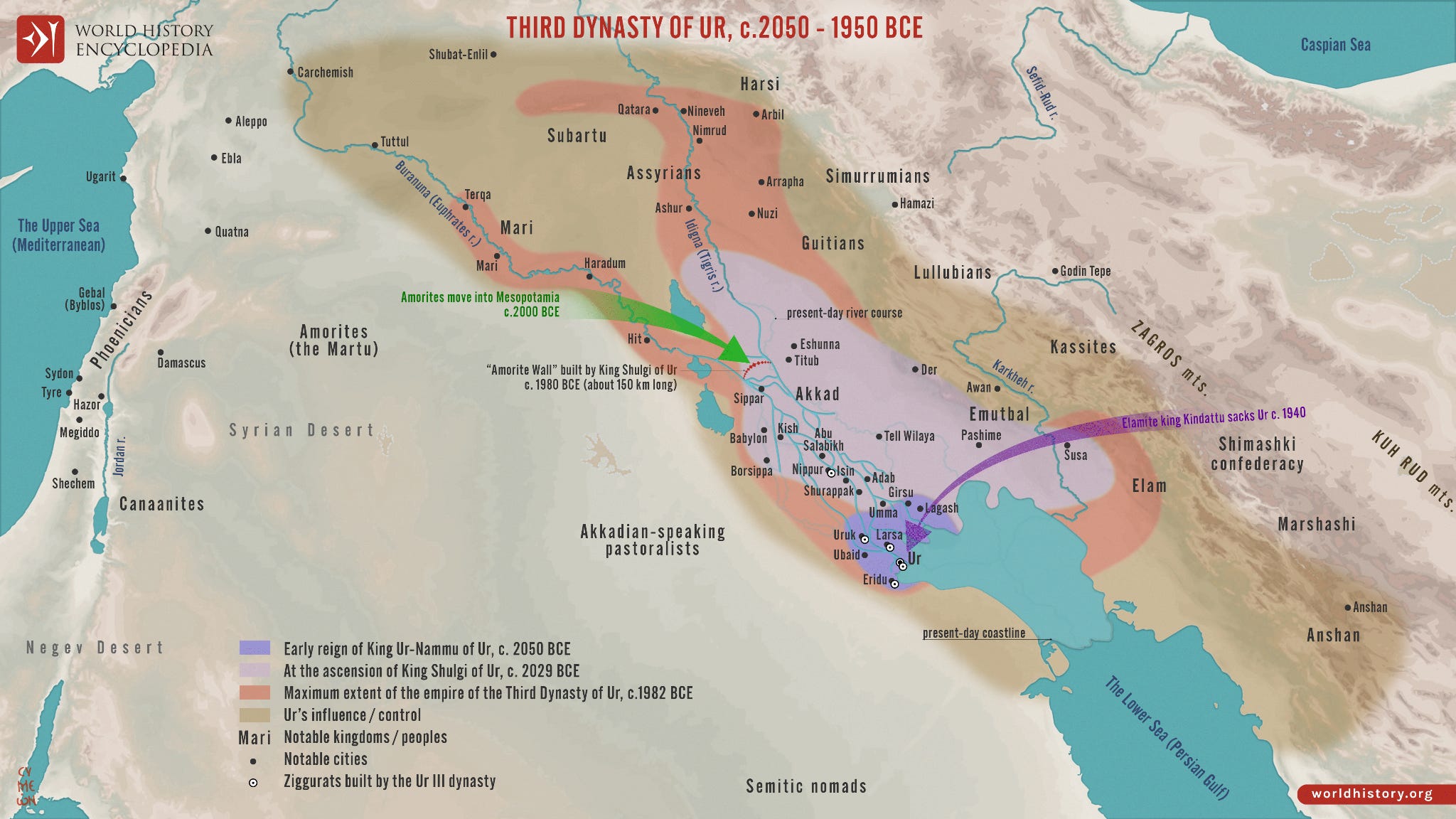
Nestled between the Tigris and Euphrates rivers, this was one of the most fertile regions in the world (water plus sediments), so home to a large population, because food became people. Population meant money and soldiers, so the earliest and strongest powers always came from places like this.
In Sumer, the world revolved around the agriculture of barley.
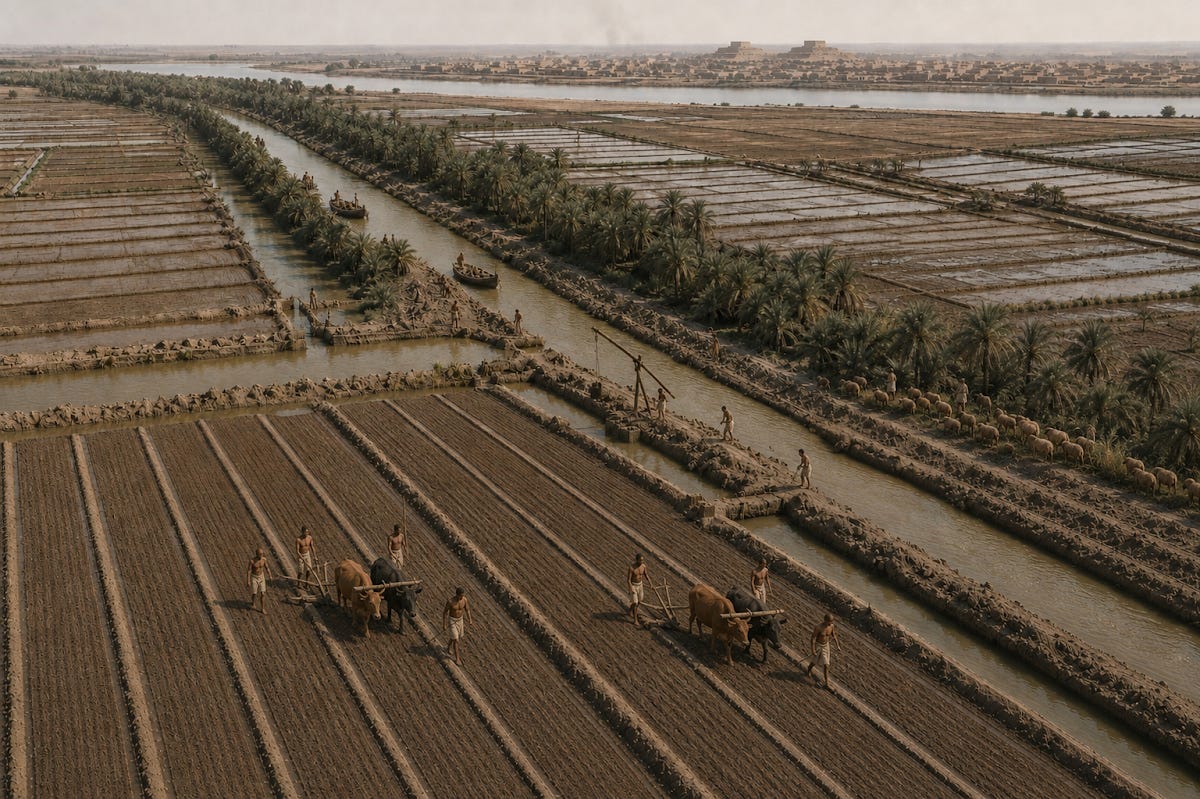
This means making canals that take water from the Tigris or Euphrates and distribute it into smaller and smaller canals until every field can be flooded, then plowed and sown. Gangs must take care of the irrigation system, while others plow the fields, and yet others transport it. Grain is the source of most calories, it’s what makes cities and kingdoms big, because it can feed many mouths. But farming barley is just the beginning.
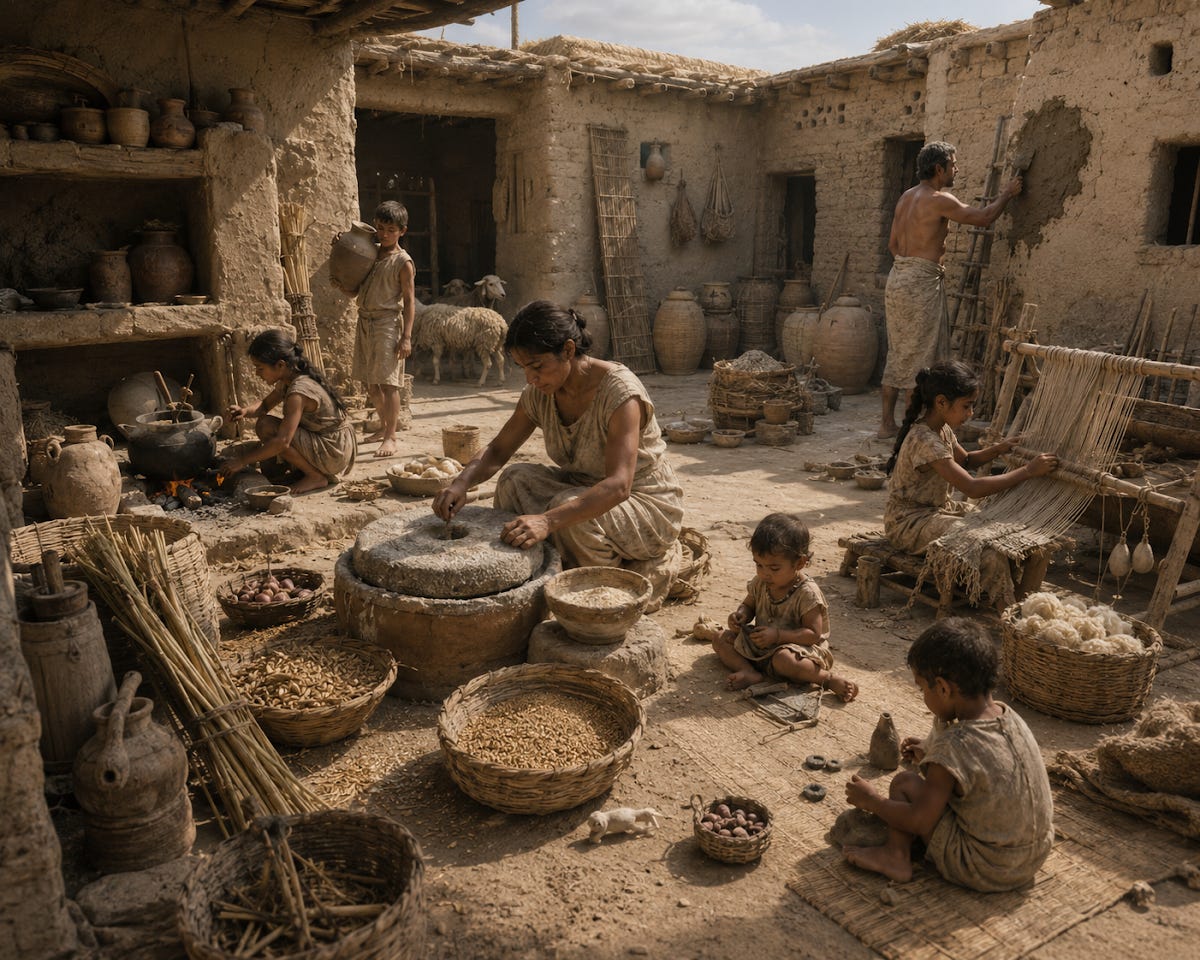
Getting the grain was just the beginning. You had to soak, dehusk, winnow, sieve, grind, toast, cook… Of course, that also meant getting pots and fetching water and fuel, tasks that took a long time too. And you had to produce more food to sell, so you could buy other stuff, including other things besides grain. Overall, over 50% of a household’s time was spent on food.
Then you had to make your clothes, build and maintain your house, transport stuff, sell some of your production to the market, work for the state (as a farmer, a ditch maintainer, or a fighter, for example), take care of the children... Of course, everybody helped since they were pretty young, but it was brutal work, day in, day out.2
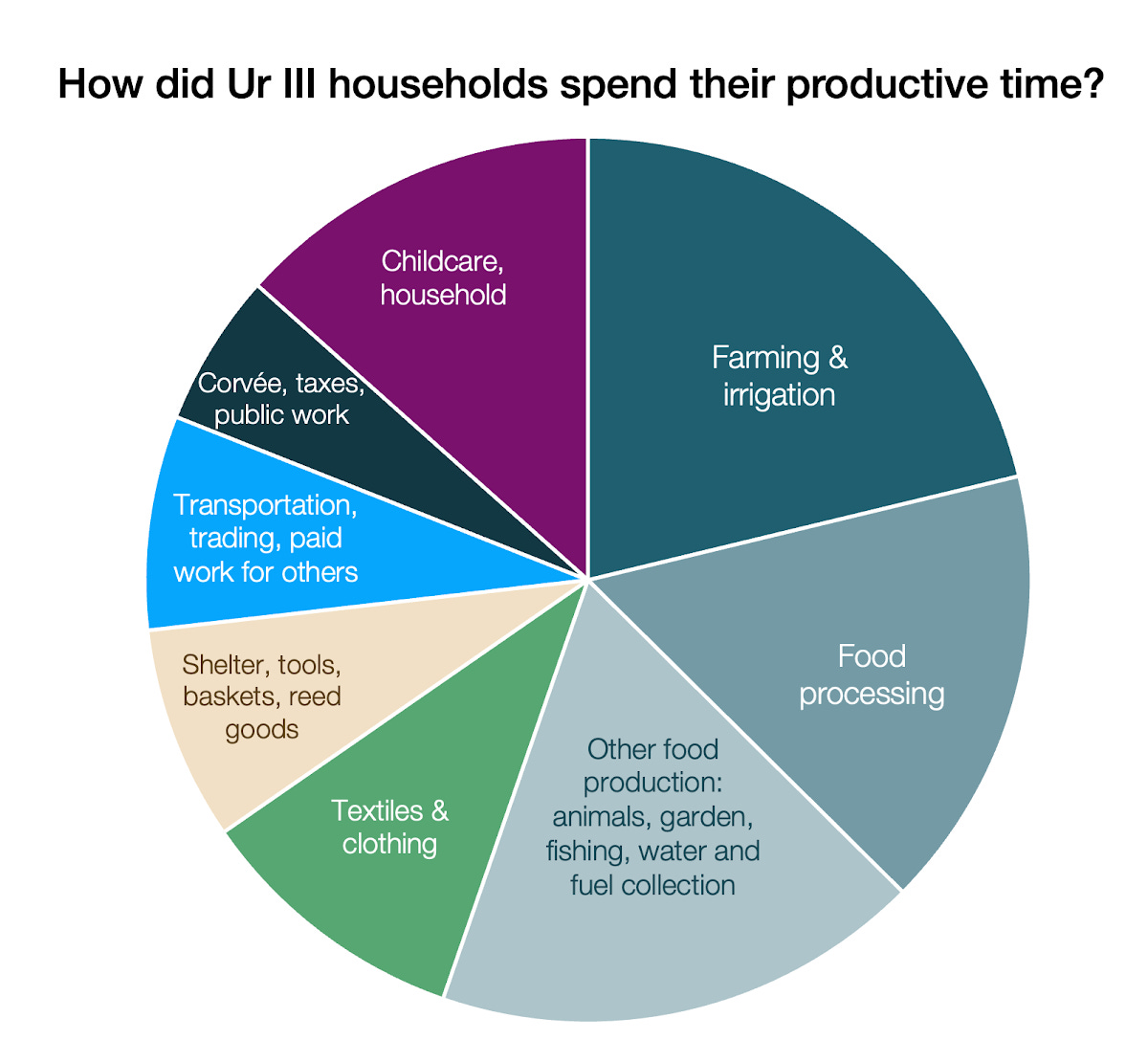
Notice how different this is from our lives! We still have childcare, household coordination, trading, institutional work (ie, the work we do to pay taxes), cooking, and cleaning, but everything else we buy, which we can afford by doing one single job (usually) which is way better than doing these tasks.3 They worked substantially more than us, doing much harder work, among other reasons because they had to do most stuff for themselves.
There were a few things they consumed that they couldn’t make themselves, though, and that’s the key to history.
When Farmers Needed Others
Coordination
There are many things farmers simply couldn’t do alone, like building and maintaining irrigation systems. You have to dig the canals, build the levees, open and close ditches, and above all constantly dredge them to fight silting. These canals were extremely long, no single household could do all this, so they needed to coordinate so that everybody chipped in, which means they also needed to coerce people to work. So that was one of the key roles of the state, one of the reasons it emerged.
Since the value of land was a direct consequence of the locations of the canals, it was also coordinated by the state. Land was allocated, and habitation land was dirt cheap—unlike today.
I wrote much more about how this shaped the cities and kingdoms of the regions in this article. Here’s an extract:
In Mesopotamia, the Tigris and Euphrates channel in and out, forming a network of rivers between them.
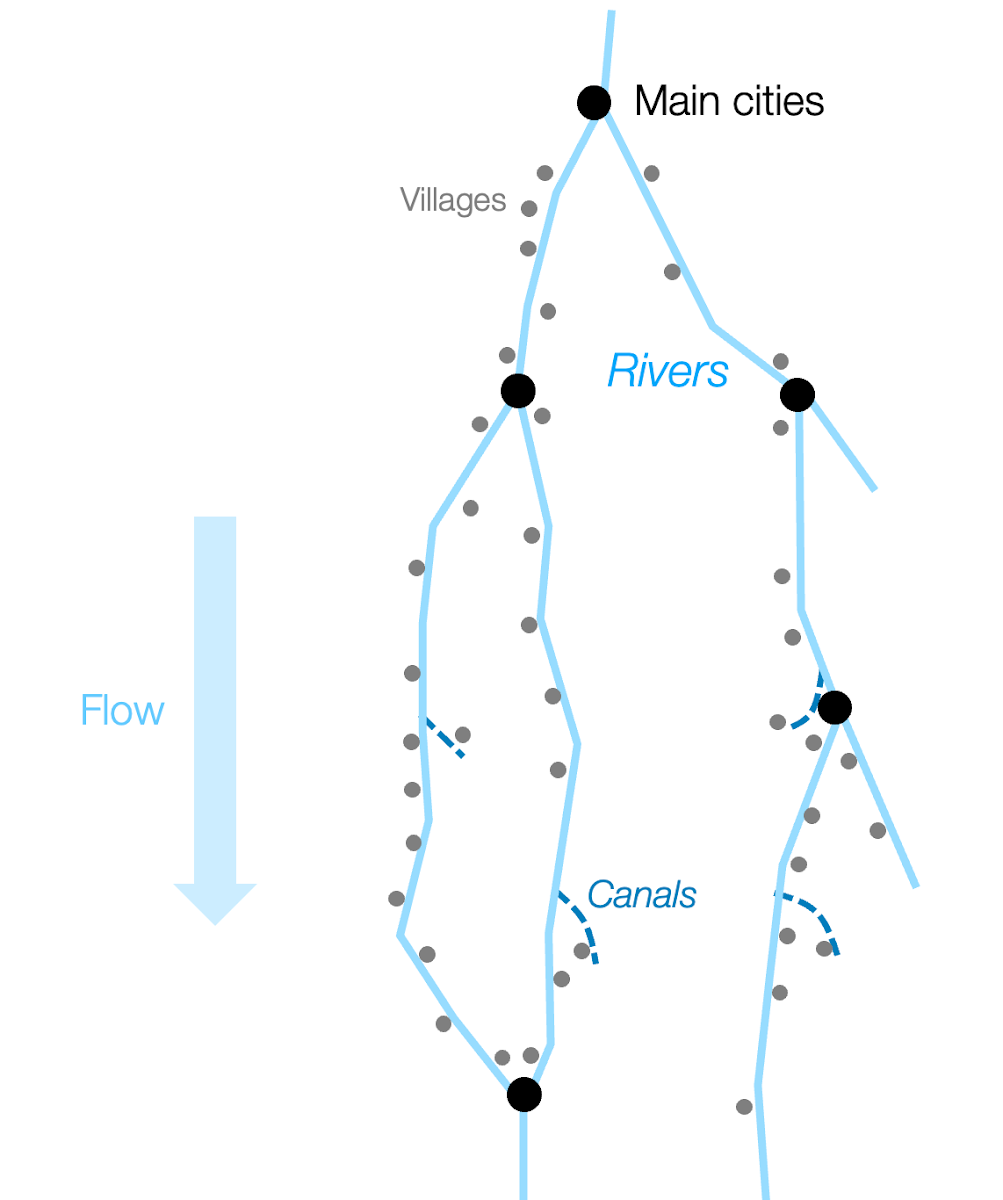
Floods don’t happen just before sowing, like in the Nile. They come at harvest time. Therefore, water needs to be tightly managed:
When sowing, little water was available, so it was precious. It had to be used sparingly.
When harvesting, floods came, and water had to be managed in a completely different way.
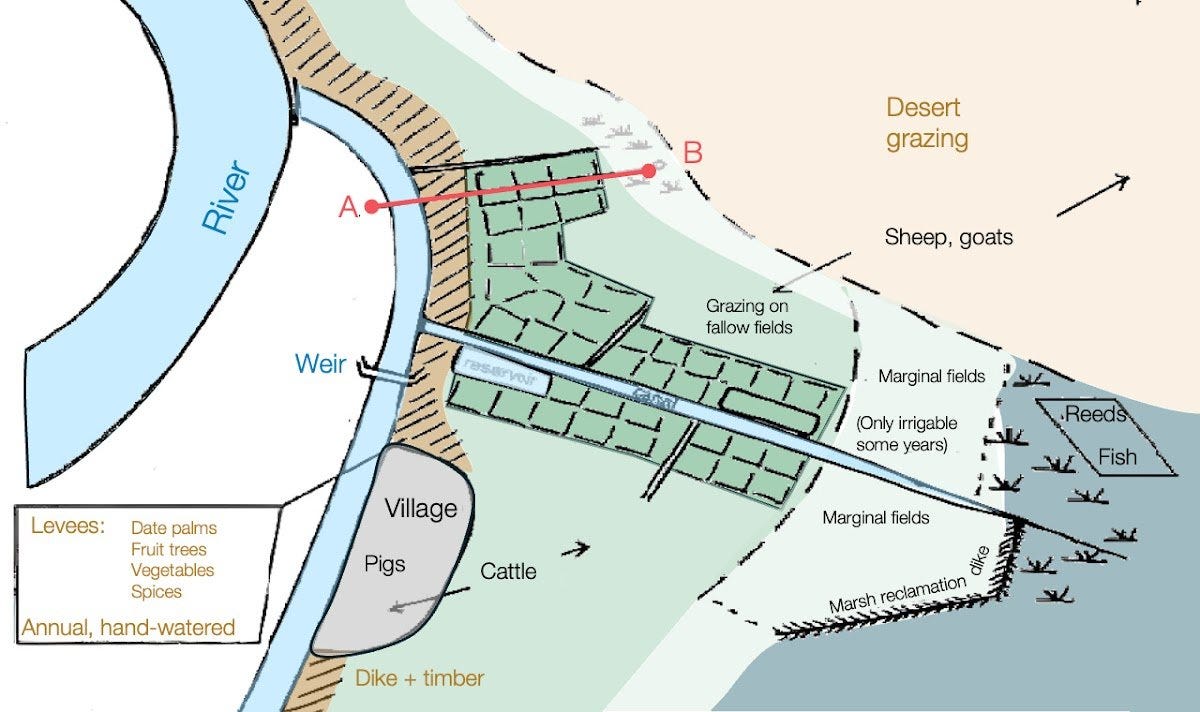
There is a fresh water table and a salty water table, which determines which soil is fertile, which soil can be reclaimed from marshes, and which fields had to remain fallow. If you look at the diagram above, you’ll see the A-B line. Its cross-section is below:

You had orchards, gardens, cereal fields, marginal fields, and marshes, all of which needed to be managed. Canals would bring water during dry times to irrigate the soil. Some fields had to be left to fallow, others had to be reclaimed from the marshes. Marshes could be used for reed and fish.
But which canals should be opened and when? What fields should be left to fallow? How much water could be tapped through wells? What marginal lands could be reclaimed? How high was the salty water table? Most of these decisions required knowledge of local conditions that varied throughout the seasons and were unique to each parcel of land, so the people who managed these fields in Mesopotamia were not easy to replace. In fact, productivity would plummet with the wrong managers at the top. So distant kings couldn’t use this stick to control local managers.
However, local rulers did understand all these nuances, and they controlled access to water during the dry times, so they were able to exact taxes that distant kings couldn’t. This is why rulers were local and not distant, and hence why Lower Mesopotamia had many city-states but no strong and enduring kingdoms and empires until much later.
Besides water, the state had other roles.
Oxen were expensive, and a household didn’t need one full time, so it made sense to share that asset too: Today, you help me plough my field with the group’s oxen, tomorrow I’ll help you. The same logic is valid for the plough itself.
Yet another function that the state could sometimes perform. In some cases, seed was also provided by the state for sowing. It also makes sense, as centralizing grain is a sort of insurance, and it’s cheaper to maintain one large granary than lots of small ones.
All of this could be done locally, so it required social coordination (which evolved into states), but not much more than that. The next level was trade.
The Role of Scarce Resources
This is what people had to buy from the market:
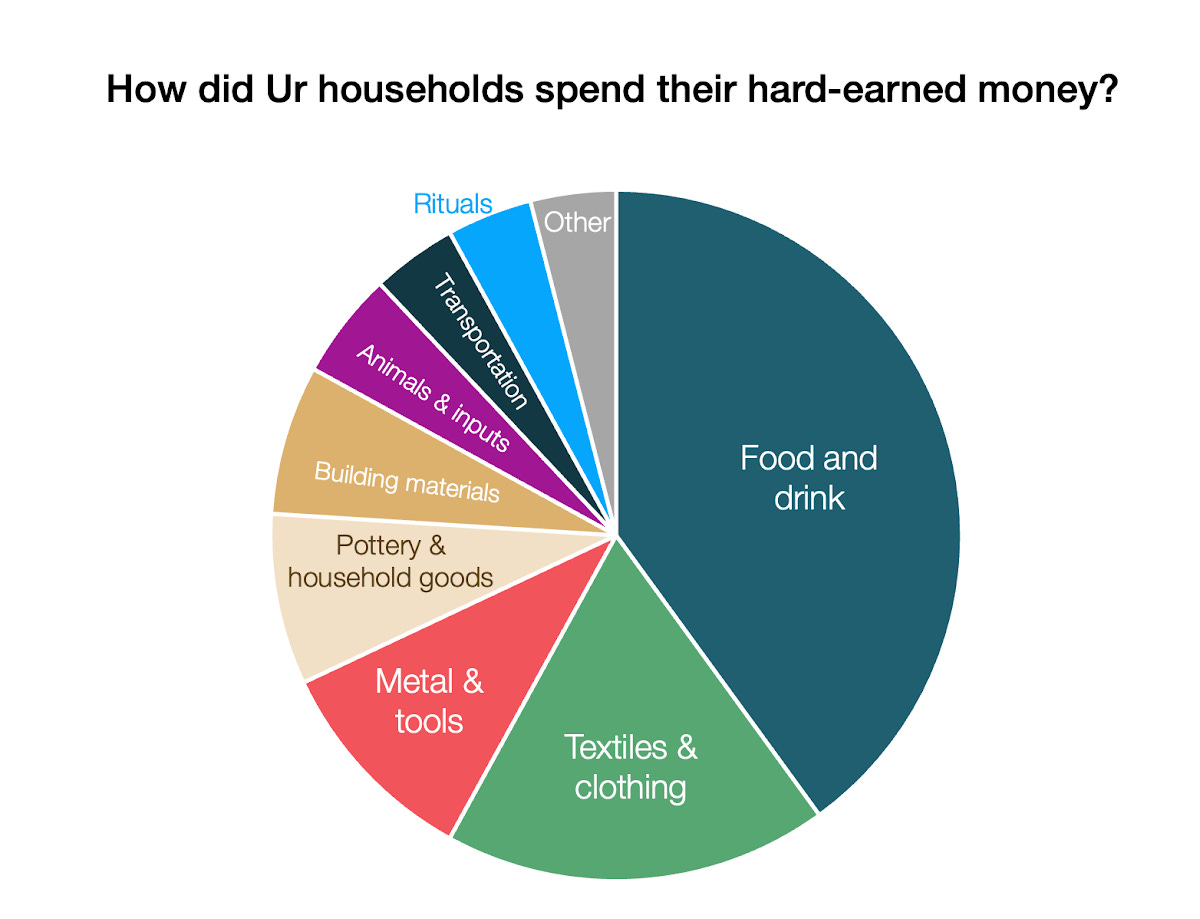
Other Food
You can’t survive just on grain or your vegetable garden. People also bought fish, meat, dairy, dates, vegetables, salt, condiments… Many of these required specialized people: fishermen, shepherds, date farmers, salt producers… But in the case of Ur, most of these could be done relatively close by, by people who didn’t possess unique knowledge, and without unique resources. Salt could be quite unique in other parts of the world, but not here.
Pottery
What do you put your food on? Pottery plates. You also used pottery for storage.
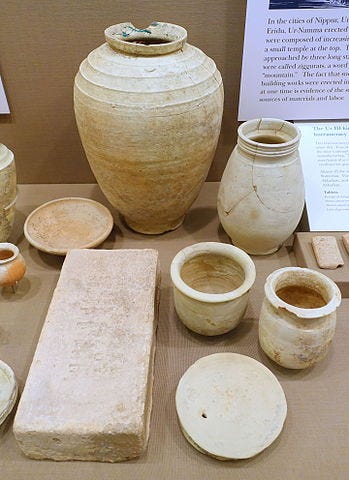
Pottery needs three things: clay, kilns (ovens), and expertise.
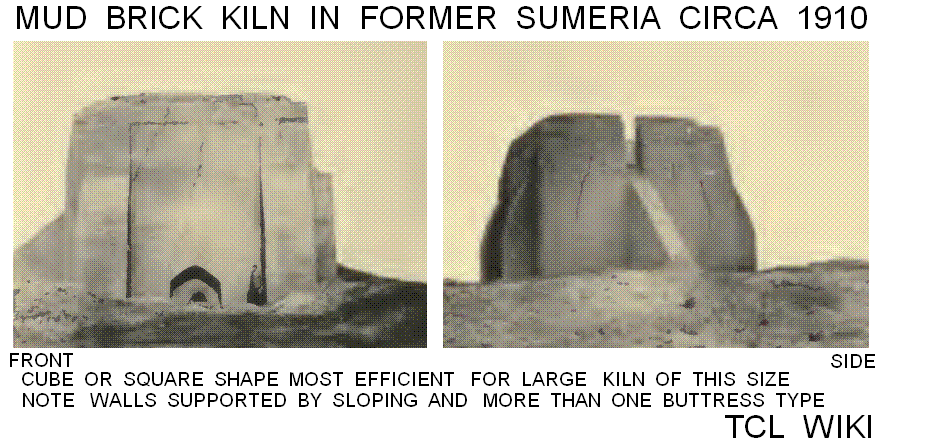
Clay is quite common, but it’s not literally everywhere. Kilns require big investments, because the bigger they are, the hotter they can get. Pottery needed enough skill that potters had to specialize. The result is that pottery tended to have some sort of state coordination, but owning a pottery operation didn’t get you very much political power, only maybe in your area.
Timber
Timber is a bit harder to get. In Mesopotamia, farmers could grow reed and palm trees, but neither are great for construction. For that, you need long, strong beams, which had to be imported. But there are lots of sources of timber, and it could be floated downstream, so the result was that there wasn’t too much political power to be gained by controlling its trade, even though local civilizations or kingdoms could emerge based on the trade of timber. In fact, that’s exactly how Phoenicians emerged, just around that time, in what’s today mostly Lebanon. This is a satellite map of the area today:
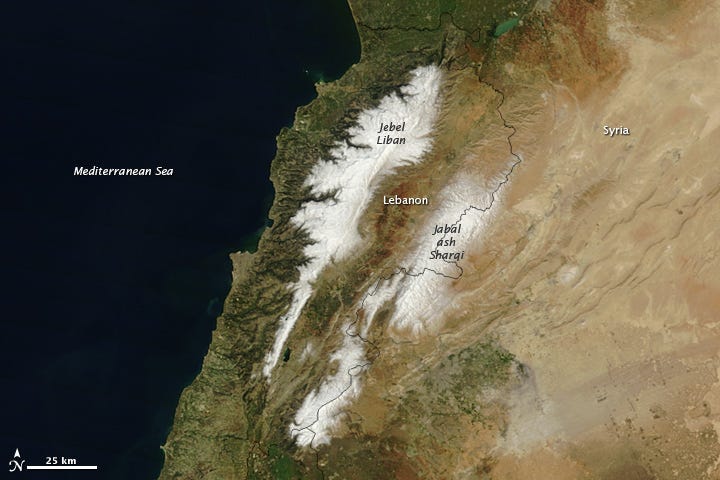
You can see how these mountains catch snow and rain, irrigating the mountainside that can’t be easily farmed, so the trees were not cleared, and Phoenicia became one of the biggest sources of timber for both Mesopotamia and Egypt.
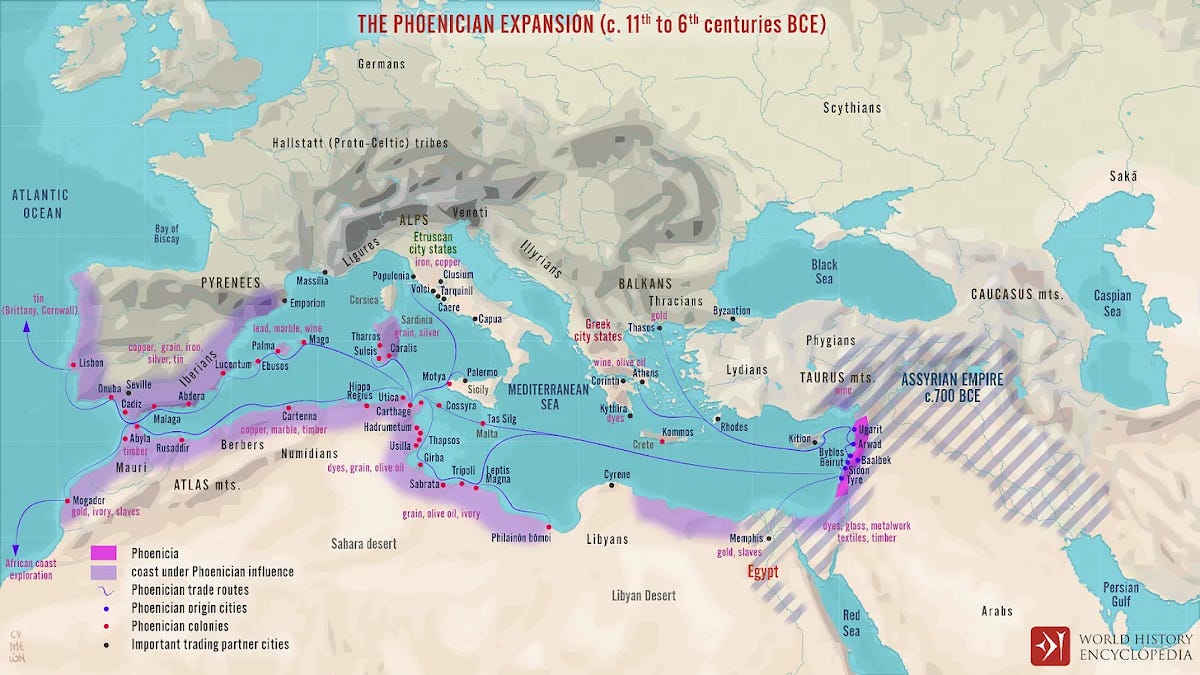
As I’ve written in the past, Phoenicians were the first civilization to spread across the Mediterranean, and it’s not hard to understand why: Anatolia and Mesopotamia are where civilization emerged in the area, and Phoenicia is one of their closest coasts. But unlike the other ones (the Red Sea and the Persian Gulf), there’s plenty of timber here, needed for ships, so Phoenicians made their ships and sailed around the Mediterranean. This advantage would allow them to found colonies left and right in the Mediterranean around 1,000 years later.
Copper
Now we’re really talking. Metals like it can explain, among other things, the predecessors of Bahrain and Oman.
