

Dispatches are a new short article format I’m exploring for a few weeks. Let me know what you think in the comments
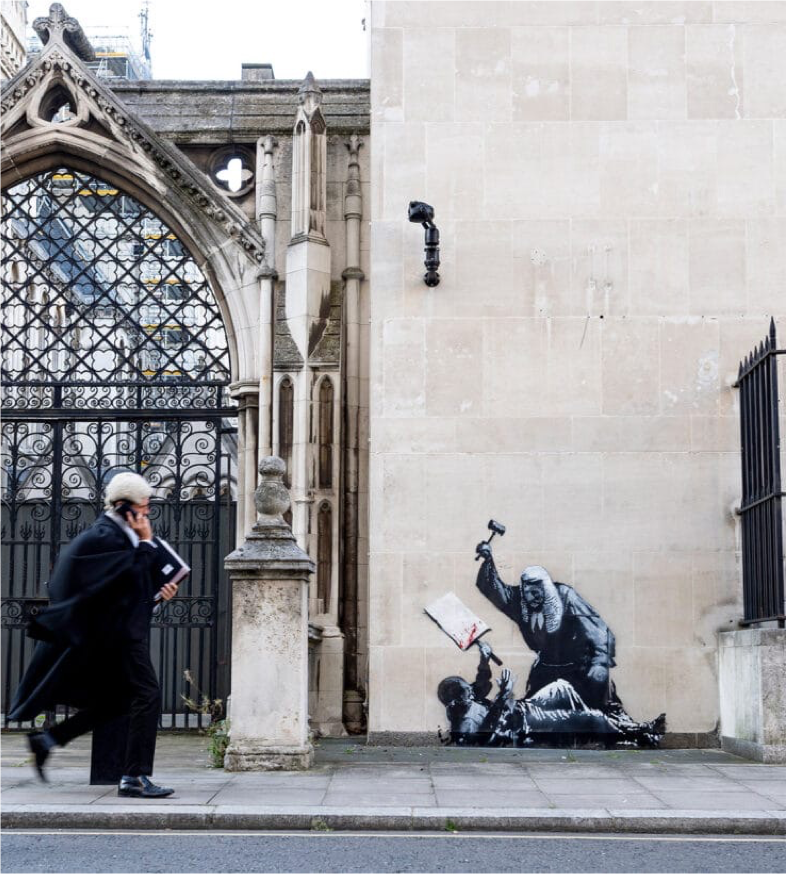
When I claimed a year and a half ago that Europe’s current path of limiting freedom of speech was dangerous, many commenters thought I was exaggerating. Unfortunately, I fear I was overly optimistic.
The UK
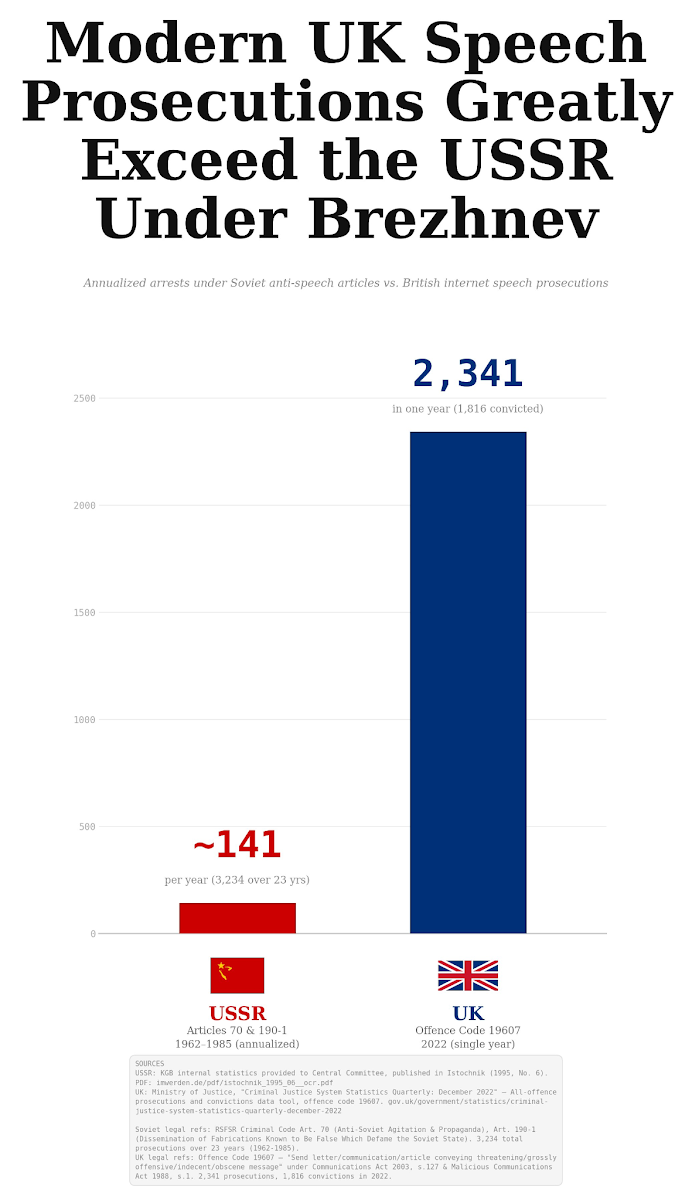
For starters, the UK prosecutes 17x more people per year for speech crimes than the USSR did!
Mind you, these are prosecutions. If you look at arrests, just in England and Wales:
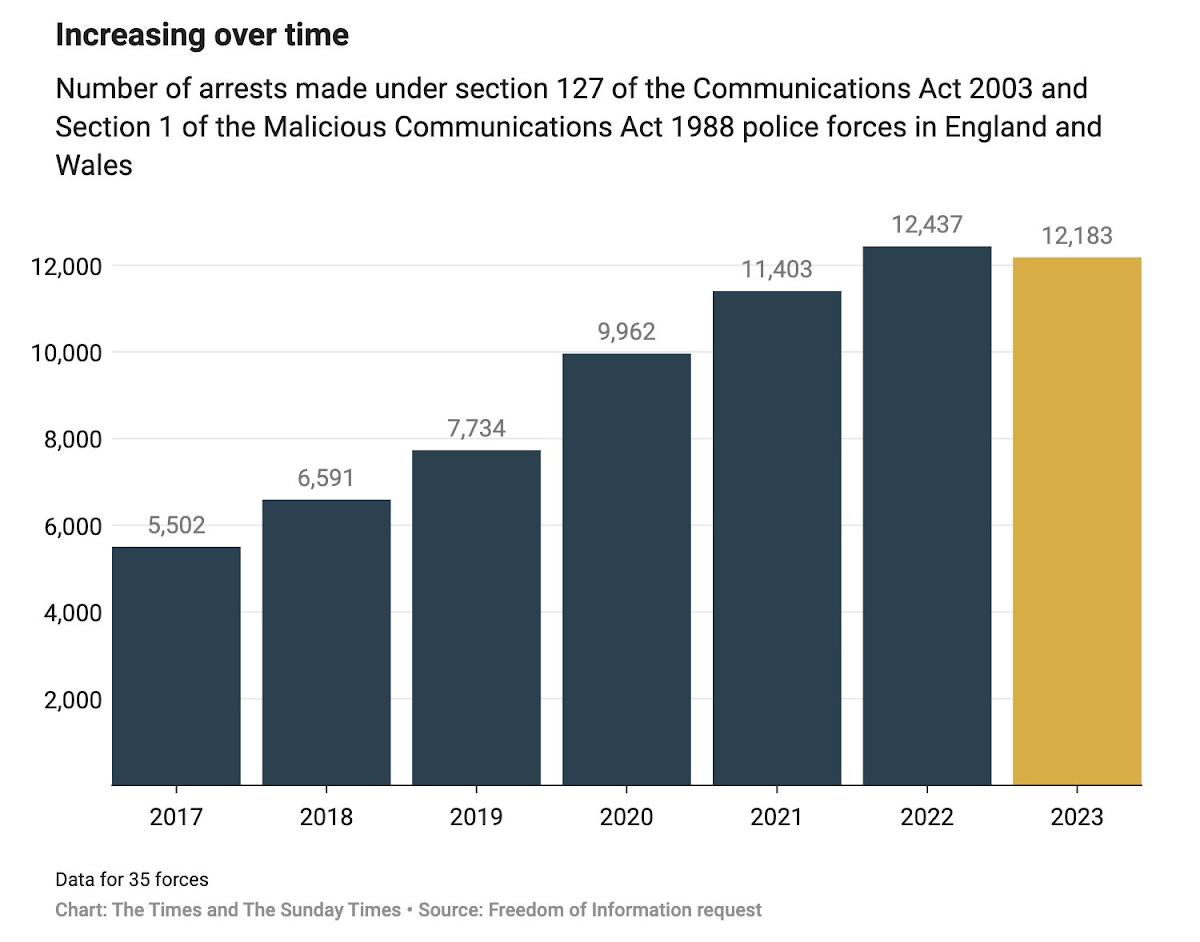
30 people are arrested every day for offensive online messages. According to Grok,1 this is 21x more than Russia today…
The crimes include retweets and sharing cartoons.
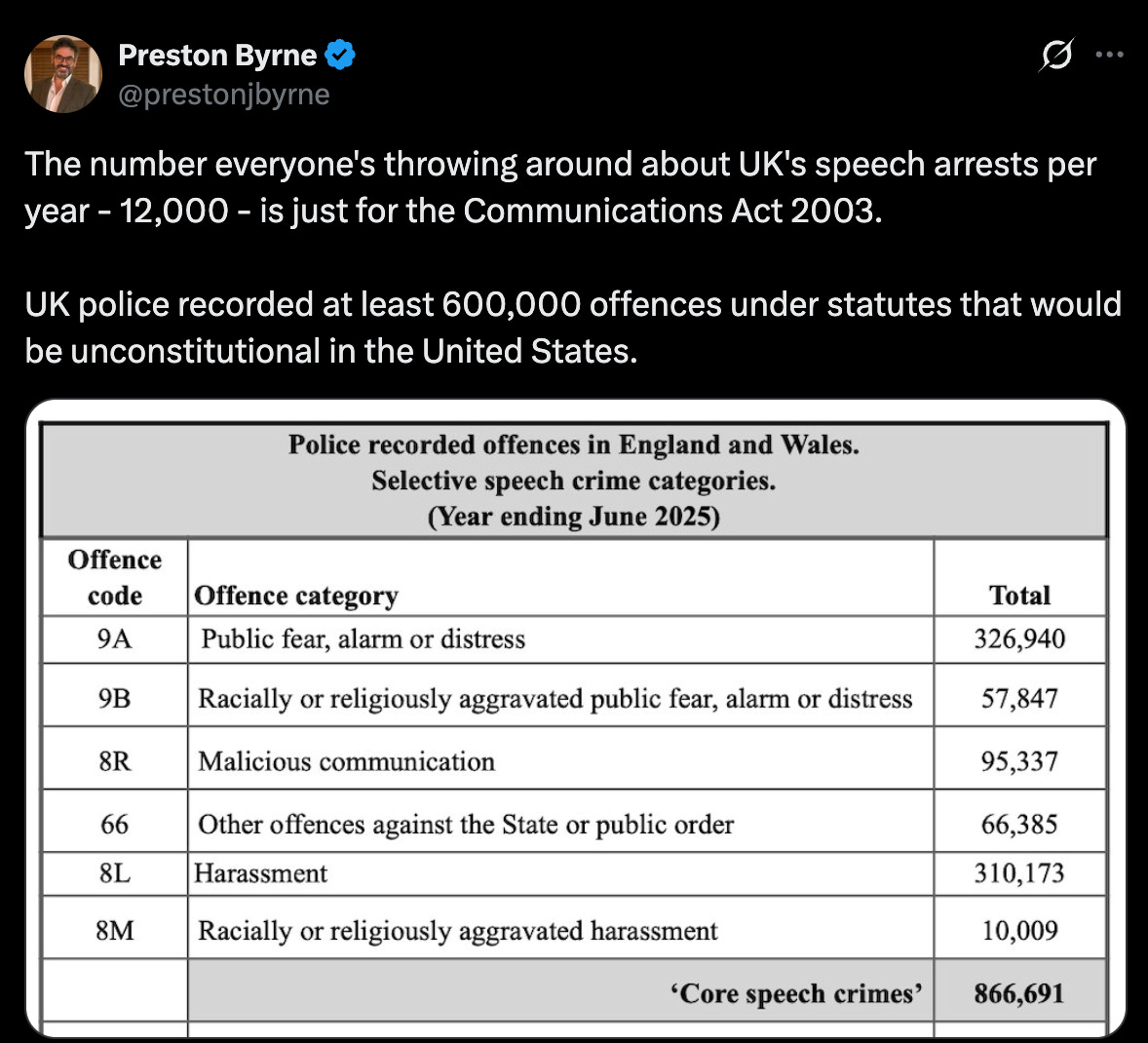
Apparently, this is an underestimate, because these numbers are just for one of the anti-speech laws. The number of recorded offenses could be in the order of hundreds of thousands per year.
This is not random. The Director of Public Prosecutions and head of the Crown Prosecution Service for England and Wales between 2008 and 2013 was Keir Starmer, now defenestrated prime minister, so those who prosecute free speech and those in power are the same.
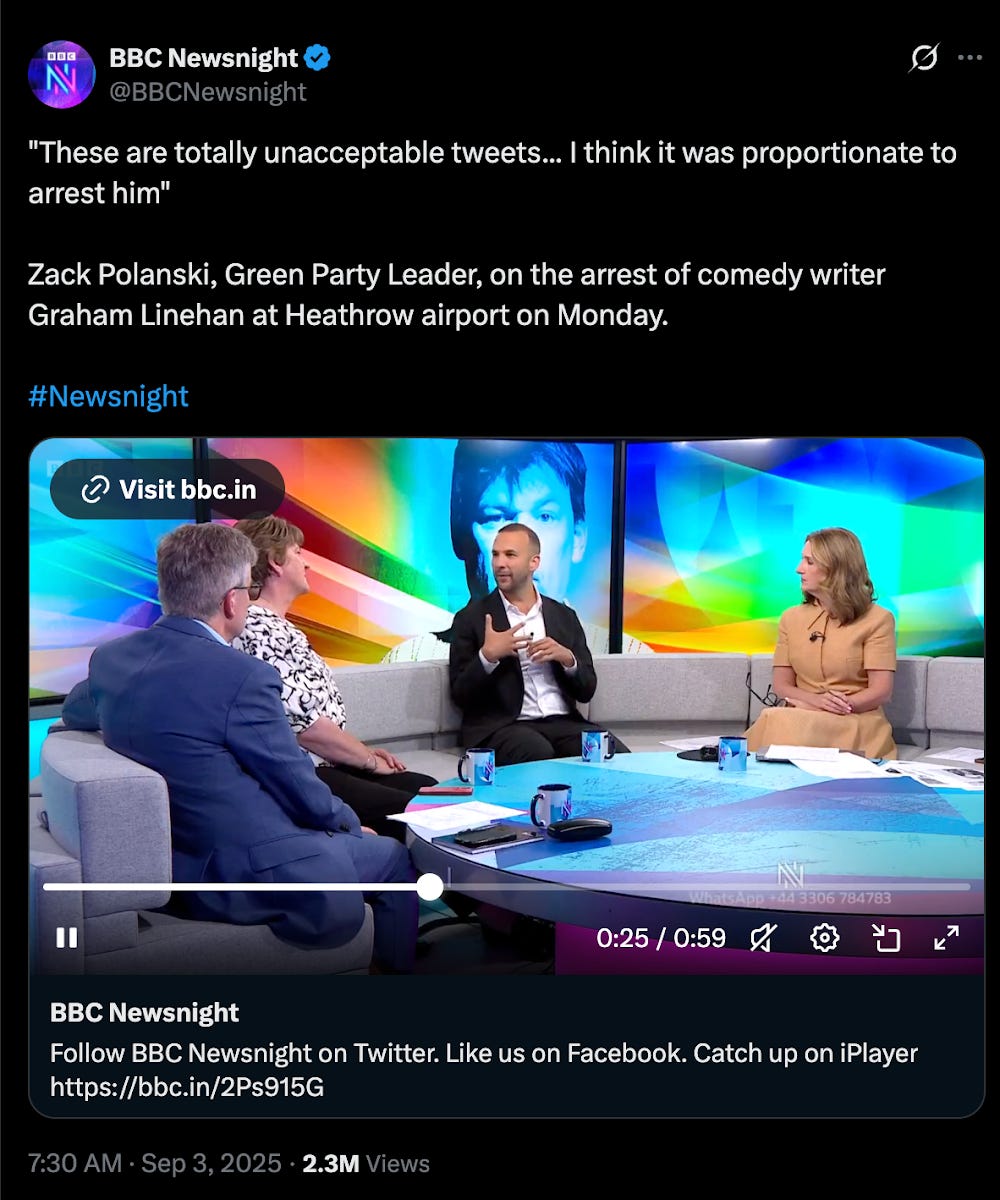
These are the types of tweets that justified his arrest.
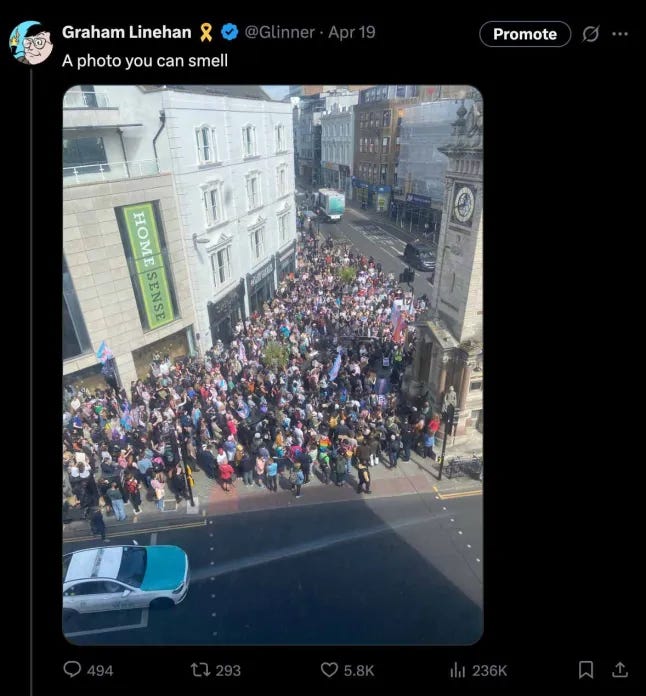
British citizens have been told they can’t wave an English flag in England near a pro-Palestinian demonstration.
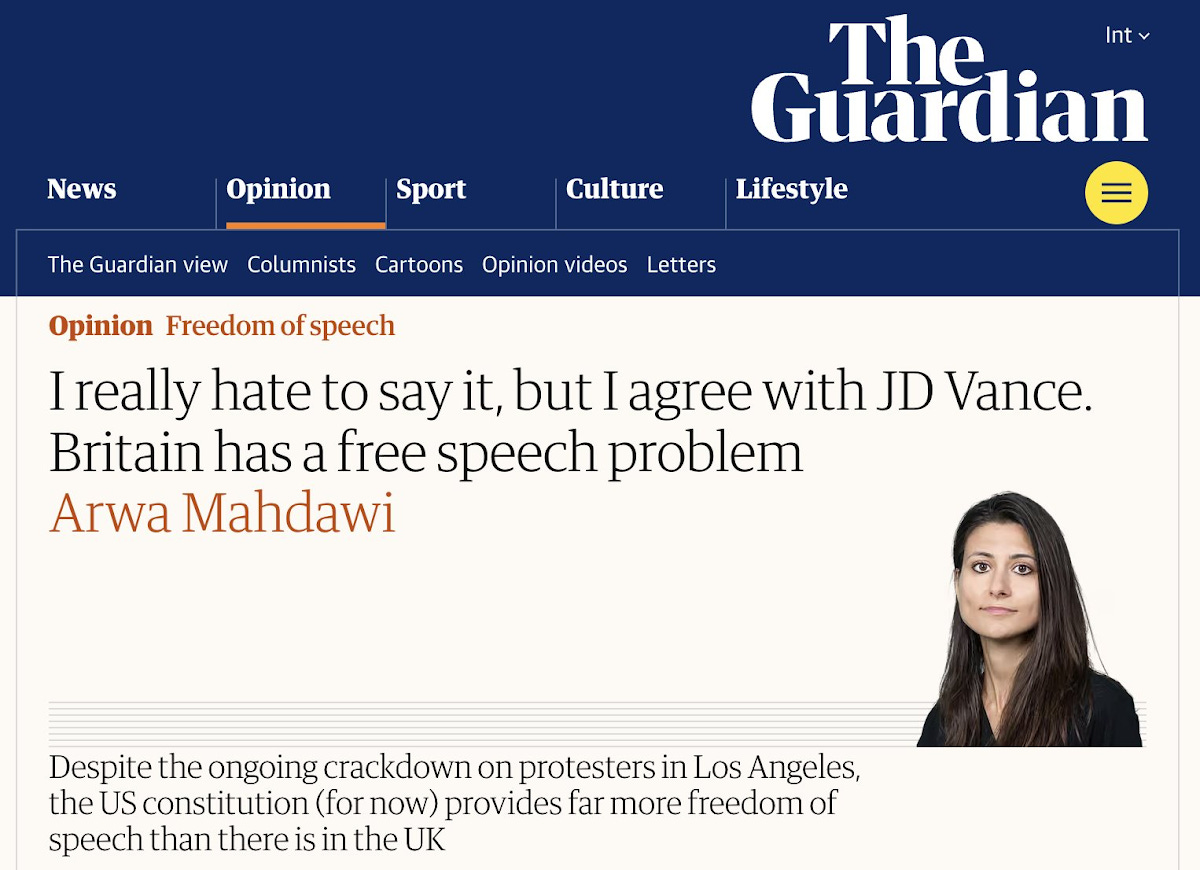
You know this is a real problem when The Guardian agrees…
The Political Bias of Censorship
I fear there’s an aggravating issue here: The persecution might be politically motivated: In this case, the left might be using these tools more than the right, and do it against right-leaning views. I have seen many arrests for right-wing speech, but few for left-wing speech. Doing some research, it looks like there are some arrests for left-wing speech (related to death threats and others supporting Palestine) but outside of that, when I asked four LLMs (ChatGPT, Claude, Grok, DeepSeek):
Claude couldn’t find any arrest against left-wing speech
DeepSeek found two: in both cases, attacks on left-wing politicians (!)
Grok found ~20 arrests for anti-monarchy speech while mourning the Queen, one against a soldier, and a couple more about attacks on left-wing politicians (!)2
ChatGPT could find 5 more.
When I made the equivalent request for arrests against right-wing speech, ChatGPT had no problem giving me long lists.
If you think that’s because the left doesn’t make the same types of speech violations, this is a video of a demonstration where the chant was “Shoot him in the neck like Charlie Kirk.” I asked LLMs to tell me if there were arrests for this type of chant, and it doesn’t look like there have been.
To be clear, I think most censorship is bad, whether it comes from the Left or the Right. It just happens to come more from the Left lately.
The desire to restrict free speech goes beyond the UK’s borders. Not only was Graham Linehan living in the US when he made the comments that resulted in his arrest, but the UK also tried to get a US company to pay fines.
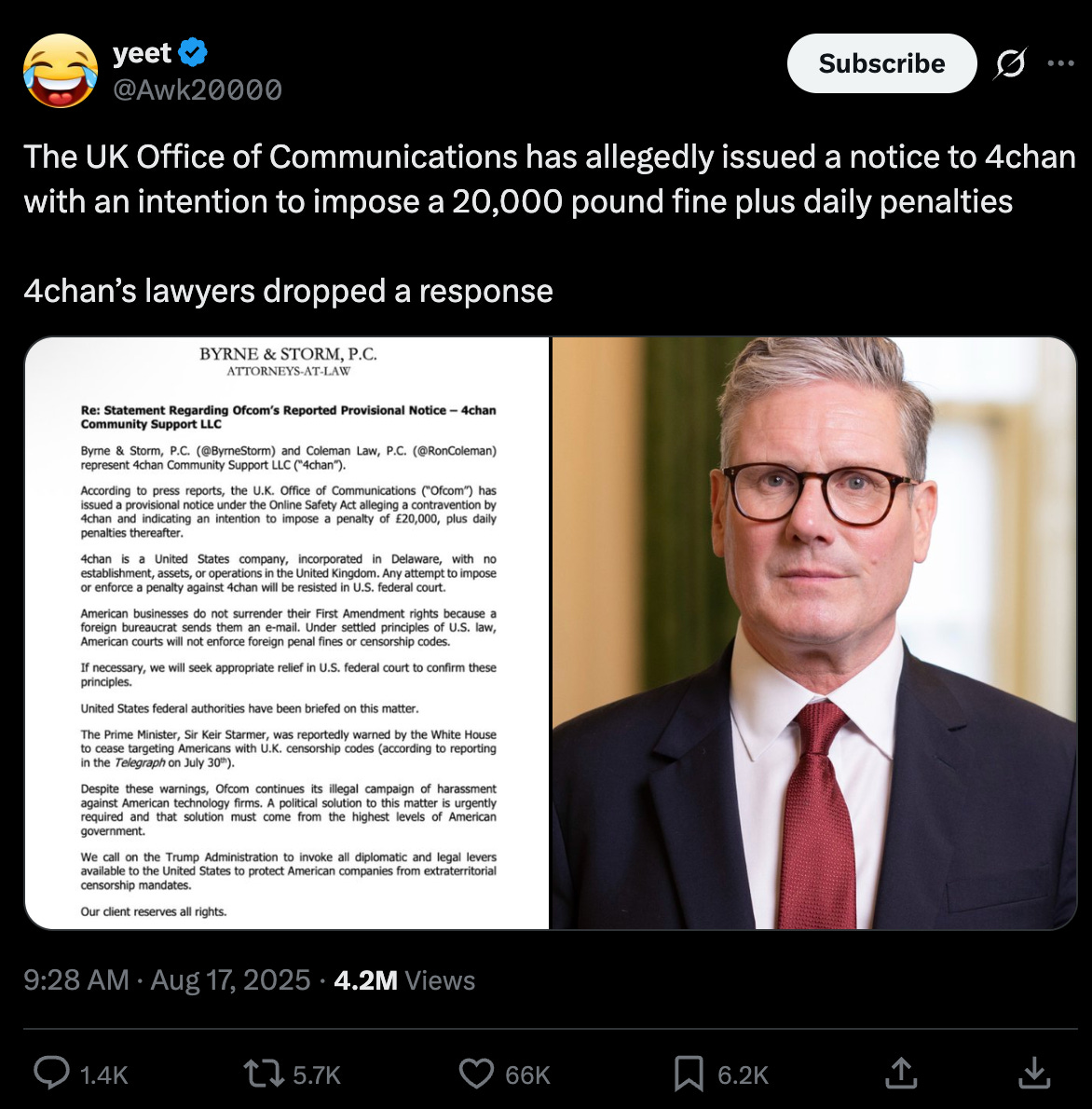
They have done this after approving the Online Safety Act, which allows the UK government to attack foreign platforms and threaten them with massive fines in order to censor what they decide is harmful speech (to whom?).
Now, right-wing British politicians are complaining that the government is weaponizing these laws to censor them, by pressuring platforms like TikTok to take down their videos (and they comply).
This lawyer claims this was very much why the Online Safety Act was designed the way it was.
More Censorship!
The UK is of course exploring going further. It has released plans to downrank competing voices in social media, so that their vetted media gets more views:
Today (23 June) the government has published a Green Paper, Watch this Space: A new strategic direction for UK media, to consult on options to require social media companies and video sharing platforms to make sure that news content from public service media (PSM), which includes the BBC, ITV, STV, Channel 4, S4C and 5, and other trustworthy providers, is prominent and easy to find on their platforms.
YouTube interpreted this more clearly: This is to downrank all competing creators, to give the government a stronger voice.
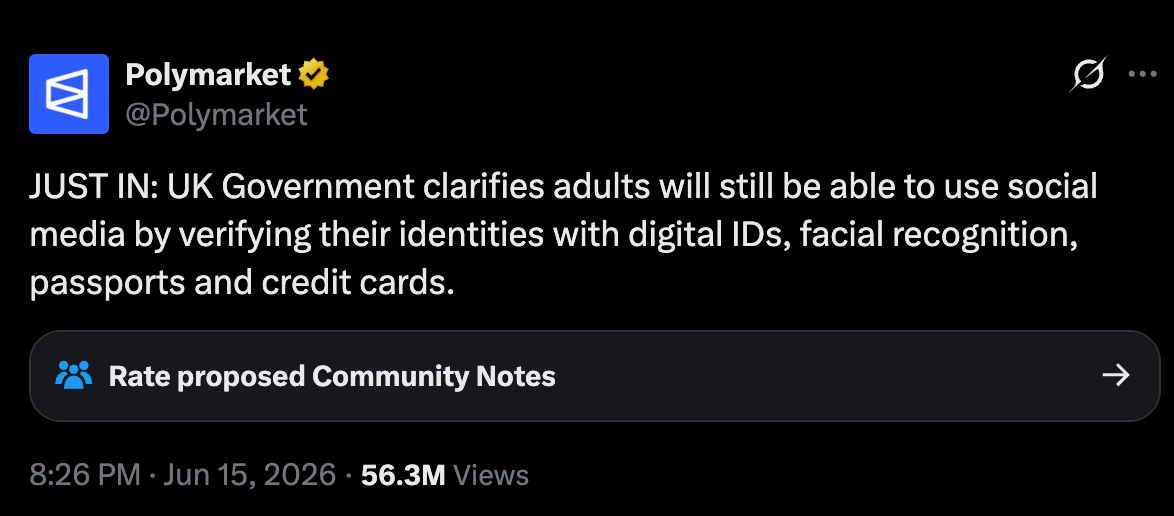
And then the UK government wants to track every person commenting online—imagine for what.
I was at a table with a European billionaire a couple of months ago. He thought it was a catastrophe that Elon Musk had bought Twitter, because now misinformation was rampant. I think that’s very telling of the different European and US approaches to speech: Americans understand that free speech is uncomfortable, but that it’s necessary because otherwise the government will end up deciding what people should think via censorship. Europeans haven’t realized this. They see speech they don’t like and conclude “We must ban that!”, not realizing this can turn extremely dangerous when the opposition takes power. I don’t care whether the party in power is from the left or the right, censorship is always bad.
More European Censorship!
All of this is not limited to the UK. Germany doesn’t want to be left behind by the UK: It’s illegal to insult somebody in public or online. Retweeting fake quotes or an insult is a crime.
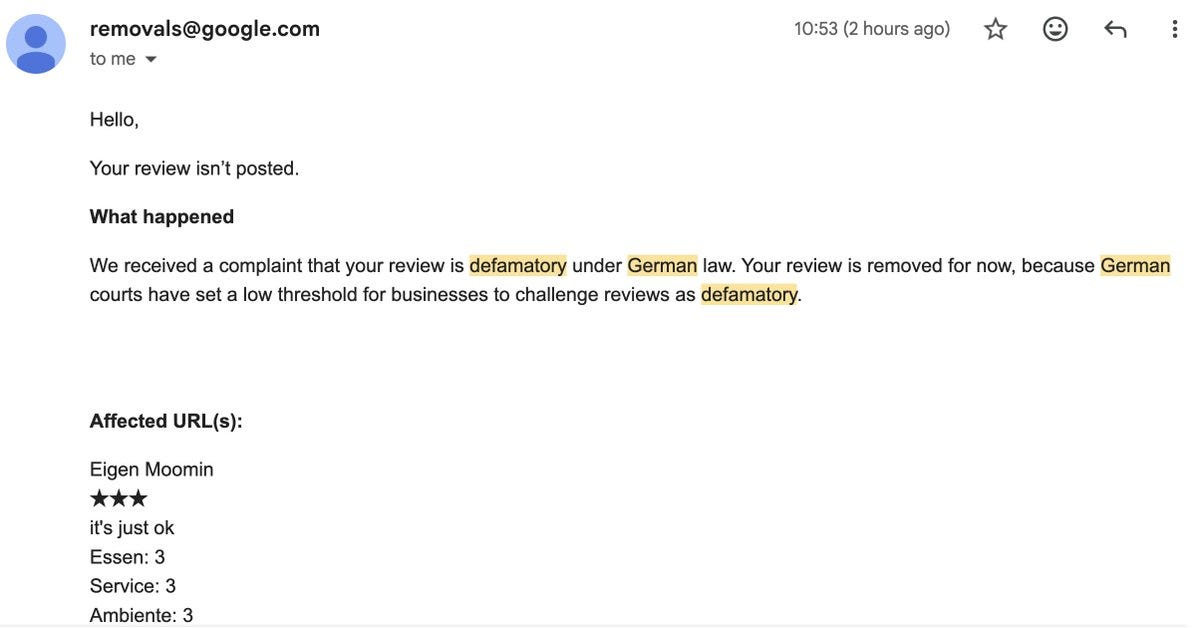
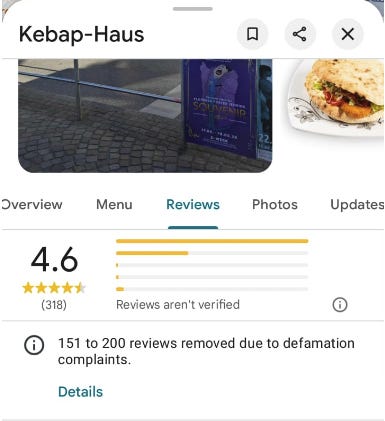
To see how far this has gone, simply look at Google Reviews. Somebody posted a three-star review of a business (“it’s just OK”) and this is what Google said:
From official EU data:
One analysis found that 99.97% of all Google Maps reviews removed for the information across the entire EU come from German businesses.—via FastCo
Since this made star ratings useless, Google Maps reacted by revealing the number of complaints that were removed, and that’s what people pay attention to now:
France also wants in. A woman who had been sexually harassed by an immigrant (who was never apprehended), and who said “the main danger to women in France is Black African and Arab immigrant men”, was convicted of aggravated public insult (injure publique aggravée) on grounds of origin, ethnicity, race, etc.
Much more worryingly, the French Senate’s culture commission adopted a report with 56 recommendations on how to regulate online information. In this video, representatives from left, right, and center parties are saying:
What would happen if a public figure, an intellectual movement, or a well-funded political party decided to devote those resources to a political project, using social media as a weapon?
In other words, French politicians want to ban citizens from funding opinion campaigns?! This is absolutely nuts! From now on, only the government can push opinion campaigns.
This is exactly the way freedom dies.
In the Netherlands, this man was convicted to go to prison for releasing statistics that link immigration to crime—exactly what I did in this article.
Ursula von der Leyen, the President of the European Commission, said that for information, “Prevention is better than a cure.” In other words, the position is not “Censorship doesn’t exist” anymore, but “Censorship is good.”
I used to be a fervent supporter of the EU, but I have now reversed my position, because of moves like this one that make my blood boil.
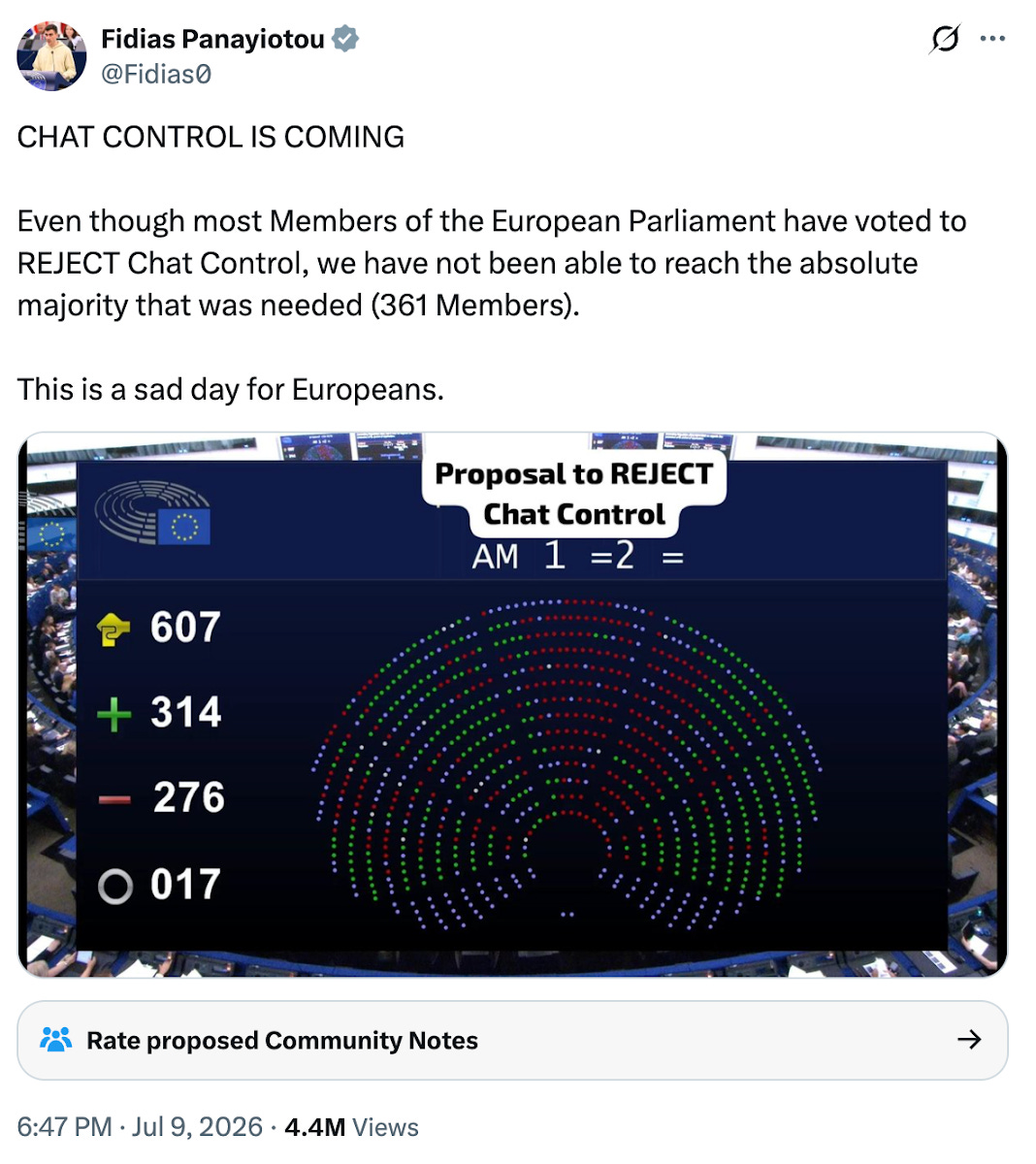
So what happened? The EU has been trying for some time to pass a law that allows governments to access personal communications. It’s like having a government agent eavesdropping inside your home. The excuse, like always, is “protect the children”:
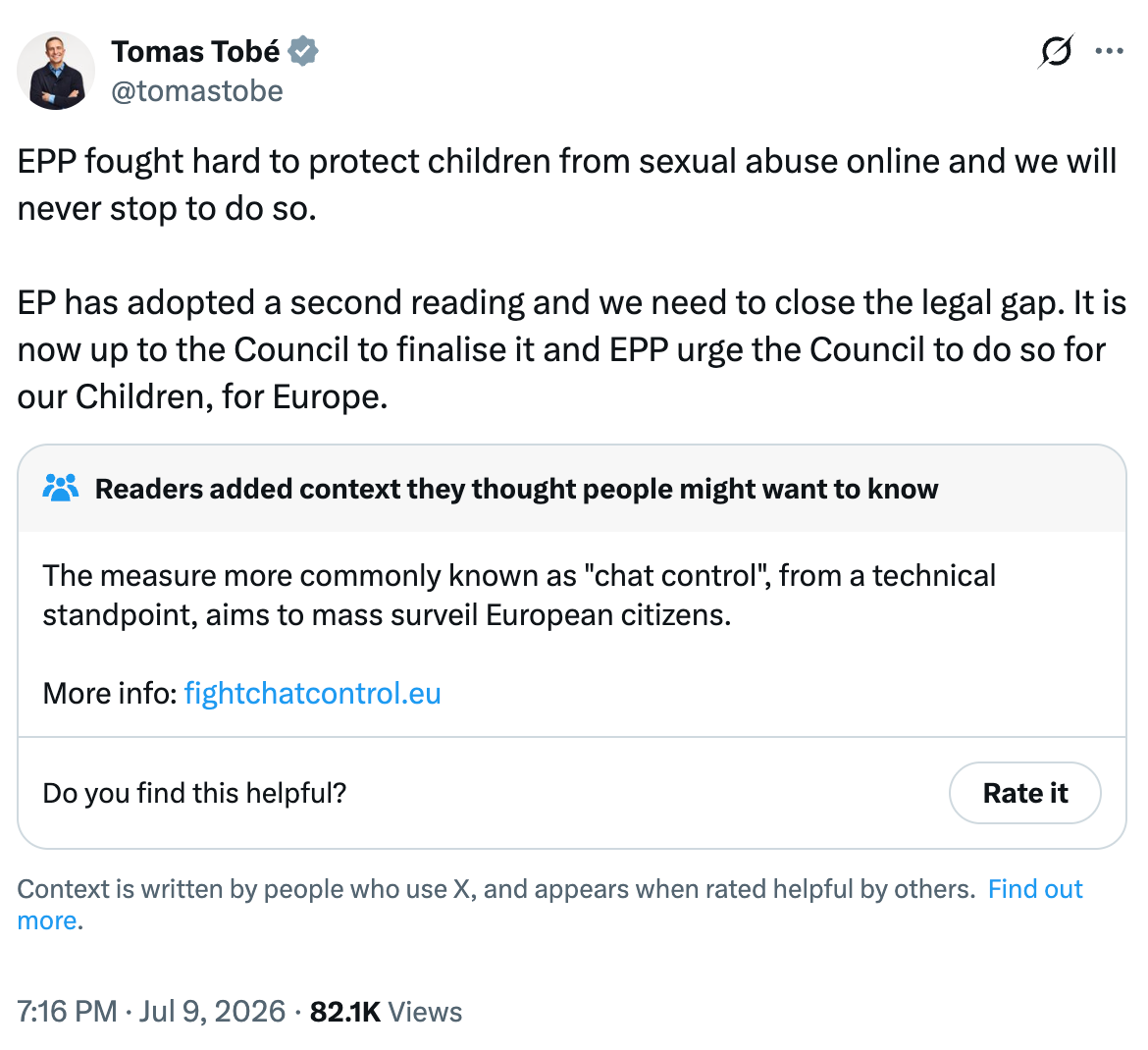
But that’s not the true intention. You can imagine what the true goal is by paying attention to what so many censorship-supporting politicians say when they’re not extremely careful. So this is what happened:
The EU parliament approved Chat Control v1 in 2021.
It was always meant to be temporary until a better solution was approved, but after five years, the better solution never came (because it’s so abusive it always loses). So in April of this year, it lapsed.
In March 2026, the EU parliament denied an extension.
So in July, in the last session of the parliament, when many MEPs are on holidays, the center-right European Popular Party (EPP) used an emergency procedure to avoid committee oversight and force a vote. In 2nd votes, the EPP needs a majority of the entire chamber (361 votes out of the total 720, not a simple majority of the parliamentarians who vote) to stop a law. But given so many people were not in the parliament, only 314 voted against it (compared to 276 in favor).
By the way, this is all led by the EPP, the center-right party in Europe, to show that many people on both sides of the aisle are against freedom in Europe.
This gives them two more years of surveillance while they figure out Chat Control v2, a way to mass-surveil Europeans forever. They’ve already failed in five rounds of negotiation, but they won’t stop until they succeed.
Canada Follows the Motherland
According to this article, similar things are happening in Canada:
Until now, a Canadian charged with a hate-propaganda offence could raise the “good faith religious opinion” defense, a narrow protection for sincerely expressing an opinion on a religious subject or advancing an argument based on a religious text. The Combatting Hate Act, which received Royal Assent on June 18 and takes effect July 18, repeals it. Whether a sermon or a quoted verse is protected now depends on context, audience, and how a prosecutor reads the room. American law has a name for what happens when people must guess what they are allowed to say and, because of the uncertainty, end up not saying anything at all: a chilling effect.
There’s more. Close behind the Combatting Hate Bill, a new Ottawa bylaw taking effect August 1 will mandate a 50-meter “bubble zone” (that’s about 164 freedom feet) around schools, hospitals, places of worship, daycares, and care homes. Inside the bubble, protest is simply banned. Not “protest that blocks the door,” or “protest that disrupts planned events,” but any protest at all.
There’s more. In early July, Canadians learned of a 35-page internal memo from Industry Minister Mélanie Joly’s department — titled “Misinformation and Disinformation Strategy” — floating “legal action” against users on Facebook, X, and LinkedIn who post what the government deems “false and misleading information.”
You read that right. This memo proposes giving the Canadian government the power to deem criticism false and punish (somehow?) the author for publishing that false information or the platform for hosting it — who exactly would be the target of “legal action” is also unclear. If that sounds familiar, it should. The Soviet Union had something very much like it.
What I alerted about a couple of years ago is now becoming a reality. Europeans and Canadians have to wake up. Free Speech is under threat.
I'm opening the newsletter to sponsorship. If you have a business that is moving the world towards a techno-optimistic future and would like to reach 135k+ curious, globally-minded people to learn about it (founders, researchers, investors, policymakers), reach out here.
We have an issue for this type of topics: Which LLM shares the most information with the least bias, given that they’re all biased? Normally, I use ChatGPT and Claude for most of my heaviest research, and Grok for anything that requires recent up-to-date information, or access to tweets. For politically-charged topics though, I lean more on the LLMs that are critical of what I’m analyzing. In this case, Grok is the most vocally in favor of freedom of speech, and is also closer to the news, so I used it more than others.
This is one additional reason why I lean towards Grok for this type of exercise. A truly left-leaning LLM should have been able to find plenty of arrests against left-leaning speech, to demonstrate bias against the Left. But most LLMs didn’t find that either. Only Grok was able to find anti-Left (and anti-Right!) censorship.
I'm sorry to say, but this is the worst that you've come up with so far. I loved you earlier post on Corona, many of the geography analyses you posted were great reading material. The political analyses are heavily biased by US ideas of what is called free speech. The US free speech, which is often not checked and often fact free, has nothing to do with the European freedom of opinion. I'm very happy that it is illegal to insult people both offline and online. With the US based approach, any sensible discussion culture goes down the drain. Just look at what utter lies famous people in the US get away with. if this minimal research is enough for you to not lie Europe it is fine for me that you stay in a country that is not slowly but very quickly losing all of its democracy.
Comparing the UK with the USSR is completely useless as the data is decades. Also you can only have a lot of expressions the opinions prosecuted if they are already expressed in the first place and made public through social media.
I live in Germany and personally got multiple emails saying my innocuous reviews of restaurants "it took a long time for the waiter to come" were "defamatory" and that they were removed. Crazy.