

I can’t believe what I just discovered. It looks like we could already eradicate malaria if we want, along with any species of mosquitoes! The main reason we don’t do it is…crazy.
We concluded in the previous article that we should eradicate a few species of mosquitoes. How, though? This is what we'll cover in this article:
How we’ve learned to fight mosquitoes over the last 130 years
How we achieved the technology to eradicate those we choose, along with malaria
Why we're not releasing this technology yet
What you can do to make it happen
If you’re not interested in the history and only want to know the answer, just jump to the bottom, to the section Weapons of Mosquito Destruction.
The Mosquito Life
To kill a mosquito, you must think like a mosquito.
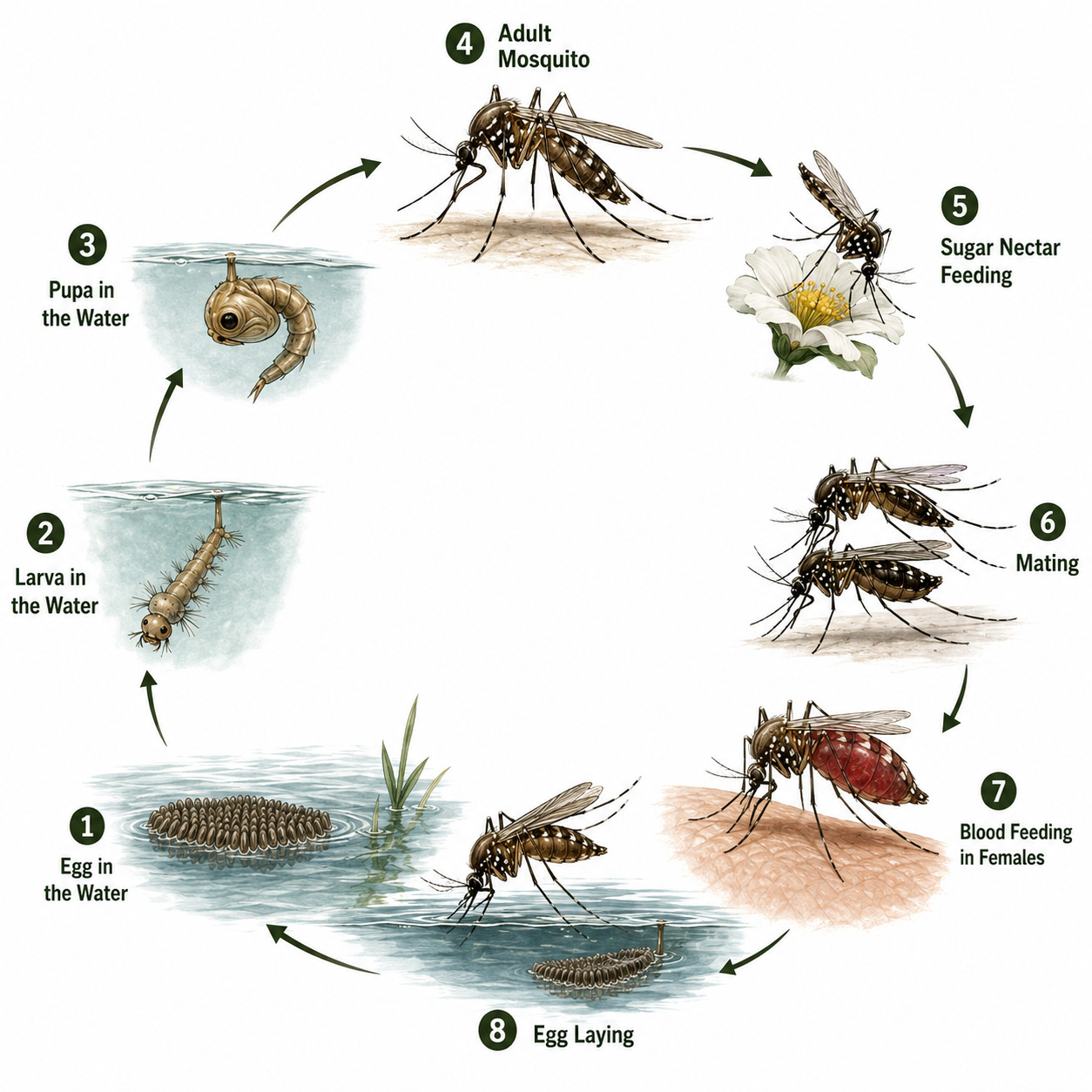
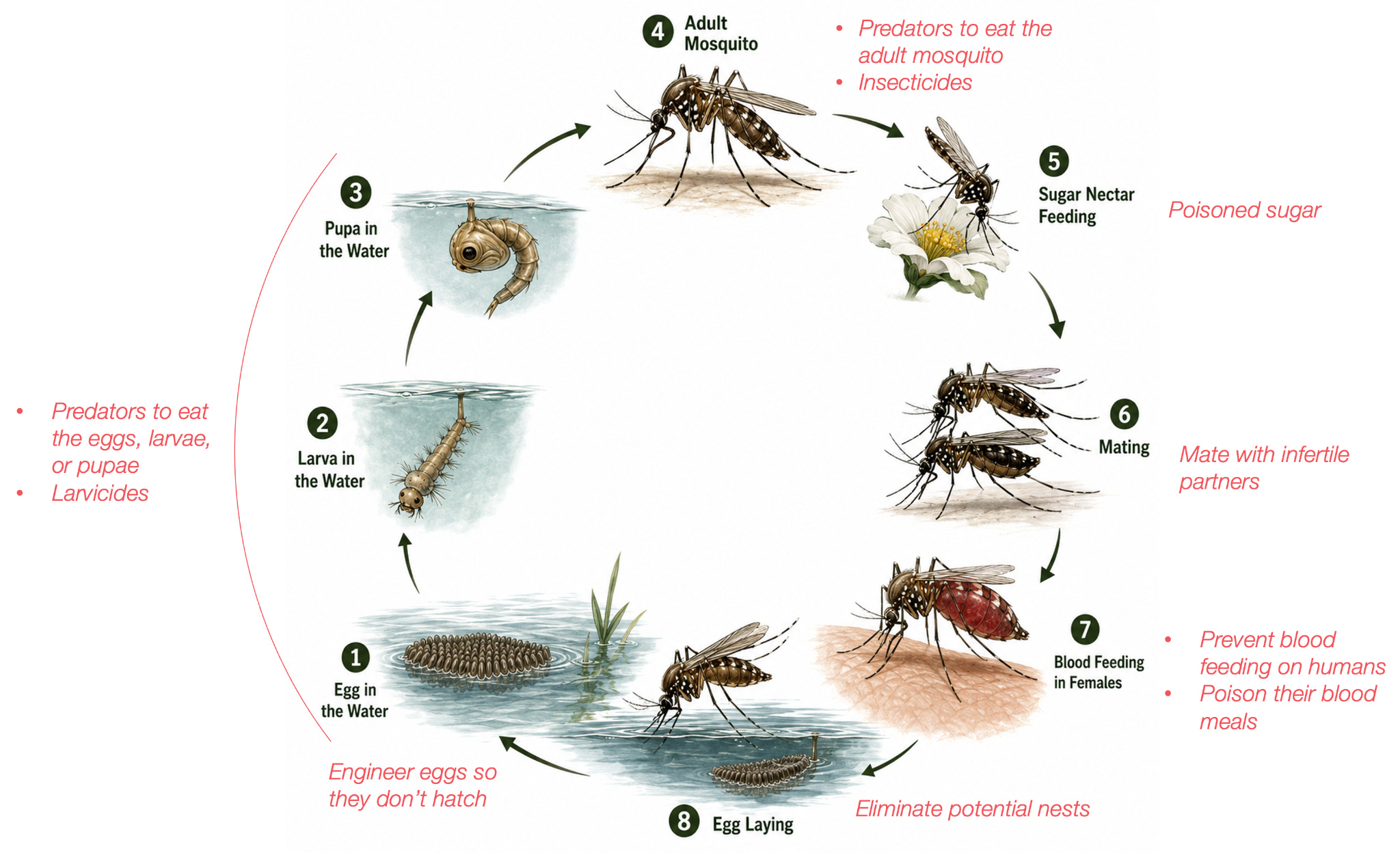
Each development step is an opportunity to stop them:
The Early Attacks
The moment we learned the mosquito was responsible for so many diseases, epidemiologists went into mosquito extermination mode, and the diseases dwindled pretty fast: Yellow Fever was eliminated in Havana in 1901, and the malaria death rate among Panama Canal workers fell by 90% between 1906 and 1909, the result of applying all the tools at their disposal:
Eliminate reservoirs of standing water.
Kill larvae in the water. One way was with oil or kerosene on water surfaces, to asphyxiate the larvae that feed in the water but come to the surface to breathe. Another was with arsenic-based insecticides.1
Use insecticides on adult mosquitoes, too. The most famous one was pyrethrum, derived from chrysanthemum flowers and already used as an insecticide for centuries.

Better Management
Later, we tried to drive Aedes Aegypti to extinction in South America. The exercise started in the 1930s and succeeded by the 1960s, but eventually the mosquito came back:
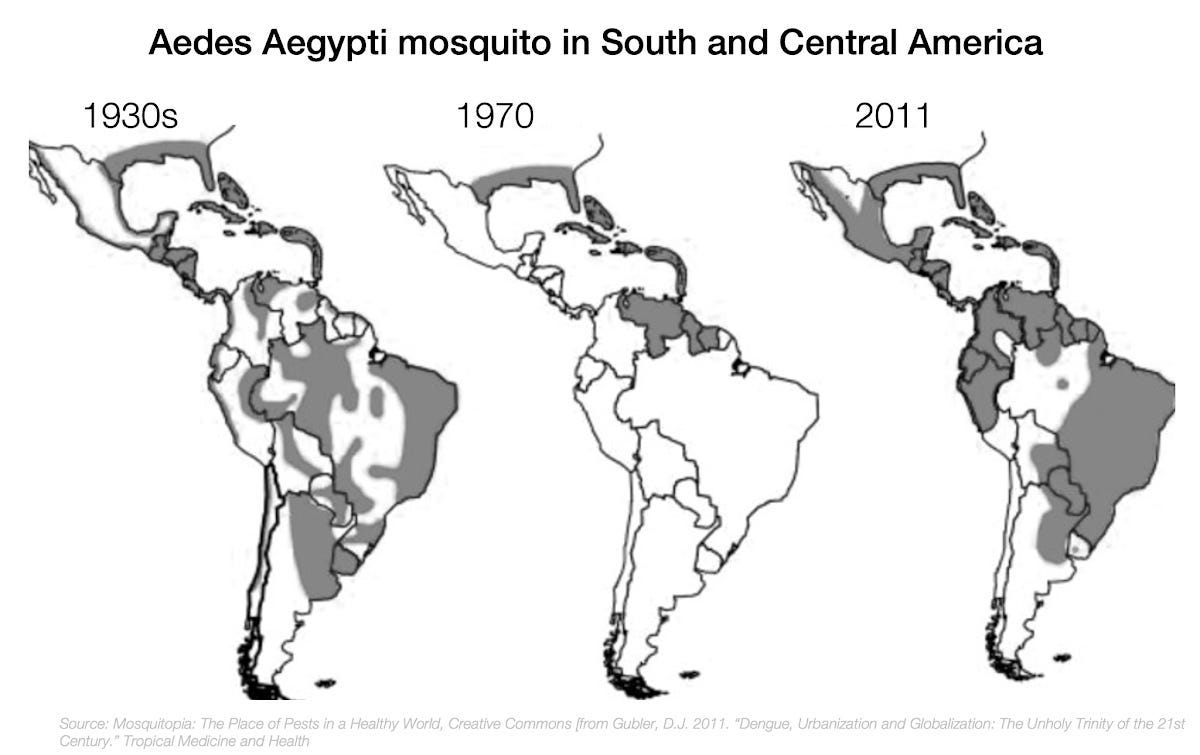
As we explained in the previous article, this was due to a bureaucracy of weekly home inspections, plus some insecticides that were either very toxic or too short-lived.2 Crucially, a third of the budget went to inspecting the inspectors.
Better Insecticides
During WW2, we found a better insecticide DDT.3 It lasted months and was not very toxic to humans, so inspectors didn’t need to visit their areas every week anymore. Once every few months was enough, bringing costs down. That’s how we eradicated Aedes Aegypti in the 1960s.4

Why Did It Fail?
Eventually, South America got reinfected because:
As diseases disappeared, it was hard to justify the continued surveillance politically. Budgets disappeared.
It was discovered that DDT accumulated in the environment, and could become toxic to some other species.
Not all countries in America eradicated mosquitoes—notably, the US—so eventually South America got reinfected.
South America’s urban population exploded, and with it, mosquito hosts and breeding grounds.
And above all, resistance.
Arms Race
We used these techniques around the world. Some mosquitoes developed resistance to DDT, so we created other chlorine-based insecticides. Mosquitoes developed resistance against them even faster, so we came up with organophosphates,5 then carbamates (both of which turned out to be even more toxic than DDT), then synthetic pyrethroids6: They are also naturally not very toxic to mammals, so they were better. That’s what we’ve been using on bed nets to fight malaria for decades now.
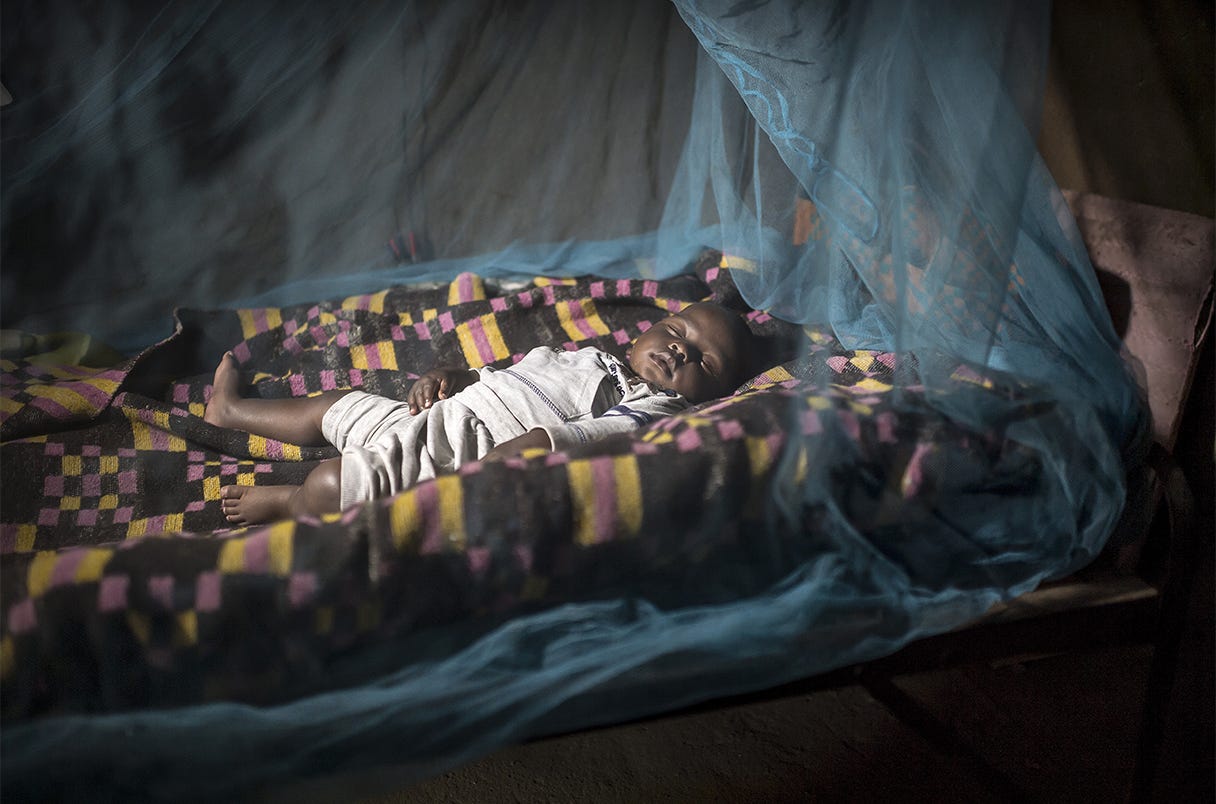
That’s how we achieved this:
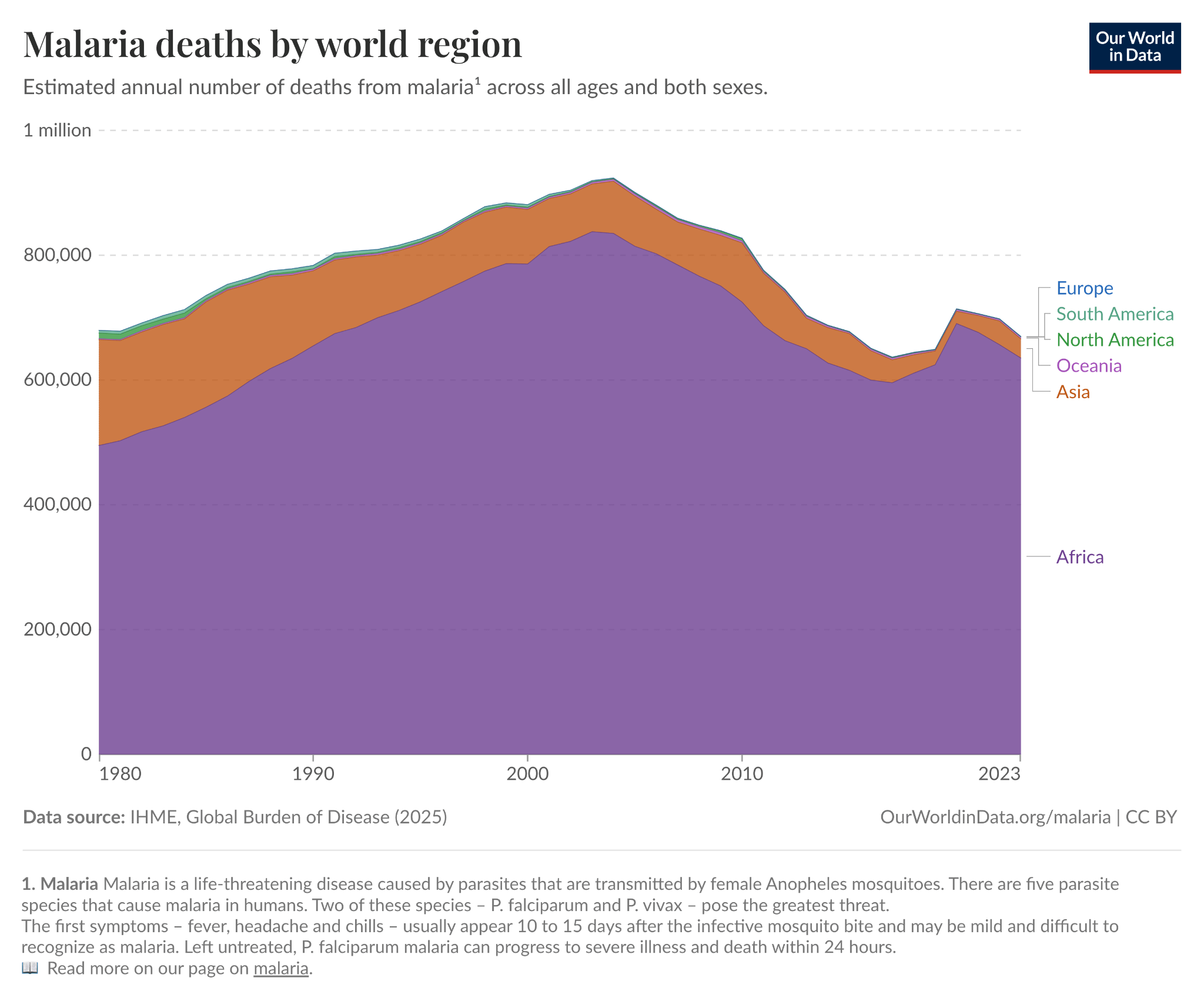
Despite a growing population in Africa, we were able to shrink malaria deaths… Until recently. You can imagine why.7
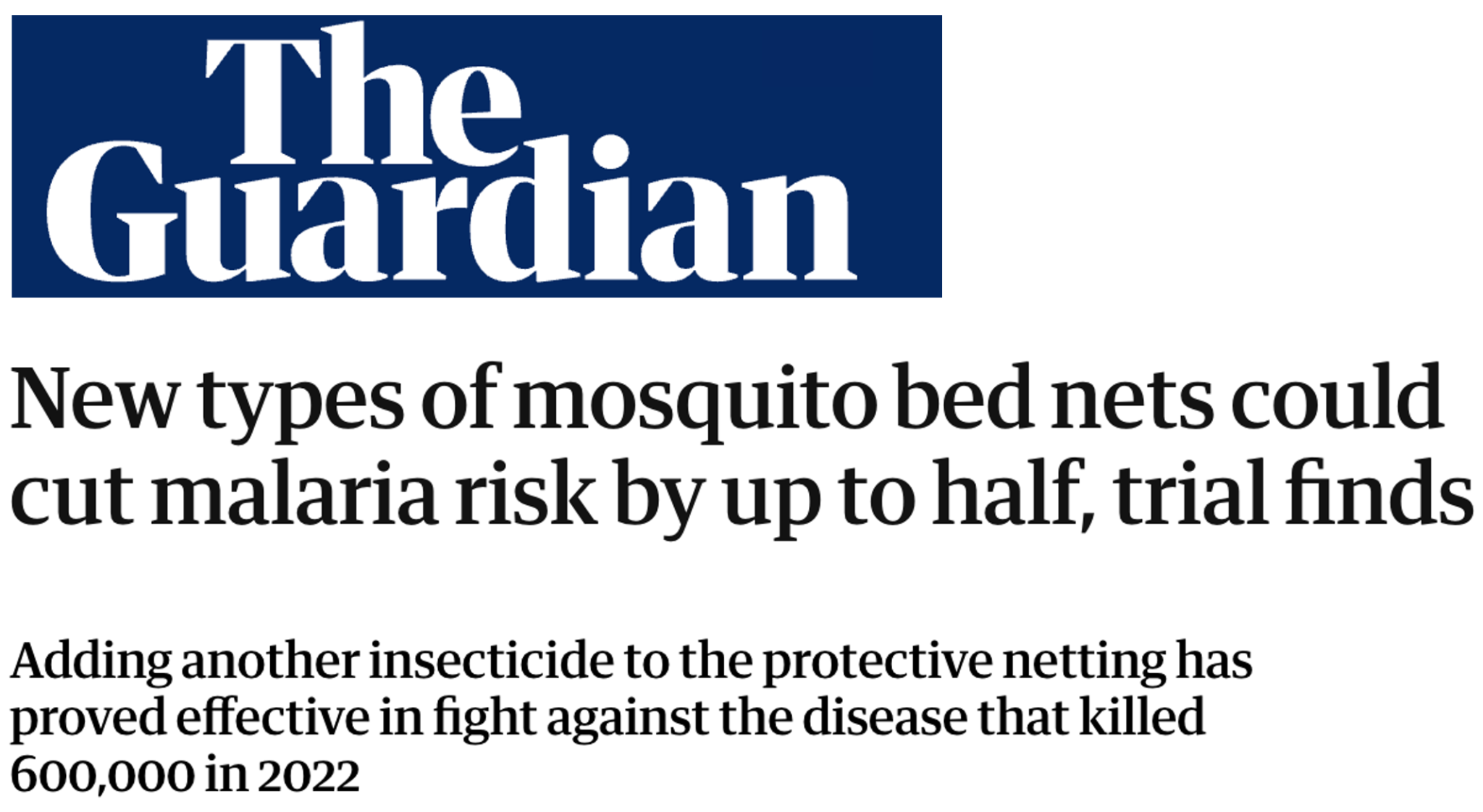
Yes, more resistance, so we need more insecticides, in a neverending arms race. We need to break this vicious cycle. How?
The key reason why it’s so hard to eradicate mosquitoes is that the more you kill:
The more they develop resistance
The harder it is to find the remaining few. For example, you might eliminate buckets of stagnant water, but what about the water in narrow gutters? What about the water accumulated in some old tire thrown in the forest?
So the challenge of anti-mosquito scientists today is: How do we come up with strategies that find and kill every single individual before they develop resistance? And for that, they have one key insight.
The best way to find and kill mosquitoes quickly is to recruit other mosquitoes.
The top areas of mosquito annihilation research all use that insight.
Sterile Mates
Male and female mosquitoes find each other, so if you release a sterile mosquito, it will find a partner, mate, and not have offspring.
So scientists release sterile mosquitoes, but only males, so they can compete with wild males in mating with wild females, who usually only mate once.
First, they breed mosquitoes in captivity, which is pretty easy: One female mosquito can lay on average 500 eggs.8 That can mean 125,000 descendants in two generations, and about 31 million in three.
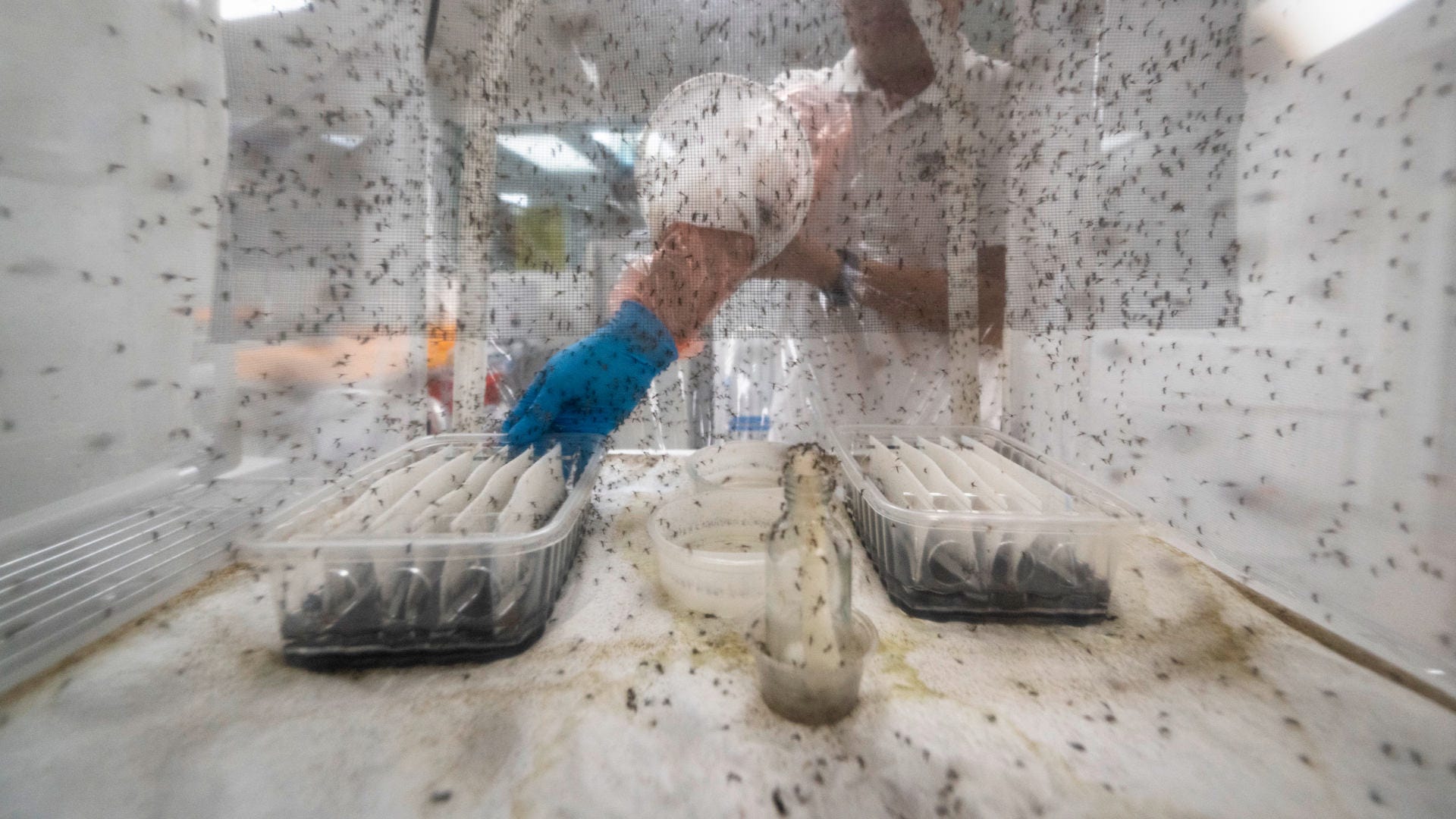
Then, they extract most of the males,9 sterilize them, for example with radiation or chemical castration, and then release them. They did this for example in El Salvador in the 1970s, and they reduced the population of mosquitoes around a lake by 99%. Of course, the population went back to normal within four months of the program stopping.10
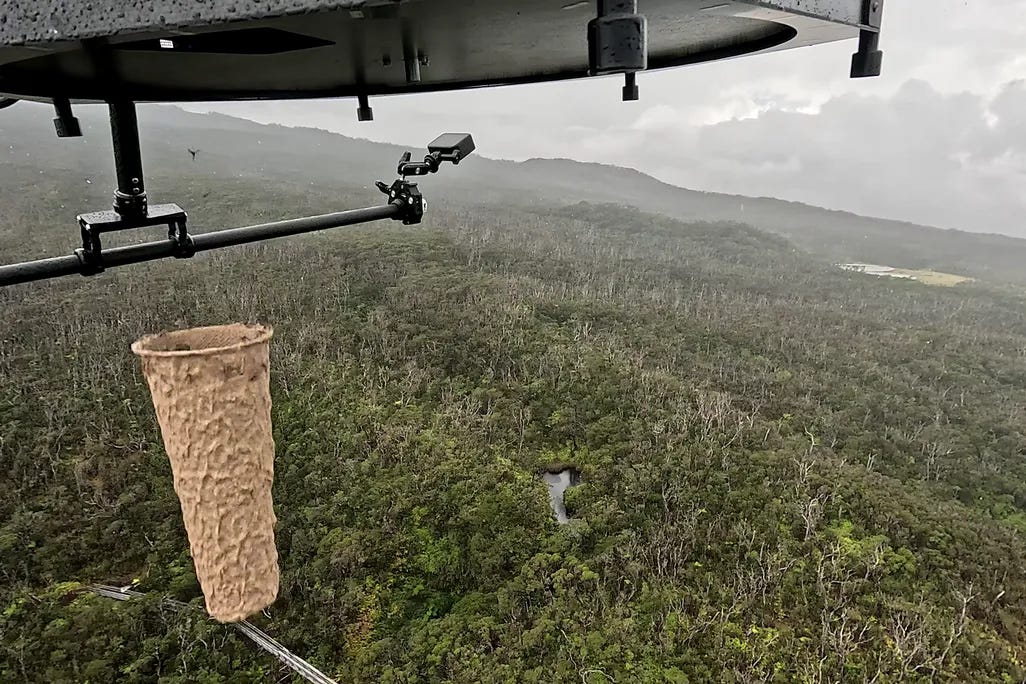
This strategy has another advantage: It’s reasonably easy. Yes, you have to produce the mosquitoes which is work, but they reproduce alright. Then, just go to a bunch of places and release the mosquitoes. You can even use drones now to make it easier.
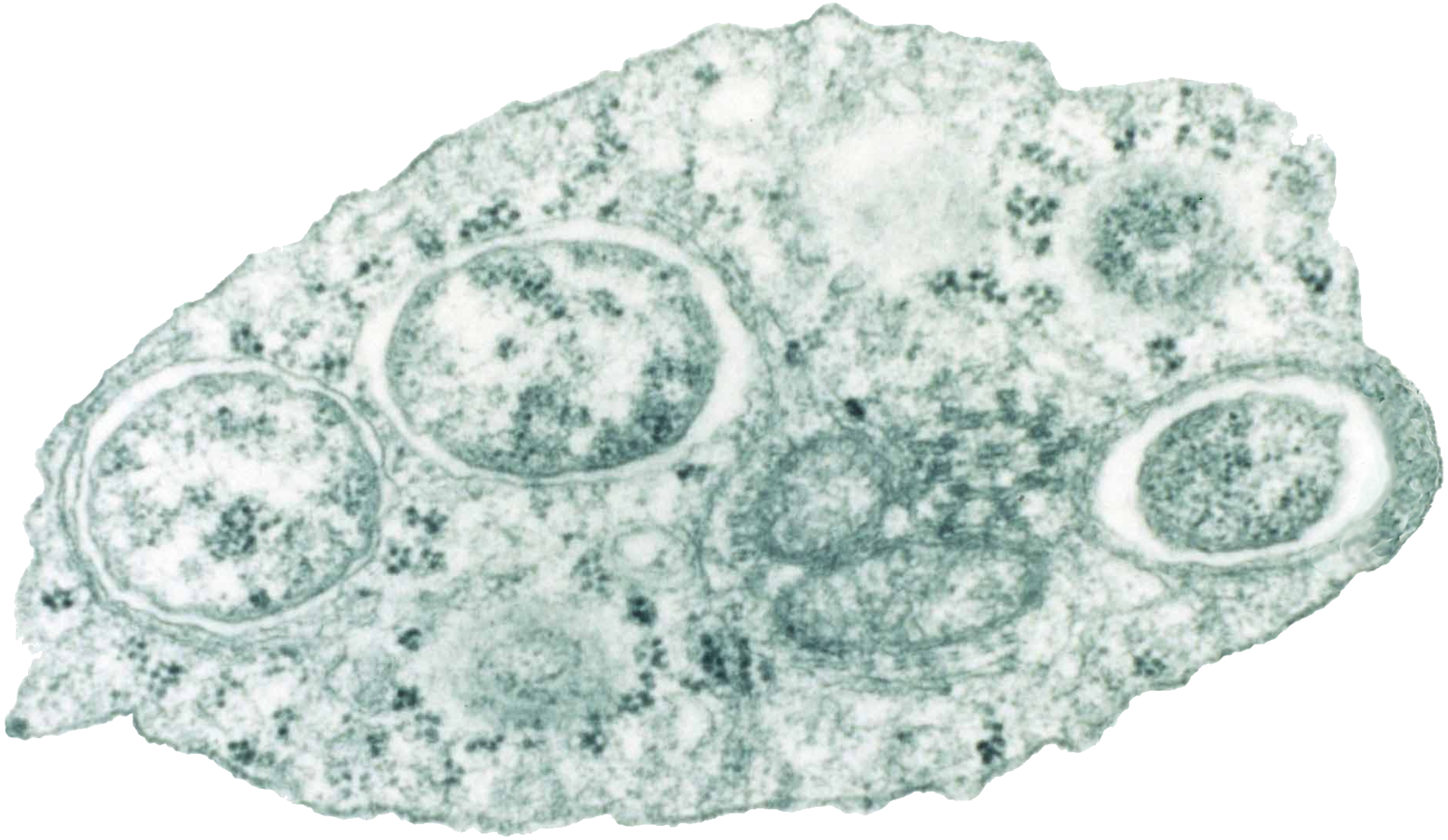
Another approach is through biological infertility, with the Wolbachia bacteria: You infect all the males, who will mate with an uninfected female, but their eggs won’t hatch.
Catching Female Stowaways
That’s why separating males and females is so important, but it’s very hard: If you’re releasing 10M mosquitoes and 0.1% are females, that’s still 10k females. No bueno. To avoid that, we use filters, like the fact that male pupae are a bit smaller, or hatch a bit earlier. This is an active area of research, and a paper from last year managed to reduce female contamination by 30x.
Radiation + Wolbachia
But a few females is still bad, so scientists treat mosquitoes with both Wolbachia and radiation:
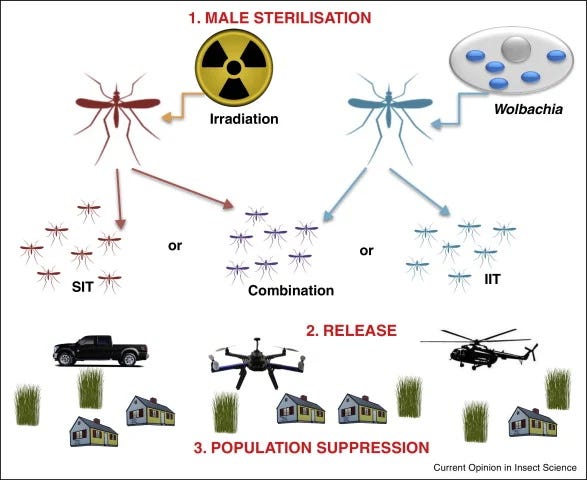
The Wolbachia makes the males infertile.
But there are still a few females.
So we radiate them all, making the females infertile and the males doubly infertile
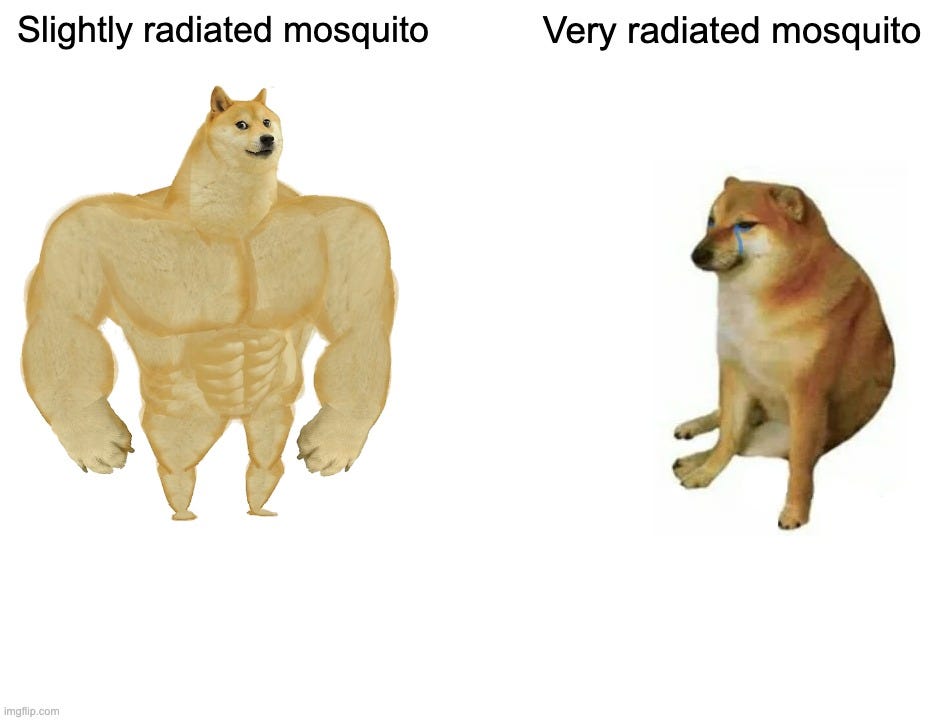
The benefit of doing this instead of just radiating is that we can radiate the males less, which is important because radiation weakens male mosquitoes and makes them less attractive. Adding Wolbachia means less radiation, male mosquitoes will be strong, and will go on and successfully mate with females in the wild.
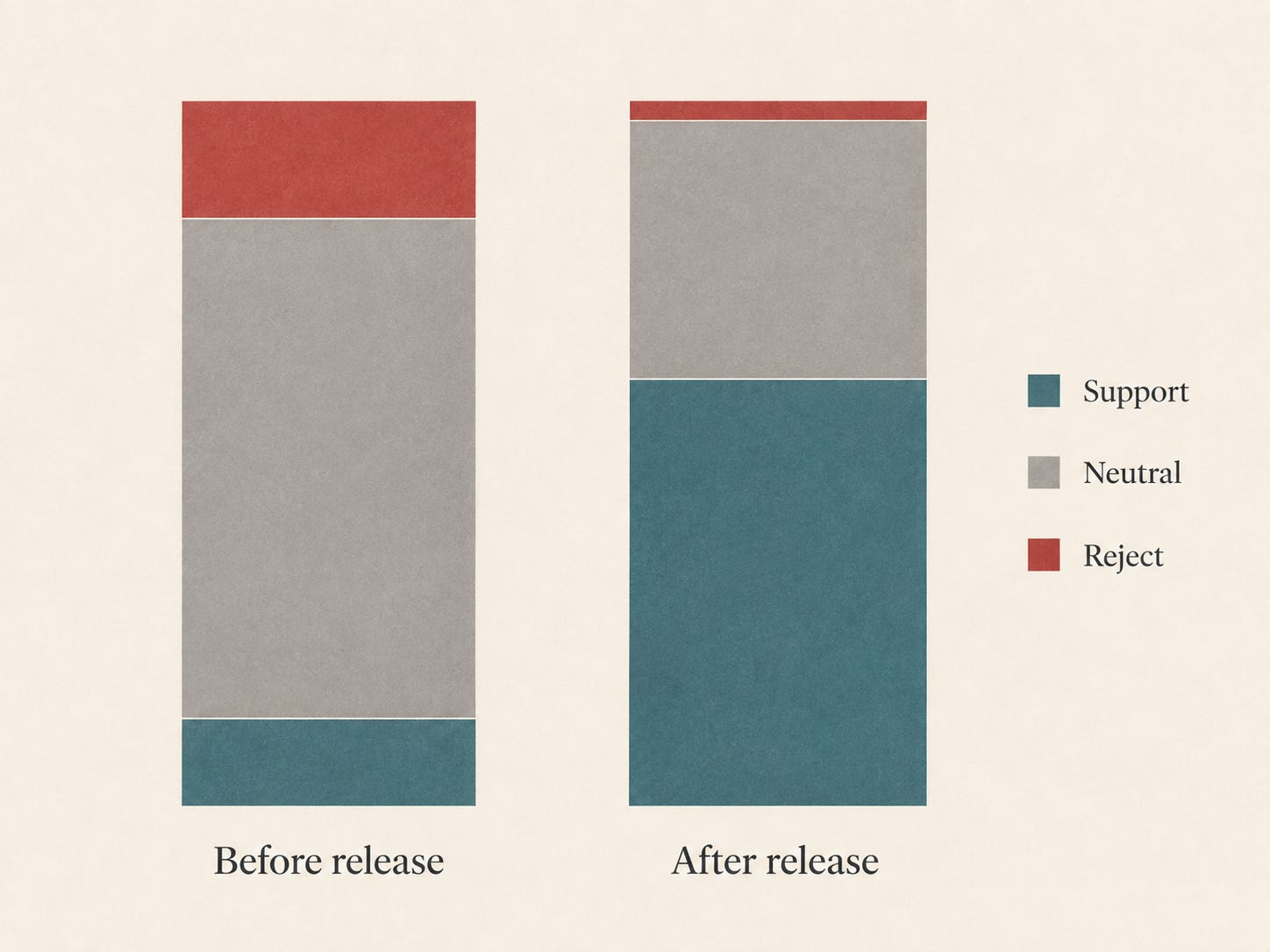
These techniques (referred to as IIT-SIT) have achieved near elimination in the wild.

The popularity for this intervention among the population exploded after its success.
This is what Singapore has been doing across the country since 2016, with incredible results:11
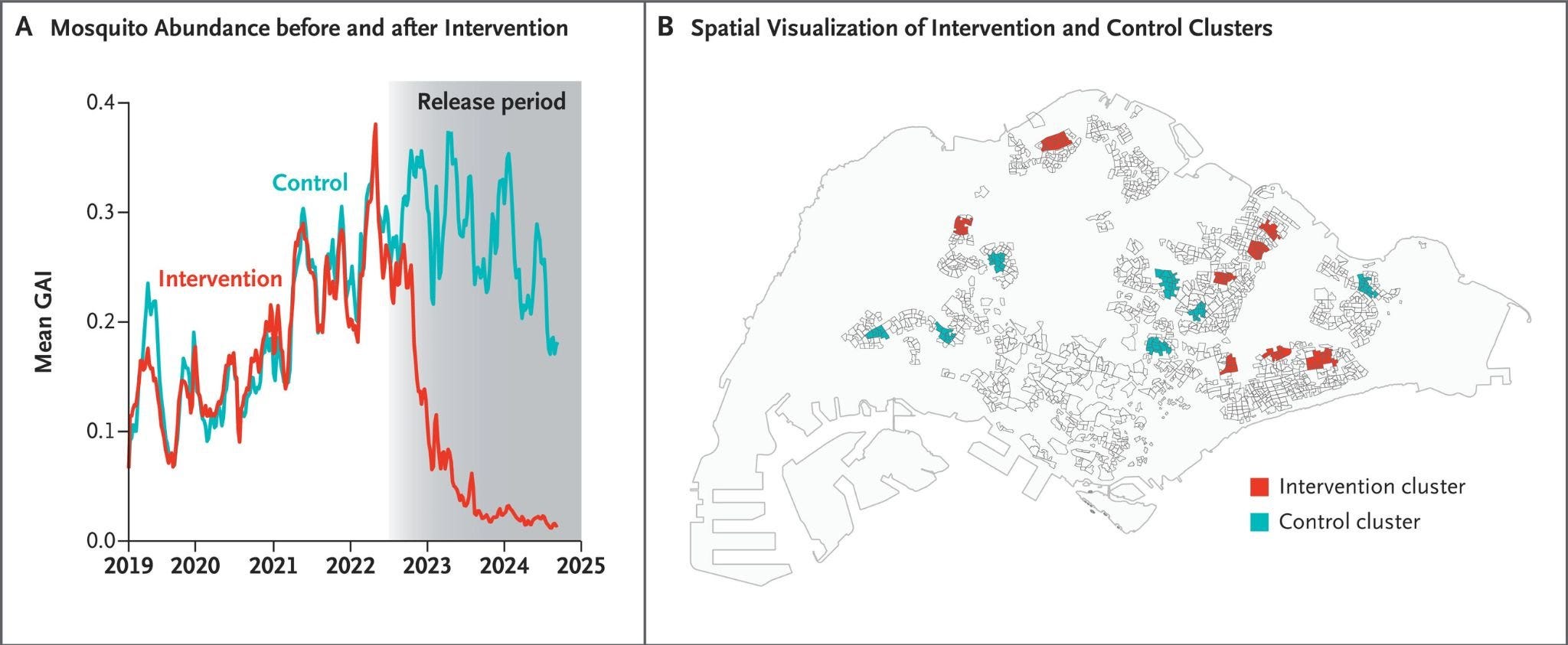
There’s a problem with this approach, though: You need to keep adding mosquitoes basically forever, because the mosquitoes you release and their partners don’t have offspring, but mosquitoes from elsewhere do, and they repopulate the areas.
Is there a way you don’t need to add mosquitoes all the time? That’s what genetic engineers have been considering.
Weapons of Mosquito Destruction
First, we genetically modified mosquitoes so that their offspring don't survive, a bit like previous approaches, with similarly good results.
But then we wondered: What if we genetically modify male mosquitoes so that they can normally mate and have offspring, but the females die before they can reproduce? Only the males survive, who will go on to carry their genes onto the next generation. This is better than the previous approach, right? Before, you killed all offspring. Now, all the surviving males join the frey to have only male children. We eliminate all females.
Unfortunately, it’s not yet the solution. We must continue releasing these mosquitoes in the wild, or else their germ line eventually disappears, replaced by males who can have fully fertile offspring.
This is where the next idea is diabolically good.
Gene Drive
One day in 2003, Austin Burt thought: What if we created a selfish gene that hijacked its hosts to spread aggressively, all while making them less fertile? In a few generations, all offspring could have the gene, just as they continue dwindling until they all disappear.
The technology to make his dream come true would only appear a decade later, with CRISPR Cas9. Immediately, scientists started to think about how they could use it to eradicate mosquitoes. In 2018, they succeeded in completely eliminating the mosquitoes in two cages, just by seeding some of the males with their genetic modification.
How do you do that though? How do you spread an infertile gene to the entire population? The fertility should disappear. That’s the crazy genius: A selfish gene takes over the offspring.
Let’s take that gene G, and the natural version is N.
A modified male with the G gene in both chromosomes will be called G/G. It’s released in the wild, and finds all N/N females.
Their offspring will be G/N, of course: G from the father, N from the mother. Except this is the selfish gene’s trick: It changes the germline! The eggs and sperm of these mosquitoes change the N for a G, so that they can only contribute G to their offspring!
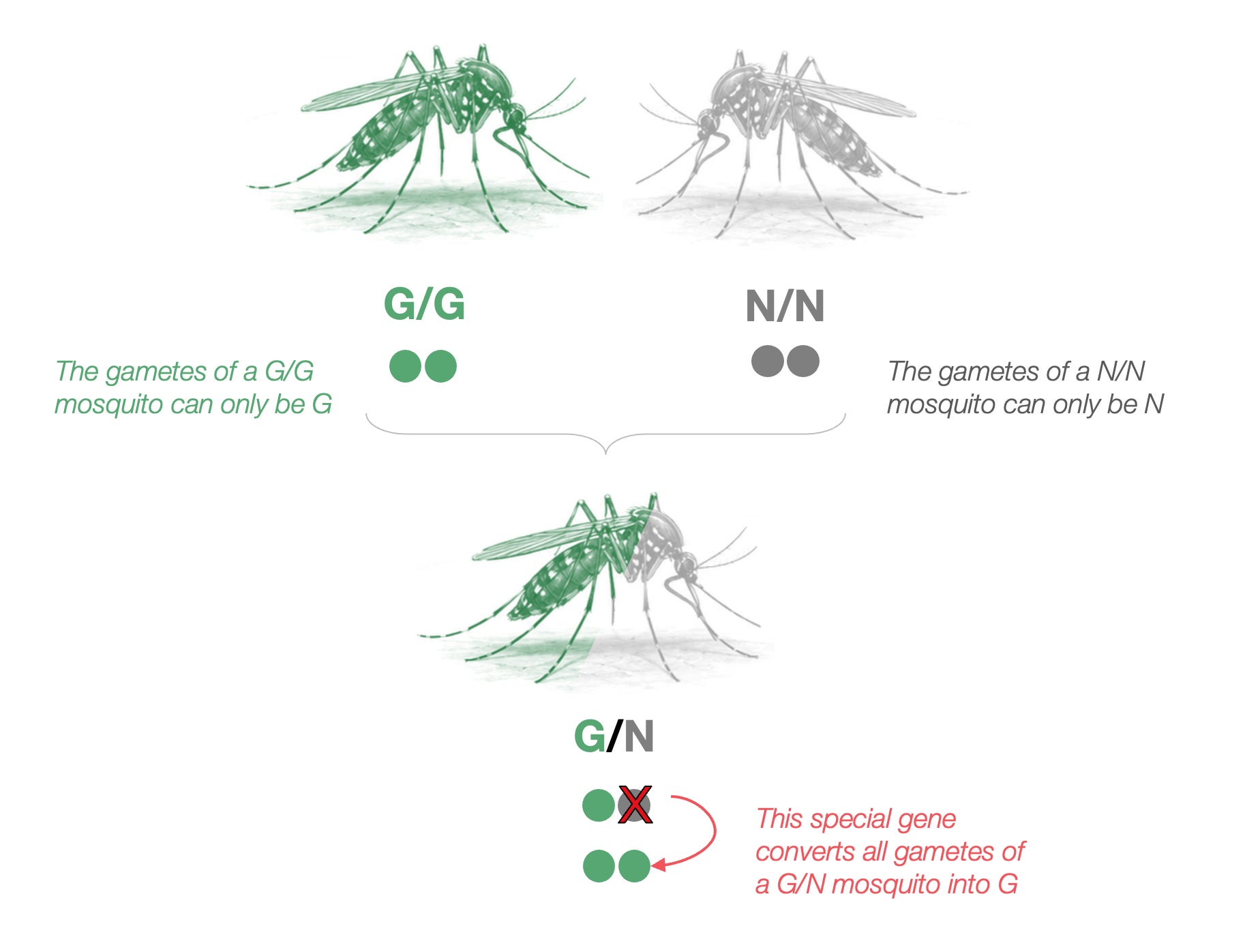
Early on, nothing happens: The G/G and G/N always contribute G genes, so as long as they mate with N/N mosquitoes, the descendants will all have G/N genes, and continue reproducing.
But what happens when this G gene has spread enough in the population that a G/N meets another G/N? They both only produce G gametes, so the offspring will be fully G/G. And that makes the female infertile, but not the male!
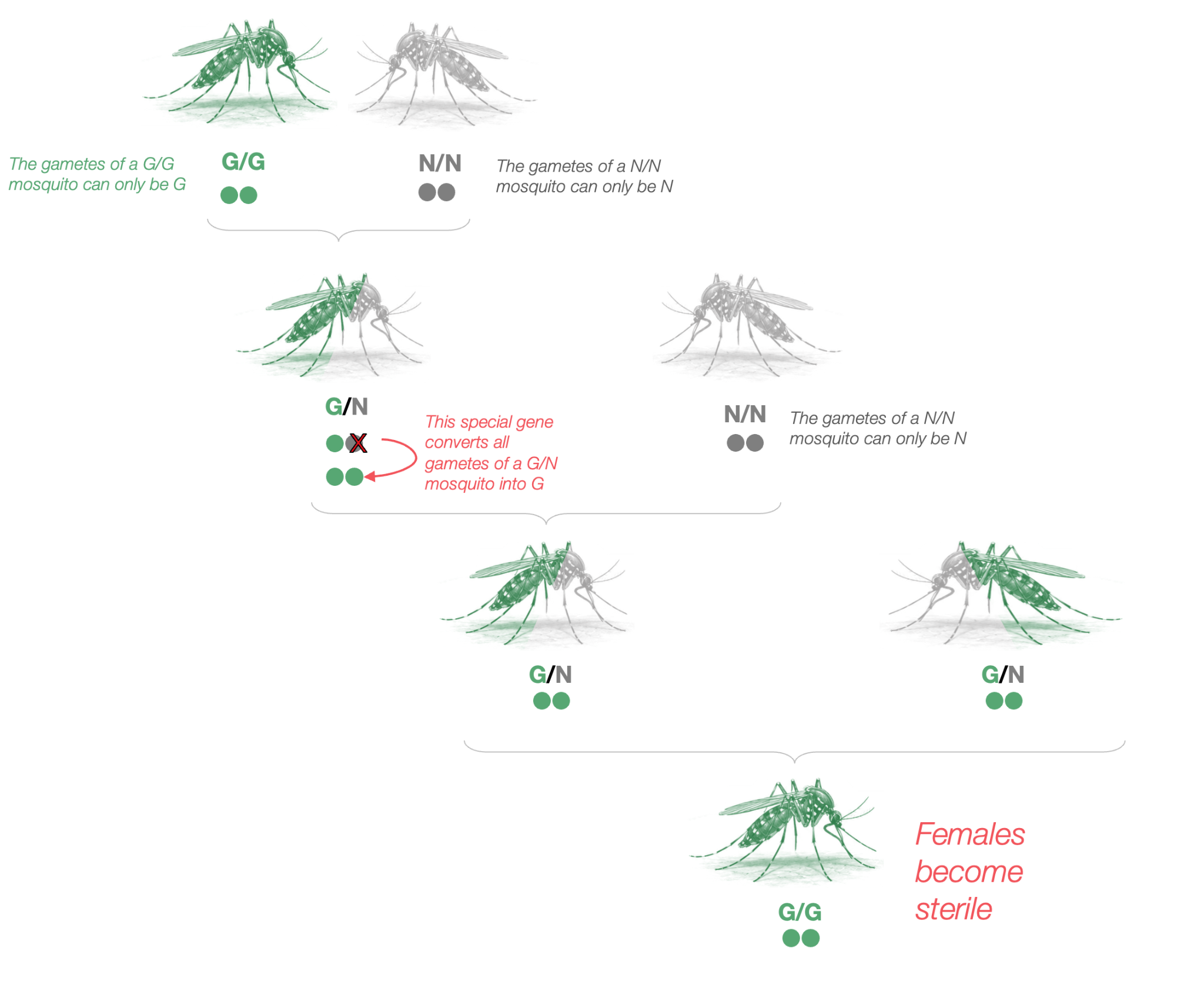
So the female stops procreating, while the male continues spreading the G gene! Eventually all the population has at least one G gene, because otherwise it means every single one of their ancestors must be N/N: Very unlikely! When this G gene is so widespread, eventually every mosquito will carry it, and no female will reproduce, collapsing the population.
Only Males
Another idea (from 2020) that might be easier to understand is a twist on this: Release males with a mutation that can only have male offspring.12
Imagine: You release 100 genetically modified males that mate with 100 wild females. Instead of having, on average, 100 surviving males and 100 surviving females, they have 200 surviving males! In the next generation, there will be 400 males, then 800… Until they overwhelm the population of wild males, and there are no more mosquitoes left. In labs, they tested this, and they found that introducing just 2.5% males like this collapsed the population in 10-14 generations.
How do they make sure there’s no resistance that emerges against this? Because in just a few generations all mosquitoes are wiped out, and because they combined this genetic change with the previous one—or several at once. It’s very unlikely that within a few generations, both genetic changes can be reversed in the same individuals.
The Caged Miracle
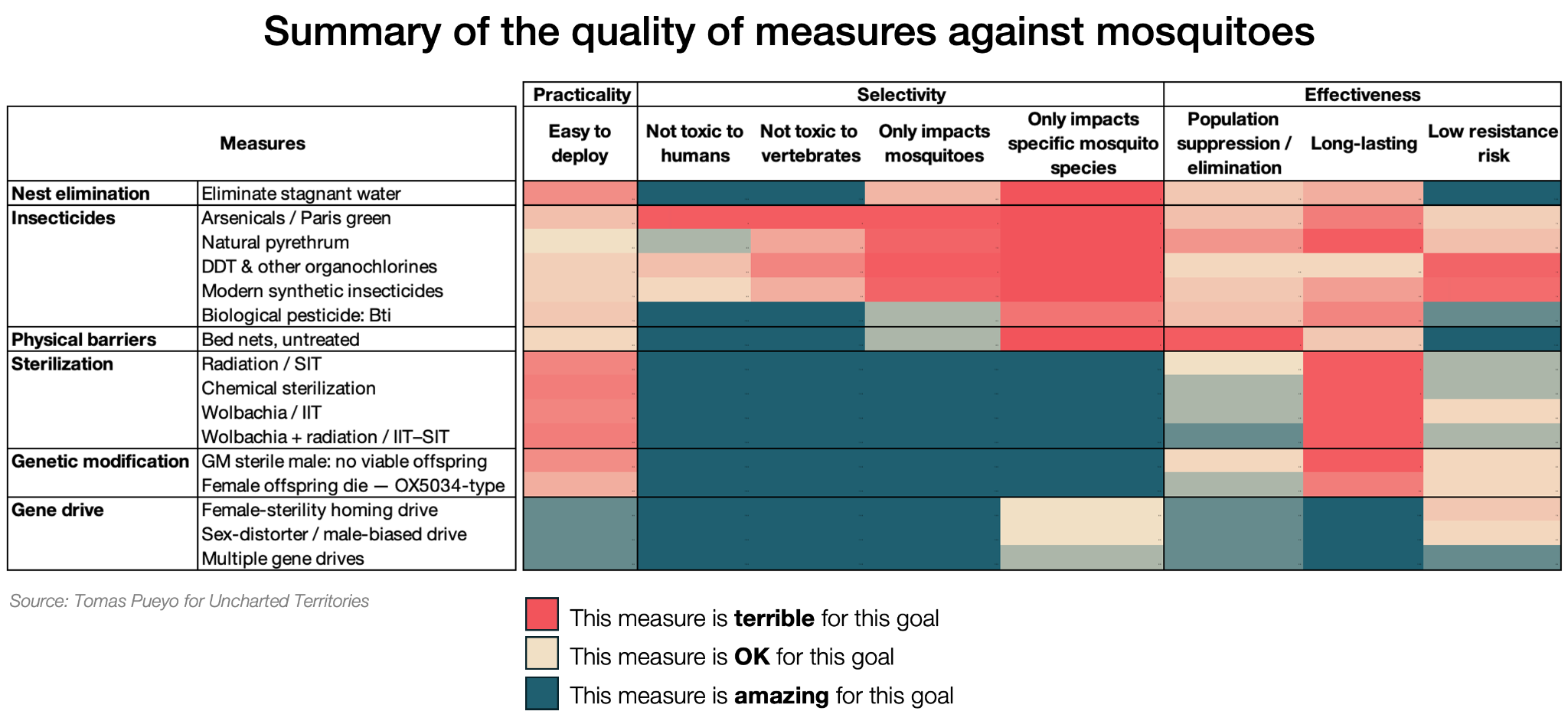
So we have it! Finally! After nearly 150 years of fighting against mosquitoes, we have a solution that is easy to dispense, only toxic to the one species we want to eradicate, can be forever, and wouldn’t create resistance! So what happened when we tested this?
We haven’t.
Surely, this is not possible. We have the holy grail that could eradicate malaria, yellow fever, dengue, and annoying mosquito bites, and we’ve decided not to release it?? We prefer that hundreds of millions of people are infected every year, and hundreds of thousands of toddlers and babies die?? No way!!
And yet.
Target Malaria says the first tests will be carried out in 2030. In other words, billions will be infected and millions will die because we will wait a few years.
Why?
Because we’re afraid the solution would be too good.
If this succeeds as we expect it, we could truly, irreversibly, erase a species from the face of the Earth. It’s not the first time we’ve done it to animals, nor the first time we’ve deliberately eliminated a parasite (we’ve done it with smallpox, rinderpest, trying wth polio). But it would be the first time we do it deliberately to an animal. Imagine we release this in Africa against the Anopheles Gambiae, to fight malaria. It could spread across the continent, then across continents, and there would not be any more anywhere. If there are unintended consequences, it would be too late.
Or at least, that’s the argument. Honestly, I’m not very moved:
As we said, there are thousands of other mosquito species. This would only kill one,13 as this is genetically targeted and can’t jump around.
This one kills a lot.
It’s a species focused on humans, so its habitats are human habitats, not nature. We don’t need them in our habitats.
We’ve looked into this and they’re irrelevant to these habitats: No flower depends on them, no predator, no symbiosis with other animals… Nothing
We can reverse it!
We can wait for all mosquitoes to die down, and when none are left, if anything bad happens, we can always reinsert a few million that we’ve kept in labs.
We’ve genetically engineered a way to revert these changes if we need to!
Another argument is: “A single country could decide to eliminate mosquitoes, and they would disappear in other countries that didn’t decide to do it.” Yes, what a horror that my neighbor decides to eliminate malaria, dengue, and mosquito bites for me. I would hate him. If we can revert this anyway, who cares?
There’s another argument I’m much more open to. What happens if mosquitoes do develop resistance? A paper from two months ago simulated billions of potential mutations and noticed that some could emerge that would stop this gene and eventually prevail.14 So they proposed to not change just one gene, but a bunch of them, so that even if one or two fail, the rest can carry through. We will need time to create alternatives, test them all in software, test them with a variety of real-life mosquitoes…
Because that’s the other thing, we probably want to test it in the wild before introducing it everywhere, but we need to be supercareful about where we do that, or the mosquito can escape anyways. So maybe a remote island, making sure nobody goes in or out carrying mosquitoes during the test?15
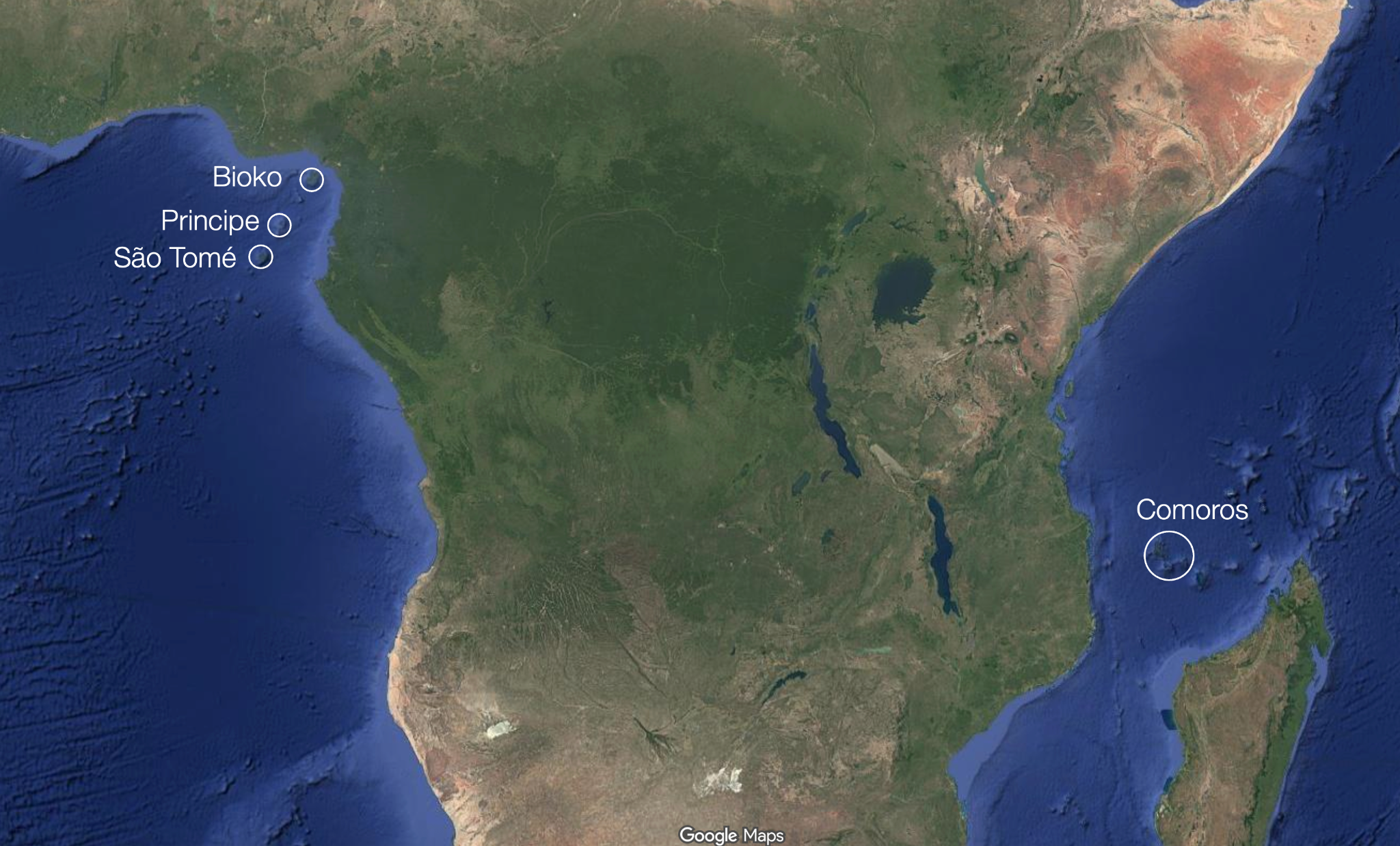
You’d think the approach to this should then be: OK we have this holy grail, let’s test it ASAP! Let’s grab one of these islands and release the engineered mosquitoes there. Then, we can test what share of mosquitoes we catch have the engineered genes over time, see if mosquito populations shrink, see if malaria shrinks, and make sure nothing else bad happens.16 If everything works, great! We should then insert these mosquitoes in other places.
Instead, we have no test programmed! This paper from last year explains why: bureaucracy!
More than a dozen organizations have published testing guidelines for mosquito gene drives. Great! People sure know how to write papers about being careful. But who’s writing about the millions dying and about hurrying to save them? We’ve seen the exact same thing with SO2 injection to cool the Earth: Lots of people have opinions, focused on fear-mongering and on the scary speculative risks that never materialize, while the real people who could benefit from the technology keep suffering. From those trying to test this:17
The first gene drive field trial will be determined by leaders in a country that boldly chooses to be the first. Unfortunately, they are overwhelmed by unclear guidance. Local WHO officers know little about their own agency’s published guidelines for testing genetic technology for malaria, and politicians and regulators struggle to engage with other international agencies that have published guidance. Large international forums and meetings are called to discuss risk and regulation for gene drives, but these are often out of reach for many who should be at the center of these conversations.
So what do they think would unlock this?
A clear message from the WHO that they support this, as well as the biggest donors: the US, the UK, Germany, France, Japan, Canada, and the EU.18
A clear, simple checklist from the WHO for political leaders who want to apply this. I’ve put together a draft here.
Stop meetings and discussions, and get national regulators to support this, ideally in the candidate countries already identified: Comoros, São Tomé e Príncipe, and Equatorial Guinea.
Releasing our Caged Miracle
We spend $4B on fighting malaria every year, and yet 600k people die. Effective Altruists have asserted for years that the best way to spend your money is on malaria mosquito nets. Just two weeks ago, GiveWell donated $276M for mosquito nets, its largest grant ever. That is probably not the best use of anybody’s time or money anymore.
We have at our fingertips the means to end this scourge—malaria, and human-biting mosquitoes too if we want—forever. It just requires one thing: Governments and institutions like the WHO must realize what they have in their hands, stop stalling, and push for a real-life test of these gene drives in isolated islands. But most of them don’t know. You can help them by letting them know: Forward this article to them, to people who might know them, or to anybody who might be interested, so they talk about it.
This can literally avoid billions of infections and millions of lives.
A mix was concocted with carbolic acid, rosin, and caustic soda in Panama. Later on, after WW1, the US health service systematically tested products to kill insects, and one of the best ones turned out to be Paris green. Conceived as a paint color, it turned out to be super toxic because of its high arsenic content. It was first used as an insecticide against potato beetles in the US in the 1800s, and enshrined as mosquito killer in the 1920s. You didn’t need to spread it across a pond, just where larvae feed, and within 24h they were dead with just a 1% concentration dust. Over time, more variants of arsenic were discovered and used as insecticides.
Inspectors would be given an area, and each week they’d inspect every water container: cisterns, barrels, jars, flower pots, saucers, bottles, cans, tanks, roof gutters, tires, rubbish, cavities… Anything that would accumulate water was emptied, covered, or received a film of oil or arsenic on top, so that larvae would suffocate. They also used flower-based insecticides indoors.
We knew it already but hadn’t realized what a good insecticide it was.
All of this was mostly done in urban areas, because human-biting mosquitoes stay near humans, so there was no need to invest huge sums in remote areas. Visiting them occasionally was enough.
Malathion, naled, temephos. These break down in the environment (yay!), but are more toxic to humans and disappear very fast, so they are much more expensive to use. Mosquitoes developed resistance to them, too.
Permethrin, deltamethrin, cypermethrin, lambda-cyhalothrin… They were just like the insecticides from the chrysanthemum flower, but modified to last a bit longer in the environment. But not forever: Nature had already evolved ways to decompose them.
Actually, ⅔ of the extra deaths were due to COVID pandemic disruptions, but resistance was growing.
Probably more in captivity as they don’t have predators or humans trying to kill them
They let the females continue reproducing with those that are left. Males can mate with several females, so you leave a few and they’ll mate with the females.
Something similar happened in India: Mosquitoes from neighboring areas would continue invading and replenishing dwindling populations.
It makes sense that this is so successful: Imagine there are 10M mosquitoes in an area (5M males, 5M females). In the first year, you release 10M additional male mosquitoes, who compete with 5M males. Two thirds of your females will mate with infertile mosquitoes and won’t reproduce. In the next generation, you have just 1.7M wild females and 1.7M wild males, and throw again 10M infertile males. Now the share of fertile males is much smaller than before. Keep doing that for a few years, and there are almost no mosquitoes left.
It destroys the sperm containing the X chromosome, so these male mosquitoes only have Y-chromosome sperm, and all their offspring is male.
It might kill more than one, because some mosquitoes mate with adjacent species, but in general these are similarly bad for us. For example, Anopheles Gambiae reproduces with Anopheles Coluzzii and Anopheles Arabiensis, but all three bite humans and cause malaria, so we should get rid of them all.
The hope was not that the engineered would never change. All genes change. The hope was that any mutation would continue making females infertile, which is what had been noticed in cages. But the computer suggested that, given the massive populations of mosquitoes in the wild, some could indeed become resistant.
The test proposed in that paper is for a gene drive to eliminate malaria, not mosquitoes, which makes it even more conservative. It targets Anopheles Coluzzii
No other mosquito species are impacted, ecological collapse, bad mutations, etc.
Heavily edited for succinctness and readability
Specifically the US’s State Department, UK’s Foreign, Commonwealth & Development Office (FCDO), France’s Ministry for Europe and Foreign Affairs, Germany’s ederal Ministry for Economic Cooperation and Development (BMZ), Japan’s Ministry of Foreign Affairs (MOFA) and JICA, Global Affairs Canada, DG INTPA, Global Fund, and the Gates Foundation.
Tomas, you may have forgot the human parameter: in order to release the modified moskitoes in the nature, "somebody" has to sign and decide. At the end, if it happens to be a mistake and if it makes more deads than without doing it, this guy may have to "pay" for his error (jail, etc.): the point is that nobody wants to be this guy... We see it in many other domains (easing any kind of rule in aviation domain, or equivalent) where constraints remain only because no one want to be the one that would be on the photo if something bad happens...
As one of those people that mosquitoes seem to prefer 100X more than other people, I'm all for getting rid of them.