

This is the first premium article from the Israeli-Palestinian conflict. I will try to keep sending a few of these in the coming weeks while also publishing the most important articles for free. Thank you for your support! None of this would be possible without you.
Last week we had a deep dive into Gaza, and why its combination with Hamas has made it into a trap. But Palestine is not just Gaza, right? We should consider Gaza and the West Bank together, shouldn’t we?
Well let’s travel from Gaza to the West Bank now.
This Google Earth trip goes from Gaza to Judea, the southern part of the West Bank. Notice the border fence between Israel and Palestine.
This one is a similar take, but it’s a drone view. More realistic. It goes from the coast of Israel to Samaria, in the northern West Bank:
Two Different Countries
Gaza is urban, the West Bank is rural.1
Gaza is flat, the West Bank is hilly.
Gaza is small, the West Bank is big.
Gaza is compact, the West Bank is spread out.
Gaza is coastal, the West Bank is land-locked.
Whereas the geography of Gaza has everything it takes to become a rich cosmopolitan seaside city-state focused on trade and dependent on international markets, the West Bank has self-sufficient farmland, and its destiny is to stay rural. Its hills make infrastructure much more expensive and separate it from the broader world. It doesn’t have readily available access to a body of water, and rains are not sufficient for farmland irrigation, so it depends on Israel for that.
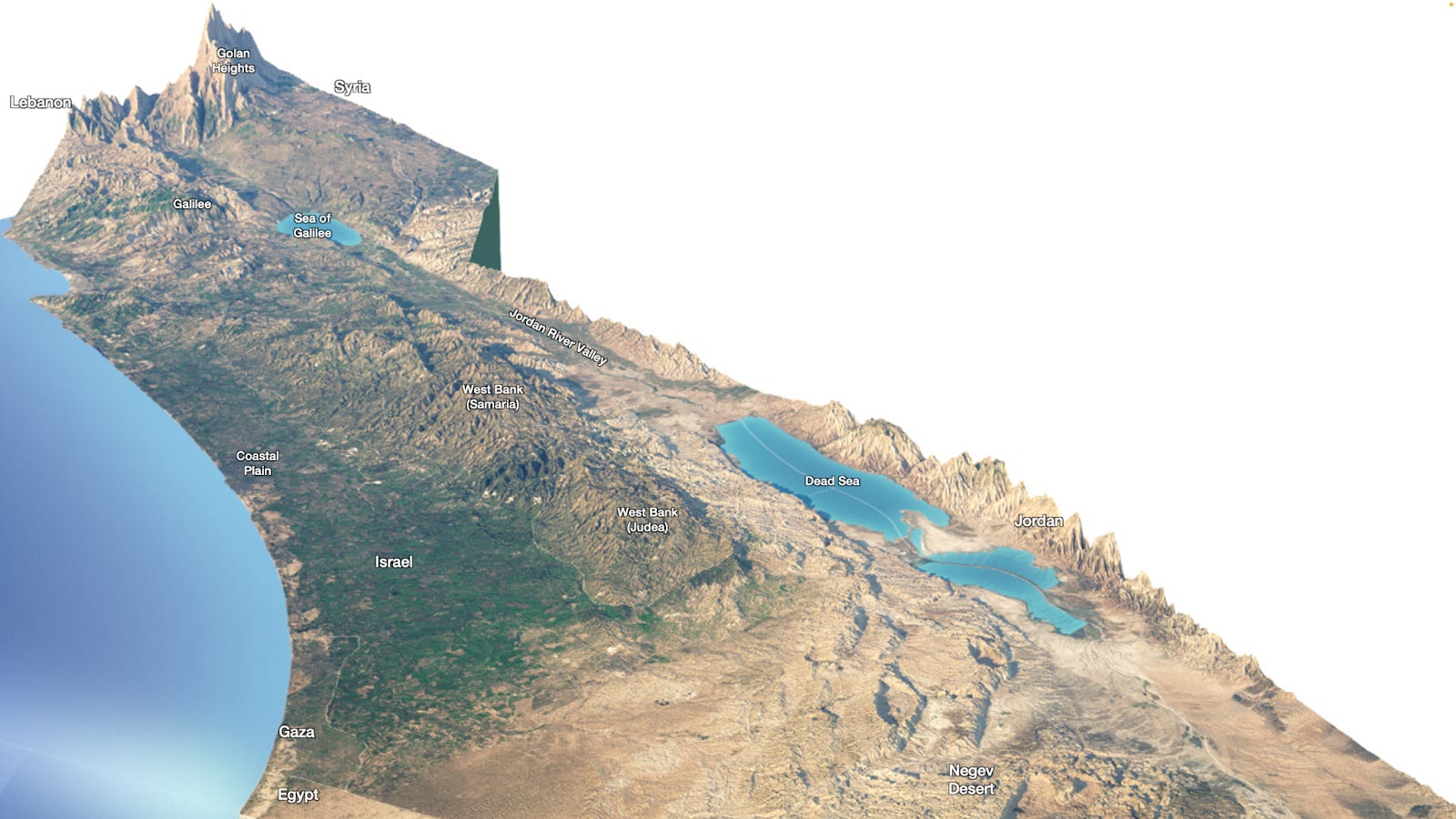

The West Bank’s situation allows farming self-sufficiency, but it also isolates it, so the West Bank is economically dependent on its richer neighbors, Israel and Jordan. Jordan is farther away across the Dead Sea and Jordan Valley, and is landlocked and poorer than Israel. Its natural economic partner is thus Israel. And since the West Bank is so hilly, it’s destined to be poorer than Israel. As a poorer but connected partner, the West Bank will economically depend on Israel.
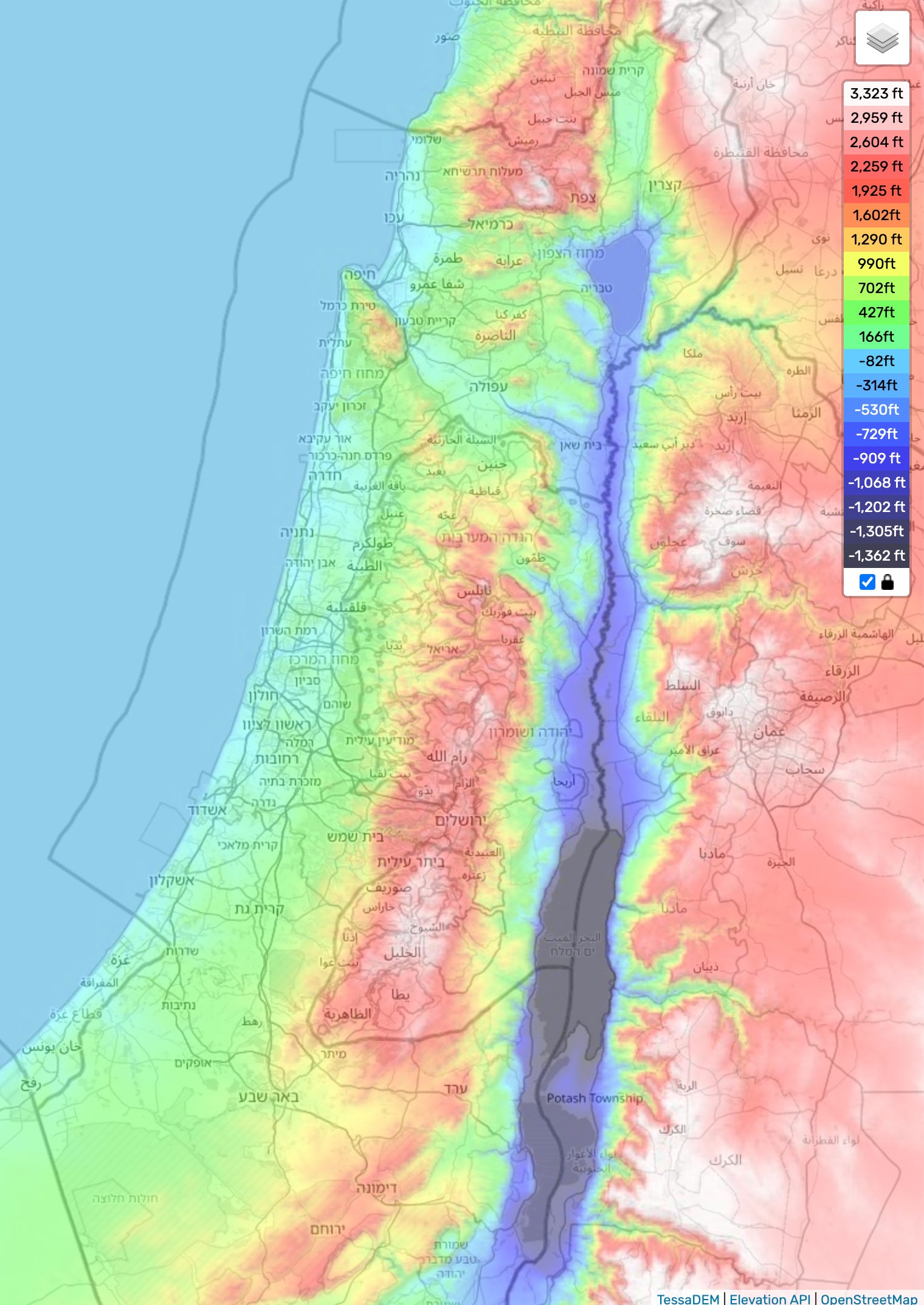
I’m going to assume none of this is a coincidence. First, there’s a reason all of this region was a single one for thousands of years: Its different regions are inextricably connected.
When Jews were buying up land in this part of the Ottoman Empire and settling it in the early 20th century, it would have been logical to buy the more fertile, flat and coastal land.2 They did not focus on the mountainous areas. Since the proposed partitions followed settling patterns, the majority Arab regions were relegated to the more mountainous, less valuable land, and that’s what became the West Bank. It was also easier to defend than the plains, so withdrawing there in the war of 1948 would have made sense. In other words, there might be some underlying forces that pushed local Arabs into this situation of poorer dependency
Could we connect Gaza and the West Bank? Sure we could. At its narrowest point, the distance between Gaza and the West Bank is about 35 km (21 mi). In the past, Israelis have been open to having a pass there, but they’ve said they wanted to control it for security reasons. f Israelis did not want to have an open pass through their territory for safety, maybe they could help build a tunnel? The distance is shorter than the tunnel under the English Channel (50 km, 31 mi). And Israel’s Prime Minister Netanyahu has proven an interest for tunnels.
But would Palestinians in the West Bank want that?
There are at least 3M Palestinians in the West Bank and 2M in Gaza.3 Although Gaza is smaller, it’s the biggest city by far. It would become the capital.4 Since it’s so far removed from the reality of the West Bank, it would be more concerned with tourism, trade, and services than rural policies. Since its main partners would be global, it would put less weight on the relationship with Israel and Jordan, whereas for the West Bank these are all that matters. The West Bank would become the poorer, forgotten land.
If you reckon this is a trivial difference, consider that this is very much the dynamic between the Democratic and Republican parties in the US today: Democrats are city dwellers that don’t care much about the rural life of Republicans, but their differences in life experiences explain the vast majority of their different opinions and voting patterns. Now add to that the huge differences of Gaza and West Bank in flatlands vs hills, being landlocked vs open to the world, and being non-contiguous, and you can get the sense of how different the politics in each side would be.
There are few precedents of non-contiguous countries. One is the US, with Alaska and the rest of the contiguous US. This works fine, mainly because Canada is basically a vassal state of the US.5 When the countries are less friendly, like Pakistan and Bangladesh split by India, things don’t go as well. Bangladesh split off in 1971.6
Gaza is such a dense, compact city that it will always be controlled by one single political entity, which will dictate the path forward. Meanwhile, the West Bank’s bigger size and mountains lead to regionalism, and different areas will react differently to events. There will be less political uniformity. We see it today, with many many factions vying for power, and Fatah having a hard time legitimately representing all West Bankers. For example, the Palestinian Authority, led by Fatah, has lost control of security in swathes of the West Bank to militant groups such as Kata’ib Jenin and the Lions’ Den in Nablus in recent years.
If Gaza and the West Bank were to become a single state, hundreds of thousands of Gazans would likely emigrate into the West Bank because it’s richer.
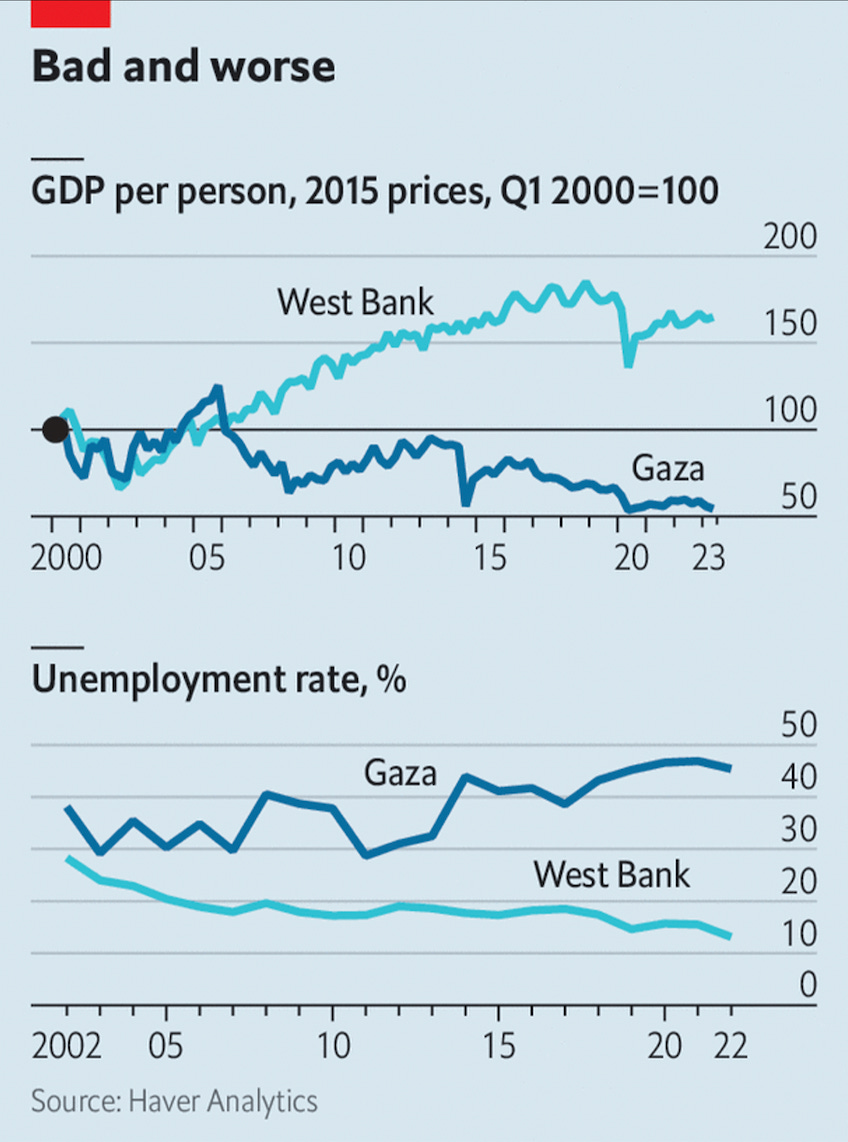
An influx that West Bankers might not welcome. This is not even accounting for the millions who might come from neighboring countries. What would Jordan do with its 2M refugees?7

Another aspect that makes the West Bank different from Gaza is that it’s harder for the West Bank to get weapons or military support from abroad, since it’s land-locked between Israel and Jordan—two hostile countries for security.
Historically and religiously, Gaza has also been less important for Israel. It occupies the land of the Philistines, who were Israel’s main enemy 3,000 years ago. It doesn’t matter for the Israelis who care about the historic Land of Israel. Meanwhile, Judea and Samaria—present-day West Bank—are historically integral parts of ancient Israel from 3,000 years ago, for the geographic reasons we mentioned earlier. As a result, Israel cares more about integrating the West Bank economically—and politically. Indeed, Israel left Gaza voluntarily.
All of these differences between the West Bank and Gaza explain why the West Bank is more coordinated and integrated with Israel, which has resulted in better economic development. Political relationships are a result of that, with Fatah leading in the West Bank and being much more collaborative with Israel than Hamas.
In other words, the West Bank is geographically very different from Gaza. This has made it much less prone to violence with Israel and very integrated economically.
The Three State Solution
Given the massive differences between Gaza and the West Bank, I can’t see how an independent Palestinian state could survive united. A three-state solution seems more feasible.8
This has another advantage: A peace agreement could be signed between Israel and the West Bank, without the cooperation of Hamas, a terrorist organization that is not interested in long-term peace or prosperity.
Gaza could move toward becoming a seaside city-state, focused on tourism, finance, and services if it so wished.9 The West Bank would remain a more rural region.
Israel could build a road or tunnel between them, to ease their connection, but they should remain different political entities.
Over time, they would both integrate economically with Israel, which shouldn’t be seen as a negative for them: It would lift them up from poverty in a way that no other neighboring Arab country has been able to so far, and this doesn’t mean they would lose their identity. They would lose their economic independence, though, and hence their geopolitical independence. But they can’t have less independence than today anyway.
Gazans must choose at some point whether they want to remain psychologically trapped in an idealistic but unfeasible takeover of Israel, or if they’re ready to move on by accepting Israel’s right to exist.
Meanwhile, the West Bank should continue on its current path.
Downsides
The biggest downside of this plan is that it reduces flexibility on a potential solution.
As we’ll see later this week, most negotiations between Israelis and Palestinians use land swaps: Palestinians would give up some land from the West Bank, and get some from Israel. Frequently, this reduces the West Bank and increases Gaza. If the West Bank were to be independent, it wouldn’t want to give up any of its land to enlarge Gaza.
And, of course, Palestinians might just not dream of a split Palestine.
Given the long-term dreams of Palestinians, they might espouse the ideal of a united Palestine instead of a more pragmatic solution. This might push peace out of reach and make an eventual Palestine hard to govern.
I hope this article helps put the situation in Palestine in context. We’re getting closer to proposing full solutions, and to touching the hottest topics in this war: settlements, the right to return, the fate of Jerusalem… And since we’re covering the West Bank, we need to dive into the most polemic policy surrounding it: the settlements. That will be the next article.
In numbers, Gaza has 6,000 people per km2. The West Bank has 530 ppl/km2, or ~10x less. Gaza has 2M people, while the biggest urban centers in the West Bank are 10x smaller, at around 200k people.
Although I think I read somewhere that at least some of the land required heavy investment before making it arable, I haven’t been able to find a strong source for this.
And about 2M Arab Israelis, who live in Israel.
Gaza would be the capital whether officially or de facto.
Look at you. Did I inflame you enough to come see me in the footnotes? Well don’t Bruv at me—Canada follows everything that the US does, and when it doesn’t, it’s either because of the French side or because it wants to make it clear that it’s not the US. If you want a more politically correct way to say it, we can say “the US and Canada are strong allies, and Canada’s legislation is closer to the US’s than any other country’s”.
Curiously, this is a somewhat similar comparison, at a macro level. Bangladesh is also a coastal country focused on trade, although 3000x bigger and nearly 100x more populous than Gaza. Pakistan is also a rather rural and mountainous country. They’re separated by ~1000x more distance.
The concept of refugees in the context of this conflict is different from the intuition most people have. “Refugee” usually refers to people who lost their homes and left. In the context of the Palestinian conflict, it includes their descendants. As a result, the number of refugees increases over time instead of decreasing.
One positive side effect of the three-state solution could be that Gaza and the West Bank would not use the term Palestine in their name (or at least not only), which is a point of conflict because historically Palestine is the mix of Israel, the West Bank, and Gaza. However, this would be against the aims of local Arab Muslims, who see it all as a whole. Giving up the name would be symbolically extremely meaningful though, because it would signal giving up the goal of eliminating the state of Israel.
Gaza could become independent or integrate into Egypt, if both sides were interested.
I hereby nominate footnote 5 for the Awards of the best footnote 2023 :)
i think this series of articles are among the most valuable you've produced. thank you for them.