

The last article caused quite a stir: Immigrants in Europe cause an inordinate amount of crime, drain state resources through welfare, and work less than natives. The problem is especially acute for immigrants from the Middle East and North Africa (all the way to Turkey and Pakistan), and from Muslim countries.
Some readers accused me of being right-wing for bringing this data to light. I understand why: They think bringing attention to problems caused by immigrants will lead to anti-immigration feelings and islamophobia. They think if the problem is denied, people won’t worry.
This reaction worries me. First, I don’t think bringing data to light should ever be a problem. I am concerned about the consistent move I am seeing that the truth can be bad. Decades ago, it seemed more true on the right. Now, it seems common on the left. The truth can never be bad. The truth just is. We need to know how the world truly is in order to improve it.
More importantly, I think this is precisely why the right is winning in Europe! Remember:
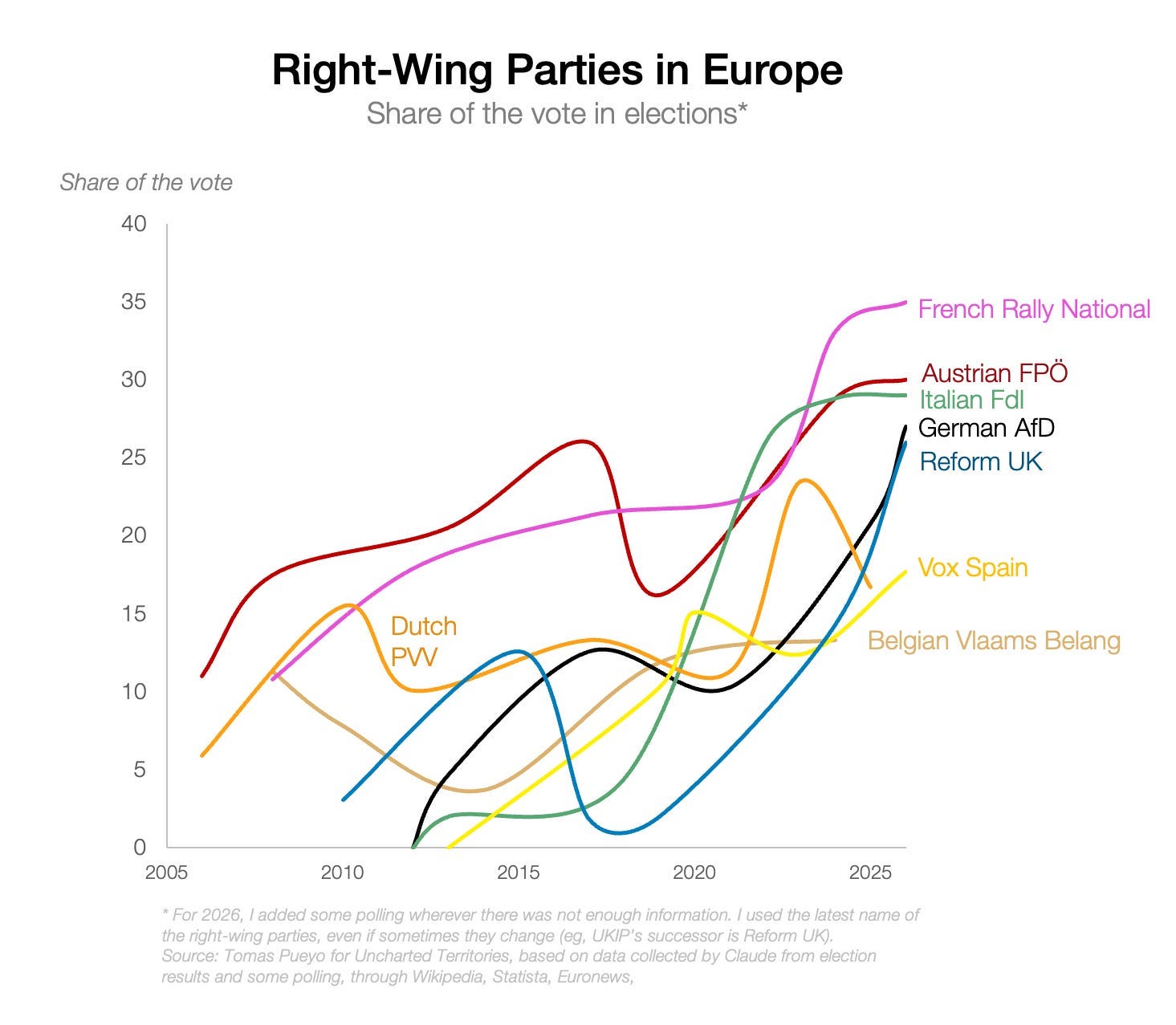
The more the left tries to deny that a problem exists with immigration, the less it can address it, the angrier the average voter gets, and the more they move to the right.1
And I actually don’t think the right’s position is good, either. Aside from positions I strongly disagree with on some topics (eg, pro-Russia and anti-Ukraine, anti EU…), many right-wing parties want to completely reverse immigration, and I think that’s bad, as we’ll see.
So since in the previous article I already outlined the serious problem with immigration in Europe, today I’ll explain why I don’t think we should conclude that the solution is a complete reversal of immigration in Europe, for five reasons:
Europe needs immigrants
The standard fiscal accounting of immigrants is flawed
Many countries make immigration work
The long-term perspective of immigration is more positive than the short term
The causes of economic and criminal contributions are much more complex than people realize
1. Europe Needs Immigrants
This is the population pyramid in the EU:
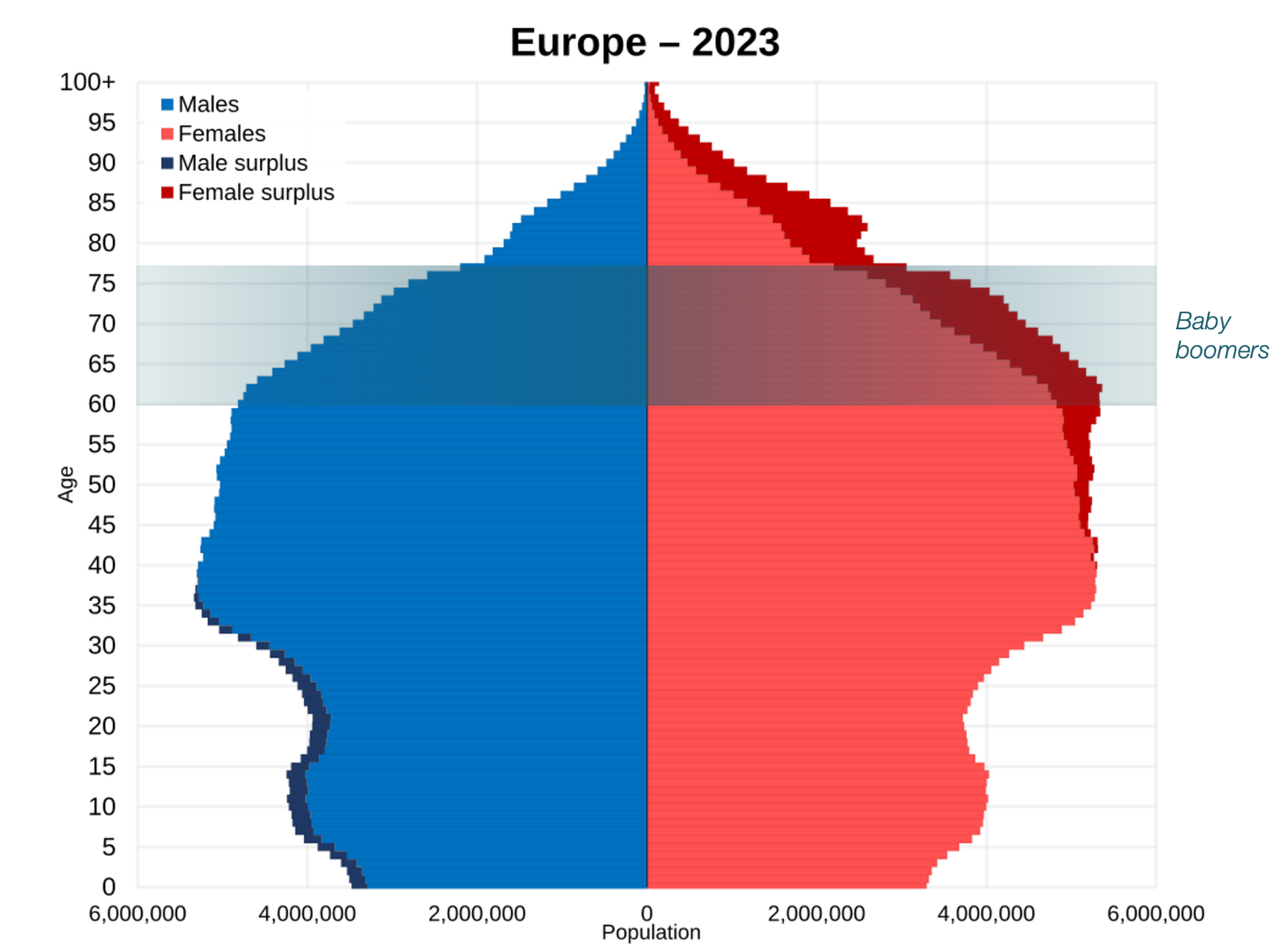
The massive generation of Baby Boomers is now at the age when it will dwindle fast. Given the low birth rates in Europe, these are the population projections with and without immigration.
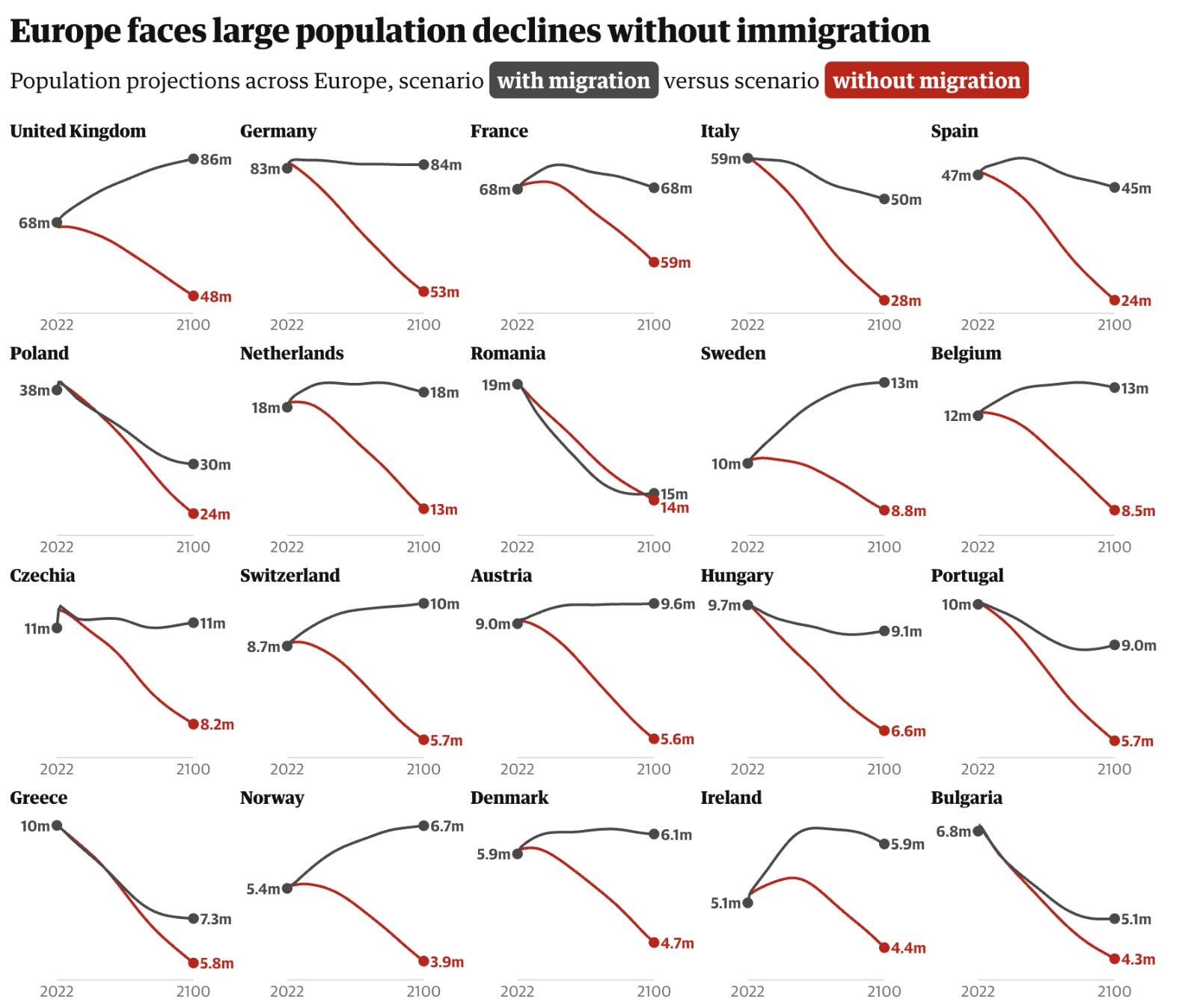
Europe has two options:
Accept immigrants to plug the hole, and manage their arrival. This is what it has been doing.
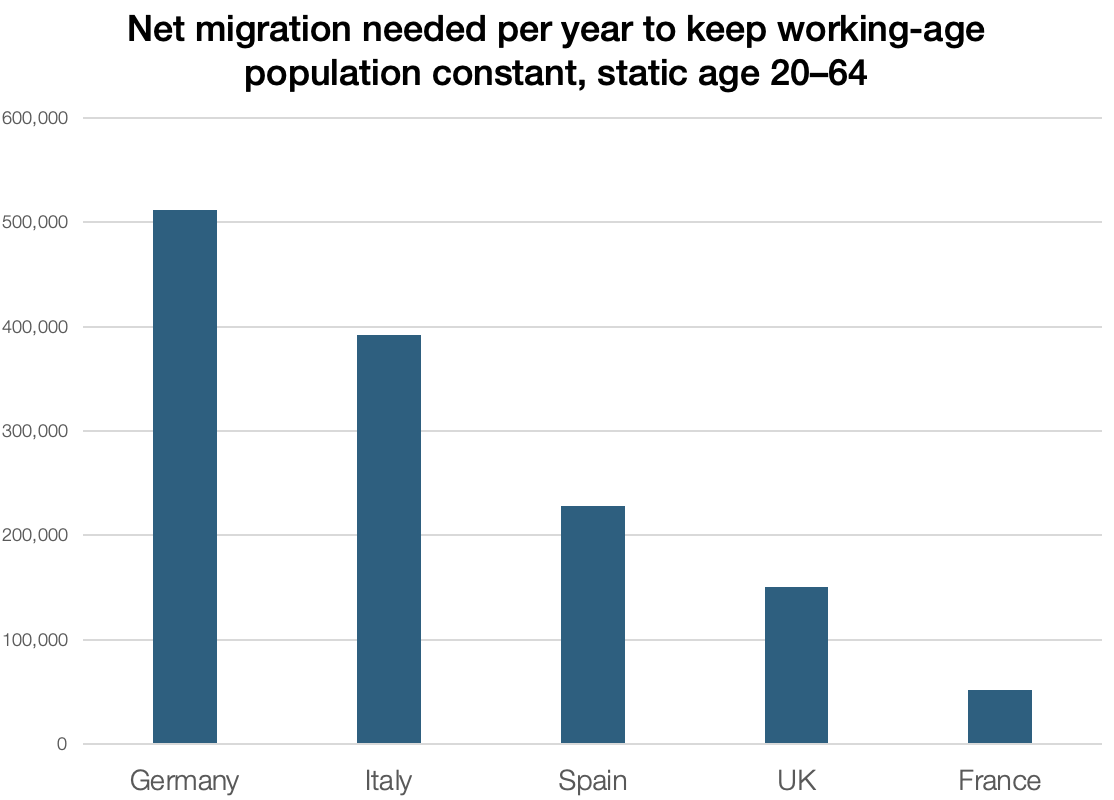
Not accept immigrants and dramatically shrink the working population.
This sounds good in theory, but reality is pretty dire. The consequence? Lose all their services: healthcare, education, coffee shops, supermarkets, construction… When you eliminate millions of working immigrants, women (in general, but men too) either have fewer children or must stay at home more. Food is more expensive, because there are fewer low-wage workers willing to do the hard work needed to produce it. When you need an electrician or a plumber, you can’t find one. You spend days, or weeks, or months with a broken elevator, or without water, or electricity, because there just aren’t enough people. Prices go through the roof. Everything grinds to a halt.
Immigration is extremely economically beneficial for the following reasons:
Complementarity: immigrants do tasks natives are less likely to do, making natives more productive.
Task specialization: natives move into more complex roles, making more money.
Immigrants’ lower salaries and the additional supply of low-cost labor lowers prices: cleaning, care, food preparation, household services, construction, agriculture… All become more affordable.
Native labor-supply release: cheaper household services allow high-skilled natives, especially women, to work more (and make more money).
Investment: larger markets allow more specialization and business investment.
Innovation and entrepreneurship: high-skilled immigrants raise patenting, R&D, firm creation, and total factor productivity.
All of that is a bit abstract, though. Let’s take a concrete example from the previous (premium) article. A Tunisian woman arrives in France at age 30 and works for 35 years taking care of native families’ children and household chores (let’s imagine she helps four families consecutively).
In these four families, the woman can return to work a decade earlier than she would have otherwise. This allows the family to make much more money. The couple also has more time to go out together, strengthening the marriage, and they can go on more family holidays thanks to the additional money and time they have.
Meanwhile, the woman is highly skilled, so the company that hires her is more innovative and productive.
2. The Fiscal Benefits Are Higher
I showed how the fiscal costs of many immigrants in Europe are quite high. That really depends on how they’re calculated, though.
For example, Portugal claims that its immigrants are net positive contributors, but their accounting misses things like the long-term costs of pensions, or most welfare costs, which is not part of social security (eg, healthcare and education).
Meanwhile, the Netherlands, Finland, and Denmark have seen a high fiscal cost of their immigrants, accounting for the elements above. What they don’t do, however, is consider the indirect economic benefits.
Let’s go back to our Tunisian immigrant. From the previous article:
She gets $6,000 in welfare a year. But during that time, the couple can make €30,000 more per year than they would have made without a housemaid. Of these €30k, let’s say €13,000 go to taxes, €2,000 to savings, and the rest (€15k) pays for the immigrant’s salary, who then pays €4,000 in taxes. The natives’ companies produce €20,000 more per year too, of which they pay €2,000 in taxes. So what’s the balance?
Fiscally: The state gets €4k in taxes from the woman but pays €6k in welfare. It looks like this woman costs €2k per year to the state!
But that’s not accurate, because the country also gets €13k from the natives, plus €2k from their companies’ increased productivity, for a total €15k positive contribution!
And that’s just the taxes. The country produces €2k more from the family, €11k from the immigrant, and €19k from the company, who then can spend them on other goods and services
This accelerates the economy or increases savings (which means indirectly more investment in companies that can then grow faster).
So what looks like a fiscally negative immigrant can actually be positive when properly accounted for.
Does it mean that every immigrant is fiscally positive? Absolutely not. But it does show how they contribute much more than meets the eye.
3. Immigration Can Be More Productive than It Is in Europe
We’ve seen that the US doesn’t have the same problems with its immigration as Europe, including the Muslim group. It’s not the only example. Immigration in Switzerland works in general quite well economically (although seems to suffer equally from crime).2
But there’s an even better example, which we looked at in a previous premium article. Which countries are receiving the most Muslim immigrants?
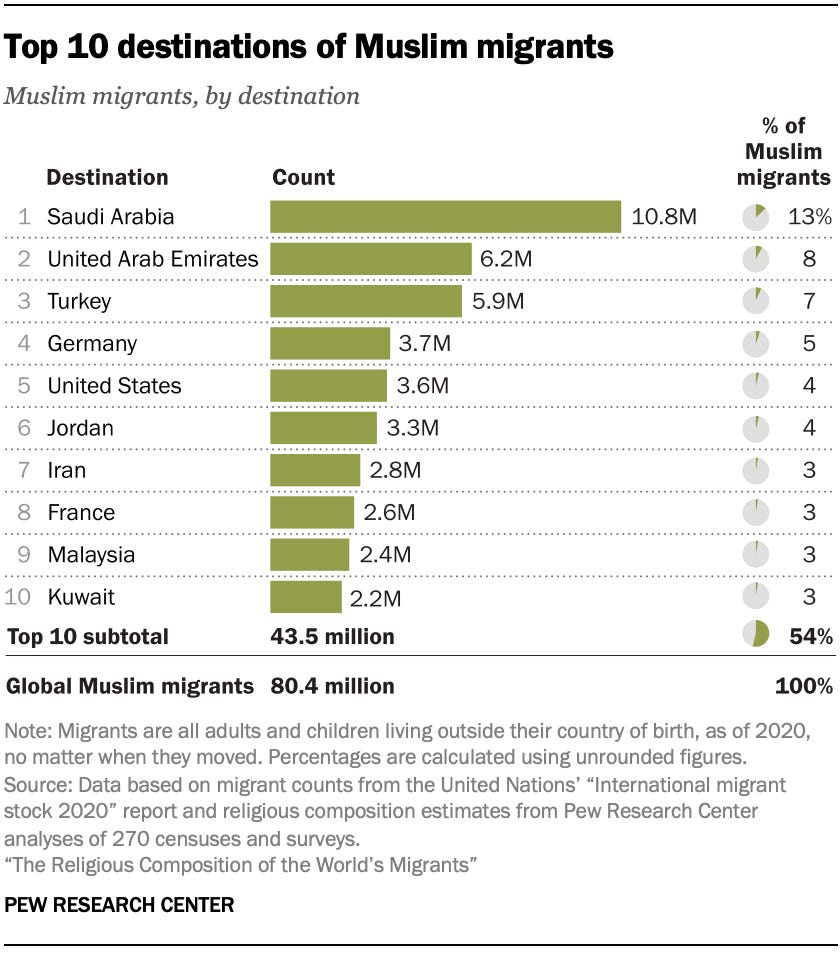
Saudi Arabia and the UAE. In both, immigrants are economically productive, and crime rates in these countries have remained stable even as massive numbers of foreigners have immigrated there. This shows that highly valuable Muslim immigration is possible. You just need to know where to look, and learn from their best practices.
4. The Long Term Perspective of Immigration
Few countries have as much of a history of immigration as the US. For decades, Americans worried about Italian and Irish immigration. And they had reason to! Their economic contribution was much lower than that of the average American, and their crime much higher. The second generation was also quite enmeshed in the networks and ghettos of their forebears. But the third generation was less segregated. And the fourth. And now, the past racism between English/Germans against Italians/Irish has mostly disappeared, and their differences are more anecdotal than fundamental.
Of course, this is not what the data is suggesting in some EU countries, where 2nd generation immigrants are worse than 1st generation ones across some dimensions. But it moderates our conclusions: We should expect that, over the long term, immigrants integrate much better than the short-term suggests, and if they don’t, the most likely culprit is the policies of the recipient country.
5. Immigrant Crime and Economic Performance Is Complex
I don’t think anybody questions that immigrants cause more crime and contribute less to the economy than natives in Europe. However, they do question why.
On the right, people might say: Immigrants bring crime and don’t work because they come from very low human capital countries3 and because they live off of other people’s taxes.
On the left, they might say: Immigrants commit more crime and work less because of their age, sex, education, exposure to conflict, institutional racism, and lack of work permits.
The thing is, they are both right. All these drive immigrant crime up and their economic contribution down:
Immigrants are young, and young people commit more crimes
Immigrants to Europe skew male, and males commit more crime
Immigrants who can’t work tend to commit more crime
Immigrants from regions where there’s a lot of crime or conflict tend to commit more crime
Low education immigrants produce less
It can’t be a coincidence that MENAPT countries are all the most crime-prone and economically expensive, and share the same religion—Islam
However, Indonesia and Malaysia are Muslim countries and immigrants from there are among the least likely to commit crime. Therefore, it can’t just be the religion.
Welfare policies are one of the biggest contributors to crime and economic contribution. For example, a policy that prevents work for years will reduce the economic contribution and increase crime. A policy that increases welfare will be much more expensive and attract less work-focused immigrants. So it’s not just the immigrants, but more importantly the laws Europe approves to manage them.
Unfortunately, as far as I know, nobody has really quantified how much each of these factors contributes to the problem. Maybe because it might be near impossible: These factors interact in quite complex ways. One low-performing immigrant in Belgium might have never entered Switzerland for example; if they ended up in Saudi Arabia, they wouldn’t commit a crime that they might commit in Belgium; and if they did commit a crime, they might end up in prison or extradited in a way that would not be true in Belgium.
Takeaways
So Europe needs immigrants, their fiscal contribution is not as bad as it appears, immigrants tend to get better across generations, other countries are much better than the EU at managing immigration, and the causes of the poor criminal and economic performance of immigrants are quite complex. All these together suggest that the solution to immigration in Europe shouldn’t simply be: Let’s close our doors. Much better policy should allow it to receive the right amount of immigrants, make them productive, and prevent the more problematic ones from causing harm. That’s what we’ll discuss in the next article.
Denmark is an outlier here: The left-wing government has moved to a skeptical stance on immigration.
Just a few days ago a Swiss-Turk Muslim attacked three people in Switzerland while yelling “allahu Akbar”. Grok says Switzerland suffers from strong immigrant crime issues, with a stark overrepresentation of immigrants in criminal statistics.
This includes culture, genetics, human development, education, and more.
This is a factor that is really under-appreciated by both xenophobic right-wingers and the progressive people who oppose them: most the reason immigrants don't integrate well in European welfare states is that they're *literally prevented from working for years!*
Not because they're lazy. Or because they aren't educated enough. It is literally against the law for them to work. Until their status is regularized. And these are countries where it's also really difficult to live "off the books," so being unable to get regular legal status in essentially exile from any chance to become part of society. The years-long delay, alone, can permanently reduce your life-chances and (rightly) make you rather alienated from the society that has refused to accept you.
In Sweden, for example, the much-maligned group of refugees that came after 2015 were expressly prohibited from entering the labor force while their applications were being processed. Which took years! So what do you do when you can't work for years?
Oh, and you also have been put in a crappy apartment on the edge of various declining parts of the country because that's where the housing was cheapest. Makes perfect sense, right?
And that's your life for your first 18-36 months in the country: Sitting around at home at the end of the train line or on the forgotten edge of a declining industrial town without any exposure to locals. What a great recipe for people integrating to their new home! Not to mention being well-adjusted and grateful to be there!
Sure, those people should just be happy to be alive and safe, right? Well, imagine you adopt a child from a broken home and then have them live in your shed where you ignore them. Think they'll thrive and come to cherish your hospitality? As an immigrant myself, I can assure you that leaving home and moving to another home is already extremely stressful in every way and even privileged "expats" hit a wall in their first year where they seriously reconsider their choices. Imagine that it just never gets better.
The United States de facto does something very different: Even for "illegal" immigrants who don't speak the language and lack formal skills, they will settle in the areas of the country where there are ready jobs to be had. They will be adopted into a pre-existing community of fellow immigrants who show them what's what. And they will generally be able to immediately work (often off the books) in ways that slowly but surely begin to integrate them into society. Americans are well-familiar with the many undocumented immigrants (including, infamously, the "Dreamers") who do, indeed, achieve their American Dream, even as they're living out their lives undocumented for years and decades. Ironically, people outside of any system can find it much easier to become normal members of society than people whose access to the formal system is so blocked for years that they become permanently socially excluded.
People made similar arguments about how slavery was essential! White civilized people can’t be expected to do menial work when there is a dull docile race available to do it for them.
The theory rests on three premises: that certain work is beneath the dignity of citizens, that a civilized society nonetheless requires someone to do it, and that the solution is to source a subordinate class whose legal status forecloses the possibility of refusal. That structure persists to the present day.
Check out this Commonplace article titled From Human Bondage to Open Borders : Americans must reject the Mudsill Theory of a two-tiered labor system.
https://commonplace.substack.com/p/from-human-bondage-to-open-borders?selection=f64171fb-d7cf-4398-a883-2679f3ef311c&r=rluf&utm_medium=ios
(Quotes from the article)
The phrase “jobs Americans won’t do” is the slavery era theory translated into the language of labor economics: the work cannot be transformed; the only question is where to find people desperate enough to do it. To accept that premise is to assert that such work is beneath the dignity of citizens by nature, and that someone else’s dignity is a lesser concern.
A nation that insists on maintaining a two-tiered labor class—whether through slavery, sharecropping, the tacit acceptance of illegal employment, the relocation of production to wherever labor is cheapest and least protected, or temporary visa programs that bind labor to a single employer—has made a political choice. It has chosen the mudsill. But it can choose otherwise. Lincoln’s answer, and the right one, is to build an economy that does not need one.