

Previous premium article: Why Did Islam Spread So Fast in North Africa & Spain?
Next premium article: An anlysis of all the news on the Game Theory of Sex & Relationships
Here’s a crazy fact I read: 80% to 90% of women reproduce, but only about 40% of men do. What?!
It made me think of this:
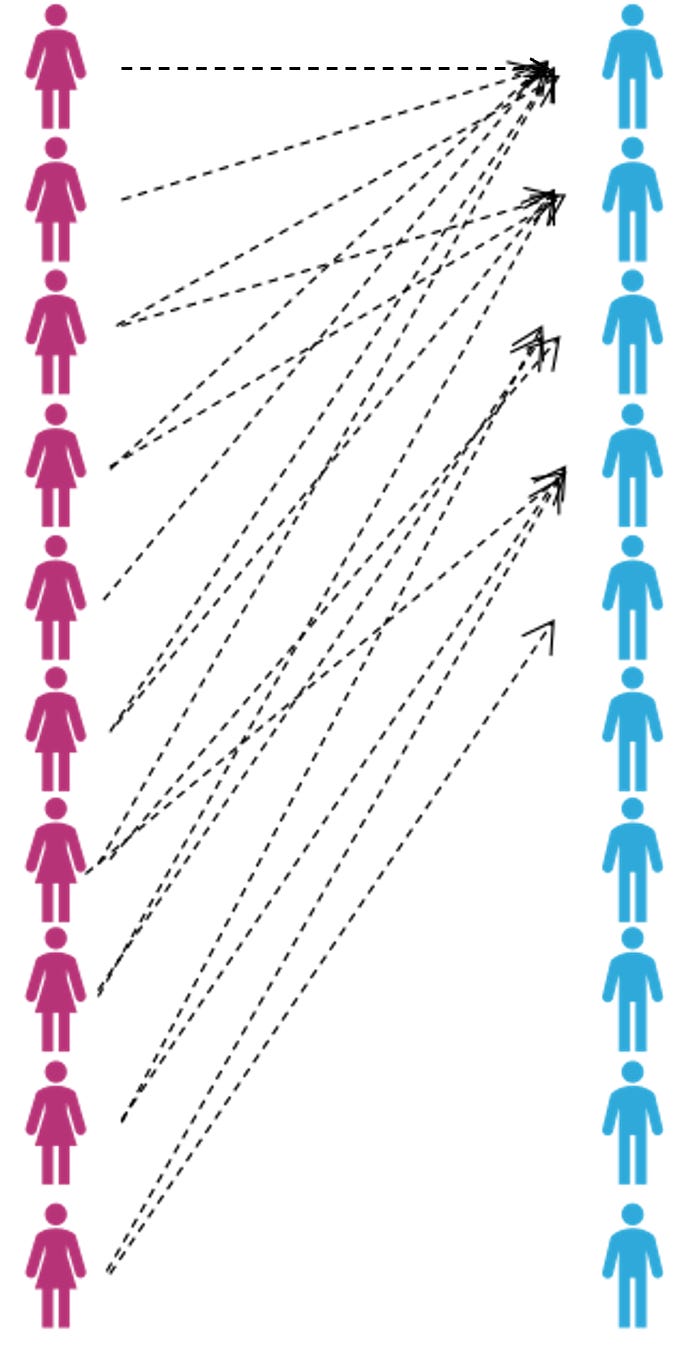
This represents the idea that, nowadays, women can easily have sex, so they gravitate towards attractive men, which is bad for unattractive men (no access to sex), and bad for all women (heightened competition for a few men only), while attractive men get all the access to sex they want and end up not partnering up.
Are these things true? Do men really reproduce less than women? Is it because historically, the more attractive men could hoard the women, leaving the least attractive men out of luck? If that’s the case, how frequent was it? How did different societies deal with this problem? Did it lead to violence? And what about today? Do more women than men still reproduce? How has technology like Tinder or contraception changed this? What can we predict about the future of sex, reproduction, and violence?
1. Men Don’t Reproduce as Much
Let’s start with the initial claim: If 80% of women reproduce and only 40% of men, that means women have been 2x more likely to reproduce than men in history. Is this true? This is an estimate of how many women1 reproduced in a studied population throughout history:
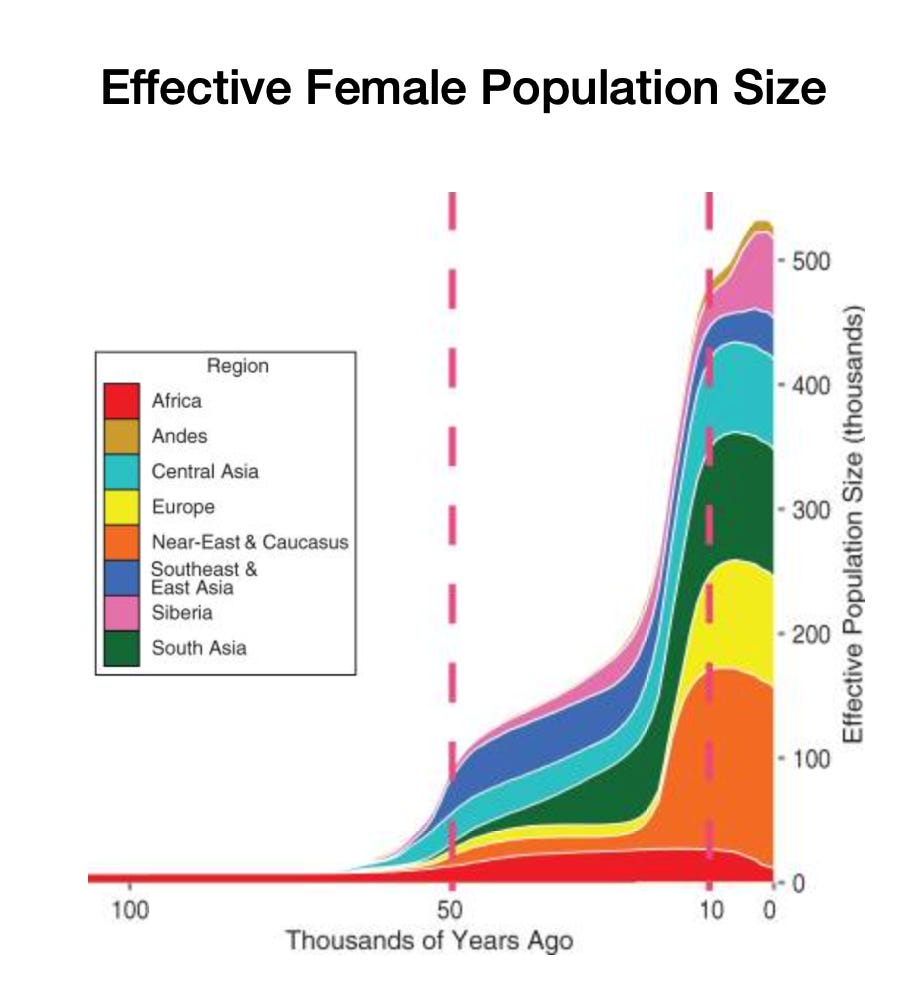
Notice how the human population starts exploding about 70,000 years ago, around the time of the 2nd move out of Africa. Then, there’s a new explosion around 10,000-12,000 years ago, around the time of the end of the last ice age.
But this is for females. How did males reproduce in comparison?
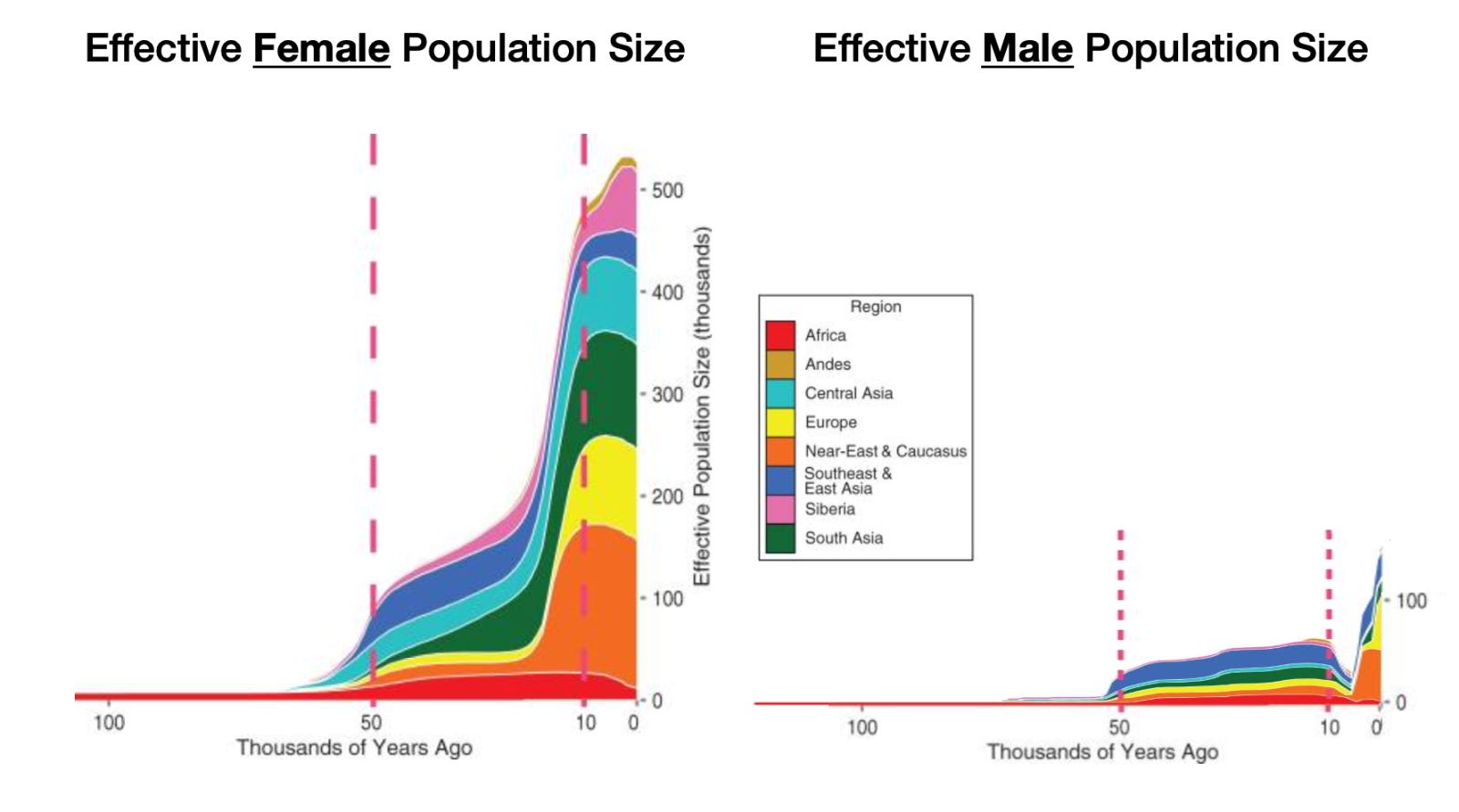
Assuming that 80% of women reproduced at any given time, what does this tell us about the share of men who reproduced?
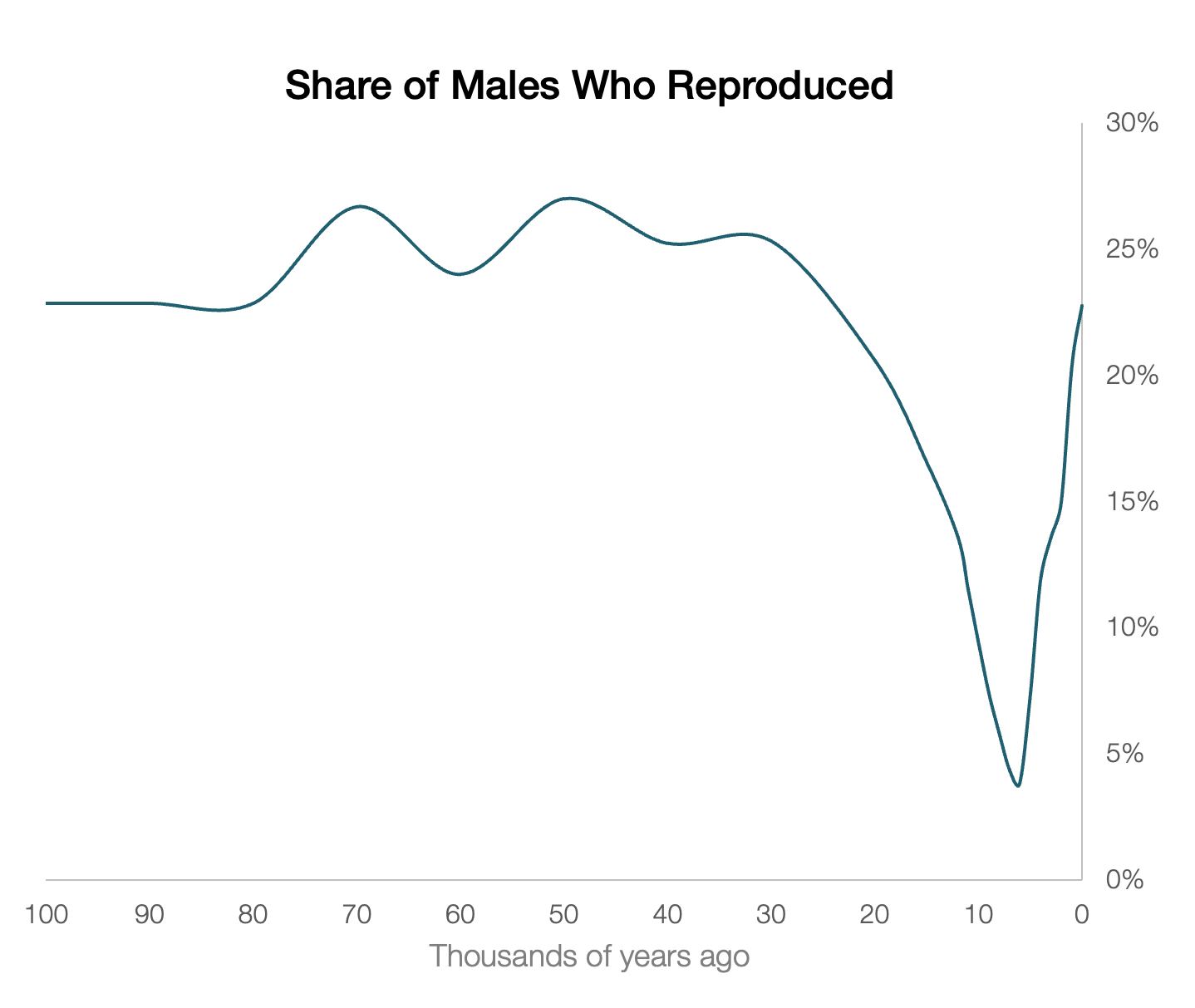
This is bonkers!! It means historically only about a quarter of men reproduced!?2
This maps tells you where:
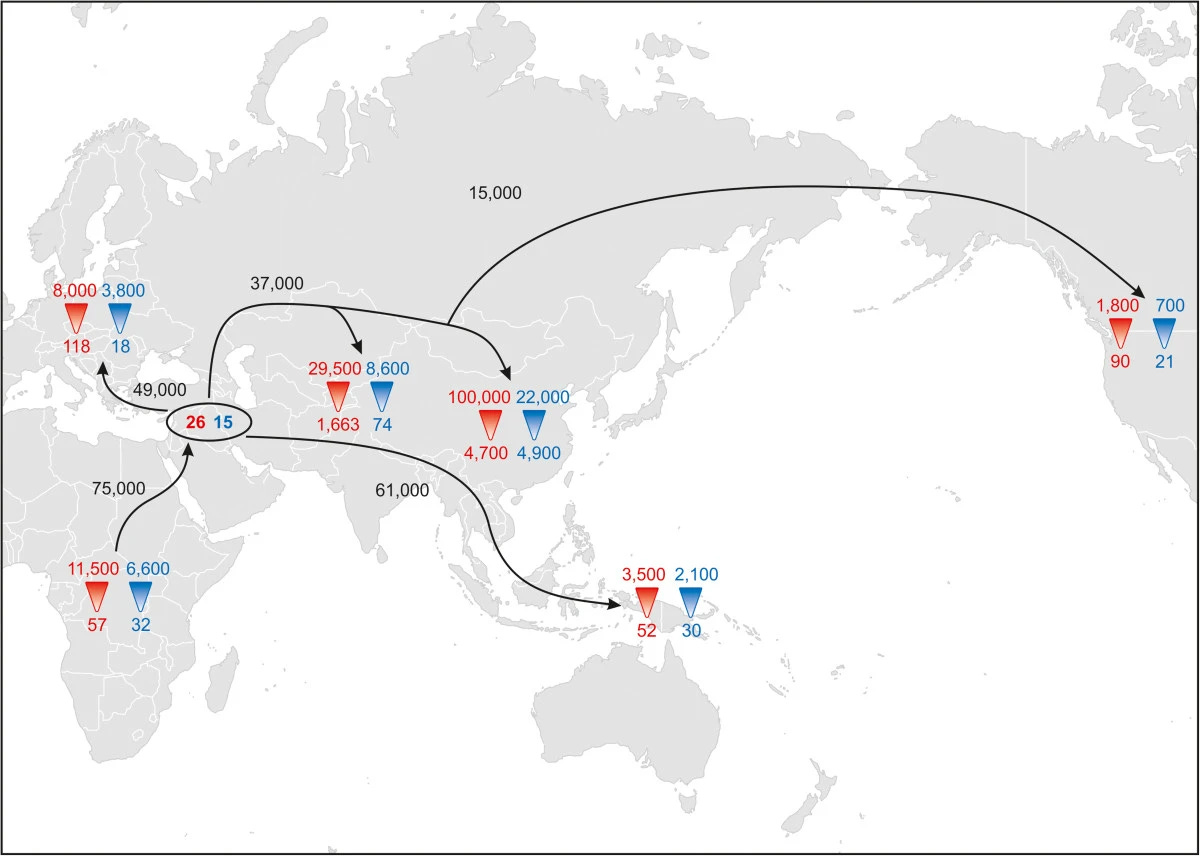
How is this possible?
Homosexuality
About 3% of men consider themselves fully homosexual, so it can explain only a tiny part of this gap.
Polygyny
The most logical explanation for this would be polygamy (one person marrying several people of the other sex), which generally means polygyny (one man, several women).3 If the average man who marries has 3 wives, it means about ⅔ of men won’t have a wife.
The Sexual Violence Problem
This causes a lot of conflict. Because you get a lot of men who can’t access sex and reproduction. So societies had three options.
One was to just be violent, with men killing other men and kidnapping and raping women. That is not very stable at all, so such societies quickly learn to focus the violence outwards: They organize in clans and tribes where you’re not supposed to kill each other, and should raid your neighbor instead.
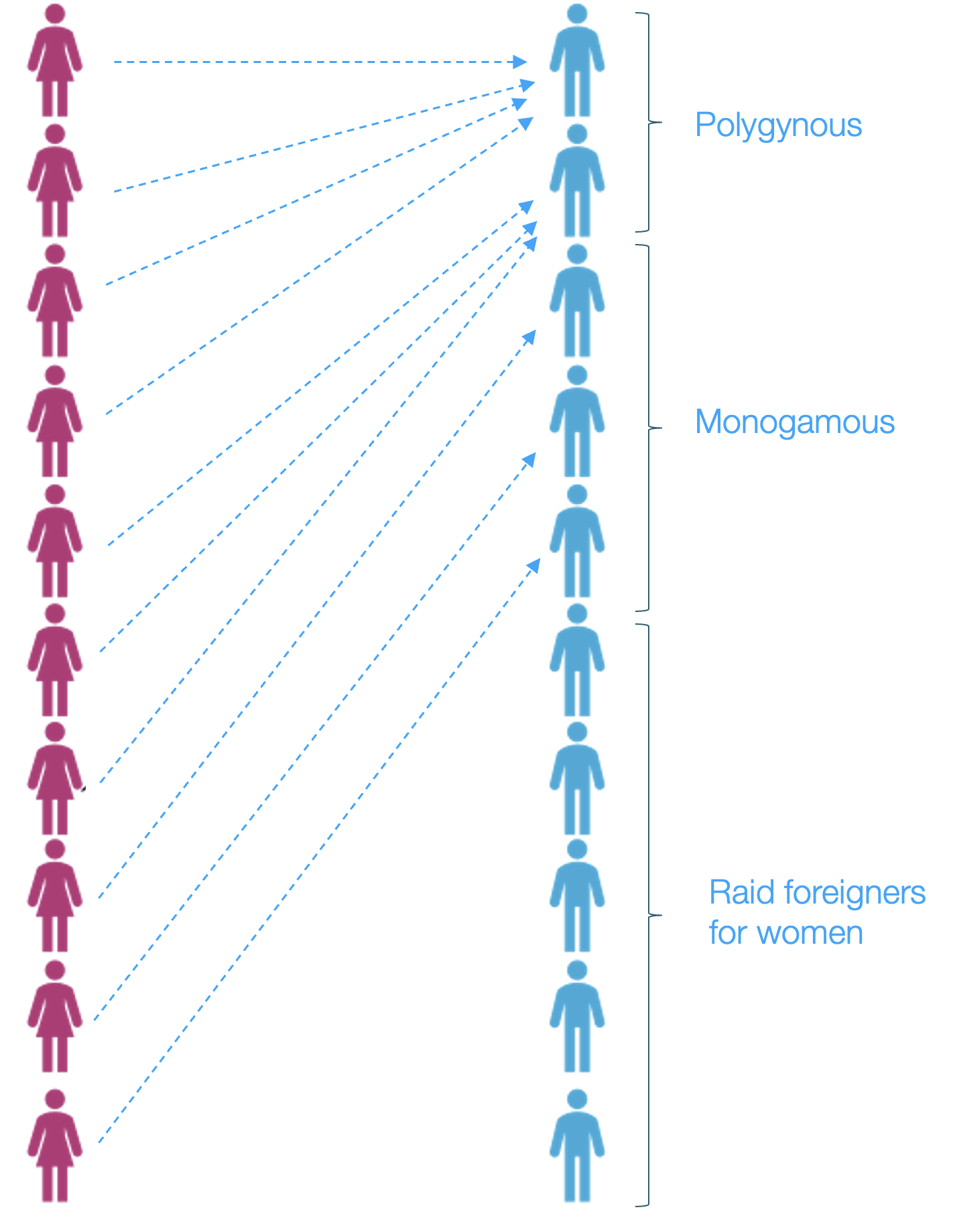
The societies that managed to do this at scale were able to spread extremely fast. Examples include the Vikings and the Arab Muslims: In both cases, they had serious polygyny, and men were recruited to go raid foreigners and take their women as partners, concubines, or slaves. The Muslims had the added brilliant idea of telling recruits: “Even if you die fighting, don’t worry, you’ll get your women in heaven.”
For example, we know from DNA analysis that 80% of the Icelandic male DNA was originally from Scandinavia, whereas 60% of women’s is Gaelic.4 So the most common way that Iceland was settled was with Scandinavian men taking Gaelic women in the British Isles and settling in Iceland. Something similar happened in Arab territories:
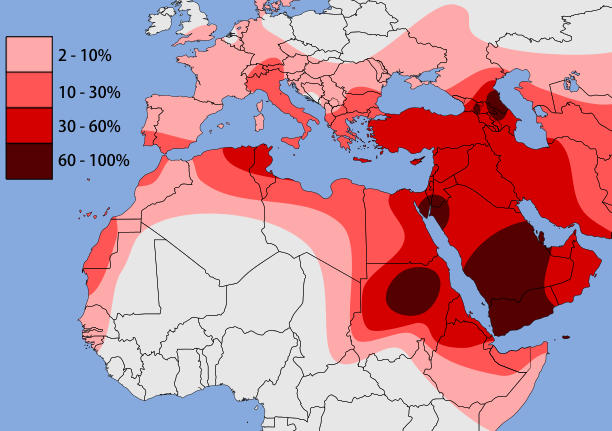
So very certainly part of the difference between male and female reproduction is that some men hoarded women, so other men either didn’t have access to women and didn’t reproduce, or had to go to war or raid neighbors to get women. They would either die trying, or succeed and extinguish the male line of the conquered.
It doesn’t always need to be violent though. For example, the Swahili Coast in Africa has in some places up to 80-90% of male ancestors from Persia, India and Arabia, with nearly 100% local female ancestors, from Africa.
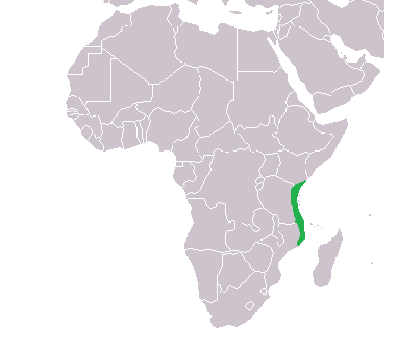
This was from trade: Rich Muslim traders would come and marry local women. But slaves were part of the traded goods, and so some of the partnerships would have been coerced rather than free.
Conversely, some Arabic ancestry comes from African women, but not men. Given that Arabs traded African slaves, the most logical explanation is that they didn’t let African men reproduce in Arabia,5 but some of the African women slaves did reproduce with the men.6
Age
This one blew my mind. There’s a second way a polygynous society can manage the sex imbalance: Growth plus age differences. This explains why old men marry young women in Muslim countries.7
If you have 100 men, and they each have on average two wives, you need 200 women. How can you get them? You can solve that if the men are 40 years old and the women are 20 years old.
The women have four children each, for a total of eight children per father—approximately four boys and four girls. That means that our total population of 100 men and 200 women becomes, 20 years later, 800 men and 800 women.
The women marry immediately and have children,8 but not the men! The 800 men have to wait 20 more years. By the time they do, there’s been a new generation. Now there are 1600 men and 1600 women aged 20: Enough women so there’s two of them per man!
Another way to think about this: If every generation is twice as big as the previous one, every man can simply marry, when he is older, two younger women of the next generation.

So by marrying women young enough, remaining fertile, and having lots of children, you can actually maintain a highly polygynous society while all men still have women!
Something like that has happened in high-growth polygynous societies across the world. It’s one of the reasons I believe old men marry young girls in some Muslim countries. I don’t like it (and with children it’s abhorrent), but that’s the logic.
This wouldn’t explain why men have had more children than women though—in fact, it increases the mystery, because it could explain away polygyny without the need for women reproducing more than men.
Monogamy
The other way to handle this problem is by forbidding polygamy. If everybody is monogamous, everybody can pair up and have children. Yay!
This has a big advantage: Instead of pouring resources (men) into violence against each other to fight for women, who are then raped and / or kidnapped, you can focus all the energy on building stuff and accumulating wealth.
This might be one of the reasons why the Greeks (and later, Romans), who were uniquely monogamous, were so successful. They imbued this into Christianity9, which then spread the concept around the world.
Islam and China were not technically monogamous, but in practice the vast majority of marriages have been, I assume for the same reason.
A study looked at the ratio of men to women in several societies, and assuming 80% of women have had surviving descendants, then in East Asian societies about 72% of men had surviving descendants; in Europe it’s 62%, and in Nigeria (Yoruba) it’s 57%. So we can see in the data that monogamy might have indeed had a strong impact in balancing reproduction and descendants—which gives credence to the idea that polygyny was originally one of the causes of this imbalance.
But if monogamy has been so widespread, why do we see such an imbalance in male-female reproduction across the world until so recently?
2. Patriarchy against Men
The most common structure for clans has usually been patrilineal: All the men in a family stay together, and the daughters leave to pair up with men in other clans. This means all men in a clan are related by blood, but not all women.10 So if a clan disappears—whether it’s wiped out, it starves, or it slowly shrinks because it doesn’t have access to resources or status—then the entire male line goes extinct. But not the female line, which is much more mixed! So, in effect, patriarchy is genetically much riskier for men than for women.
Meanwhile, this effect was compounded by the fact that successful clans would wipe out many other clans, further reducing genetic diversity.
And then, these successful clans would grow too much and would need to split. When they did, they tended to do so along lines of close relatives. So for example each successful son would move out with his male descendants. The result is that every split would increase male line genetic concentration.
One paper tried to figure out how much the effects described in this section could explain the gap between male and female reproduction, and it found that it could theoretically explain it all. In other words, you don’t theoretically need polygyny or violence between men to explain this gap. The clan structure could be enough.
My guess is that it’s something in between:
Polygyny meant that many men could not get wives and never reproduced.
Many men killed other men and took the women, further reducing the share of men who would ever reproduce (or killing off their offspring). This was more common in polygynous societies than in monogamous ones.
Even if some males reproduced, clan structure could eliminate their entire male line, if the entire clan was wiped out.
What does all this tell us about today? Here are the consequences we can draw for dating apps, incels, polygamy in the West, immigrant profiles, Ukraine and Russia, and AI and robots.
