

In the 600s AD, Mecca was a village of a few hundred people, off the beaten path, a backwater uninteresting to distant empires. Then along comes a guy—Muhammad—and somehow within five years he and his heirs went from ruling one oasis to controlling all of Arabia, and thirty years later everything from Morocco to Pakistan. HOW?!
My goal is to understand the mechanisms of Islam’s lightning-fast spread. I am sure I will get some facts wrong here. I know I can count on you to correct me as you find them.
To start, let’s look at a satellite map of the region.
1. The Middle East at the Eve of Islam
For 1,000 years, the Middle East had been the battleground between two megapowers: one from the sea, the other from land.
Sea vs Land
Greece vs Persia
Rome vs Parthia
Byzantium vs Sassanids
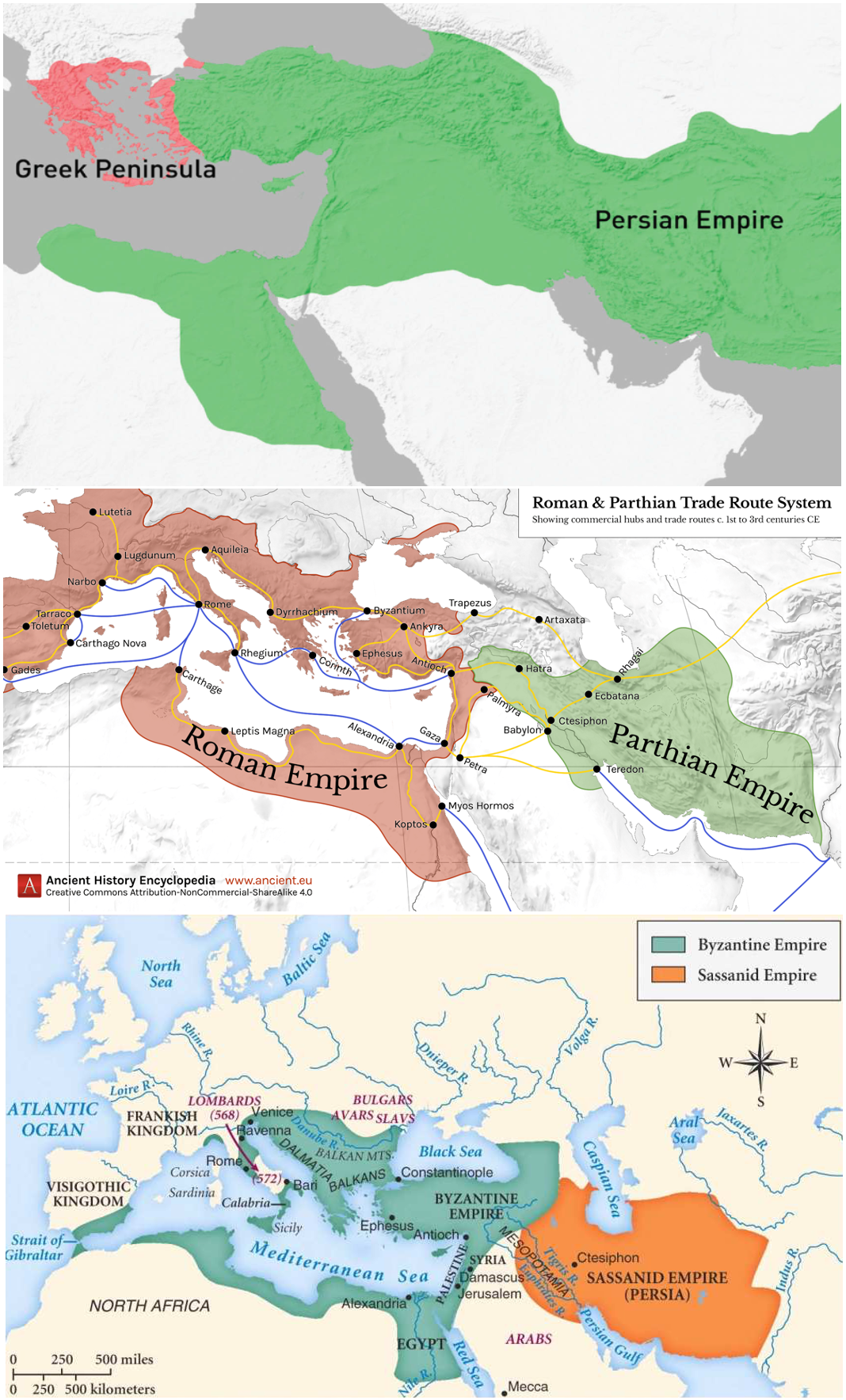
In all three cases, we had a sea-based power built around the Mediterranean on the west.
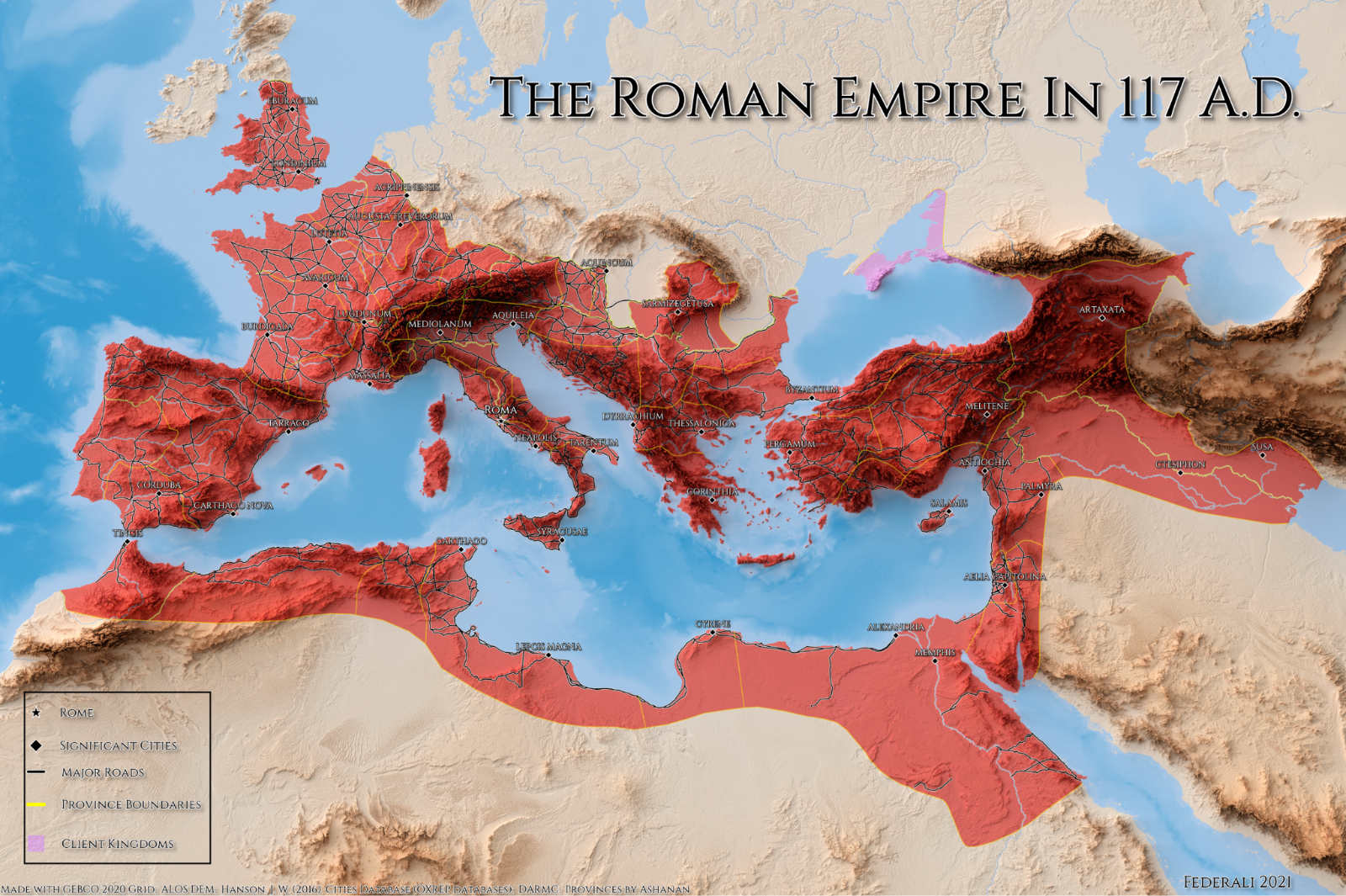
While to the east ruled a land-based power.
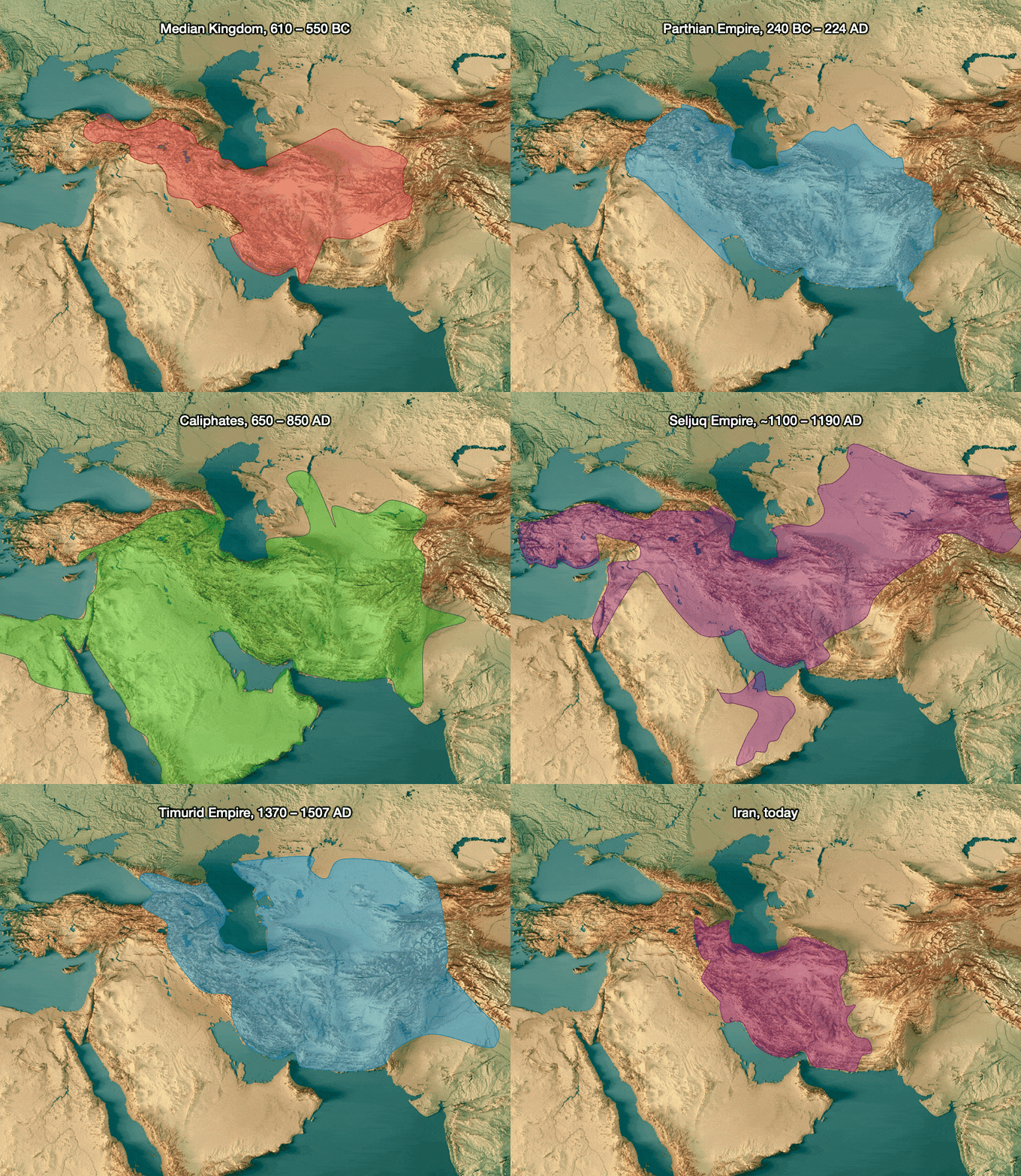
In all these maps, you’ll see that the Arabian Peninsula is in the smack middle of both, yet was never a part of either empire. Why? Because it’s too remote:
Sea: The sea power couldn’t access it from the Mediterranean
Land: Both powers are separated from Arabia by a massive desert
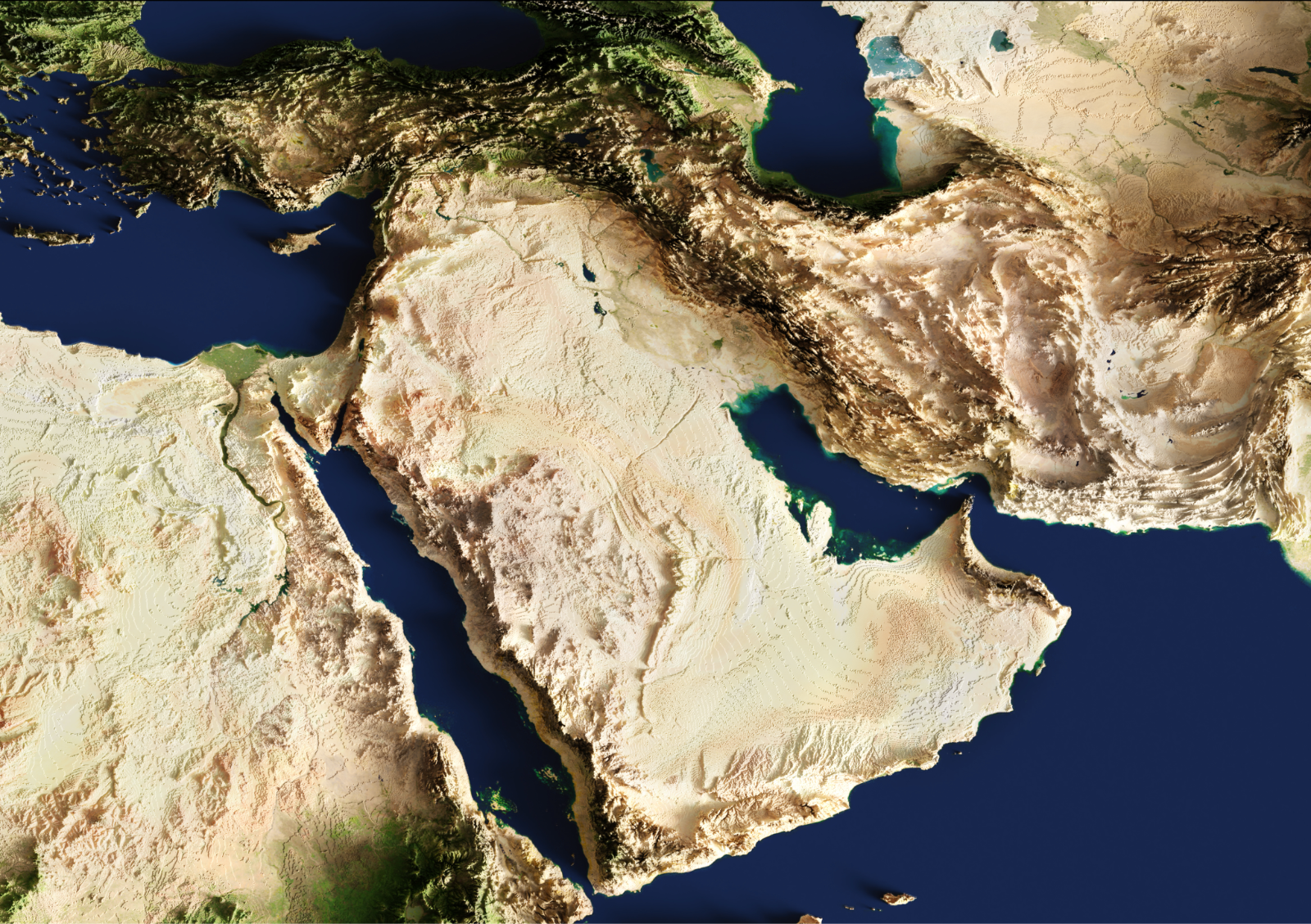
Here, the only place you can live is in the mountains, which capture rain.
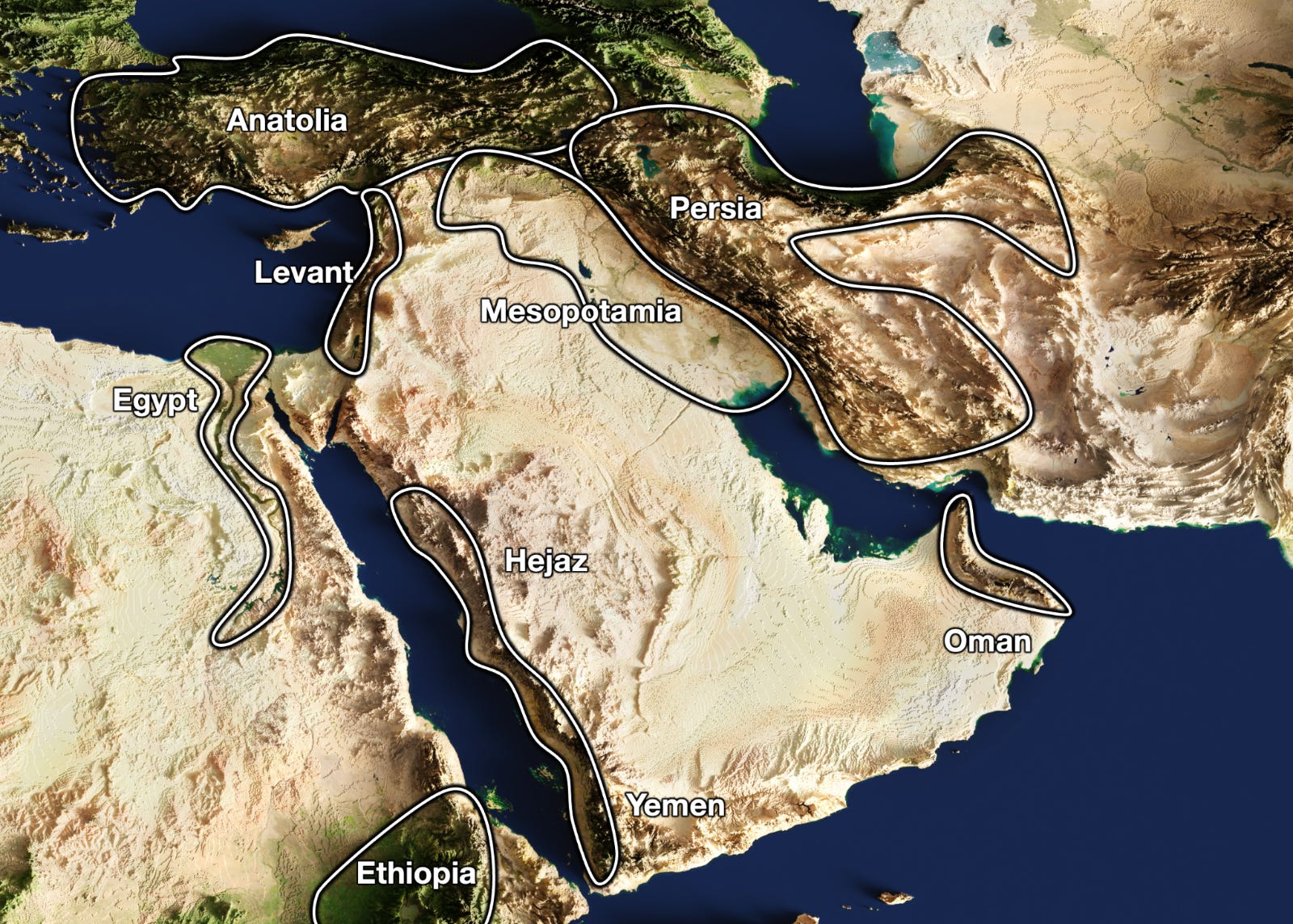
Clockwise starting with Ethiopia:
As we explain here, the Ethiopian Highlands catch the African monsoon rains.
They flow north through the Nile, giving birth to Egypt.
Water evaporated in the Red Sea rains down in the Sarawat Mountains, in western Arabia, creating the historical regions of Hejaz and Yemen.
Just north of that, the same phenomenon, but the water from the Mediterranean forms the Levant, with present-day Israel, Palestine, Lebanon, and Syria.
Rains caught in Anatolia form present-day Turkey.
Rains caught in Persia form present-day Iran.
These rains flow down the two rivers of Tigris and Euphrates, forming the historic region of Mesopotamia (between two rivers), mostly present-day Iraq.
The mountains in eastern Arabia also catch some rain, forming what are today the eastern UAE / Oman
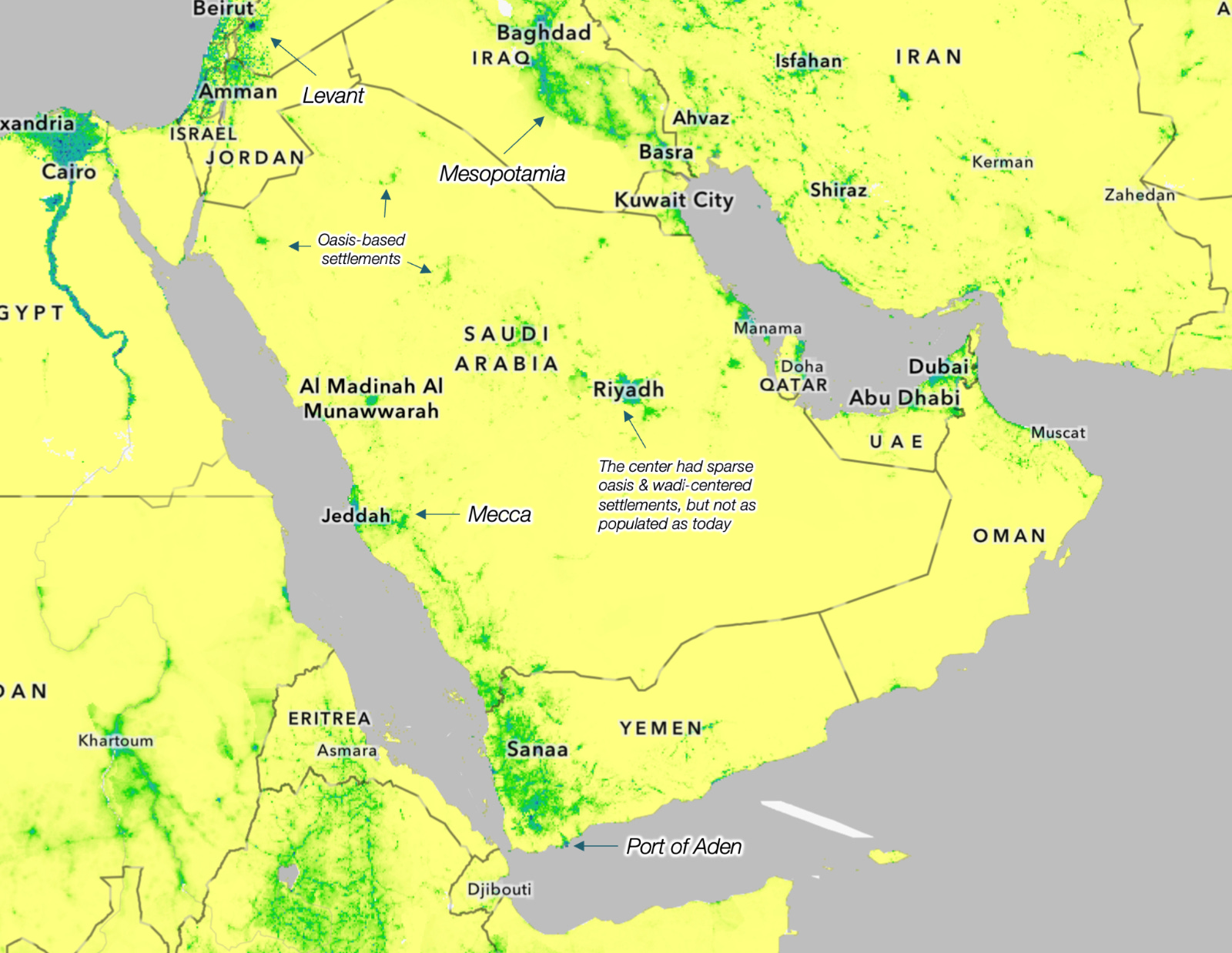
You can see this pattern reflected to this day in the population density map below:
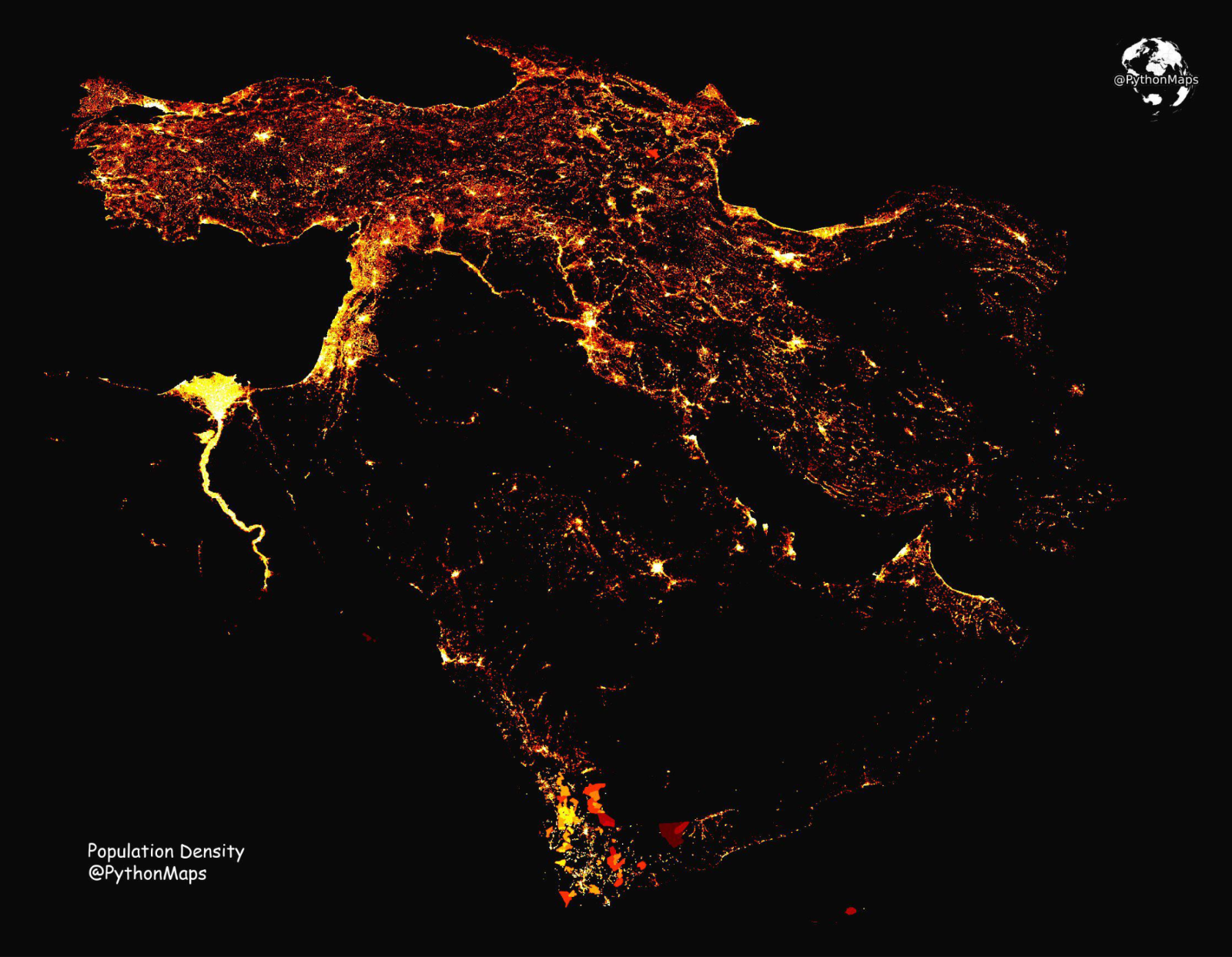
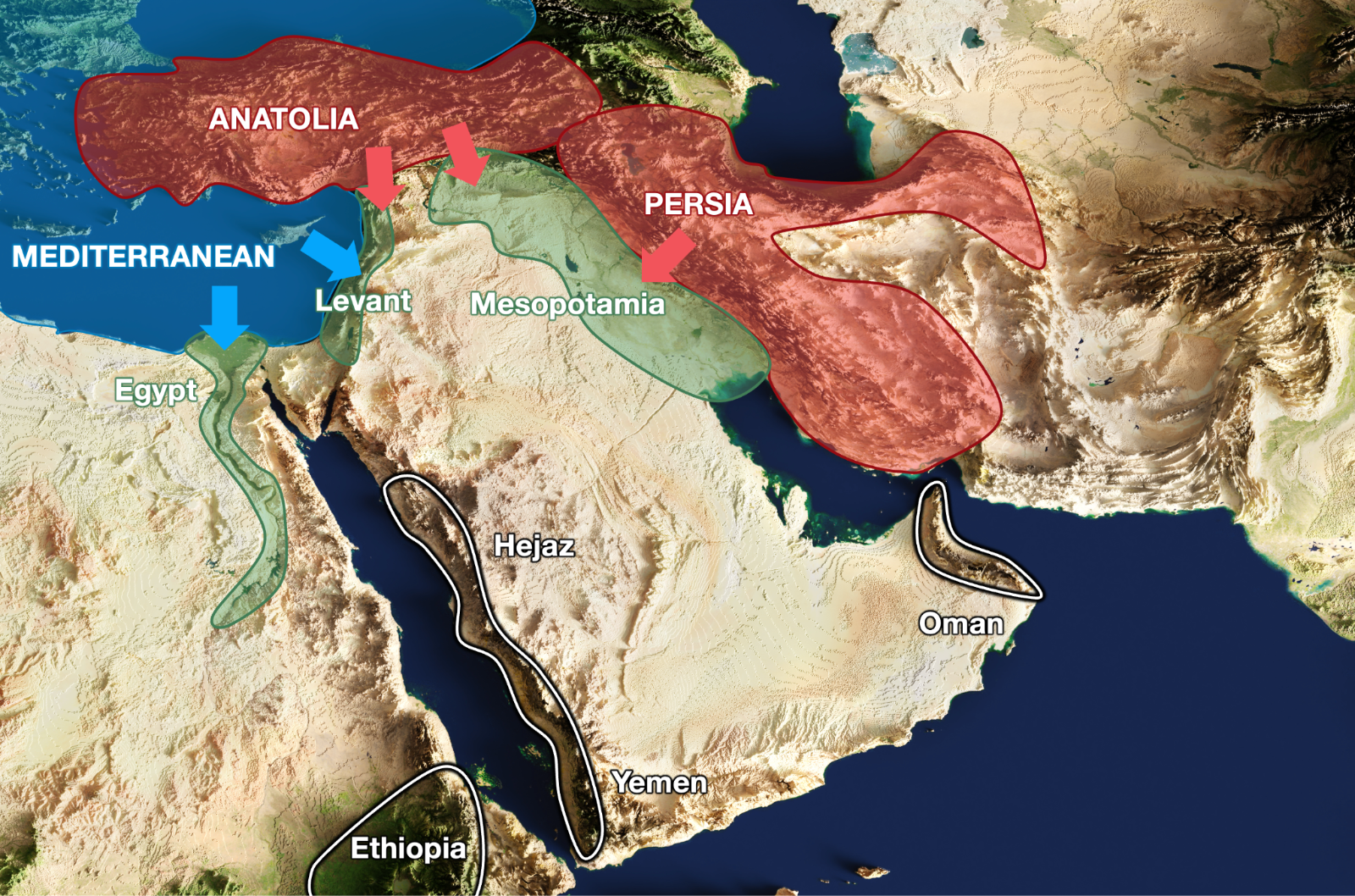
If you notice, there are two very different types of regions here, the mountains that catch water, and the plains that emerge around their rivers. The mountains are hard to rule, but defensible. The plains are hyperfertile and easy to rule, but exposed to foreign invaders.
Early on, this was not problematic: People emerged where food was easiest to produce, on the riverbanks of the Nile and Mesopotamia, which would naturally flood the riverbanks, filling them with water and sediments. That’s why civilization emerged there. There was very little population and civilization in the mountains.
But as time passed, agricultural practices developed, were brought to more mountainous areas, and the population grew there too.
This exposed the river civilizations to the mountain people. This is why, for most of its history, Egypt, the Levant, and Mesopotamia have been under the yoke of neighboring powers:
In the case of the Levant and Egypt, those that control the sea (the Mediterranean)
In the case of the Levant and Mesopotamia, those that control the land (Anatolia and Persia)
The Arabian Desert
So what was in Arabia? As the northern empires grew for the previous 1000 years, they encroached more and more on Arabia, especially its north. But this influence was limited because of the geography. In most of Arabia, there were just secluded tribes in the mountains, and some people on some coasts, for the maritime trade with the Mediterranean.
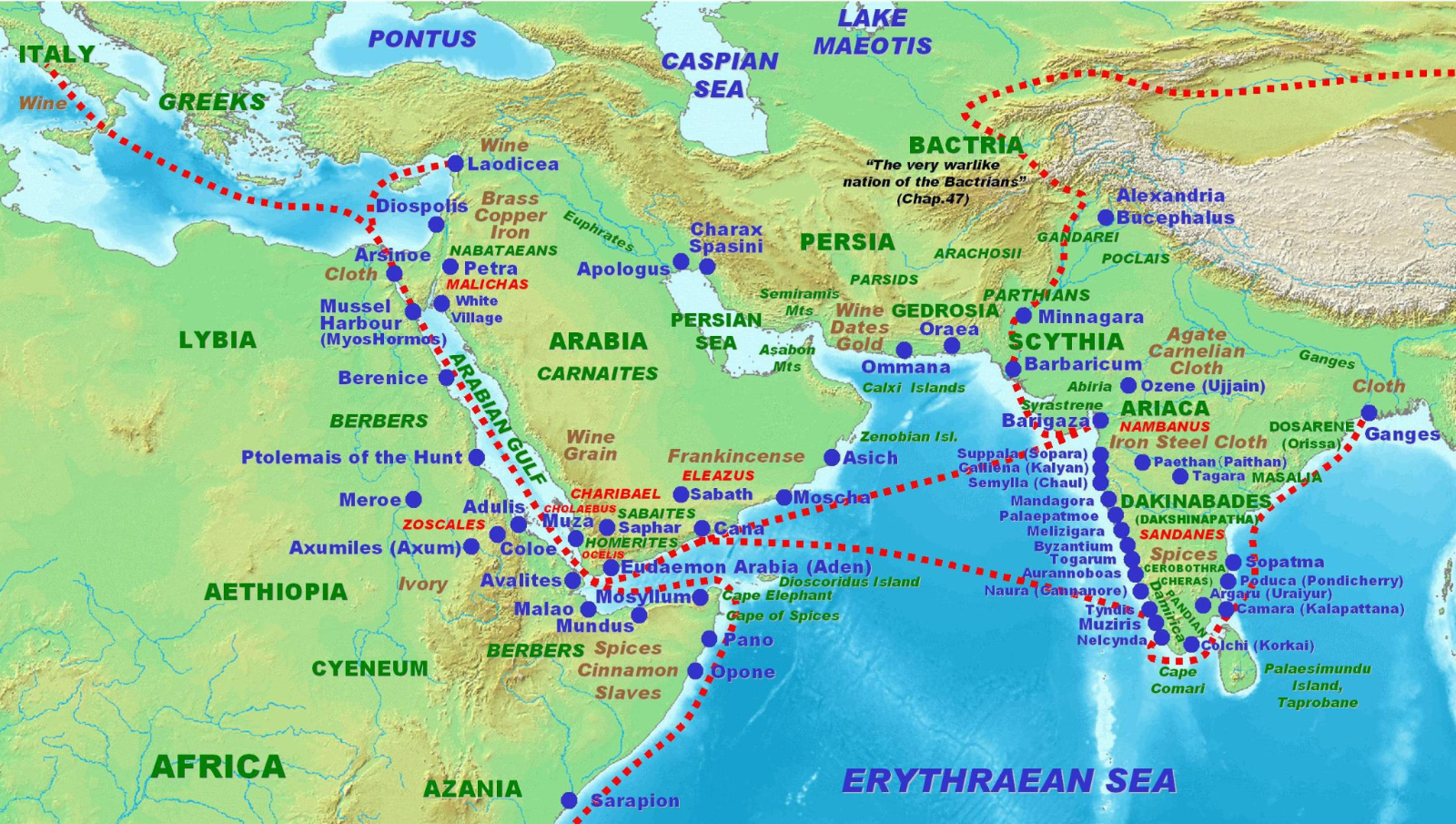
So all of Arabia was mostly empty and arid, except for some northern border tribes that interacted with the empires, the western mountains, and especially their south, in Yemen, which caught some water from the Ethiopian monsoon rains and some sea trade.
Notice on the trade map above that there were no stops between Yemen and the Mediterranean on the Arabian coast. That’s how awfully dry that region is: not even port settlements could survive.
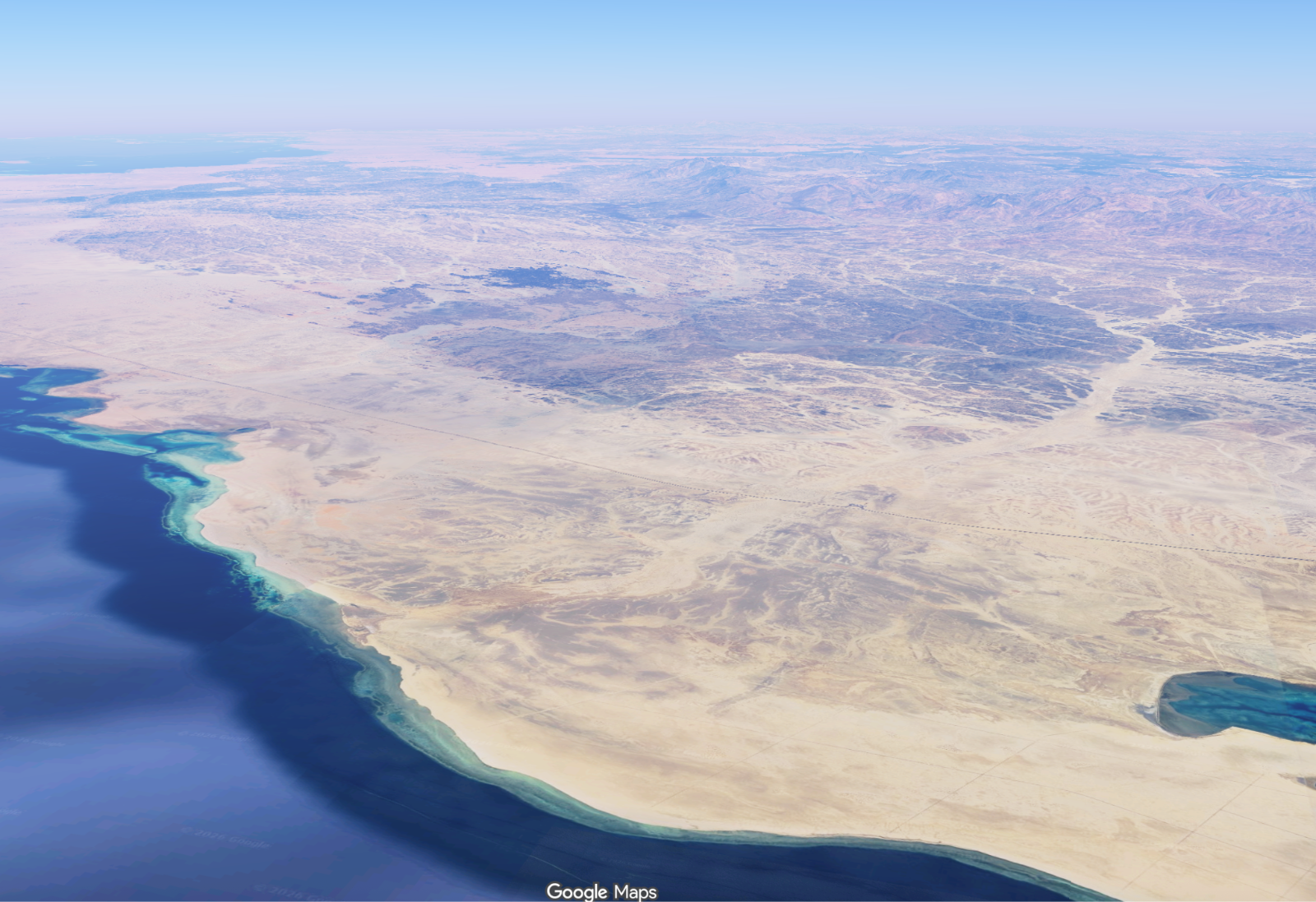
That’s why Mecca and Medina are inland: They’re away from the sea trade routes and isolated by mountains and desert, but they have some water caught by the mountains.
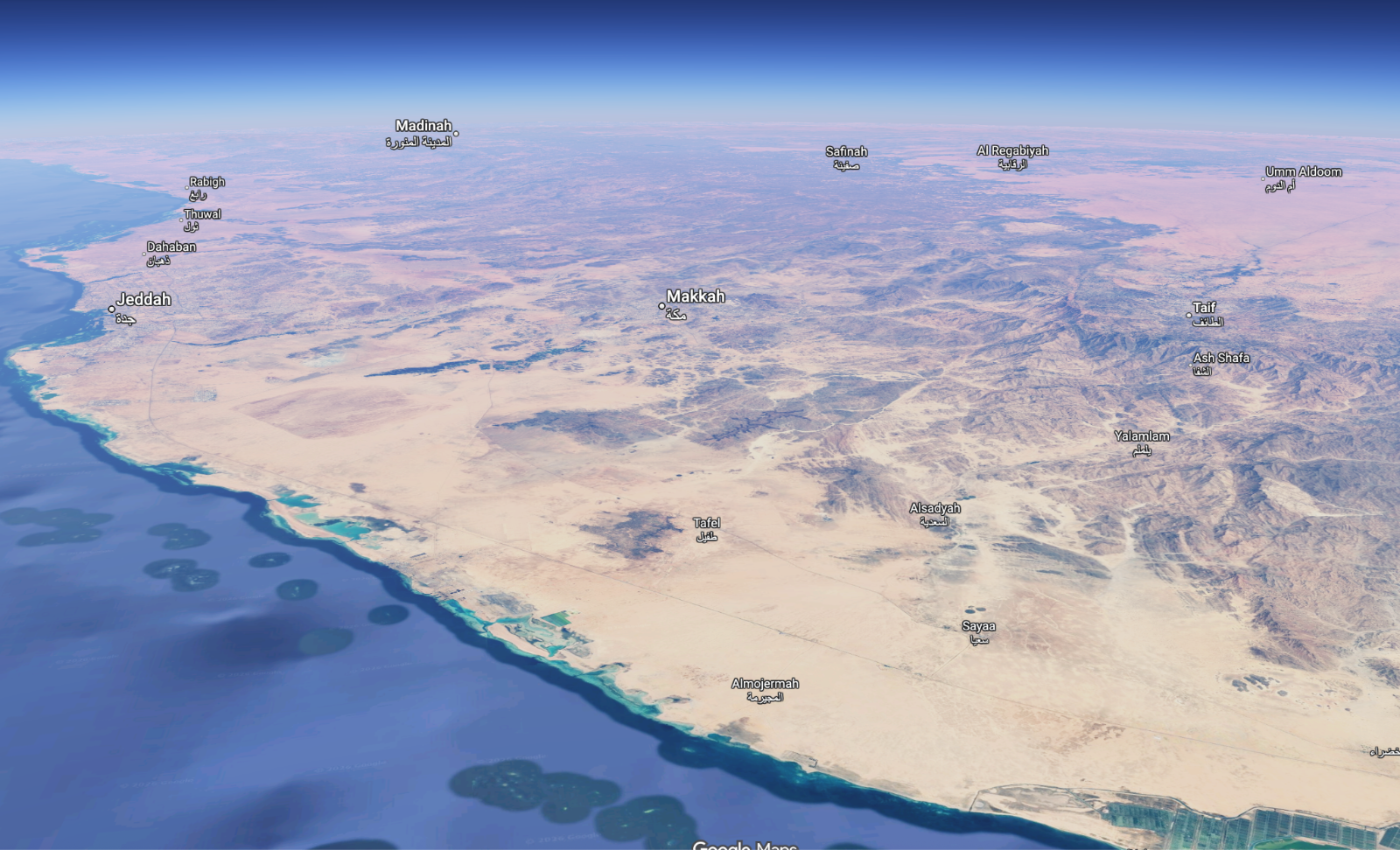
Not much water, mind you; probably enough for a few hundred people in Mecca. Hundreds? What about the claims that Mecca and Medina gathered thousands of soldiers?
The sources of these claims had an incentive to exaggerate: the bigger the forces, the more impressive their exploits.
The soldiers could have been sourced from herders from the surrounding valleys rather than just a specific town like Mecca or Medina.
The Quran says Mecca is a plantless valley.
Due to the lack of water: There’s very little rain here. It’s so hot that most of the rain evaporates. The little that remains is not enough for permanent rivers, only seasonal wadis. This makes trees and agriculture very hard to maintain.
So the most common type of vegetation is shrub, inedible by humans so they need animals to eat it (goats, camels), and then the humans consume the milk & meat of these animals, which means a loss in terms of calories from the grasses and shrubs to the animal products.
With these types of insights, you can approximate the carrying capacity of an area. In the case of Mecca, I asked ChatGPT Pro, and it estimated a few hundred.
An analysis of the genealogy of Muhammad’s Mecca suggests a population of ~550 people.
Mecca is not just distant from trade routes. It’s very desertic, which means little food produced, so the population had to be quite small. The lack of plant or animal resources also meant few goods to trade anyway. In fact, if it traded anything, it was probably to get food, as the region is so infertile that even a few thousand people at the time would have been hard to sustain. What did they trade in exchange for that food? Probably hides from their pastoral activities, very likely slaves.1 It had a shrine (an earlier version of the Kaaba) that the local population and maybe some regional tribes came to visit. Probably not much more.2
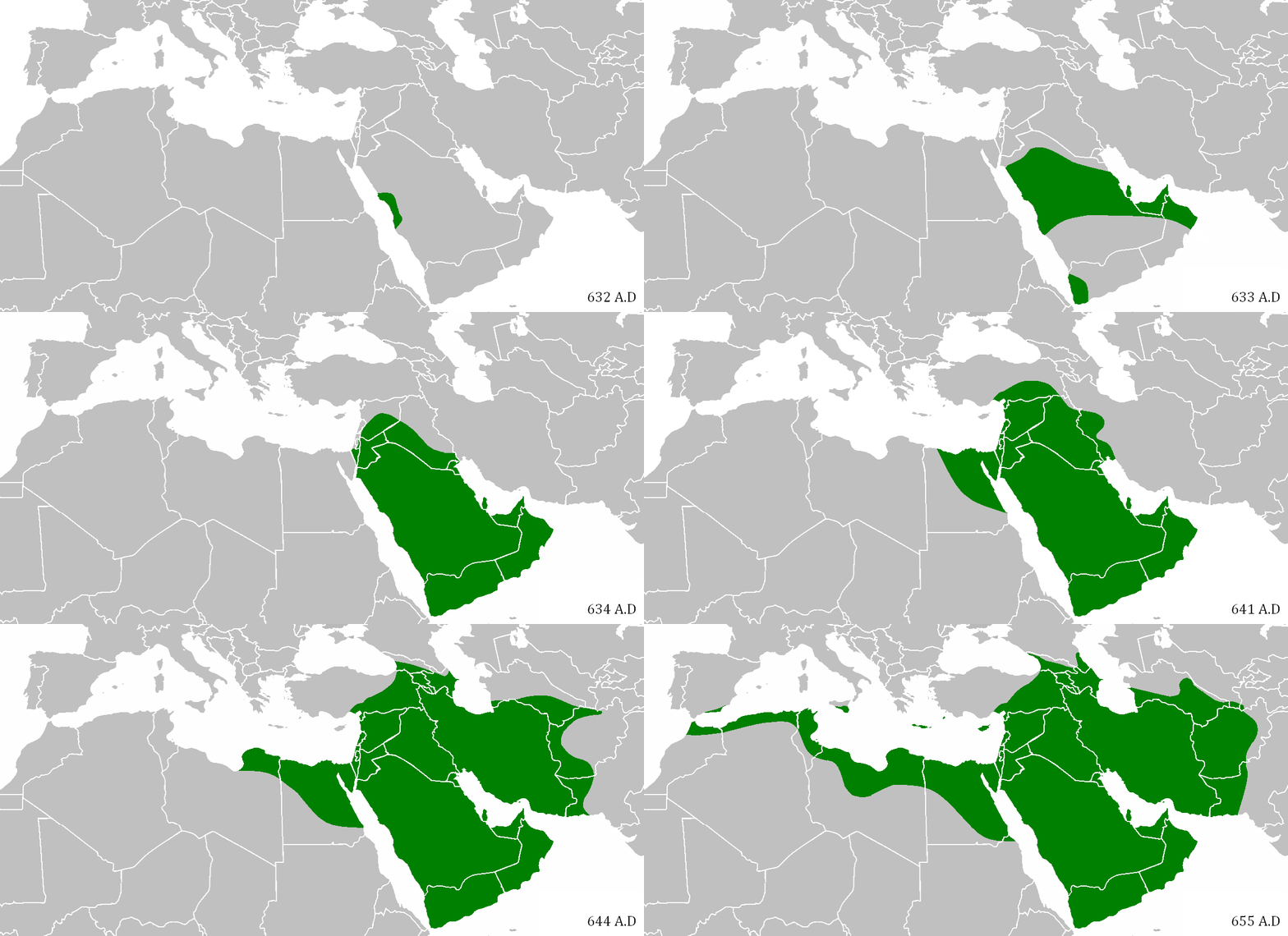
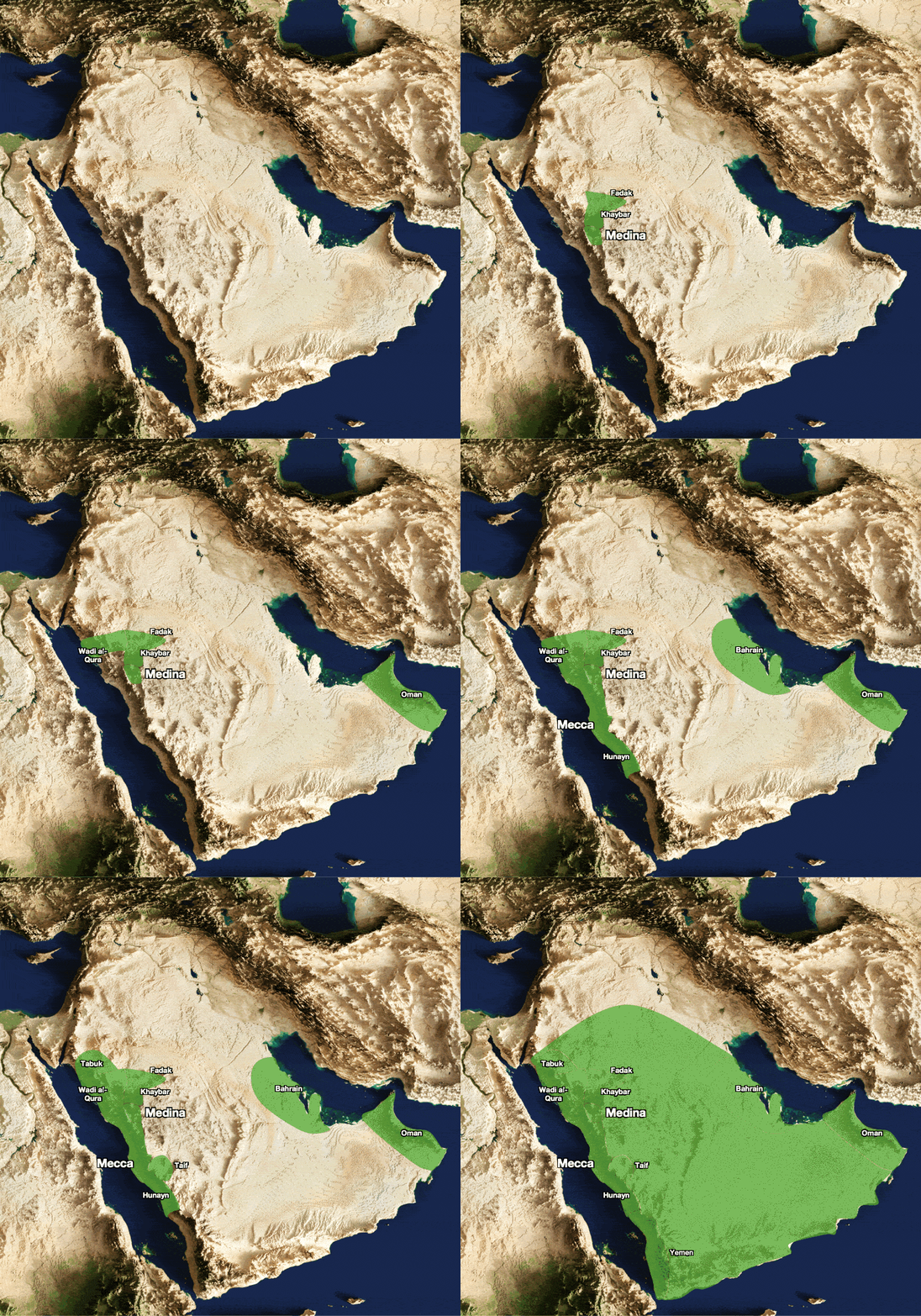
And yet Muhammad and his successors went from Mecca, a city of a few hundred people, to controlling Medina, to then all of Arabia in four years, from 629 to 633:
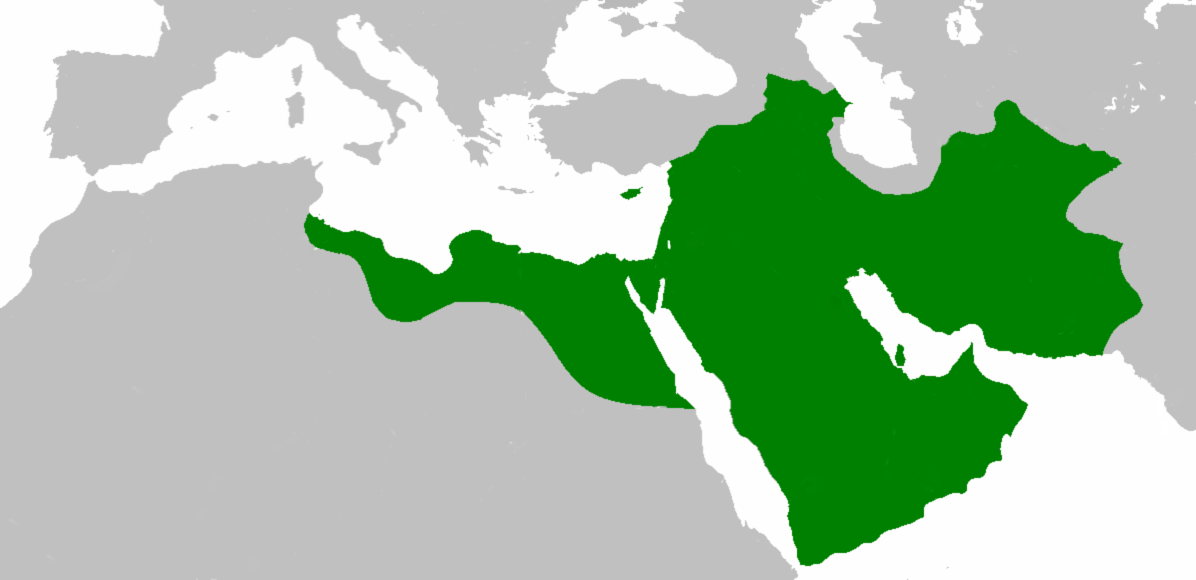
Four successors and 30 years later, this is what the Rashidun Caliphate looked like in 660:
This only thickens the plot. How on earth could a village off the beaten path, with a population of a few hundred people and weak trade, birth a religion shared by 25% of the world’s population today?
No source prior to the Qur’an makes any mention of Mecca, and the Qur’an itself mentions it only a single time (48:24)3. Despite the fact that we have detailed descriptions of western and southern Arabia from various Roman historians, including Procopius (ca. 500–570 CE) most notably, Mecca seems to have been completely unknown to the classical and late ancient worlds. This provides strong evidence that Mecca did not have any significant cultural, economic, or political ties to the broader world of the late ancient Mediterranean and Mesopotamia. Of course, once we recognize that Mecca was a small village with only a few hundreds or thousands of inhabitants and a subsistence economy, its omission becomes perfectly understandable.—The Hijaz in Late Antiquity, Social and Economic Conditions in the Cradle of the Qur’an, Stephen J. Shoemaker, 2022
2. The Software Update of Islam
This is the typical geography in the area of Mecca:
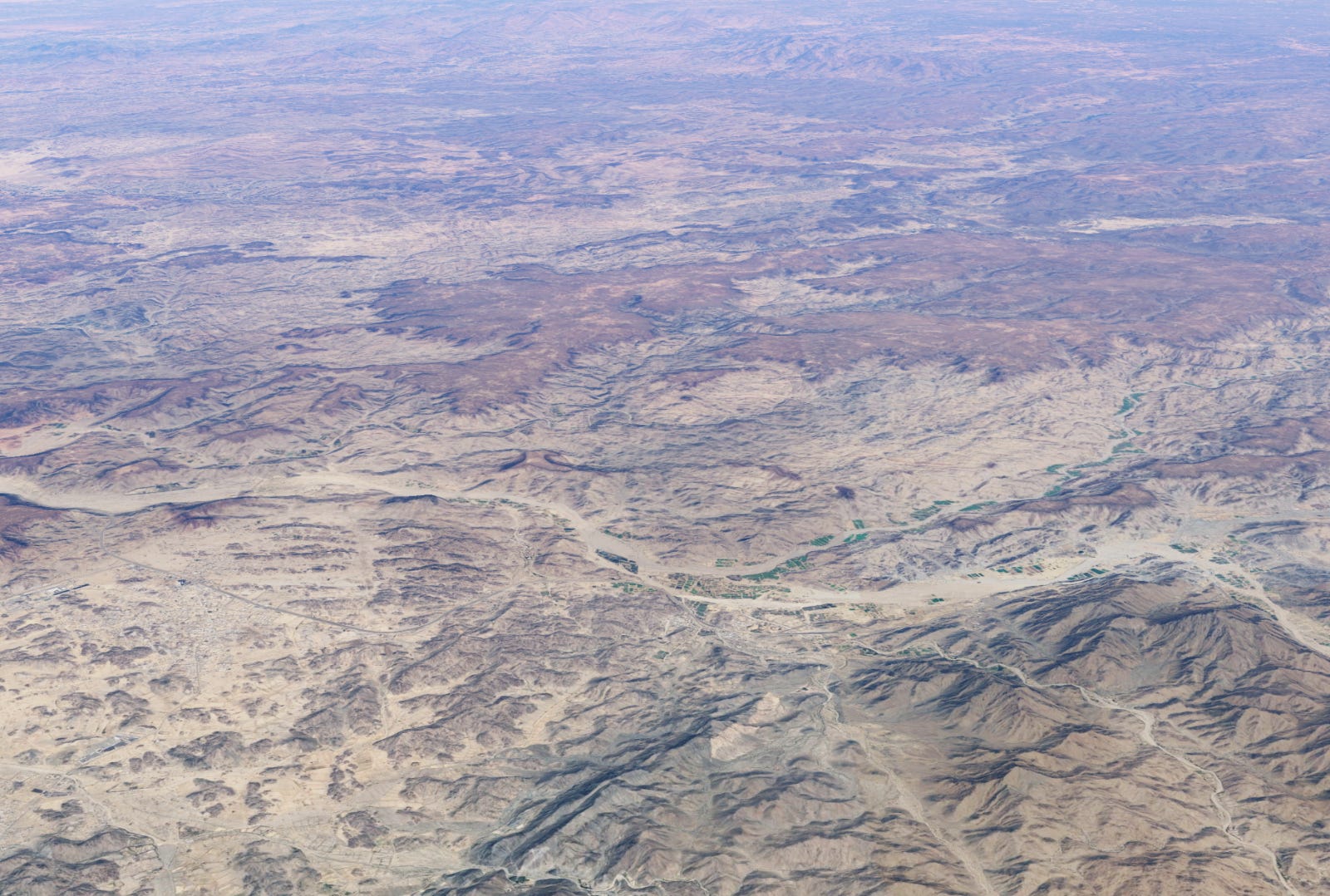
Lots of mountains, some valleys or oases that allow for a little bit of agriculture, mostly shrubs here and there that allow for camels and goats to browse. This is conducive to pastoral clans, who tend to use bloodlines as the unit of community to protect themselves, and tend to attack neighboring clans because it’s easy to steal livestock. So the clan structure looks like this:
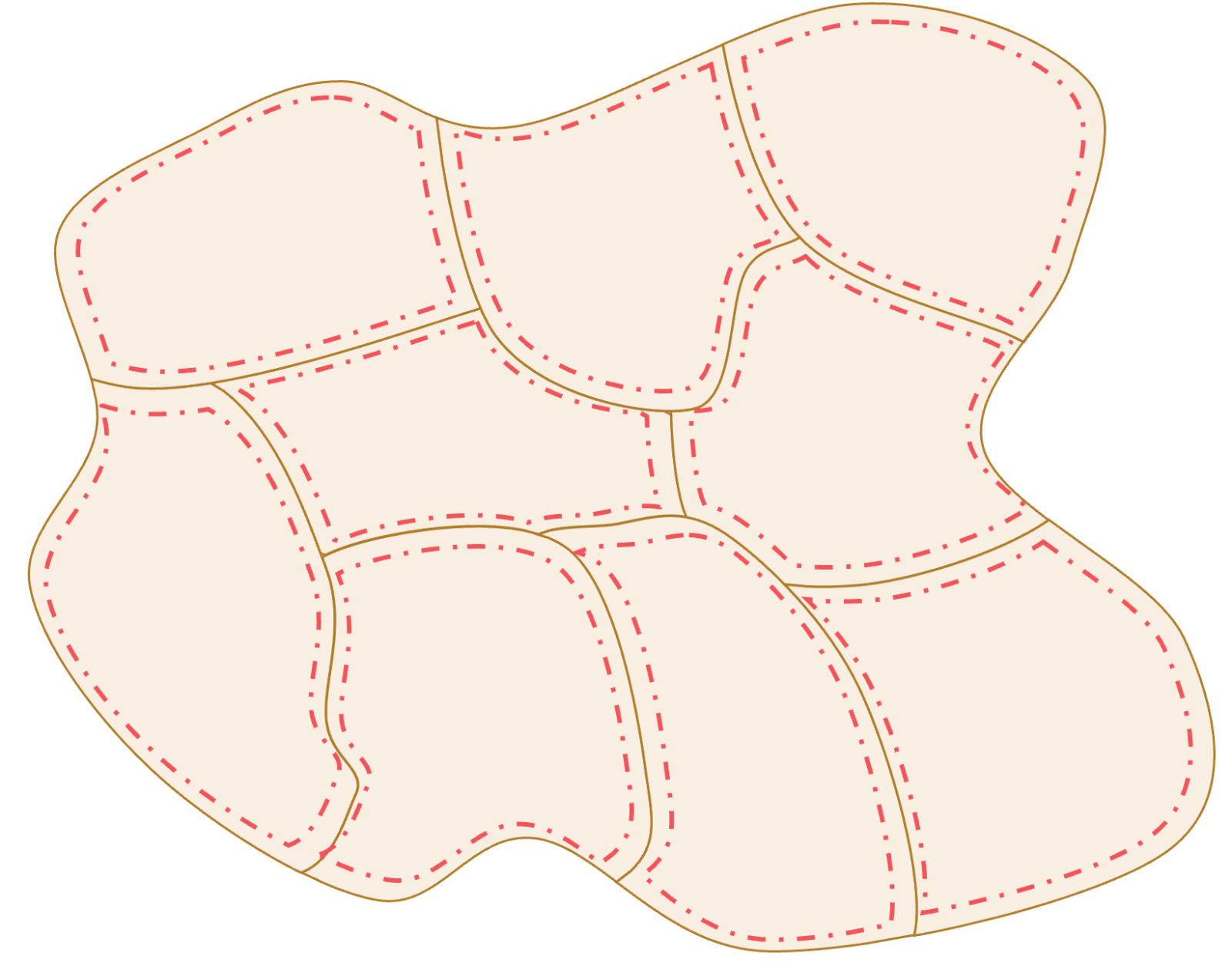
But although this is a stable situation (a “local optimum”), it’s bad: It’s expensive, and will sometimes result in tribal wars that deplete everybody.
A much better and stabler situation (“global optimum”) is this:
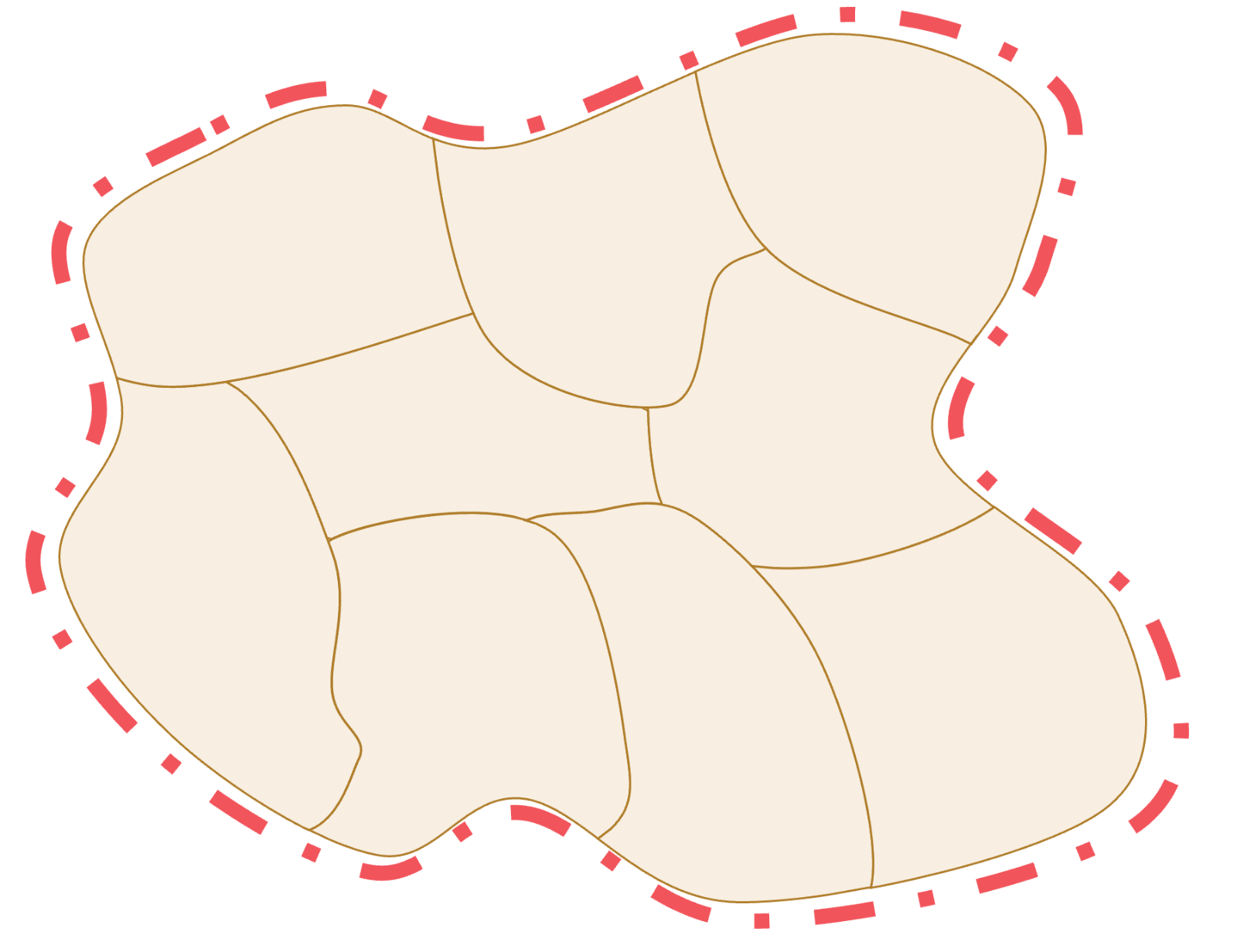
So how do you vanquish the inertia to establish a more optimal situation?

A series of serendipitous situations meant Muhammad was the right person at the right place and the right time to do this across this whole region, and where once there were constant inter-clan wars, there was suddenly a formidable force.
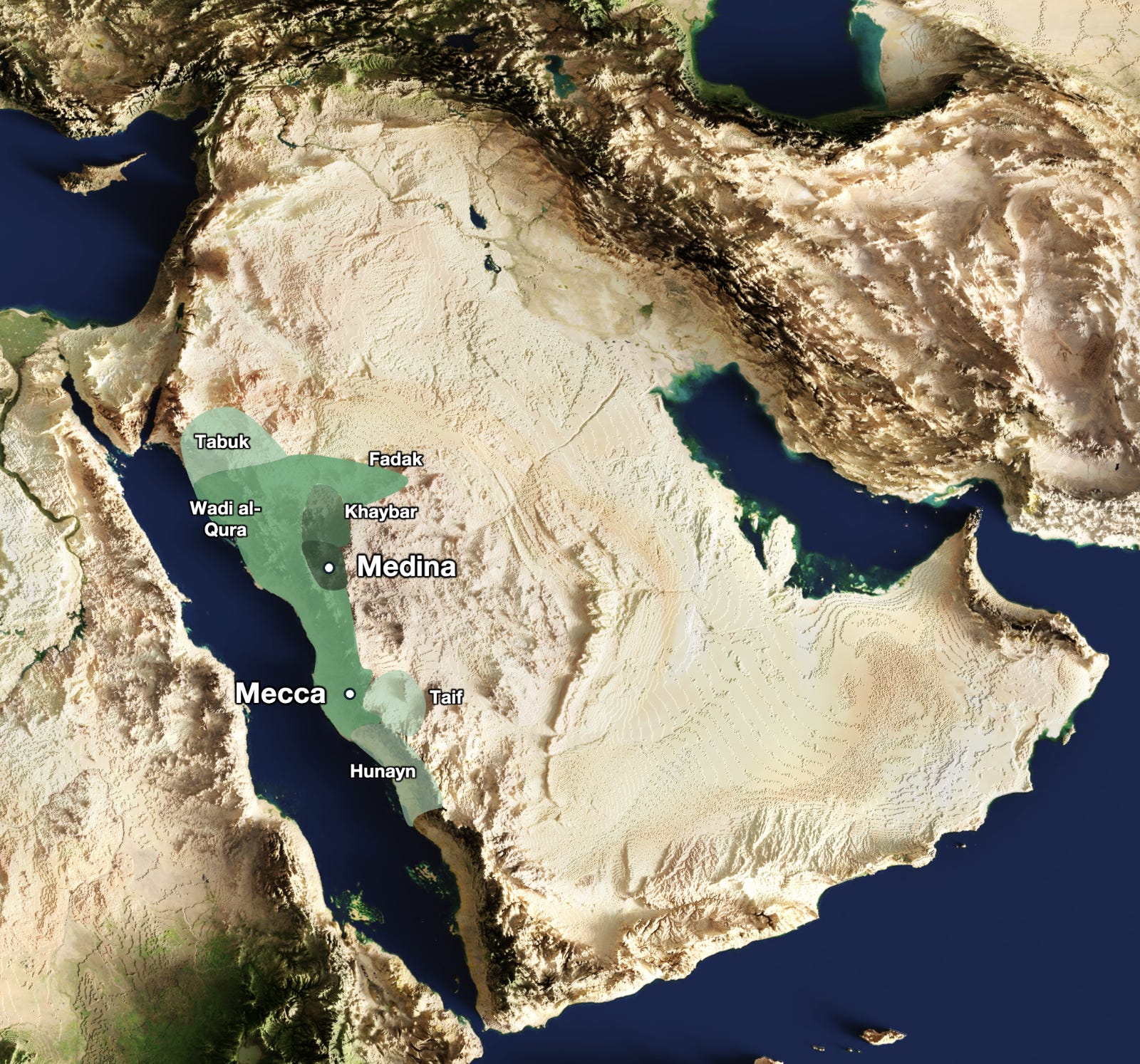
Muhammad, born in 570 AD, was a member of the Quraysh, the predominant4 clan of the village of Mecca. He was part of a smaller branch of the clan, his father died before he was born, and his mother when he was 6. He was raised by his grandfather and later uncle, and was a trader. In 610 AD, he starts seeing visions of the Angel Gabriel. How did this have such a big impact?
Trade
One of the keys to unite people is trade. Unlike goat herding or local agriculture, which don’t need cooperation with foreigners and lead to storing wealth that can be stolen, trade needs cooperation. It’s win-win. So traders have a strong incentive to pacify regions, make clans respect each other and stop war. In exchange, the trade is taxed and clans receive some of the taxes. This is what we saw in Pax Mercatus: Whether it was the Roman Empire, China, rivers in Europe, the Atlantic Ocean in the Age of Discovery, the Pax Mongolica, the Pax Americana… In all cases, trade begets military expansion to bring peace.
So it’s not a coincidence that Muhammad was a trader: He had an incentive to pacify all the clans in the region to allow for camel caravans to trade freely.
It’s not a coincidence either that he really started Islam not in Mecca, but in Medina.
Medina was a bigger town because there was an oasis there.
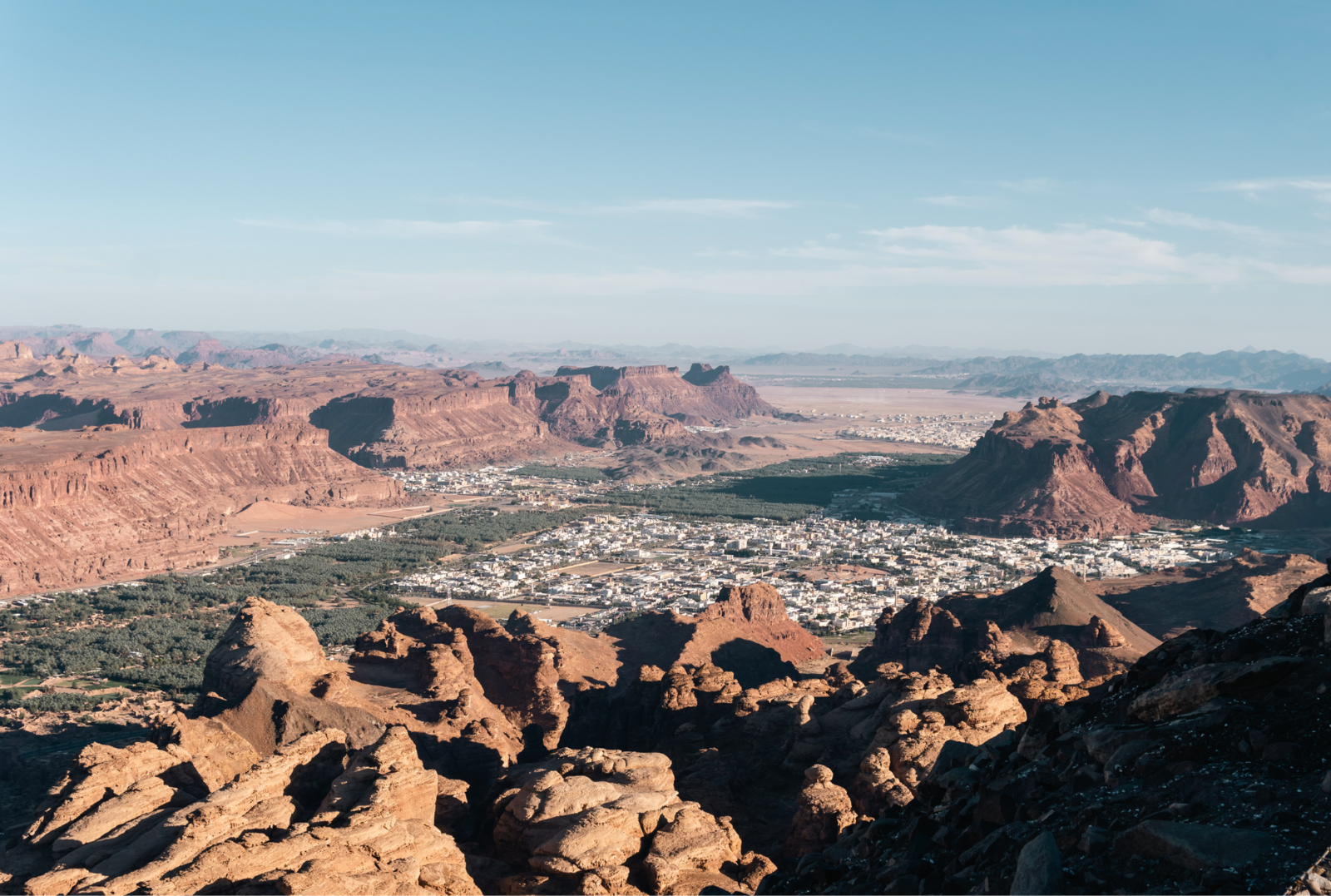
We can understand why when we look at the local topography:
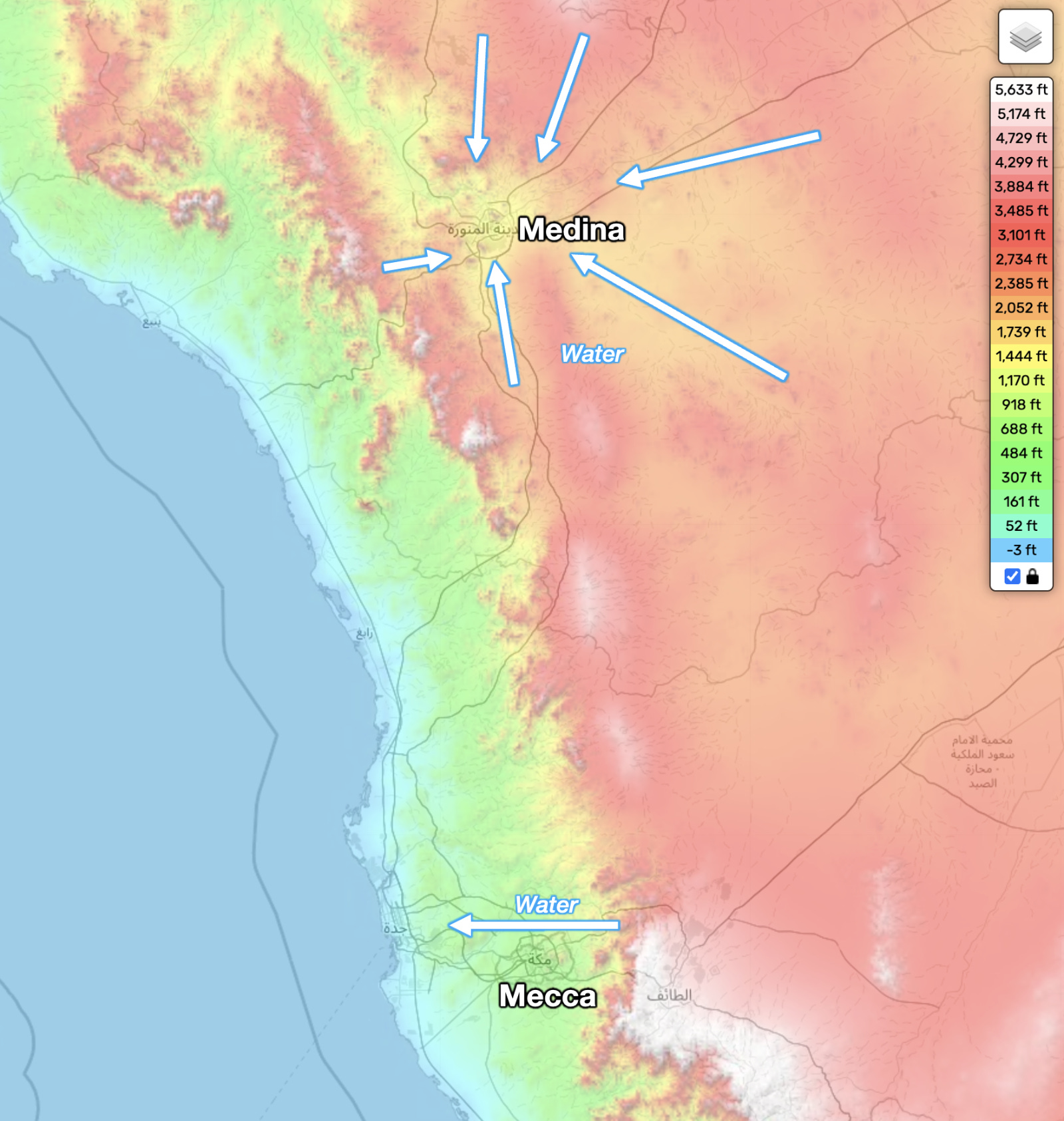
Muhammad started preaching in Mecca and that got him into problems. At some point, other clan members wanted to kill him so he escaped to Medina.
But luckily for him, Medina was just emerging from a tribal war, and was thus especially open to a solution to their clan problem, especially from a trader who promoted trade, peace, mutual respect, and taxation, instead of inter-clan war.
Muhammad created the concept of Umma, or Muslim identity: We’re all the same, we’re all together, we should like each other and not fight each other. He created a meta-identity above that of clans, promoting their union.
By making apostasy strongly punishable, Islam increased the barriers to exit the community: You’re in, and you can’t get out.5
The exhaustion from internecine conflict in Medina made the townspeople open to these changes, and Muhammad became a local mediator, eventually reaching a position of power.
But there were lots of other social engineering innovations that allowed this to happen.
Monotheism
The date of all this is relevant too. We’re now in the 620s, and this is happening:
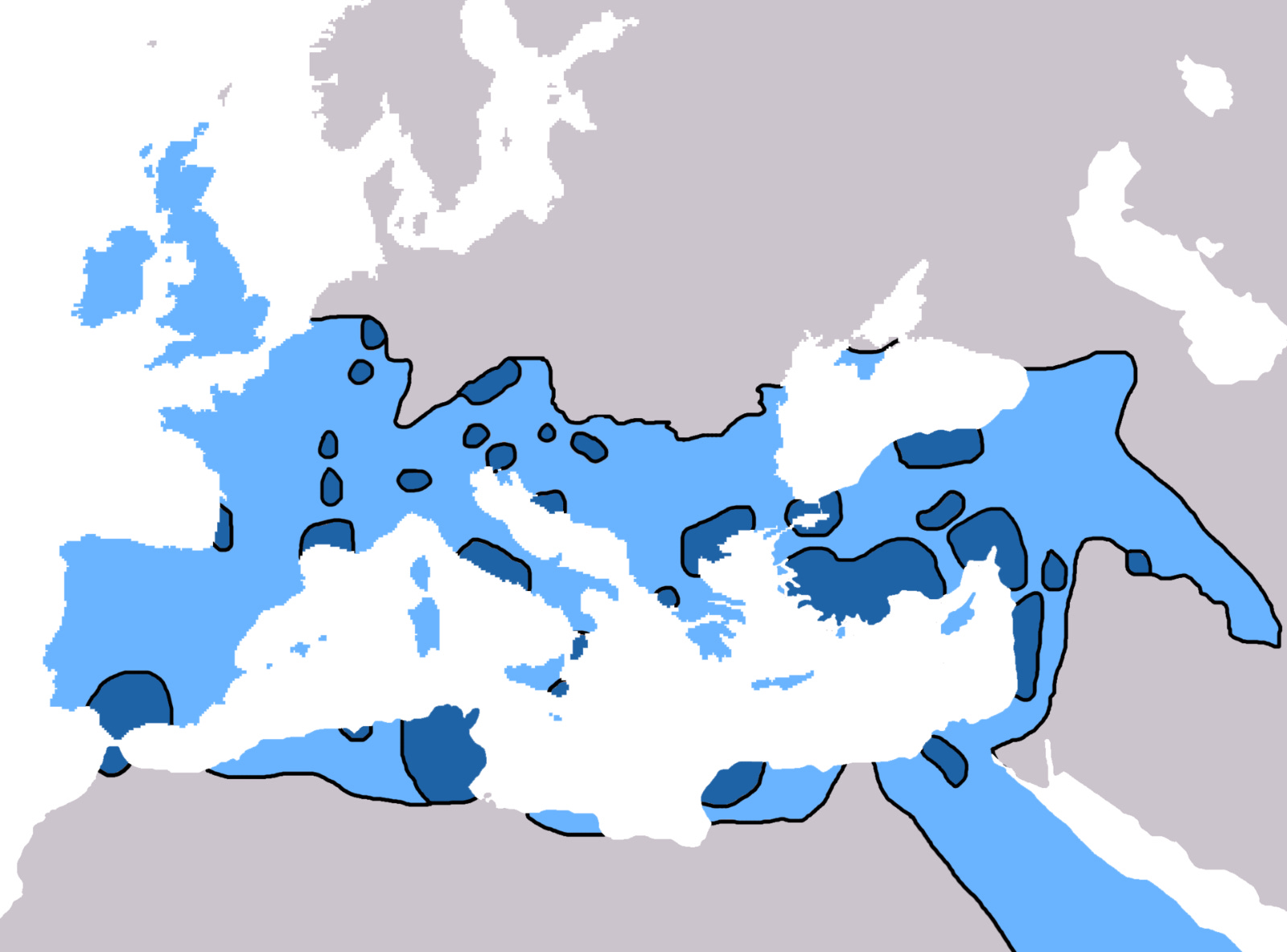
The region was on the border of Christian spread. Although Muhammad was illiterate, he knew about the Bible, Jesus, and the Angel Gabriel. But this belief was not predominant in the region at that time. The main reason why he was kicked out of Mecca was because he adopted the Judeo-Christian idea of monotheism, and that meant he was against the polytheism reigning in Mecca.
The bright side, though, is that once he convinced a group to become monotheistic, he took away one more reason to fight each other.

This also meant that an attack on one of the clans was an attack on all the clans, reducing inter-clan hostility.
Adopting the Judeo-Christian concept of omnipotency (which was not common of deities before monotheism) made the enforcement of rules much easier: Now you couldn’t hide in order to violate the norms, Allah would always see you.
Taxation
When Muhammad escaped from Mecca to Medina, he was starved for income. That’s the context in which we should interpret the importance of alms in Islam. He needed money!
By no means shall you attain righteousness unless you give freely of that which you love, and whatever you give, Allah knows it well.—Qur’an 3:92
Alms became taxation, and Muhammad even sold its ROI:
The example of those who spend their wealth in the way of Allah is like a seed [of grain] which grows seven spikes; in each spike is a hundred grains. And Allah multiplies [His reward] for whom He wills.—Qur’an 2:261
The most important tax is the zakāt, 2.5% of disposable income per year from wealthy-enough people. To me, this is a way for clan leaders to control more funds, as they could tax other wealthy clan members and control how that money would be used. A bit like a subscription: If you pay into this community, we’ll be able to afford more good things for you and your clan.6
A core aspect of this is that the more powerful individuals get more benefits from this tax (clan leaders), while their juniors in power are just compelled to pay up.
This is why, when Muhammad died, there was a war: The bedouins didn’t want to pay up7 so they left the agreement they had with Muhammad, but they were defeated and forced by the richer, more powerful clans to keep paying.
Another way to see the zakāt is pooling money for an investment: With more money, you can afford more warriors fighting for longer, which will then give you more booty to share with them and amongst yourselves.
Violence
As we said, when you eliminate so many internal boundaries, you can redeploy your forces to the external boundaries, so you end up with a much higher concentration of forces to attack neighbors.
The taxation enables funding for these attacks. The Quran is explicit about the mechanism here:
8:1 says the booty belongs to Allah, so no stealing
8:41 says 20% goes to the community (God, the Messenger, kin, orphans, the needy, and travelers. In practice, mostly leadership, dependents, political grants, and the emerging state), and 80% to the fighters.
59:6–7 says spoils without fighting go to the community.
This gives an institutionalized method for everybody to be happy: The fighters pool their strength, they invade, sack, get a bounty, and share some with the organizers, who can keep expanding.
The problem with this is that it can quickly become a scorched-earth strategy, where if you don’t conquer more, you don’t have income to finance your armies, which then turn against you, or can’t maintain peace. So early Islam made sure to keep the local population intact instead of trying to replace it, kept freedom of religion, eliminated and replaced the elites, and charged them the jizya, another tax dedicated to non-Muslims, to fund the entire operation.
These taxes could be hefty. When Muhammad conquered the Jewish settlement of Khaybar, north of Medina, the annual tax was 50% of what was produced.
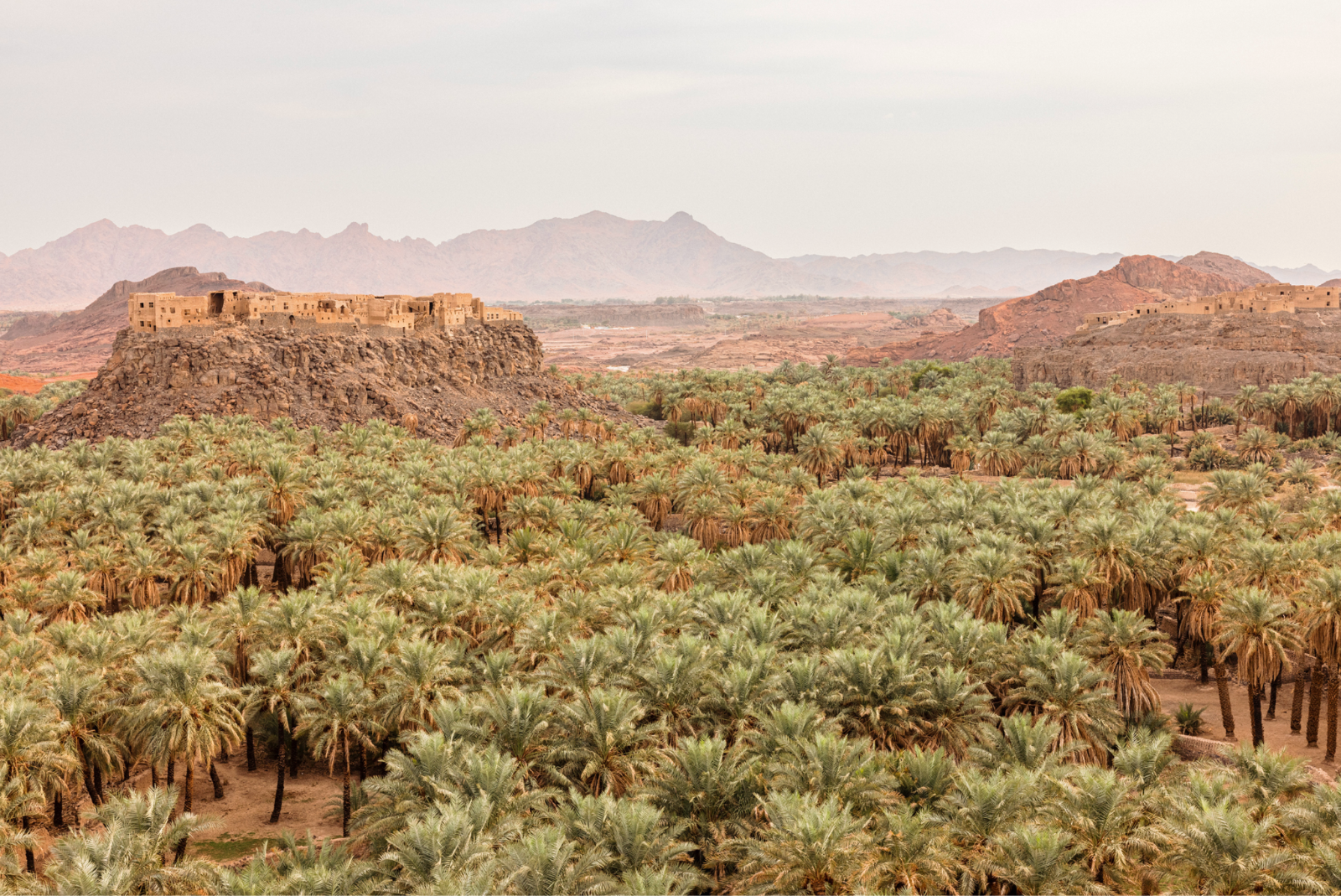
Notice the pattern here: early on, Muhammad didn’t have power or money. He used his position as a respected external trader to broker peace in Medina, which gave him enough power to raid caravans, eventually taking Khaybar and its date production. He was converting military power into economic power, and every time he did, he could reuse the local resources to tax them, recruit new soldiers, or both.

In effect, this meant warriors went from potential raiding threats to subjects of a standing army, with a stipend they could lose if they left. This became obvious in the Ridda Wars: When Muhammad died, many tribes seceded from Islam, but his successor Abu Bakr was able to harness the existing ones to subdue the secessionists and reunite Arabia.
Desert Nomad Logistics
Arabia naturally breeds the type of warrior that thrives in all the regions from Morocco to Iraq. The cornerstone is the camel, which can eat the type of vegetation in this area and store water to sustain long trips in the desert. They are quick and don’t need roads.
On top of that, Arabs had become careful water and grazing managers. They knew where to go to refuel, how much to take, and when to move on. They could move quickly from oasis to wadi, to fertile valley, not depleting their resources in the process. Compare that with European and Persian armies, which had to bring some of their food with them, had to feed the horses fodder besides the grass they ate on the way, and had an entire logistics train to manage to make all this happen.
Garrison Towns
Another innovation in violence that came a few years after Muhammad’s death was the garrison towns, such as Basra and Kufa in Iraq, and Fustat in Egypt.
Most armies were raised specifically for a conquest and then returned. This made the control of occupied lands difficult.
So other empires had garrisons too, but they tended to be either in existing cities or become cities themselves, and soldiers and locals commingled, which could dilute the force of the conqueror. Indeed, all the invasions that took place in Europe at that time from eastern hordes ended up with these hordes adopting the mores of the locals (Latin language, Christianism…) rather than the other way around. Not for the Muslims.
Early on, the Muslims made sure to keep the conquerors and conquered separate. This allowed for less corruption, more control over the local population, and keeping the soldiers more in line and easier to redeploy. And since they stayed put in these garrisons rather than coming back, they could maintain control of the lands taken over.
Polygamy
Whereas in Byzantium marriages were monogamous (because of Christianity), this had not percolated into the region. Muhammad didn’t adopt it in Islam, which might have been quite clever for the religion’s spread. Instead, he regulated polygamy, which had been too extreme before (too many wives per man). It limited men to four wives at any given time (so more wives could be taken sequentially).
Keeping polygamy had a couple of advantages. First, a conqueror could marry the daughters of several conquered elites to pacify them. The more wives they could have, the better. Muhammad had 11-13 wives. This was crucial to unite Arabia, as many of these wives were taken to cement the adhere of new clans to Islam.
Second, polygamy created a surplus of single men with no access to sex. If, say, ~25% of men were polygamous and they married on average three women, and 25% had one wife, then 50% of men would not have access to a woman.
Banning access to sex to lots of young males is a recipe for raids—they’re hunting for wives—so it made much more sense to repurpose their desires to attack foreigners. So Muhammad continued the practice that part of a soldiers’ loot would include slaves, wives, and concubines.
The problem is if your soldiers fear dying in battle, they might not want to engage at all. So a great innovation of the Quran was to conceive beautiful, pure, virgin companions in heaven for true believers. A couple of centuries later, that would become the story of 72 virgins for religious martyrs.
Succession
By making allegiance to Allah and not just a person (himself), he made the new community outlast his own life.
But crucially, it wasn’t settled how the leadership of Islam would work, as Muhammad died suddenly.8 This led to internecine wars for power, which sometimes are bad because they lead to civil wars (plenty of these in Islam), but on another side, they allow competitive forces to play within Islam: The religion can’t settle and rot from inside from a series of bad leaders, because there’s always some competing reading of Islam to challenge the current one.
From Software to Hardware
So these are some of the mechanisms that let Islam grow from a tiny settlement to taking over Arabia.

I’m not saying these mechanisms were purposefully designed. Whether they came from Allah via the Angel Gabriel, or Muhammad and his successors chose them (consciously or unconsciously), the fact is they were software ideal for fast spread.
I’m sure I got some of these mechanisms wrong, and that I’m missing a few more. If you have more, please share them! But these look like the most important parts of the software update that unleashed the potential of the Arab tribes.
At the right time.
3. The Fall of Empires
This was the region when Muhammad arrived.
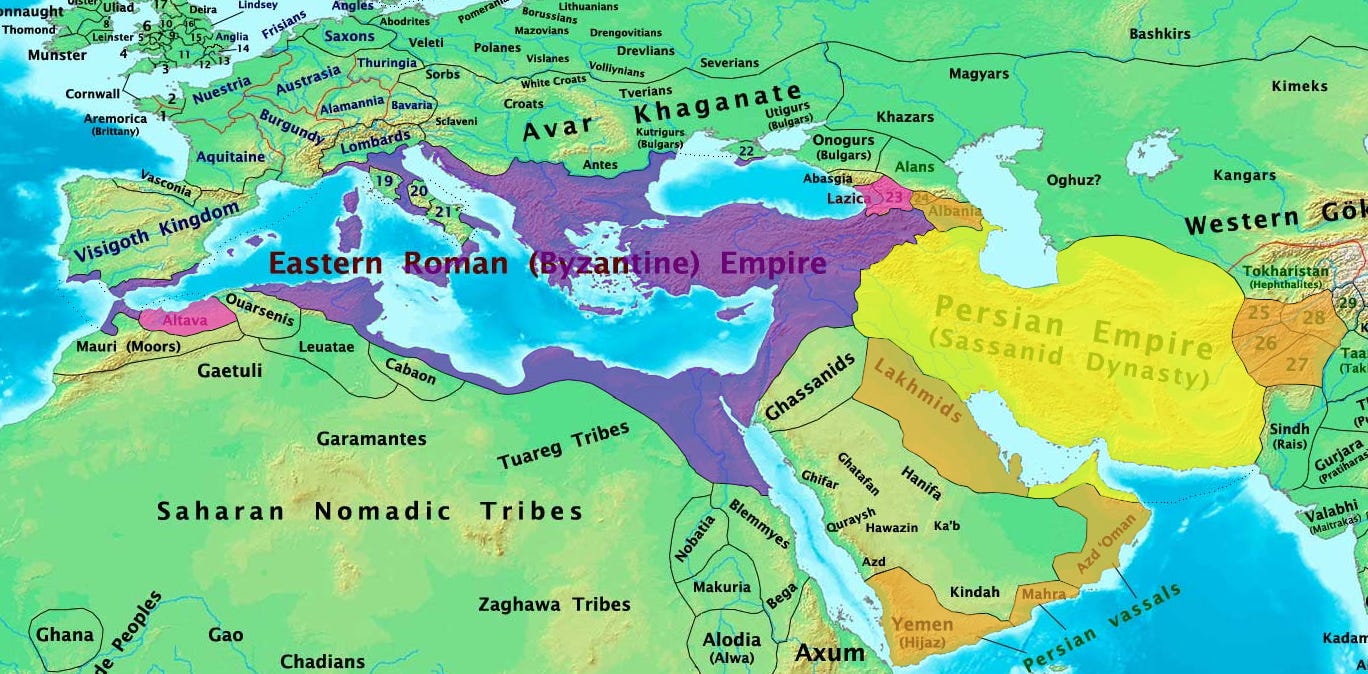
The Byzantines were weak: Half of their empire had disappeared under the arrival of the hordes from the north and east: Ostrogoths, Visigoths, Vandals, Franks, Goths, Huns... It spent its time warring with them, and with the Sassanids to the east.
It had remained mainly a maritime power, as you can guess from the map above. This exposed it dearly to land-based threats.
The Sassanids were also threatened to the east by similar nomadic tribes.
Crucially, the Byzantines and the Sassanids fought a terrible war between 602 and 628, just as Muhammad was uniting Arabia. By the time Arabia it was completed in 633, the situation was:
Two exhausted rivals
The plains of Egypt, the Levant, and Mesopotamia fully exposed to a neighboring power
Egypt and the Levant were especially exposed because their patron (Byzantium) was a naval power
Mesopotamia was very exposed because it was directly connected to Arabia, and the Sassanid Empire, aside from its exhaustion from the war with Byzantium, was fighting on its eastern side
And this happened:
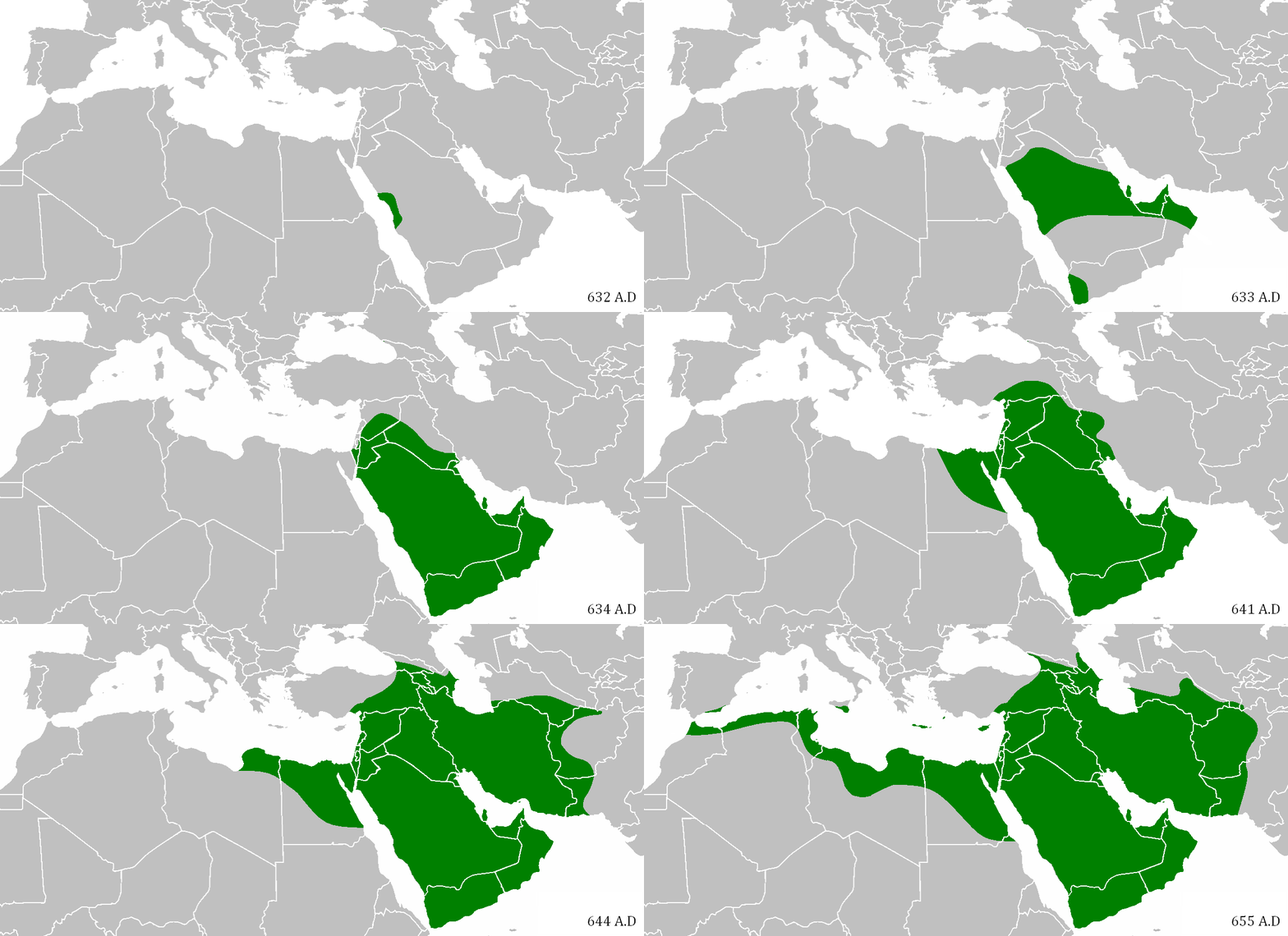
The Rashidun Caliphate (the first four descendants of Muhammad) reached:
In the north, the Levant and then Anatolia
In the east, Mesopotamia and then the Sassanid Empire
In the west, to Egypt, and then northern Africa
As they grew, they could simply take over existing elites and keep the economic production and tax it.
The expansion across all of north Africa looks especially incredible, until you realize a couple of things:
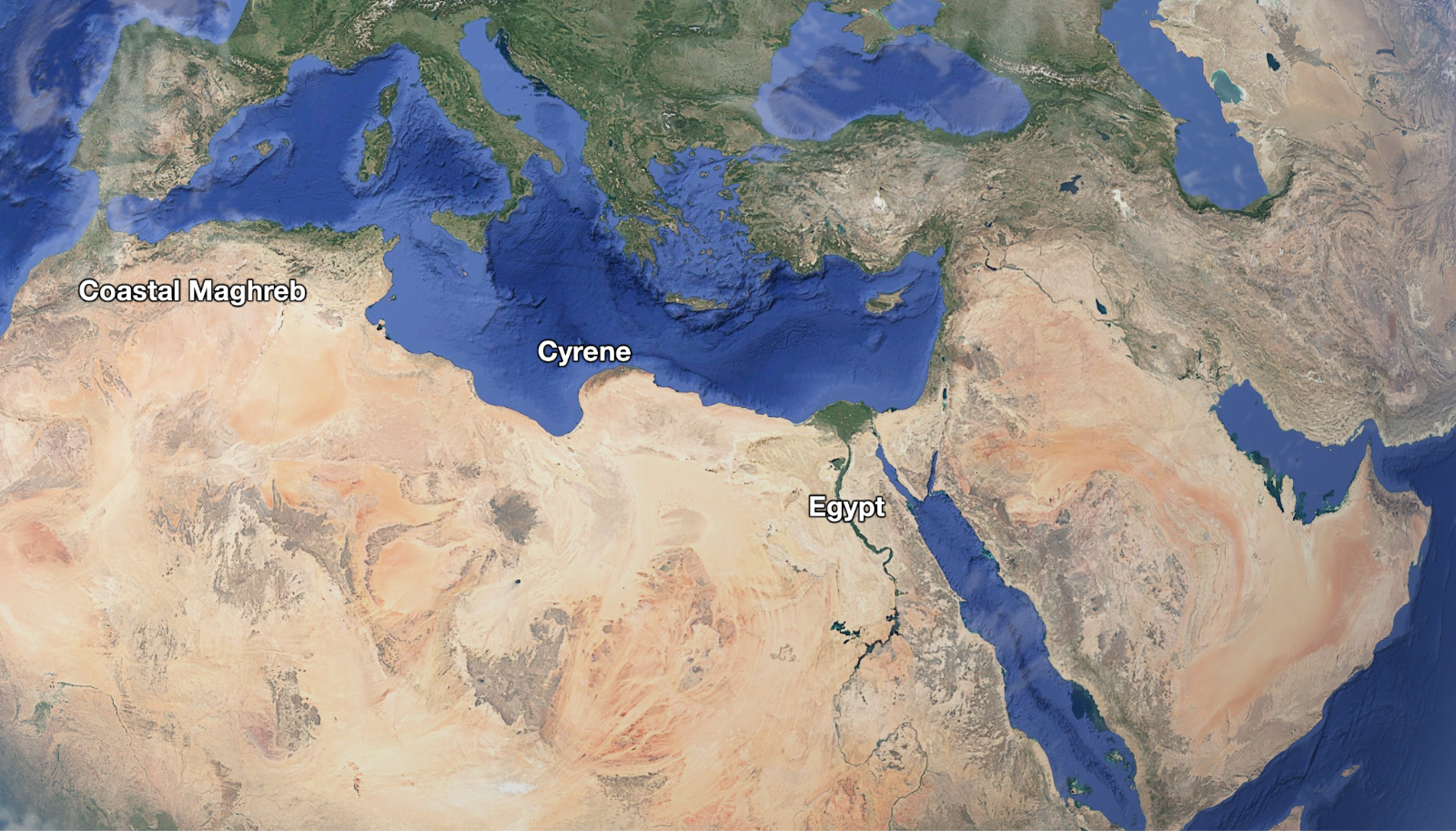
First, virtually all of it is desert, which means there’s not that much opposition. It’s focused in the three areas of Egypt, Cyrene, and Coastal Maghreb. All three were colonies of Byzantium (so not self-ruling), and all three were focused on sea threats rather than land threats.
Second, the Arabs were specialized in long treks across the desert. This didn’t fundamentally change their logistics.
So this is how I understand that the Arabs went from a few clans in the mountains of a peripheral region to conquering one of the biggest empires of the time in a mere 30 years:
Beyond Egypt, most of North Africa is a repeat of Arabia, so easy for Arabs to conquer, ad they’re naturally adapted to the terrain
Muhammad added new software to unite the clans and harness taxes, so that Islam had soldiers and money to fund wars
Three bordering lands (Egypt, Levant, Mesopotamia) were easy to conquer as they have few mountains to protect them and are close to Arabia: Egypt, the Levant, and Mesopotamia
There was a moment of unique weakness of the two regional powers, so Muslims could take parts of the otherwise hard-to-conquer Anatolia and Persia
There are large swaths with no water and settlements. North Africa is just Egypt, Cyrene, and northern Maghreb.
How did Islam keep expanding? How did it invade Spain? Anatolia? Europe? How did it spread across east Africa? Southeast Asia? What’s the relation between Arab, Arabic, and Islam? How did they each spread in somewhat different places? That’s what we’re going to see next.
This is a highly scrutinized part of history, I welcome your feedback on what I got right or wrong!
Slaves were probably from Abyssinia, present-day Ethiopia, as it’s mentioned in the text of the period, and the successor to Muhammad freed slaves. There was frankincense and myrrh trade in the region, but it probably bypassed Mecca and Medina and was traded via sea routes. There were not metals (gold, silver, copper), despite their presence in the region, because all evidence points to them being mined after the time of Muhammad, not before.
There was a local oral tradition that claims regional trade pacts. Some have interpreted them as treaties between Mecca and kingdoms or empires like Byzantium, Persia, Yemen, or Ethiopia. But these are unlikely. First, there’s no document supporting this. Second, most trade in the region was by sea. Third, the overland trade was mostly by caravan, which meant that local protection and no taxes were much more important than treaties with distant powers.This doesn’t mean Mecca was a secondary hamlet in Arabia, because the rest of the region was equally unpopulated. Mecca had some regional connection through trade and pilgrimage, even if it was quite small compared to the standards of other regions at the time.
There’s also a Bakkah named, which could be Mecca. Medina is mentioned once in the Quran. To be fair though, the Quran doesn’t mention cities much at all. Medina appears in more places in sources from antiquity, although usually in lists of places, not as a place of special importance.
By predominant, here it means most people in the village were part of the clan one way or another.
The Quran says apostates should be seriously punished, especially in the afterlife, but it does not say the punishment for apostasy is death. This came later.
Whereas a tax nowadays is money that disappears from your pocket and you don’t have much of a say on how it’s spent aside from a vote every four years or so.
Some say due to poison from a Jewish lady from Khaybar.
Interesting article.
I think that there are clear parallels between this and Genghis Khan. Both united warring tribes within Herding societies into centralized political authority and turned them into vehicles for external expansion against much larger Agrarian empires. The biggest difference is that in the Middle East, religion played a much bigger role.
Genghis Khan built unity through:
* Forced restructuring of tribes
* Merit-based advancement
* Military organization
* Shared spoils and success
* Strict legal code (Yassa)
Lovely post and I agree with most of it, although I would like to add a few thoughts regarding the Roman Persian war.
Firstly, I think that war was essential to Islam conquering Arabia because in the normal course of events, neither power would have permitted one single force to take over Arabia. It’s just that they were too busy fighting each other to do anything and afterwards, they were pretty exhausted. Secondly, Persia descended into a pretty chaotic civil war for four years after losing the war and ended up with a child king at the end with the actual government being run by a bunch of regents instead of a single king. This is a major problem both because of normal in fighting issues, but also because central authority was dramatically damaged and obviously no regent has the kind of legitimacy that an adult Kingwood and thus has less political capital. Also just easier to conquer a chaotic government recovering from a civil war instead of a prosperous and stable kingdom that has not undergone any recent problems.
On the Roamen front, the Persians had taken over a lot of their territories, including Egypt the Levant and parts of Anatolia, before being finally defeated, which meant that the territories had been outside their control for over a decade in many cases, which doubtless made them easier to conquer an integrate. And while they weren’t in civil war, when the conquest started their political stability during this period was generally pretty bad and got worse with time. Although I expect, this was also in part consequence of losing legitimacy on account of losing wars. Add in the fact that they had pretty much thrown everything they had into fighting the persons and with us pretty exhausted and it’s not surprising that they collapsed so fast, especially since in places like North Africa, the Arabs were pretty good at integrating other nomadic tribes into their military force, which obviously increased their military power. By integration, I don’t mean hear that they were treated like Arabs, but they became part of the Arab military, and this was obviously a force multiplier for them as it has always been for nomads, integrating other nomadic groups into their army.
Honestly, the whole thing reminds me of the step where the moment a single leader can get their snowball rolling by uniting the entire step under their leadership. They immediately become capable of taking over a huge empire. Although of course many of the advantages that the step gives you don’t exist for the Arabs. The obvious solution of course is to never let the step unite under a single leader and the same applies to Arabia, but as I mentioned earlier, being distracted, fighting each other meant nobody was keeping an eye on that.