

This man has the hardest job in the world:
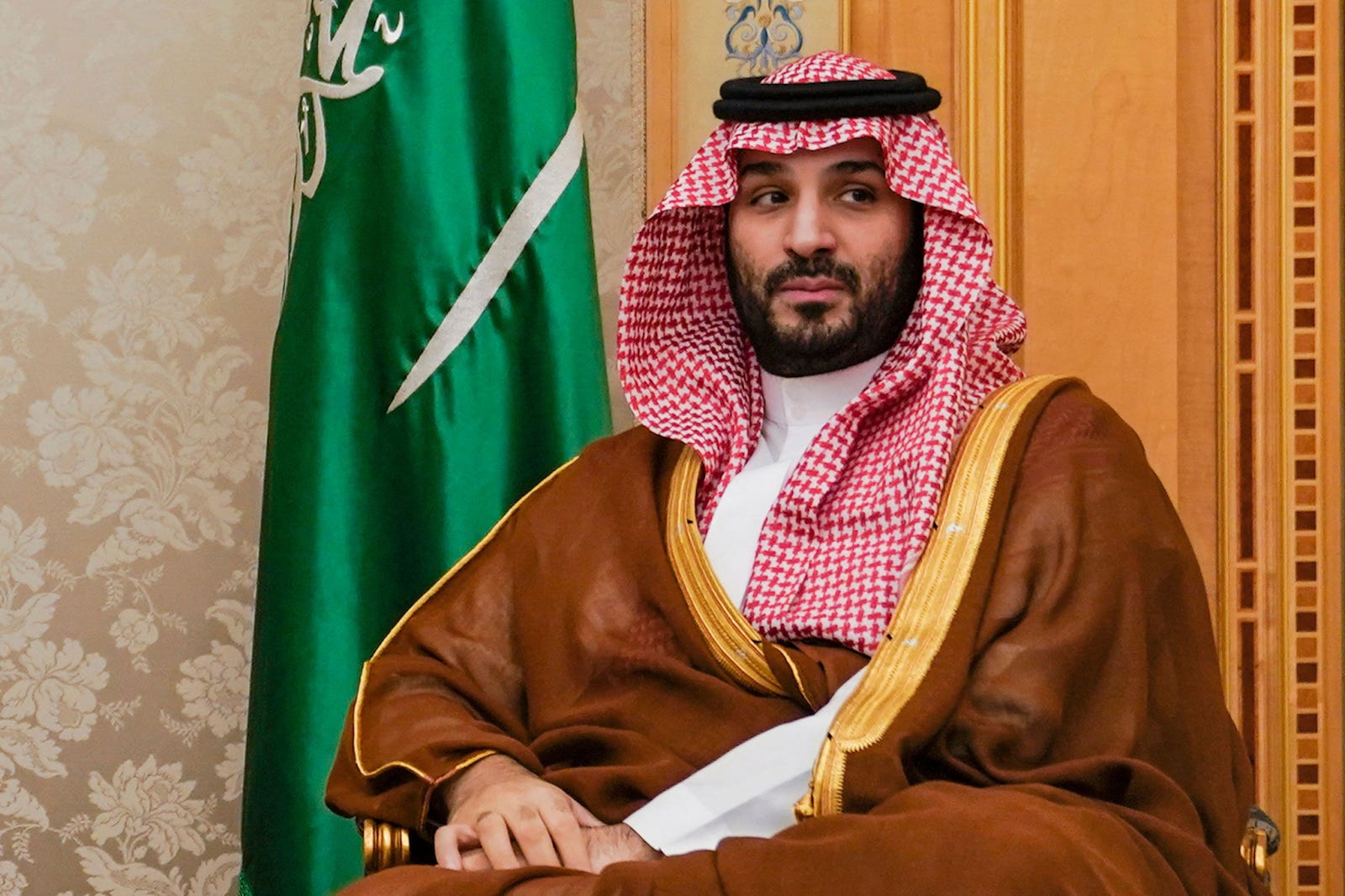
He has to transition the biggest conservative petrostate in the world into a modern, diversified economy. The odds are stacked impossibly against him. To understand why, and how likely he is to succeed, we need to understand the three words that encapsulate his predicament: Saudi, Arabia, and Oil.
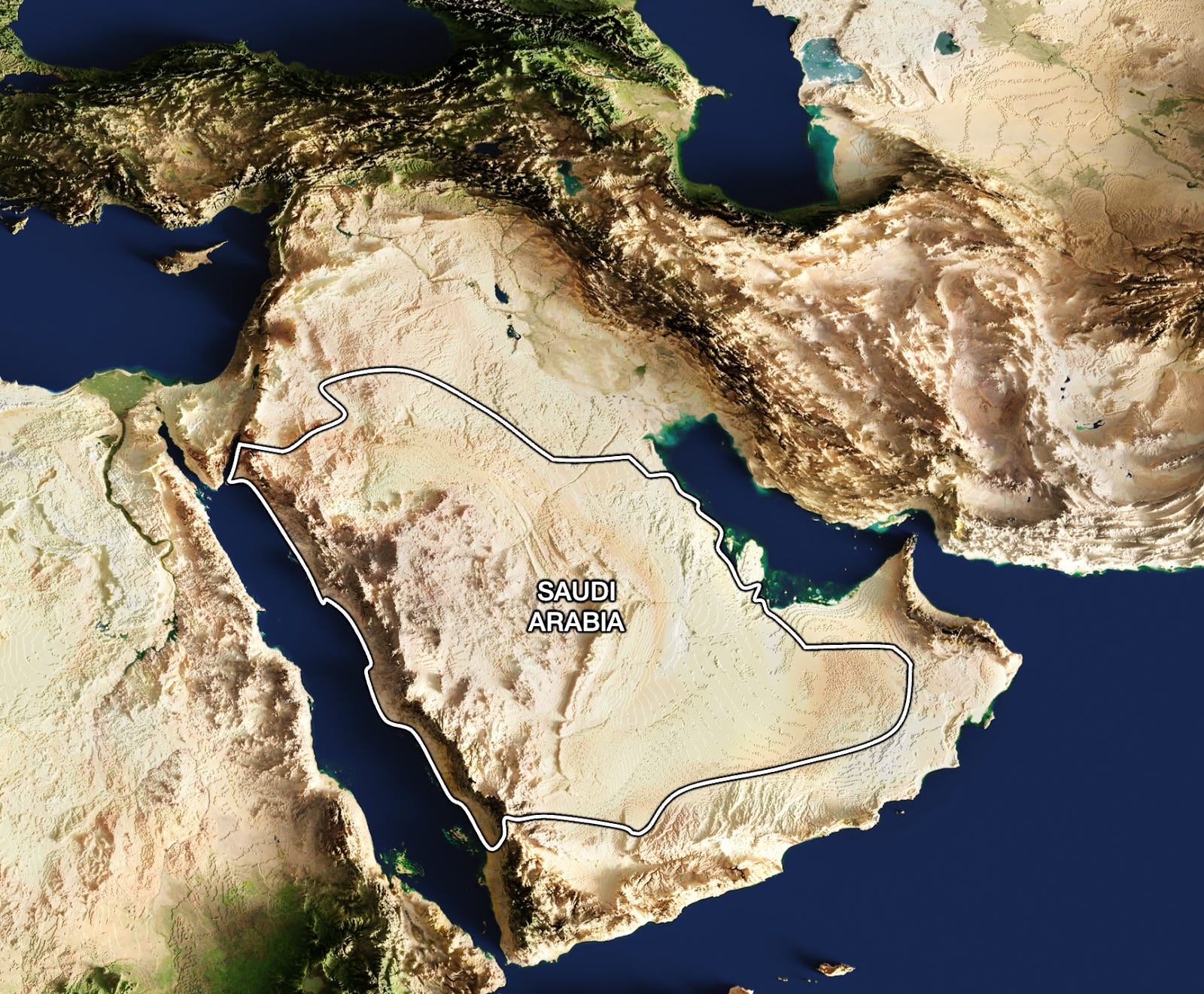
Arabia
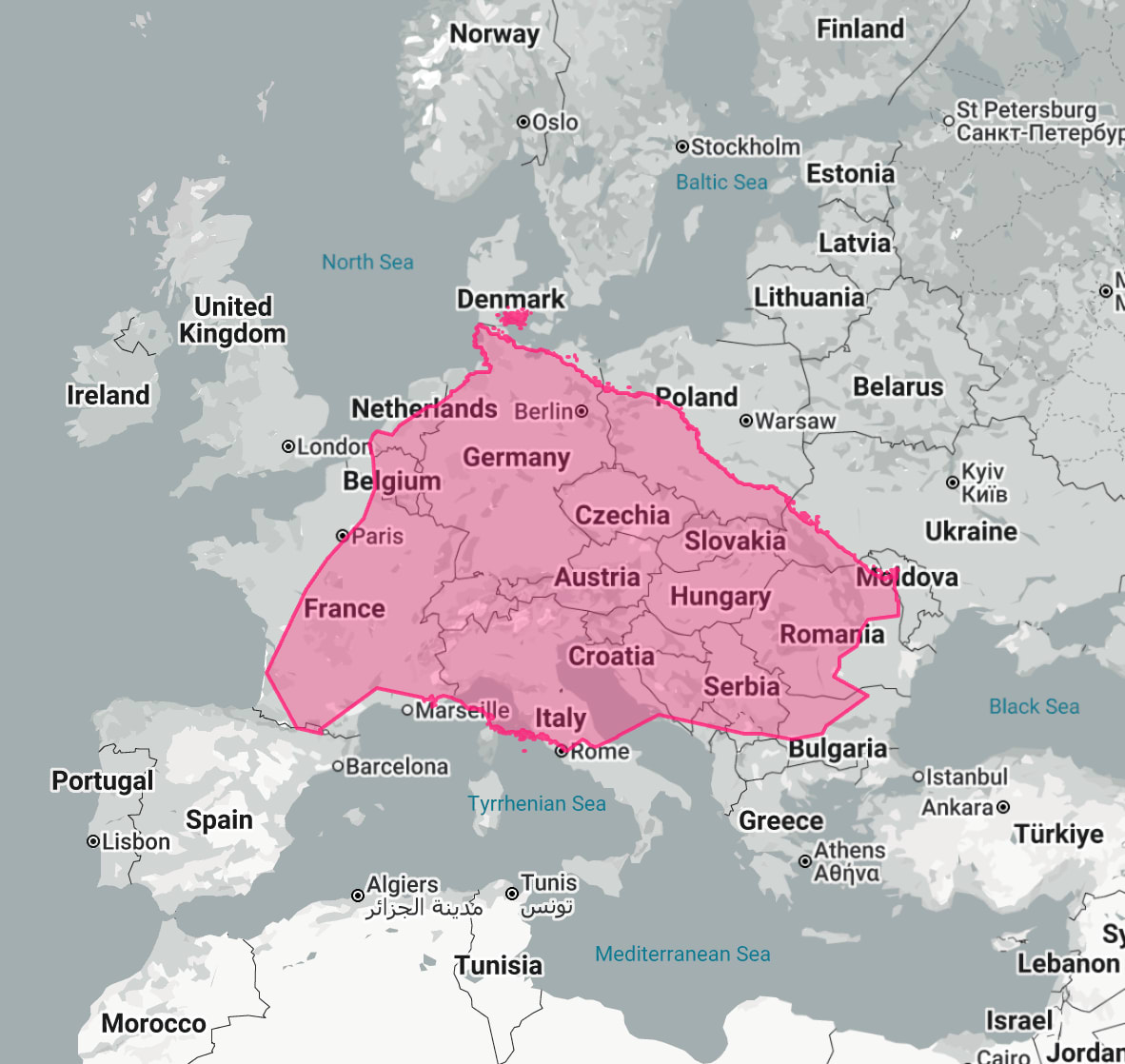
Saudi Arabia is a big country.
It’s big, and it sits in the middle of an otherwise pretty divided region:
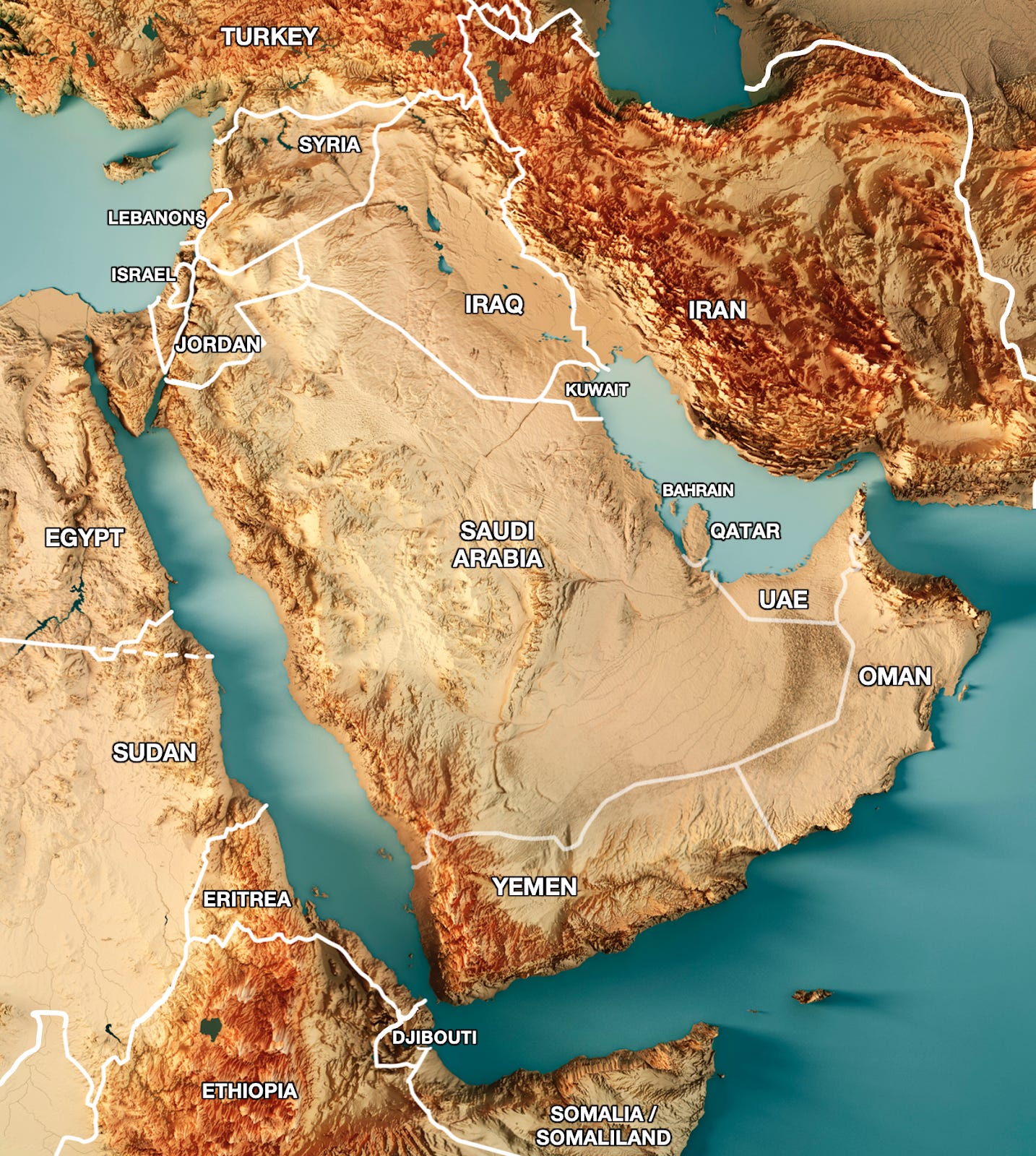
Why is the region so divided? Because it’s in the middle of everything.
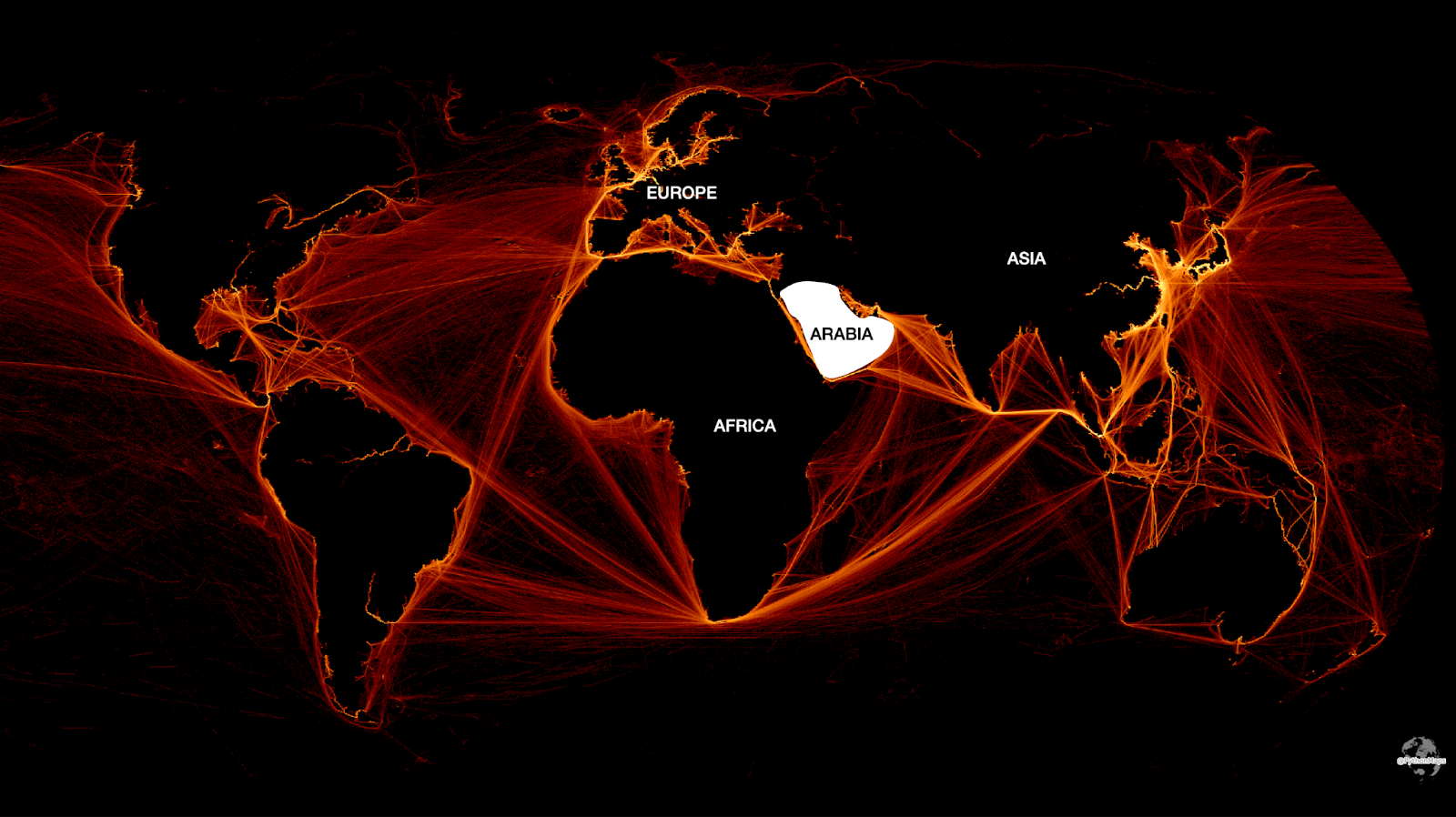
Virtually everything that moves between Europe, Asia, and Africa moves along the border seas of Arabia, pretty close to the coast because the passages are narrow:
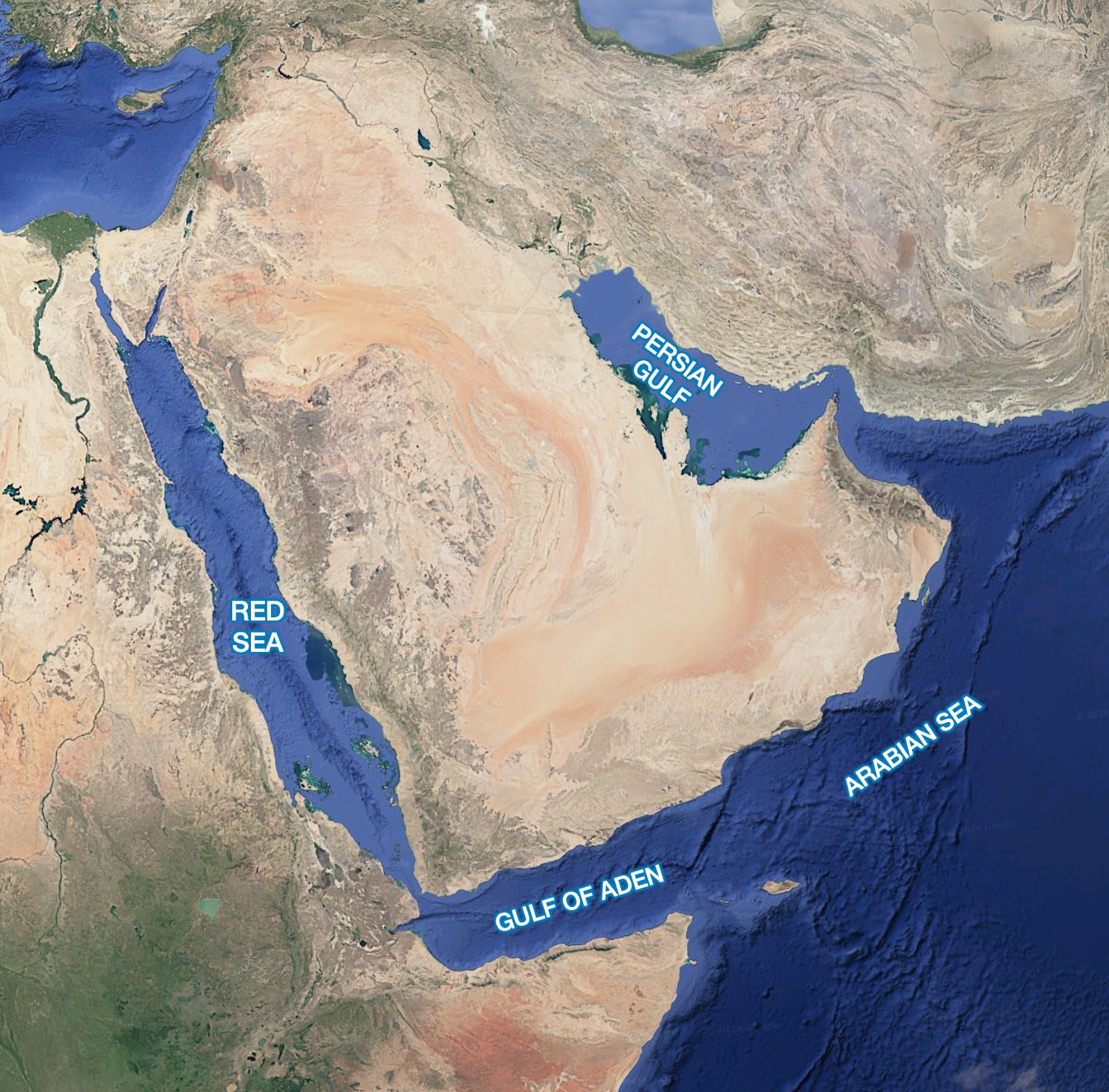
That has been true for millennia.
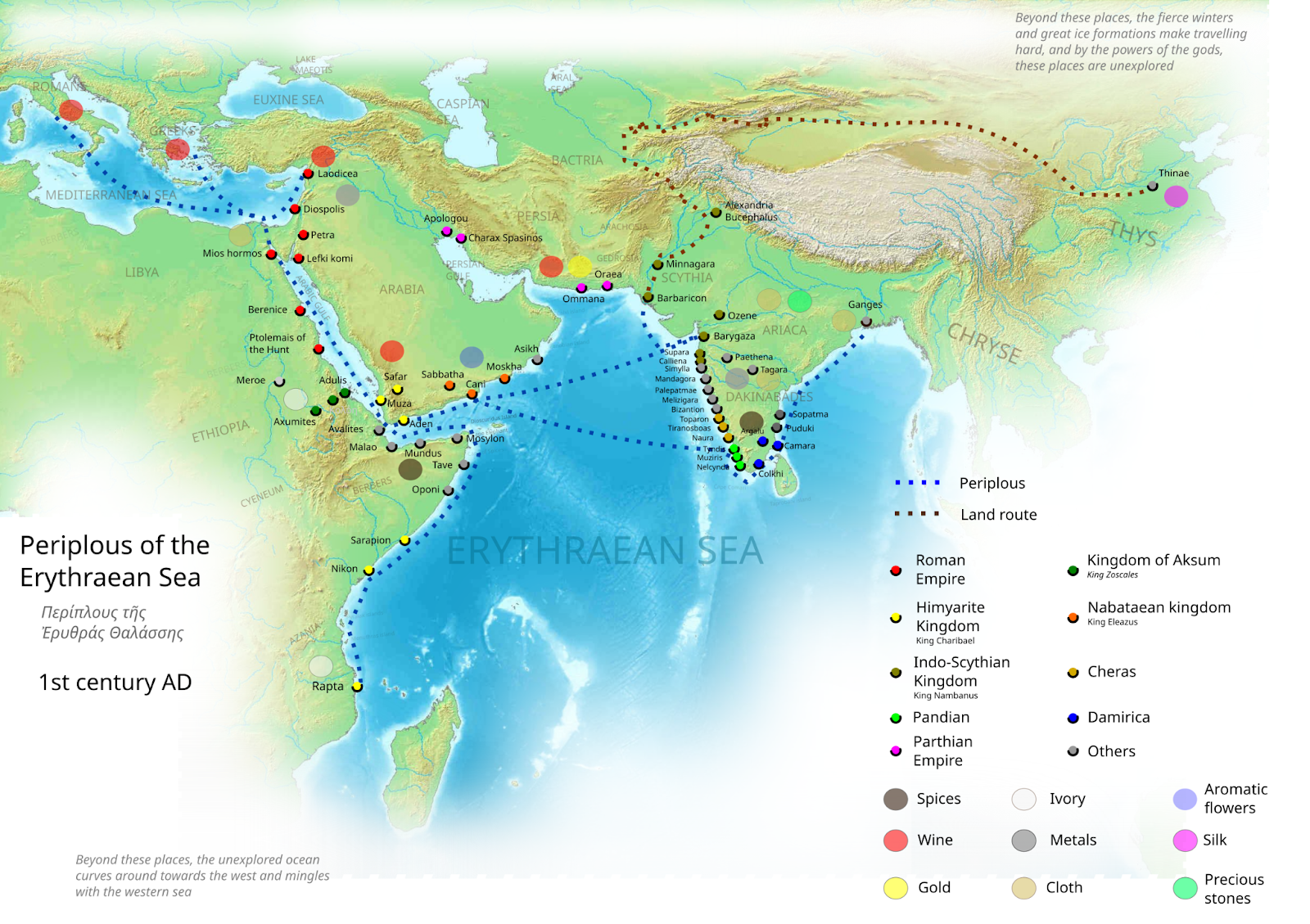
This means that trading posts appeared along its coasts for millennia, and cosmopolitan kingdoms emerged:
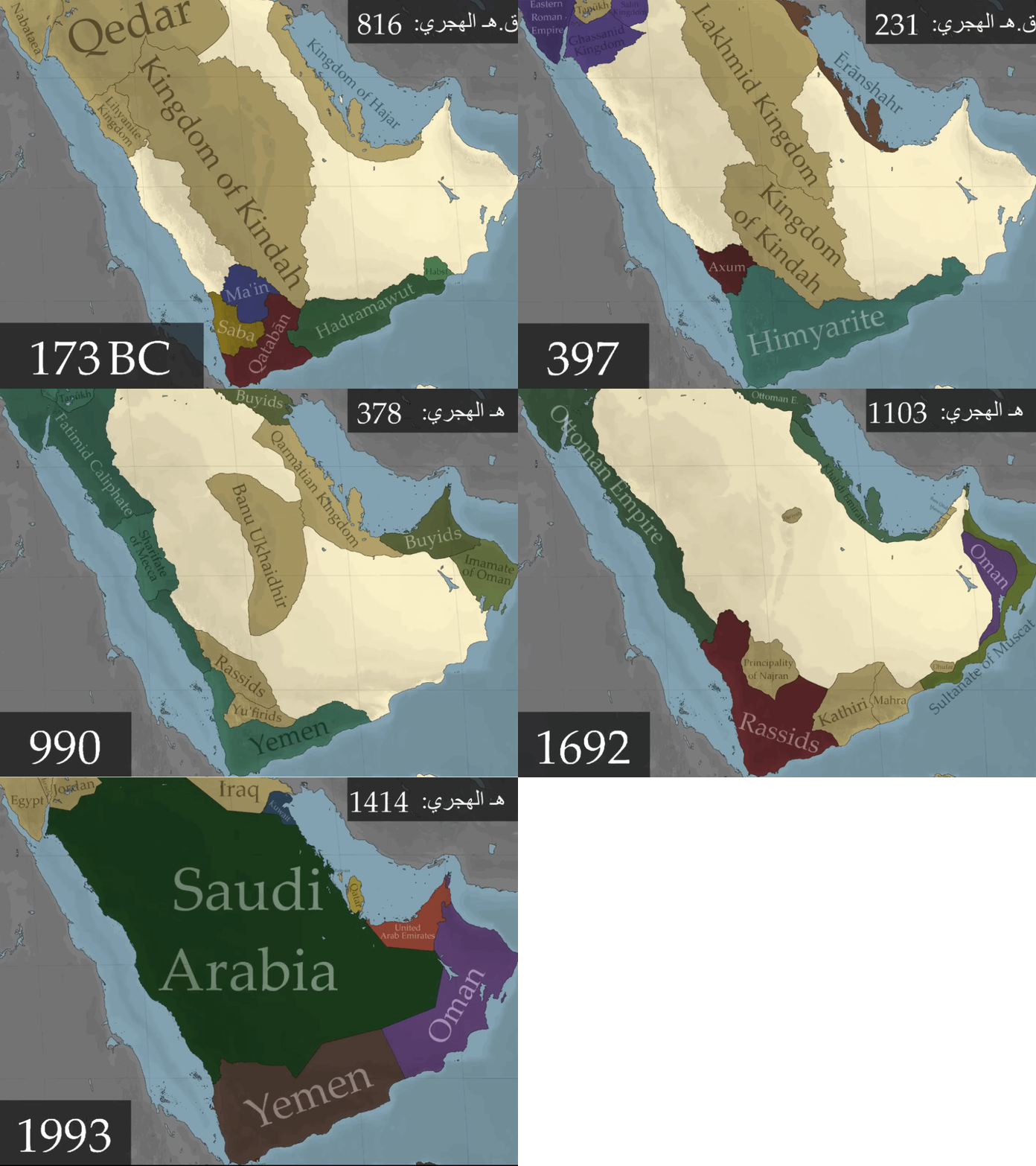
That’s one of the main reasons Saudi Arabia is surrounded by so many smaller countries along the coasts, including Jordan, Yemen, Oman, the UAE, Qatar, Bahrein, and Kuwait.
Before Saudi Arabia, the peninsula had only been united for about 200 years, between 650 and 860 AD, through the Rashidun, Umayyad, and Abbasid Caliphates. Why not longer?
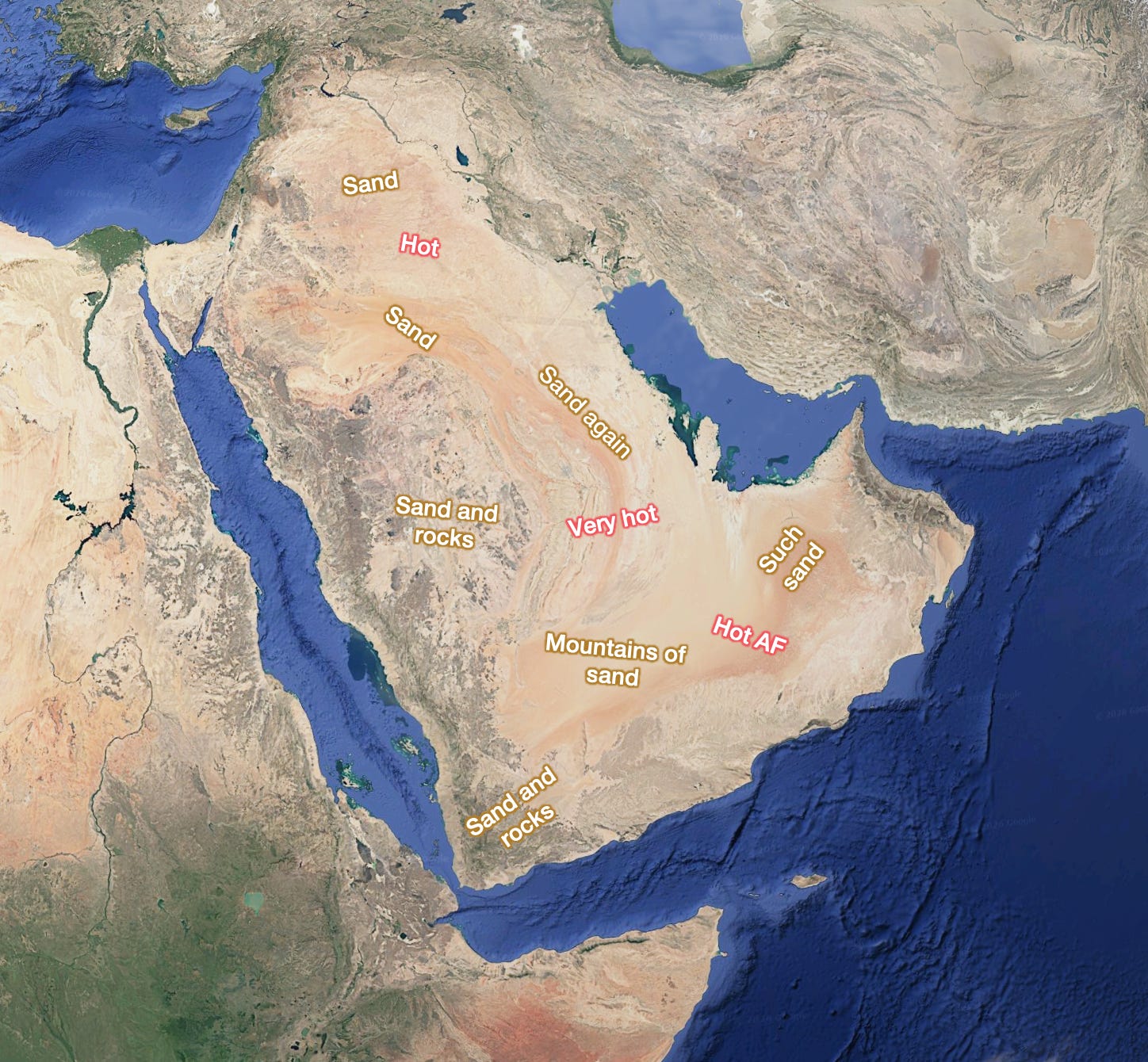
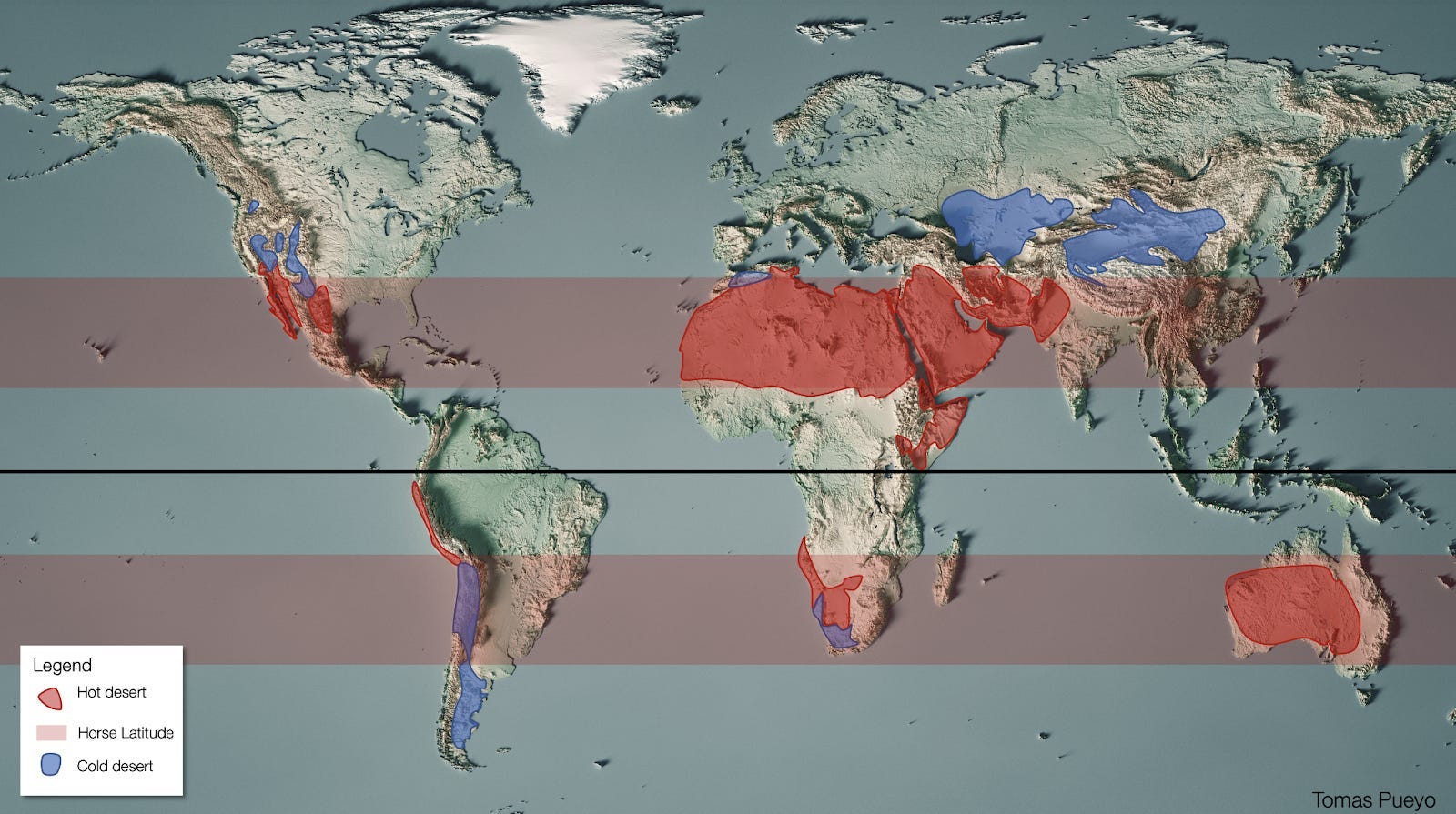
It’s nearly all desert. Why? Like the Sahara, it’s smack in the middle of the horse latitudes, with dry air coming down from the upper atmosphere preventing humid air from coming in from elsewhere and raining on the region.
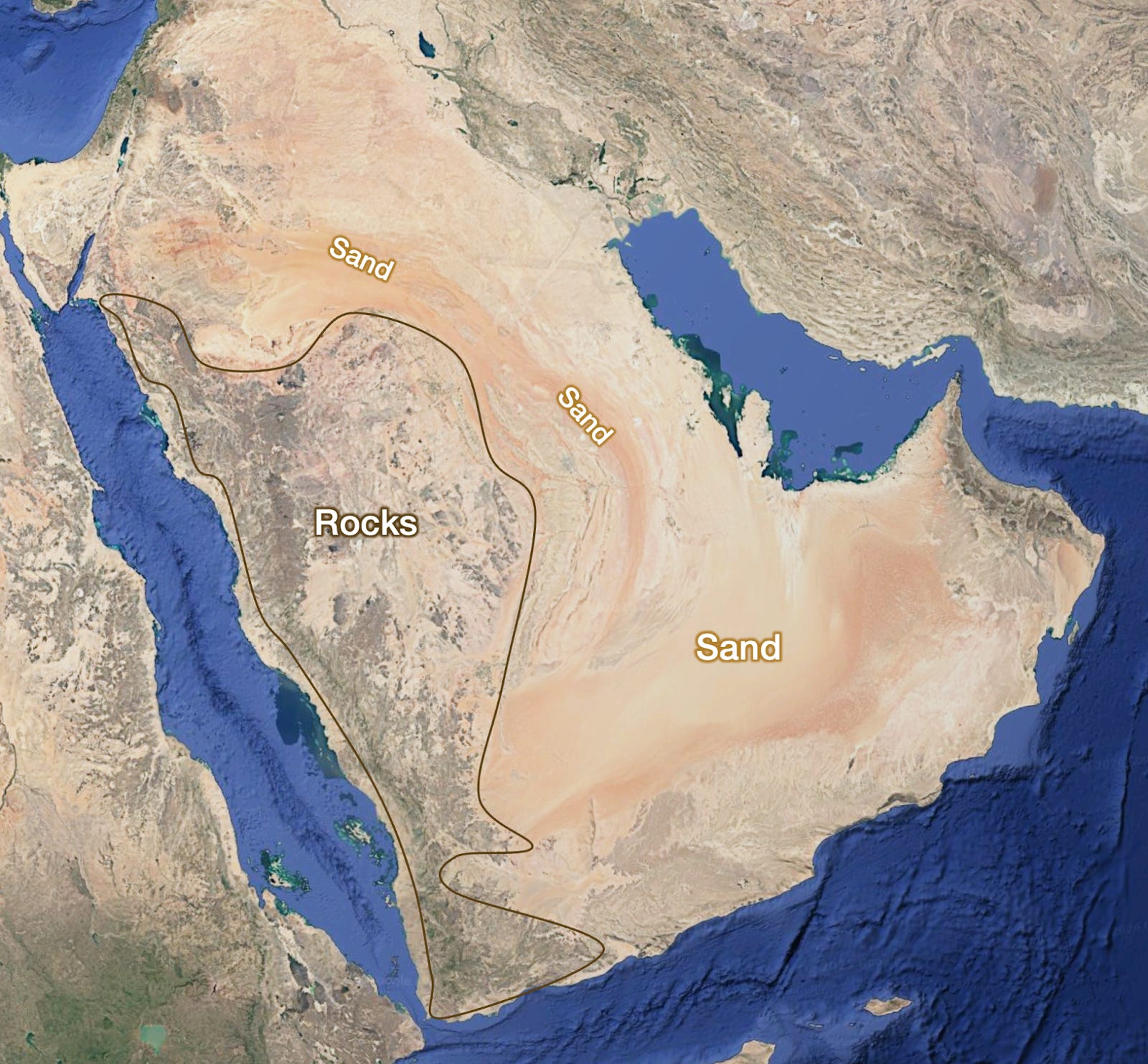
Saudi Arabia is the biggest country in the world with no rivers! It only has wadis, ephemeral river beds that only occasionally carry water after rain. You can actually tell how dry it is simply by looking at the satellite image—there’s a bit of rocks and water, and the rest is just infinite amounts of sand.
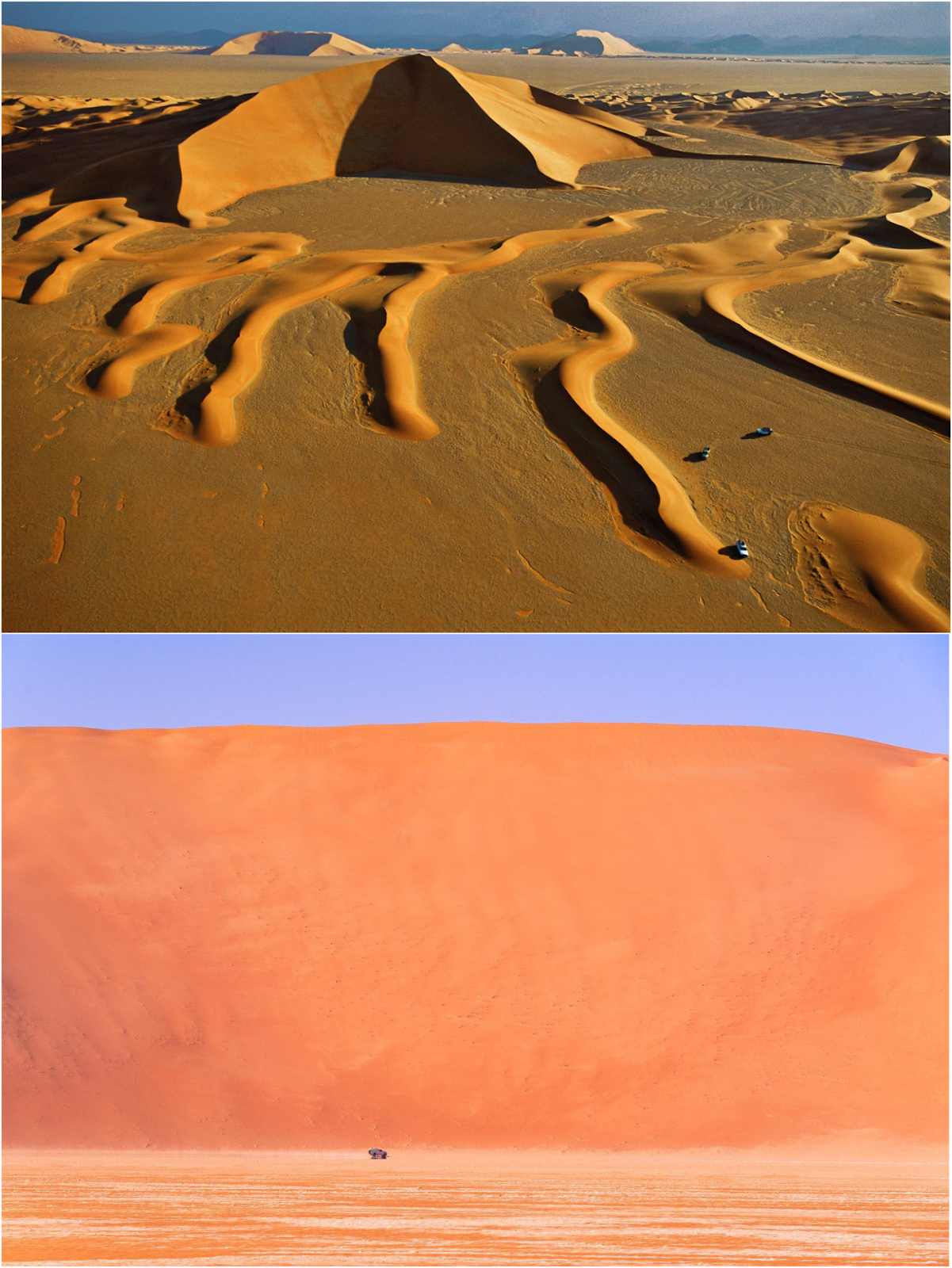
Dune
The sand is so sandy that there are dunes up to 250 m high!
Although to my ignorant eye, it all looks like desert, the locals can distinguish the nuances and have different names for each. The three big sand-dune deserts are Nafud, Dahna, and Rub’al Khali (the Empty Quarter in English).
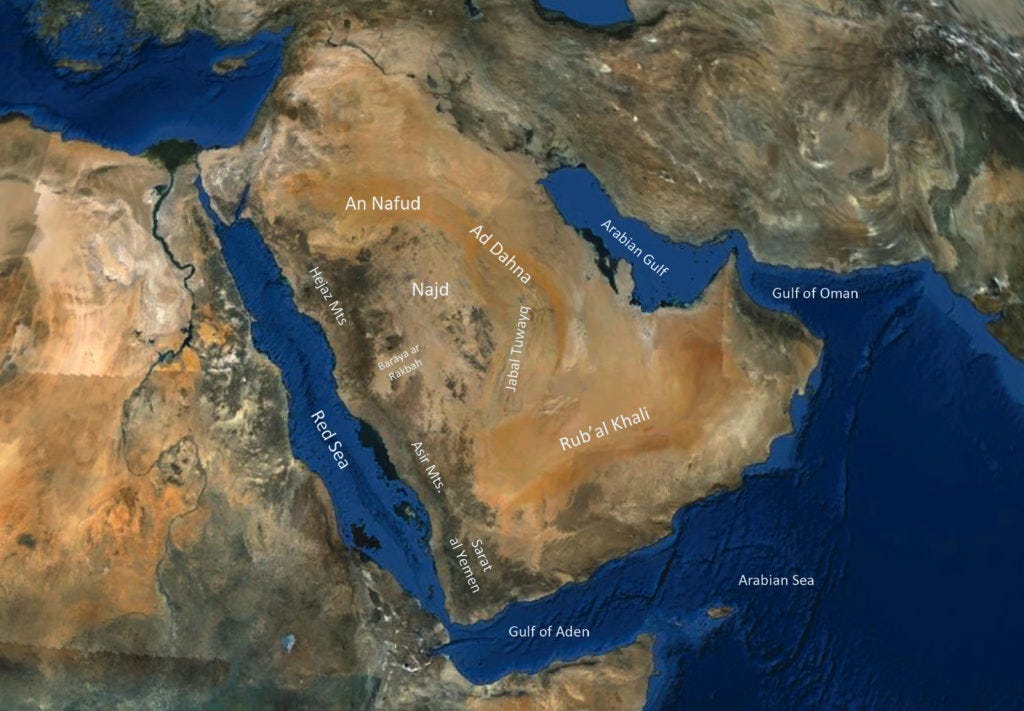
The Empty Quarter is so vast that, to this day, no road crosses it!
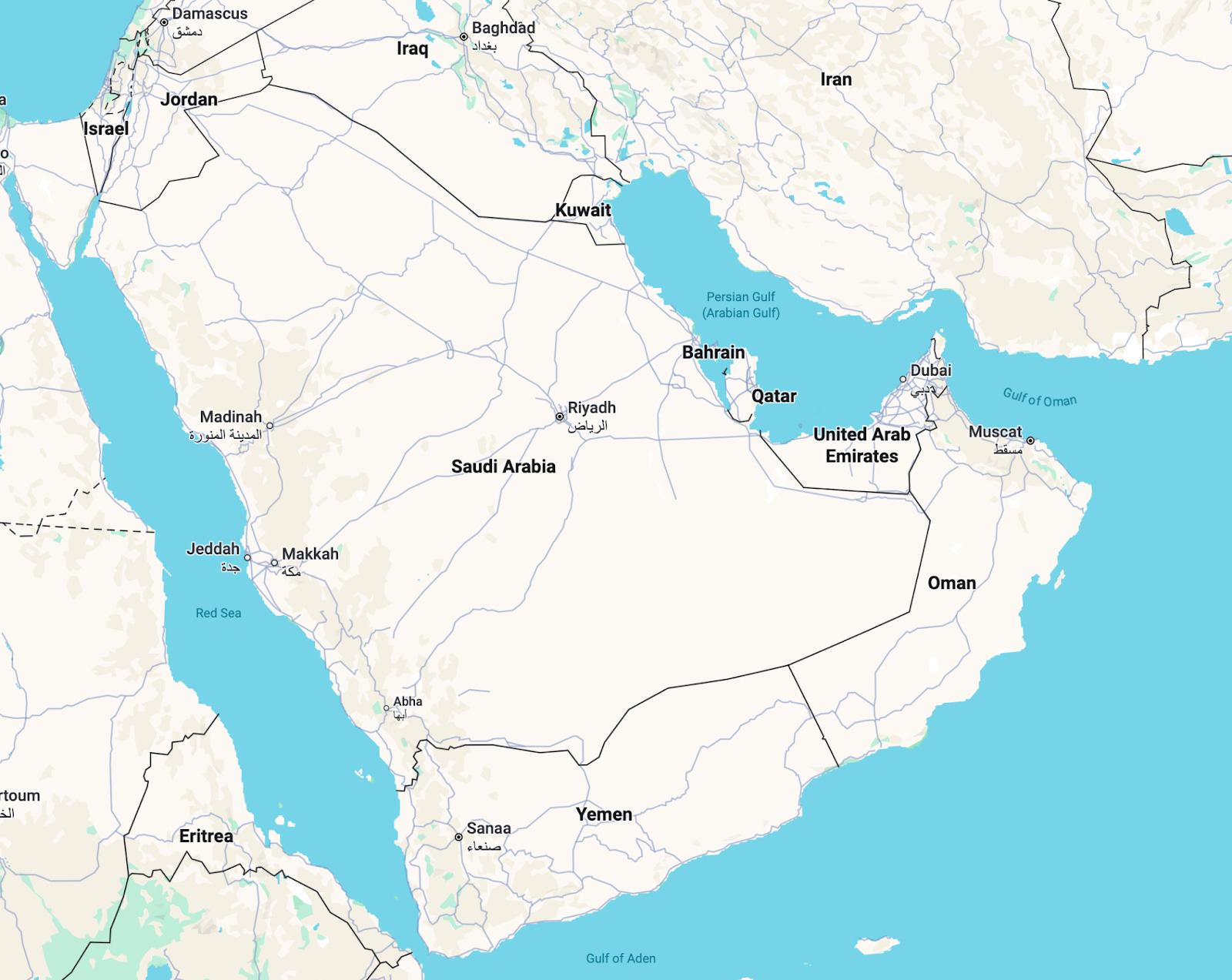
Why is the west rockier?
The Red Sea and the Sarawat Mountains
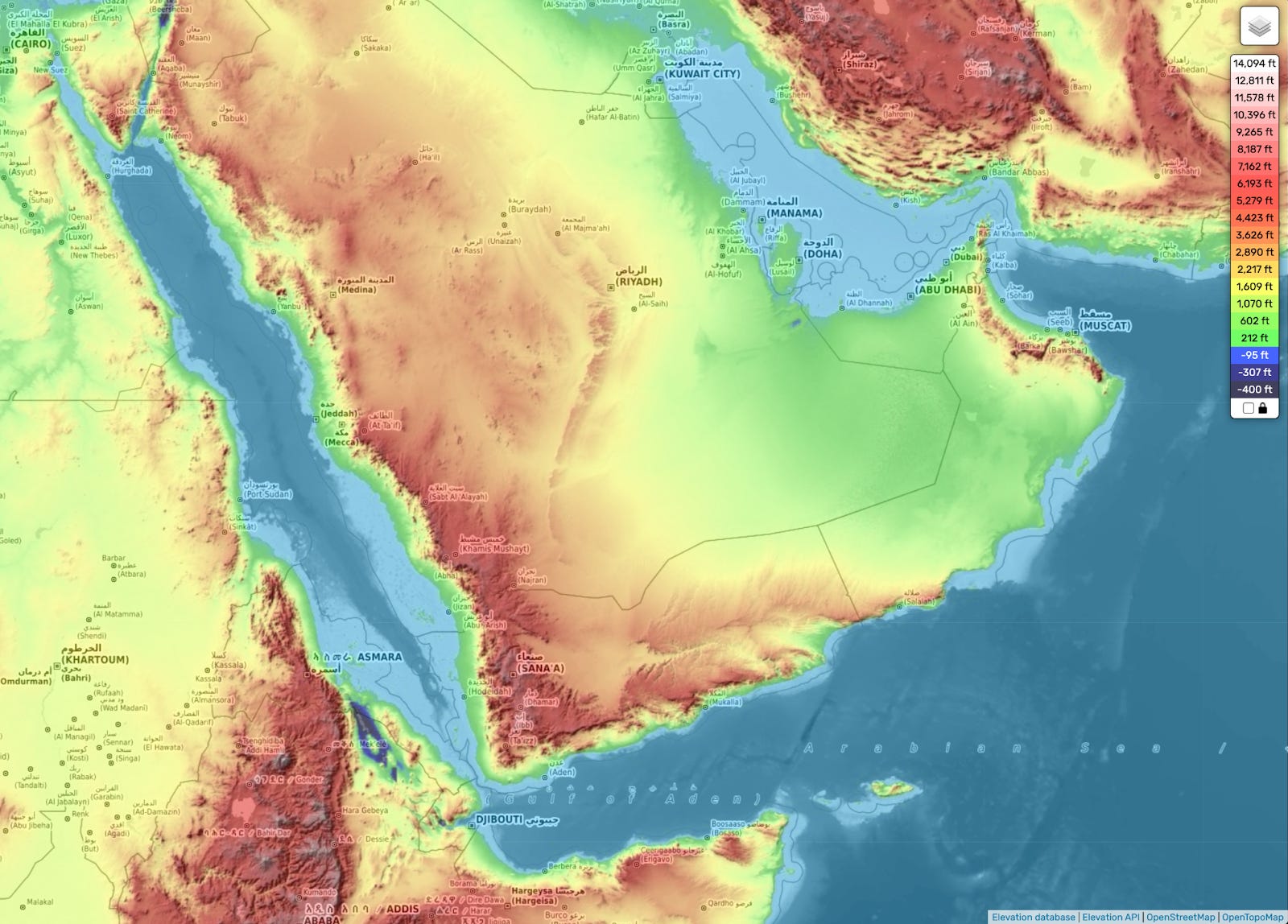
You can see here the relative elevation of the west:
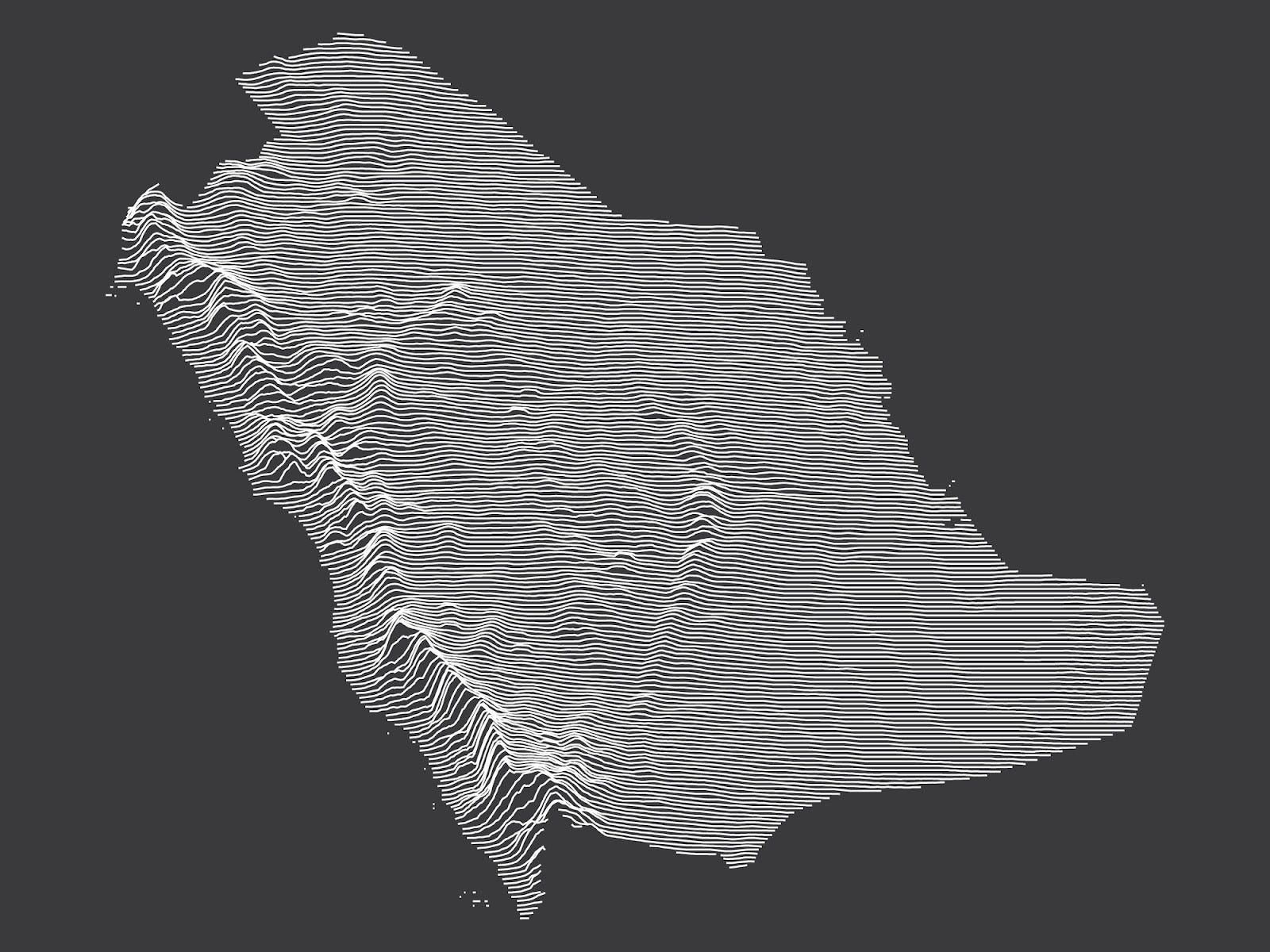
Where does that come from?
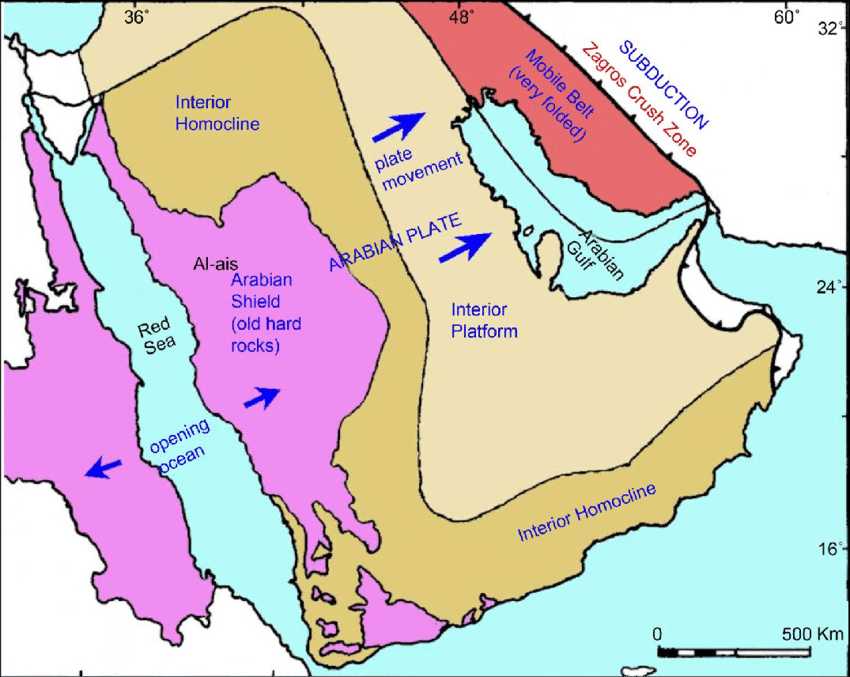
The Arabian-Nubian Shield was a big rocky mountain formation that was then split by the Red Sea. Now the mountains remain on both sides of the sea, and the east part (the Arabian Shield) has some pretty tall mountains!
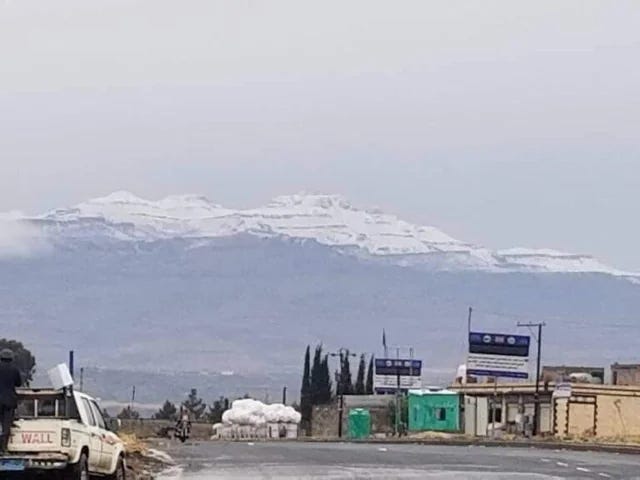
These mountains are so high that sometimes it snows in Yemen, and even in Saudi Arabia!
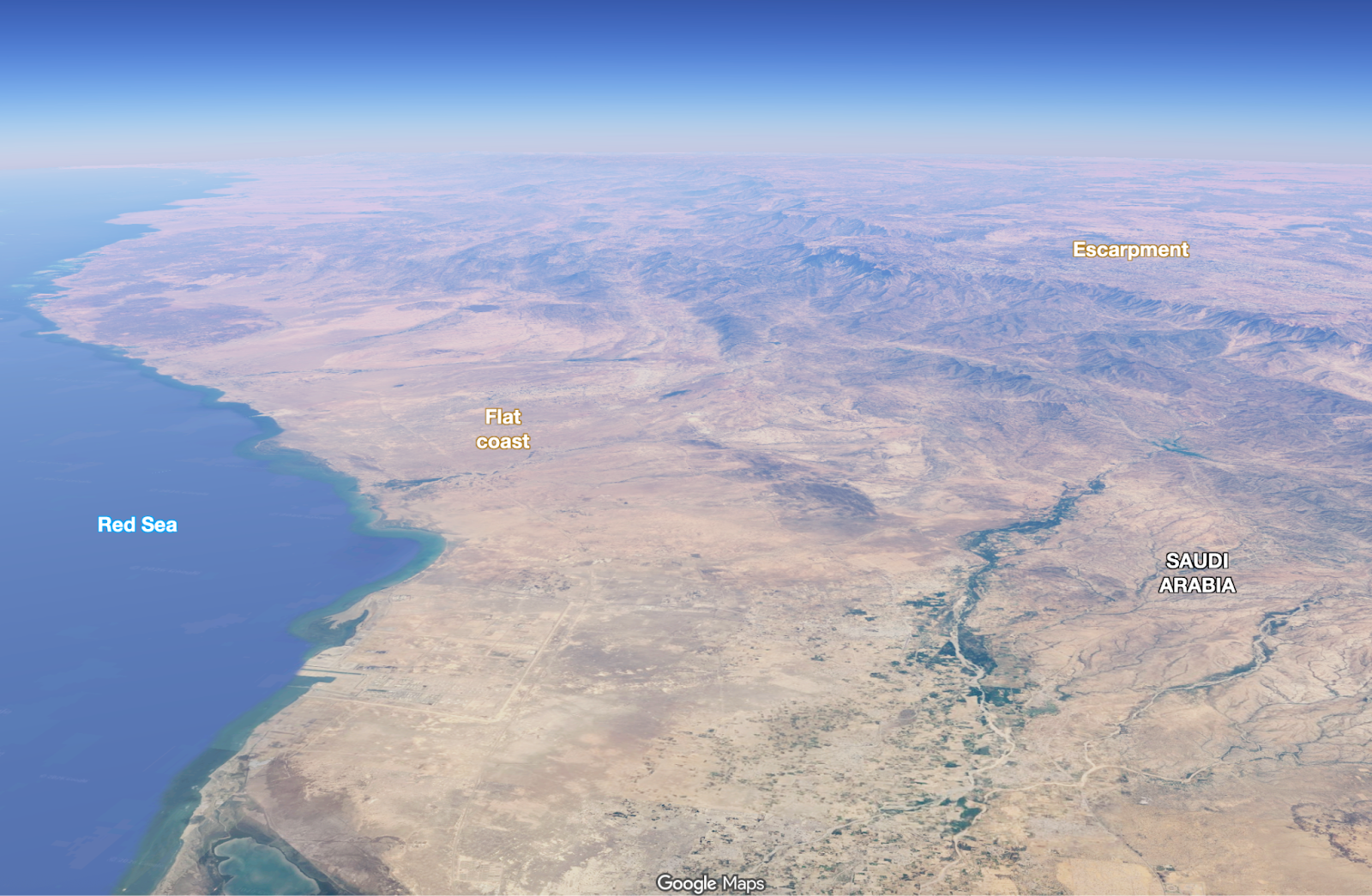
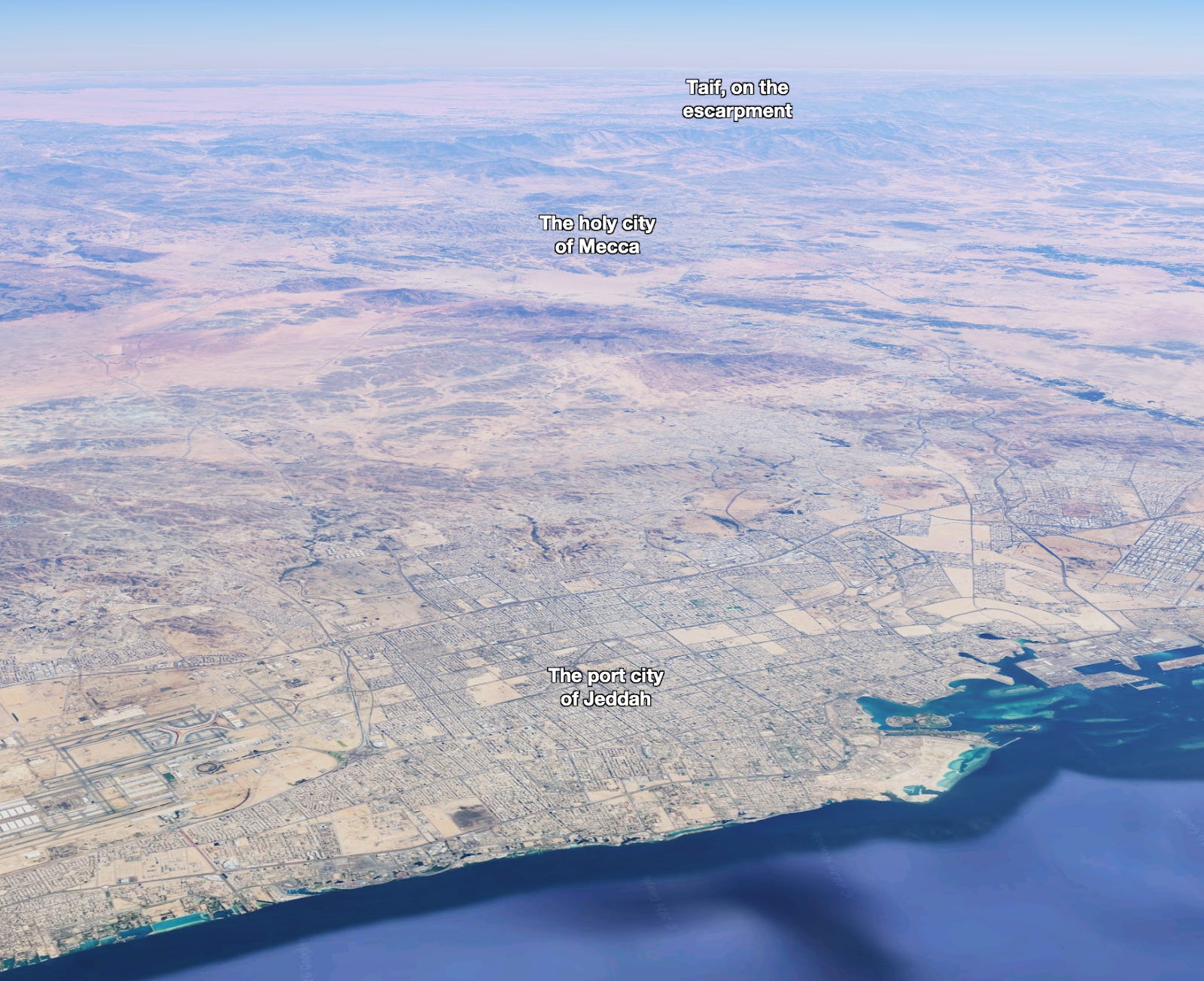
You can get a sense of the coastal escarpment here.
This coastal range is called the Sarawat Mountains.
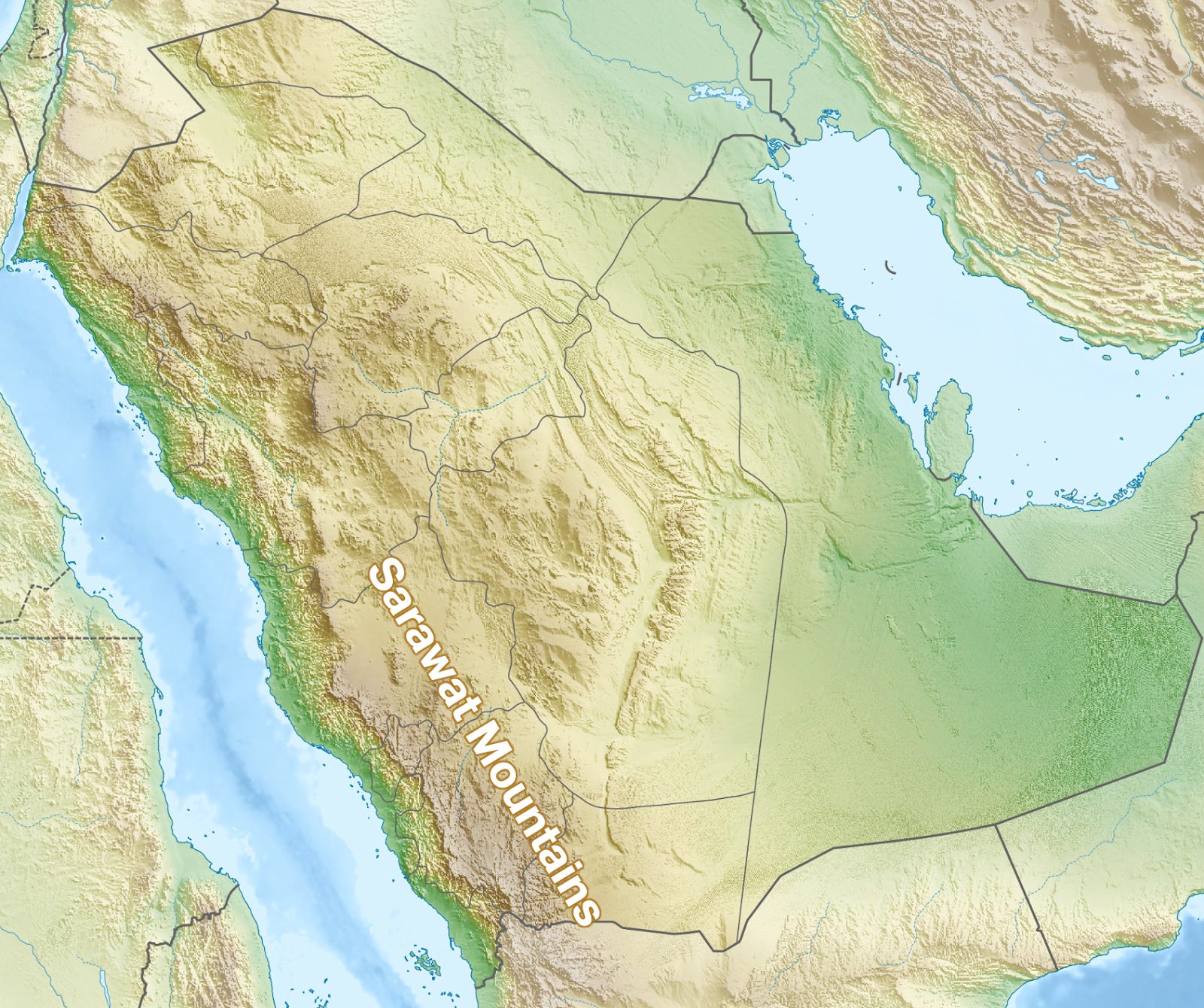
Thanks to its altitude, it catches the rainwater coming from Africa and the Red Sea.
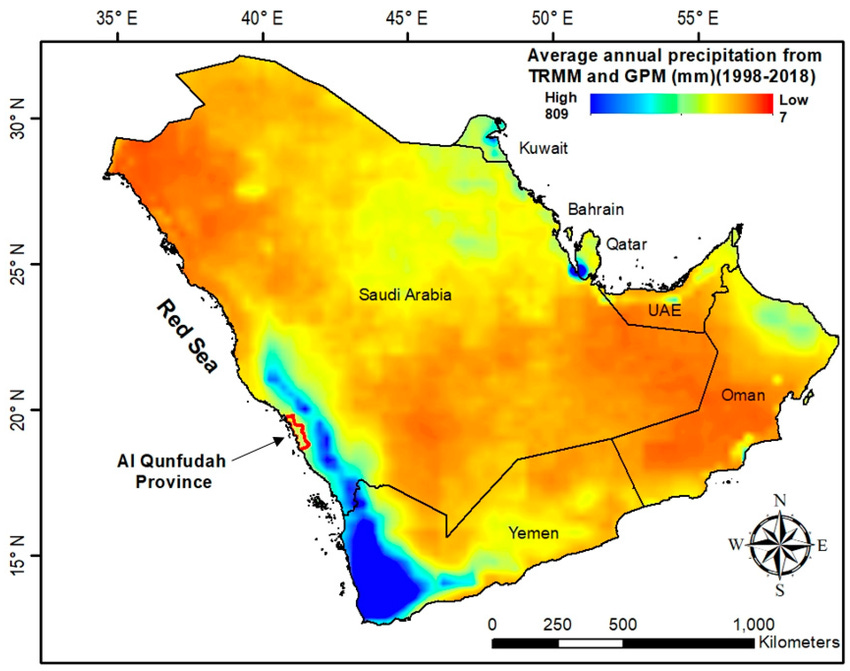
Fun fact: It mostly catches water from the African monsoon!
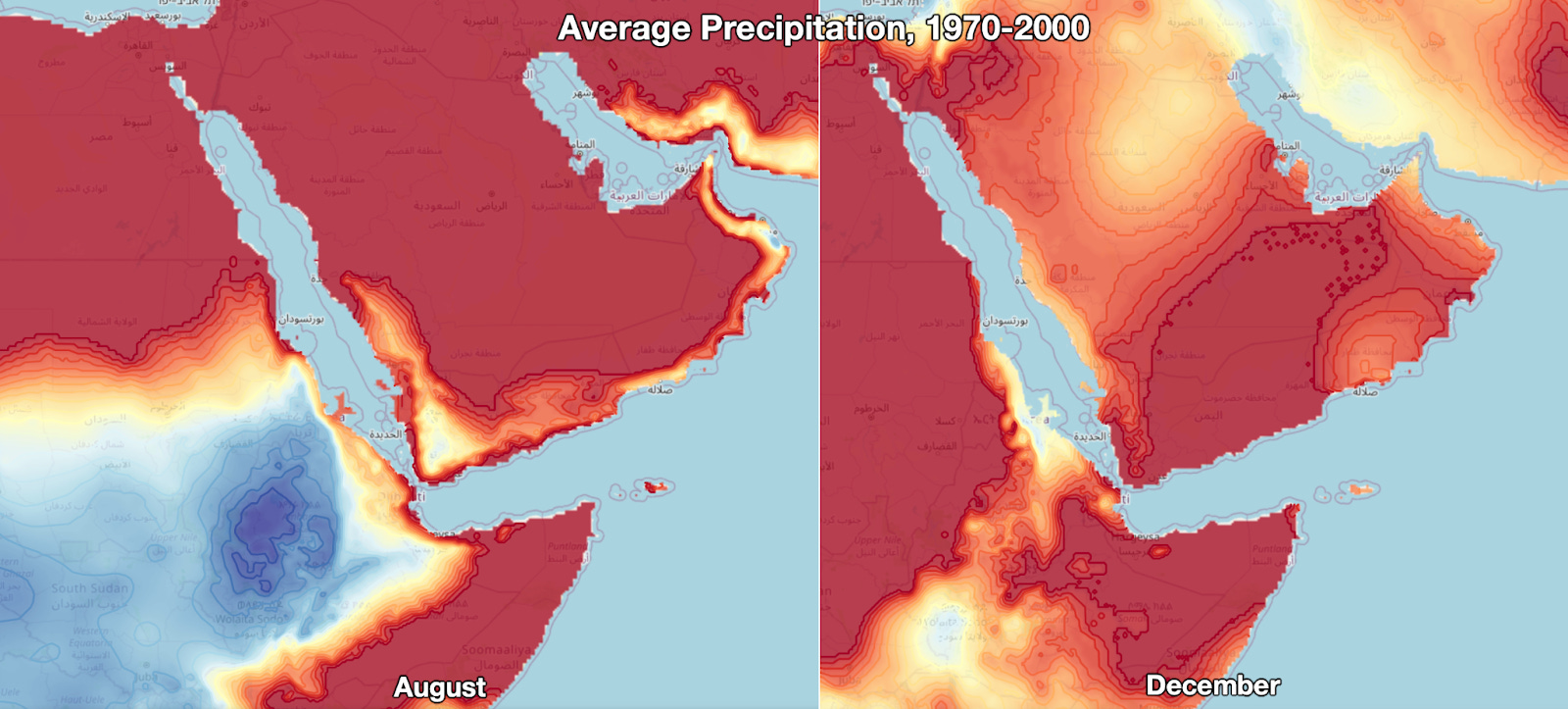
That rain is necessary for the population to grow:
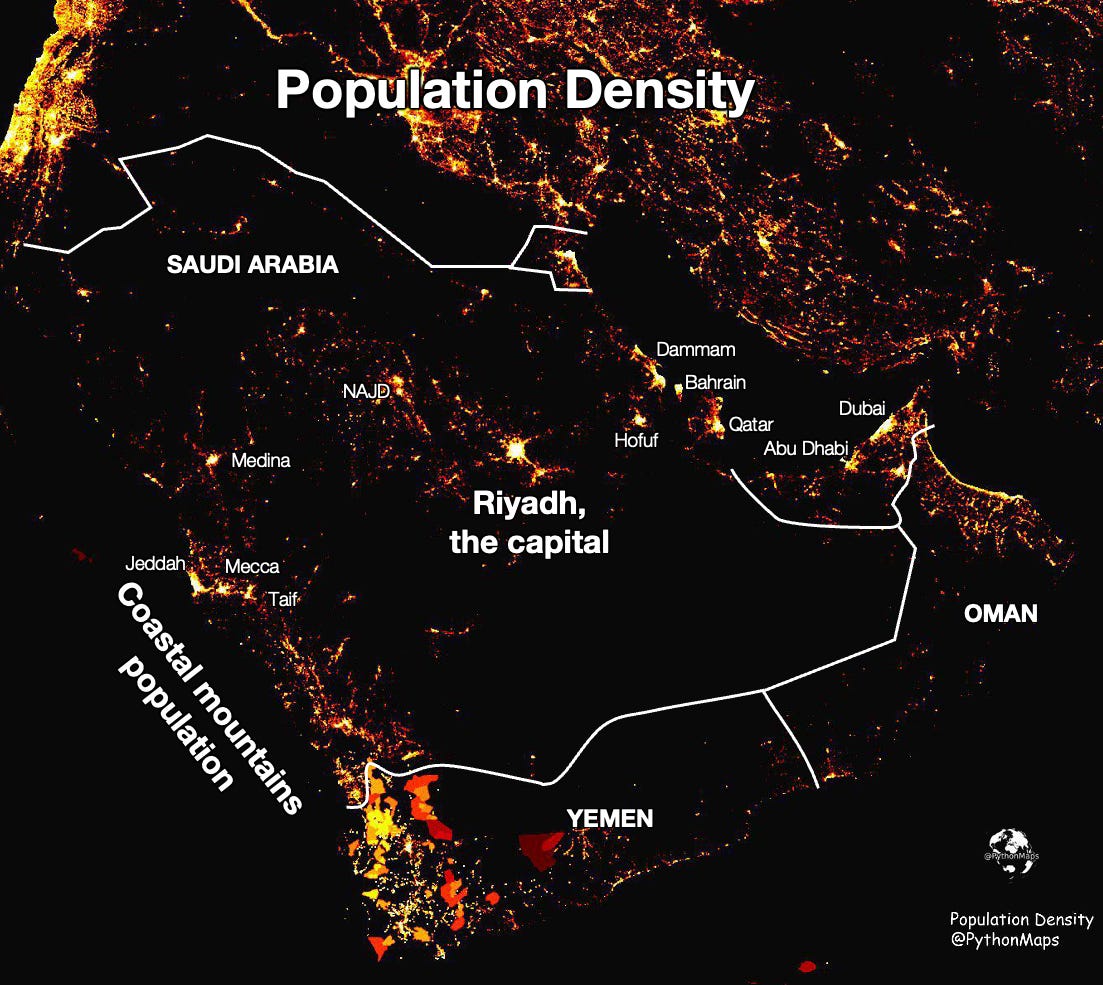
That’s why the historic kingdoms on the west coast, on the Red Sea, were traditionally the more powerful ones: They had the access to trade and they had the population. This is where you find the cities of Mecca, Medina, Jeddah, and Taif, and the birth of Islam.
These coastal regions are also the most exposed to foreign powers: Trade moves in very narrow corridors, the Red Sea and the Persian Gulf, which can be easily controlled through three choke points.
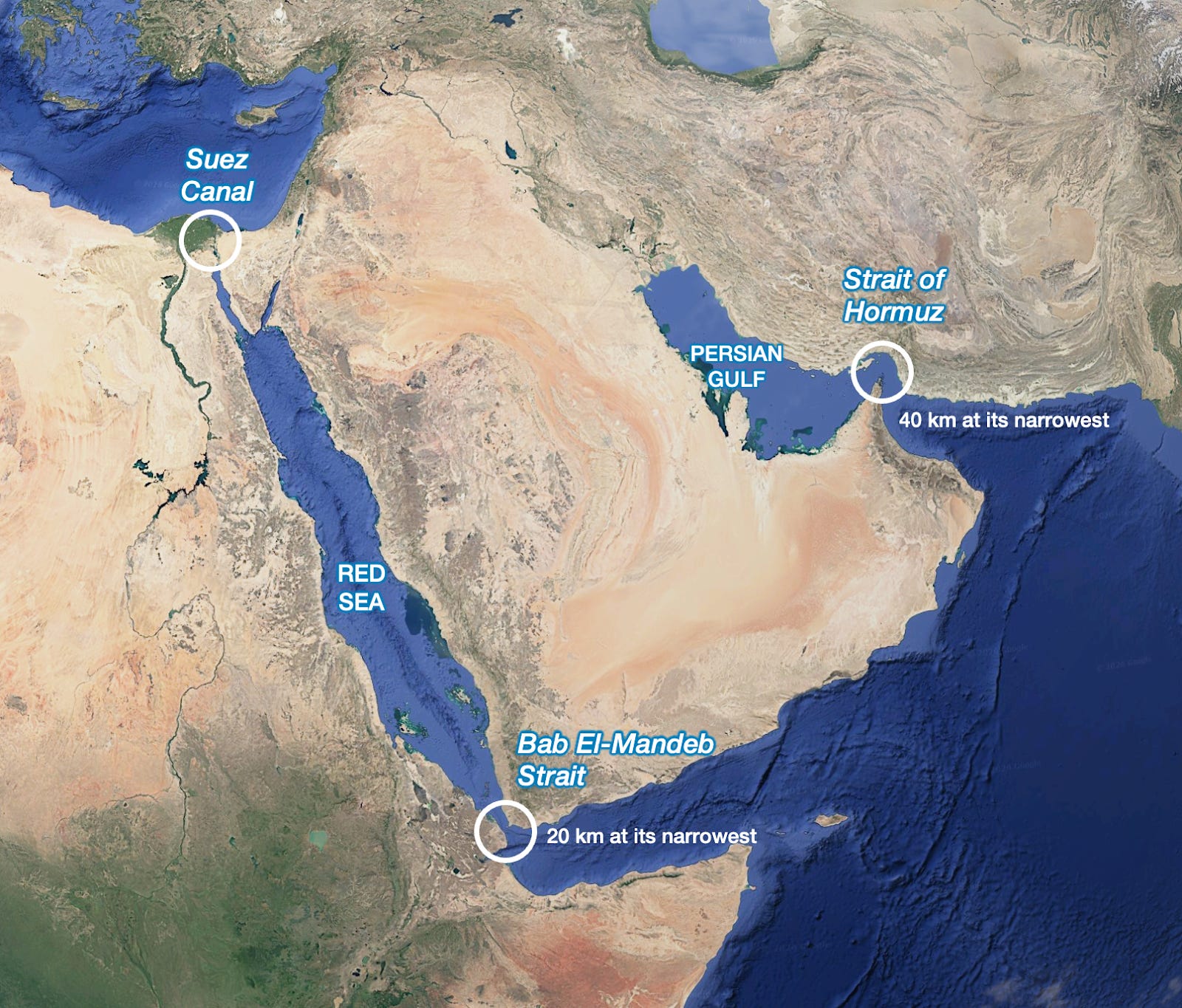
This is why most regional empires controlled only parts of the coasts—especially those of the Red Sea, crucial for Europe-Asian trade—but not the interior:
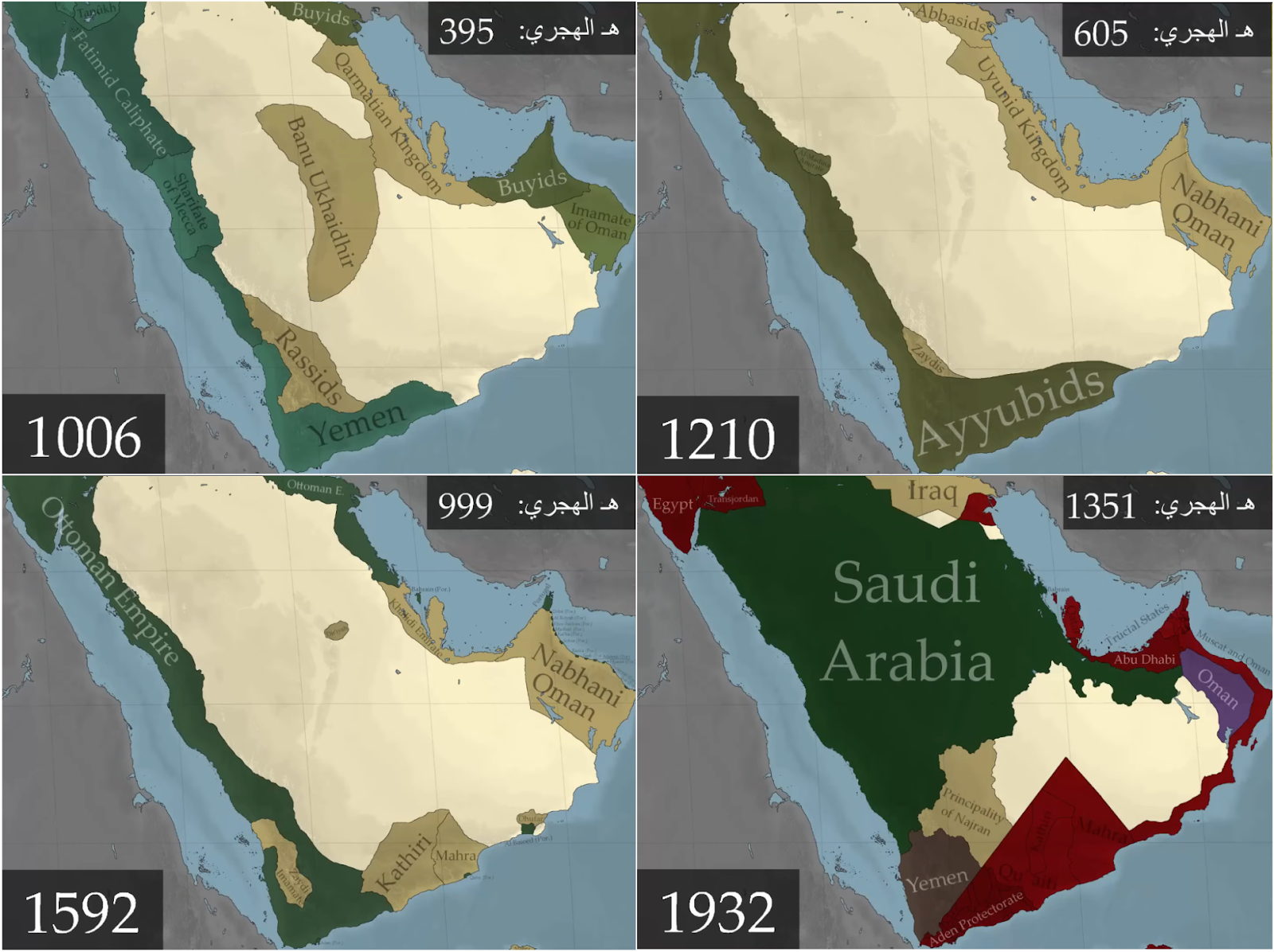
But the capital of Saudi Arabia is not in this richer, populous region! It’s in Riyadh, nearer the center, in a more desertic region called the Nadj. Why?
The Najd
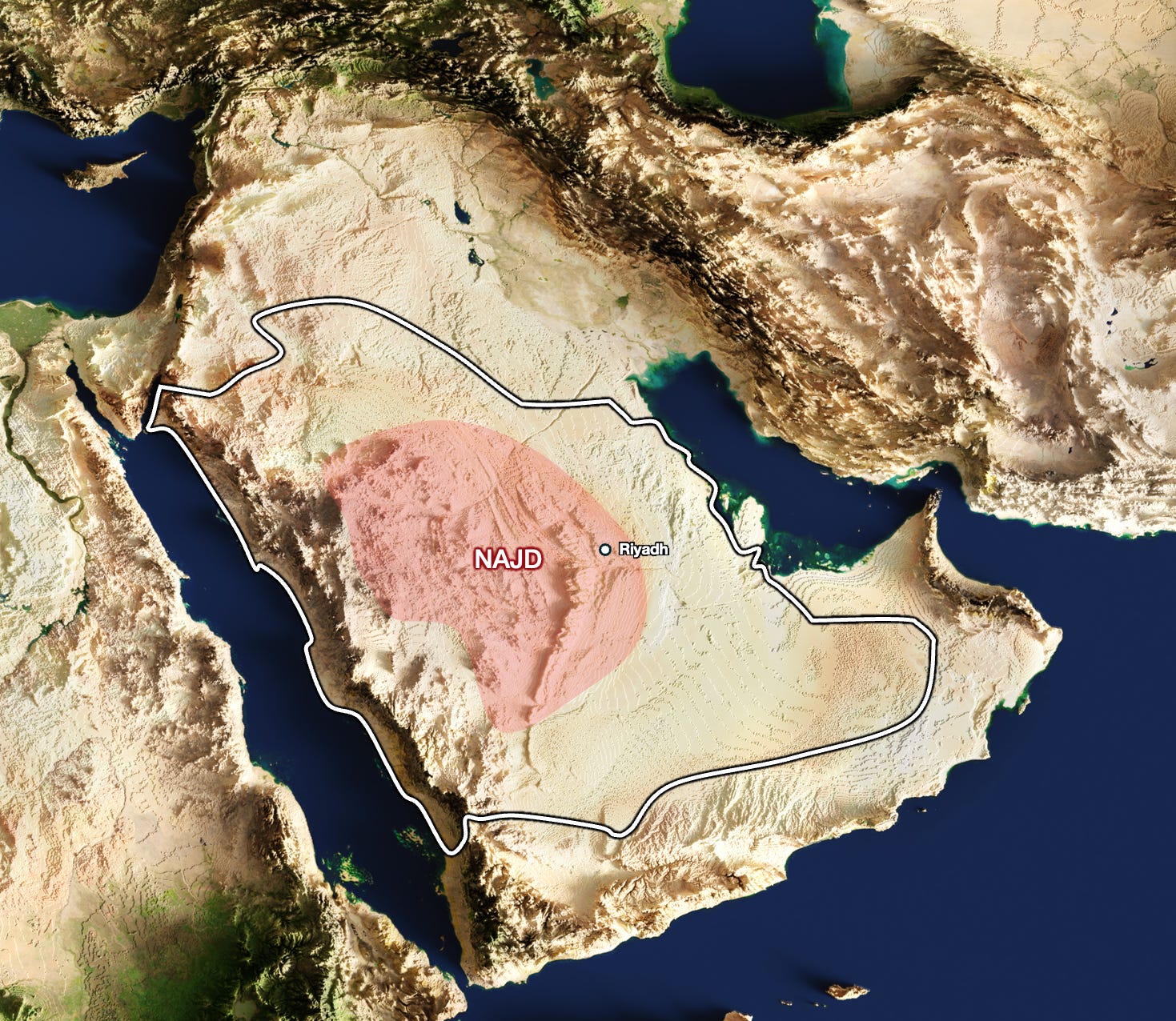
The Najd is basically the Arabian Shield outside of the coast.1
Thanks to the mountains, it still catches some rain and humidity. This water follows gravity, so it usually concentrated around wadis—riverbeds that dry up during parts of the year but are generally more humid than the surrounding areas, and can sustain vegetation.
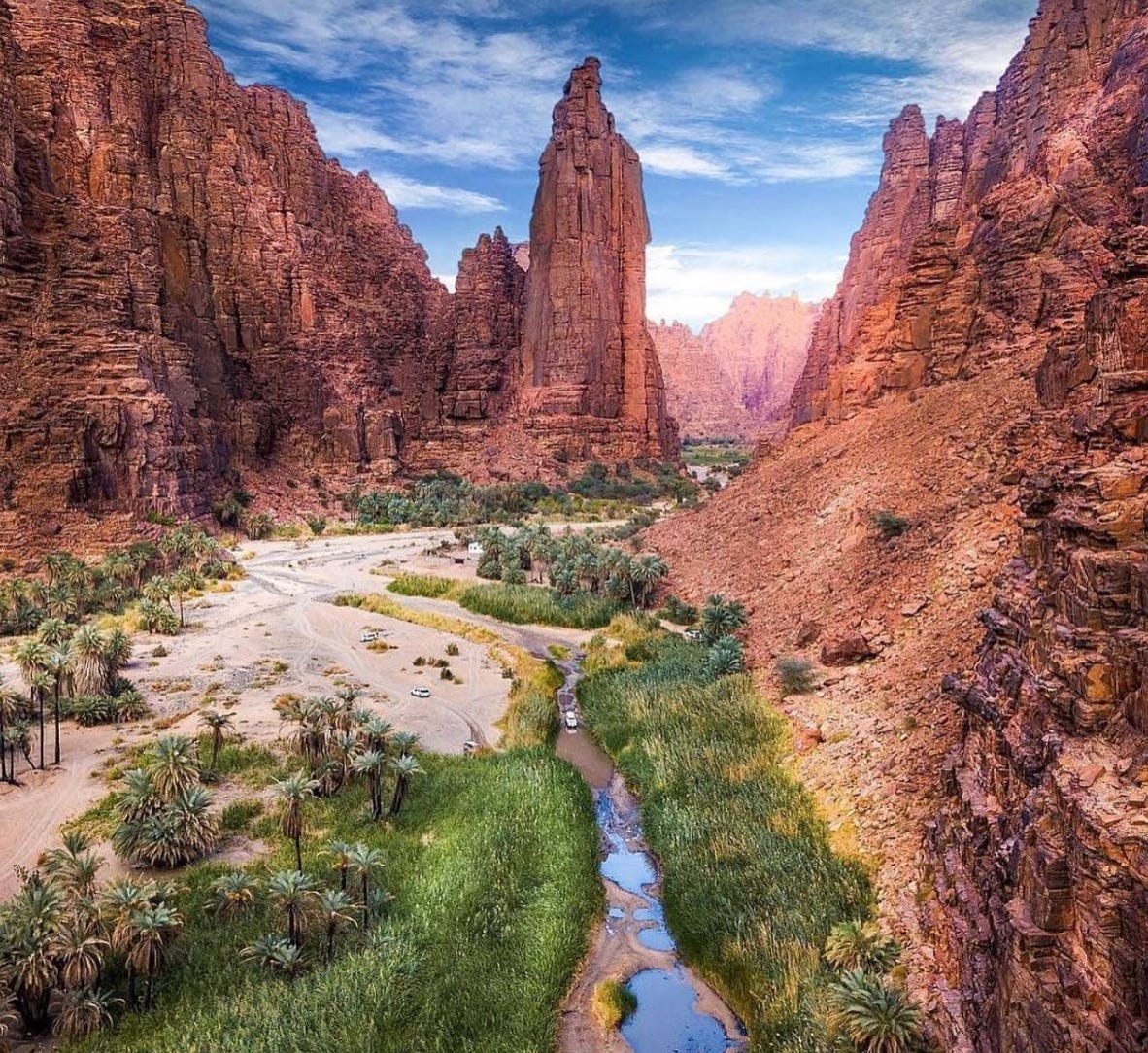
Where water accumulates it can form oases, or if the water table is close to the surface, it can be pumped. This is what formed settlements in the region.
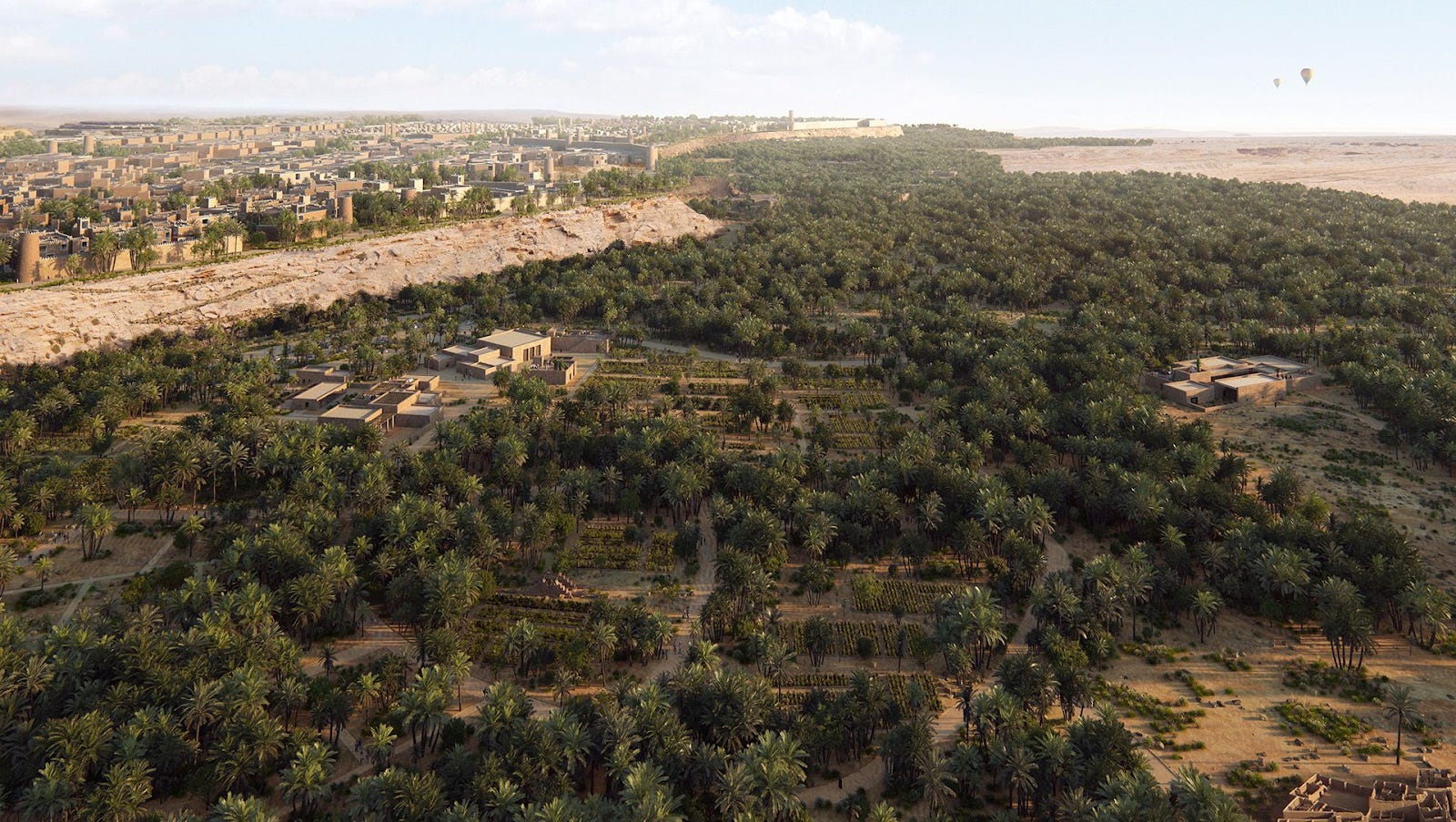
Since water is so precious, these settlements needed protection:
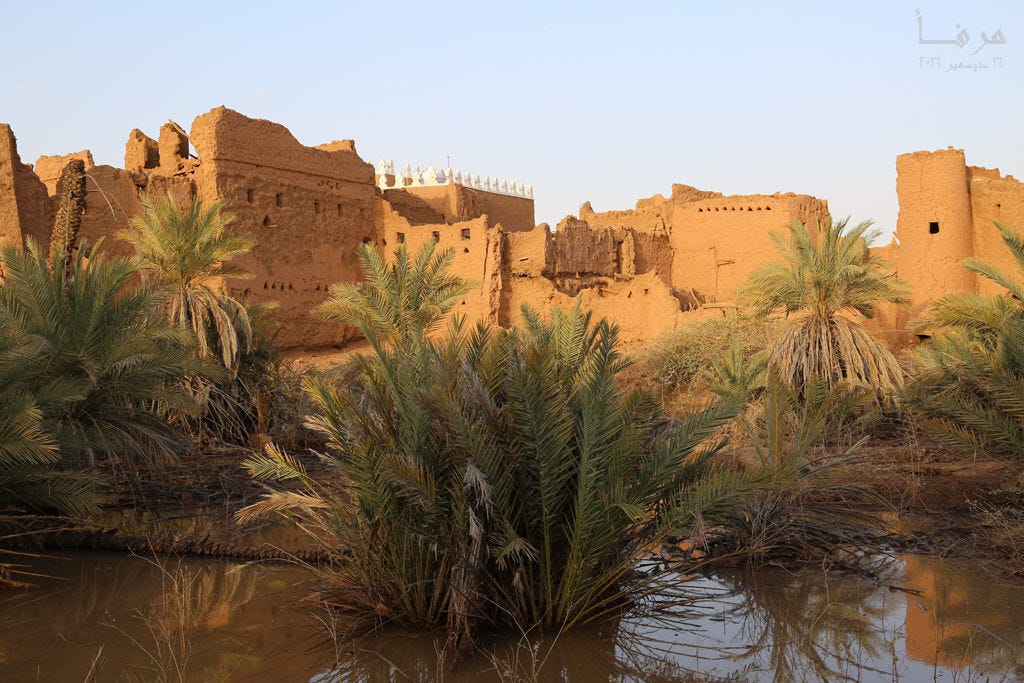
Some of these wadi-fed settlements are cities in Najd today:
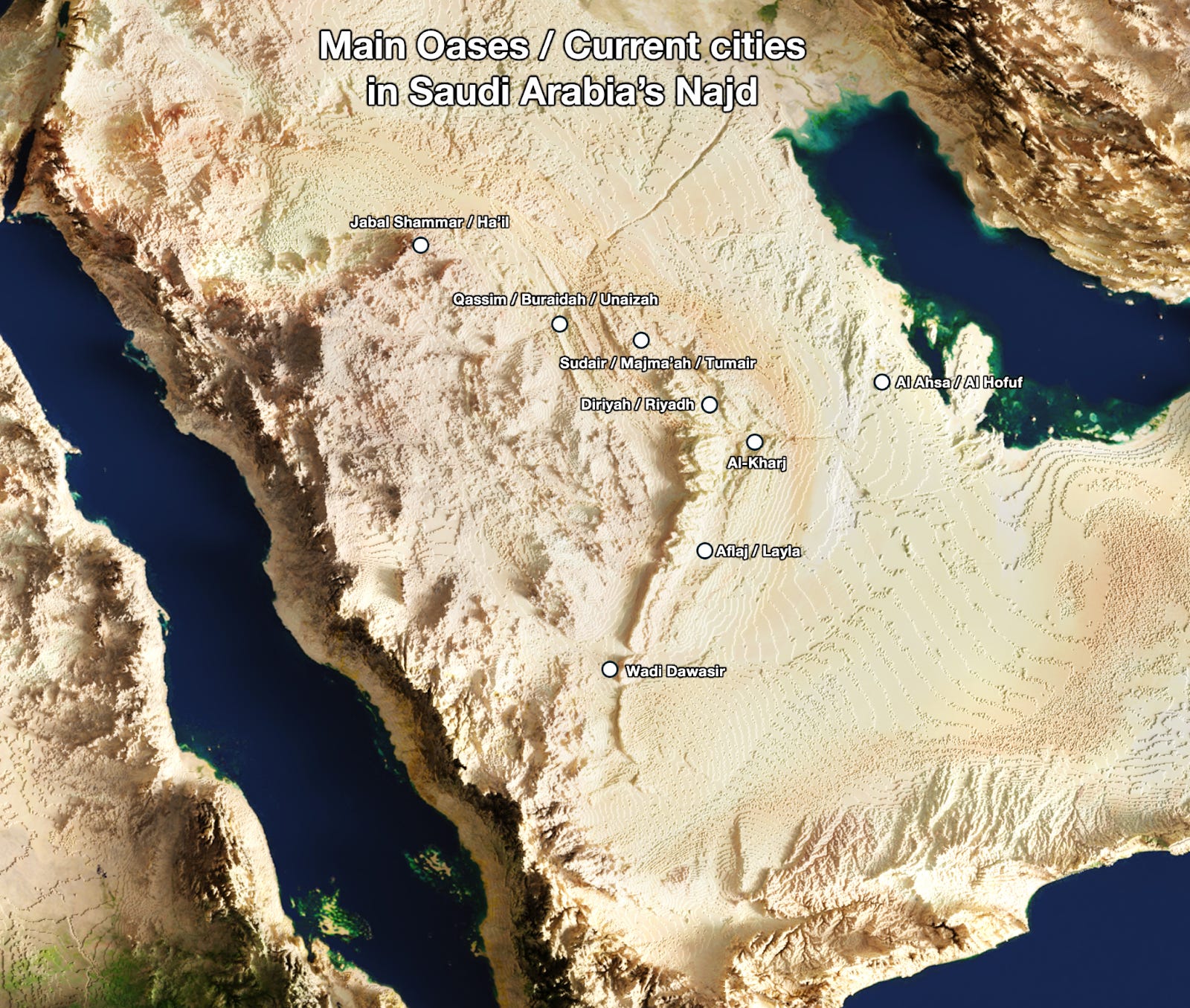
You can easily see them in satellite pictures:
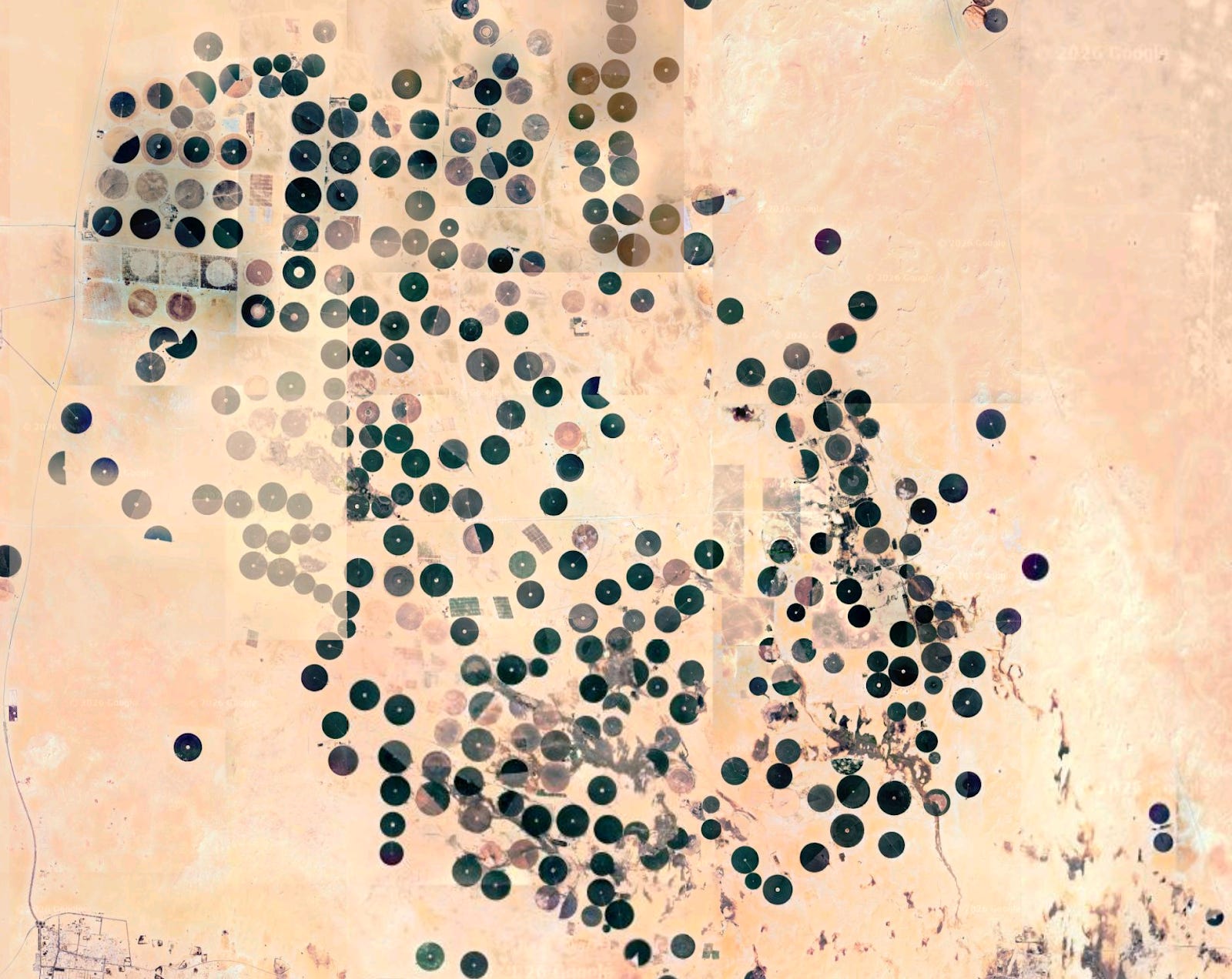
And since each wadi is independent from the others, the region ended up with several independent settlements—which, naturally, fought each other for these resources.
Along these wadis, where agriculture couldn’t survive, grazing could, so pastoral societies emerged shepherding goats, sheep, and especially camels.
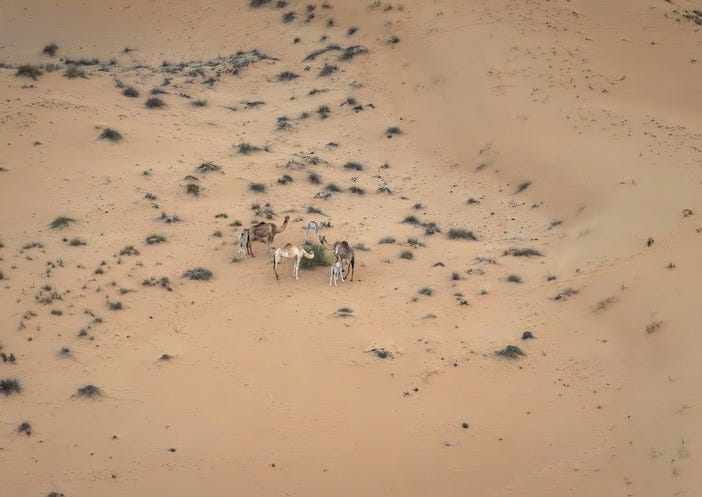
Pastoralists are very mobile and can carry their wealth with them, so they can easily attack settlements when the need arises. Combine this with independent settlements and scarce water, and you have a recipe for intense tribal warfare.
Saudi
This is the context in which we should understand the other part of Saudi Arabia—the House of Saud.
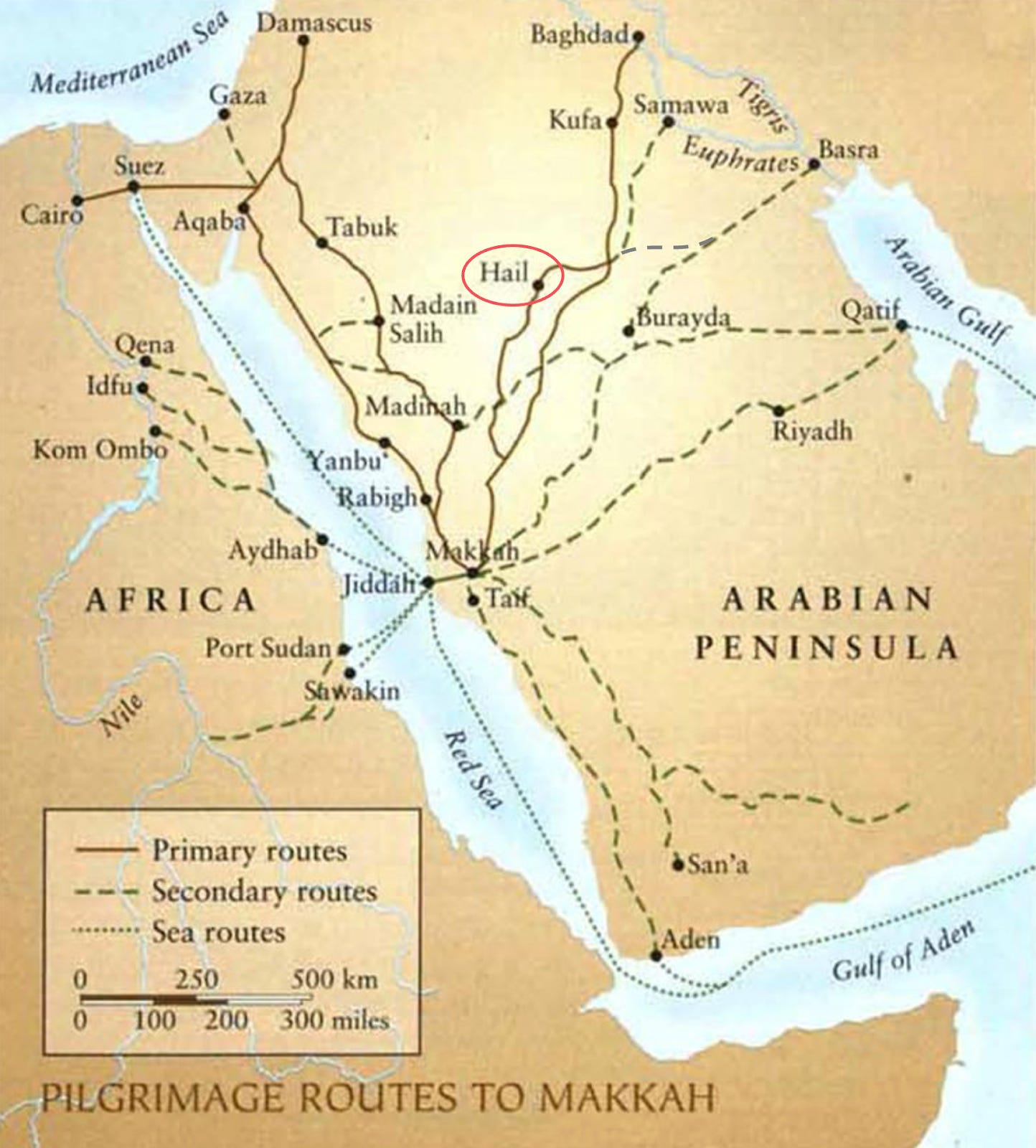
The Al Saud family comes from Riyadh and fought other tribes to prevail in the Najd, especially the Rashidi, whose wadi system was on one of the main pilgrimage paths from Mesopotamia to Mecca:
Religious Zeal
One of the keys to defeating the Rashidi was the Al Saud alliance in 1744 with the Wahhab tribe, promoters of Wahhabism. Their religious zeal brought the Al Saud family the manpower they needed to contest the region, and eventually prevail in the early 1900s after over 150 years of conflict.
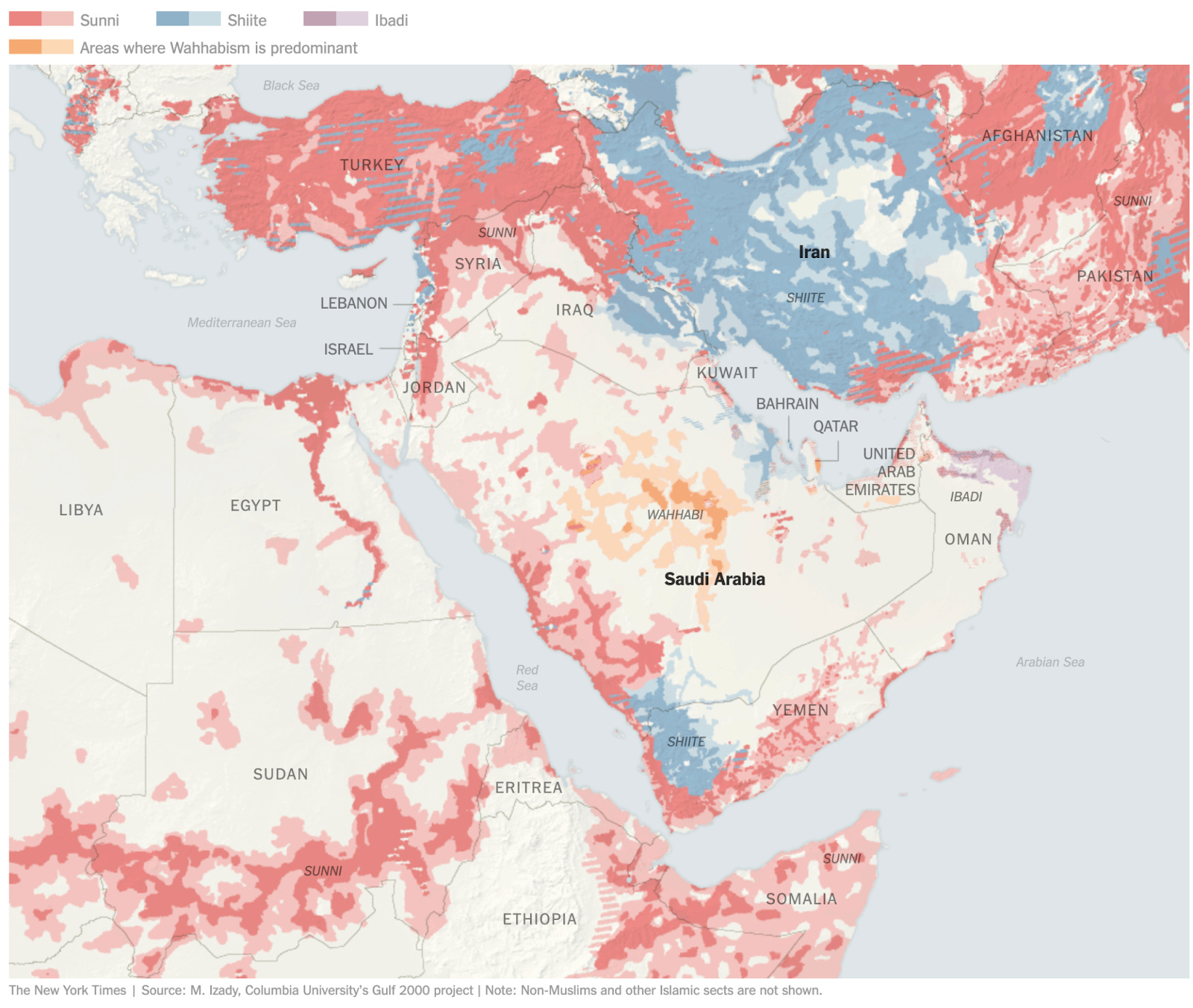
We saw how the geography of the Najd gave birth to a certain type of politics. Now imagine the type of religion that can emerge there: One very centered in Arabia, Arabs, and original Muslims, that repudiates anything foreign—as there was virtually no contact with foreigners in the Najd, and when there was, they were Muslim pilgrims. The result is one of the most radically Islamist versions of Islam. To this day, Wahhabis are concentrated in the Najd.
The House of Saud brought the secular force, the Wahhabis brought the religious zeal. This alliance can be seen on the flag of Saudi Arabia:
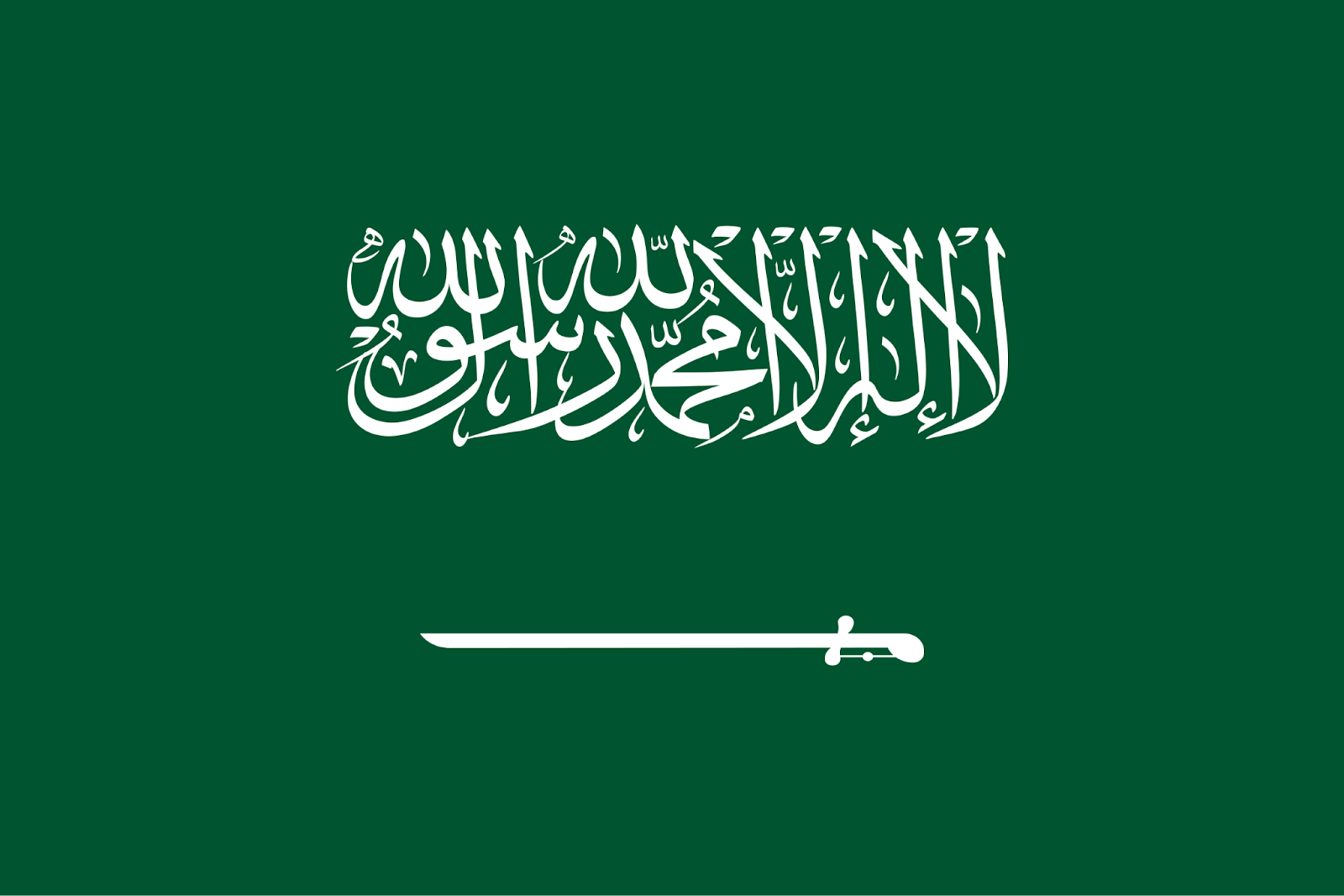
Green represents Islam. The writing at the top is the Shahada: “There is no god but God, and Muhammad is the Messenger of God.” It represents the religious aspect of Saudi Arabia brought by the Wahhabis. The sword represents the secular force, the other tribe that controls power in Saudi Arabia—the Al Saud.
Note that the previous flag of Saudi Arabia was more blatant about the scimitars being the same as those of the Al Saud:
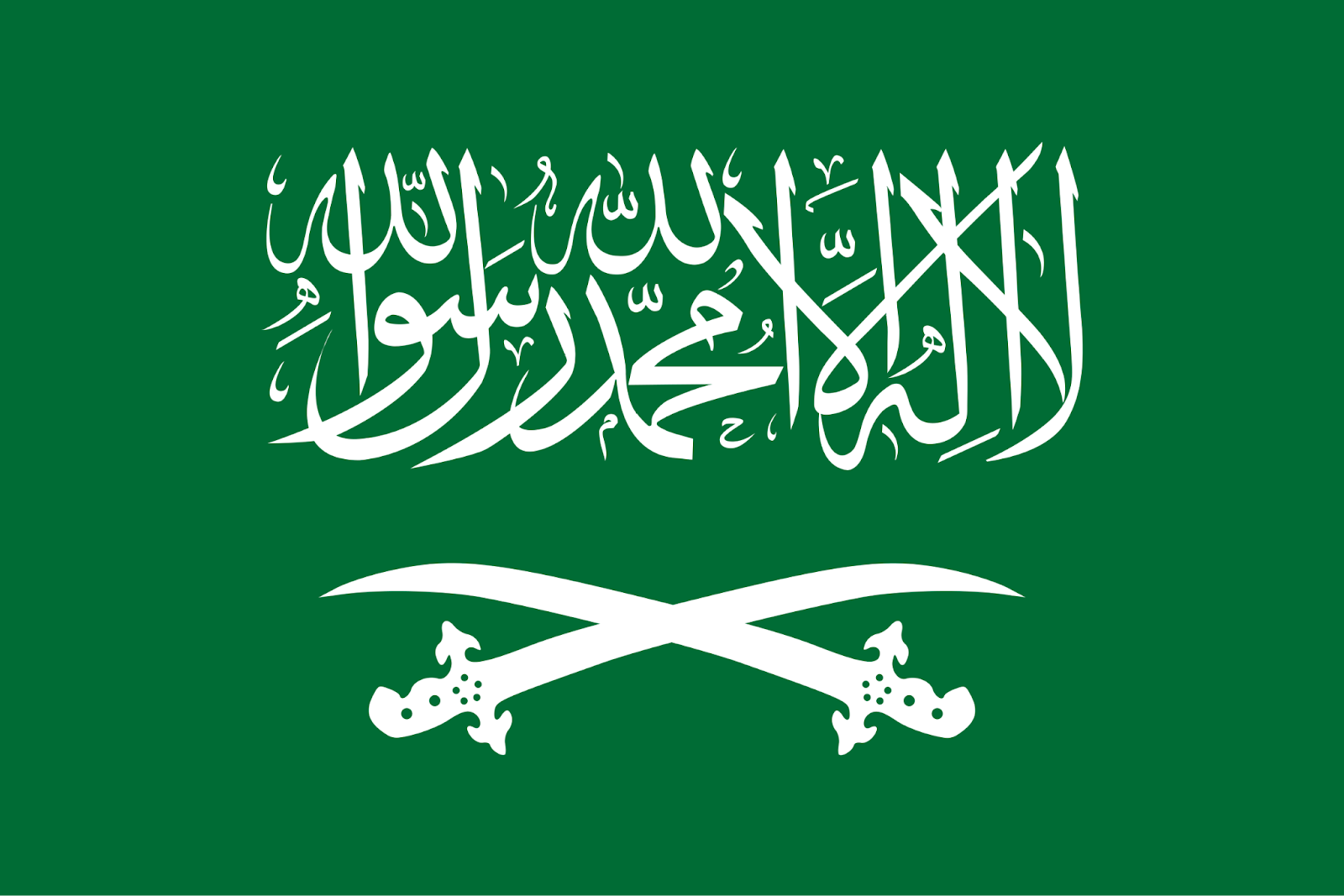
The Wahhabi were among the first to fight foreign empires in Arabia, fighting the Ottomans in the early 1800s. The Rashidis allied with them and used their power to prevail. But then the Al Saud / Wahhabis partnered with the British Empire, and as it overpowered the Ottomans, so did the Al Saud / Wahhabis. This is how the Al Saud/Wahhab alliance took over what would become Saudi Arabia, and that’s why the country is a hyperreligious monarchy to this day: It’s the result of the central Najd religious-inspired fighters taking over the rest of the peninsula from the center, just at the right moment.
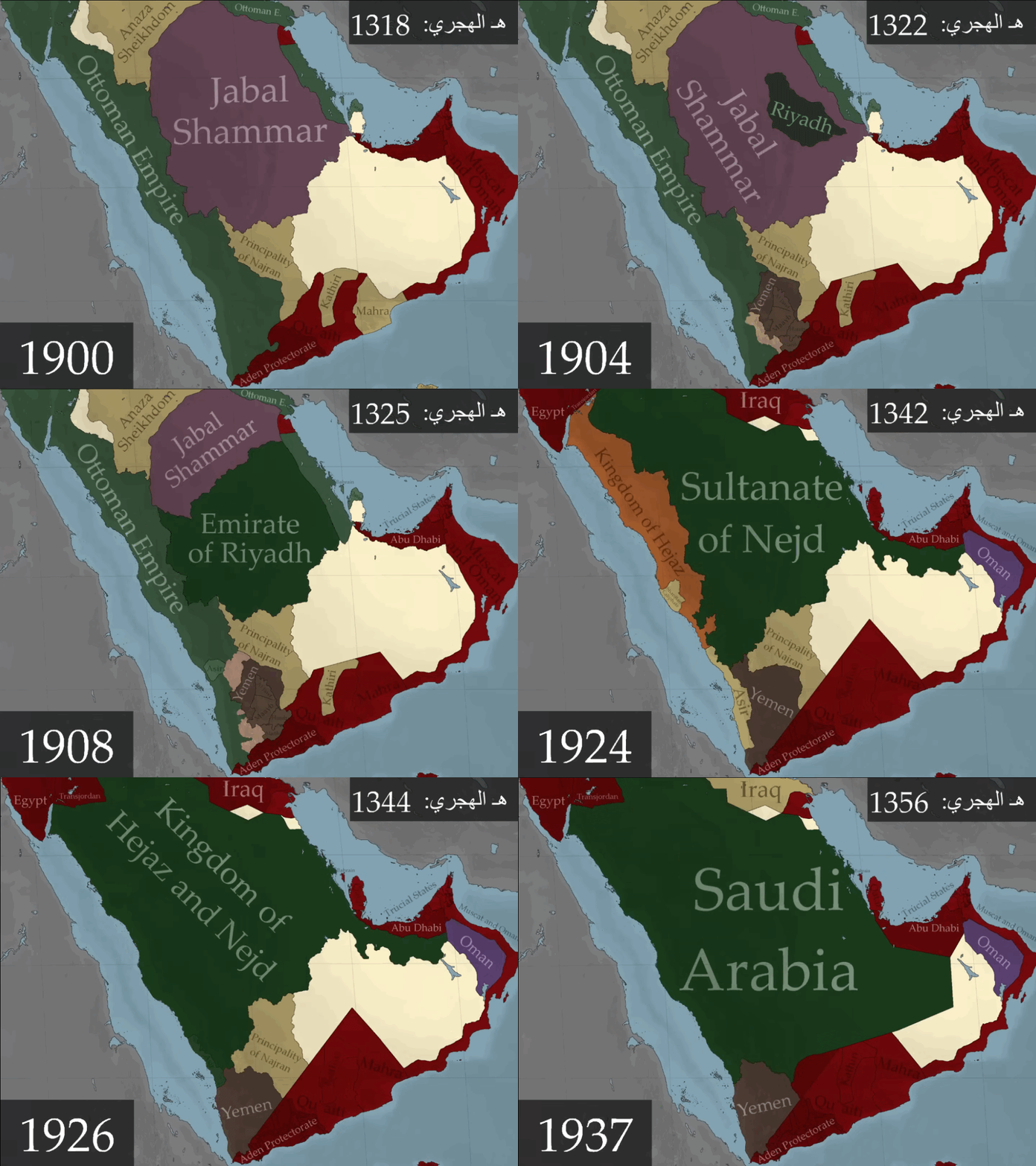
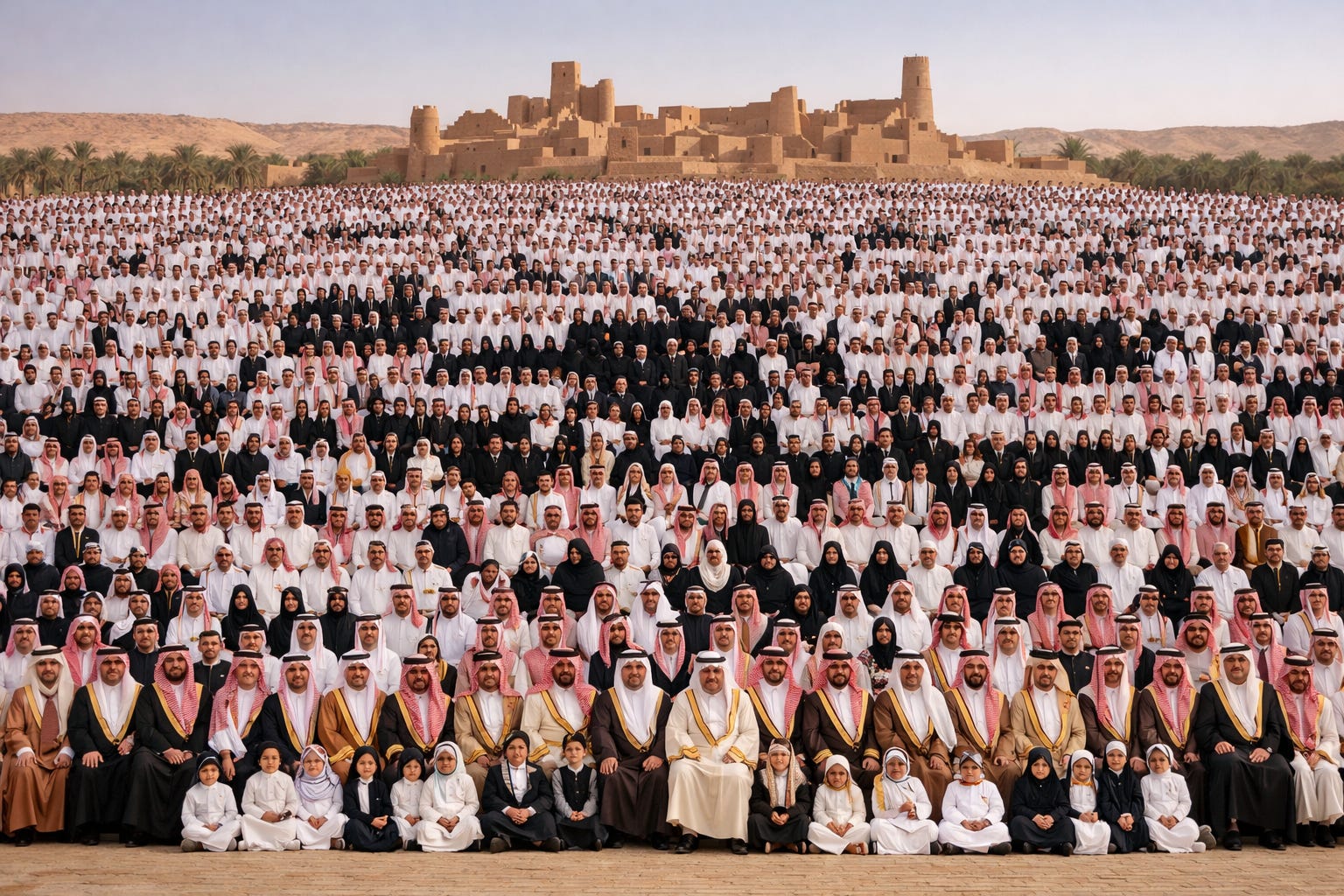
Believe it or not, this entire conquest—going from nothing to retaking Riyadh to conquering all of what would become Saudi Arabia—was done under one single Al Saud ruler, Ibn Saud, AKA Abdulaziz. He then proceeded to marry over 20 women—many of them from different Arabian tribes, to cement their alliances—who gave him around 100 children. Today, the family has 15,000 people, of whom 2,000 are close to power.2
Hejaz’s Hashemites
Of course, not all of the other families are very happy about this. Most notably, the Hashemites (a family that had ruled over Mecca continuously since the 10th Century) ruled the Kingdom of Hejaz on the west coast when the Al Saud took it. Both families had allied with the Brits during WW1, so after the Al Saud conquered Hejaz, Britain compensated the Hashemites with the kingdoms of Transjordan, Syria, and Iraq. Of those, today they only control Jordan.
The Shia
In the spirit of “making friends”… you know who the Al Saud have not married into? Many Shia.
Of course, the Wahhabis, as Sunni zealots, don’t tolerate the Shia well. Among other nice things, they attacked and sacked the Shia Mesopotamian city of Karbala in 1802 (Ottoman at the time), killing thousands, including children and women. Unfortunately for the social cohesion of the newly-formed country in the 1930s, some parts of Saudi Arabia are inhabited by Shia Muslims.
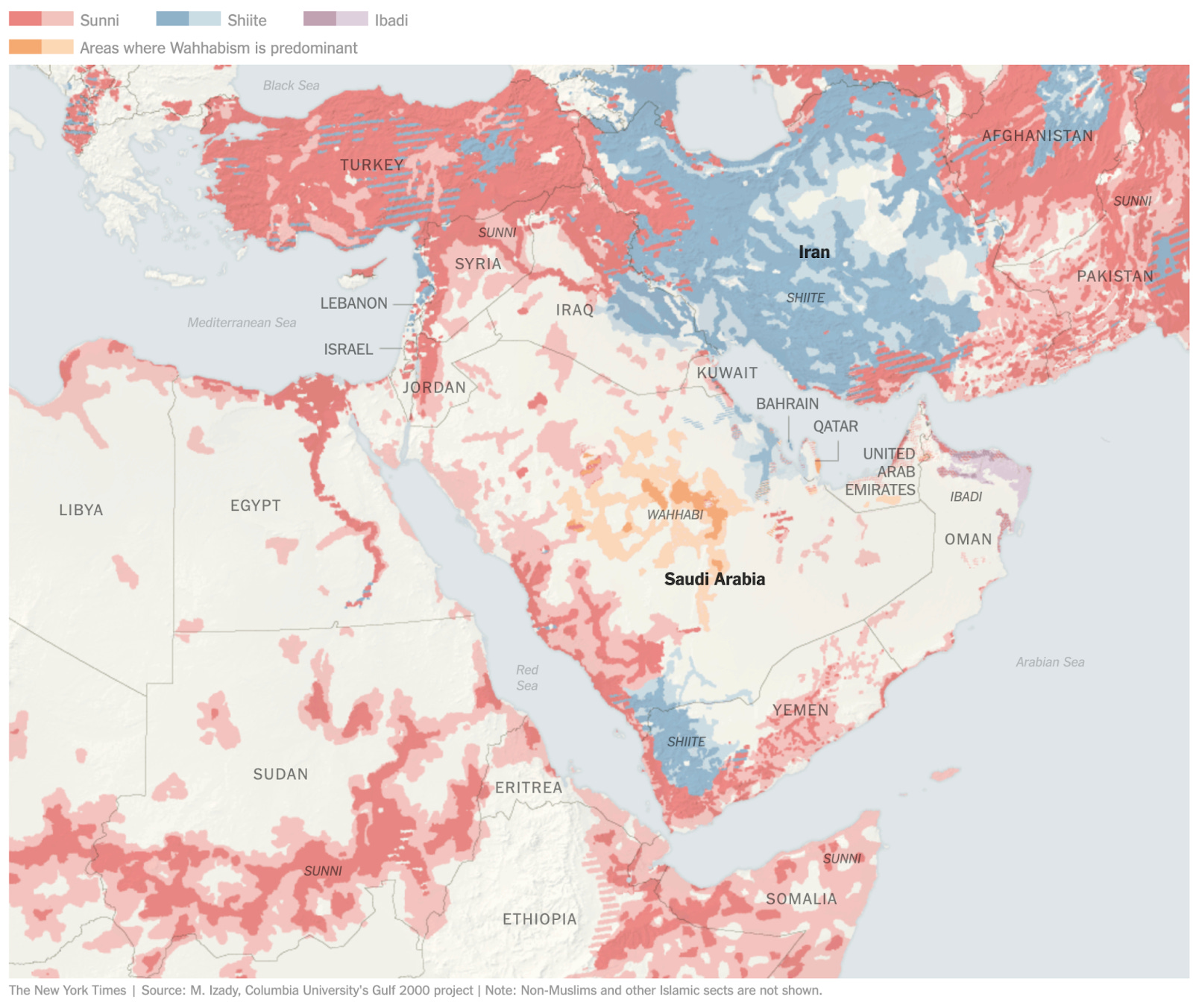
As luck would have it, the Shia region on the Persian Gulf coast in the east is where the oil is.
Oil
Just as Ibn Saud was unifying Arabia with his family and the Wahhabis, Western companies found oil in Persia (modern-day Iran), and then in Bahrain. The Saudis searched for oil and found it in 1938.
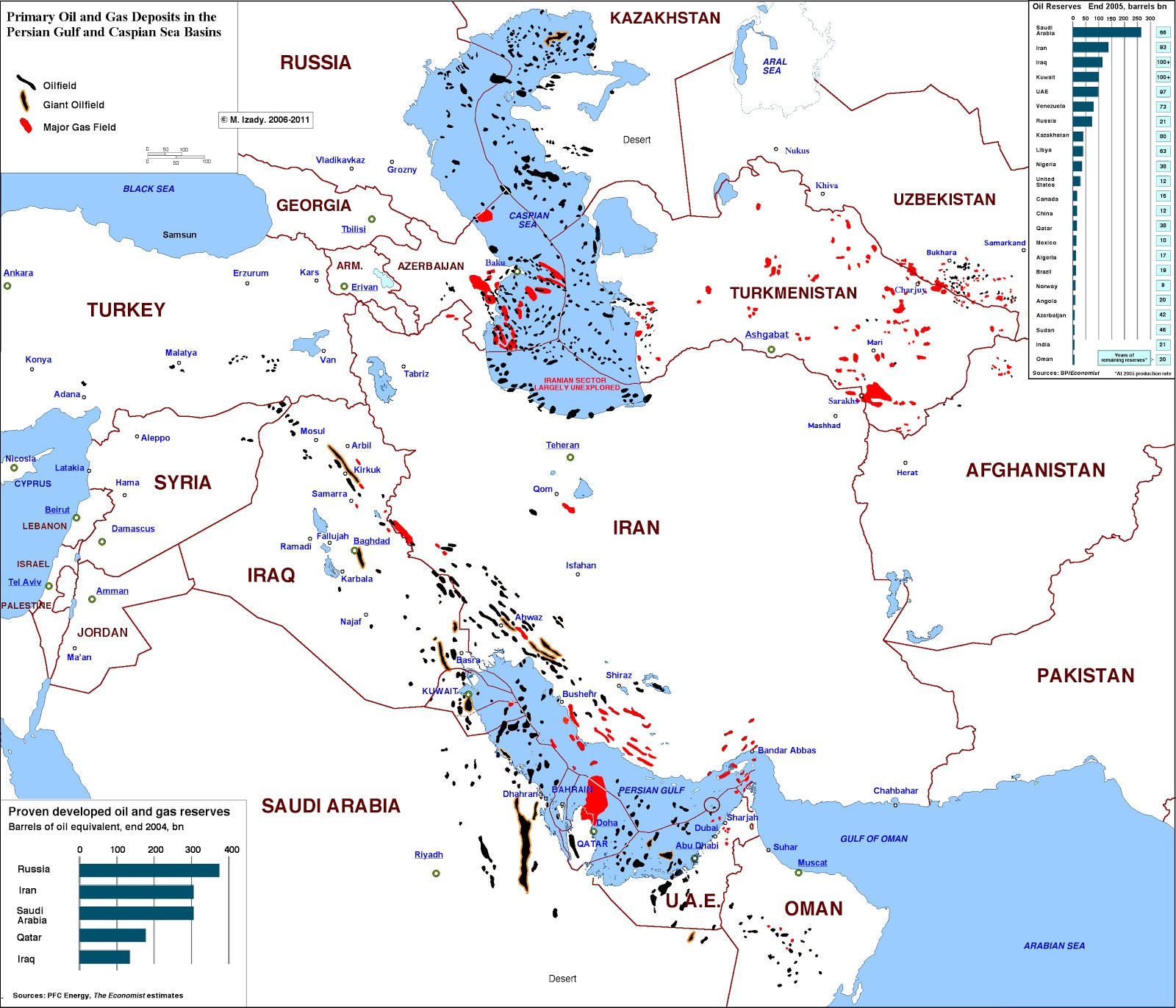
The east coast of Saudi Arabia has the biggest onshore and the biggest offshore oil fields in the world.
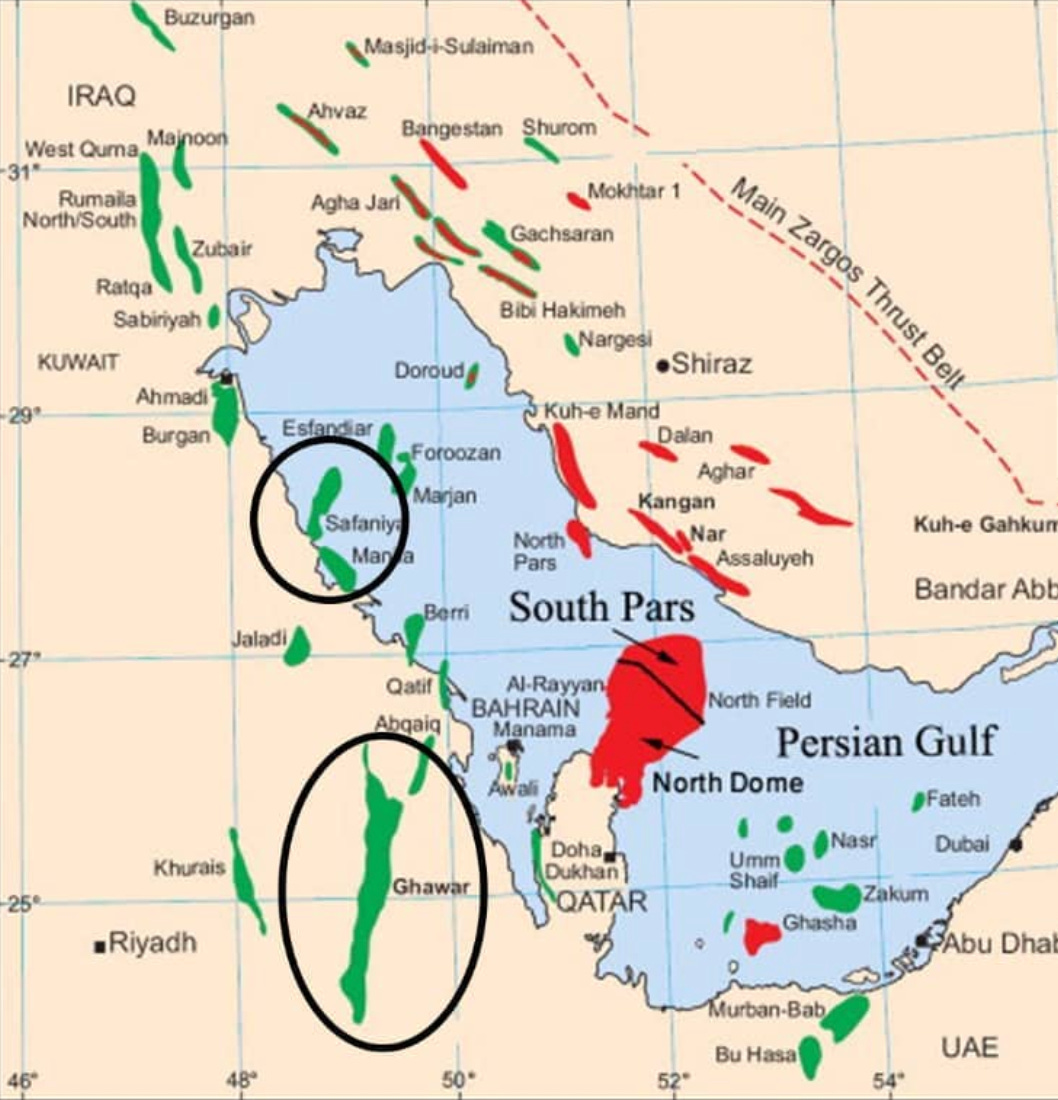
This is why Saudi Arabia is the 2nd largest producer of oil in the world and the largest exporter.
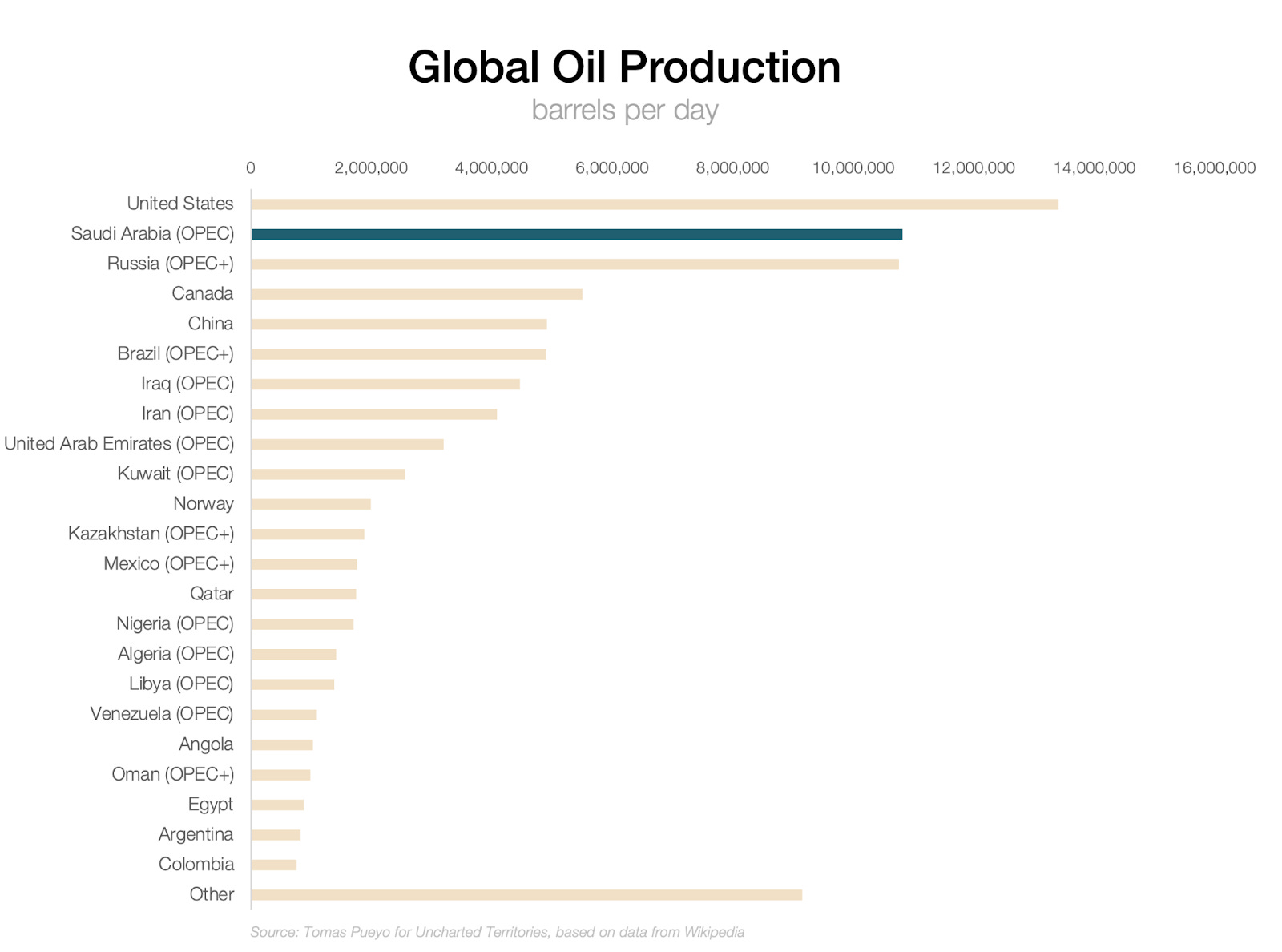
But Saudi Arabia makes much more money from its oil than any other country, because its oil is much cheaper to produce.
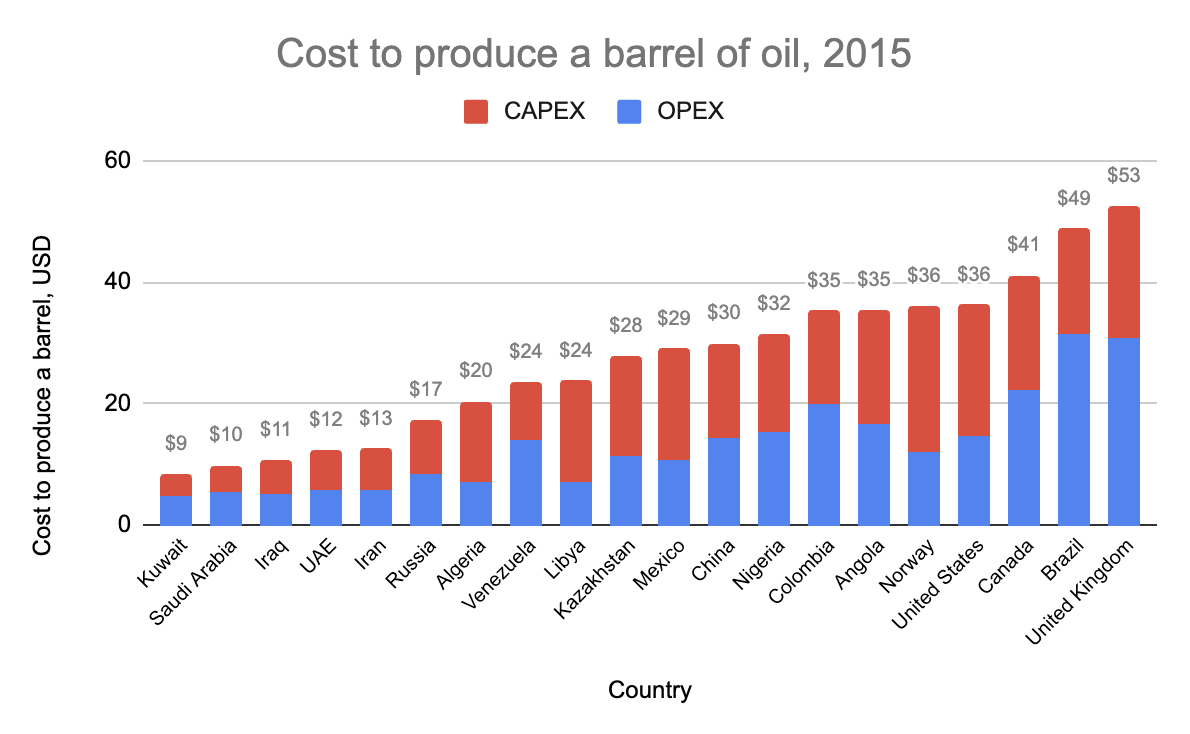
That’s because Saudi Arabia’s oil is in huge fields, mostly onshore, near the surface, easy to access, a lot of it spurts out of the ground without much effort, and the fields are close to the coast, so it’s cheap to get it there.
As a result, oil represents about 42% of GDP… but 95% of the country’s exports.
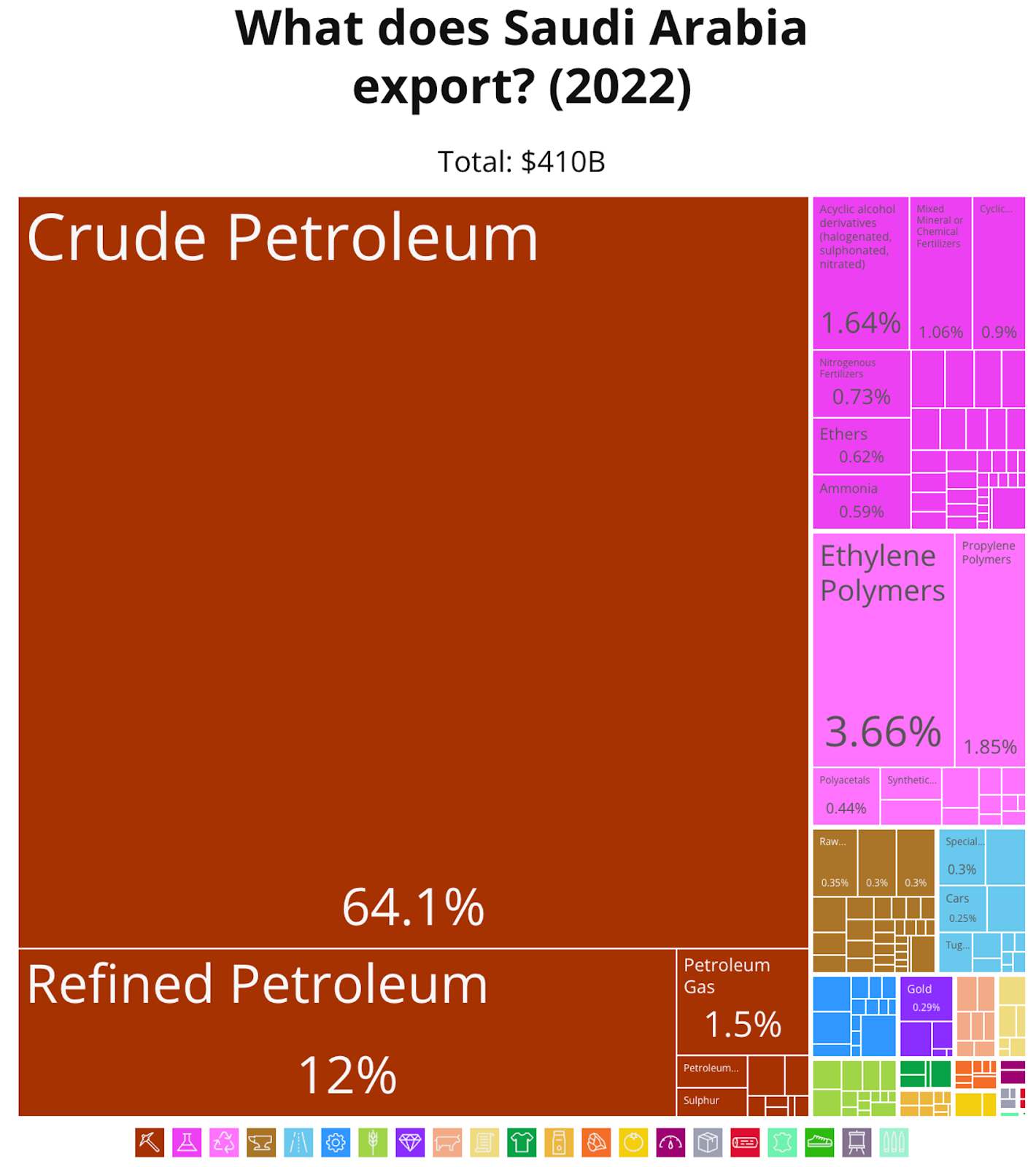
Scarily, oil accounts for ~80% of government income!3
It’s so cheap for Saudi Arabia to pump this oil that it has built a lot of spare capacity. This is a tremendous geopolitical asset, because it can threaten other oil-producing countries with crashing oil prices by dumping millions of additional barrels of oil per day. This leverage frequently pushes them to reduce their own production to keep prices up.
How does Saudi Arabia use this oil?
The Geopolitics of Oil
Saudi Arabia spends on its military a bigger share of its income than the US. It spends more than Russia!
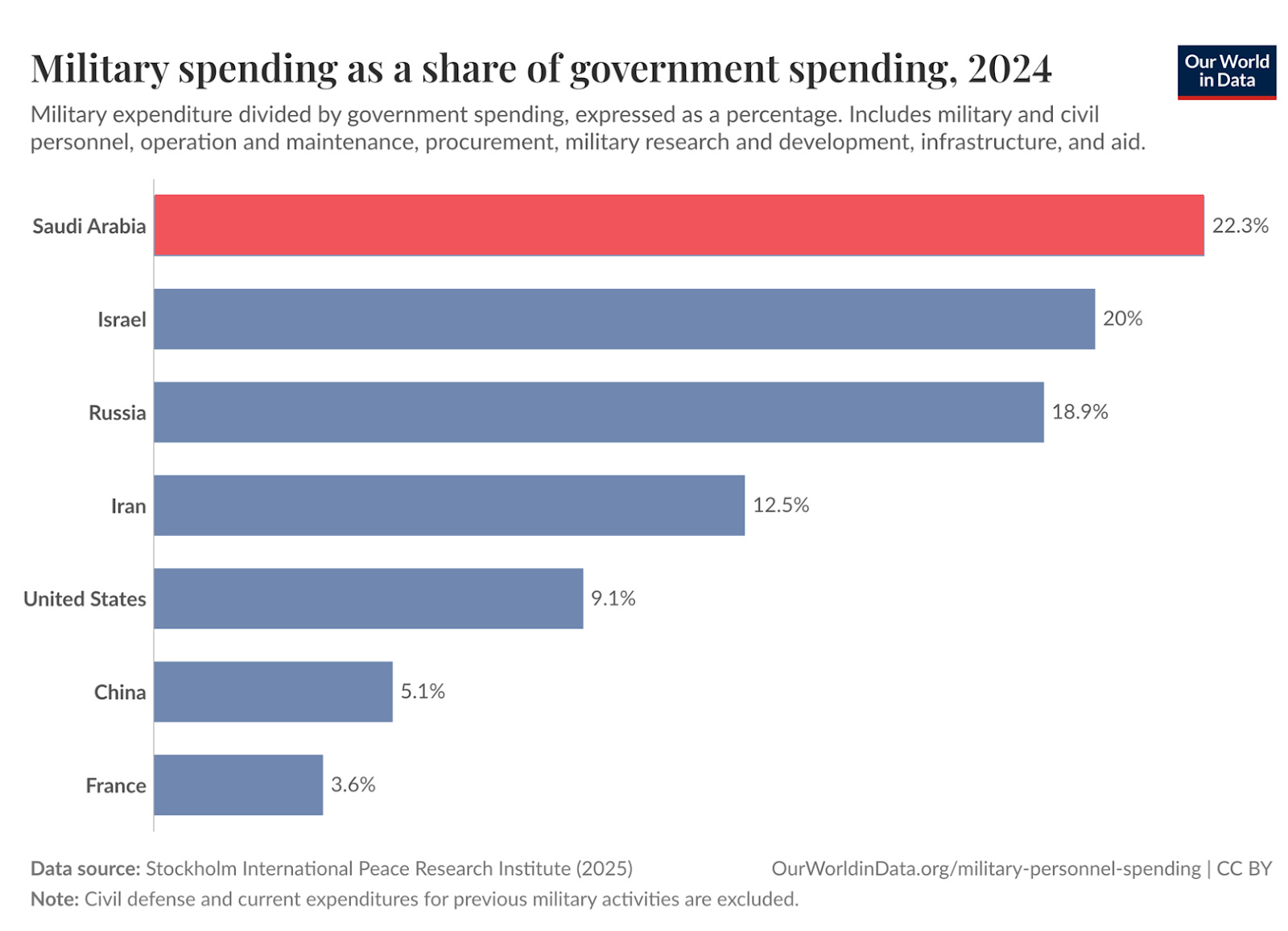
How come?!
Part of it is in the alliance with the US: The deal is that the US gets Saudi oil in exchange for protection, but that oil is not free, and neither is the protection. Saudi Arabia needs to pay for it.
Part of it is because the government has no legitimacy beyond that of the sword and religious radicalism, so it must make sure people are not scheming against it. This requires a big security apparatus. That’s the stick.
The carrot is to have plenty of government jobs in the military, as well as procurement budgets that can benefit important families.
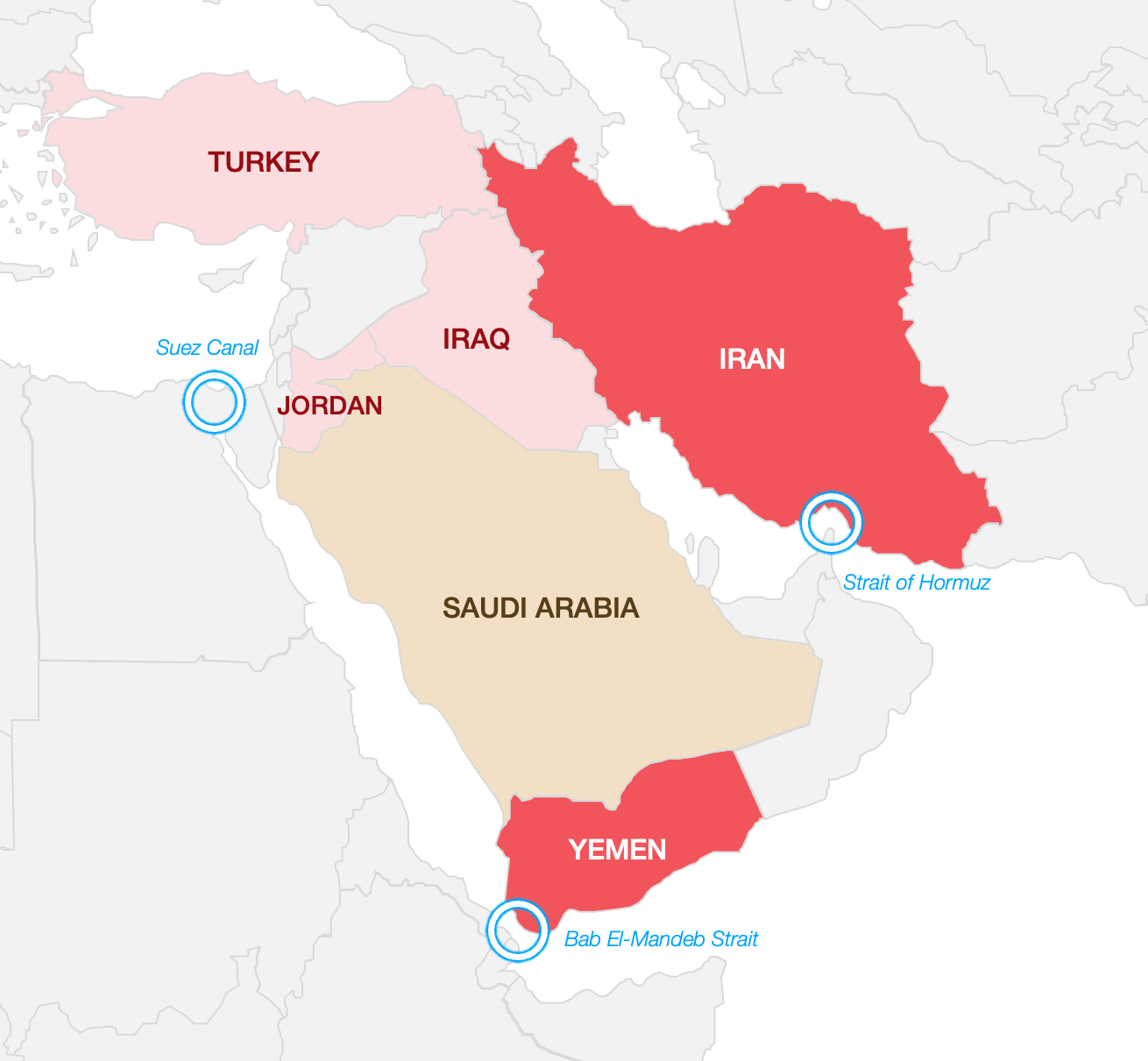
But the most important factor is geopolitics, going back to this map:
The main opponent is Iran:
It’s right next to Saudi Arabia (SA), about 150 km (~100 mi) away
Iran is Shia, SA is Sunni.
Yet Iran has Sunni populations and SA has Shia populations, both of which can be propped up by the opponent as internal enemies.
Iran is an Islamic republic that took down its monarchy to replace it. Since then, it’s been trying to take down monarchies across the Muslim world, and the biggest one is Saudi Arabia’s.
Both are the big regional players, so both vie for influence.
Iran as a rule of thumb is pretty hostile and violent to its enemies.
Iran has directly attacked SA in the past: It destroyed Saudi refineries with drones in 2019.
That threat has been multiplying. Iran has taken indirect control of Iraq, which has a huge border with SA that is hard to defend, as it’s in the middle of the desert.
And of course, Iran backs the Houthis—Shias in Yemen—in their civil war against the Sunnis. That war is on the border with Saudi Arabia, and SA has some Shia in that region.
Iran is the biggest threat, but it’s not the only one. Until a century ago, large parts of Arabia were controlled by the Ottoman Empire, and the Turks still eye the region as they build back their strength. Both compete for the global Sunni leadership. Turkey has supported the Muslim Brotherhood while the Saudis condemn the group—and even facilitated a coup in Egypt to oust them.
Jordan and Saudi Arabia have a cordial relationship, but Jordan is still ruled by the Hashemite family, who have a strong claim to the throne of western Arabia, Hejaz. If Saudi Arabia were to weaken, and the Hashemites saw an opening to retake Hejaz, wouldn’t they take it?
Finally, we still have the issue that all the trading lanes around Saudi Arabia are narrow and have choke points. If Saudi Arabia loses them—as it has partially with the Red Sea near Bab El-Mandem with the Houthis—its entire budget is at risk. They are one blockade away from financial ruin.
This is why Saudi Arabia had to be so close with the US, and why they signed an alliance of oil-for-protection around the end of WW2. But that’s not the only balancing act that Saudi Arabia needs to maintain. It also needs to keep oil prices up, which is why it was a founding member of OPEC and raised oil prices against the US. It’s why, after Russia invaded Ukraine, it agreed with Russia (2nd largest exporter of oil in the world) to reduce their oil output to keep prices up. It’s why it must keep China happy, as the main customer for Saudi oil. These very interests are why the US decided to invest so heavily in its own oil, and why it has become the world’s #1 producer. Thanks to that, and the rise of solar and batteries, the US’s interest in the region will continue waning. Saudi Arabia knows this. And it’s not prepared for a crash in oil demand.
The Military Bind
Saudi Arabia has 260k military personnel and spends over $60B on military gear every year, but even with the help of the other half of Yemen, it hasn’t been able to beat the Houthis.4 So the Saudi military is not that good.
This is by design. Maintaining any military force poses the risk that it will topple the government and take power, as happened in Egypt. It’s especially true in Saudi Arabia, where the government has no more legitimacy than having taken power by force. So the Al Saud systematically undermine the power of the military.
Half of the Saudi force is in the National Guard, the personal protection force of the Al Saud! The remaining forces are split between the Armed Forces, the Border Guard, the Royal Guard, and state security and intelligence services, all of which report to different princes. Personnel is recruited and promoted based on allegiance, not ability.
Notice what’s at the heart of the emblem of the Saudi Arabian Armed Forces? That ain’t the Saudi Arabia flag…
But the military is not the only dubious beneficiary of oil money.
Rentier Citizens
Saudis make more money than Canadians5 but read worse than the Gabonese.
A big chunk of that money comes from oil, as 50% of Saudi nationals are employed in the public sector.6 The OECD average is 18% and the highest in the OECD, the petrostate of Norway, only employs 30% of the country’s workers… Saudis working in the public sector make 30-50% more than their counterparts in the private sector, so these jobs are more prized—not even accounting for all the job benefits they get in the public sector.
The result is that 40%–50% of government spending is in wages, compared to 8% in the US, 18% in bloated France, and 15% in Norway!
Wages are not the only way Saudis are supported by the state. For example, Saudi Arabia provides huge fuel subsidies to its citizens:
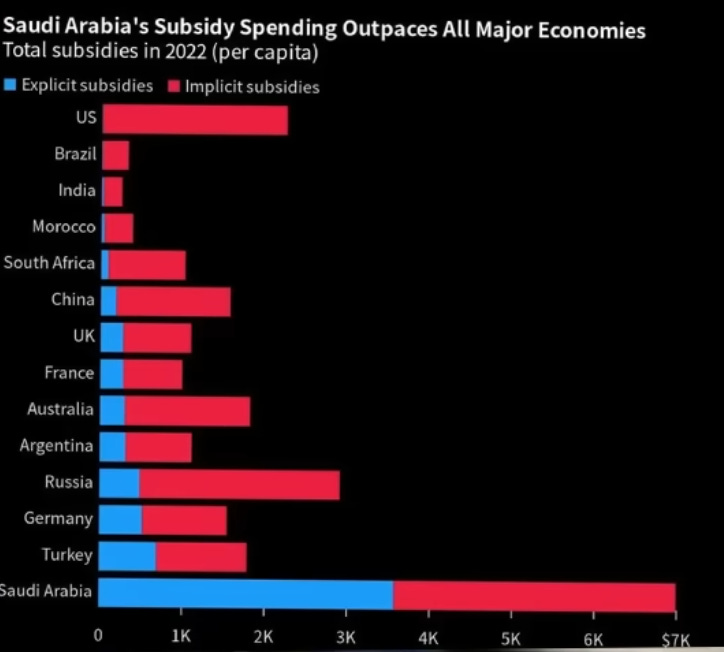
$7k in subsidies per person for a family of four, that’s $28k per year…
In other words, Saudi Arabia is burning a huge share of its revenue in subsidizing its population, either directly, or indirectly via unproductive public jobs.
All this work performed by millions of people… You can’t tax that. You’re using your government revenue to pay for them! How is Saudi Arabia supposed to maintain this level of spending if oil revenue drops?
Rivers of Oil, Wadis of Water
Of course, that’s not the only way Saudi Arabia has been wasting its oil money. In the country, rivers of oil have become rivers of water, as it has developed the world’s highest capacity for water desalination:7 60% of the water the country consumes is desalinated! Of course, the energy for this desalination comes from oil, so oil is subsidizing the country’s water. Until recently, a sizable amount of this water was dedicated to agriculture—literally watering the desert!
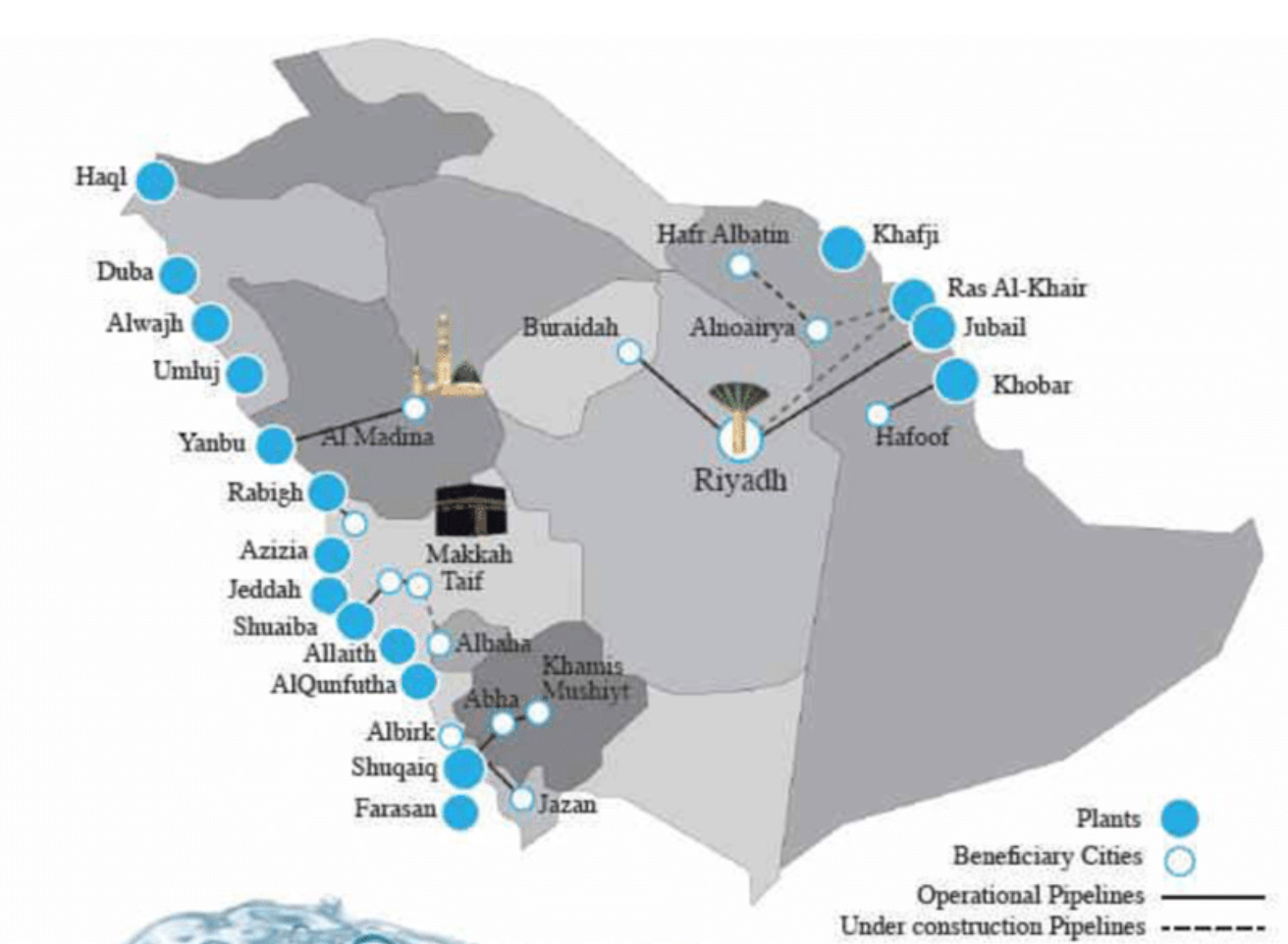
Apparently, another 30% of water consumption in the country is from non-renewable groundwater, so 90% of the country’s water is basically at risk, as oil revenue shrinks.8
MbS: Between the Sandworm and the Quicksand
In Homer’s Odyssey, as Odysseus crosses the Strait of Messina, he must decide which monster his ship will pass closer to: the six-headed Scylla or the whirlpool formed by Charybdis. He won’t be able to avoid danger and loss.
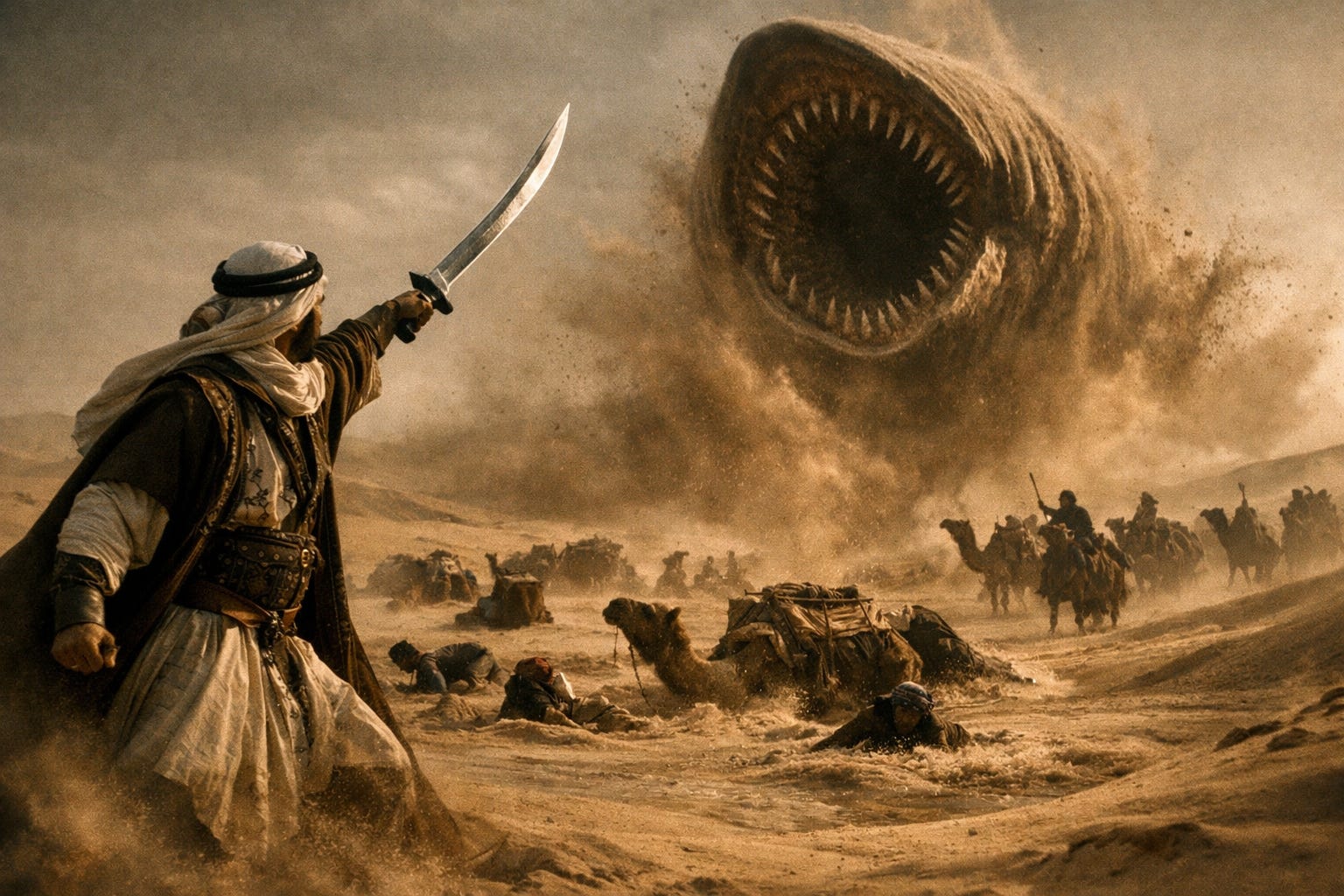
As I think about Mohammed bin Salman’s predicament, I can’t help but think he’s in a similar position, but in the sand—like in Dune, between a sandworm and quicksand:
The foundation of the Al Saud reign is force, underpinned by oil—but oil is waning.
Their power comes from the central Najd, which is culturally and religiously very local and conservative. But the peripheries of Saudi Arabia have a very different history and culture.
Hejaz, to the west, is traditionally much more cosmopolitan, centered on the Red Sea and its trade. It was a kingdom until very recently, and the previous ruling family still reigns in Jordan.
To the east, the population is majority Shia, at odds with the Wahhabi religious interpretation.
Iran, the regional Shia power, is extremely at odds with Saudi Arabia, as Iran replaced its Western-allied king with an Islamist republic, and it hopes to do the same in Saudi Arabia.
Iraq is now aligned with Iran, creating a huge pro-Shia border with Saudi Arabia.
The biggest protector, the US, is losing interest in Saudi Arabia as its own oil production increases and the surge of renewables and batteries limits the importance of oil.
Meanwhile, the other regional hegemon, Turkey, is becoming increasingly assertive.
The Saudis can barely trust their own military to fend off these threats, as the ruling family’s legitimacy is based only on strength and oil. If one goes, the other goes with it, and a coup is likely.
That is, if there isn’t an internal coup first within the Al Saud family—entirely possible since there are 15,000 of them.
As oil income continues shrinking, the Saudis will also have to diversify the economy from oil pretty dramatically.
This is difficult, as the entire economy revolves around oil, from the massive number of civil servants to water, agriculture, and energy subsidies.
A key to achieving this economic turnaround is to thrust Saudi Arabia into the future, but how can you do that when its culture is anchored in Wahhabism? The very modernization it needs economically is radically at odds with its traditional religion, going back over 250 years to the first alliance of the Al Saud with the Wahhabs.
If MbS succeeds, the transformation might be as impressive as the one carried out by a trader in the region 1,400 years ago. But will he? In the next (premium) article on Saudi Arabia, we will explore what he has tried, how it has gone so far, how likely he is to succeed, and how that helps understand the recent changes in policies in the kingdom. Subscribe to read it!
Every map draws it differently, so I had to pick what I thought made the most sense, and my guess is the Najd is defined by the Arabian Shield outside of the coast, because:
Outside of the shield there’s too much sand, and you can’t build anything on sand.
On the coast you had populations more centered on the sea, which also means they’re more cosmopolitan and focused on trade.
This is a claim from Wikipedia. I assumed that meant all the Al Saud from forever, but ChatGPT, Gemini, and Grok all suggest the vast majority are direct descendants of Ibn Saud! Assuming every generation takes on average 30 years, and that Ibn Saud’s children were born on average in 1930, by 1960 he had a 2nd generation on average, by 1990 a third, and by 2020 a fourth. The first generation (Ibn’s children) were apparently ~100, and at least one of them had ~100 children, which is how you can get to 10,000 descendants within two generations, and after four, you’d reach 10M. In reality, daughters can’t marry so many men and have so many children, so if you only consider the patrilineal sides, Ibn Saud had 36 sons that survived to adulthood. Four generations like that gets you 1.7M male descendants. Therefore, it is reasonable to assume that most of the 15,000 Al Saud are direct descendants, although some also likely come from “cadet lines”, or branches other than Ibn Saud’s direct line.
The figure is actually hard to get, I assume because of course the government wants to sandbag it. Official figures suggest ~60% of income from oil, but they’re breaking down the oil revenue into straight income, royalties, taxes, dividends… Many of which really come from oil. Some of the income comes via the sovereign fund, the PIF, which owns part of the state oil company, Saudi Aramco. But the fact that it comes from PIF and not Saudi Aramco directly doesn’t matter. There’s also the indirect revenue: About ⅔ of Saudis work in the public sector (paid through money coming from oil!). They pay their taxes on goods and services, which apparently are 50% of non-oil taxes. But that money comes mostly from oil, via the salaries of the public servants! That’s ~17% more government income directly attributable to oil. This is why Wikipedia quotes ~75% as the figure. My guess is the true revenue is probably higher than 80%, but my point here is not to be precise, it’s to convey the idea that the government is terribly dependent on oil, and this is enough for that.
The Houthis now have 200,000 military personnel, but there are also hundreds of thousands of Sunni Yemeni soldiers.
GDP per capita in PPP is a better measure than GDP per capita, but is not perfect here, as Saudi Arabia is much more unequal than Canada. But I couldn’t find a measure of median representative income that exists for both the West and Saudi Arabia. GNI per capita shows something similar. A better measure is median household income, but we need to collate different sources for this. The OECD says Canada’s is $40k, while Saudi Arabia’s government says the equivalent number for Saudi families (not those of foreigners) is $44k. So yes, the average Saudi has more money than the average Canadian!
It claims 7.5M m3, and from my calculations the 2nd largest is the UAE, which has about 7M m3.
Saudi Arabia will always be able to pump its oil to burn it for cheap electricity for desalination, though. It might just be fiscally harder without income from the share of the oil it sells.
The recent efforts of the PIF have been spectacularly wasteful, based on conflicting objectives and faulty premises.
The sports washing complaints in the west (for things like LIV Golf and various football team investments) routinely ignored how they were transparently value destructive investments that didn’t even achieve the reputation laundering benefits they supposedly were for.
Additionally, mega projects such as The Line were sold as ways to induce productive capacity via enormous demand. Unfortunately for the Saudis, their economy lacks productive capacity and unworkable and unproductive modern age equivalents to the Giza pyramids don’t generate it on their own.
They do not have a labor force that has the requisite skills to staff a modern economy and are very unlikely to be able to foster that after spending decades subsidizing their population into submission.
The resource curse isn't just about GDP diversification. Oil revenue let the Saudi state buy social compliance instead of building civic institutions. Vision 2030 can diversify the export basket. But the harder problem is two generations of citizens whose relationship with the state is "we provide, you comply" rather than the tax-representation bargain that creates functional accountability. Singapore built that from scratch. Saudi Arabia has to replace it while operating.