

These are shorter articles on broader topics, based on everything we’ve covered in depth so far. Today, GeoHistory:
Did Plains and Mountains Make Countries?
Humans Terraform the Earth Before History
External Stomachs
Clans Are Bad for Society
Iran vs US (Premium from hereon)
African Slavery of Africans
Colonial Empires Made the Homeland Poorer
Population Density in Europe in 1600
Population Changes in Europe in the Last 25 Years
The EU Will Soon Produce More Weapon Shells than China
Are the Chinese a Single Ethnicity?
China in the Arctic
The Lowest Point of the Chinese Communist Party
We’re about to Discover More about the Past
In the previous article, I omitted that Oman controls the end of the tip of the Strait of Hormuz on the western side. We’re working on an automated fact-checker to avoid these, if you find any mistake please point it out, it should help it get better over time.
Did Plains and Mountains Make Countries?
One of the key hypotheses of Jared Diamond’s Guns, Germs, and Steel is that Europe had plains and mountains placed in such a way that they encouraged the formation of separate countries that competed against each other, and that this competition led to Europe’s progress.
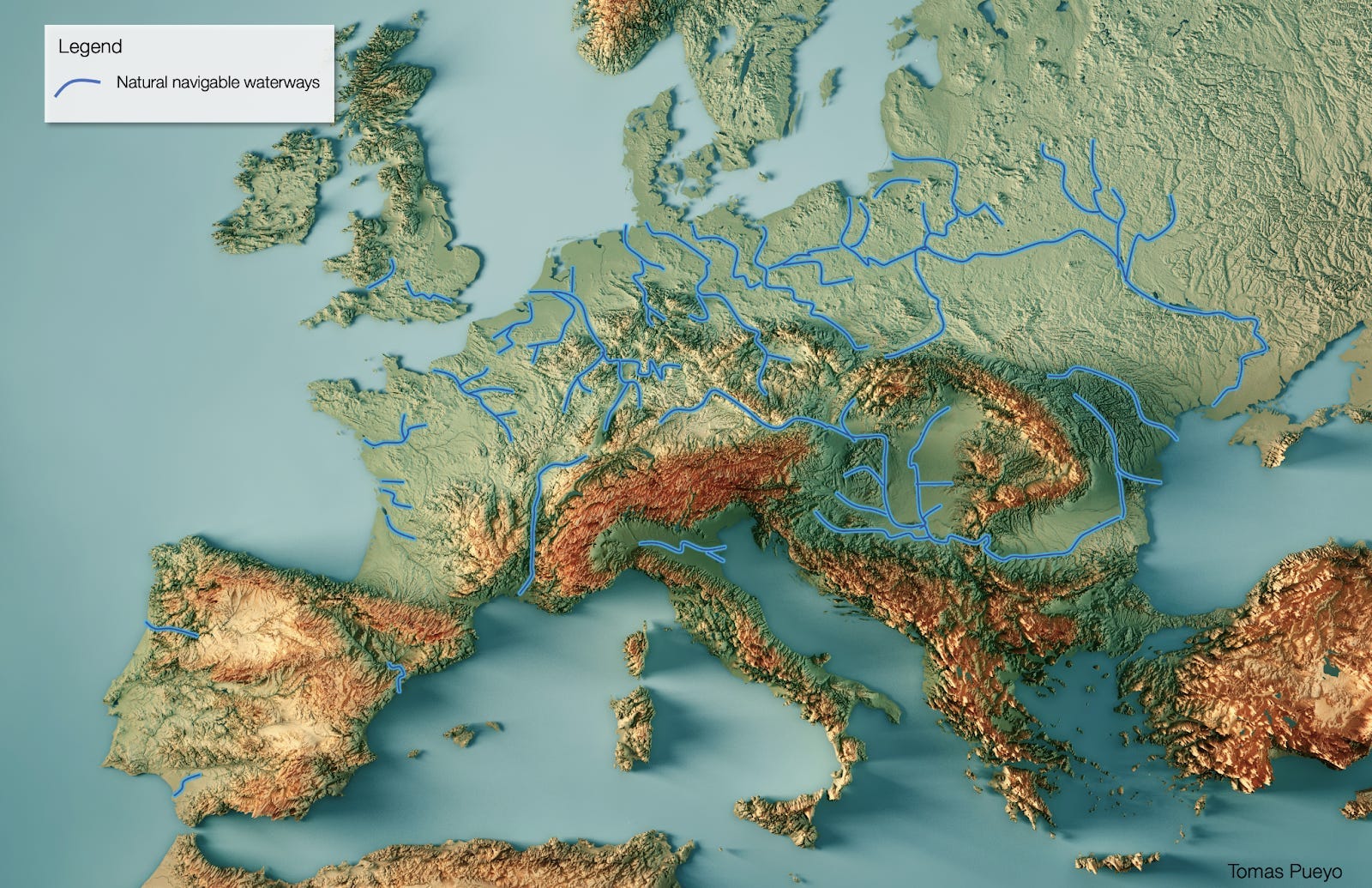
Meanwhile, China’s heartland is the one massive North China plain, and from it, it’s reasonably easy to conquer adjacent spaces, none of which have plains that are as good.
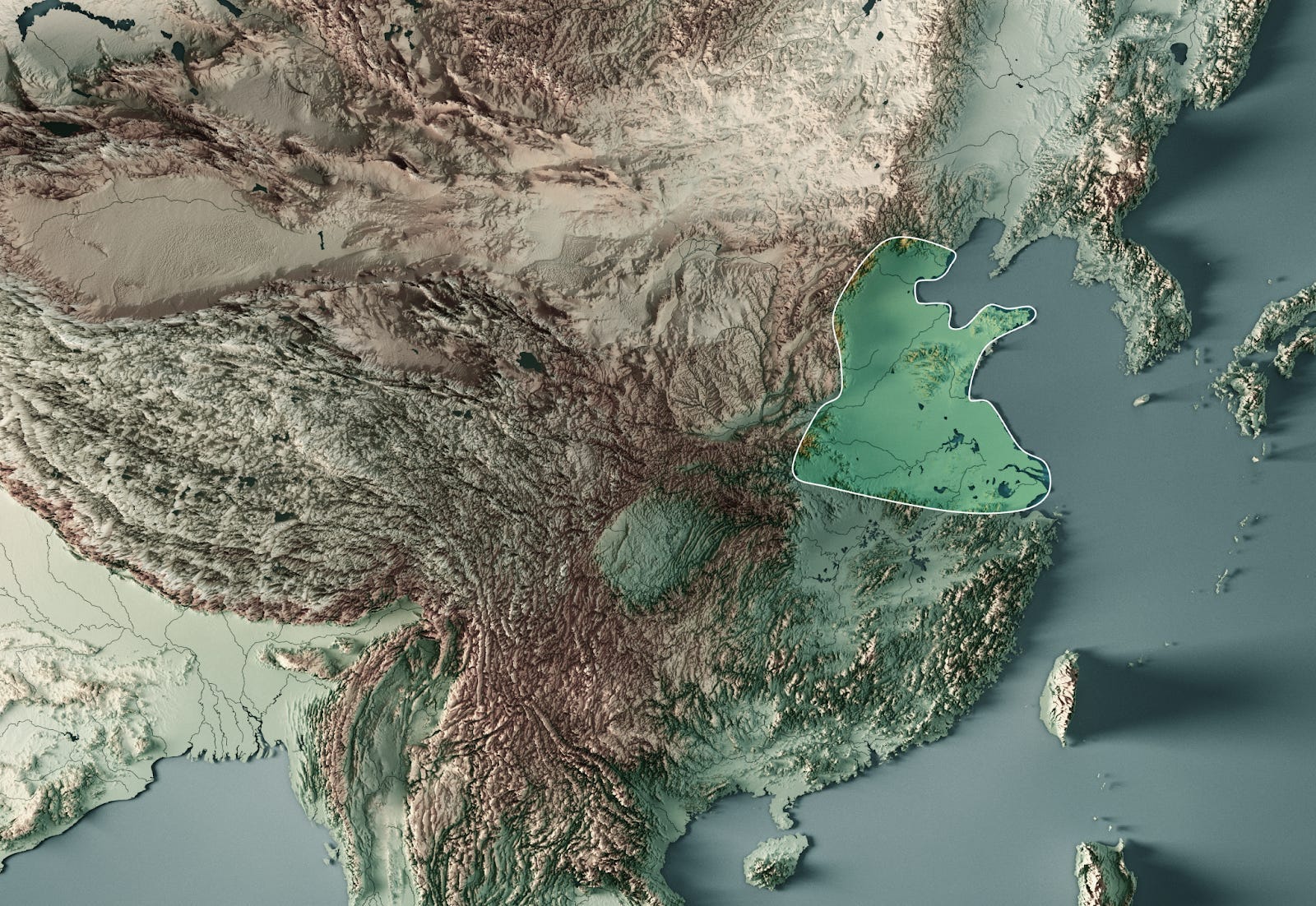
This paper assessed this claim with numbers, finding that topography is sufficient to explain the formation of many countries in Europe and a single one in China. They found, however, that differences in land productivity could also explain this phenomenon. Specifically, the North China Plain is so hyperfertile—crossed by the two massive Yellow and Yangtze Rivers and crisscrossed by their tributaries—as to singly justify the centralization of China.
Humans Terraform the Earth Before History
Until recently, I thought the world was mostly pristine until humans hunted many megafauna species (such as mammoths) to extinction a few tens of thousands of years ago and started cutting trees around 5,000–10,000 years ago to replace forests with farms.
But Against the Grain (no sponsorship link), argues that humans terraformed the Earth much earlier, among other ways through fire.
The main enemy was trees. They’re like very tall umbrellas capturing most of the sunlight from above and lots of nutrients from below, and producing wood and very high leaves, both of which are nearly impossible for humans and animals to eat—wood because we can’t digest it, and leaves because they’re too high.
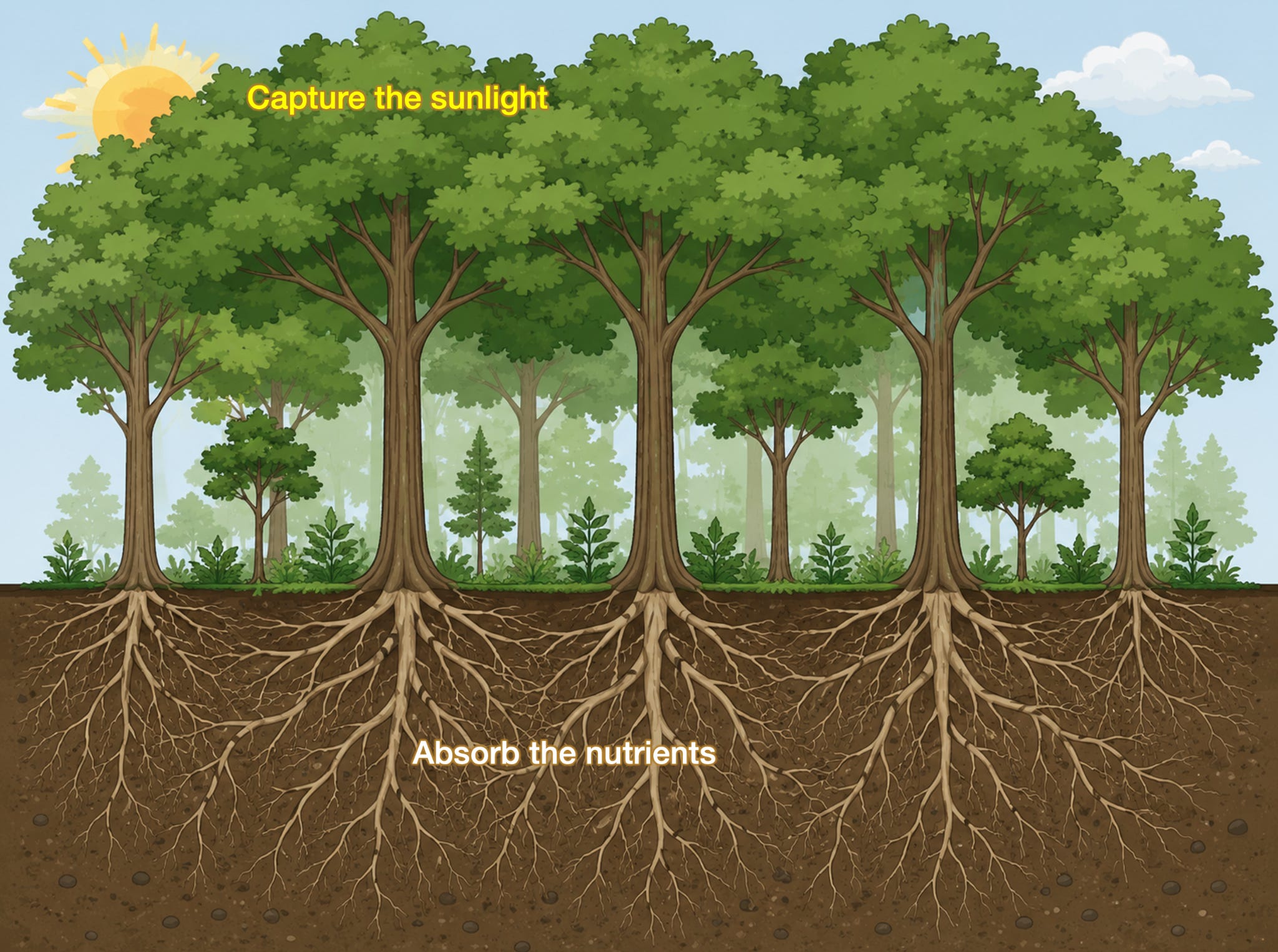
Humans therefore burned them, which replaced trees with:
Ash, which is basically a concentration of all the nutrients that the trees have accumulated, placed onto the ground
No competition for sunlight
Fast growing bushes and grasses
The grasses could then feed animals, which could then be hunted
The bushes and grasses produced food that humans could eat, such as grains, seeds, nuts, shoots, tubers, and berries
Of course, the burning itself was a weapon, which humans used to hunt, for example by encircling animals, exposing nests and burrows, or pushing prey off a cliff or into traps or bogs.1
The best way to understand this as a system is as an improvement in the cost-benefit of calories. By transforming calories from wood and high-up leaves into edible plants and animals, fire increased the density of calories available to humans per acre, which also meant they had to walk less to feed themselves. A higher number of calories per acre is the single most important factor determining human population.
This fire thing has been going on for about 400,000 years, so the Earth we know (and even the Earth that the first farmers knew about 10k years ago), has nothing in common with the pristine Earth of 500,000 years ago. This includes the Amazon Rainforest, which has signs of this type of fire landscaping!
Food for thought for those who want to go back to a wilder Earth.
External Stomachs
We can’t eat wood. But we also can’t eat most grasses. So it’s a big problem when most of the calories after a fire are converted into grasses. As I mentioned before, this was solved by animals eating the grasses. The mechanism here is that we used the bioreactors of animal stomachs, thanks to their gut bacteria, which transform grass matter into edible matter for humans.
The problem with wild animals is that you need to hunt them, which takes a lot of calories. So the ROI (return on investment) has a high benefit (meat!) but at a high cost (hunting!).
This was solved by domesticating animals. First sheep and goats, but also chickens, pigs, and cows, foraged for us, converted that organic food through their bioreactors into meat, and stored it right there without the need for salt or fridges, for us to harvest when we saw fit. We selectively bred these domesticates for the qualities we desire: rapid reproduction, toleration of confinement, docility, meat, and milk and wool production.
Fire is the other external stomach we’ve used. Cooking food makes more calories available to human digestion because it weakens the plants’ cellular protection, makes proteins easier to attack by enzymes, disables defensive chemicals, opens starch granules…
Clans Are Bad for Society
I never realized how harmful clans were to civil development.
Clans are families made up of several generations of siblings and cousins. They can be quite big, if they have lots of children and maintain connections with family members for generations. They’re a pretty natural way for humans to organize, if you think about it: You share your assets with your blood relatives, whom you likely trust more than the average stranger.
Unfortunately, clans have many disadvantages. For example:
By linking trust to blood, it makes cooperation between clans much harder.
Cooperation with complete strangers is even harder, because justice is served within clans. If you can’t keep somebody honest because you don’t know their clan, how are you supposed to trust them?
They prevent ambition, because the success of a single individual is shared across the entire clan. It’s like a huge tax, and taxes on labor reduce labor. Why would you work too hard if the fruits of your labor will be shared with others?
I’ve been reading The WEIRDest People (no sponsorship link), which advances the idea that the Catholic Church eliminating cousin marriage ended up weakening clans, so people had to start building institutions to coordinate with unrelated people, and that created institutions like guilds, chartered towns, religious orders, universities, companies, or stockmarkets.
This is supported by this paper, which provides evidence that:
The medieval Catholic Church's marriage regulations dissolved Europe's clan-based kin networks.
Strong kin networks are detrimental for democratic institutions.
So the Church contributed to the emergence of participatory institutions.
It does so by showing associations:
The weaker the ancestral kin, the stronger an ethnicity’s democratic tradition.
The more exposure to the Church, the more self-governed cities with participatory institutions grew.
The more cousin marriage bans, the more communes were formed.
The weaker kin networks, the more civic a group is, and the more political participation there is.
