

This is the 6th and penultimate article in the series of immigration in the Western world. We’ve seen that:
However, today, immigrants to Europe commit more crime and terrorism, can undermine social cohesion, work less, and consume more welfare than natives.
Muslim immigrants tend to be overrepresented in these stats. To understand better why, we looked at the beliefs of Muslims in their native countries and in the West.
We also pondered how we should think about immigration: Who to welcome or reject, and how to best manage them.
So today, we’re going to apply all this to suggest the best policies Europe can adopt to improve its immigration.
If you take immigration as a system, you need to:
Get the best people in
Reject the worst ones
Make the most of the ones you got in
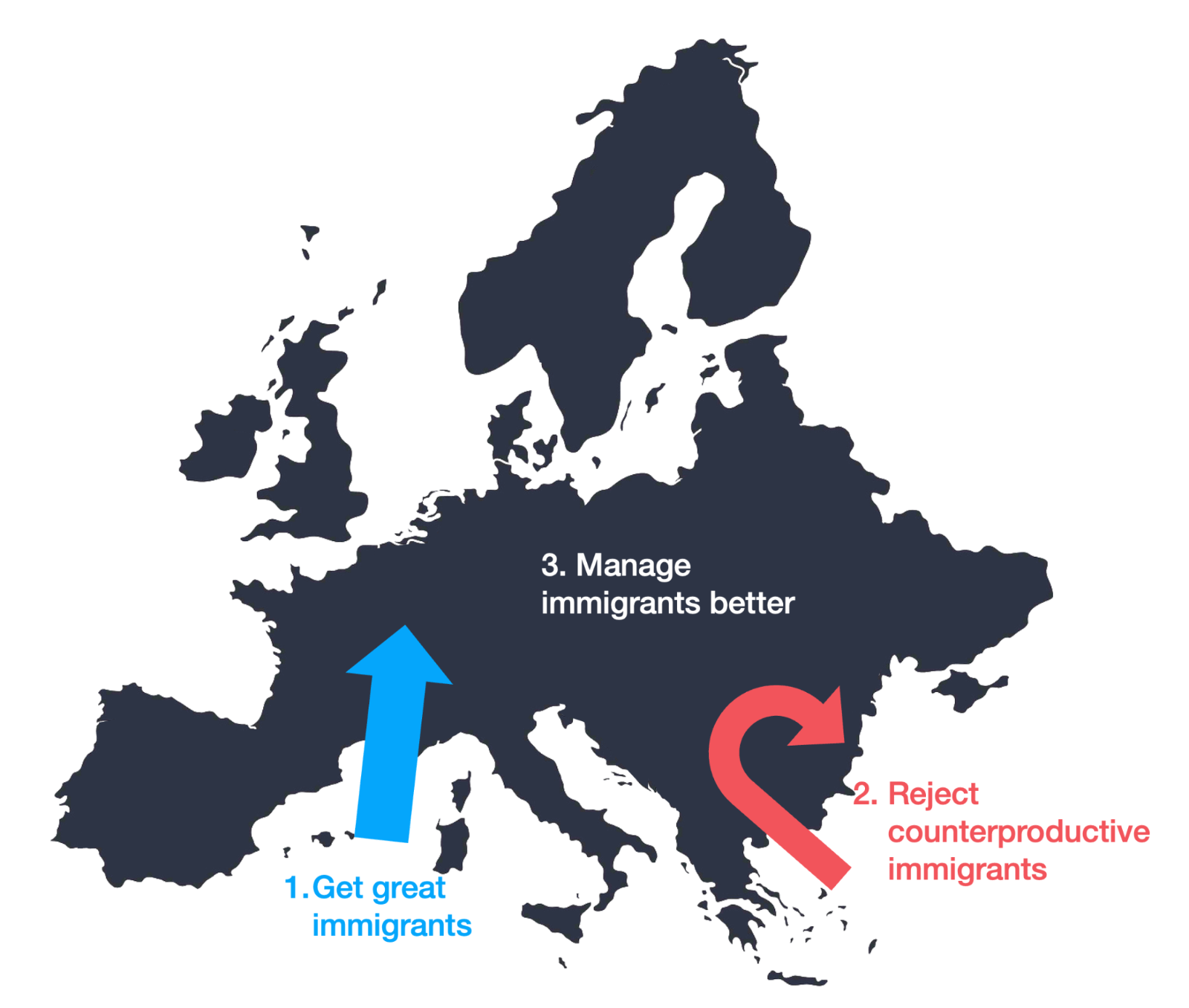
1. Get the Best Immigrants In
Virtually every study I’ve read shows the same thing: Immigrants who come to work tend to be beneficial, and the high-skilled ones are the best, so that’s what Europe should aim for.
a. Have Targets
France now says it has reached its limit of immigrants, but how many is that? And why?
This is the most basic thing. Countries should know quite precisely how many immigrants they need. That number should be published, and success should be tracked against it.
Immigrant countries like Canada, Australia, and New Zealand do it, but most others don’t. They have caps for certain visas, or expected arrivals, but no goals to aim for.
b. Hire As Many High-Skilled Workers As Possible
Counterintuitively, if there’s one group that doesn’t need targets, it’s high-skilled workers.
They are nearly always positive net contributors. They commit less crime, work more, make more money, spend more, pay more taxes, increase innovation, and create more jobs. And this is all independent from background nationality or religion.
The EU has already improved the bureaucracy to get this type of immigrant with the Blue Card, but only a tiny share of immigrants come through this process today.
One way to do that is to open many postgraduate degrees in European schools. Let foreigners pay for their advanced education and, once here, allow them to stay and contribute. Joining through a university is also beneficial, because they get a community, friends, and an institution vested in their success after school, all of which increase integration and income.
This can open a loophole though, where universities have an incentive to accept foreign students with dubious credentials, as a way to bypass immigration barriers, so the government should vet these credentials. Foreign students who don’t have valid ones should follow a process of validation / remedial work / cultural acclimation / denial.
Another thing they can do is piggyback on other countries’ vetting systems. Canada did this for a short period, accepting high-skilled US immigrant workers. We should see more of it.
Another thing Canada does well is its point system, which allows it to evaluate the potential contribution of immigrants. It apparently succeeds at selecting immigrants well (even though the country doesn’t always succeed at making them productive).
Personally, I’d also target India and China specifically: Together, their populations account for 35% of the world’s population. If you can get the best and brightest from there, even if they’re just 1% of the population, you’d get a flood of high-skilled workers.
c. Sponsorships
But it’s not just high-skilled workers. All immigrants with work visas tend to make more money than any other type.
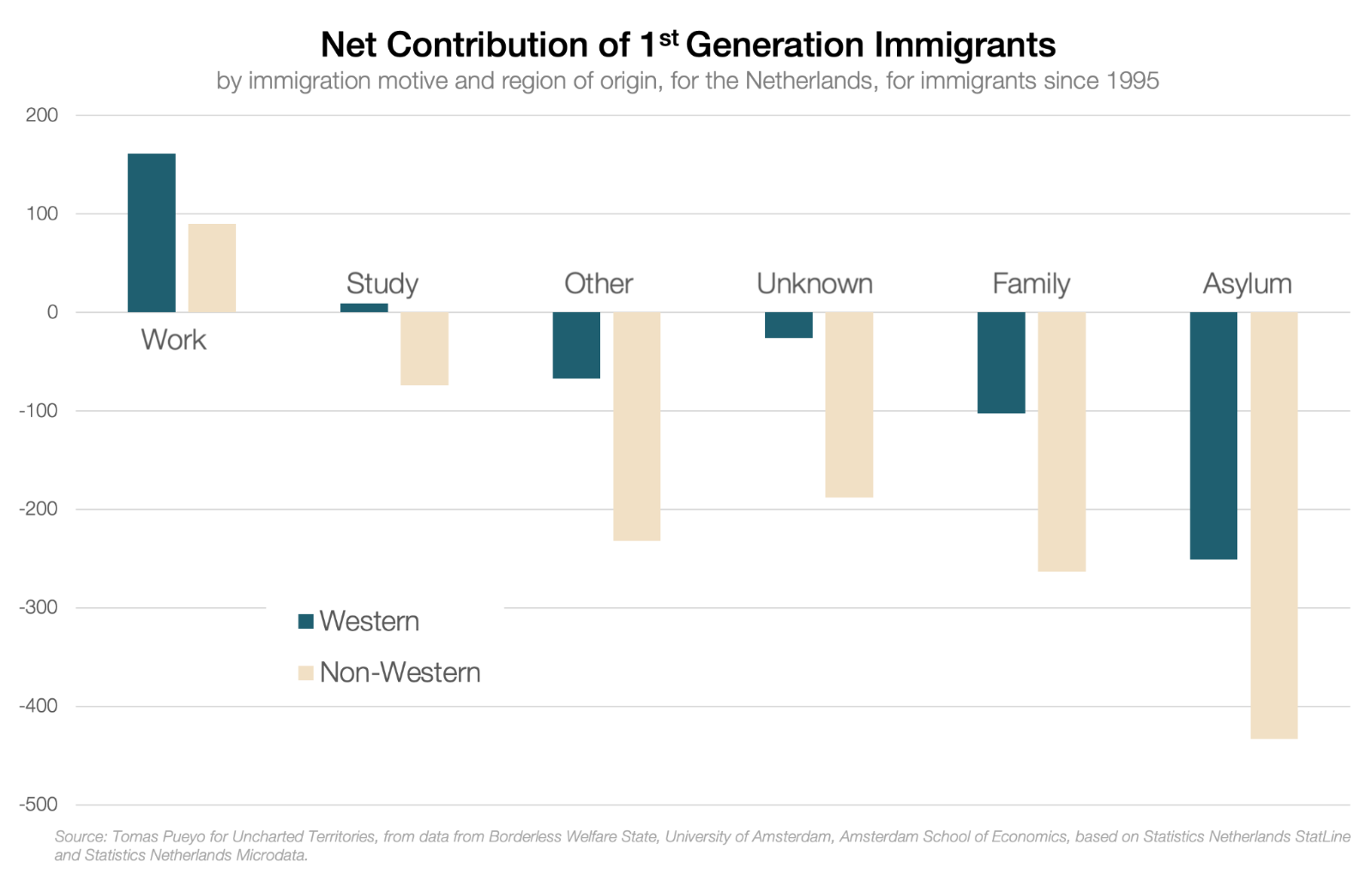
So of course, European countries should prioritize work visas. That’s what happens in countries like Saudi Arabia or the UAE: Immigrants go there to work. No asylum, no family reunification. When I was there, I spoke with many Pakistanis who were happily working there while their wives and children were in Pakistan.
To avoid unemployment, workers need a local sponsor. If they lose employment, they need to find another one. So this is also another way to reunify a family: Get a job sponsor for the wife.
It’s not just Muslim countries. Switzerland does the same:
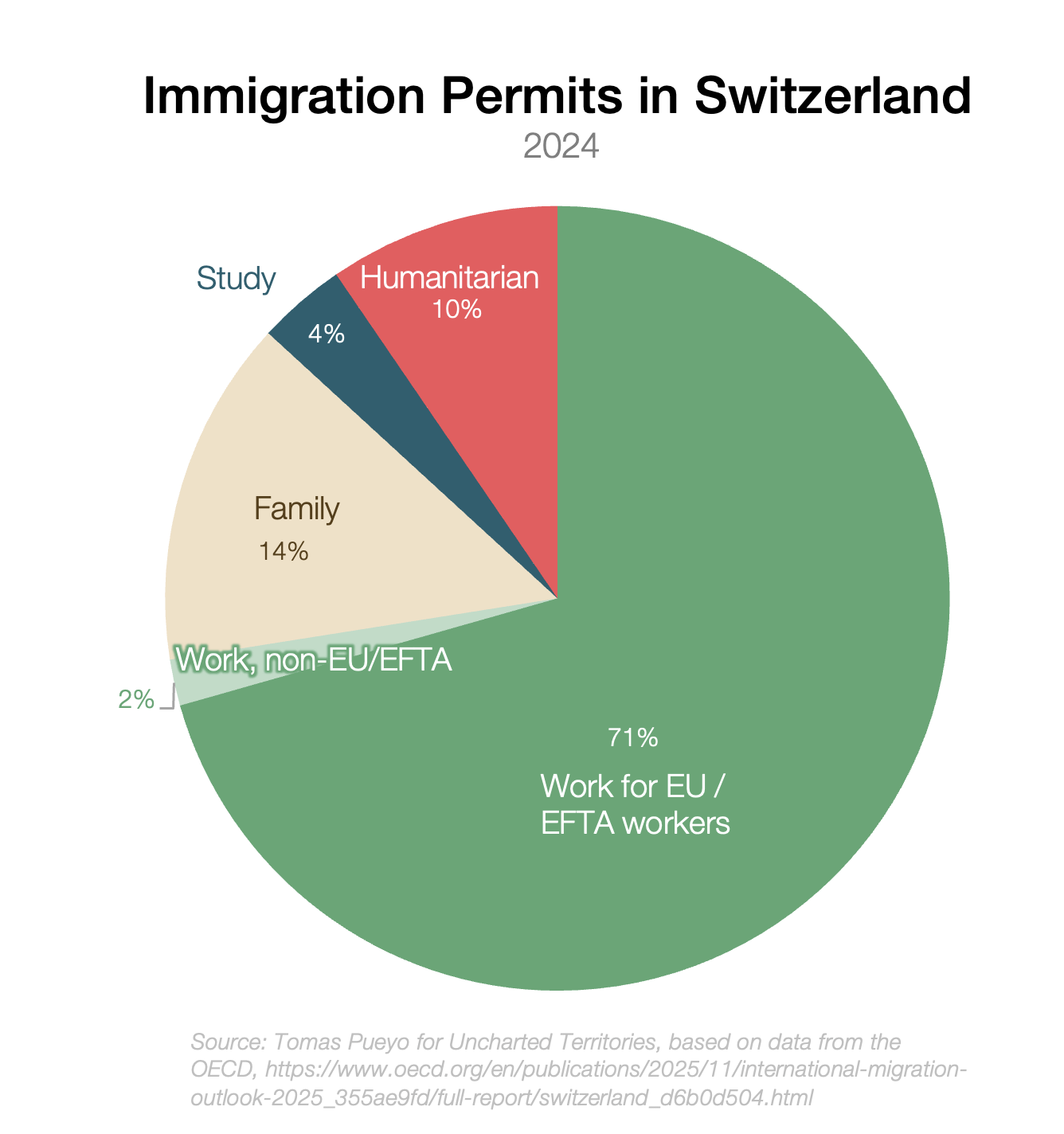
In Switzerland, even EU members need either a job or to prove that they can sustain themselves in order to live in Switzerland. Non-EFTA workers need to prove they would be economically beneficial to Switzerland to be accepted. They are generally all high-skilled; there are virtually no low-skilled non-EU worker visas.
When I was an immigrant in the US, I was sponsored by a company. When I lost my job, I had a limited number of months to find another job before leaving. That makes sense to me.
d. Prioritize Workers vs Other Visas
You’d think “making sure most immigrants come to work” is obvious but look at Belgium.
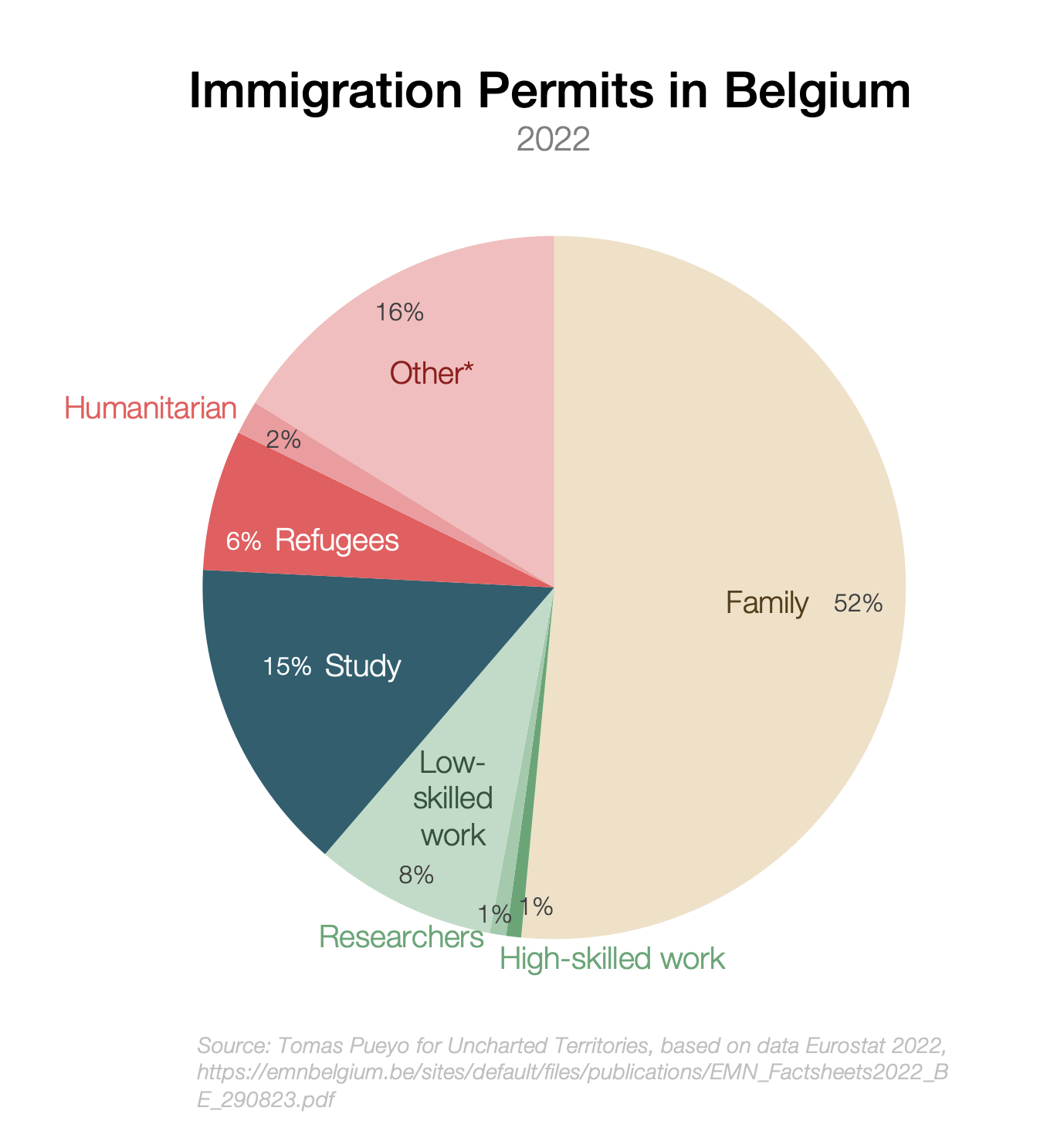
In 2022, less than 10% of Belgian visas were for work!
Of those, only 2 percentage points were for high-skilled work or research! Madness!
So where do the rest go? 15% are for study, which is OK. But a whopping 52% are for family! This is nonsensical. For every work residence permit, there are five family permits! That should be dramatically curtailed.
Does this mean family reunification should be impossible? Absolutely not! The worker should just be able to prove that his income can support the family’s housing, education, health coverage, and the like without requiring welfare. If a worker can’t support his wife, the wife should only come if she can work. We’ll talk more about this later.
The red section in the circle above shows that about 24% of all permits are humanitarian—the most costly, least value-add types of immigrants.1 I think it’s honorable to have a few refugees, but a quarter of all immigrants is completely untenable. According to a Dutch study, they each cost ~€500k in their lifetime!
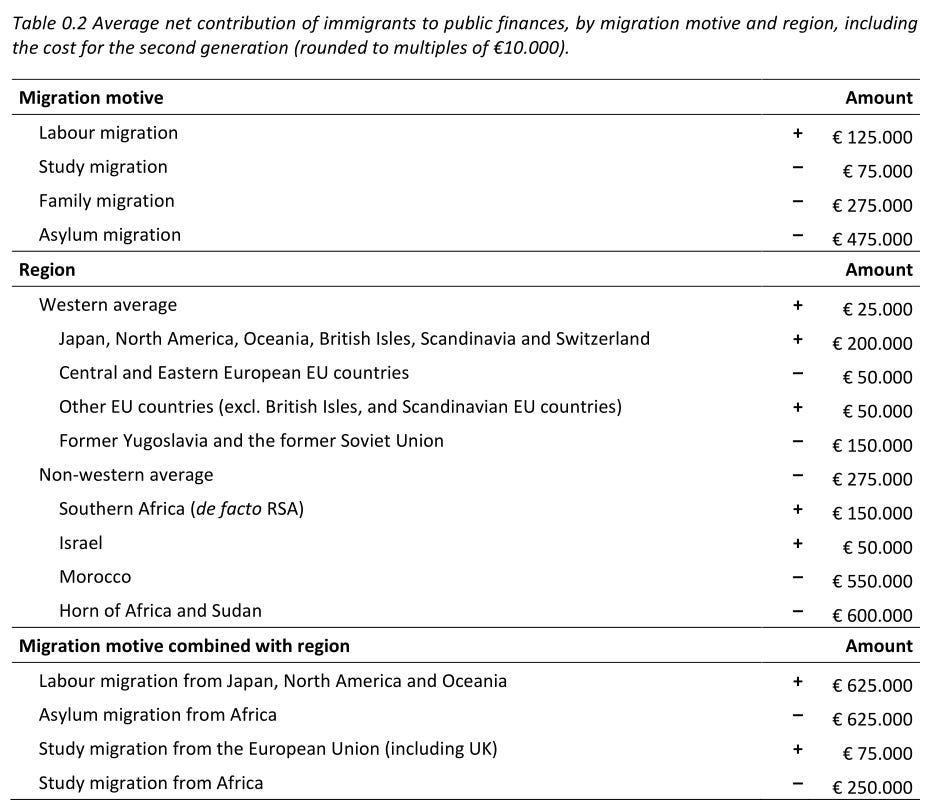
It’s reasonable to welcome some refugees, but the amount should be capped (remember those annual immigration goals?) 25% of a high amount of immigrants sounds unsustainable to me.
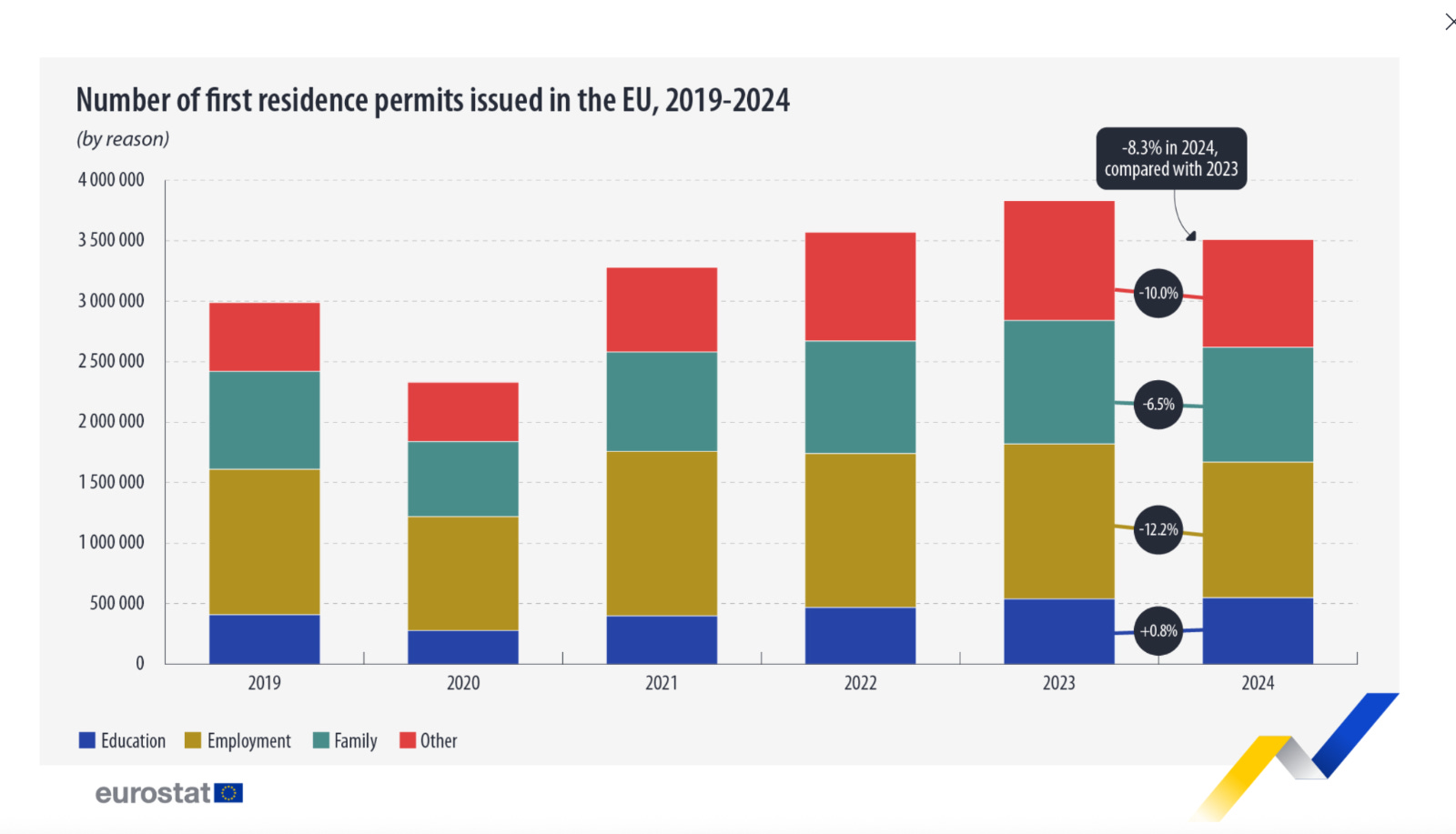
Belgium is an outlier, but it’s not the only one. Here is the data for the EU:
The degree of suffering should be better considered. For example, I’d expect asylum seekers from Afghanistan to the UK be mostly women and girls, yet:
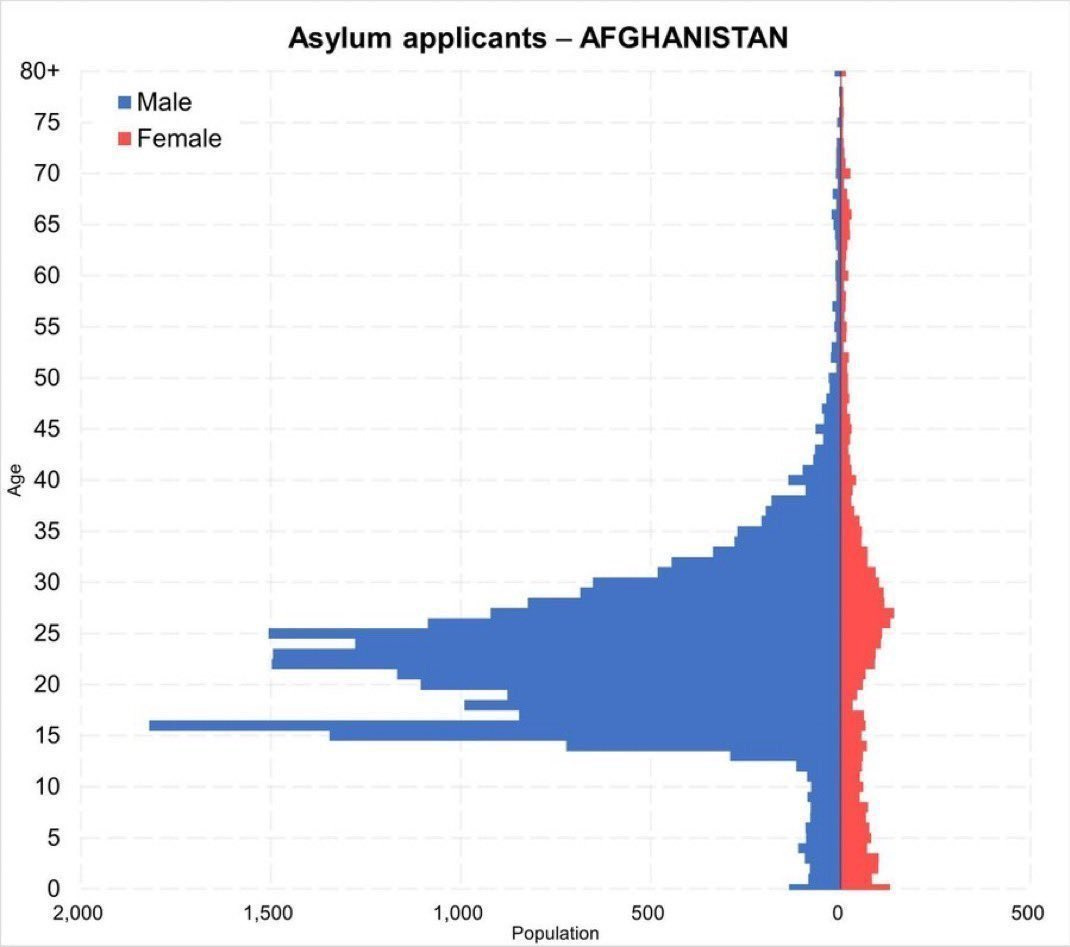
You could argue that Europe accepts asylum seekers because it’s the responsibility of rich people to support poorer people, and that makes sense to me. But I respect that this is my opinion and not everybody should share it. Why should that be a public endeavor for a private choice? How are Afghan male refugees the responsibility of the state of Belgium?
The concept of the sponsor visa could be extended here: Those who want to increase the number of asylum seekers should be able to pay NGOs or companies to sponsor them (or do it themselves). They would be in charge of their costs, work, and integration. If these organizations fail frequently at these goals, they should lose pay for the costs of their failures and lose their licenses.2
Pushing this to the private sector would have several additional benefits. One is that private organizations tend to be better at achieving clear cost-benefit goals than public systems. Another is that they’re better at finding original solutions for problems. For example, it can be much better for the origin country and for the destination country to take a small part of that money and use it for development in the origin country. This can create many more jobs, enrich the origin country, and reduce welfare costs, social cohesion costs, and crime in the host country.
e. Prioritize by Age
In a perfect world, the immigration service would assess every immigrant individually, as Canada does with its point system. But some countries don’t have these systems yet. So what can they do? In the interim, the next best way to select immigrants is based on what a destination country knows about them, like age.
A person near retirement age will consume much more in welfare than they will produce in taxes, so these people should not get permits as easily as their younger counterparts. If they do, they should not retire following the same retirement rules as natives, but much later (in the spirit of the welfare section we will discuss later).
2. Reject Counterproductive Immigration
This is the other side of the same coin: Defining which ones you accept means defining which ones you deny. More in detail:
f. Fraud
Selecting by age is one of the ways immigrants get an incentive to lie on applications. Look at the bump at ages below 18 in the graph we just saw:
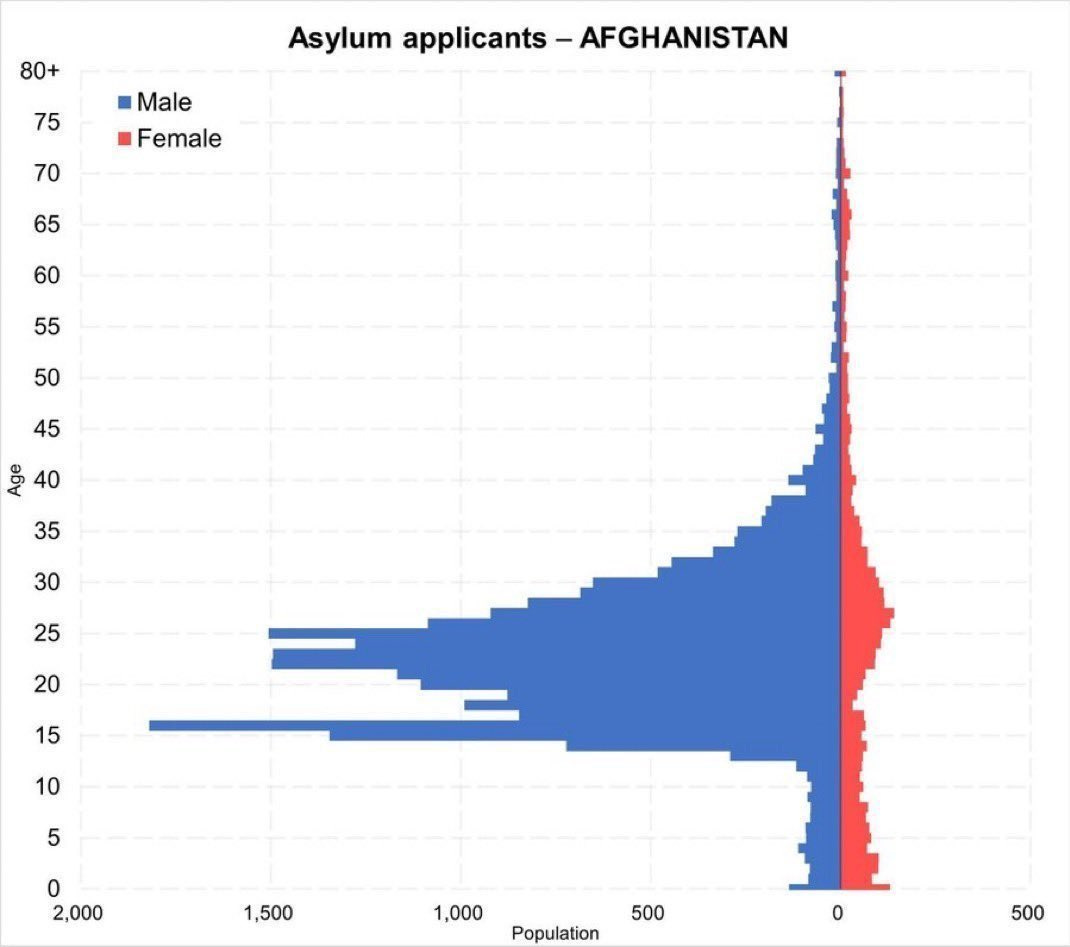
It’s very unlikely that there are two peaks (“modes”). It’s much more likely that these are 18-25 year olds passing as younger to get special benefits.
Other ways in which immigrants have gamed the system have been by claiming statelessness, destroying their papers, forging others…
Gaming the system through lies on applications should be immediate grounds for visa or residence permit denial.
g. Prioritize by Country
Besides age, the other obvious way to prioritize is by country. As we’ve seen, the most expensive, least productive, and more crime-prone regions tend to be MENAPT, so a reasonable destination country policy would be to install a points system, and until then, deprioritize immigrants from this type of country.
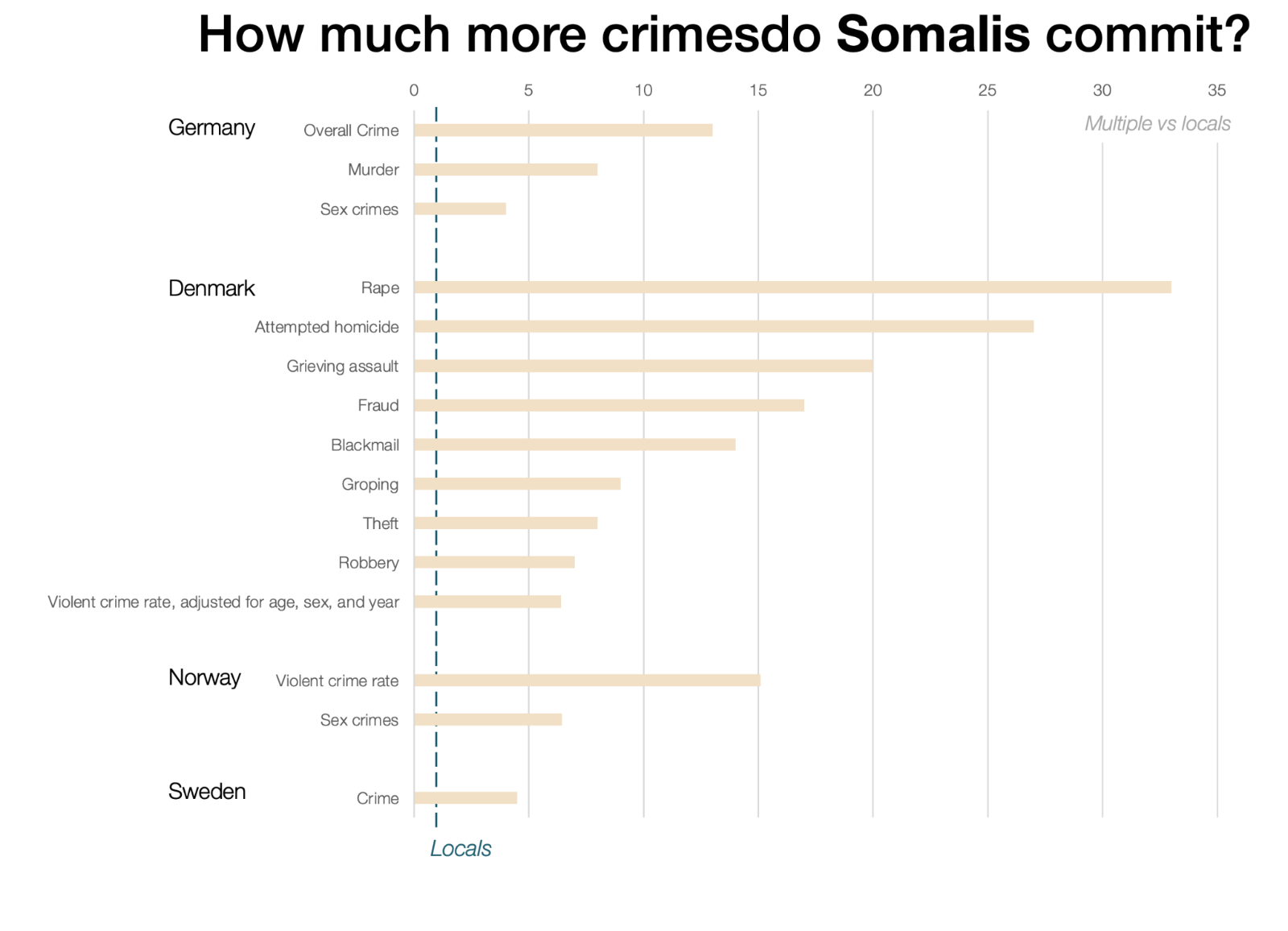
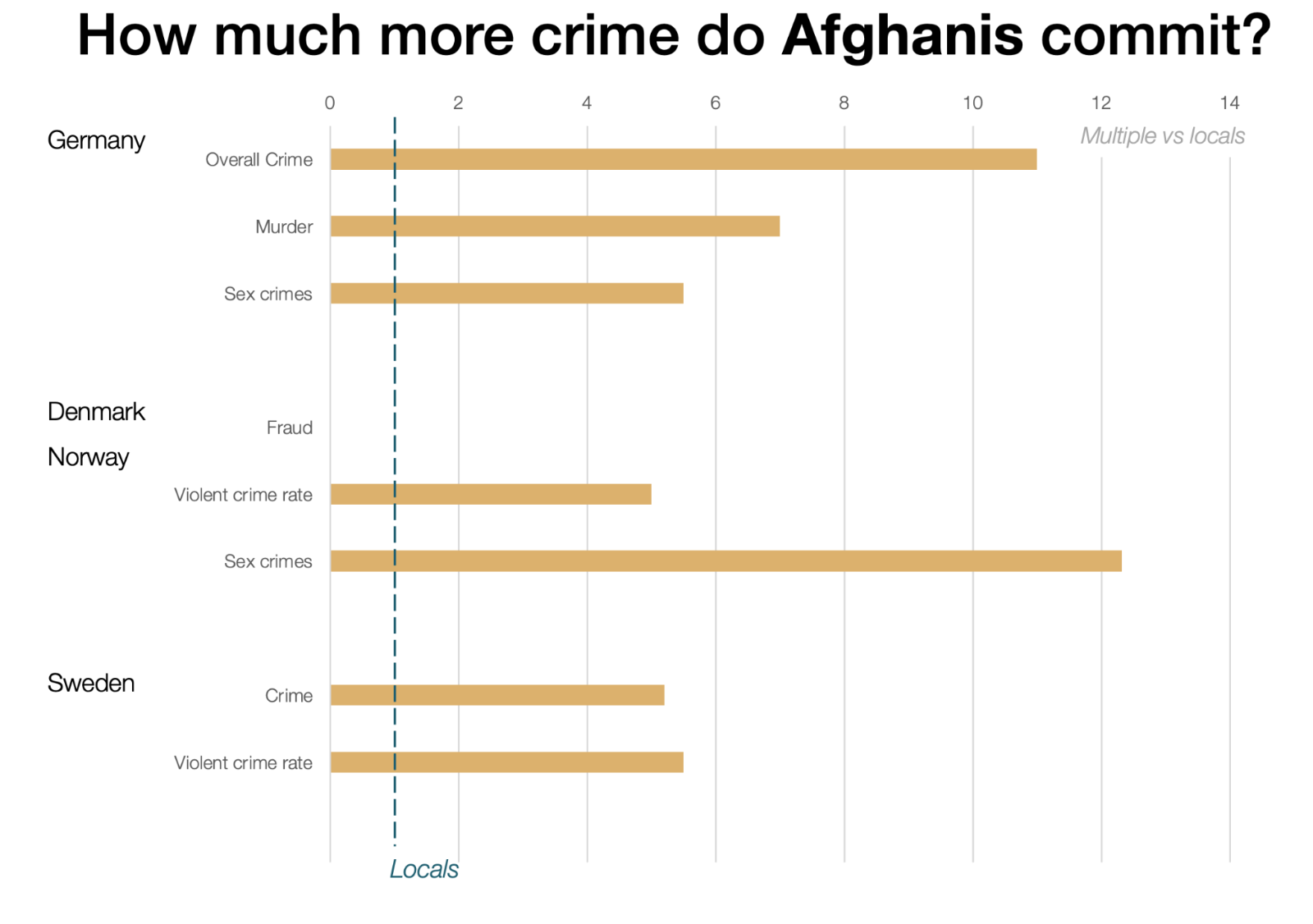
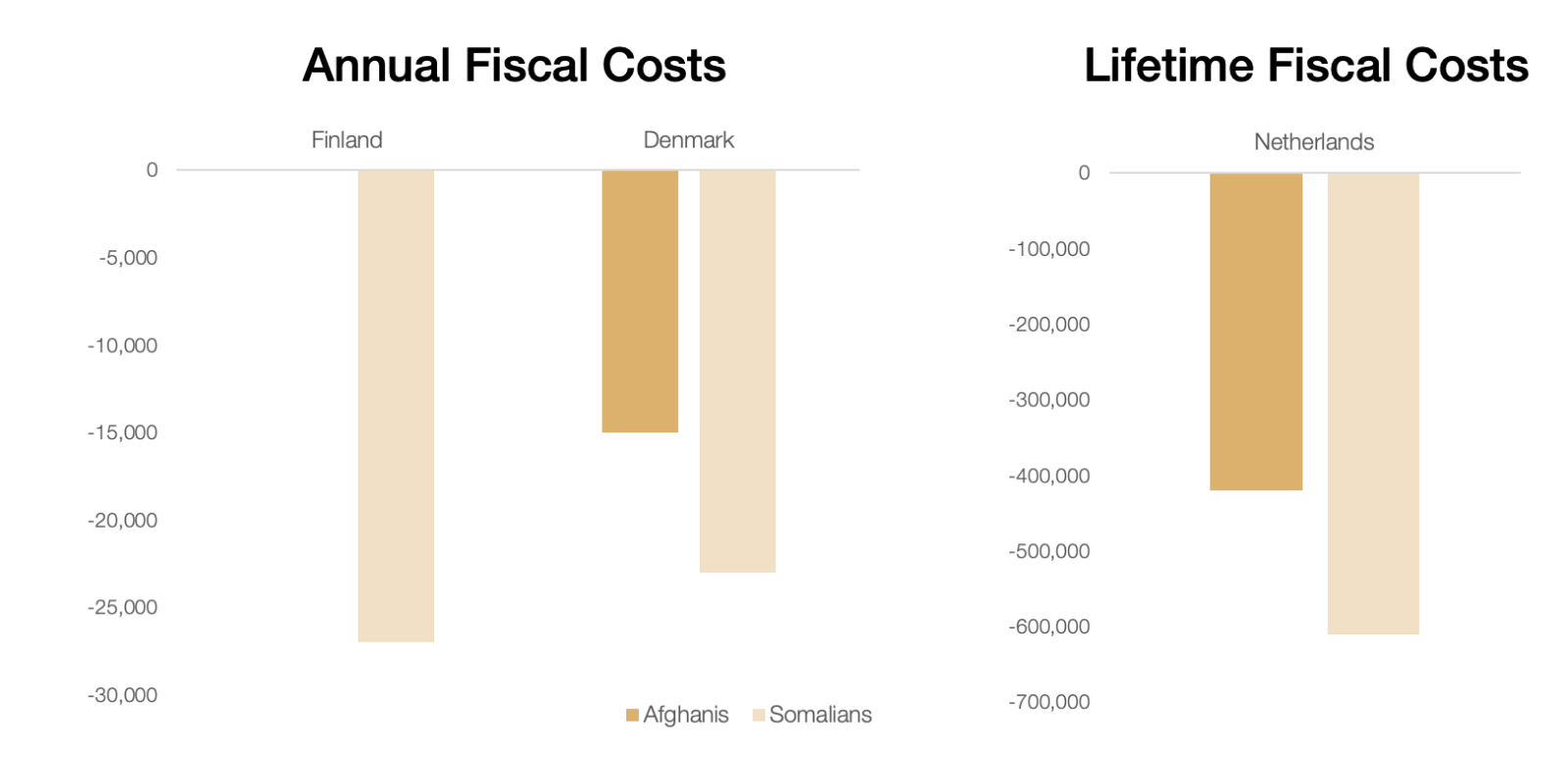
Notice I didn’t say Muslim countries though. Somalians, Afghanis, Palestinians, and Algerians tend to be at the top of the lists for crime and welfare spending, so European countries should be cautious of their allocations to such origin countries.
This is for Afghanistan:
Here’s data for the economics:
But Malays and Indonesians have very low crime rates; Colombians tend to have high ones. Some African countries are more prone to crime and less prone to work than others. This should not be based on random lists of countries, but rather on some objective assessment of the immigrant’s potential based on the available information (in this case country of origin). If other data points are available, they should be taken into consideration too.
h. Stop Dangerous Boat Trafficking
As mentioned, any country should have targets for immigrants (and maybe get as many high-skilled immigrants as possible!), and then people should use legal channels to tap into these quotas. Bypassing them is against the law, which means it’s against the will of the people, and they hate it.

And in Europe, the main path of illegal immigration is by boat: 150,000 people in 2025, ~80% of the total. This is also very dangerous for the immigrants, so it shouldn’t be incentivized.
Fortunately, we know how to stop it:
