

There are not enough countries.
There are not enough jurisdictions.
There are not enough new cities.
This is terrible, because entrenched interests freeze governments over time. They make change impossible; you can’t easily update regulation. We end up with the sclerotic democracies and enshittified cities we suffer in the West.
But this is new! Just a century ago, regulations were light, and vast swaths of continents, including America, Africa, Asia, and Australia, barely had any. The growth of the 20th century was in part because of this freedom. No more.
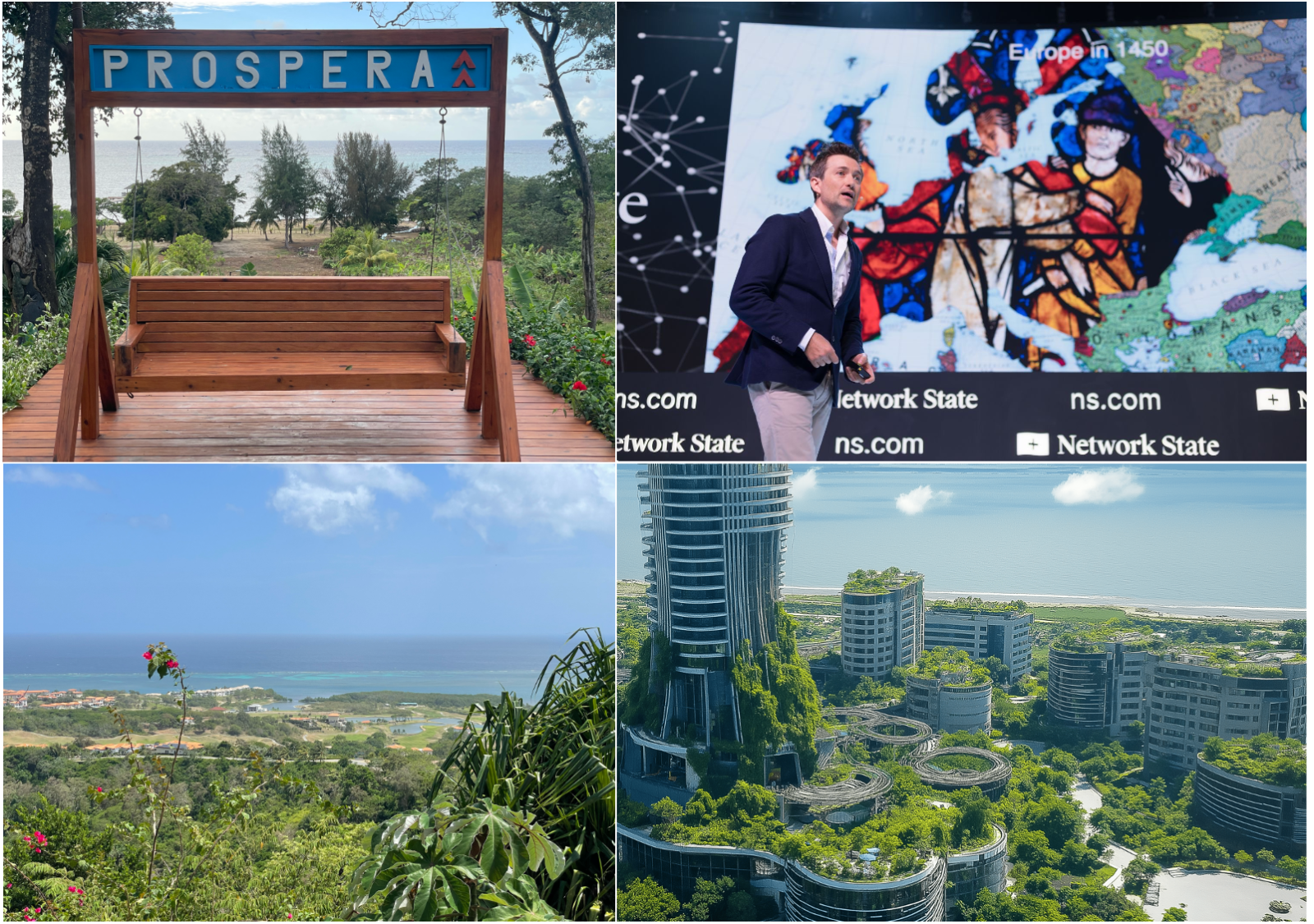
But some people are not satisfied with the status quo. Across the world, visionary founders are building new cities and jurisdictions near Singapore, Abu Dhabi, Rio de Janeiro, San Francisco, on the Honduran island of Roatán, on islands off the African shore, near Nairobi… They dream of a better world where the government doesn’t impose all its answers on its citizens, where they’re treated not as subjects but as customers, where regulatory exploration is welcome.
I’ve traveled the world to talk with dozens of them over the last year and a half. In every conversation, the atmosphere has been electric. I feel like I’m witnessing history in the making, like when the founding fathers were crafting the US Constitution.
But when their vision meets the reality on the ground, these leaders share one problem: How do we grow a new city or jurisdiction from scratch?
Today, I’m putting everything I know in one piece, to help them—and you—think about this problem. Hopefully, this will accelerate the process and we’ll have hundreds of new jurisdictions in the coming decades. Maybe it will inspire you to move to one.
The Cold Start Problem of New Cites & States
How do you compete against New York, Madrid, Singapore, or Tokyo?
When you have millions of creative professionals, good schools, shops, museums, airports, highways, buses, gyms, IKEAs, cinemas, theaters, restaurants, sports facilities, parks, swimming pools… It’s easy to attract thousands of ambitious young people to participate in civic life and add their value. But what if you’re the president of Liberland?1
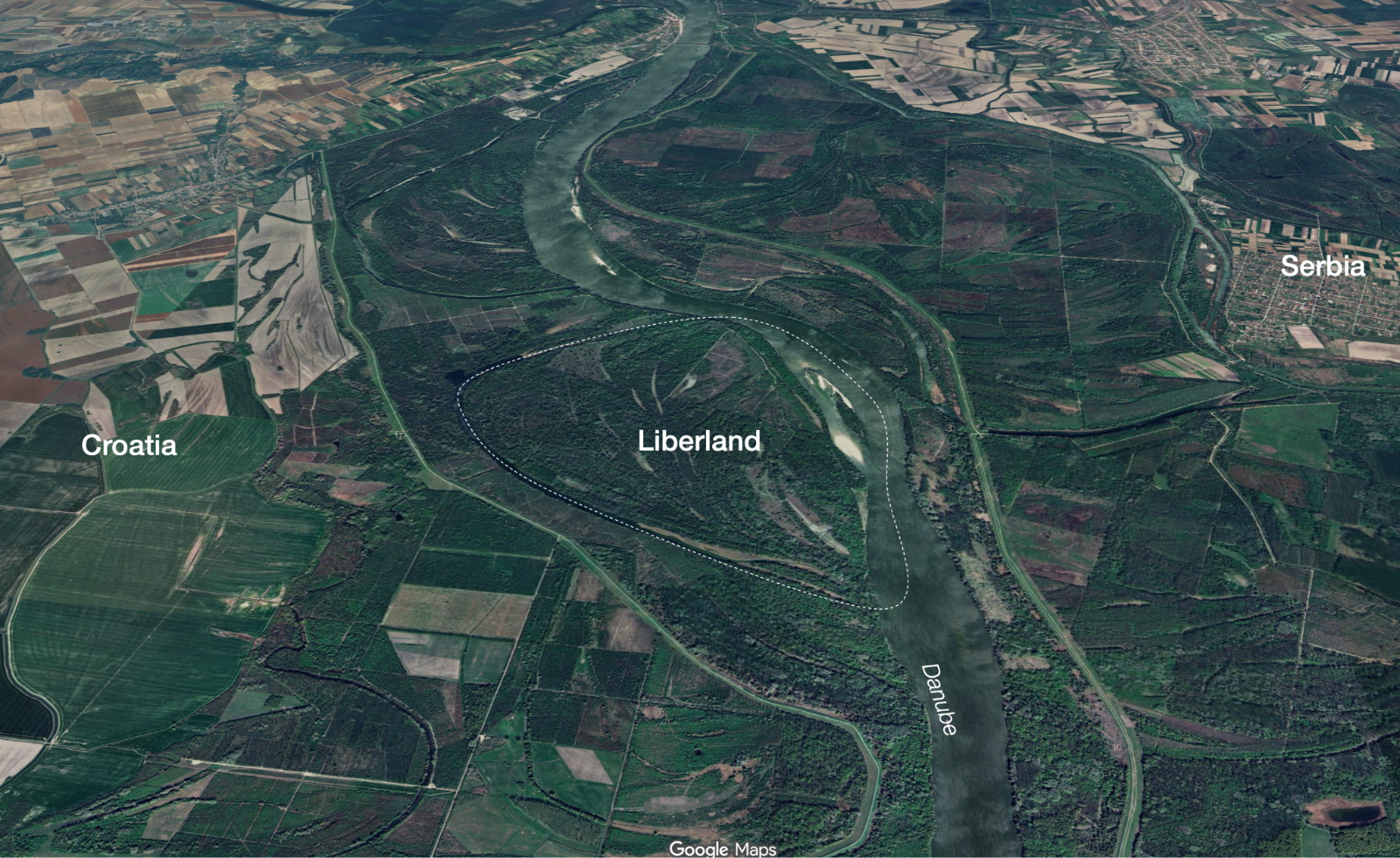
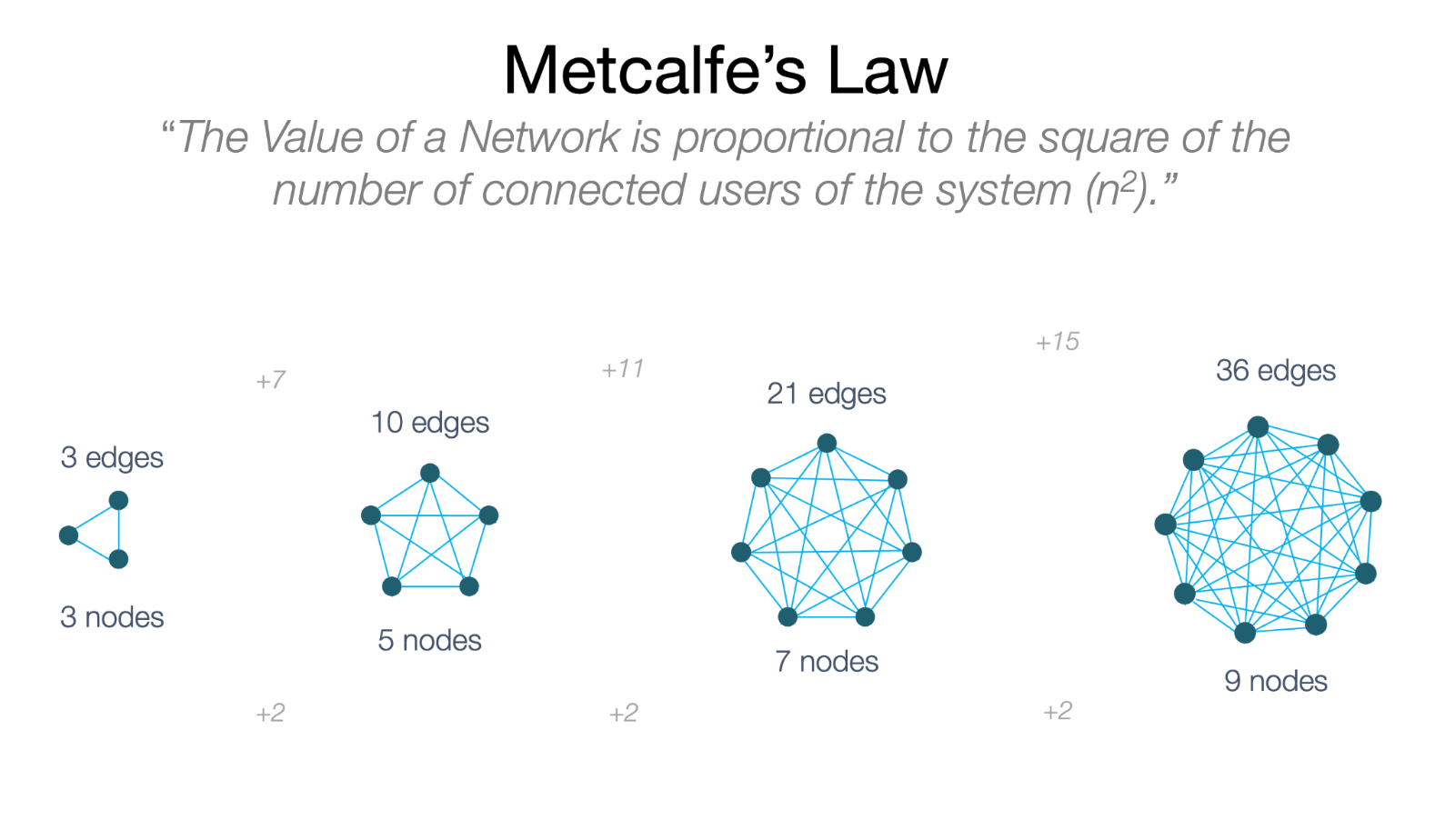
The average person doesn’t want to go to an empty piece of land between two countries, devoid of schools, shops, restaurants, or even houses! It’s much easier to grow a city from 1,000,000 people to 1,000,100, than from 0 to 100, because of network effects.
This is the resulting value of cities:
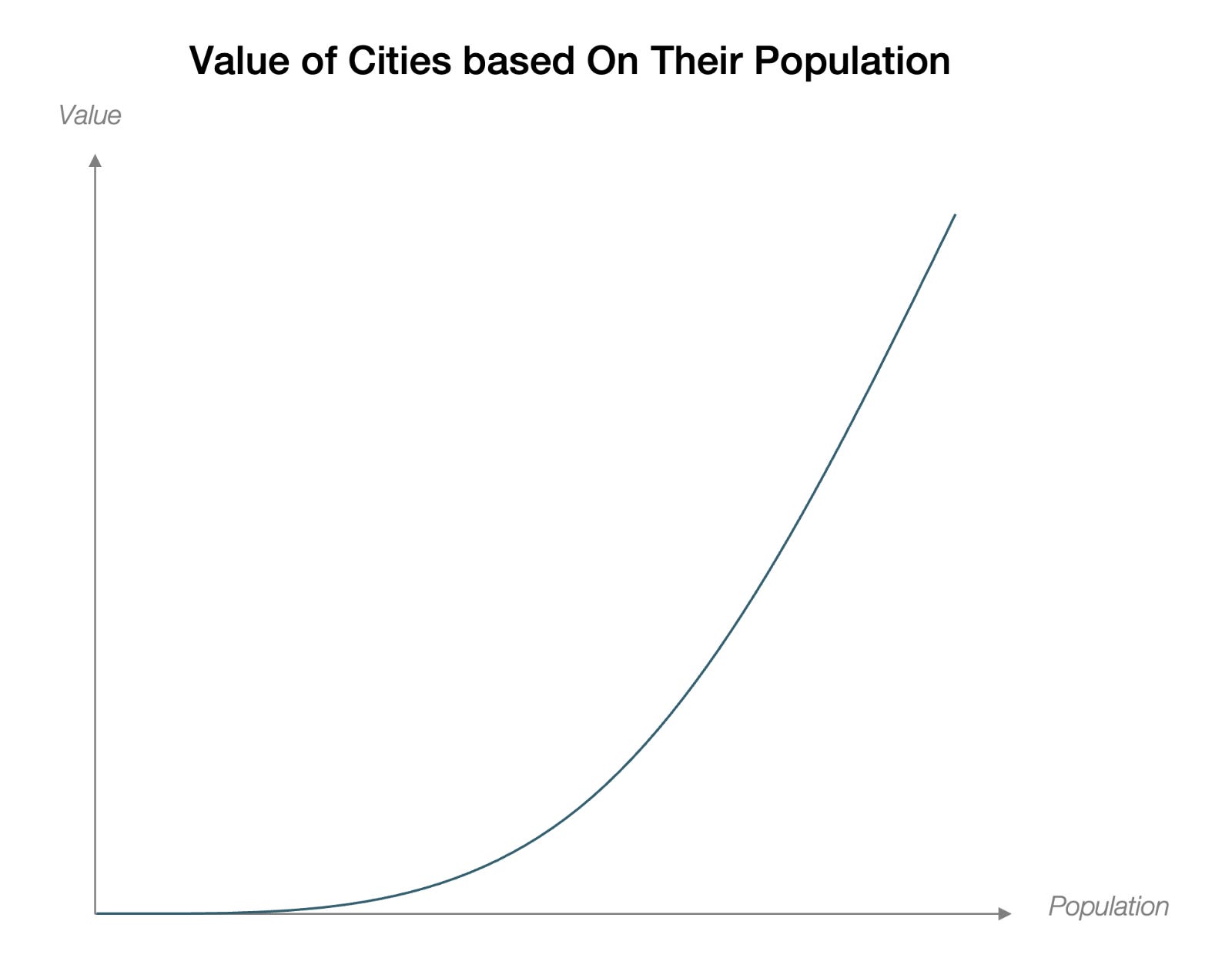
This is why the bigger a city, the fewer such cities exist: The bigger ones suck in all the population from their surroundings. The bigger they are, the more they attract.
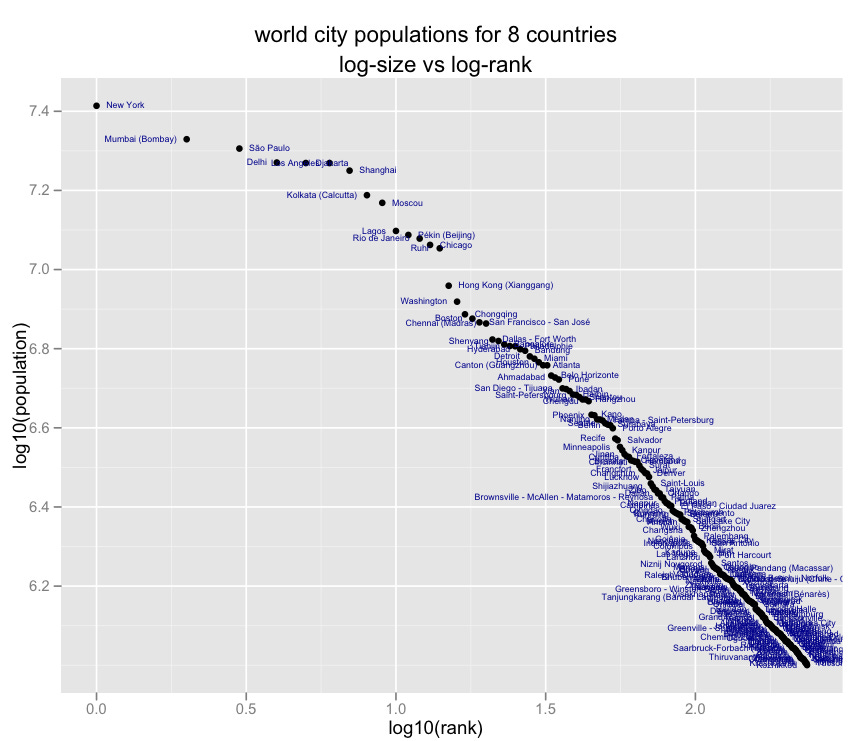
This suggests that it’s hard to go from 1 citizen to 10, which is as hard as going from 10 to 100, from 100 to 1000, and so on, because bigger and bigger cities are rarer and rarer, in an exponential way. Every order of magnitude of growth is as hard as the previous one.
Going from 1 to a small city of 10,000 means 4 orders of magnitude of difficulty. This is the cold start problem: When something is worthless when it’s small but very valuable when it’s big, how do you get from small to big? It’s hard to start a city from scratch! How do you solve it?
The Dubais & Singapores
The sacred blueprints that all new cities want to emulate are Singapore and Dubai, two city-states that grew from early 1900s backwaters to some of the richest places on Earth. How?
Dubai
Dubai doesn’t seem as amazing today as it was a few months ago, given the Iranian attacks, but I would argue that it doesn’t change anything: Dubai is as exposed as other capitals in the region like Riyadh, Abu Dhabi, Bahrain, or Doha. If anything, it’s a target because it’s so successful.
I covered the city here: In the early 1900s, it enlarged its creek, provided free warehouse space for goods, eliminated trade taxes, and guaranteed security for all trading ships. This is the result people know:
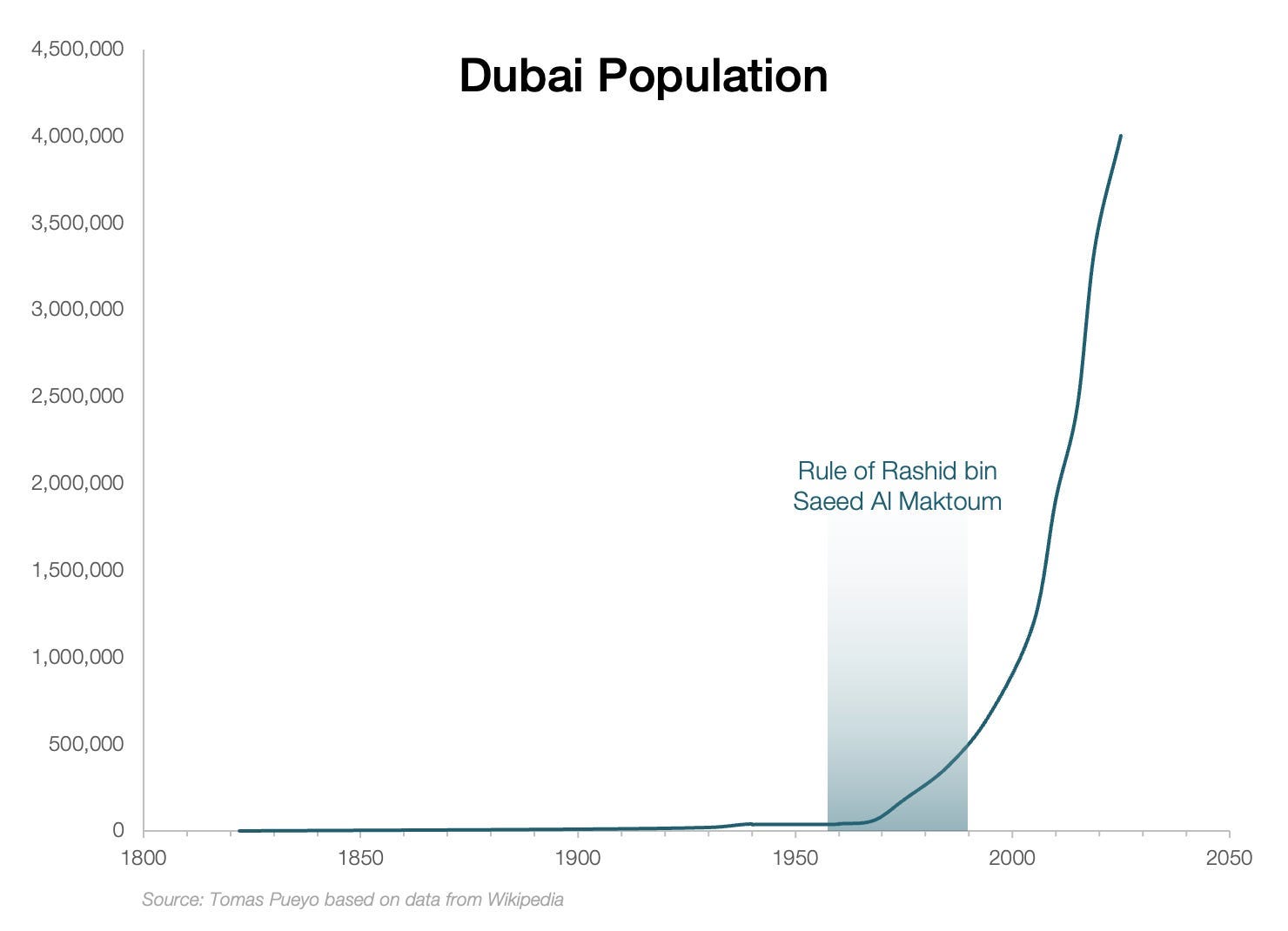
But this inflection point hides the true reality:
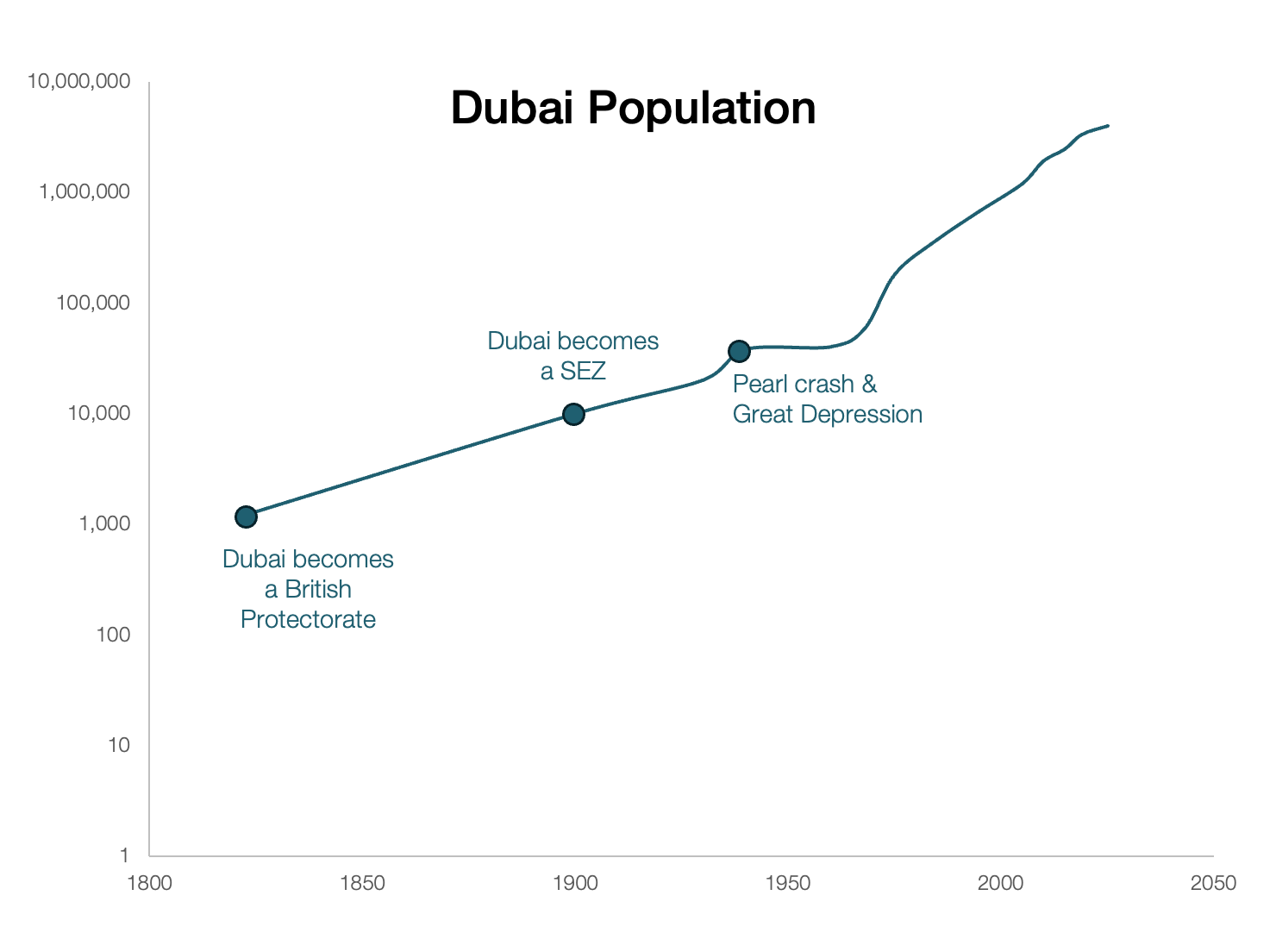
It took two centuries of growth, including over a century of constant support for these policies, for Dubai to win. We can see our rule at play here: Every order of magnitude of growth took the same amount of time as the previous one.
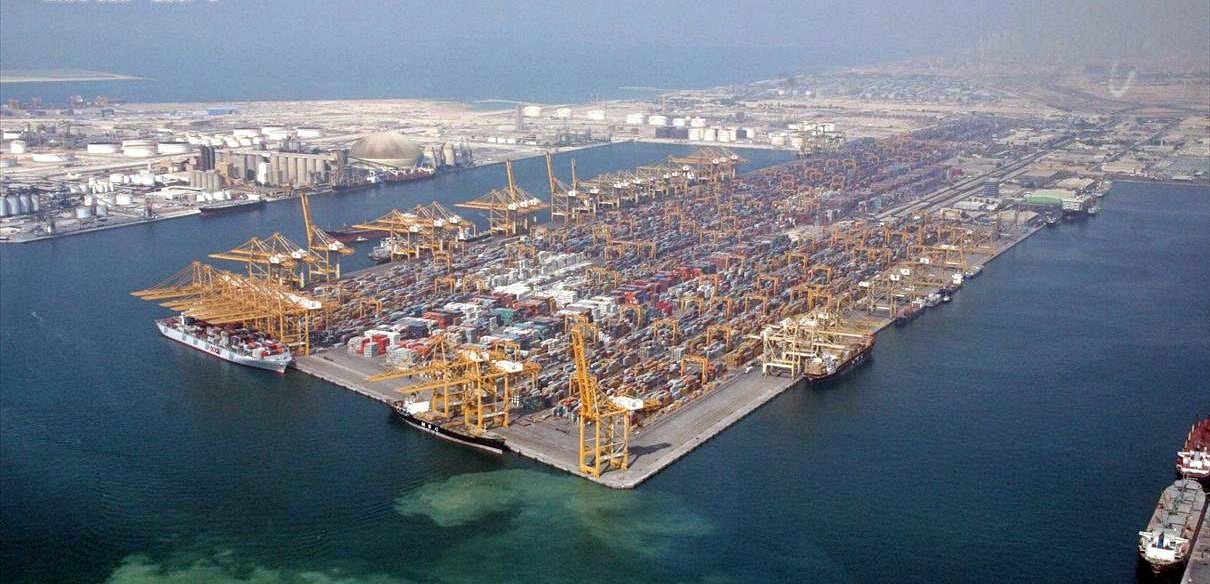
Dubai solved its cold-start problem through a century-long commitment to cater to tradesmen. First came the shipping companies, followed by the merchants of the goods transported by the shippers. Merchants need loans and currency exchange and insurance, so a finance industry emerged. They need a strong administration with an efficient police force that keeps the peace and prevents theft, a working judicial system to adjudicate conflicts, a bureaucracy that can keep norms nimble, good schools and healthcare systems to serve all these people.
Singapore
I’ll write a deeper article on Singapore at some point, but here’s a short summary of its growth.
Everybody thinks Singapore was a backwater when it got its independence from Malaysia in 1965, but this is not the case. Why did it become independent? Because it had a majority of ethnic Chinese citizens. Any why is that, given that Singapore is 2,500 km away from China? Because it had been the major British port in the region for centuries. When Lee Kuan Yew assumed leadership in 1965, he did an amazing job in developing the nearly 2M people who already lived there and the logistics hub he inherited.
Port SEZs
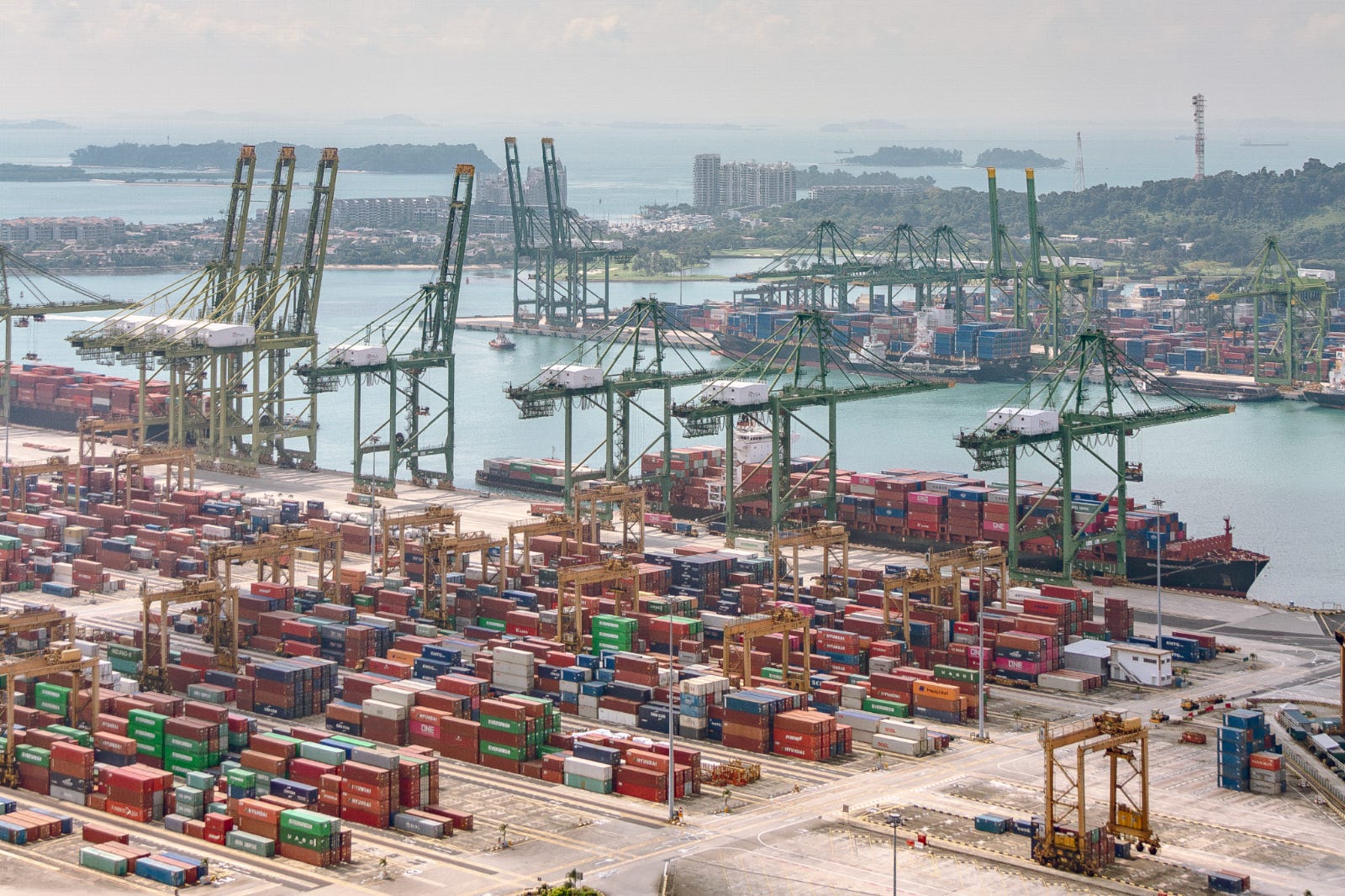
Dubai, Singapore, but also Hong Kong, Shenzhen, Shanghai… They all followed the same pattern: convert a village into a port via SEZs (Special Economic Zones) with low taxes and administrative burden, services for shipping and trade, and safety. From there, growing investment in infrastructure to make operations easier and easier. From there to finance, other industries, and a growing population thanks to network effects.
Many cities try to emulate this today.
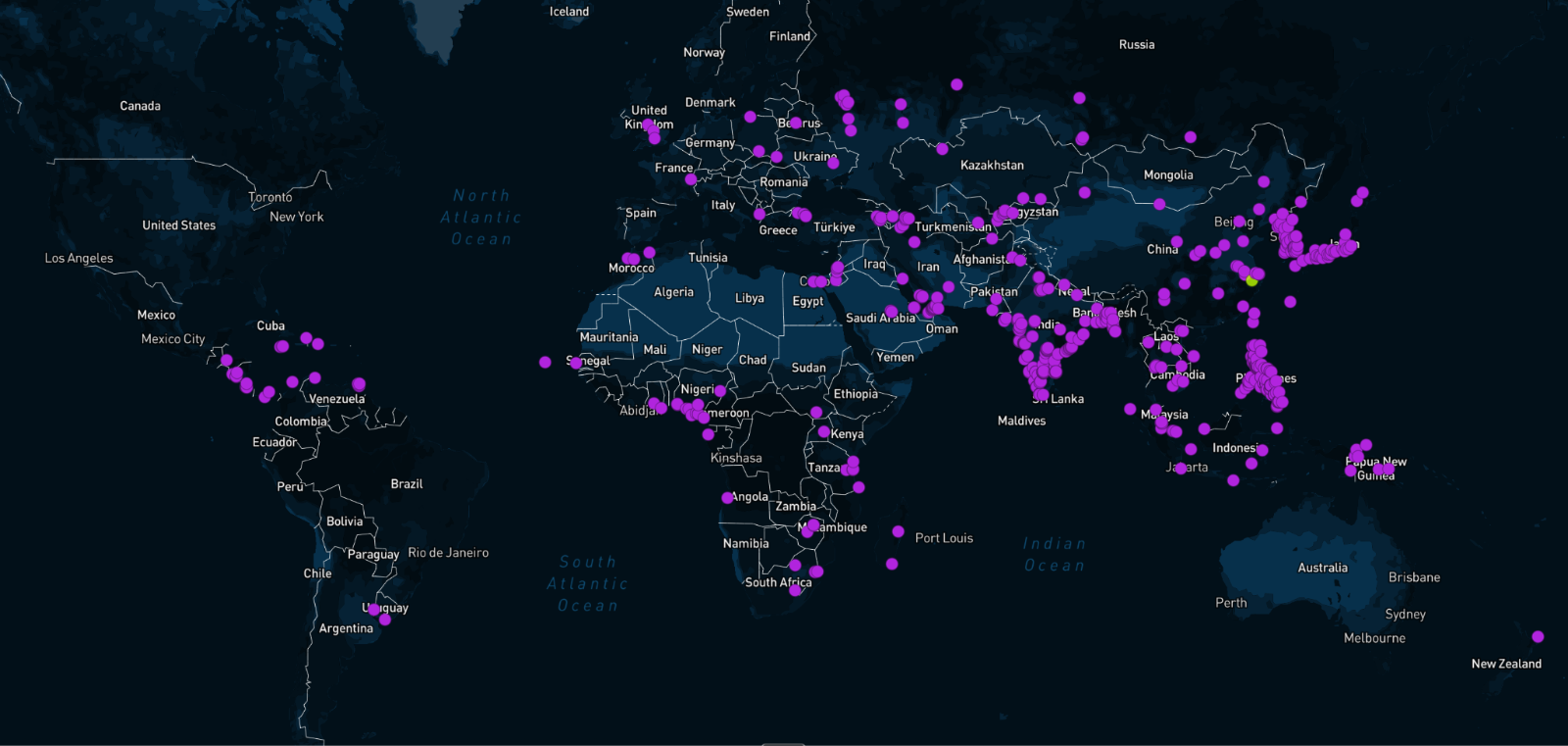
Which parts of the world are most promising for locating new cities or city-states? I’ll cover this in another article, but the short answer is that there aren’t that many ideal spots, and we only need so many ports. We need another model for growing new cities. How do you most successfully go from 1 to 10,000 inhabitants?
Customer Needs
Cities must attract customers—inhabitants. What do they need?
Nice, affordable housing
As little crime as possible
Good transportation infrastructure
Reliable utilities: energy, water, phone, Internet
Core services: education and healthcare
As many amenities as possible
A dating pool
Jobs
Some of these are better in small cities, others in big cities. However, some matter more than others. How does that translate into competitive advantages?
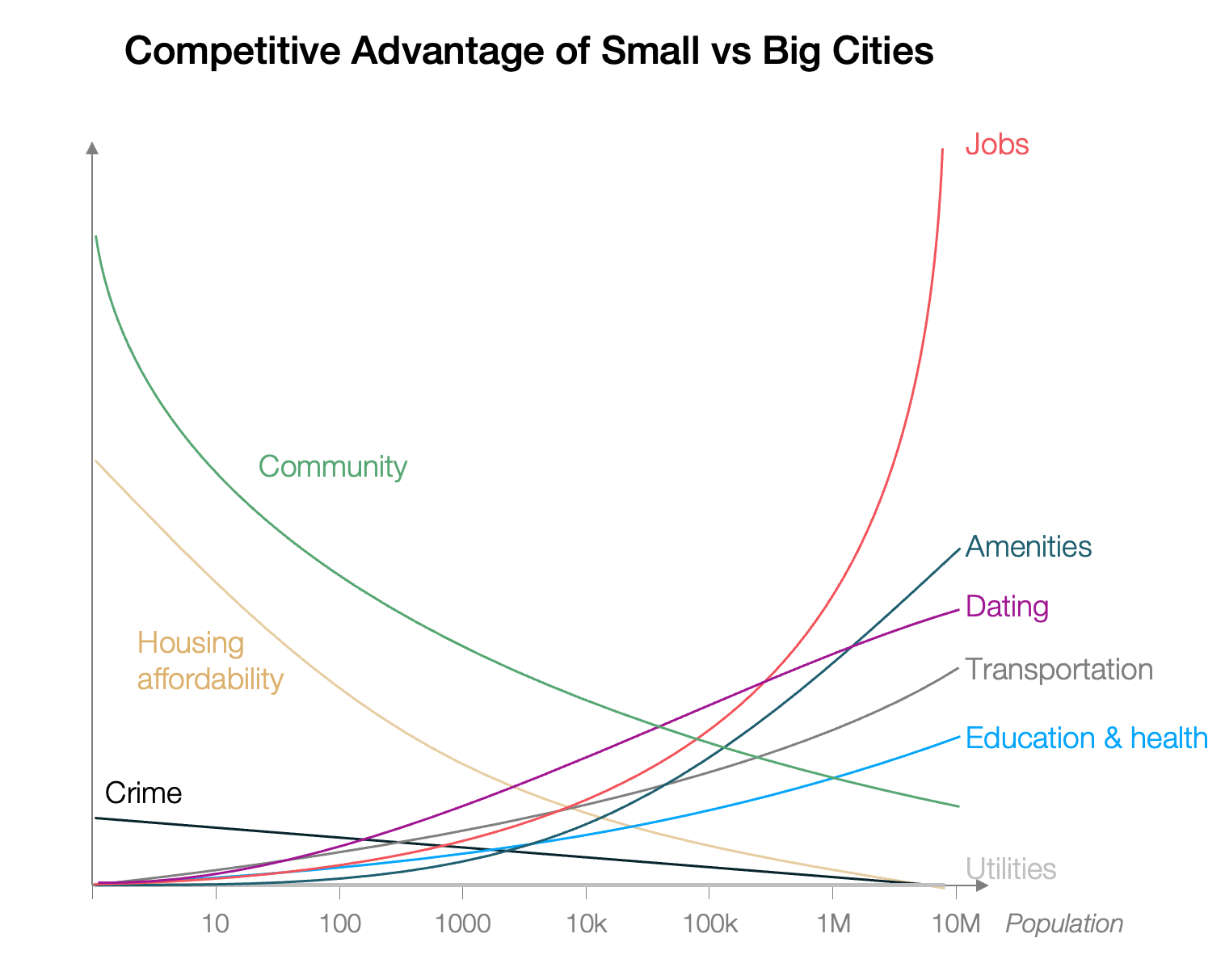
This is probably the most important graph of this article. If you understand it, you’ll get the challenges for small cities to grow into big ones.
The Advantages of Tiny Communities
Tiny communities (tens to low hundreds of people) can get affordable housing, good utilities, and low crime:
Utilities (water, electricity, Internet, phone) are now as easy to get in small cities as big ones, so there’s no competitive advantage: Get Internet and phone with Starlink, electricity with solar panels and batteries, and water from a local well or source, with a water treatment system if needed.
Crime is less in smaller communities, since everybody knows each other, and the communities can easily vet newcomers. A few guards can solve any problem from external communities.
Housing tends to be much cheaper in small areas because land is cheaper.
It’s easy to shape a small community’s culture: You can hand-pick the people, hand-craft the events, hand-build the environment to nudge people’s behaviors, and it’s small enough that virtually everybody knows everybody else, creating a tight feeling of belonging. This is the exact opposite of a megapolis, where people can be alone in the midst of multitudes, and loneliness is rampant.
The Advantages of Small Towns
Small towns, with high hundreds to a few thousand people, retain most of the benefits of tiny communities, and add new benefits as they grow:
You need a few hundred citizens to warrant a school. Before that, you’re basically blocked from attracting families. When solutions like AI education and humanoid robot caretakers become widespread, this will change.
With a few hundred citizens, you also get amenities like a gym, restaurant, bar, or supermarket.
A clinic needs a few thousand citizens.
Competition between schools starts with tens of thousands of citizens.
Hospitals and universities require several tens of thousands, or even hundreds of thousands of people.
If citizens are like-minded, a few hundred to a few thousand people is enough to start finding partners: After all, we lived in small villages forever and were still able to couple up. If you’ve ever lived on a college campus or in a small town, you might have felt the fishbowl effect: As time passes, the few options available become more and more attractive. That said, I fear the fishbowl effect is weakened with the current access to world standards of attractiveness via Instagram and the like. It makes it harder to settle for whoever is available.
The Killer Advantage of Big Cities
Amenities grow dramatically with population size. You get a variety of restaurants, shops, gyms, doctors, dentists, lawyers, repairs…
Transportation can get congested as cities grow, but at least they get airports, train stations, highways, and the like. If you need to travel the world, you need an international airport within 1-2h.
Dating pools become super deep in big cities. Anybody can find someone they like. However, choice can become overwhelming, so I don’t think dating gets exponentially better with bigger populations.
But the most important factor, by far, is jobs.
Jobs pay for everything else. They are the main reason why people move to big cities, for economic opportunity. And the network effects are massive:2
The more businesses, the more likely a person can find a position that suits their unique skills. And vice-versa: The more workers, the more businesses can find the right employee for them.
Workers and businesses can both specialize more.
With more job opportunities, the time needed to find a good job is shorter, so there’s less unemployment.
As companies develop specialized knowledge, it spreads to other companies through observation, informal conversations, and job hopping.
Industry clusters can appear as suppliers start colocating with vendors to reduce costs. Cities integrate vertically.
Because of all this, people are more productive in cities, which earns them higher wages, so there are more amenities and more companies and more jobs, which attract more people.
Knowing this, how can a new city go from 1 person to 10, 100, then 1,000, and 10,000 and beyond? This is a problem tech companies have been facing for over a quarter century now to get their digital communities to grow. We can learn a lot from them.
The Cold Start Problem in Tech Marketplaces
Imagine that Uber has just arrived in your city. You download the app, open it and see no drivers available, so you close it and never open it again. If you’re a potential driver, the same thing happens: You open the app, get barely one or two rides per week, realize this isn’t worth your time and close the app forever.
Uber is a marketplace where supply (drivers) and demand (riders) meet, but they need a critical mass to be viable: Enough drivers must know there will be riders available, and vice-versa. Without critical mass, there are no network effects, and the marketplace dies.
So instead, Uber doesn’t start by operating everywhere. It specifically launches in every city, one by one. But the launch isn’t limited to a simple announcement. If it was, Uber would get a few drivers and riders on launch day, but not enough to make it profitable for drivers and valuable for riders, and it would die out.
That’s why an Uber launch in a new city is a much bigger deal: For weeks or months in advance, it recruits drivers and pays them, whether they get rides or not, just for being available. That way, there will be enough drivers on launch day for an amazing experience and riders will come back again in the future. Meanwhile, drivers need enough riders on launch day to know this will be a viable business for them, so Uber creates a big launch campaign to raise rider awareness, including discounts to lure riders to try the service.
This model is effective in all network effects businesses. When Bank of America launched credit cards, it didn’t do it nationally, because not enough people would have them, and not enough businesses would accept them. So instead they launched in Fresno, California, because 45% of families already banked with them. It provided the devices to read the credit cards to businesses, and it mailed 60,000 unrequested cards at once to its customers.
Tinder launched at the University of Southern California and then repeated its playbook campus by campus. Facebook launched at Harvard. Once everybody used it there, people in other Ivy League universities wanted in. Once the Ivy League was conquered, students from other universities wanted in, too. Then, high school students wanted access. Once they had it, their parents wanted it, too.
You can see the logic here: Take one vertical and saturate it, before moving on to the next. Because a network is never completely homogeneous: It has subnetworks that are much more tightly connected than others. Tackle these, and the subnetwork (“vertical”) will join, see plenty of value, and then move on to adjacent verticals.

Depending on the industry, you might have to focus on the supply side, the demand side, or both. Uber focuses on getting supply (drivers) ready for when demand hits on launch day. OpenTable also focused on the supply side by making software for restaurants to manage their tables and reservations. Once they had lots of restaurant tables on their platform, they opened up to diner reservations over the Internet. LinkedIn did the opposite: By gathering online resumes, they had lots of demand for jobs that became very valuable for recruiters (suppliers of jobs), who joined later.
What are the equivalents for new communities and cities? What are the verticals, the supply and demand? What tactics from tech marketplaces can we apply to cities?
Customer Segments: Who Can Early Cities Cater To?
There are three obvious segments, but none are straightforward.
Young People
Trying to attract young people sounds like a great idea: They don’t have dependents, can travel solo, they take more risks… If you target the rugged, adventurous, idealistic type, they might be willing to make do with minimal housing options and few amenities. But what, exactly, do you give them that they can’t find elsewhere? What’s the benefit of moving?
Because the costs are clear: Young people need jobs, and to progress they need to learn from experts who work alongside them. Neither are available in small towns.
Also, young people tend to not have a romantic partner—especially the more adventurous types who might be willing to move. Unfortunately, early cities don’t have many people, so their dating pools are shallow.
On top of that, these people are not the richest, so you have to keep your costs as small as possible, including your Customer Acquisition Cost (CAC). You can’t spend that much on marketing.
Families
The parents in a family no longer need a deep dating pool, and they tend to be more professionally settled. They might have a remote job that pays well, but still, a good job opportunity would definitely be welcome for most.
But children need schools, which require many families to be viable. Children also need doctors, and a hospital not too far away. And both parents need a remote job, which is much less common than a single one.
Retirees
Retirees don’t need a job, a school, or (usually) a dating pool. But they care a lot about healthcare, an airport to see the family and travel, and a community and amenities so as not to be bored to death. Examples of this include Florida in the US or Portugal and the Spanish Mediterranean coast.
Based on this, to create your city you need (depending on the segments you focus on):
For all: a strong reason to come (something that’s unavailable to you where you live), and some basics (utilities, a nearby airport, etc.)
For workers of all ages:
Some way to attract jobs
A dating pool
For families: school options
For retirees and families: great healthcare
Demand: Attract & Settle Nomads
The first people you attract must be digital nomads, people who can easily work remotely and already have a job, because as we’ve seen, it’s near impossible to get jobs upfront: They require network effects, and there aren’t any when there’s nobody in a new city.
Thanks to the Internet and AI, remote work is now common. Many take advantage of that to move around the world, from Lisbon to Bali, Buenos Aires, Dubai, or Bangkok. That gets lonely fast, though: They often don’t stay in one place long enough to form local bonds, and other digital nomads are moving constantly, too, so they don’t form dependable friendships. On average, people are nomads for a couple of years before they settle. This is where new cities can help: By settling nomads, they can facilitate long-lasting friendships that are rare elsewhere.
But few people decide to join a community they don’t know, in a place they’ve never been.3 They visit a place for a weekend maybe, meet a lot of people, get to know some and really hit it off with a few. They then come back again and maybe this time they stay for a longer period of time—maybe a few weeks or months. Finally, once they feel comfortable with the place and the people there, they move in for a few years. In other words, there’s a funnel:
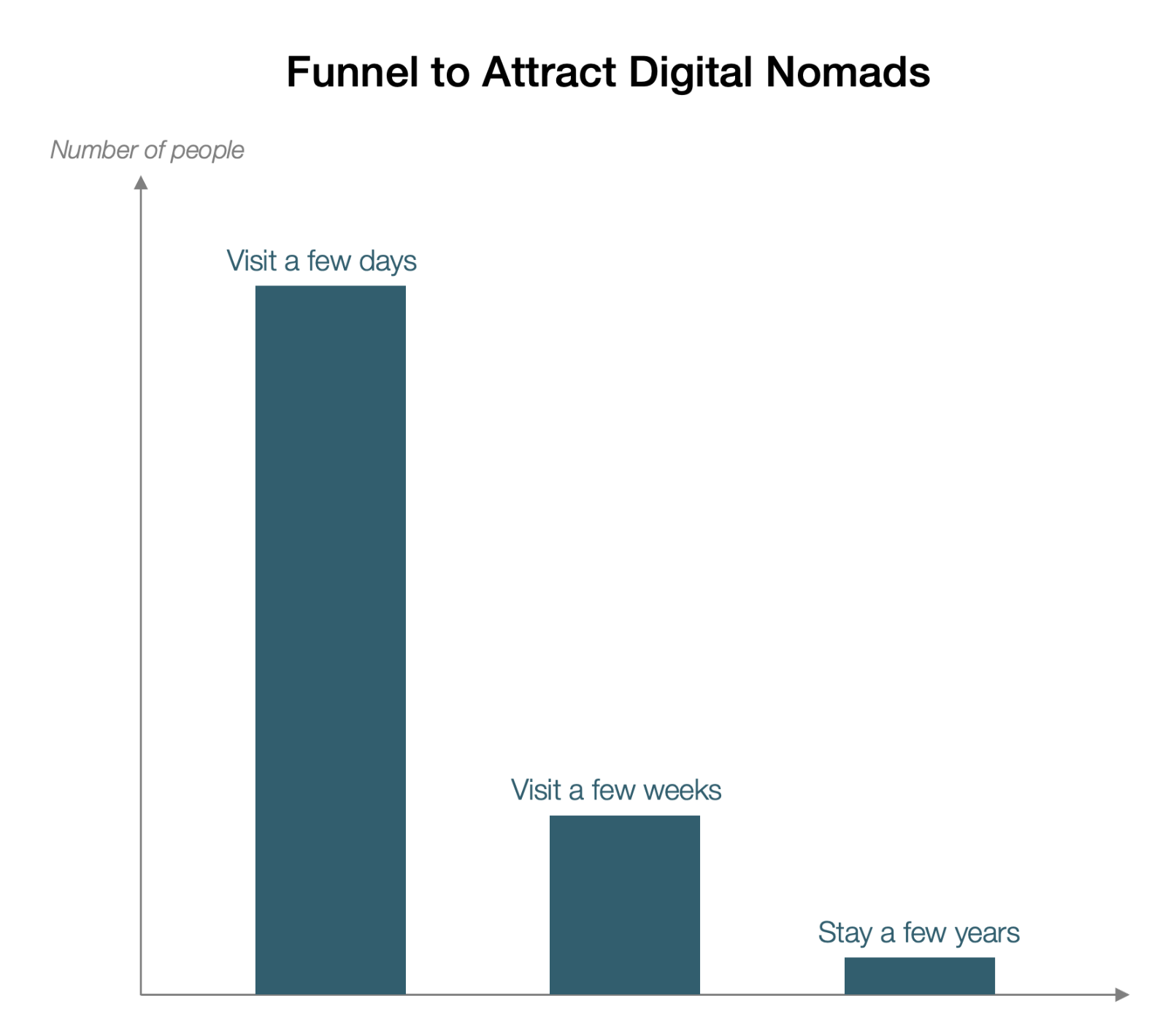
Each step in the funnel must be optimized.
Short Term: Events
One idea city founders float is to start cities from festivals: Get 5,000 people to come to your, say, music festival, and some of them will stay. Year over year, more and more people will stay, until a city is born.
I don’t buy this. Who goes to a festival and wants to stay there forever, once the music, the people, and the vibe is gone, and all that’s left is to clean up the mess with a thin crew?
Also, people know festivals are not the real world. You don’t go live in a place where you just have fun.
A festival can provide a taste of a place, though. If the infrastructure is solid, nomads might want more. And that’s the point of events.
If you don’t know about a new city, but you want to go to a special festival, you might discover the city in passing, and realize “This is not bad at all!” In marketing, that’s what’s called the awareness stage.
If you already know about the place, you might be thinking of an excuse to go there, and an event might be the perfect excuse.
It doesn’t need to be only festivals. Conferences gather like-minded people around a topic of common interest. But what do you make conferences about? The concept of new cities and states is one topic (which Network School uses for its annual Network States conference), but not every new city can do that. At some point, you have to do industry-specific conferences, but what legitimacy do you have for that? This goes back to the problem of jobs, which we’ll cover later.
Whether you do festivals, conferences, or other events, making the entire experience amazing is important, but the most important moments are the first one, the last one, and a peak experience. So the arrival at the airport, the ride in, the entrance to the venue, are all important. Same thing when leaving. And throughout the event, some magical moment(s) must be designed so that when the person goes back and reminisces about the trip, an indelible image remains.
Medium Term
Popup cities try to solve this: For a few months at a time, organizers propose that digital nomads live in an off-season resort with hackathons, speeches, workshops, and other social events, which help people get to know each other, form friendships, social groups… The first one, Zuzalu, was in 2023, and since then, the idea has expanded. Edge City has organized eight villages across four continents with over 12,000 participants in total.

As participants get to know each other better and better, some will want to live together. Once your group of people who want to live together is big enough, the logical next step is for all to settle somewhere specific.
This strategy has at least four benefits:
It targets the most mobile people already, digital nomads who are very flexible on where to live.
It’s much easier to attract a person to a conference or short-term event than to make them commit long-term to a specific spot.
With each new popup city, people make new connections, their circle of friends increases, and they’re more likely to want to live with them somewhere long term.
It’s also much easier for organizers: There’s much less work and commitment in terms of real estate, regulatory rights, paperwork, utilities, etc.
When I last talked with Edge City co-founder Timour Kosters, he was wondering if the next step could be buying out an abandoned university campus to provide a full-time base for the community.
There are other ways to get people to explore a new city for a few weeks. For example, Daniel Thompson and his Numa Collective is organizing a month-long summer camp and event for families in the Honduran city of Próspera.
Longer Term
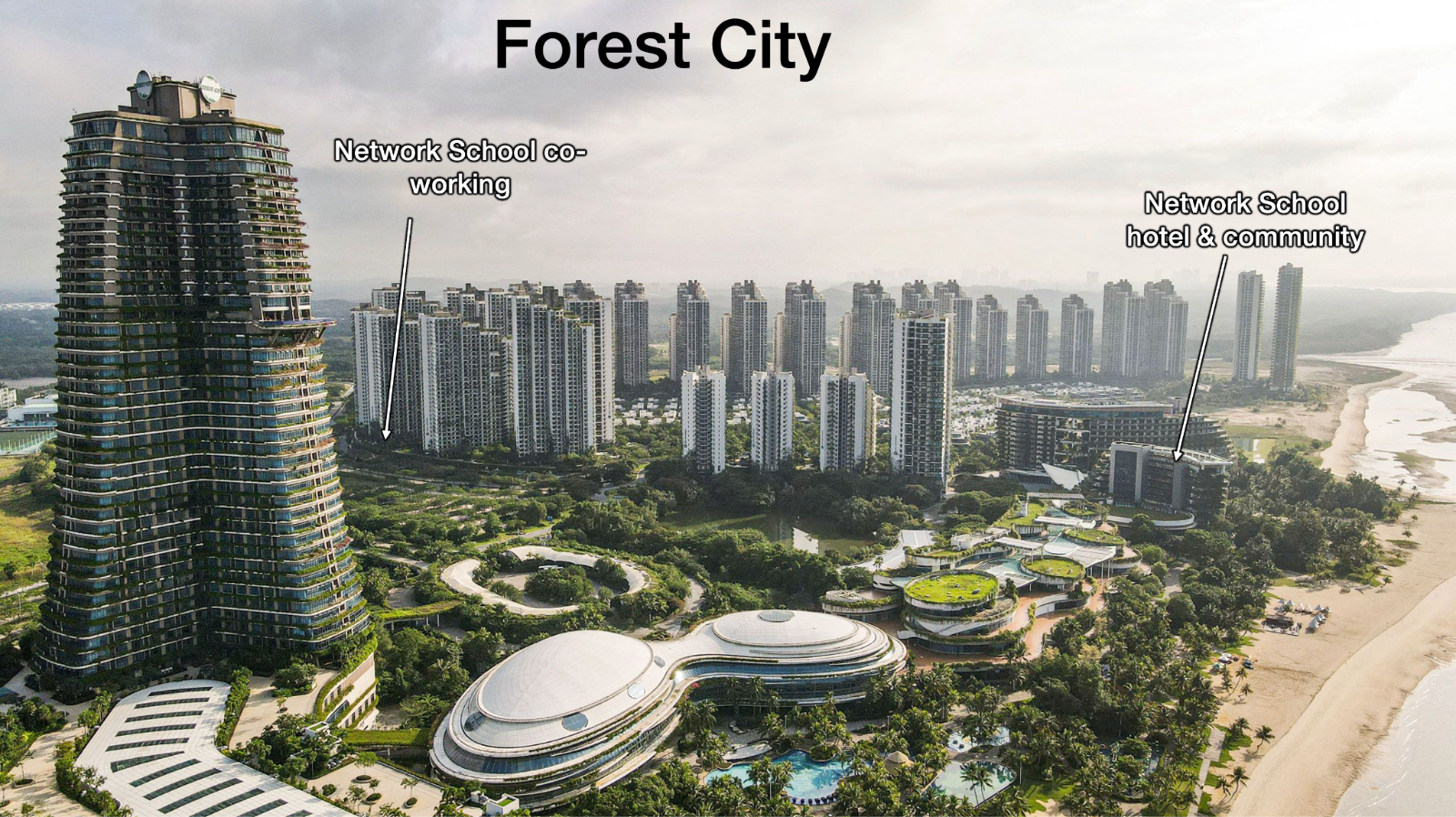
One of the most successful new communities is Balaji Srinivasan’s Network School. I’ll write a full article on this, but here’s the short version. In 2024, he took over an entire hotel in a Chinese development in Malaysia, 45 minutes away from Singapore, and presented it as a fixed place for nomads to spend a few months at a time. The price includes a room, cleaning, food, coworking space, Internet, community events, workshops, gym... All in a safe, tropical, walkable space.
In other words, what you’re getting in a place like this is the college experience after college. This is clever: College years are some of the most fun for most people. Extending them or reviving them is very cool.
Thanks to Balaji’s popularity, enough people came and formed friendships that there was demand for long-term stays (one year or more). Now, Network School has had thousands of visitors, some of whom have become full-time residents.
Balaji’s huge audience, drawn to his leadership in investment, cryptocurrencies, and the future of nation-states, was crucial to get there.

His popularity still helps raise awareness of his Network School and convert doubters, but the bigger NS is, the more his personal popularity will have been tapped, and the less it will influence people to move. NS has already transcended him, it doesn’t rely on him anymore, and is growing. Good for them, because that requires a transformation: What works early on doesn’t as a city grows, because the early adopters are unlike those coming after.
Crossing the Chasm
In his book Crossing the Chasm, Geoffrey Moore explains how early products don’t cut it for most people. If you’re an innovator or an early adopter, you love new stuff and are willing to try it. But for the vast majority of people, that’s not true.
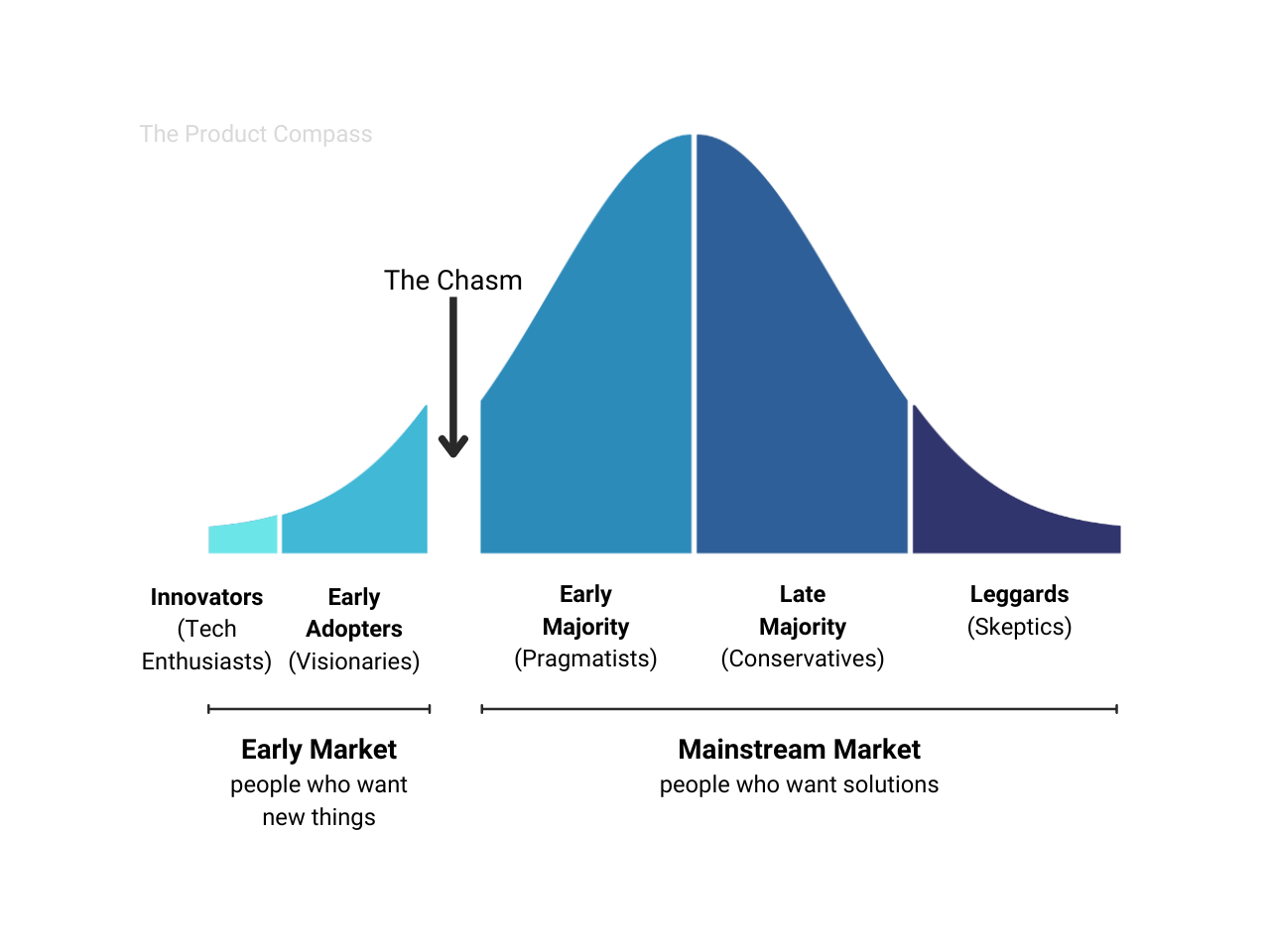
Pragmatists are less moved by a vision or adventure, and much more interested in cold pros and cons. This is true for all products: Early adopters will tinker with things that are broken but show potential, but for the vast majority to adopt them, their kinks need to be ironed out until they’re easy to use.
So even if it’s hard to get a community to a few hundred people, the step after is equally hard, just for different reasons! Now, some of the biggest advantages of the early community (cheap real estate, strong community) get diluted, while the network effects of amenities, jobs, and microcommunities are not yet kicking in.
I think the answer is that these cities/jurisdictions need to make sure crime remains zero, while investing heavily in amenities, healthcare and education. These are a matter of money, and although you might not be able to make them profitable early on, they will make pragmatists cross the chasm.
OK we’re done looking at the demand side. You can see it’s very hard to get it off the ground without the other side of the marketplace: the supply of jobs.
Supply: Jobs
Nomads (single and coupled) can only get a new city so far, and even they want their industries to be represented where they live. So there’s just no way around needing to attract businesses to your city.
But companies are usually happy where they already are. They have employees, and they tend to be in big cities where they enjoy network effects. What kind of industry (vertical) would be willing to relinquish the value of its current location to move to an empty one where they can’t hire anybody? What kind of unique asset can a new city provide?
Regulatory arbitrage.
What’s the one human decision that frequently prevents companies from growing to their full potential? Overregulation. Don’t get me wrong: Some regulation is good. But the entire reason we want new cities in the first place is because the existing regulatory burden is way too high, supported by entrenched interests, and nearly impossible to eliminate. New jurisdictions’ raison d’être to form is to fight overregulation.
So which industries suffer the most from regulation?
Real estate, finance, and healthcare.
Real Estate
We talked about real estate: Overregulation is what makes it expensive in many cities; killing regulation is one of the biggest assets of any new jurisdiction.
Finance
Overregulated finance is the very reason for the existence of Bitcoin, cryptocurrencies, DeFi (decentralized finance), blockchain, and all these new financial technologies. It wants a libertarian world where big states and financial institutions can’t dictate who has access to money and who doesn’t, where banks can’t profiteer from their power, where they’re too big to fail, where states overtax their citizens. This is why the crypto movement is extremely aligned with the development of new jurisdictions: All the people who believe this and make a living off of it want new places where they can be free. When you travel to these places, there’s always a strong community of people working in crypto, payments can always be made in cryptocurrencies, whether international ones like Bitcoin, or the local one.
But finance has two problems. First, finance is not just regulated at the national level, but at the global level. Anti-money-laundering institutions and regulations are active enemies of decentralized finance, because they see its anonymity as the shadow criminals yearn. Any banking service that is tied to the global financial system must abide by its rules, so innovating on rules is not as beneficial.
The second problem is that it’s hard to keep the crypto tribe in one place. Crypto doesn’t want boundaries. By definition crypto workers are mobile, international. And since they’re so aligned with the concept of new cities, many new jurisdictions try to cater to them, so there’s lots of competition for these highly mobile people. Hard to rely on finance as an industry to jump-start the supply side.
Healthcare
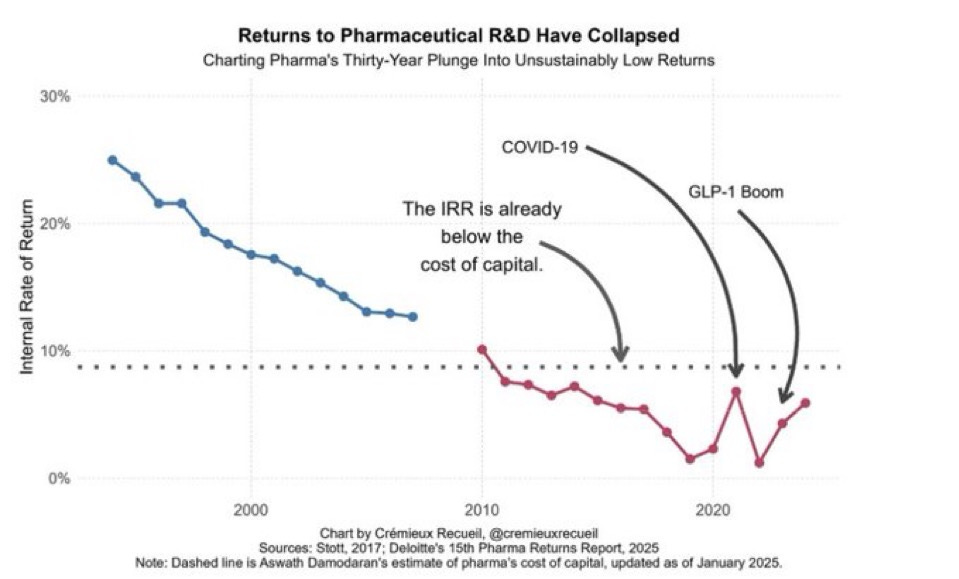
Healthcare is different, though. Drug companies and hospitals are not especially libertarian or excited about new jurisdictions. They just want regulation to be reasonable, and they can’t get that where they are. This adds billions of dollars to their business costs—so much so that it’s simply financially impossible to develop new drugs.
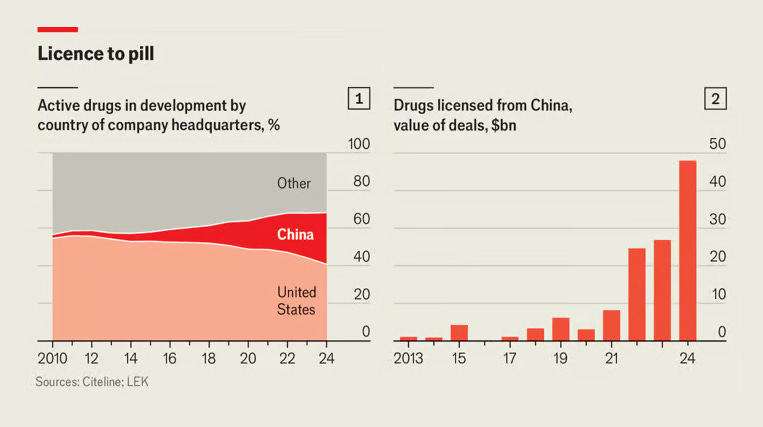
As a result, other countries like China, with much better regulation, are taking over in drug production.
This is why Niklas Azinger formed Infinita in the new jurisdiction of Próspera, a Special Economic Zone (SEZ) in the Honduran island of Roatán, on the Caribbean.
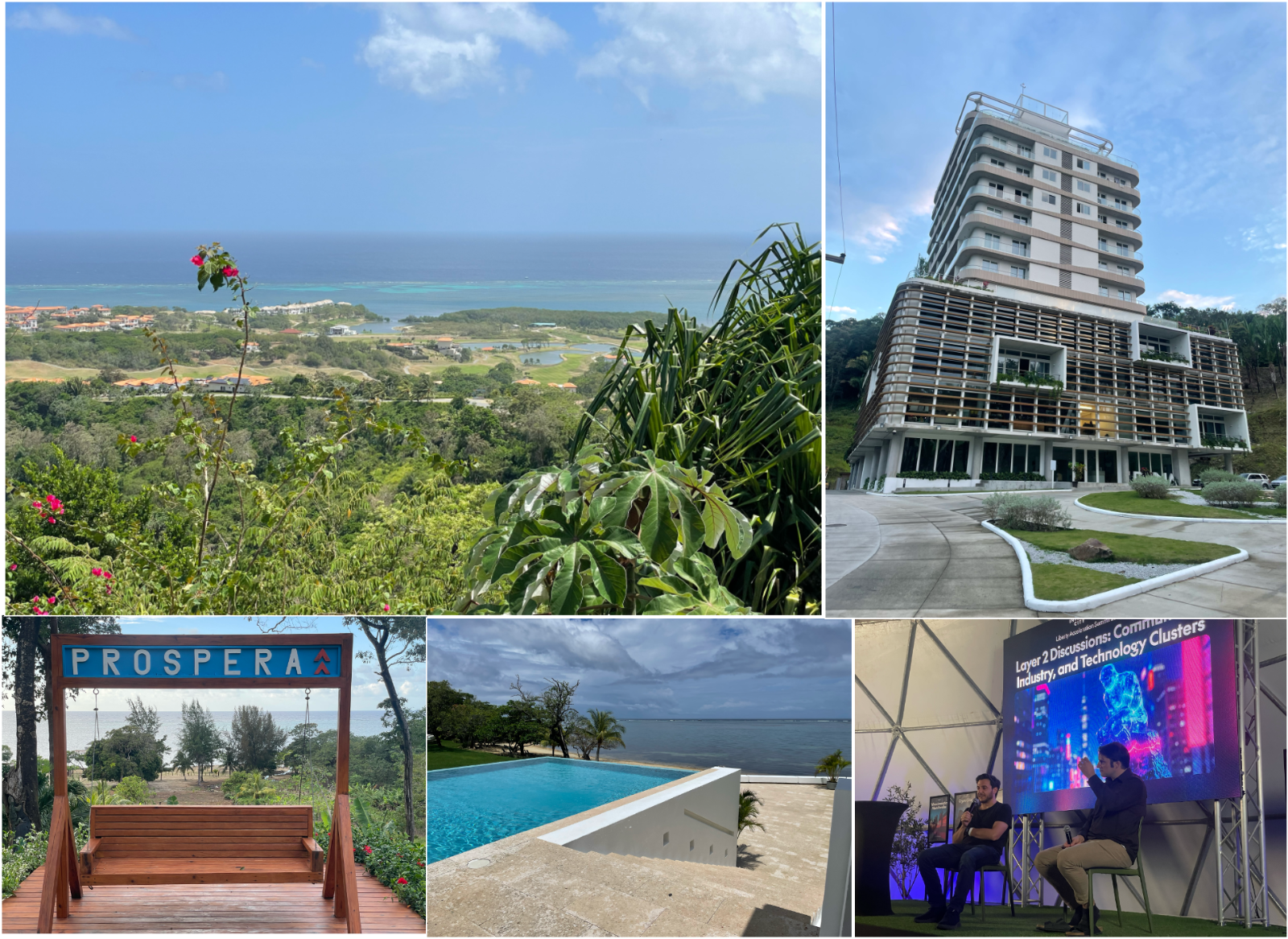
Niklas realized that the US’s healthcare regulations are irrationally tight, so he figured out a much more reasonable set of regulations that allows Western drug companies and hospitals to do things there that they can’t do back at home.
To give you a couple of examples, an easy one to understand is drug repurposing: Many drugs are already approved, which means we know they’re safe to take. And sometimes, we discover new uses (“indications”) for them. Eg, GLP-1s were diabetes drugs that became weight loss drugs. But it’s hard and expensive to repurpose drugs for new indications. This makes no sense! We already know they’re safe (from the previous clinical trials), and we have data on their performance in real life, since we track their side-effects. Do we really need the hundreds of millions it would take for a perfect new clinical trial? Every time?
Another example: Aging is not a disease in the US, so you can’t test drugs to treat it, or make anti-aging claims about medications. You can test drugs against aging in Próspera.
Real Estate, Finance, and Healthcare are three examples, but any industry that has too much regulation is a good target for SEZs like Próspera. The more money that is at stake, the bigger the regulation arbitrage, and the easier it is to exploit it abroad, the more likely an SEZ is to attract companies from a new industry, kicking off the supply side of city marketplaces (jobs), attracting workers to take these jobs, and kick-starting the flywheel of a new city.
Dating Pool
Of course, the other relevant marketplace early on in these places is dating. This is not relevant for married couples, but hyper relevant for single nomads.
Early on, the biggest issue is that these new cities, being new and riskier than established cities, tend to attract a higher share of men than women. From my conversations, this ranges between 60% and 80% of men when these cities have just a few hundred people.
This is bad for most people:
There are not enough women, so many men remain single.
Most women prefer not to be in such a minority. They prefer a stronger female community for friendship and support.
As such, early cities would benefit from programs targeted specifically to attracting women. This should be easy.
Another asset is that, in my experience, many men in these places are young, ambitious, adventurous, hard-working, fit, and intelligent. Women who might be looking for a life adventure and might also be interested in such men would benefit from visiting these places.
If you think this is secondary, you should read this article:
Why Doesn't North America Speak French?

Why is French only spoken in Québec, and not all of Canada? Why not in all of North America?
In it, I explain that this gender imbalance is the reason North America speaks English and not French. The French side in Canada attracted male nomads, because fur trading was amenable to this type of worker since trappers had to travel a lot, hunt, deal with natives, fight… The English side had a good climate for agriculture, which is settled, and more conducive to forming families. This meant there was a population explosion in the British Colonies in Canada while the French side remained underpopulated, and when they went to war, the British outnumbered the French.
I’ve talked with several leaders in the field and they’re understandably wary of intentionally attracting women to their cities, but personally, I think it’s quite natural, logical, and moral. They should do it!
OK, so far we’ve discussed how to accelerate the progress from 1 to 10 to 100 to 1,000 to 10,000 people. But wouldn’t it be cool to bypass all this work and shoot straight to 10,000 people?
Bypassing the Early Stages, Straight to 10,000+ Citizens
The best way to short-circuit the chicken-and-egg issue of no people → no jobs → no people is to artificially get 10,000+ people or 10,000+ jobs. How can we do this?
Satellite Cities
I discussed this model in this article.
Ten New US Cities: Satellite Cities

This is the 8th short article of the series Where to Create Ten New Cities in the US.
A great example is what Jan Sramek is doing in California Forever, a new city between San Francisco and Sacramento, in California. Instead of starting from scratch, Satellite Cities co-opt the people and amenities of a big city nearby. No need for thousands to relocate dramatically across the world, just get them to move a short distance from where they live today. They can keep the same friends, the same family, use the same airport, use the bigger cities’ amenities when need be…
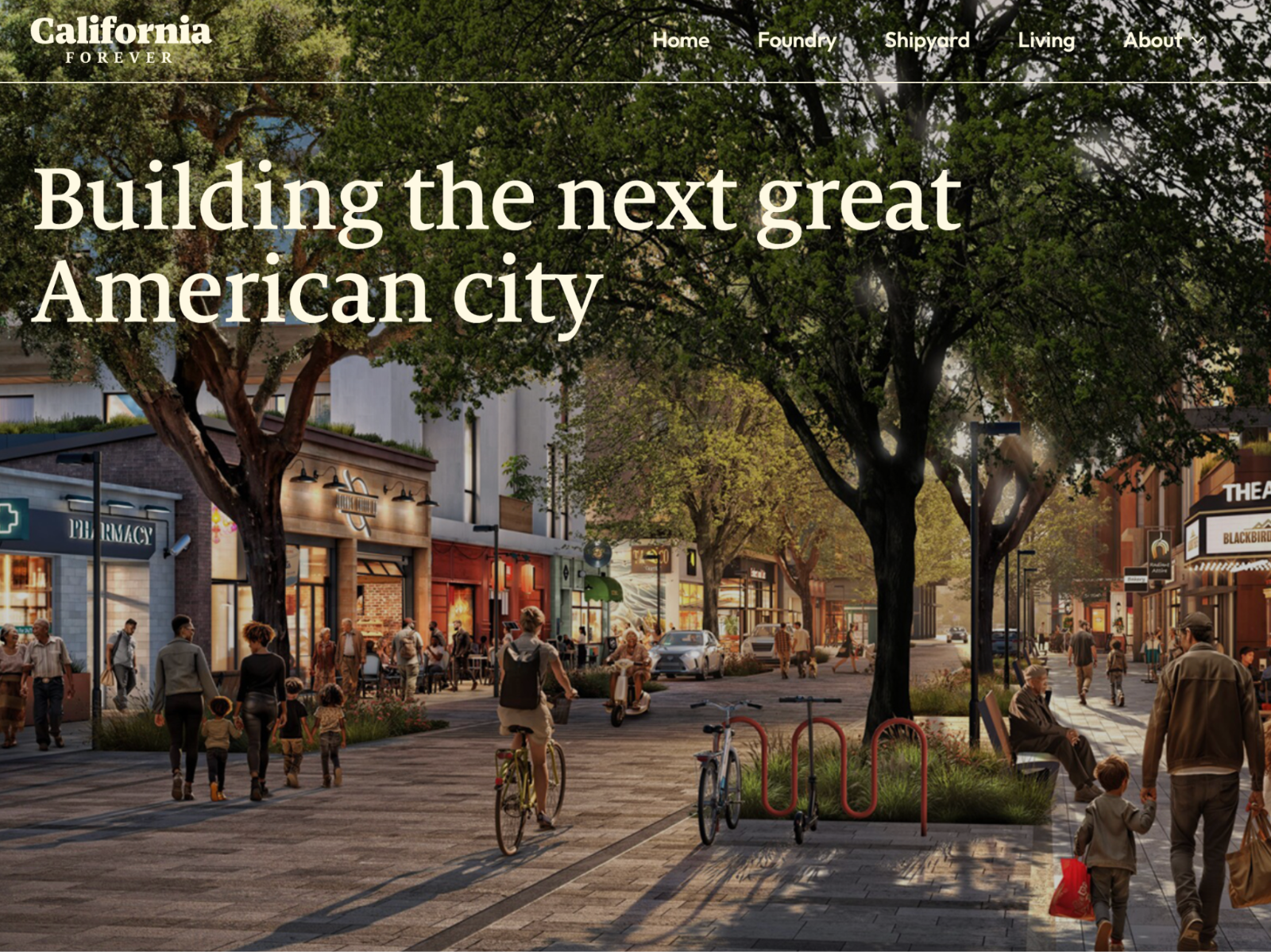
In the case of California Forever, they’re aiming to build a huge industrial park, but with regulations that make it much easier to build industry in California (a state famous for its anti-industrial policies). With its proximity to the San Francisco Bay Area, the hope is that many hardware startups will be inclined to move there, providing the jobs that will attract more people.
Anchor Tenants Near Existing Cities
You can combine the idea of a satellite city with that of an anchor tenant. A Texan developer told me it’s actually not that hard to get companies to commit to bringing their operations to a new satellite city within the US. These are also perfect ways to kick-start cities, because they concurrently bring hundreds or thousands of jobs, along with the workers, who then need to live in the place. They beget lots of services, sometimes supported by the company (shops, schools, clinics, etc.). You can shortcut the first few orders of magnitude of growth (from 1→10→100→1000 and even →10,000) with an anchor tenant. You just need a few things:
A city in its close proximity, for amenities and workers
Utilities: electricity, water, etc.
Legal certainty
This last point turns out to be the hardest. Having the mayor, the board, the opposition, the judges, the state legislature, the country government all aligned to help a new city be born is the scarcest resource. But it’s doable. This is for example how Celebration, Florida was born: It was Walt Disney’s city.
Tourism Settlements
In the 1970s, the Yucatán Peninsula was mostly jungle and sand. Then, the government chose a tourism spot there, built infrastructure, and called on hotel chains to establish themselves there. Now, we know the destinations of Cancún, Playa del Carmen, Cozumel, the Riviera Maya…
The Mexican government was visionary in making this area into a tourism destination, but the vision didn’t extend to governance, so the area suffered from crime, overbuilding, and overdependence on tourism. Maybe a city founder could add regulatory vision, and find a spot that has amazing, underdeveloped beaches that could house great resorts, within a country and region that is open to giving enough governance freedom to an SEZ.
In other words, the cold start problem can be solved through tourism funding the growth from 1 to 10,000 citizens via hotel resorts: The citizens would be the workers. Once you have that, you can expand to other verticals.
If you think about it, this is not far from what Forest City was (where Network School lives): A Chinese developer agreed with the Malaysian government to allow a Special Financial Zone and built dozens of beachfront buildings there. The city was meant to host hundreds of thousands of people, but is currently mostly empty, with only around 9,000 residents. Maybe this was too big, too fast, too exposed to the national risk of both Malaysia and China,4 and not visionary enough on the governance side, but the thinking was directionally correct. We’ll talk about it more another time.
Cruise Cities
Remember the idea of birthing cities out of festivals? I don’t think it can work because one festival a year is not enough to anchor a settlement. But what if there were dozens of festivals per year in the same place? That’s what cruise companies can do.
Cruises carry thousands of people from place to place, reliably, week after week, providing customers to local economies. But after some time, these cruise companies have thought: Why would we give up all this reliable business to outside entities? So they’ve started buying islands (now over a dozen) and creating their own resorts, events and festivals. Vertical integration.
What if they organized ongoing festivals, so that each one of their cruises could benefit from one? This would increase the revenue per customer. And once they have recurring festivals on land they own, they would need settlements there. From there to cities, there’s a very small jump. In fact, some cruises already operate as small sea settlements. Maybe some could move into land-based settlements. But they’re not in the business of city founding, they need either visionary leaders or to partner with visionary city founders.
This reminds me of the early growth of Airbnb: Its founders noticed that during conventions, all hotels were booked and prices were through the roof. Demand was guaranteed, so they focused on events like the Democratic National Convention or Oktoberfest, sending employees to review listings. Each time there was a new event, they added more listings, and more people started using them.
Existing Industry with Low Quality of Life
While the Honduran SEZ of Próspera focuses on real estate, finance, and especially healthcare, the other Honduran SEZ of Ciudad Morazán tackled the problem differently.
The region already has local industry, tied to the neighboring city of Choloma. But nobody wanted to live there because of the low quality of life, especially due to crime and corruption. So Ciudad Morazán took over an area, made a gated community for the workers, took over the local governance and law enforcement, and that was enough to make it a favorite for workers.
Putting Everything Together
When new cities and jurisdictions are putting together their offering, they’re basically trying to weigh their competitive advantages between real estate quality & affordability, crime, the feeling of community, jobs, education, healthcare, transportation, utilities, amenities, and dating. They’re trying to do something like this:
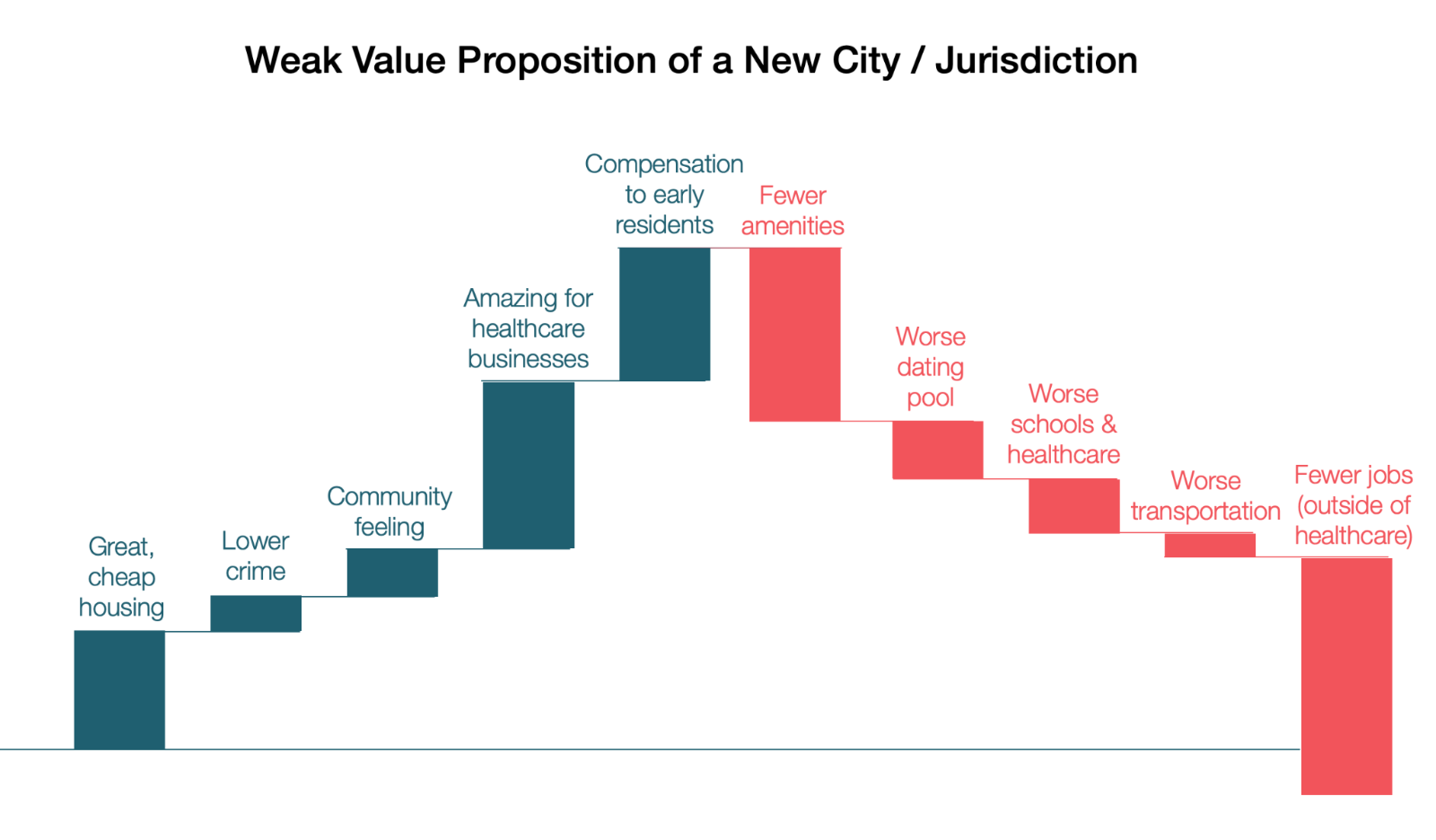
Their goal is that the teal assets outperform the red liabilities, so that the city is such a no-brainer that many people want to go.
Every new jurisdiction is different. In the example above, the value proposition is not strong enough, so people will only trickle in. Conversely, a satellite city with an anchor tenant might look like this:
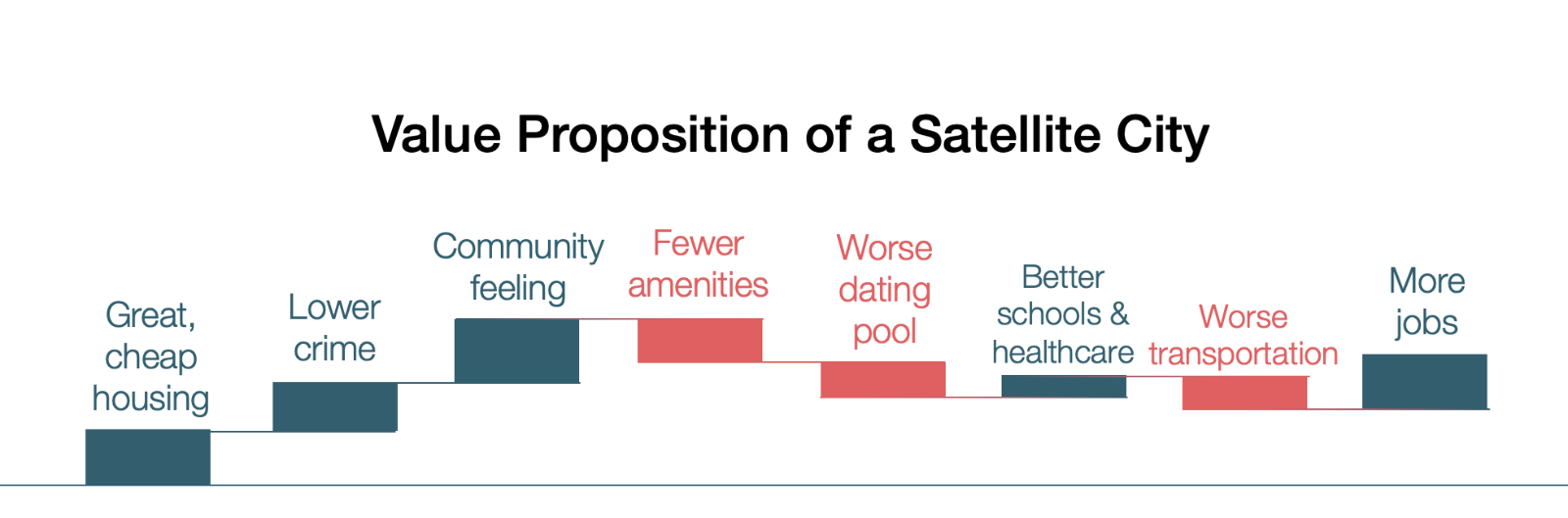
Based on their own estimations, cities can decide to invest more or less on a given thing.
The more remote and novel the city is, the more these assets or liabilities will stand out from existing cities, creating a starkly differentiated product. But the big thing they’ll be fighting is the lack of network effects. The best way to solve this problem is bypassing the early stage (e.g., satellite cities, anchor tenants). If they can’t do that, though, the best strategy is to invest heavily in the other aspects: cheap, great housing, less crime, a community feeling, jobs in some vertical, and compensation for early residents, while they try to mitigate the other issues as much as possible, with schools, sites with good nearby airports, clinics, and the like.
When I was last in Próspera in March 2026, one of the founders, Erick Brimen, closed with this video of a Mos Def concert in which Mos Def never appeared.

A video of a guy dancing alone in front of a crowd for over 40 minutes until some people join in. Erick didn’t play it for 10 seconds. He played it for what might have been two minutes, and felt like one hour. Torture.5
His message: If you want to create something big, something few have dared to do before, something breaking so much with conventional wisdom, you have to endure dancing alone for a long time before the first few join. But eventually, they do, and it becomes a party.
May the party come to new cities and jurisdictions. I hope this article will help the current founders and workers to accelerate their growth, and people like you to move there.
If it does, and you decide to visit Próspera or move there, let them know you came from me and you’ll get 50% off their residency or e-residency program by using this link.
And if this article helped you do your job a bit better, or meaningfully changed how you think about the world, consider subscribing.
Thanks to Niklas Anzinger (Infinita), Trey Goff, Erick Brimen, Gabriel Delgado (Próspera), Balaji Srinivasan, Jackson Steger (Network School), Patri Friedman (Pronomos), Daniel Thompson (Noma Collective), Mark Lutter (Charter Cities Institute), Timour Kosters (Edge City), and the many other city / jurisdiction founders or early workers who have talked with me over the last couple of years and / or have read this article to make it better. Of course, thank you Heidi and Shoni for your edits, as always.
It turns out no country claims Liberland, a tiny corner between Croatia and Serbia, because of obscure laws about rivers defining country borders. The Danube riverbank has shifted since the boundary was set in the 19th Century, and both countries claim the bigger pieces of land.
If you have W workers and F firms, the potential matches ≈ W×F. If both scale with city size N, then matches scale roughly like N2.
Although I’ve been told this has happened in Network School. Crazy! These are true trailblazers. It reminds me of the 1848 Gold Rush, people reading in newspapers of the gold discovered, and booking tickets to go there from across the ocean.
Or maybe the developer is just thinking on a different timeline than most others and is okay with an empty city for a while. Some could argue that Forest City was never a ghost city but rather a city that just hasn't grown into itself yet.
The music is still stuck in my head two weeks later.
I've really liked your articles in the past but this one lost me.
There's an assertion in it that I took to be the real thrust of why people want to set up their own states:
"It wants a libertarian world where big states and financial institutions can’t dictate who has access to money and who doesn’t, where banks can’t profiteer from their power, where they’re too big to fail, where states overtax their citizens."
Maybe it's a bit too blunt and a bit too cynical to say that these micro-state-chasers basically just want to run away from paying tax and not adhere to regulations that prohibit them from doing whatever they want. But it seems to me the gist of it.
I do want to call out one line which I disagree with: "where financial institutions can't dictate who has access to money and who doesn't". In my mind, this is exactly the scenario that could arise without regulation, not with it. In the UK, where I'm based, the FCA (the financial regulator) mandates that financial institutions must follow the Treating Customers Fairly principle which means banks can't favour certain customers over others, and therefore can't dictate who has access to their services. And using another example to build on this, when you file for bankruptcy, your debts are dissolved, meaning that you don't fall into lifelong debt-traps to other people. I'd suggest here that laws and regulations actually mean that financial institutions don't have the power to dictate and without safeguards like these we could easily see citizens of micro-states being tiered by financial institutions. This could manifest in a very obvious way using your digital nomad example; if everyone's a software developer, where do the cleaners come from? Presumably from the neighbouring country which envelops this microstate. As we see in Dubai, Qatar, etc, these low-skilled workers are basically deprived of human rights.
And onto tax. With a very low tax microstate - which I've inferred will be the case from the "where states overtax their citizens" comment - what happens when one of these digital nomad microstate citizens gets made redundant and receives no severance pay from their employer? Or what happens if they developed a serious illness? Whatever does happen to them, it won't be good - there's no state taxes to pay for their healthcare!
All in all, it would have been great if your article explored what scenarios a lack of regulations or taxes can lead to rather than just fielded the utopian vision of it.
As ever though there was a lot to like in your article and I really loved the Competitive Advantage of Small vs Big Cities section.
I hope that all made sense and apologies for the long comment!
"Just a century ago, regulations were light... They dream of a better world where the government doesn’t impose all its answers on its citizens, where they’re treated not as subjects but as customers."
No. We. Do. Not. Full goddamn stop.
We dream of a world where your right to live in peace, safety, and prosperous freedom is NOT dependent on the size of your bank account. Where governments act in the interest of the citizens who elect them to office, and not in the interest of corporations who grease the campaigns of their favorite politicians.
Between the 1930s and 1970s, the U.S. treated its non-millionaire citizens as voters who benefit from the common good, and not as consumers to milk for "rich people play money". The result? Leaps in education, communications, human safety and general health, medical care, technology, infrastructure, rights, modernization, safety and fairness regulations, average income...
But starting in the 1980s, when the Reagan administration and the Friedman doctrine decided that corporations mattered more than citizens, the U.S. has increasingly treated its non-millionaires as wage slaves and "paying customers", who only "deserve" anything if they "can pay for it".
Regulations, public systems, infrastructure, and social nets (which benefit the People) were either torn down or allowed to rot, as politicians and anti-regulation hawks drove money upward toward the already-wealthy, so that they could have even more.
Corporations also began purchasing homes (liquid wealth mobility for the lower 90%) and bulldozed them for apartment complexes (liquid wealth for the upper 10%), turning "owners" with investment into "renters" with nothing to show for it. Software also flipped from something you "own" to something to which you "subscribe", at the whim of the company which publishes it.
Meanwhile, social services (school, medicine, banking) prices went up beyond the ability to afford them, and media transformed from "owned" physical media to "rented" digital, which can be yanked away at any moment for any reason.
This has left everyone else to scrounge for what their diminishing paychecks (in real currency value) could afford. And it has enshittified everything; from families to workplaces to media to products to cities, ensuring that governments become focused not on the good of the People, but the good of their own pocketbooks.
Bonus: Seemingly "successful" places such as Abu Dhabi, Dubai, and Singapore rely on heavy censorship and restrictions on general democratic freedoms for anyone in the lower 90%. Because, you know, if the "poors" rise up, the ultra-wealthy who keep these cities lookin' good can't drink their champagne in peace.