

One of the big tech transformations of 2026 will be robotaxis.

Waymo
Waymo keeps eating market share in every market it enters, and it does so pretty fast. I expect that initial adoption will accelerate over time when they enter new markets, as their brand and safety reputation will precede them.
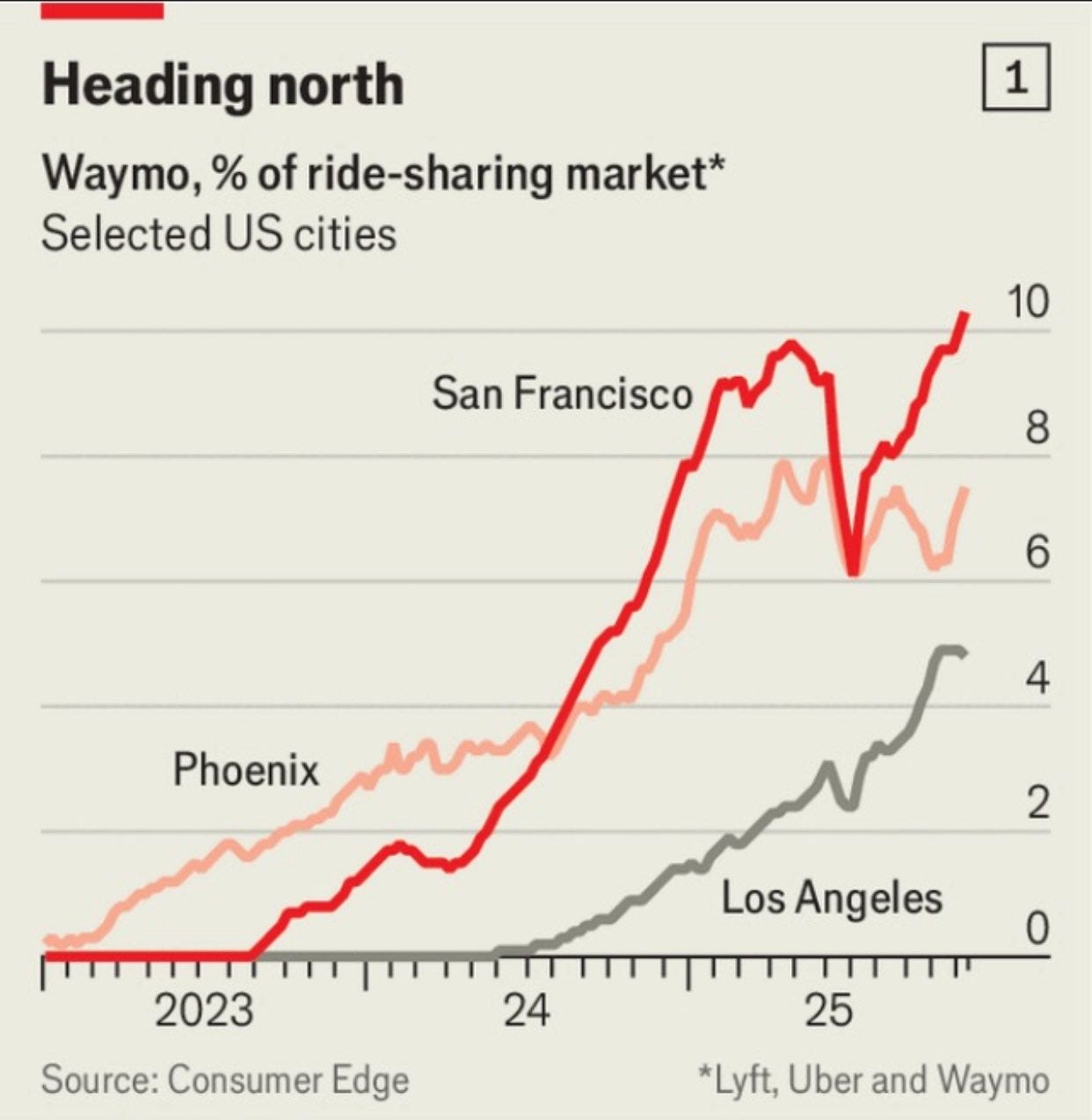
This is crazy. The founder and previous CEO of Uber once said robotaxis would destroy human cabs and ride-hailing cars because they would be cheaper. But Waymo is not cheaper! It turns out people prefer to ride without a driver! In retrospect, you can imagine why. Nobody to judge you, to talk to you if you’re not in the mood, to smell bad, to drive recklessly, to disregard app payments and request cash… Imagine when prices drop way below current levels.
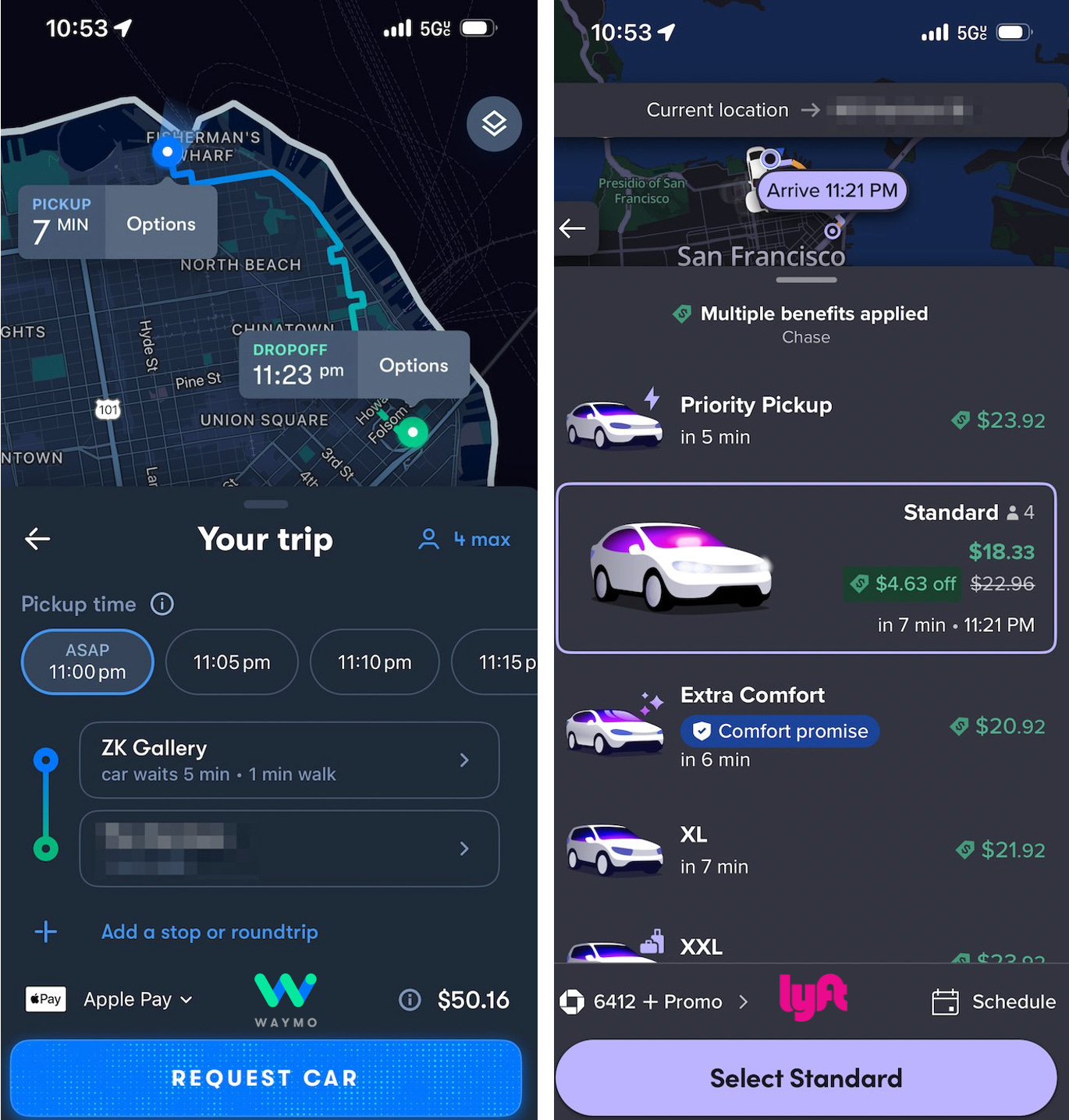
Speaking of price drops, when Waymo moved from Jaguar to Hyundai, the cost of each of its cars dropped, potentially from ~$150k to ~$70k, because instead of having to be manually retrofitted, they started leaving the manufacturing plant as Waymos. Months ago, this was already predicted to happen eventually.
The company had said they’d be present in 10 cities by the end of the year, and it claims to be—apparently in Phoenix, SF, LA, Austin, Atlanta, Miami, Dallas, Houston, San Antonio and Orlando. But that’s just presence, not real operations. How are rides faring?
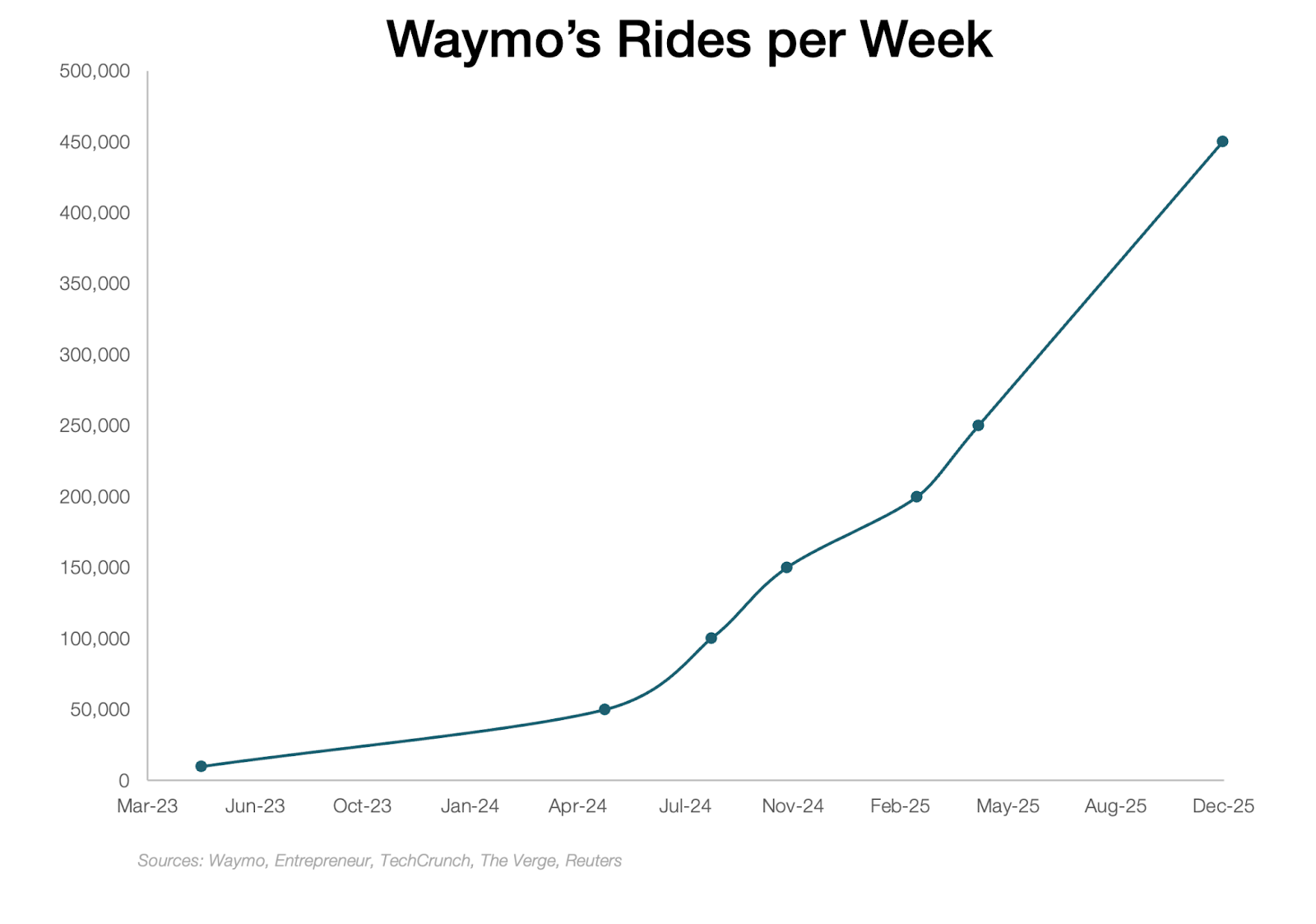
They’re growing thanks to more cities and more rides per city, not just stealing market share, but also creating more market:

450,000 rides per week translates to about 25M rides per year. This is slow! The last year was approximately linear. For Waymo’s own sake, it should be exponential, but it’s not.
And of course, it’s bad for jobs. Since a full-time Uber driver does ~4,000 rides per year, 450k rides per week is the equivalent of over 6,000 drivers already.1
Tesla
Of course, the reason why Waymo’s growth should accelerate is because Tesla is hot on its heels, and when Tesla is ready, it’s going to ramp up much faster than Waymo:
“Cybercab is not just a revolutionary car design, it’s also a revolutionary manufacturing process. If you’ve seen the design of the Cybercab line, it doesn’t look like a normal car manufacturing line. It looks like a really high-speed consumer electronics line. The line will move so fast that people can’t even get close to it. It’ll be able to produce a car ultimately in less than five seconds.—Elon Musk in Tesla’s All-Hands, March 20, 2025
And that’s just the dedicated Cybercabs. It doesn’t take into account the millions of Teslas already on the street, which owners will be able to dedicate to ride-sharing to top up their incomes.
So when will Tesla be ready?
The key is safety. As soon as the cars can drive themselves with minimal or no human intervention, and they have substantially fewer accidents (and incidents) than humans, Tesla will floor the accelerator. And that moment seems to be approaching. Tesla’s supervised autonomous driving (FSD) is improving quickly and is now ~7x safer than human drivers. A recent update reduced human interventions by over 10x. The next step is unsupervised driving.
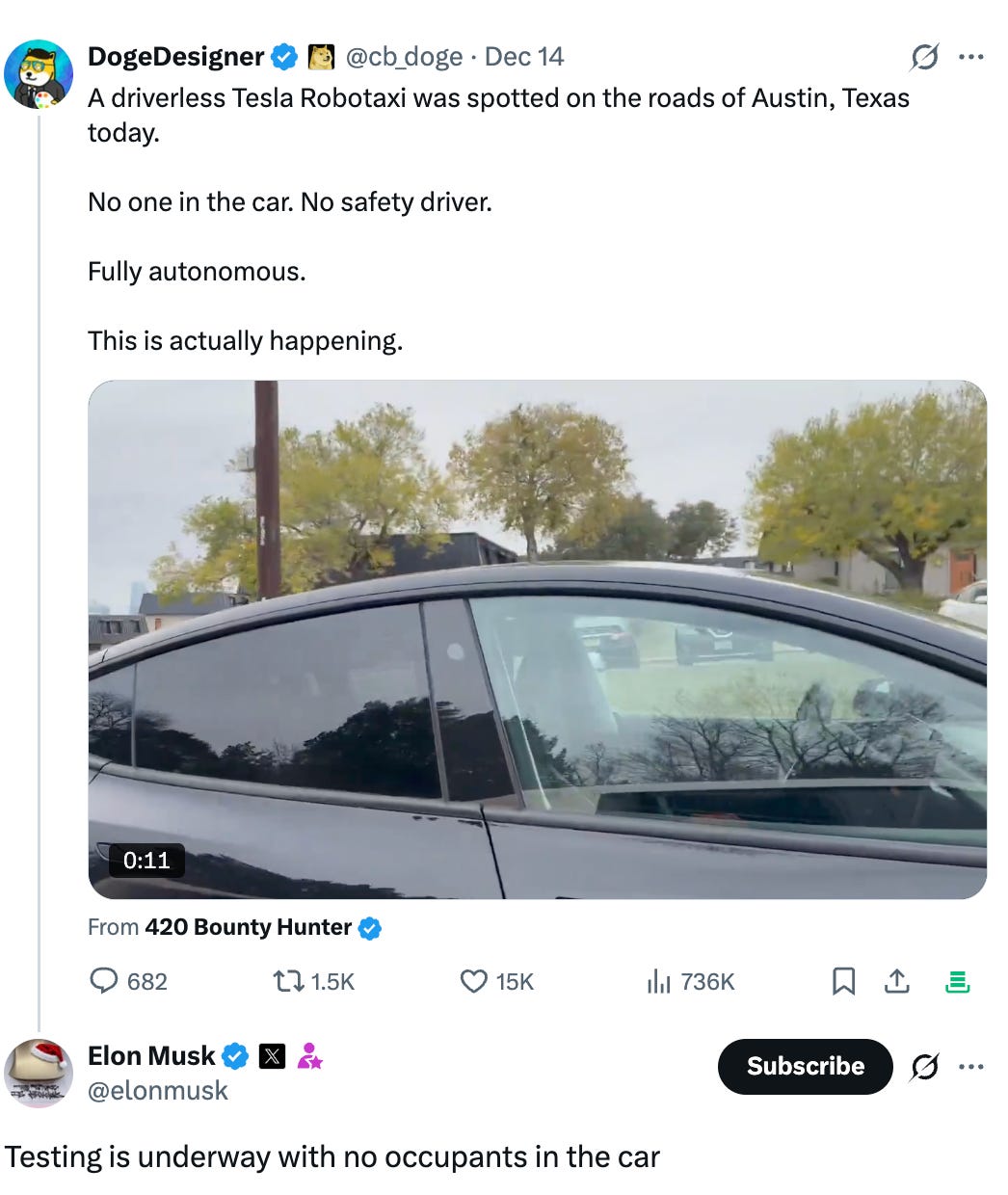
It’s the first of many to come.
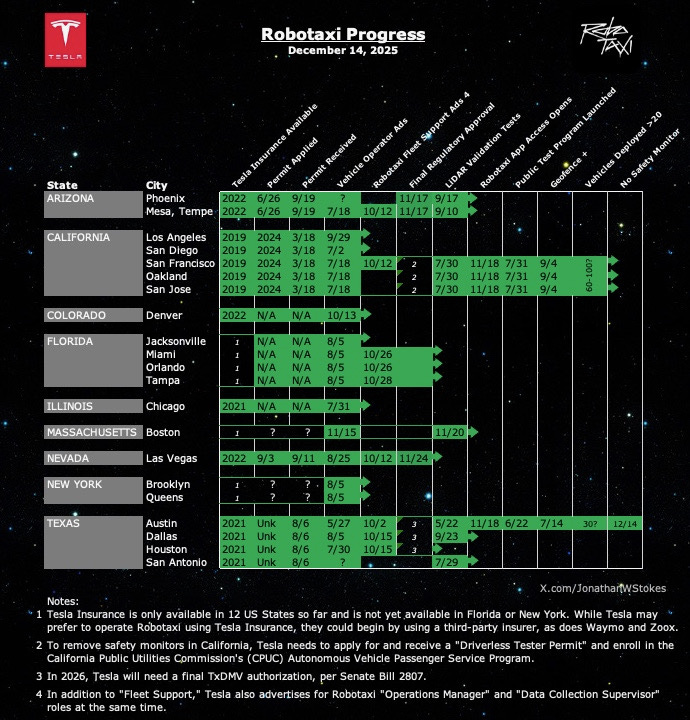
How does Tesla fare when there’s no human present to supervise driving? Nobody knows yet, but it seems to have many more accidents.
But Musk says unsupervised driving is solved at this point, the company has released its robotaxi app in a dozen countries, and the company’s gigafactory in Texas will be mass-producing them in five months.
My prediction is that probably by the end of next year, we’ll have probably hundreds of thousands, if not over a million Teslas doing self-driving in the U.S. Unsupervised full self-driving where you do not need to pay attention. We’ll have a model that is kind of like some combination of Uber and Airbnb. If you’re a Tesla owner, you’ll be able to add or subtract your car to the fleet. So, just like an Airbnb, you could rent out your spare bedroom or rent out your house when you’re not using it—Musk, May 20, 2025
Musk has a track-record of optimism, so if you want to discount what he says, this is the market’s opinion:

So more than a 50% chance that Tesla can service Cybercab’s unsupervised ride-hailing within three months!
I don’t think Waymo has much time. As Ramez Naam says:
The autonomous taxi market is now a race between Waymo cutting hardware costs and Tesla getting their system to drive sufficiently well.
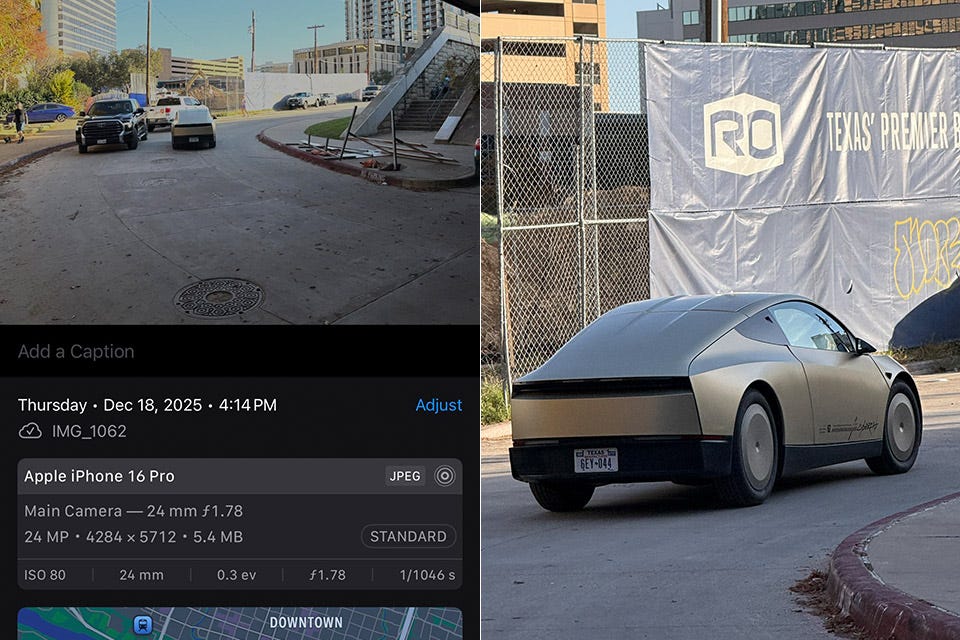
Will Uber & Lyft Get Wiped Out?
Legendary investor Bill Ackman doesn’t believe so, and has invested in Uber. The arguments:
Self-driving cars are bad in extreme weather so not ideal for all geographies.
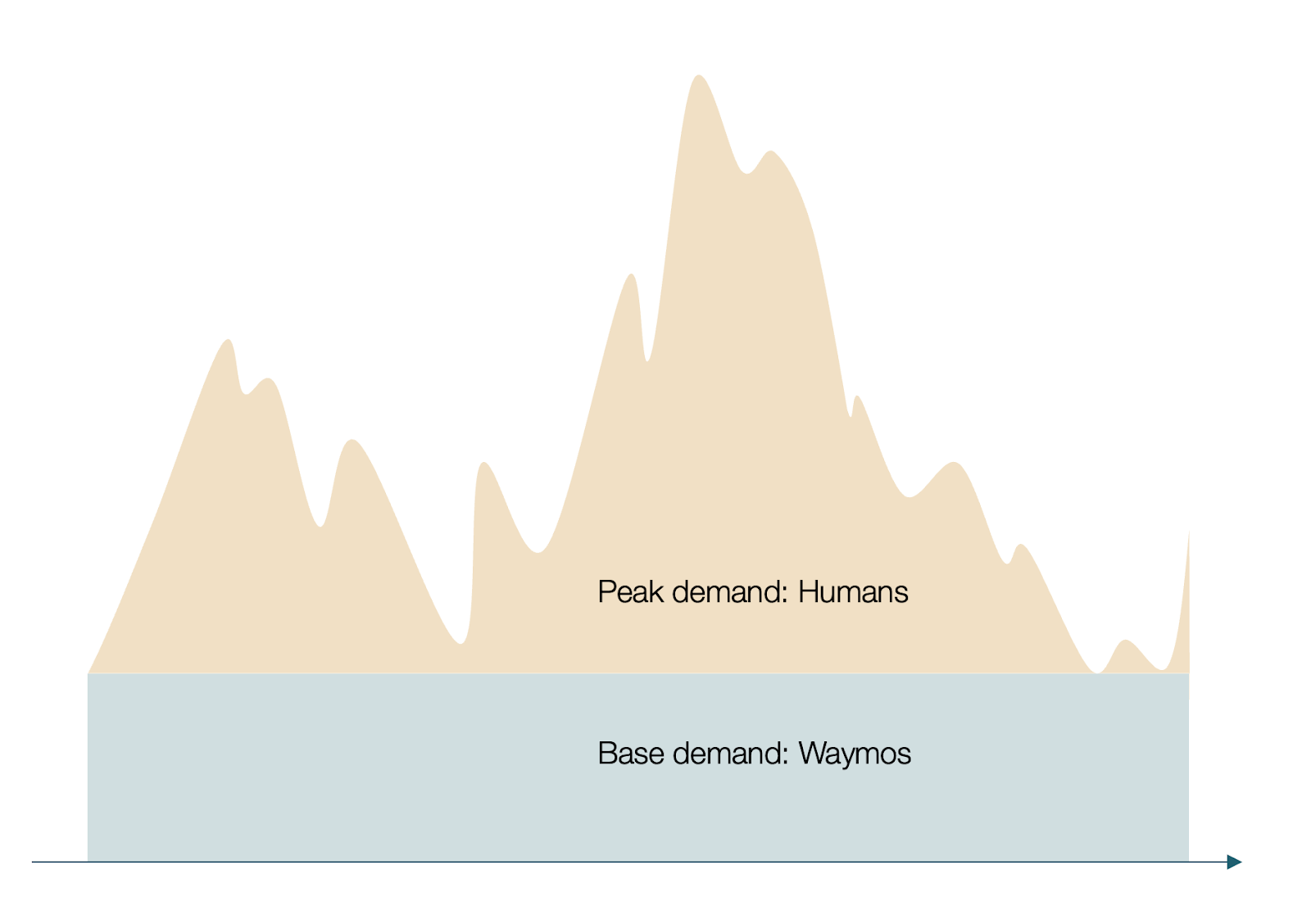
Building a robotaxi is expensive, so they will have to be continuously in use to amortize the cost. Like a nuclear plant. That means they’ll only cover base demand, while peaks will be covered by human drivers.
Uber also delivers food. This adds demand for rides, which optimizes car utilization and helps amortize costs for drivers.
Uber already owns demand—hundreds of millions of people already have the Uber app downloaded and are used to opening it to summon a ride and to order their food. They won’t download another one for another type of ride.
Here’s why I disagree:
1. Self-driving in bad weather
What captures more information, eight cameras on all sides of a car, or human eyes? The cameras are obviously much better. The reason why humans have been driving better than AI is not because of their ability to see, but because of the processing of this information. And information processing by AI is improving all the time. Supervised autonomous cars are already safer than manually driven ones, including in bad weather. It’s just a matter of time until unsupervised self-driving reaches that same milestone.
2. Peak vs Baseload Demand
A Waymo will likely be more expensive than a normal car, at $60-$70k. But Tesla’s Cybercab won’t be, because it doesn’t have certain additional costs like LiDAR, its cameras aren’t expensive, and its extra costs compared to a normal car will be counterbalanced by eliminating elements, such as the steering wheel, pedals, steering column, backseats, backdoors, side-window mirrors, rear window, charging ports, or interior consoles. It will also use single-piece casting and simpler materials like a metal roof and framed windows. This will reduce the vehicle’s parts by 60% compared to the Tesla Model 3.
So Cybercabs will:
Eliminate the cost of drivers, which together with the Uber share take 70% of the revenue.
Reduce other costs like insurance.
The cost of the Cybercabs themselves will be in the same ballpark as normal cars driven by Uber drivers, maybe even cheaper.2
Remember, robotaxis will be ~8x cheaper per mile than Ubers with drivers!
With these economics, it’s worth it to buy a fleet of Cybercabs not just for baseload, but also for some of the peak demand.
Also remember that demand is going to change dramatically with robotaxis, as many more people will want to use them, and the more demand there is, the less spiky it is, so there’s a higher share of demand that becomes baseload vs peak.3
More importantly, Tesla has millions of cars on the road already! It costs an owner nothing to add his car to the pool! That’s where the cars for peak demand are going to come from.
3. More Utilization through Food Delivery
It’s true that Ubers today have better utilization than robotaxis will in the near future, because Ubers also deliver food when there’s a lull in demand for rides. They call this “cross-dispatch”.
But utilization is more important for a human driver in an Uber than for a robotaxi, because:
Better utilization benefits both the car and the human
Humans can only work so long, so better utilization matters a lot more for them. Robotaxis can work more hours.
4. Disintermediation
You go to Amazon instead of going to hundreds of brands online; you go to Twitter instead of asking thousands of people for their opinion; you go to Uber instead of soliciting thousands of drivers, or waiting for a cab. You normally stay with these aggregators because it’s impossible to get this range of options elsewhere.
This doesn’t apply to Waymo or Tesla’s cabs, though, because they’re aggregators, too. They’ll each have their own car fleet. What advantage will there be to get a ride through Uber as opposed to going direct to Waymo/Tesla? Although the costs might be slightly lower due to better utilization from cross-dispatch, the fares will be higher because of the fees taken by Uber and drivers! If people prefer a robotaxi, they will eventually move to dedicated apps, as is already happening in the markets where Waymo is present.
Many people have several ride-hailing apps on their phone, and when one is too expensive, they try another one. It’s not just because Tesla and Musk have an amazing marketing ability. It’s because every ride is a commercial. When you see many Cybercabs on the street and one day your Uber is late, or expensive, or smelly, or your friend orders a Cybercab… You will download the app too.
Also, Uber doesn’t have super strong global network effects. Its strength is mostly city by city, so its current global footprint is not a huge asset the way Airbnb’s is.
All of this is why Uber is desperate to partner with Tesla, but Tesla has turned them down. Why? Because Musk knows he has more negotiation power and he will eventually win.4
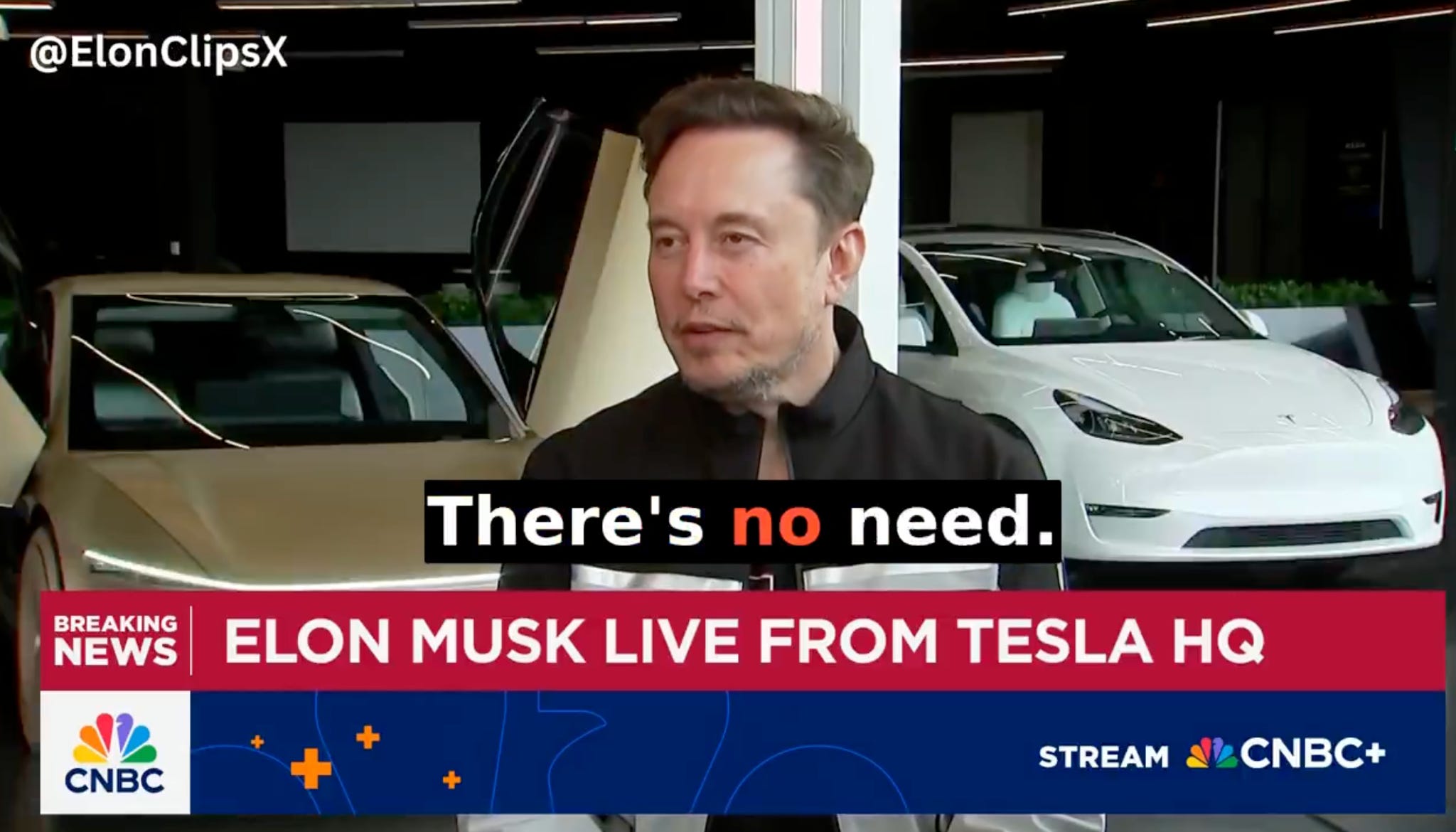
CNBC interviewer: Why doesn’t Tesla buy Uber?
MUSK: There’s no need.
Takeaways
From all this, here’s my best guess as to what will happen:
Waymo will continue growing.
It will partner with Uber in many locations because it’s true that Uber already owns demand.
Over time, people will grow more used to robotaxis, and will prefer them in many cases.
They will eventually download both apps.
At some point, Waymo will grow tired of sharing fees with Uber and will go direct.
Knowing this, Uber will probably ask Waymo for a certain number of years of exclusivity, during which Waymo can only operate through Uber in certain cities. Waymo will wait that out and then go direct, undercutting Uber through price.
At some point in the midst of this process—probably starting in 2026—Tesla’s robotaxis will appear, undercutting both Uber and Waymo in price.
This will be a widely popular topic, many people will learn about this from either the news or by seeing Cybercabs on the street, and the adoption of Tesla’s robotaxis will be fast.
Uber’s demand for rides will go down pretty quickly. It will still retain some riders and the food business, but at that point, Uber won’t have a strong advantage over pure food delivery businesses like Doordash. If it survives, it will be a smaller company than it is today.
As a result of all of this, I decided to buy some Tesla stock as I was writing this article over the last couple of weeks.5
Of course, these are not direct replacements, because people will be taking more rides thanks to robotaxis.
I’m seeing quotes for electric cars in Uber’s marketplace starting at $22k. Most quotes I’m seeing online are much higher than that, in the $35-$60k range. A Tesla 3 today costs $30-$40k, and the Cybercab will have 60% fewer parts and therefore, probably cost even less.
In reality it becomes more predictable, not less spiky.
An important additional point: Every time I read a take defending Uber against Tesla, it makes mistakes like: Assuming the ride fares will be the same, assuming that the take rate for the car owner should be in a similar order of magnitude vs those of Uber drivers, assuming people won’t switch quickly to a new app…
Note this means I have a conflict of interest, because it’s in my interest that others buy Tesla to increase its stock price. That’s why you should NOT take this as financial advice. Please don’t invest based on articles on the Internet, this is not financial advice, just information, and disclosure.
Appears you have never actually experienced a Tesla with FSD. I have FSD in my Tesla S, and have NEVER been able to use it to actually complete a trip. It might manage a few blocks, or a few miles on the interstate, but it inevitably encounters something which confuses it and I must take over to avoid an accident. The fundamental problem is that Elon insisted on doing it without LIDAR, so it simply will never perform as well as Waymo. I'd sell that Tesla stock if I were you.
"As a result of all of this, I decided to buy some Tesla stock as I was writing this article over the last couple of weeks"
I'm sure you know this and but plenty of people lose lots of money because they don't - "This seems like a good business plan" isn't really the right way to think about buying stock. A better question is "Is this company worth 1.5 trillion dollars - as much as every other car company in the world combined? 15x Waymo? Do I really think it will have higher profits than all these companies combined in the foreseeable future?"
Of course, the best question is "Can I buy this on the way up and find someone else dumb to buy it off me for more before it crashes?" But I prefer to at least pretend most people aren't just treating stocks as a casino.