

All buildings everywhere are the same—the International Style.

Towers of concrete, steel and glass. We mourn for the traditional architectures of yesteryear, without realizing why.
Why are these buildings the same everywhere?

And why were they so different before? Is it just a matter of globalization, or is there something more?
Here’s a little known fact: A lot of the world’s architecture was the consequence of geography.
In some cases, it’s easy to see, such as steep roofs in places with heavy snowfall.

But the depth of the influence of geography is hard to grasp. So today, we’re going to take a trip across different world architectures to see how geography influenced them: Egypt, Ancient Greece, India, China, Japan, and Britain. As we do, we’re not just going to learn why things are the way they are, we’re also going to understand what elements we could bring back to our architectural styles today.
British Stone
Here’s a map of Britain’s soils, along with some of its most notable architecture.
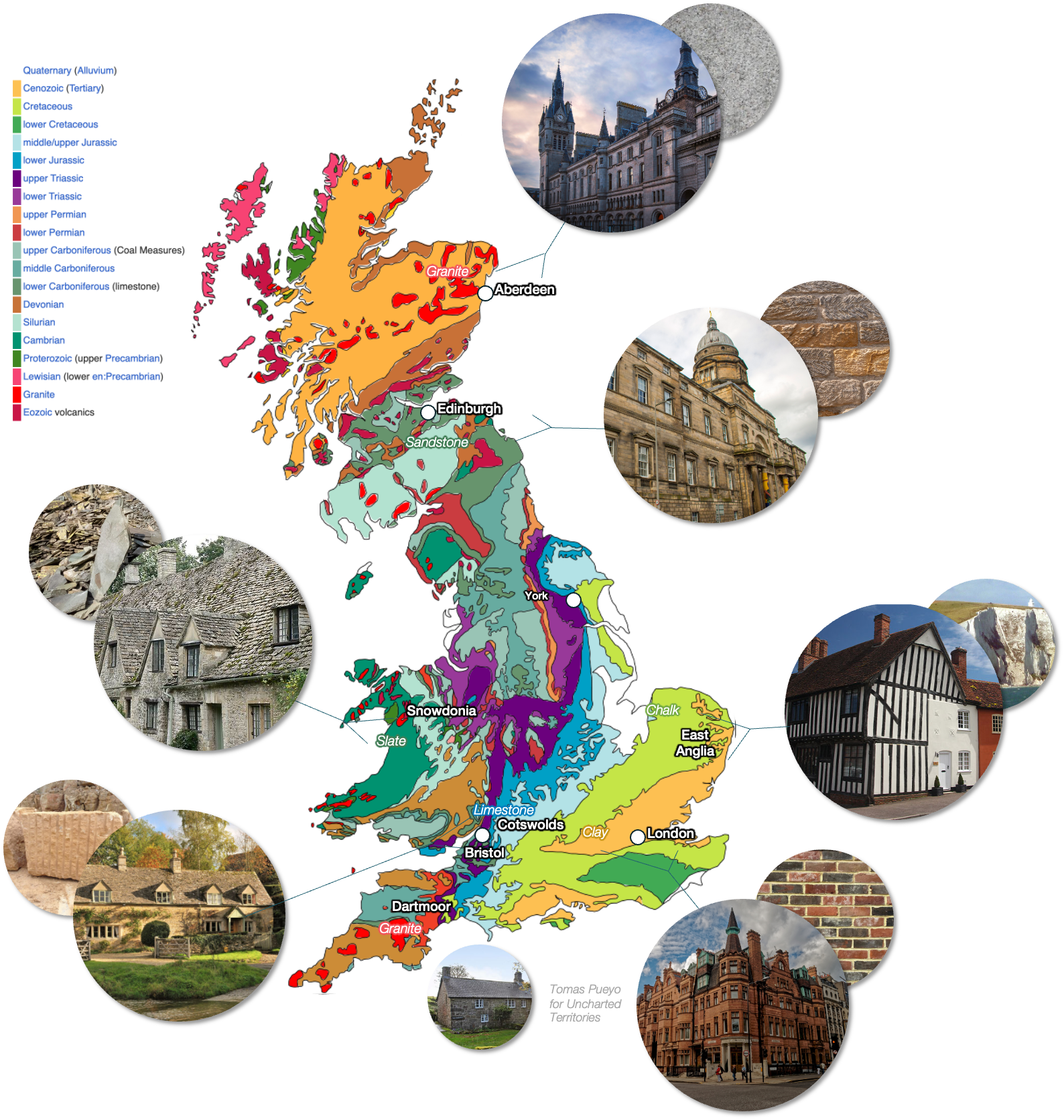
The island’s geology changes strikingly, from oldest in the north to youngest in the south. Every type of stone gave birth to a different type of architecture.
Aberdeen is famous for its dark granite. We can also find granite in southwest England around Dartmoor, and sure enough, there, homes tend to be made of granite. Edinburgh has sandstone, evident in its sand-colored buildings. Golden limestone is common around Bristol, and old country houses are golden as a result. The soil in the surroundings of London is the result of sediment accumulation, so there’s much less stone to go around. But there’s clay, which can be made into bricks. Sure enough, London is full of brick buildings. The chalk in South and East England is too brittle for walls, but use timber frames, fill the wall with twigs, wet soil and straw, and then whitewash it with a solution made with chalk, and these homes can last centuries if well maintained. For the roof, use thatch.
Once the Industrial Revolution was in full swing, the cheapness of canal and train transportation meant bricks for walls and Welsh slate for roofs could be used everywhere, so they were.1
So stone is important. But it’s not all-encompassing. What else matters? Let’s travel far back in time to Ancient Egypt to figure this out.
Ancient Egypt
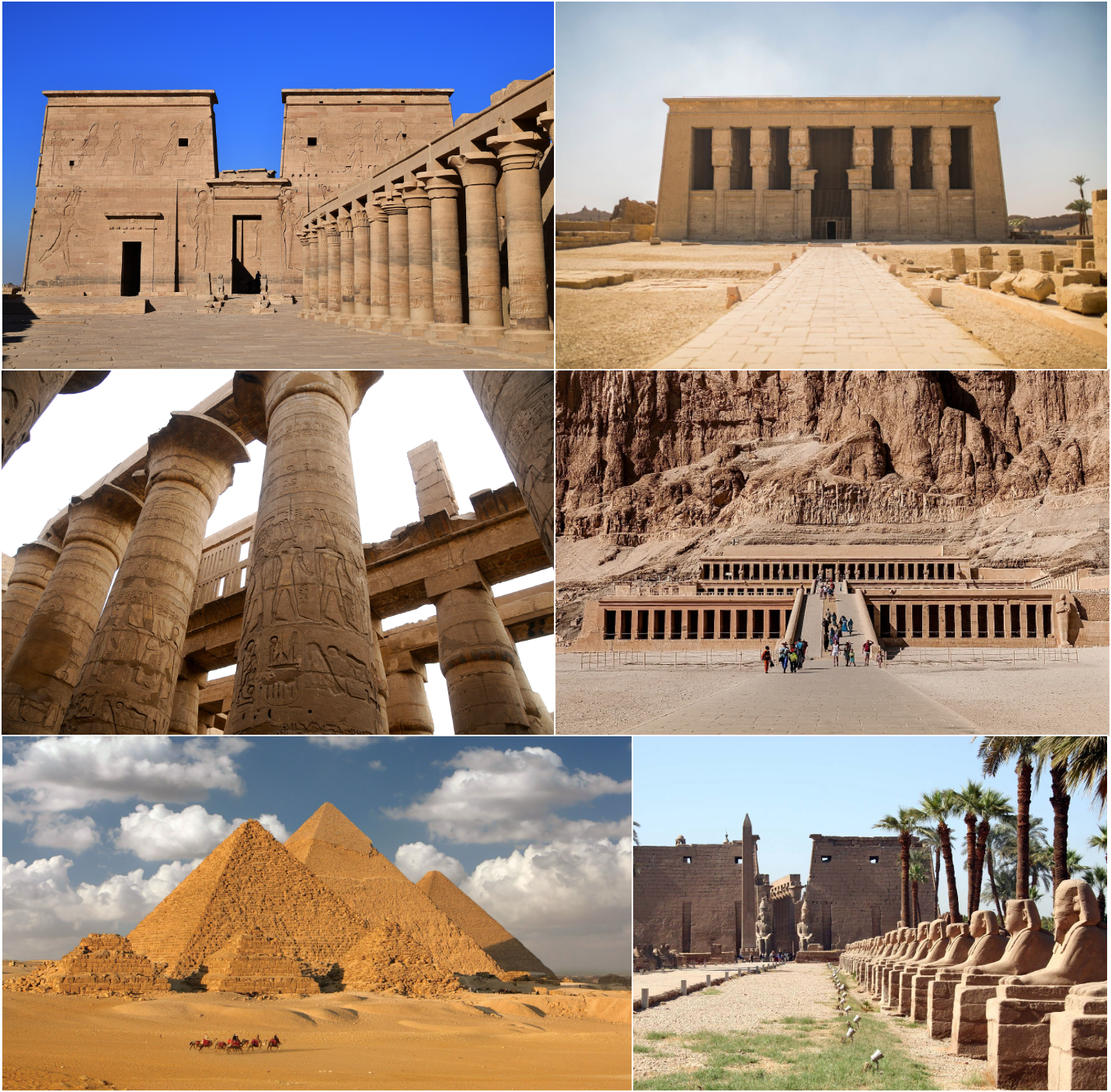
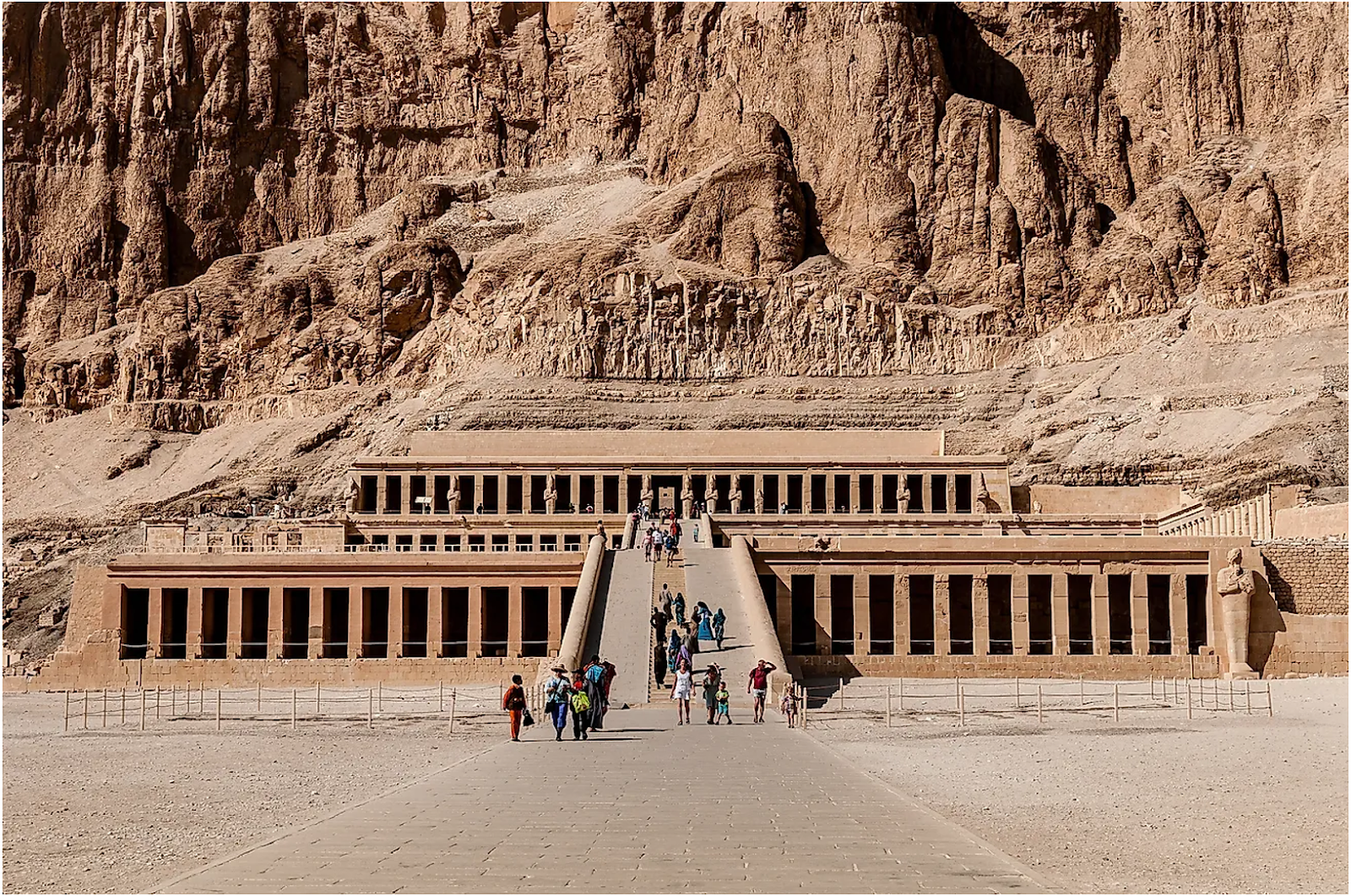
What do these have in common?
Big monuments
Bold geometric lines
Light brown color
Lots of rows of things, notably columns
For temples and tombs
Why?
The Egyptian government always had massive power because it controlled the Nile and knew how much food it would grow, so it could tax it precisely. The farmers couldn’t escape because the country is surrounded by desert and sea. So the government was extremely powerful and had lots of resources at its disposal.
If you want to project power, the best way to do that is to build big things.
But building technology is not very advanced. If you make a big column of stuff, it falls. How do you build a huge thing so that it doesn’t break and fall apart? You pile matter into a mountain.

Stacked mass is the simplest way to create stable height. That’s why we find it across the world, not just in Egypt.
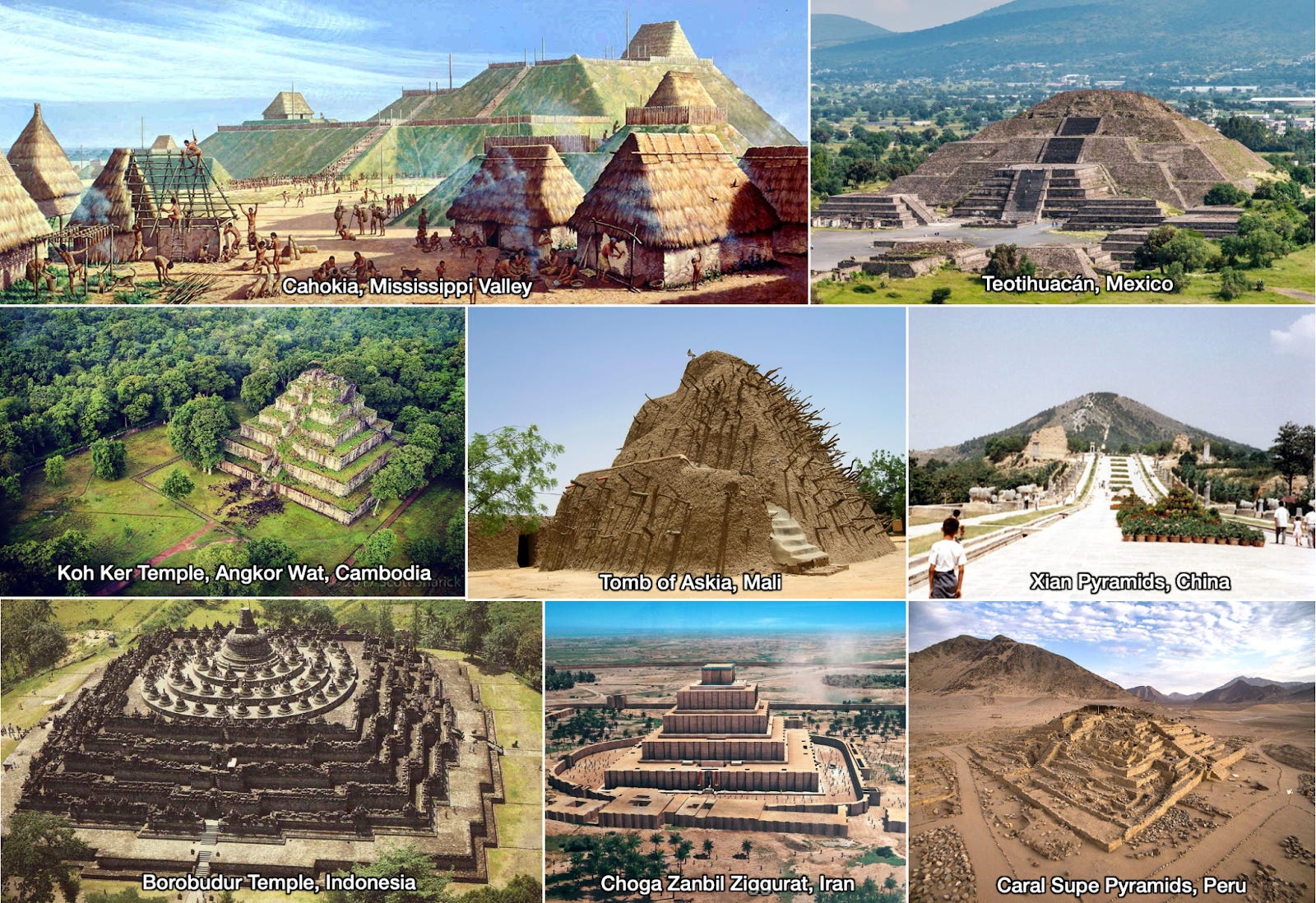
Stacked mass has another benefit: If you can make an indoor space inside, It protects you from temperature swings because of the thermal mass stored in the stone/dirt.
But these spaces must be small: All that mass risks collapsing on you. As a result, no grand indoor halls, only small rooms.
With flat roofs, because why would you slant them? It’s difficult and expensive, and unnecessary in places with little rain like in Egypt.

The rooms you do have need plenty of columns to support them.
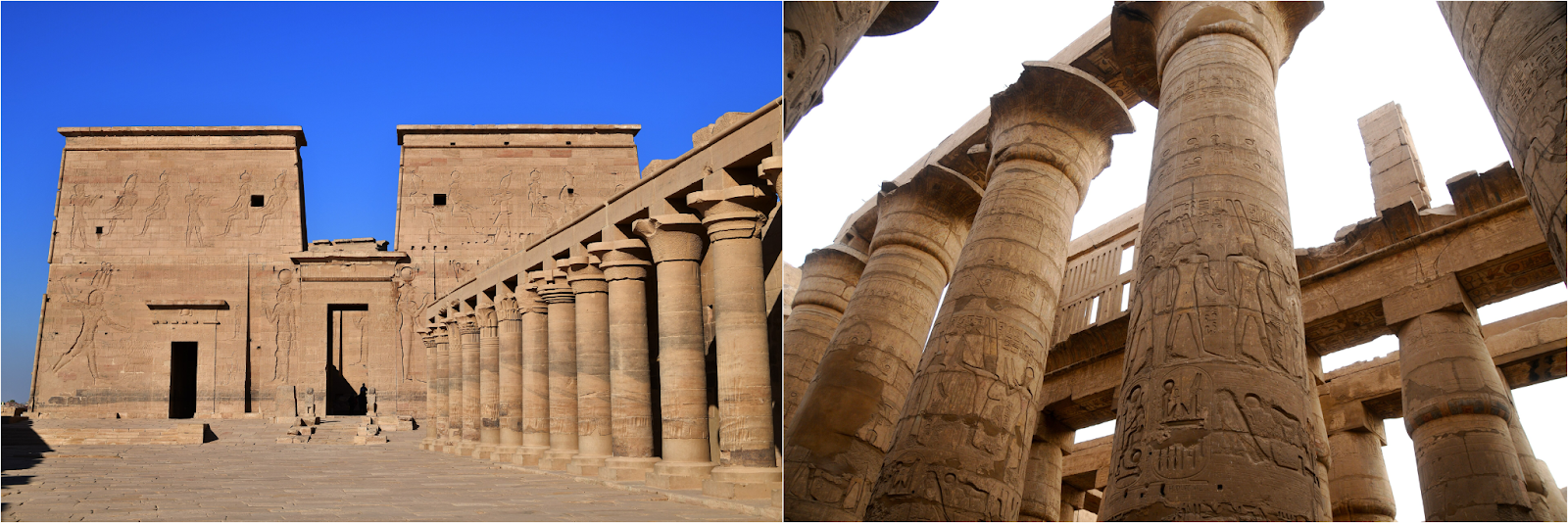
But you want to make lots of big columns, so everybody knows you’re such a powerful ruler! So you’re going to use your millions of minions to build many rows of these columns. Except how do you coordinate these minions? You need to standardize. Most columns, or rows of stuff, need to be as similar as possible.

You haven’t learned yet how to do arches well, so the moment your windows are too big, your walls fall. So small windows.
Notice how it’s also very axial: Lots of these buildings are constructed along a main line (axis).
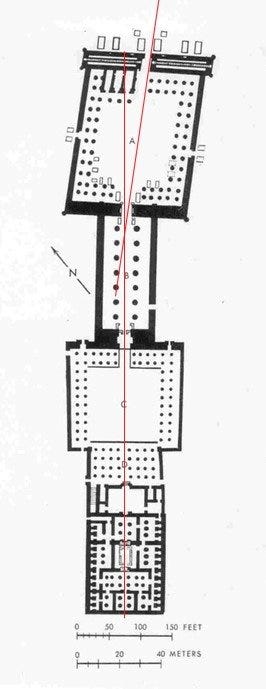
Axial architecture is meant to wow you as you arrive and follow the line towards the entrance. These structures tend to be organized along cosmic lines, like cardinal directions, solstices, etc.

If you’re aligned with the stars, your architecture is cosmic, it has meaning tied to the sun, the moon and the stars, so you as a ruler surely must be cosmically ordained.
Since you have constructed lots of big buildings and columns, you now have all these surfaces. What can you do with them? Maybe depict your grandiosity and how cozy you are with the gods. And since you have plenty of money and workers available, you can arrange this:

Notice how there’s plenty of carving? Stone is normally hard to carve. But not all stone. Most Egyptian architecture is made of limestone and sandstone, which is relatively soft.

Why? It’s what Egypt had available. Carrying big blocks of stone is not easy, so Egyptians mostly quarried them close to the Nile and used the river to transport them.
And Egypt used to be a shallow ocean—Tethys. This is why today it has some of the biggest depressions on Earth, enough to make them into seas again.
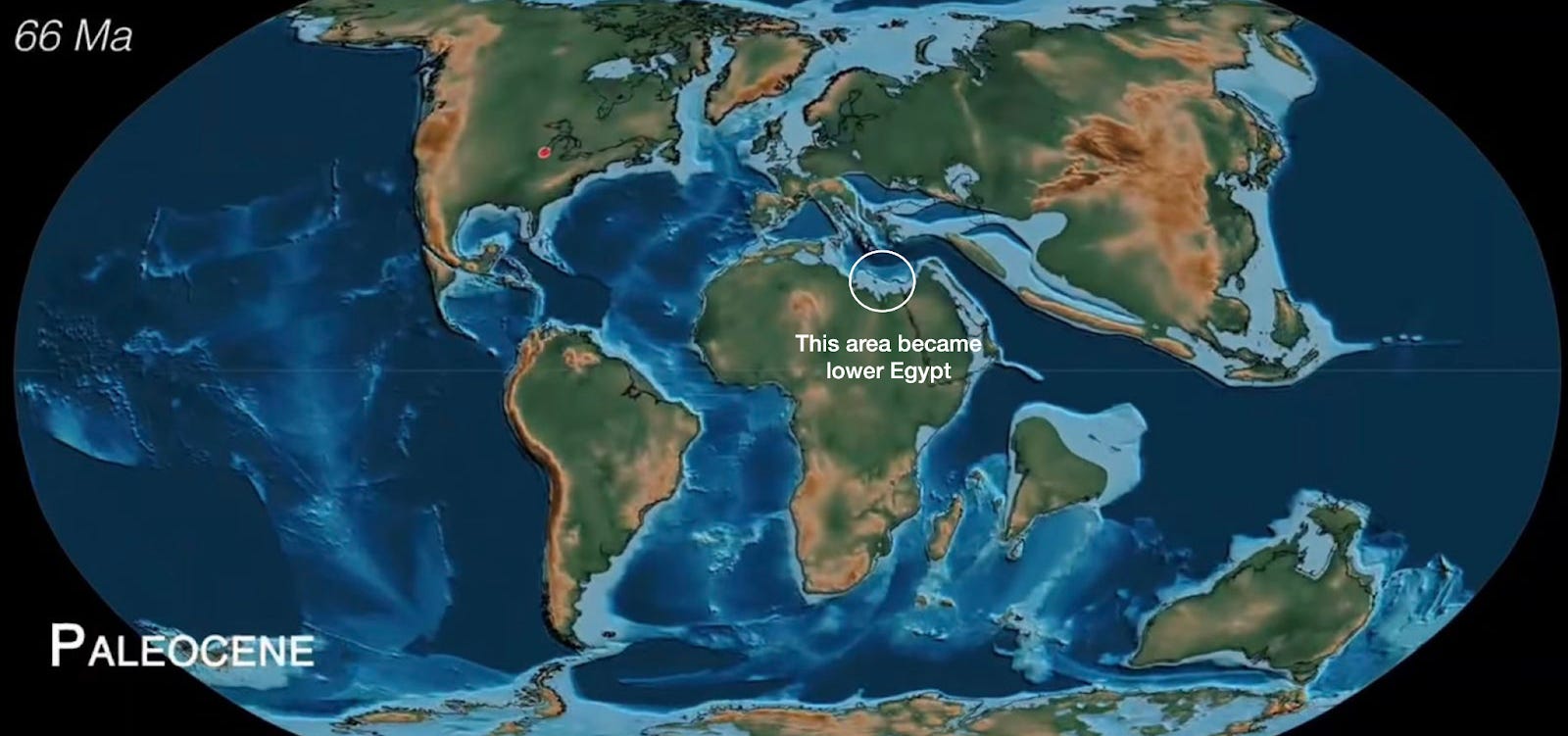
As a shallow seabed, it teemed with life, so its floor got covered by those sediments: shells. As they compressed, they became limestone. As sand compressed, it became sandstone. They are both a similar white-brownish color.2

Both are easy to work with copper tools, and hold up well when compressed, so they’re ideal to cut and stack as blocks to form shapes. Which is why Egyptian blocks are so geometrically accurate, unlike those in Mycenae:

The grandiosity, the connection with the seasons and the cosmos… all of this fits well with the Ancient Egyptian mindset—a civilization that lasted thousands of years with very little change, because the geography is so stable:
The Nile’s annual flooding, which was measurable, cyclical, drove all work, and generated the most wealth (and the food needed to survive!)
Isolated from other civilizations through desert and sea
Strong governmental control because it’s so easy to tax the Nile’s production, so state stability
And that’s how you get the Egyptian Aesthetic:
Mostly limestone and sandstone, and their ochre colors
Their tech was ideal for compression, not spanning, so no windows, no big indoor spaces
But lots of resources, so just pile up stuff and create many of the same thing
Focus it all on your grandiosity: big piles of stuff, long lines of columns/decorations, all along a strong, impressive line, aligned with the cosmos to create a sense of godlike legitimacy
Flat roofs: just protect against the Sun and its heat, not rain
Market yourself through messaging on the walls, mostly through carving, adding color when possible
It all fits the philosophy of the place: not dynamism, progress, or experimentation, but permanence, continuity, and repetition.
Ancient Greece
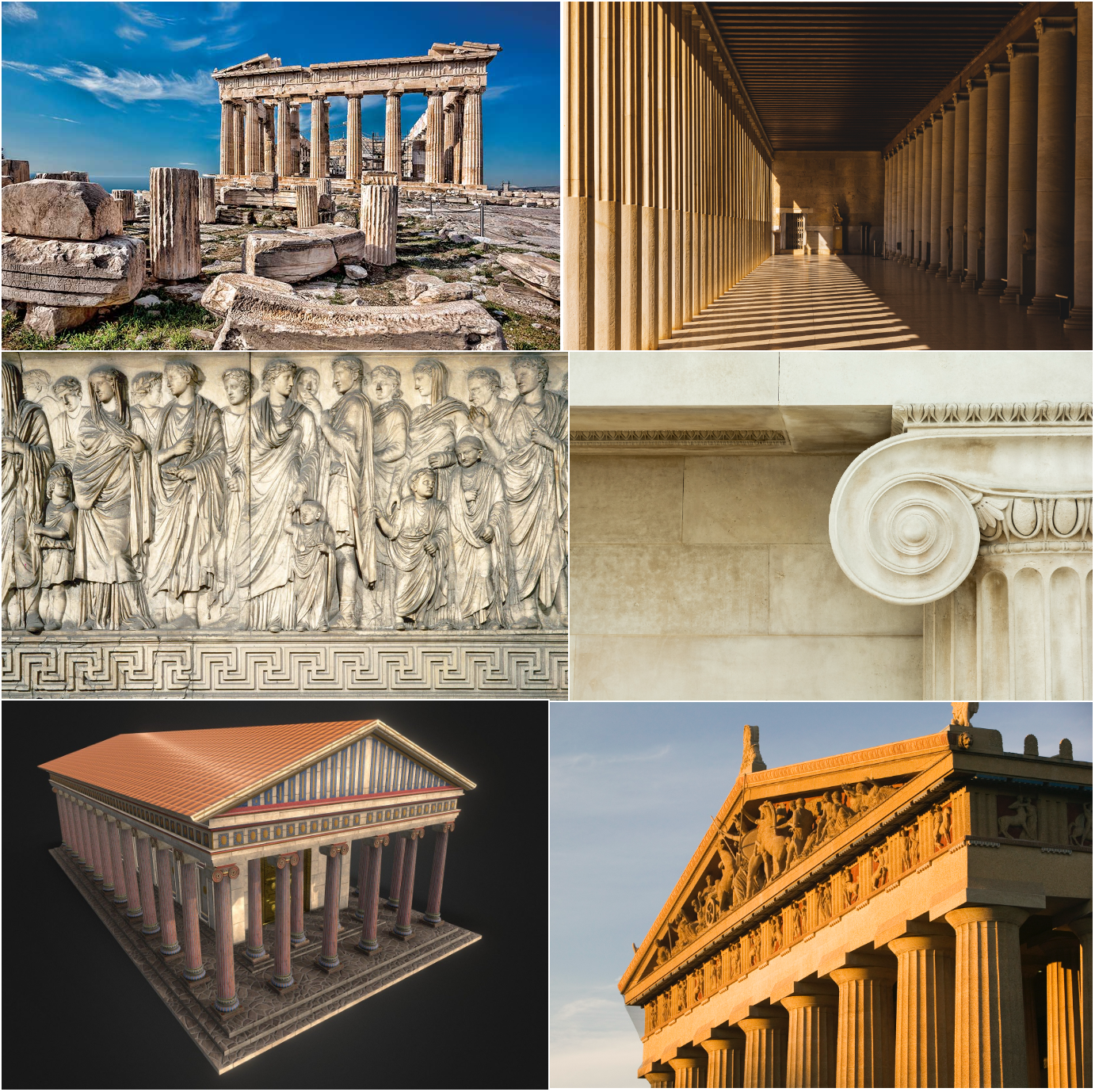
While Egypt is flat and desertic, on the other side of the Mediterranean, Greece is extremely mountainous.

This is because Africa subsided for a long time below Eurasia, and pushed the mountains up on the European and Asian side.

With so many mountains, Greece has abundant workable stone, including limestone, but also another type that was uncommon in Egypt—marble.

Marble starts as limestone: shells and tiny marine organisms that are compressed together, with other particles that cement them and some void that forms between them. That makes it easy to carve, but you can’t use too much detail or your edges will round or chip.
When limestone goes deeper down inside the Earth, it gets more compressed and heated. These particles fuse into interlocked crystals. These are much harder to separate, so the stone is harder and breaks more cleanly, as crystals remain together. You can polish these crystals into a very smooth surface, and their varying angles will scatter light in different directions, making the stone shiny and luminous.3

Naturally, the Greeks played with the ability to finely shape the marble and with its light. For example, notice the vertical lines on these columns? They’re called flutes.

In hard Mediterranean light, small changes in depth create strong shadows. Since the flutes surround the columns, the sun will hit different flutes differently, creating different shadows. Together, all these alternating lights and shadow lights give a sense of vertical elegance to the temples, multiplying the effect of the columns themselves.
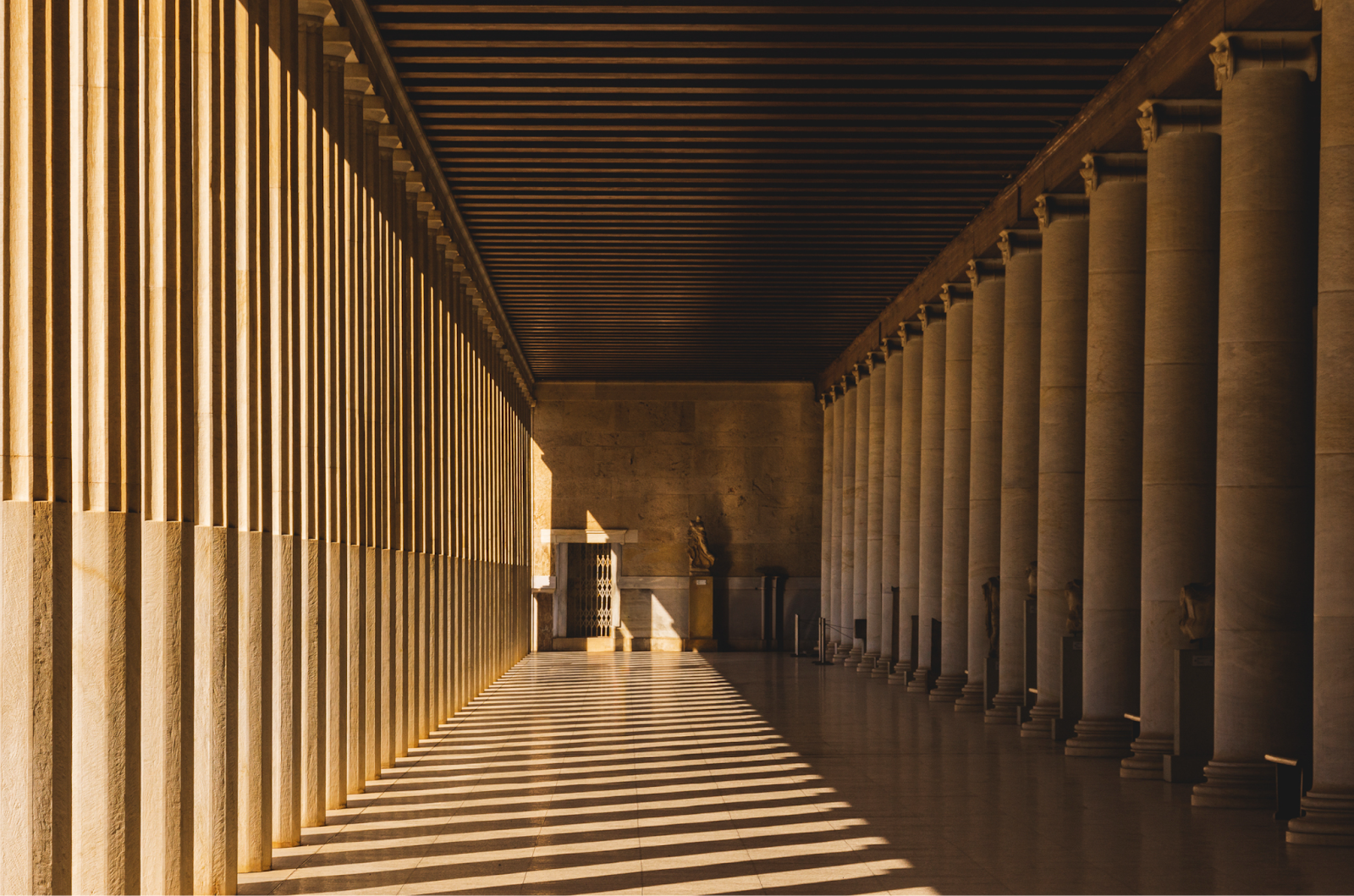
Marble allows you to play with light and shadow much more than other types of stone.
Columns shouldn’t be perfectly straight, though, because the base carries more weight than the top, and the center tends to bulge because it’s not as supported as the top of the bottom, so the Greeks used entasis:

Notice the pediment, the triangular shape on top of the columns three pictures back? Why triangular? Because it had to hold a slanted roof to evacuate rain—something that was not needed in Egypt because it basically never rains there, given the difference in latitudes.

Thankfully, Greece also has access to plenty of clay that could be fired for roof tiles, something that temples had at the time, which many people don’t realize because roofs crumble more than columns, so most Greek architecture doesn’t show them anymore.

You need something to support that roof and pediment—the lintel, that horizontal beam that spans across columns.
And since we’re in the mountains here in Greece, the ground is uneven, so you need to place your temple on top of a platform to even it out, the stepped platform.4
We have now rebuilt from first principles the most iconic aspects of Greek architecture.
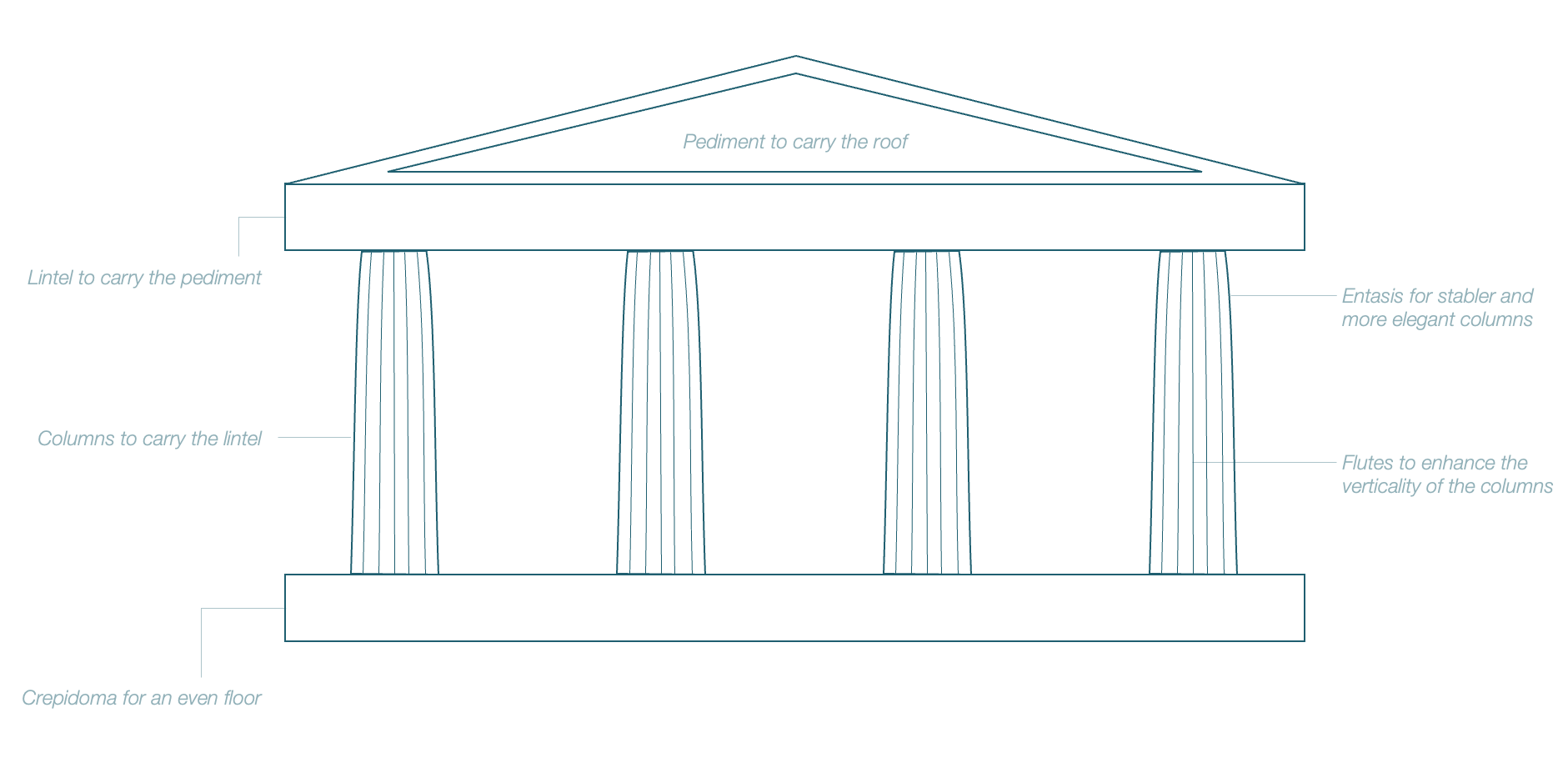
Notice another detail about this type of architecture:

Marble can be cut with extreme precision. When two marble blocks are perfectly dressed, the contact surface is large, the friction is high, and compression loads transfer cleanly, preventing blocks from sliding.
Stonemasons realized they could make do without cement, which added a paste that was less elegant, uneven, and was actually bad for earthquakes—of which there are a fair amount in the region, if you recall the tectonics. With sufficient precision, dry contact is stronger than cement.
You can’t just pile blocks and hope they don’t move at all, though, especially during earthquakes, so masons carved a hole in the blocks and placed iron clamps to hold them together.

The post-and-lintel structure (columns with a beam on top of them) doesn’t allow for big indoor spaces, so these temples were not designed to hold lots of people, just the statue of the temple’s god and a few other artifacts.

As a result, congregations happened outdoors. Altars were in front of the temples, and that’s where animal sacrifices were held.

Why have a temple at all then? First, because it provided shade on hot days and cover on rainy days. Second, it was a way to convey wealth and success. This meant that the external appearance of the temple was more important than the inside. Hence the flutes and the entasis, and also all other kinds of decorations.

Early on, the style of column tops was pretty basic (Doric), but as time went by, the Greeks explored ways to decorate them further without jeopardizing temple integrity. With the Ionic, and later Corinthian styles, they achieved thinner columns and added more flutes and decorations. The same was true of the friezes above the columns.

These styles evolved relatively fast, because architecture was one of the ways to compete with other Greek city-states, and there were many.
With so many mountains, Greece couldn’t connect overland easily, and ended up with lots of small valleys developing semi-independent cities in each.

You can see some of them if you zoom in on the region:
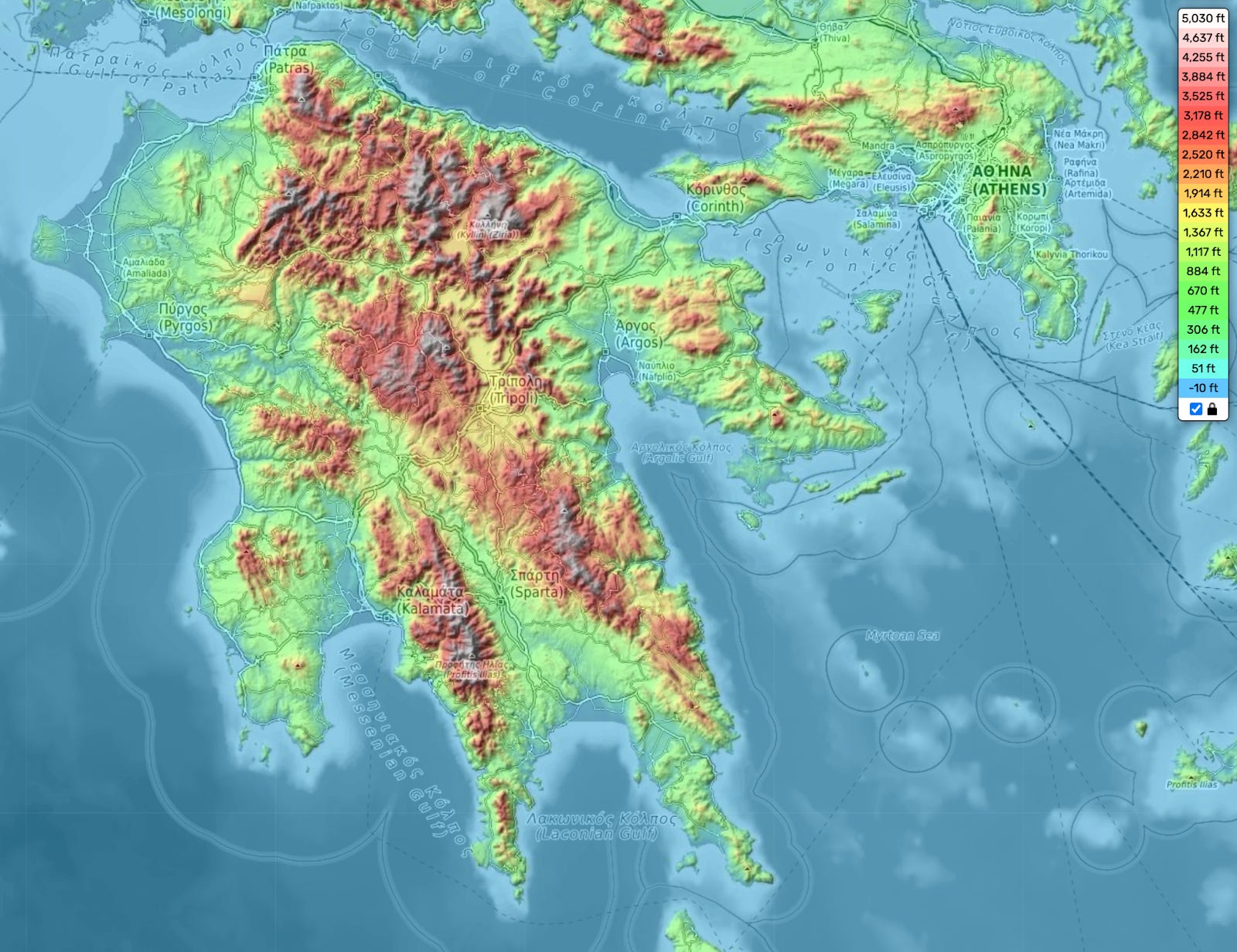
I assume that most architecture at the time was trial and error, but errors in architecture are bad, so when builders found new, better shapes, others would adopt the same recipe without questioning it too much, and this resulted in pretty standardized sizes for any architectural element: column height, width, spacing, size of pediments, of friezes… everything.
We can see how so many aspects of Ancient Greek architecture are direct results of the region’s geography (and the technology they had at the time): mountains, sunlight, and infrequent rains:
Mountains provided lots of stone, including marble, which promoted the development of precision masonry
Mountains are also uneven ground for construction, so Greeks developed bases (crepidoma) of one or more levels for their buildings
The harsh sun necessitated shade, which required columns to support a roof
The harsh sun, together with precision masonry, pushed the aesthetic limits: flutes, capitals, friezes, perfect stone blocks, waiving cement
But since there’s also rain in the region, roofs had to be sloped, with tiles, which begat the triangular pediment
The technology was not advanced enough to allow for big indoor spaces though, so most ceremonies still happened outdoors.
In other words: Although Greece is just across the Mediterranean from Egypt, its slightly different geography (more mountains, more rain)5 brought a different architectural language.
This is enough for today. We’ve seen how geology determines the stone available, and how that drives the type of architecture that is possible and unfolds. In the next article, we’re going to move to Asia, and cover India, China, and Japan, and then we’re going to bring it home: Why are all buildings the same now, and how can we do them differently, if we wanted?
I got the idea for this section from Lewis Dartnell and his great book Origins.
We now mostly just see their structure, but in the past, some parts of the Egyptian sandstone and limestone walls were heavily decorated and colored. This detail has mostly washed away over time.
Many of the typical Greek structures were first developed with limestone, and marble only helped push them to the extremes of perfect cut, perfect alignment, no need for cement, or perfect polish.
The crepidoma was a base made of three steps
And slightly more advanced technology on average, as Egypt had been building temples and pyramids for literally thousands of years before Greece started building its most beautiful temples. For example, the time between the Giza Pyramids and the Parthenon is the same as the time between the creation of the Roman Empire and us. So the most famous Egyptian buildings used old technology. The Greeks inherited and then improved upon this type of Egyptian know-how.
I'm fairly sure there are first year architecture students who'd benefit from this material
Thank you, Tomas; illuminating as always. When you say we bring it home post-Asia, could you tie in the philosophical/social/economic?/geological/etc. underpinnings of Christian church building, in the same way you've been describing Egyptian and Greek architecture, first-principled? And given that Christian Europe is a broader realm, how might this differ across places?