

On July 30th 2026, over 70,000 people moved from Morocco into the Spanish city of Ceuta, an enclave in Northern Africa with only 84,000 inhabitants.
All sources found through Twitter searches. No endorsement, only used for the videos. Sources: 1, 2, 3, 4, 5, 6, 7, 8
Most of them returned to Morocco.
But weeks in, thousands remained.
Sources: 1, 2, 3, 4, 5, 6, 7, 8, 9, 10, 11
This is bizarre. How does an invasion of such proportions happen so fast? Why? Why does it deflate with no apparent long-term consequences? Or are there? Who is behind this? Who stood to gain anything from it? Morocco? How do we know the truth? Will this change anything between Spain and Morocco, or across the EU? That’s what we’re going to look at today.
The Invasion
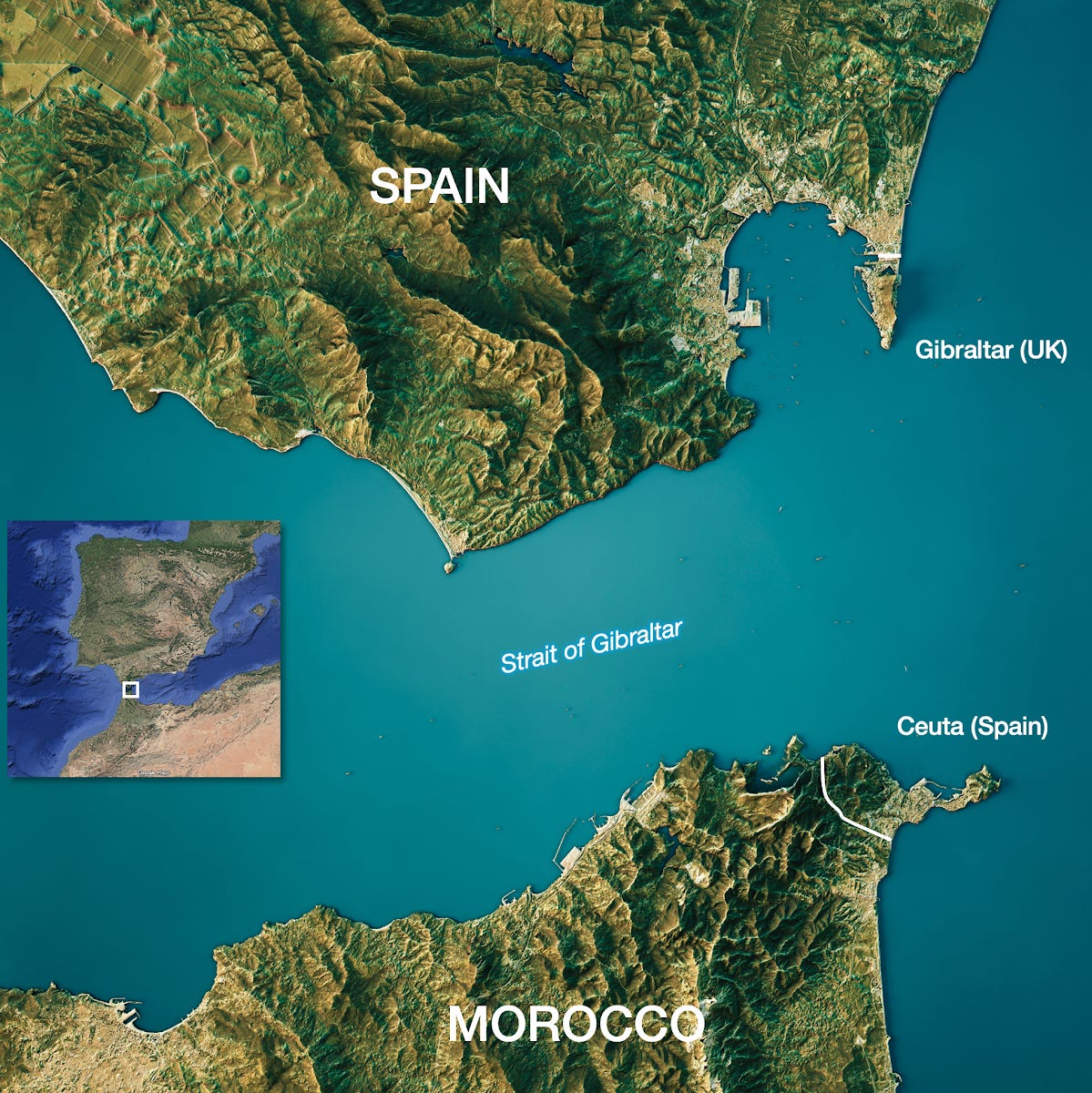
This is the Strait of Gibraltar:
This is what the border looks like on the ground:
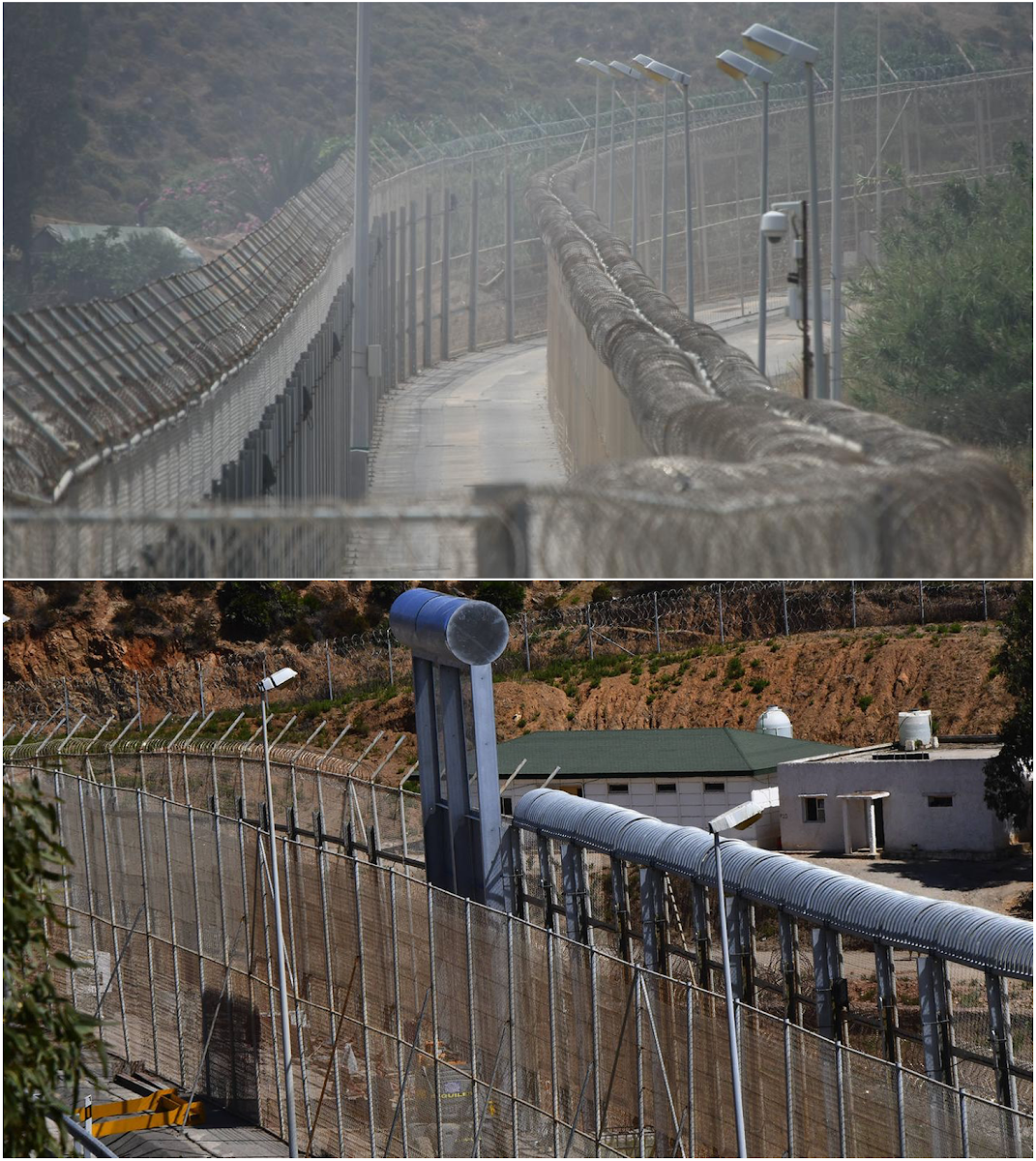
The border security is in place because of immigrants entering Spain from Morocco for decades, because the Spanish GDP per capita is 6x that of Morocco’s, and 25% of Moroccan men aged 15-24 neither study nor work. As a result, Spain has had to create obstacles, and now, few can pass. So on July 30th, thousands of immigrants tried to cross the border by… swimming.
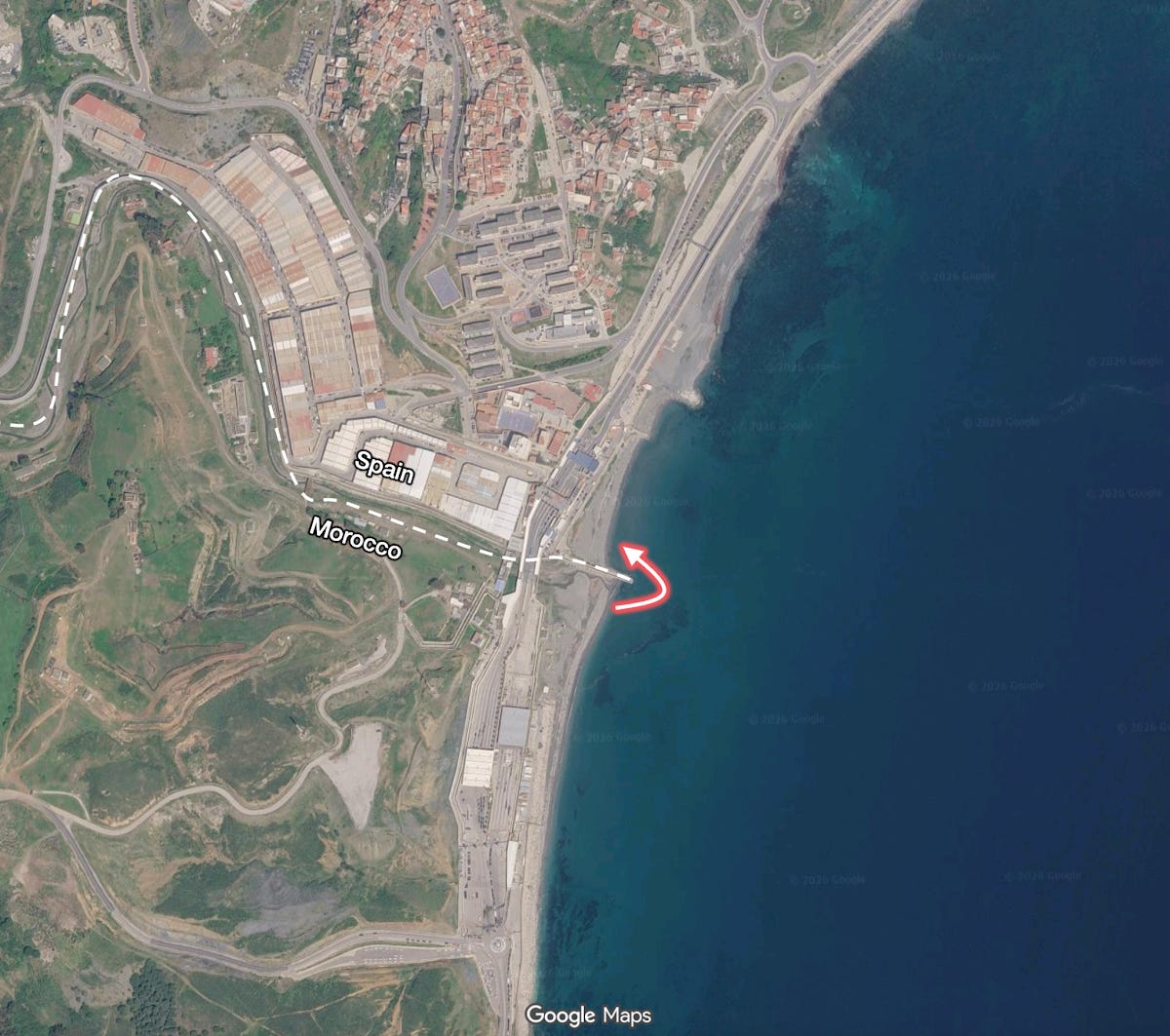
But they didn’t just come up with this idea. They’ve been doing it for ages: That border is not really so impenetrable.
The reason immigrants weren’t taking advantage of that more often is because they were insta-returned to Morocco when they did.
Until last month, when the Spanish Supreme Court specified that immigrants who swam into Spain wouldn’t be insta-returned. Wait, what?
Insta-returns have been going for a long time, but NGOs objected to them because some immigrants might be asylum seekers, or minors, or their return could put them in danger, and demanded that they be assessed properly. A legal battle between them and Spain followed for years, until the recent ruling of the Spanish Supreme Court that the insta-returns were legal for fence climbers.
For fence-climbers.
Not swimmers.
In 2024, an Algerian was trying to swim to Spain from Morocco. He was intercepted and insta-returned to Morocco. Spanish lawyers used that to appeal,1 and the Supreme Court agreed on June 29 2026: He didn’t try to climb a fence, so insta-returns don’t work for him.
The week before July 30th, 1,500 immigrants had already swum around the fence—about 200 per day. It picked up steam on social media:

The majority of immigrants, not being well-versed in Spanish legal jurisprudence, interpreted this as if you swim into Spain, you won’t be deported.
They had reason to believe that, since the current administration of the Spanish Socialist Party legalized over a million illegal immigrants in Spain,2 and there are several carve-outs to insta-returns.
This is why 22 EU country leaders accused Spain of encouraging this sort of behavior:
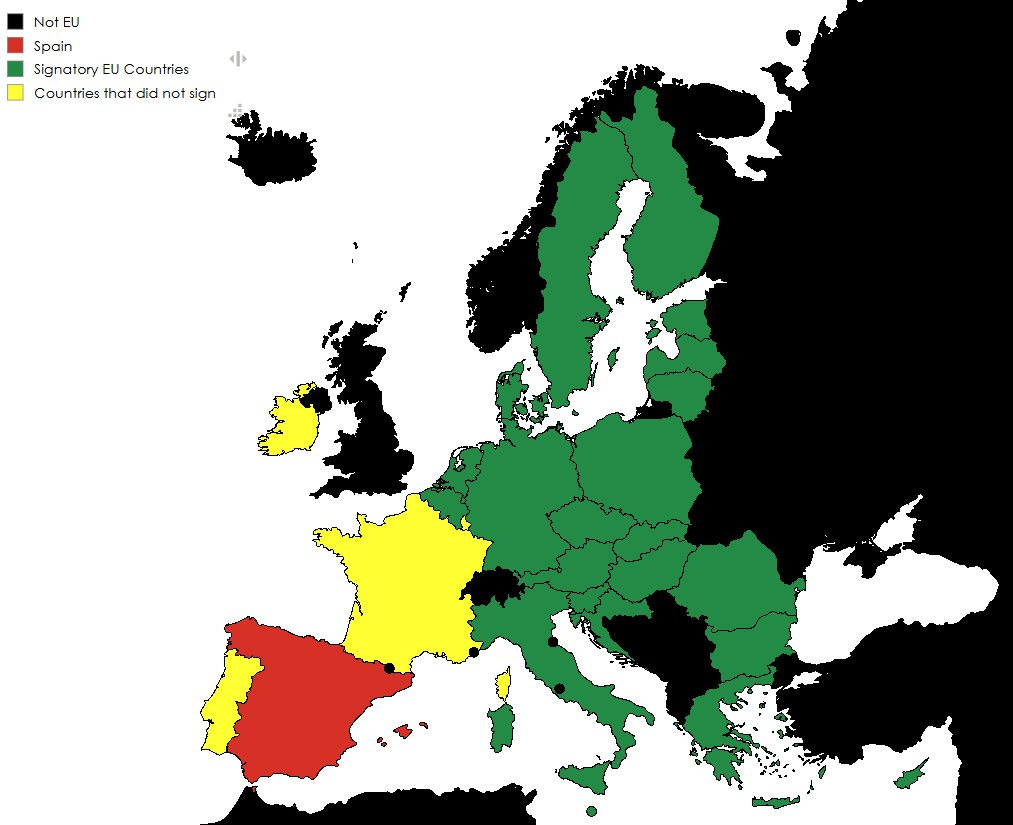
In any case, the message that immigrants could freely move into Spain started spreading on July 30th.
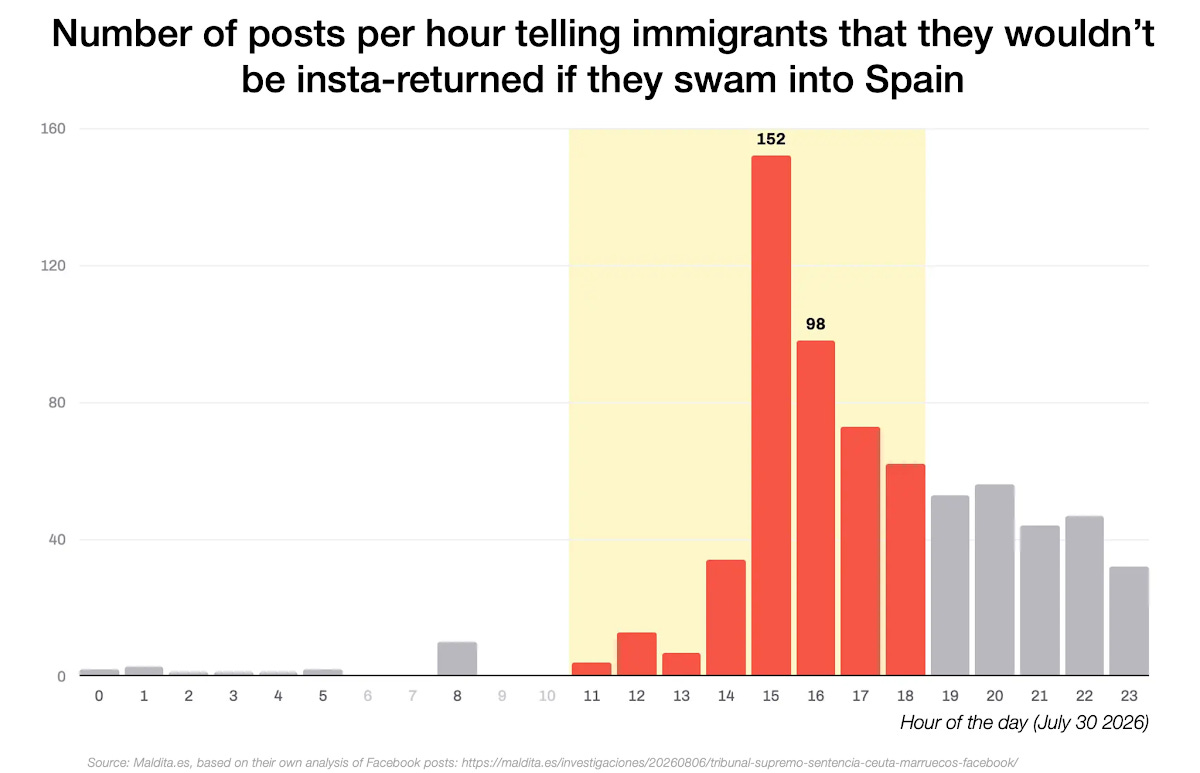
The message said: “The Spanish Supreme Court: There will be no immediate expulsion of migrants who reach Ceuta and Melilla by swimming.”
This site analyzed the posts and found lots of accounts repeating that same message within minutes, which suggests coordination. One of the accounts that repeated the message was that of Youssef Belhaissi, a presenter at Al Aoula, Morocco's public/state television network, with 1.3M Facebook followers. According to The New York Times, he is also spokesperson for Morocco's Interministerial Delegation for Human Rights, explicitly a Moroccan government agency in Rabat.
For days, the Spanish secret service warned that something was brewing in Ceuta, and on July 29th, it alerted that about 180,000 people were preparing to enter Ceuta. Within 24 hours, between 60,000 and 80,000 people poured in. About 100 died, mostly drowned or trampled.
Once inside, the standard system was so overwhelmed that it couldn’t process the immigrants. They proceeded to loot supermarkets for food and camped wherever they could. There were reports of group rapes of underage migrant girls, daily sexual assaults,3 physical assaults, drug trafficking, home invasions, robberies, fights, theft, car burnings… Police are now in schools, the military is being assaulted, and is asking for license to use proportional force.4
Eventually, without food, safe shelter, or a hope of being admitted to Spain, most of them went back to Morocco or were returned. About 5,000 remain. Of those, about half are minors, who can’t be insta-returned as per Spanish law—even though Morocco, the EU, and Ceuta want them returned. Meanwhile the Spanish government now wants to send 500 of them to mainland Spain, away from their families…
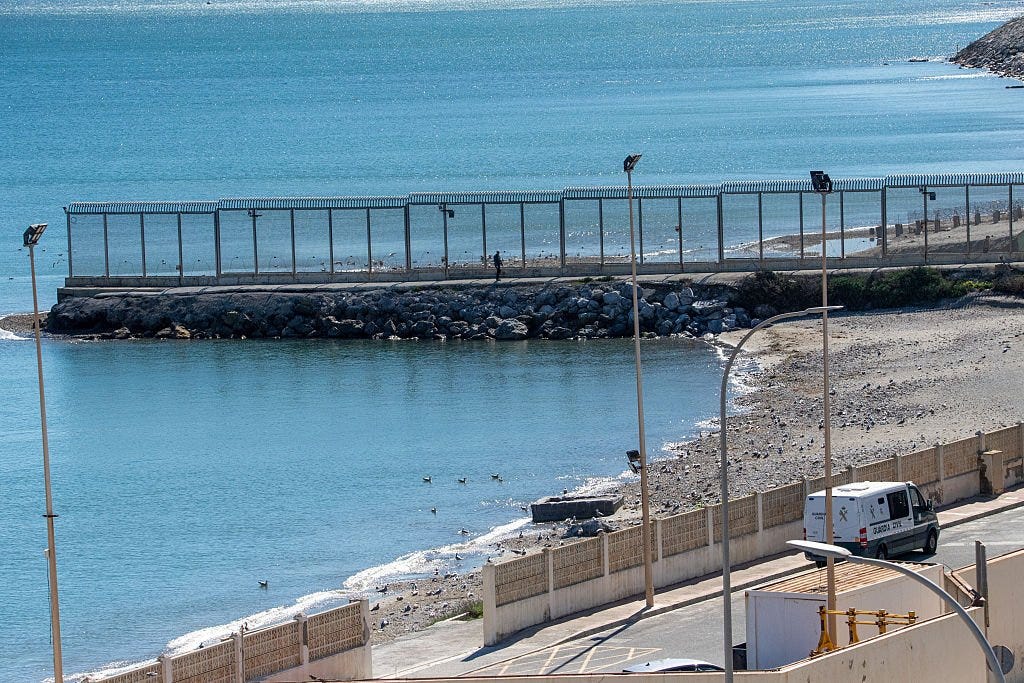
Since then, the Spanish government has been “extending the fence” 500 meters into the sea, so that it can technically claim it’s a fence, and swimming immigrants will also qualify as fence-climbers.5
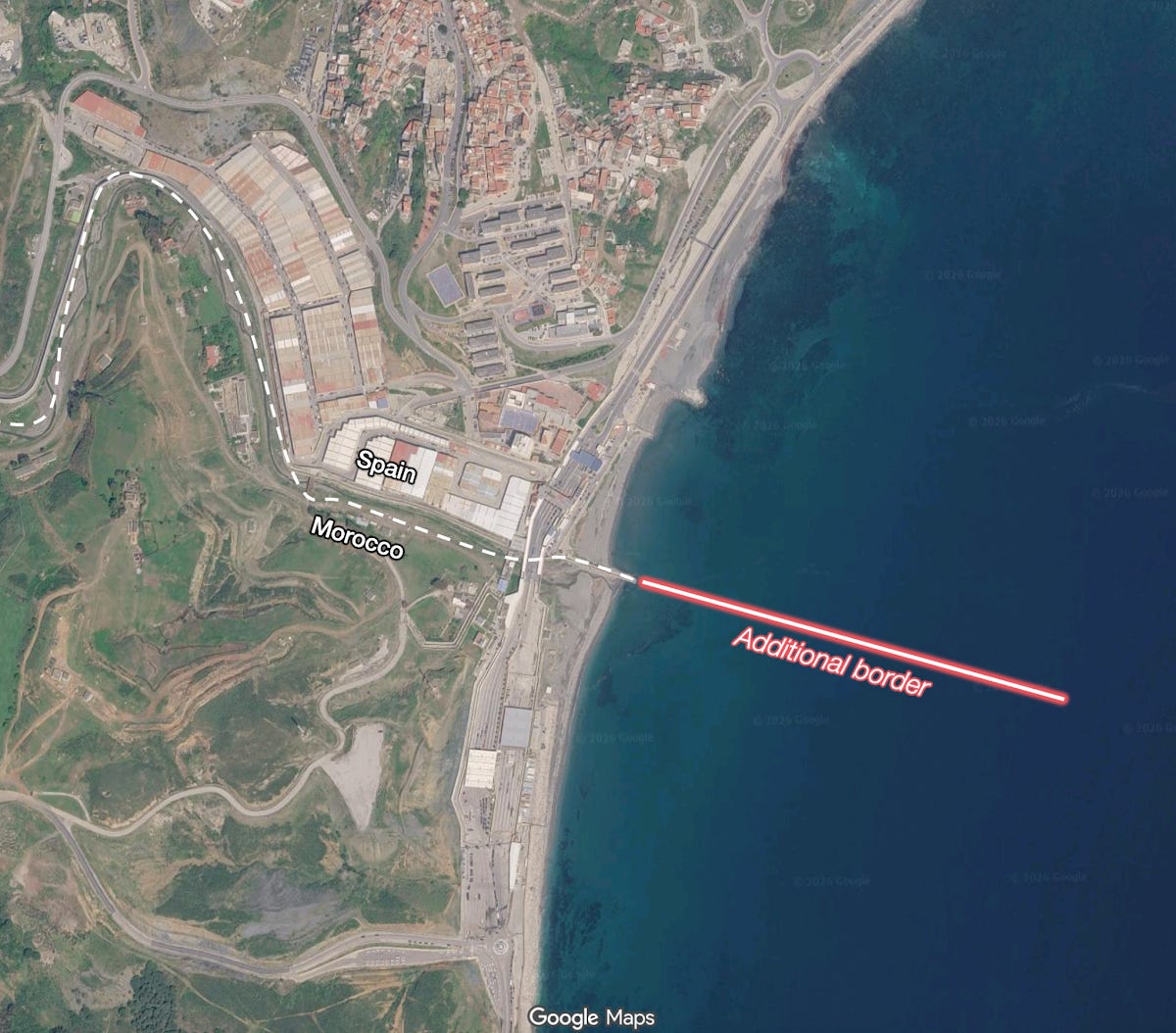
Here’s their fence:
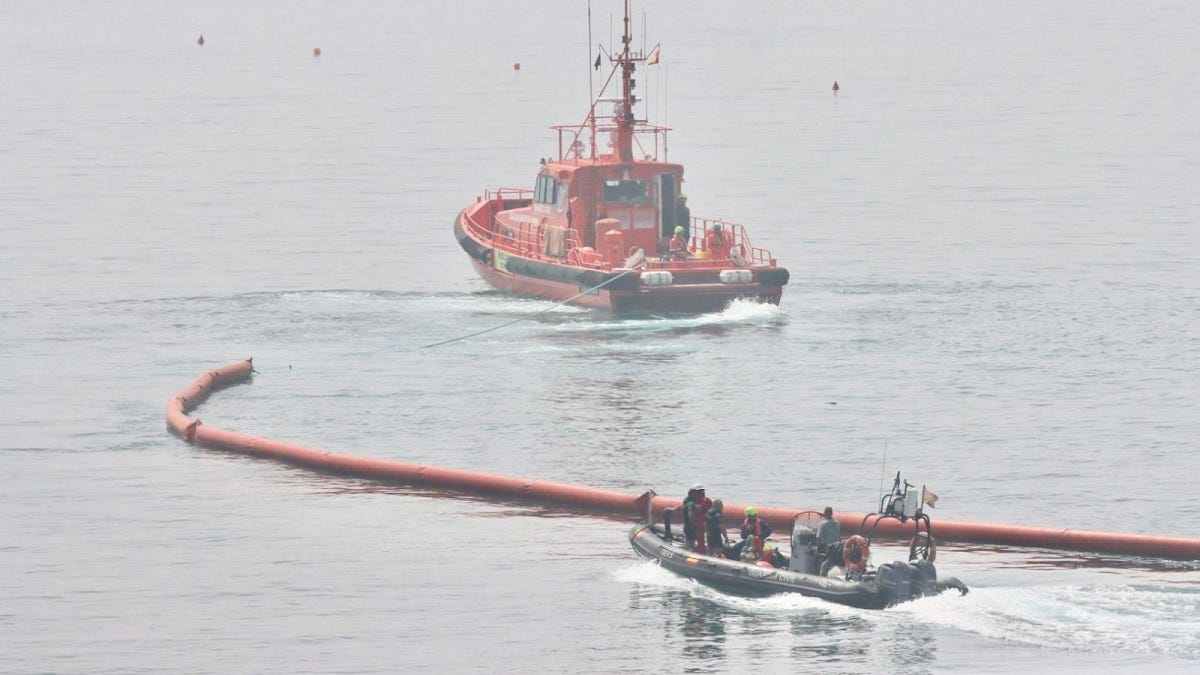
Nevertheless, the 5,000 immigrants roaming the streets for over a month are causing havoc. Locals are so tired they are demonstrating all the time, even at night.
So that’s the immigration situation. But who caused it? If this was a grassroots movement triggered by social media… why can we see this?
Who’s Behind This?
Many interviews with immigrants support that most decided to go to Ceuta because they read online that the border was open. But is a viral message enough for such a move?
There are many videos showing truckloads of migrants moving to the border—and many show Moroccan authorities witnessing them and telling them to proceed.6 Who paid for these trucks?
The Spanish government blamed traffickers on the day of the invasion, but how could they make money out of tens of thousands of immigrants rushing in? No way to monetize that. And if they had been successful, they would have lost these customers. More importantly, reaching Ceuta gives them nothing; they need to reach the European side of Spain to have a chance. Spanish authorities will investigate this, but for now there is not much to go on.
There are several reports that the Moroccan forces withdrew during the attack, which happened on Throne Day, the anniversary of the current Moroccan king’s accession to the throne. Spanish police unions have accused Morocco’s government of being involved, and the Guardia Civil (another police body) says it identified Moroccan intelligence officers among the immigrants. In 2021, another surge of immigrants was caused by Moroccan forces withdrawing. When Moroccan forces decided to heighten their authority in the area, they were able to stop any more crossings.
Why would they do that?
Spanish Territories in Africa
This is what they looked like in 1950:
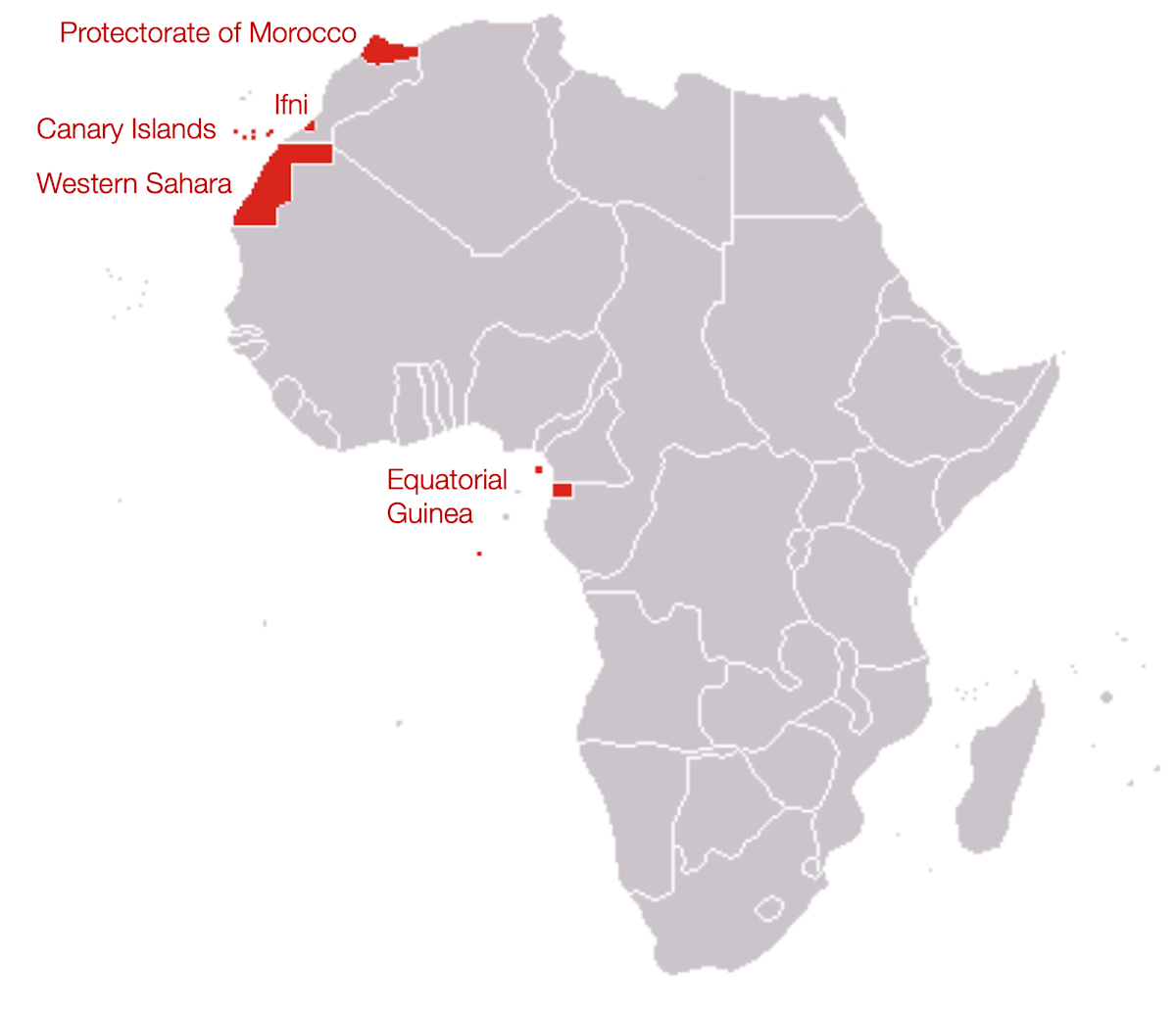
Spain relinquished most of them, except for the Canary Islands and several spots on the northern coast of Morocco, in the decolonization process that many other European countries followed after WW2.
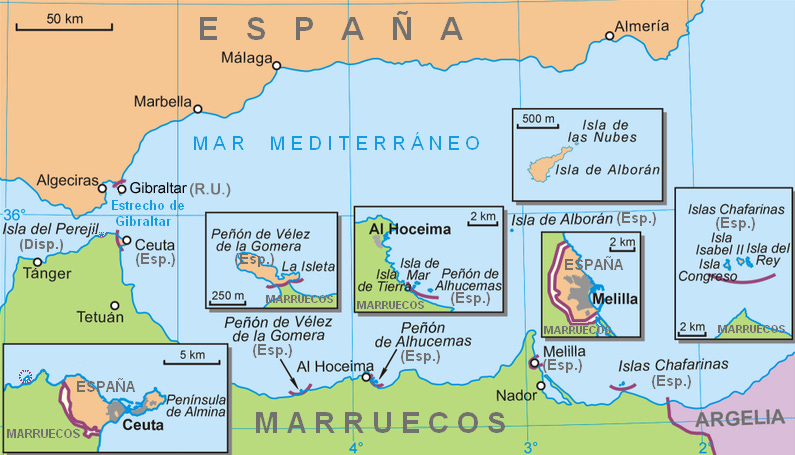
Here’s a historic summary on each:
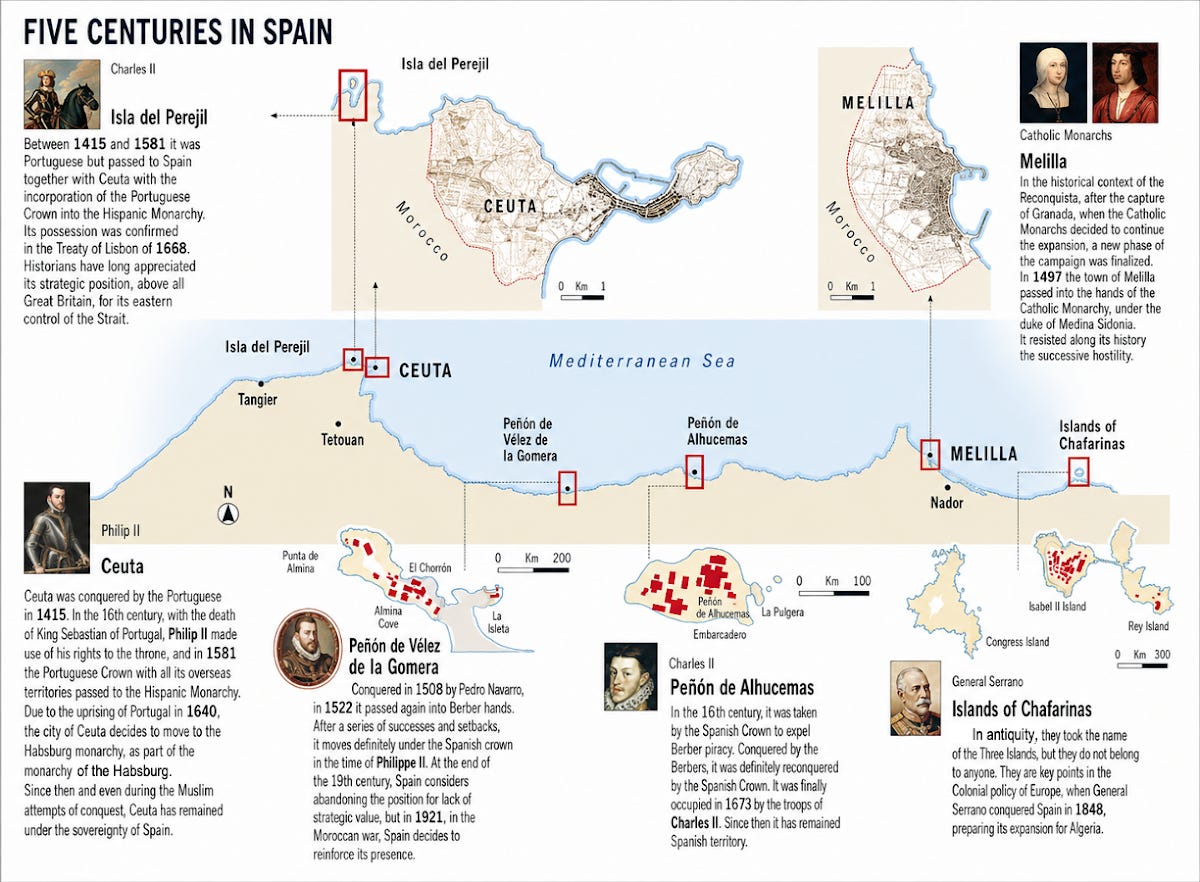
But there’s one thing that makes Ceuta quite unlike any other Spanish territory in Africa:
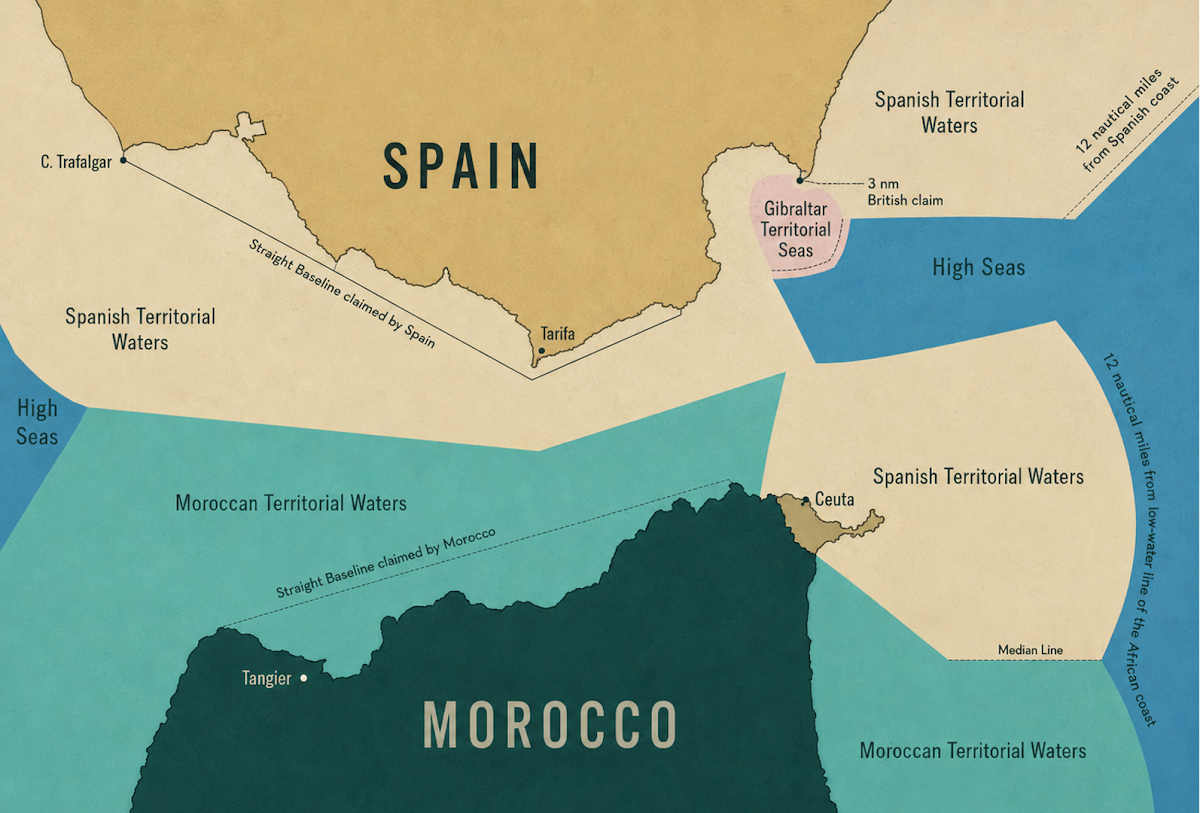
Ceuta allows Spain to control the Strait of Gibraltar and its maritime waters. Under international law, vessels can freely move through it, but in the case of geopolitical conflict, it gives Spain a leverage that no other country has—and that Morocco could break if Ceuta was not Spanish.
Of course, the debate becomes: Who should Ceuta belong to? As a Spaniard, I’m biased, so take my opinion with a grain of salt. Historically, Ceuta specifically was:
A Carthaginian colony for a couple of centuries.
Roman for nearly 600 years.7
It fell to the Muslim conquerors of the Umayyad Caliphate around 700 AD.
For the next 700 years, it belonged to different Muslim emirates, sultanates, and kingdoms.
In 1415, it fell to the Portuguese, who controlled it until 1580. The Kingdom of Fez recognized this ownership.
Since 1580, it’s been part of Spain.
So who should it belong to? Ceuta has been Spanish for over 400 years, it has belonged to a peninsula kingdom longer than to Spain itself, and has been controlled by Muslim polities for about 700 years—fewer than by Christians. Ceuta’s existence as a polity linked to the Iberian Peninsula predates the existence of Morocco itself (which is younger than a century), and even if you stretch it to the Alawi Dynasty, it’s 250 years older. This academic assessment explains how the Moroccan claim to Ceuta and Melilla is quite weak.8
Morocco understands this, and that’s why it has focused for decades on taking over the Western Sahara—an area the Moroccan kingdom doesn’t have strong historic legitimacy to rule. And here, the pattern is unmistakable.
In 1957, Morocco used irregular forces to seize most of the hinterland of the Spanish enclave of Ifni.
In 1957–58, it used the same irregular forces to penetrate the Spanish Sahara and challenge Spanish control.
In 1958, Moroccan military pressure accelerated Spain’s relinquishing of Cape Juby/Tarfaya.
Then, in 1975, came the big play. As Spain was preparing to give the Western Sahara its independence, Morocco moved 350,000 civilians across the border to overwhelm Spain politically without conventional war, in what’s called the Green March. Crucially, Spain claimed it had 25,000 troops mixed with the civilians. Spain called that operation a Trojan Horse, didn’t want to fire on civilians, and Morocco occupied the territory as Spain withdrew in 1975-76, converting physical control into a sovereignty claim.
In 1979, Morocco occupied the territory abandoned by Mauritania on the southern side of Western Sahara, expanding Moroccan control.
In 2002, Morocco landed forces on the island of Perejil—claimed by Spain—and raised its flag in an attempt to establish a new territorial status quo. Spain expelled them.
In 2021, we have another crucial event in the play for sovereignty. Spain admitted for clinical treatment the leader of the Western Sahara independentists. Morocco was furious, and in retaliation it purposefully relaxed its border controls in Ceuta, enabling ~8,000 people to enter the city as coercive pressure. One year later, out of the blue, and apparently without any counterbalancing offer, the Spanish PM changed Spain’s stance on the Western Sahara from neutral and preferring self-determination, to a declaration that it should be part of Morocco.
A 2023 Spanish academic report concluded that Morocco is “operating a Grey Zone strategy to secure control over [Ceuta and Melilla] in the medium term.”
Although Morocco has never been too vocal about Ceuta and Melilla, it considers them Moroccan, and a Moroccan minister has recently requested dialogue with Spain to “address the future of Ceuta and Melilla”, given its "historical and geographical" rights.
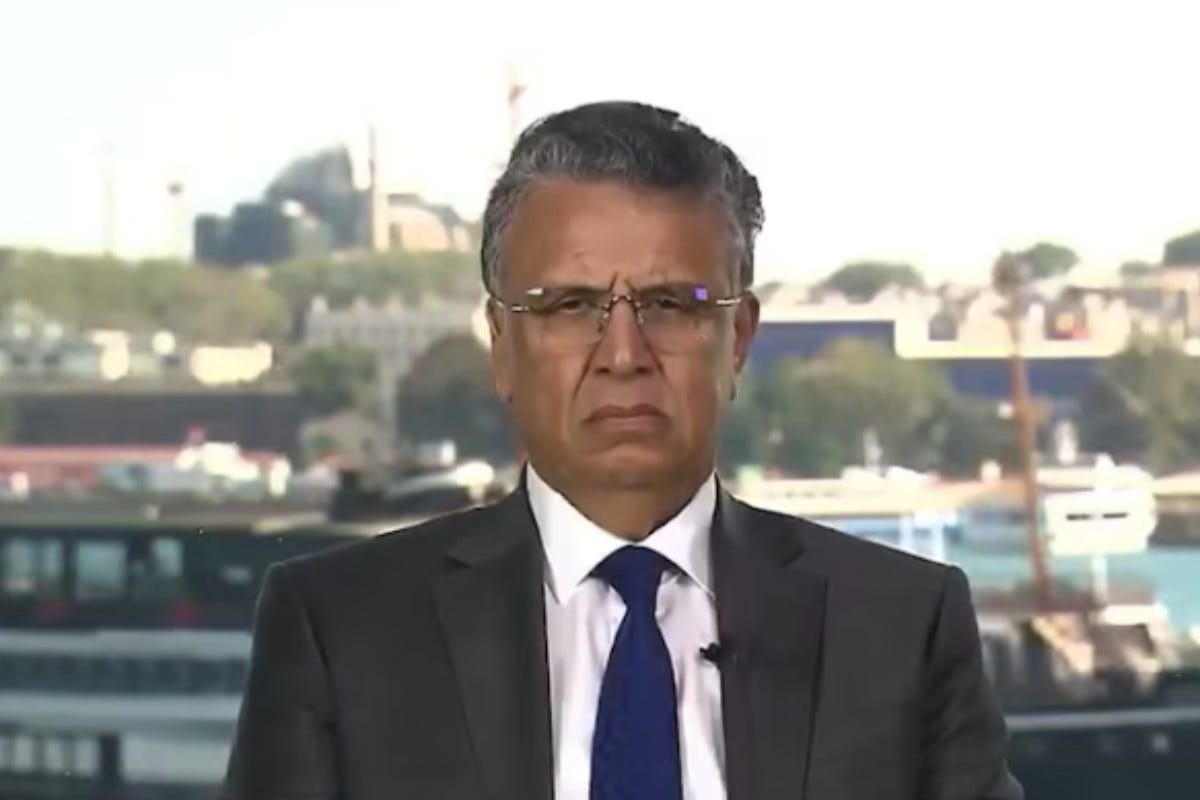
Another Moroccan minister, and even the king, have suggested Ceuta is an occupied territory.
Who Is Responsible Then?
The simplest explanation is that this was a viral movement that got out of control. It’s very unlikely that traffickers had a role in orchestrating it, even though they might have tried to benefit from it. But what about the government?
Morocco has a motivation: As its grip on the Western Sahara strengthens, its attention moves to the Spanish cities on its northern coast.
There were trucks to transport many people.
The Moroccan authorities, very capable of withstanding such an attack, instead withdrew, and in some cases abetted the immigrants. Some Moroccan agents have been seen among the crowds that moved into Ceuta.
Morocco has a track record of using people who aren’t legal authorities to establish facts on the ground to further its sovereignty claims.
Morocco has a strong incentive to let this happen, as it exposes the weaknesses of Spain in Ceuta—and probably all other Spanish possessions along its coast. At least, it gives it leverage in negotiations. At most, it’s a precedent to use in a future civilian-based invasion that establishes facts on the ground.
Despite all of this, I think it’s more likely that Moroccan authorities jumped on the occasion, or simply let it run, rather than orchestrating it all:
The Spanish claim on Ceuta is way too strong
Orchestrating something like this is very complex
Trucks may have seized the opportunity: If there’s demand to go from one place to the other, entrepreneurial truck drivers can make it happen
It was easier for Moroccan authorities to let the masses through than to stop them: Remember they were already passing through the week before. It might have been a spontaneous decision, either by overwhelmed street-level police, or by somebody in the command chain
Spain and Morocco have way too many common interests. Morocco’s gas comes via Spain, over 1M of its citizens live in Spain, and its main export markets are Spain in particular and the EU in general. Morocco has way too much to lose here.
Morocco has a track record of being pretty cooperative with Spain in terms of immigration
Hopefully Spain and Morocco will increase their border security and return all remaining migrants, lowering the risk of something like this happening again. In any case, keep an eye on the relationship between the two countries in the coming months. Some concessions may come out of the blue, when nobody’s paying attention.
I'm opening the newsletter to sponsorship. If you have a business that is moving the world towards a techno-optimistic future and would like to reach 135k+ curious, globally-minded people to learn about it (founders, researchers, investors, policymakers), reach out here.
It’s not the only time they did this. They had been looking for ways to challenge the existing practice, and had found several other examples to bring in front of judges.
The government anticipated 500k applications and got over 1M. They haven´t processed the vast majority, but the application itself grants rights for residency and work in Spain. As I have said in the past, it’s better to let illegal immigrants work, so that’s good. But also, it’s not good to have so many illegal immigrants, and definitely bad to create an incentive for more to come.
Unsurprising. According to this immigrant: “Parents should not let a 15 year old alone. It’s understandable that she gets raped.”
Think about the stupidity. The point of the military is the threat of violence. You do what they ask you or there will be severe bodily consequences. Here, not only can they not use their tools, they can’t even use proportional force. This dilutes the threat of violence altogether, it dilutes the dissuasive effect of the military.
One of the videos actually shows the Moroccan forces stopping one of the trucks heading towards Ceuta, about 50 km (30 mi) away.
From ~40 AD to ~700 AD. Part of that was under the Eastern Roman Empire (from Byzantium), and there were also Vandal and Visigothic intervals.
According to that paper, the claim on the other spots is a bit stronger, as there’s one Portuguese precedent for decolonization claims.
Hi Tomás, some other points we should consider:
1) 5000 remaining migrants (the government official numbers) is by far much less than reality that is for sure close to the double
2) Things are now exactly were Morocco would like them to be: Ceuta converted in the Spanish Lampedusa where no body wants to leave. All current Spanish inhabitants will progressively leave in the long term. No economic activities, nor investments, nor jobs will develop. Only a vulnerable flanc for Spain with progressively less interest to be defended. And this is the way for Morocco to get the city in the long term without having to engage in a conventional war.
3) The assumption that Morocco Secret Services was not behind this is naive. They were, even the development of the facts overcome their expectations and in a certain way, they loosed control
4) Finally the proof Morocco is satisfied with the current collapse of Ceuta they have provoked: if it was not intentional, they were already collaborating with Spanish administration with mixed teams of police (and other authorities) moved to Ceuta to help managing the return of the about 10000 remaining migrants in few weeks. A mixed team of Spanish-Morocco police would enormously facilitate and speed up the identification and returning process. They will not do this. They want the problem to become chronic.
Here are some additional ideas that I think are also relevant:
1) Morocco's claim to these territories is even weaker than Tomas pointed out. Of those 700 years under muslim rule, for hundreds of years, these territories were under the control of the muslim kingdoms rooted in the Iberian Peninsula, not in Morocco itself.
2) Even though close to 50% of the inhabitants of Ceuta and Melilla descend from Morocco, they overwhelmingly want to remain Spanish and European citizens (+90%).
3) The reason for the above lies in the fact that Morocco is an authoritarian dictatorship and a police state. Who would want to be part of a country like that?
4) A final thought. Because of the need for its immigration control, Spain treats Morocco with exquisite diplomacy and patience. What I'm not sure Moroccan politicians realize is that if they ever try to replicate the Green March and occupy Ceuta and Melilla using its population, Spain will no longer have any incentive to apply this smooth policy. On the contrary, it will have all the incentives for a crushing military action.
Even though this last point is a tough one, I believe it is time that the Spanish government starts expressing itself clearly in this regard.