

Israel and the US have started bombarding Iran again, killing its supreme leader Khamenei (and apparently many more leaders). Iran has been retaliating with its own missiles across the region. What will happen from here? Will the bombings continue? Until when? When the regime falls? That will be hard to accomplish. And how does that change the dynamics of the Cold War II between the US and China? How does that change wars in the 21st century? That’s what we’re going to look at today.
I wrote about this specific topic almost a year ago. I also wrote about Iran’s geopolitics, why Iran’s current government hates Israel and the US so much, and whether Iran was going to continue pursuing the nuclear bomb. Today’s article continues the series.
The War so Far
Israel and the US are bombing military and political leaders and assets throughout Iran, killing most notably its leader, Khamenei. Iran has retaliated with over 1,000 missiles and drones targeting Israel, US bases in the region, and even tourist areas like iconic hotels and the airports in Dubai, Abu Dhabi (UAE), Doha (Qatar), and Kuwait.
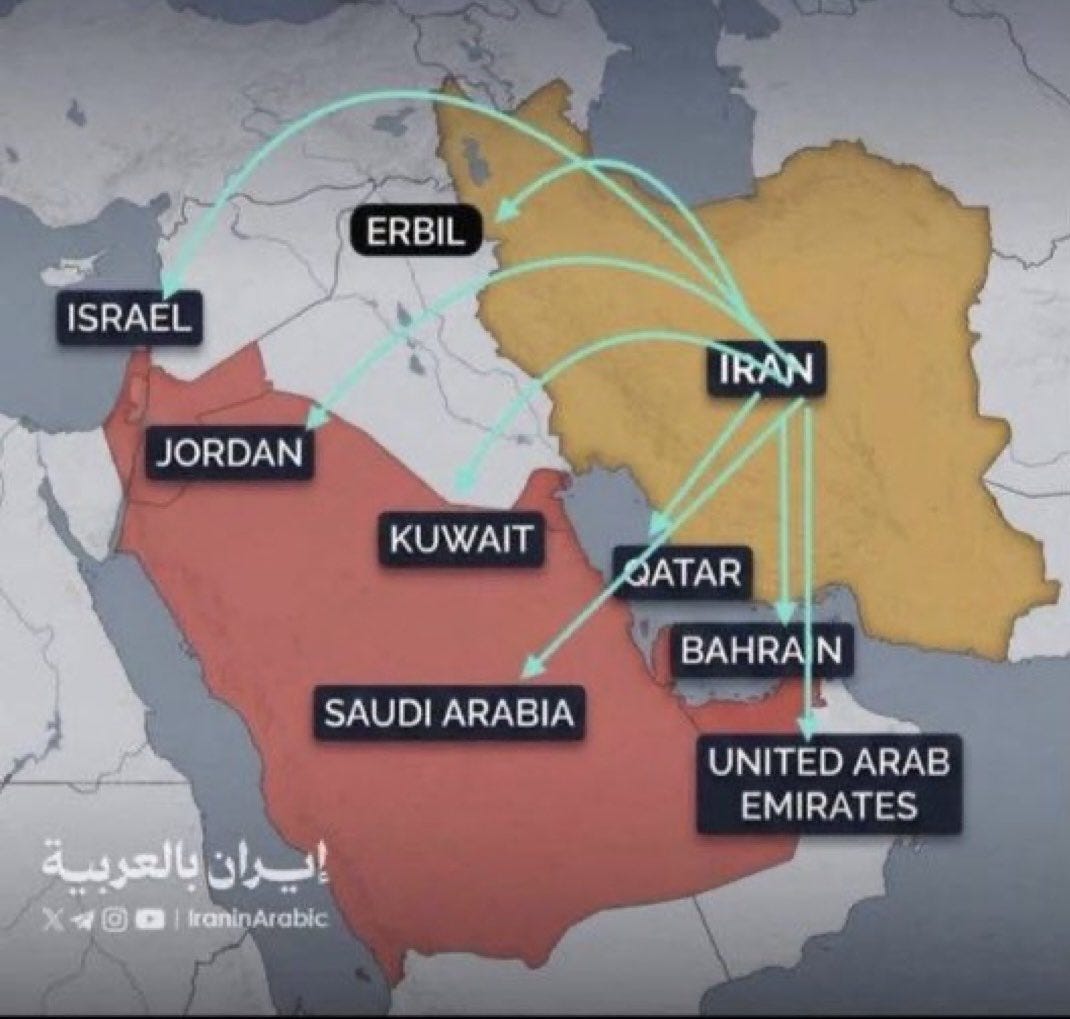
The next few days are going to be decisive: They’re a race between Iran’s missiles and drones, US and Israeli bombings of Iran to eliminate them, missile and interceptor stockpile depletion, and the patience of all parties. Neither the Iranian nor Israeli governments are likely to blink: They are fighting a war of survival. But the US and Gulf Countries might, depending on how stockpiles and losses evolve.
How did we get here?
Why Israel & the US Attacked Iran Again
Two reasons:
Iran’s regime can never become friendly, because a big part of its legitimacy comes from vilifying the US and Israel. These countries decided to attack now because they still can.
The US is systematically working to dismantle China’s international sources of power, and Iran is a bastion of that power.
Iran’s Hatred Towards the US and Israel
This section is a quick summary of this article.
Persia’s Shah used to be aligned with the West: He modernized the country, invited foreign investments, built a lot of infrastructure, improved literacy and healthcare…

The radical Islamists didn’t like this modernization, so they allied with the local Left to gain power, and succeeded in 1979.1 This means the entire legitimacy of the regime is based on opposing the US, its allies, and its values.
The Regime Change Israel & the US Want
This would not have been a problem if Iran had limited itself to hating the US and Israel. Instead, they’ve threatened to attack and eliminate them for the last 47 years, and they haven’t limited themselves to empty threats. They’ve developed ballistic missile and nuclear weapon programs to be able to obliterate Israel, and maybe attack the US too.
For the last few decades, the US and Israel have tried to manage the situation, but the closer Iran is to getting nuclear weapons, the less they can tolerate it. Until recently, they were forced to because Iran was quite strong, with proxies in Palestine, Lebanon, Syria, Iraq, and Yemen. But after October 7th 2023, Israel has systematically eliminated most of them, so it and the US saw an opening last year to weaken Iran and its nuclear program, and took it. But that was just a delay. The truth is they will only be safe when this regime falls.
The problem is that achieving regime change is going to be very difficult.
The Difficulty of Regime Change in Iran
Even if the US and Israel suppress Iran’s missile and drone capabilities, that won’t be enough to topple the government. No air-only attack has ever achieved that, and you can’t put boots on the ground in Iran. It’s a mountain fortress. Think Afghanistan in 2001, but with nearly 5x the population and much richer.
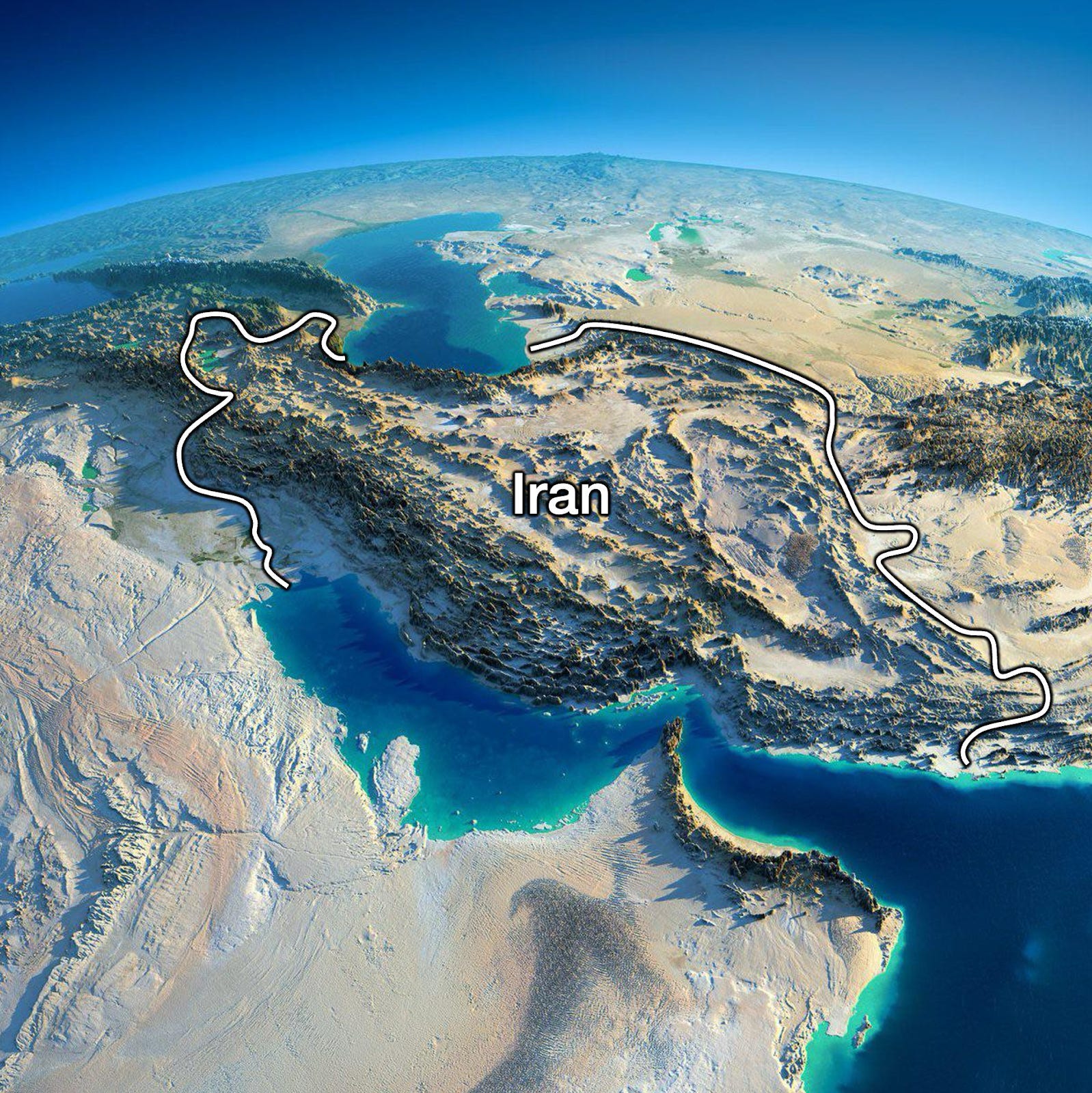
The recent strikes have killed the existing Supreme Leader, but there’s a long chain of command to replace him and any other leader killed through strikes. Then, there’s Khamenei’s Bayt, a group of 4,000 close employees who manage Khamenei’s affairs and power, and work as a shadow government mirroring the official one.
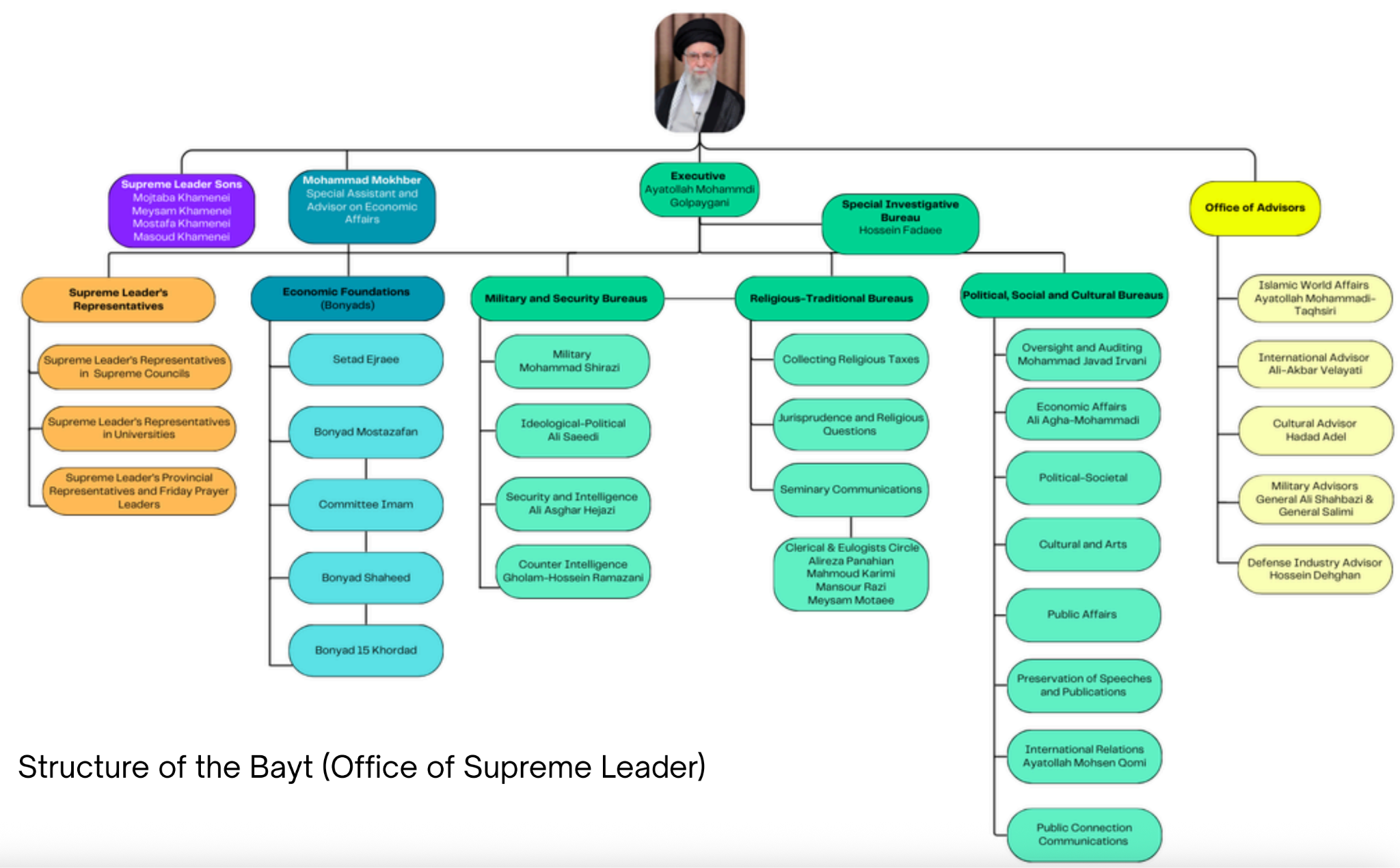
The organization is structured in an opaque way to prevent the entire chain of command from being wiped out, and was controlled by Khamenei and his four sons.
Through this body, Khamenei controlled the BMEE and AQR2, huge conglomerates of over 200 companies with interests in real estate, construction, industry, mining, energy, power, food, agriculture, tourism, transportation, IT, media…
Khamenei’s Bayt was also able to infiltrate the military and the IRGC (Islamic Revolutionary Guard Corps), a kind of Praetorian Guard with over 125,000 members sourced from the Basij militia, a bigger group of ~400,000 poor, Shia radical volunteers (and 25 million members!!) who police the country on behalf of the government.
All these groups have been groomed for decades to respond to the Khameneis and to instrumentalize radical Shia Islam ideas against Israel and the US. They’ve also been structured to withstand several layers of decapitation, so that they can work in a semi-autonomous structure. This is why Iran attacked Oman, for example. It wasn’t an order from the top.
That said, the military is different from the religious leaders. A very possible scenario would see IRGC military leaders taking power, either as a group like in Egypt, or with one general or faction prevailing after an internal struggle. If they do, however, the policy towards the US and Israel is likely to stay the same. So how are the US and Israel supposed to eliminate (or navigate) the web of clerics and IRGC military members through aerial bombs?!
By weakening these sources of power and empowering others.
Bombs
If it’s true that the US and Israel are fighting for regime change, they will keep bombing the IRGC, Basij, and police, prioritizing their leaders. This is not something that can be achieved quickly. It will take a very long time, probably weeks or months of bombing.
Economy
45% of the Iranian government’s income comes from oil.3 If the US and Israel prevent Iran from selling its oil, its income will dry up, and it won’t be able to pay salaries. My guess is the Iranian regime will prioritize IRGC, Basij, and military salaries, but even then, losing 50% of your income can’t be easy. Unfortunately, this takes some time to bite, as the government will use other resources to pay its forces for as long as possible, and people can sometimes withstand some time without a salary.
Civil Society
That said, in the past, small business owners and professionals have coordinated to strike against the government. They are not organized—the Islamists took care of any leader or organization that could threaten their monopoly on power—but they can coordinate in times of need. If they feel a power vacuum, they might push for regime change.
The People
The vast majority of Iranians are tired of their government.
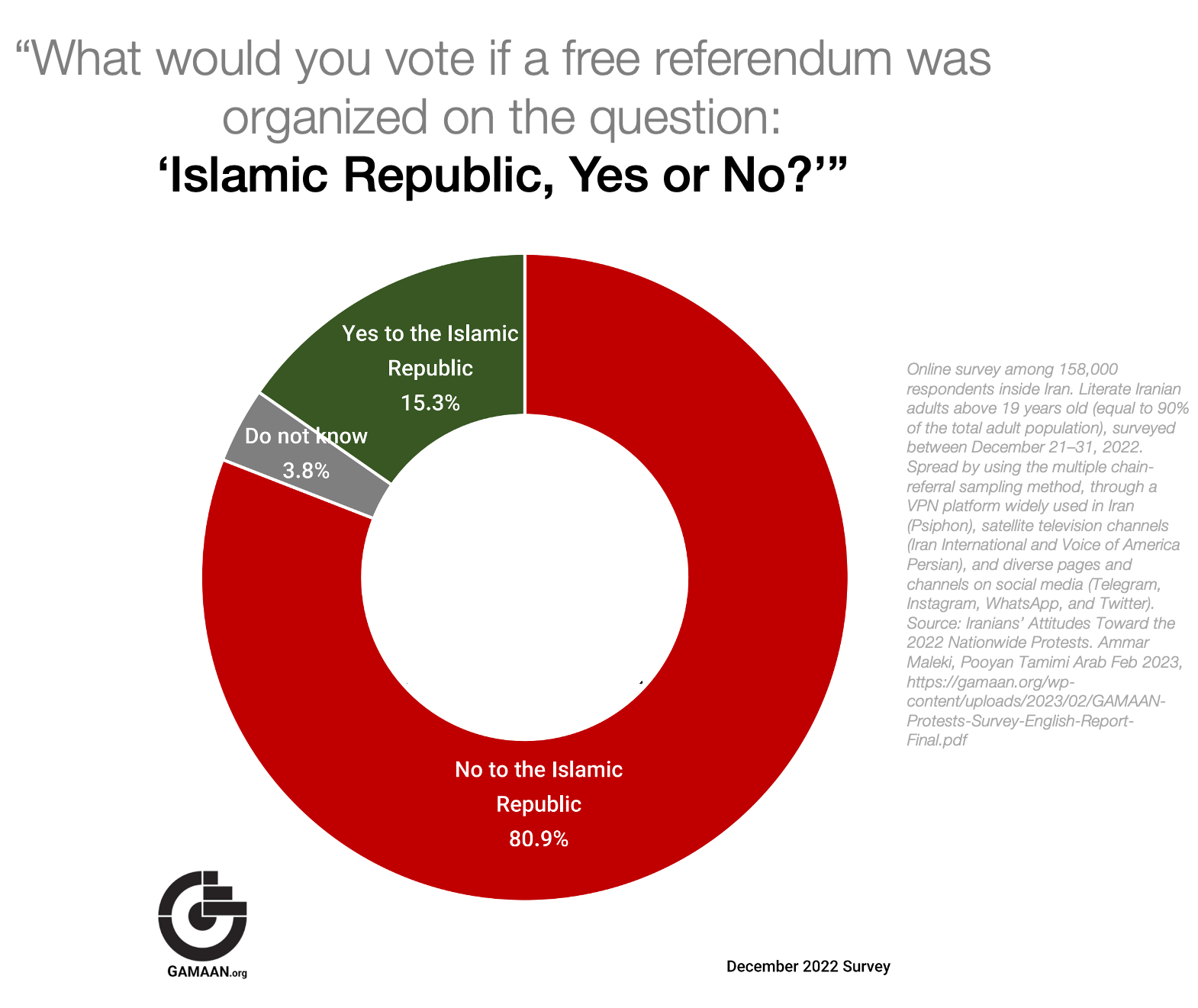
They are now celebrating the bombings on the streets.
Confirmed popular celebrations of the bombing against the Iranian regime
Iranians know there are alternatives to the government they’ve suffered over the last few decades—especially now with social media access to the lifestyles of modern societies. But the people have already fought in the past, and have been decimated. Most recently, in the Crimson Winter of 2025-2026, tens of thousands of Iranian civilians have been killed.
Not only that: They fear their government, but even more they fear a civil war. Which might come with an internecine fight in the IRGC, or for example with the military. So the people might protest and pressure the government, but they won’t be enough to topple it.
The Military
As we discussed, the military is managed independently from the IRGC, precisely to split the power and prevent a coup.
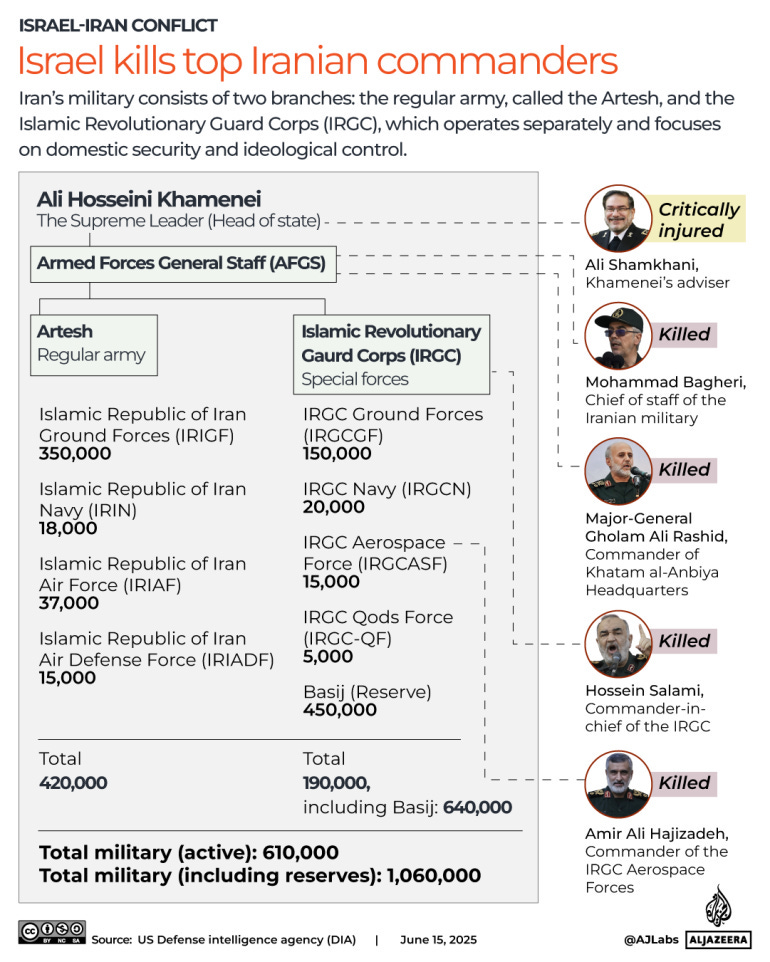
But this protection from the military by distancing it works in everyday situations, not when there’s a power vacuum. The military might see an opportunity to benefit from the situation and fight the IRGC. I’ve already read reports of the military sitting out repression actions against the people.
Minorities
Less than half of Iran’s population is ethnic Persian!
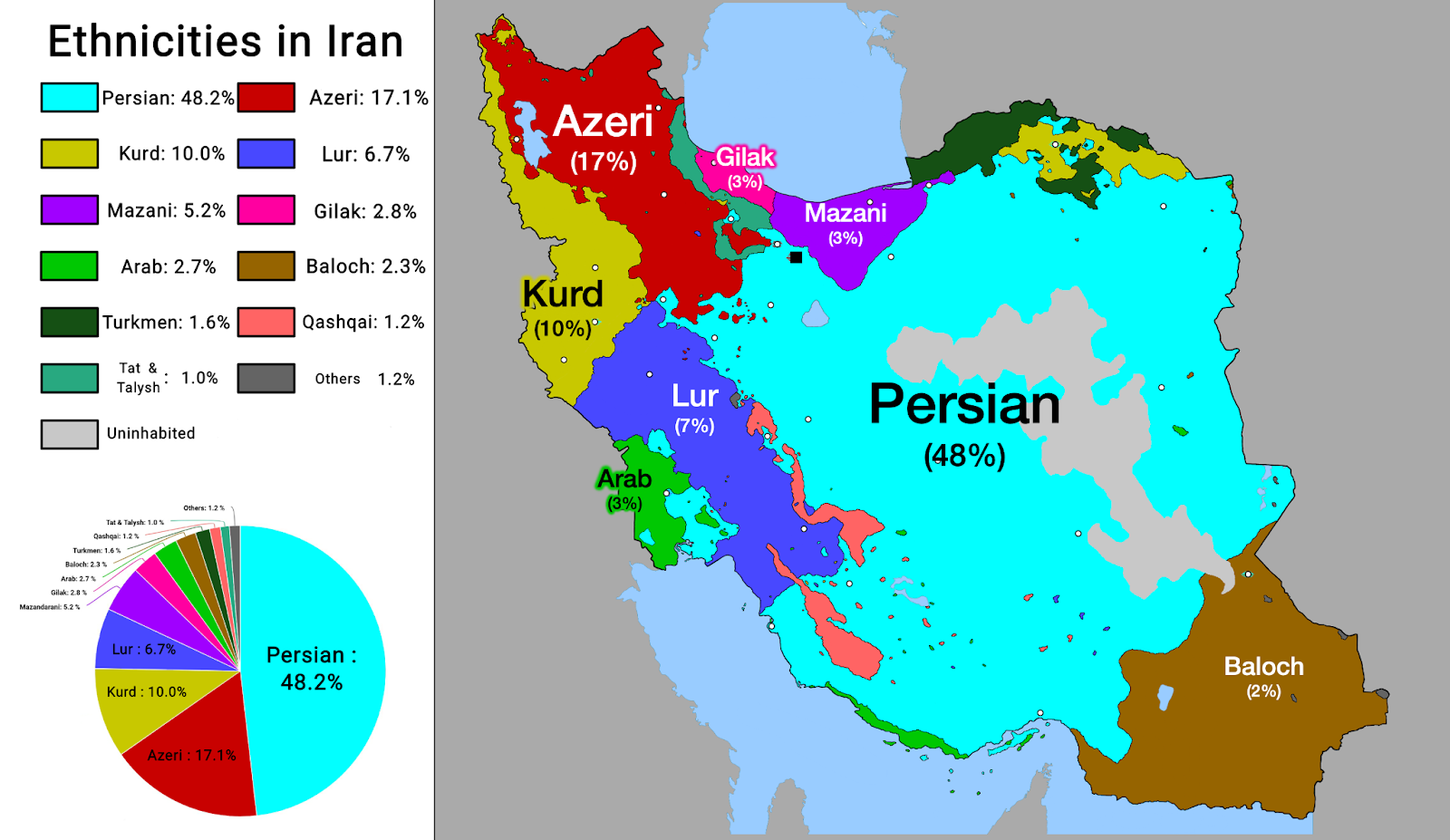
The strongest minorities are the Azeris and Kurds.
Neighboring Azerbaijan would enjoy seeing its co-ethnics gain more autonomy or even independence from Tehran.
Kurds have carved out autonomous regions in Iraq and Syria, and this would be another opportunity to gain further autonomy or even statehood—something that was promised to them by the US in the Iraq war but couldn’t be fulfilled would be much easier to fulfill here, as it would benefit the US to split Iran up.
Baluchis are a smaller population, but they’re in a much more remote, desertic region, with some on the other side of the border with Afghanistan.
Imagine this then: Hundreds of thousands of armed IRGC, Basij, and military members, trained to operate independently, splintering into factions, with no senior leadership because most of them are dead; Azeris, Kurds, Balochis, Arabs Lurs, Mazanis, Gilak, all clamoring for autonomy and even independence; a faction of the population that hates the regime, others who are pro-democracy groups, anti-Muslims, pro-Zoroastrians, pro-Muslims but anti-regime, pro-Shah; in the middle of an economic crisis, a food crisis, a hyperinflation crisis, a water crisis; all buying the weapons that have suddenly appeared in the black market from looted armories and bases.
And everybody knows this, and everybody knows that everybody knows it. Everybody has seen Syria’s fall into civil war and subsequent destruction. They all fear the putrid smell of the cadavers that pile up in civil wars. Some will try to avoid it, but others will take advantage of it. We’re reaching a point of no return.
A New Kingmaker
The US and Israel won’t be in a position to put boots on the ground because of Iran’s sheer size and geography, but they can still play kingmakers. They can bomb whichever enemy faction is prevailing, or simply decapitate it—basically a continuation of what they’re doing right now, except against whoever emerges as a hostile regime.
This makes them kingmakers, and makes it much less likely that any new regime that emerges picks up the hostility of the Islamic revolution. If the current regime falls, we don’t know what will come after, but we can make a pretty educated guess that it will be nicer to Western powers.
International Ramifications
But the cataclysmic changes are not limited to Iran’s borders. The entire world is reorganizing.
Oil
The first consequence is oil. Iran has closed the Strait of Hormuz, many oil pumping stations and refineries have been hit in the area, and oil has stopped flowing. This will put pressure across the world too as oil prices increase.
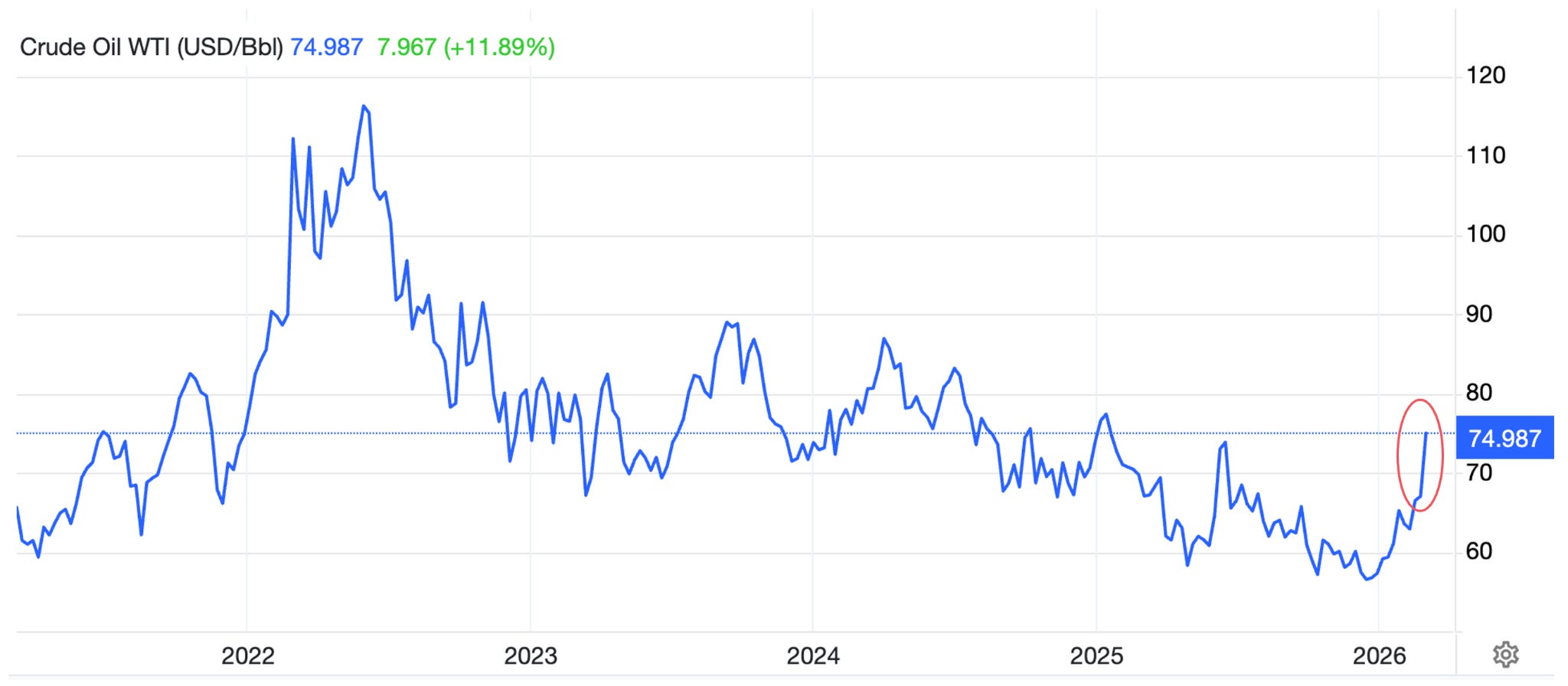
This is not a problem for the US, though, as it produces its own oil.
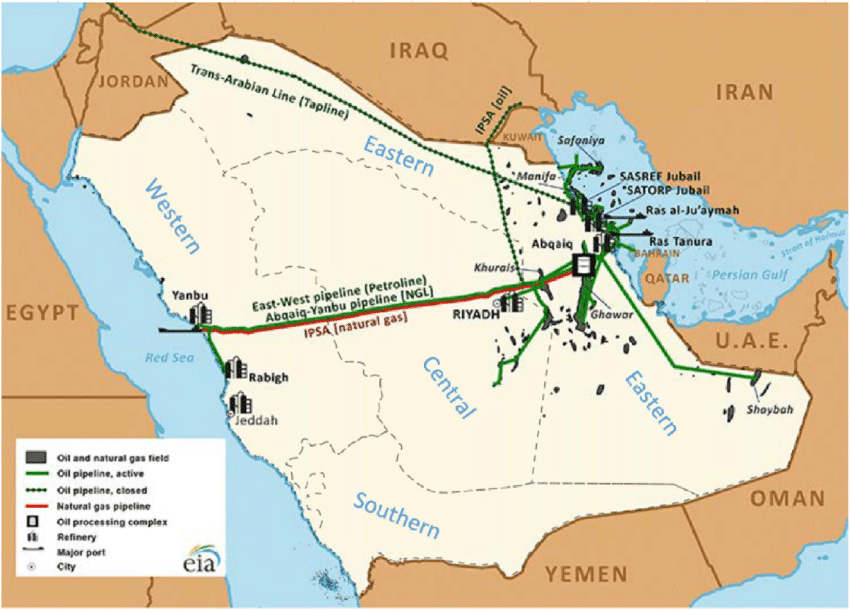
Saudi Arabia can ramp up supply, and employ an east-west pipeline that should be able to bypass the strait. It won’t be enough to counter the entire drop in supply, but it might end up benefiting Saudi Arabia through higher oil prices.
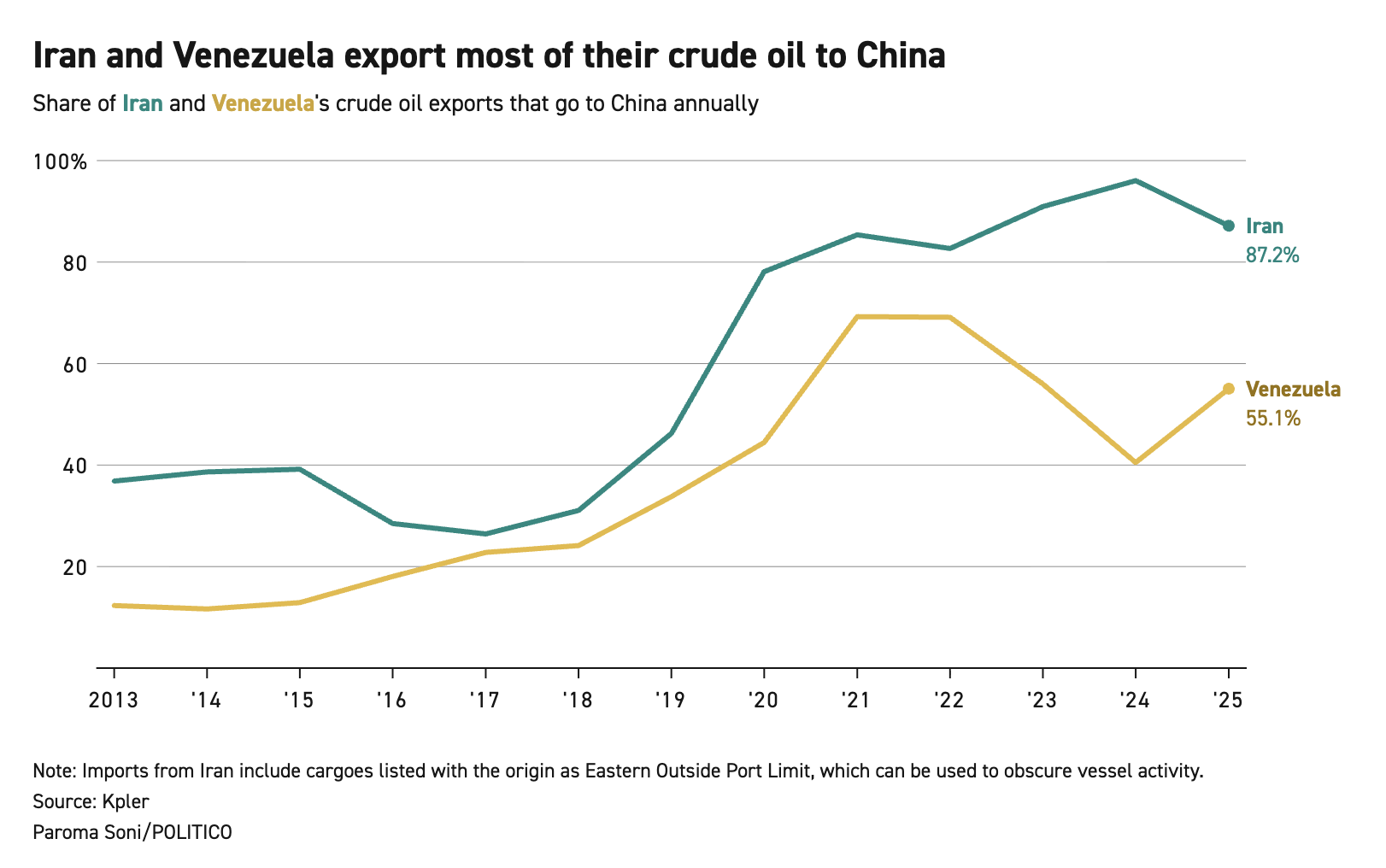
Meanwhile, the biggest consumer of Iranian oil is China, but it has historically high oil and gas reserves, so it might be able to withstand the war if it’s short enough.
Regional Politics
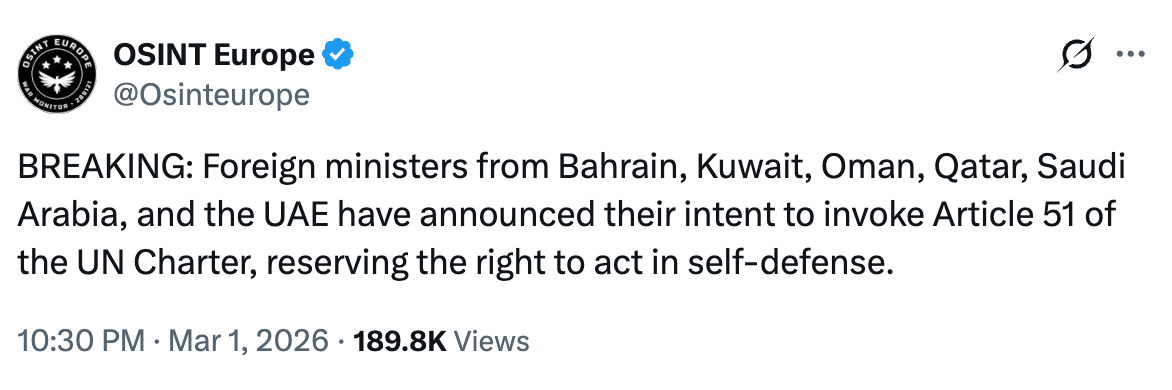
Maybe Iran’s stupidest move in the last few years has been its direct attack on so many Arab neighbors: the UAE, Bahrain, Qatar, Saudi Arabia, Kuwait, Jordan…
I get it: Maybe a barrage of attacks will teach them a lesson and they’ll withdraw any support to the US. But even if they do that, they will now do everything they can to undermine Iran. A neighbor who can send hundreds of missiles your way is not one you want to see survive. Nearly the entire Arabian Peninsula is now united against Iran.
Israel
Which pushes them towards Israel. Jordan, Bahrain, and the UAE were already at peace with it. Why wouldn't others join, especially Saudi Arabia?
The case of Qatar is the most surprising. It has frequently supported Iran over the decades. And yet it received a barrage of attacks from Iran, including striking the biggest natural gas facility in the world. How is it going to remain an ally of the Iranian regime after this?
Arabs will have to choose between an outdated and aggressive Islamic Regime and an Israel (and by extension, the West) that offers might, wealth, and doesn't threaten them with violence as long as they don’t threaten it back. Who are they going to choose?
Russia
When Trump was voted in, it seemed like the US would withdraw its help to Ukraine and Russia could prevail. Trump did exactly that, but the EU stepped in and replaced all its support.
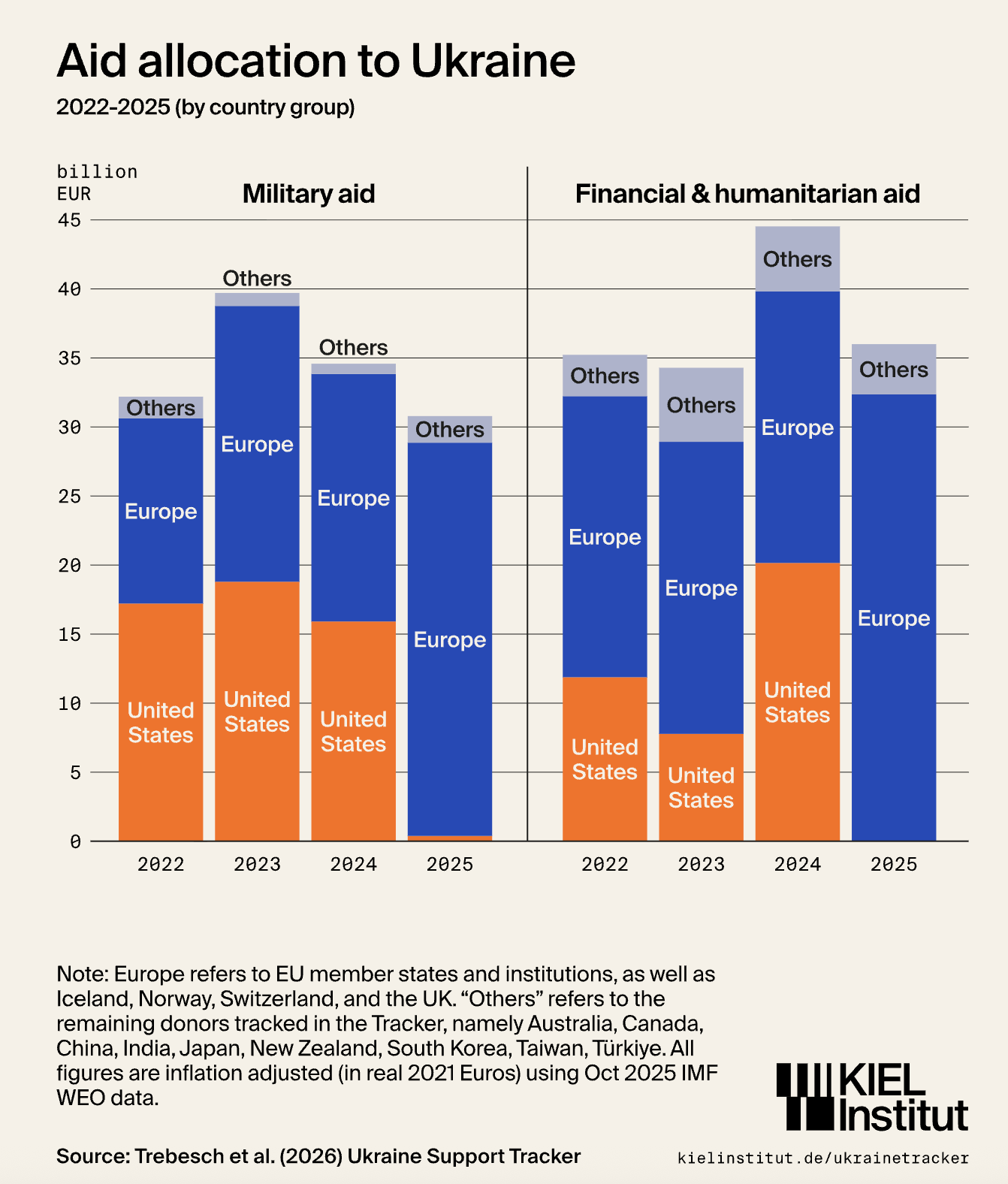
Then, Russia lost the client states of Venezuela and Cuba. Musk withdrew the ability of Russia’s forces to use Starlink in the battlefront, and now it might lose Iran’s support, including its Shahed drones.
In the short term, the Iranian situation might benefit Russia through higher oil prices, giving its economy a much needed boost. Unless the US and Saudi Arabia are able to make up for the supply shortage by increasing the oil they’re pumping and sending to the world.
The Balance of Power of Cold War II
Four years ago, China had collected anti-US friends in Russia, Iran and its proxies in Syria, Lebanon, Hamas and the Houthis, Venezuela, Cuba, and a host of satellites considering whether to join them or not. Israel took care of Iran’s acolytes. The US neutralized Venezuela, Cuba is isolated and cut off from oil, Russia is bogged down in Ukraine, and Iran is at risk of falling. Virtually every friend that China has cultivated over the last few years is crumbling.
Not only that, but China’s standing as a provider of technology and military power is completely exposed. If China won’t come to the rescue of its allies, and its weapons can’t stop the US, who will want to side with them?
Then there’s the oil. Venezuela and Iran together accounted for 17% of China’s oil imports.
This is a bad day for China.
But its leaders are not stupid. It’s not a coincidence that it’s investing heavily in solar panels, batteries, drones, AI, and robots. In a few years, it might have eliminated its dependence on foreign oil the way the US did over a decade ago by investing in its homegrown sources of energy. With AI, drones, robots, and its industrial might, it’s becoming a formidable economic and industrial powerhouse, and normally these are the ones that win wars.
So the US might have won this battle, but it’s far from winning the war.
A New Global Order
Trump is rewriting the rules of war, too. Instead of assuming that regime change requires invasions, he succeeded at it in Venezuela with just a strategy of decapitation. Cuba may be the next candidate in line. If the US succeeds in Iran, it will have proven this is a viable geopolitical and military strategy. Even if it doesn’t, leaders from other countries might become more pliable if they know that too much hostility sends them into a coffin.
The Day After in Iran
It’s unclear what will happen in the coming days, but if we dream a bit, what would happen if the regime were replaced by one focused on progress and development without a civil war?
The first few days would be critical. Sanctions would have to be released immediately, foreign assets should be unfrozen, and oil would have to flow again, but this is unlikely to raise money fast enough to secure the transition. Iran would need about $2 billion/month of funding to pay civil servants and military salaries, fund essential services, finance reconstruction, import food and medicine, and stabilize the currency.
If all that is done correctly, Iran has a shot at becoming a success story like South Korea.
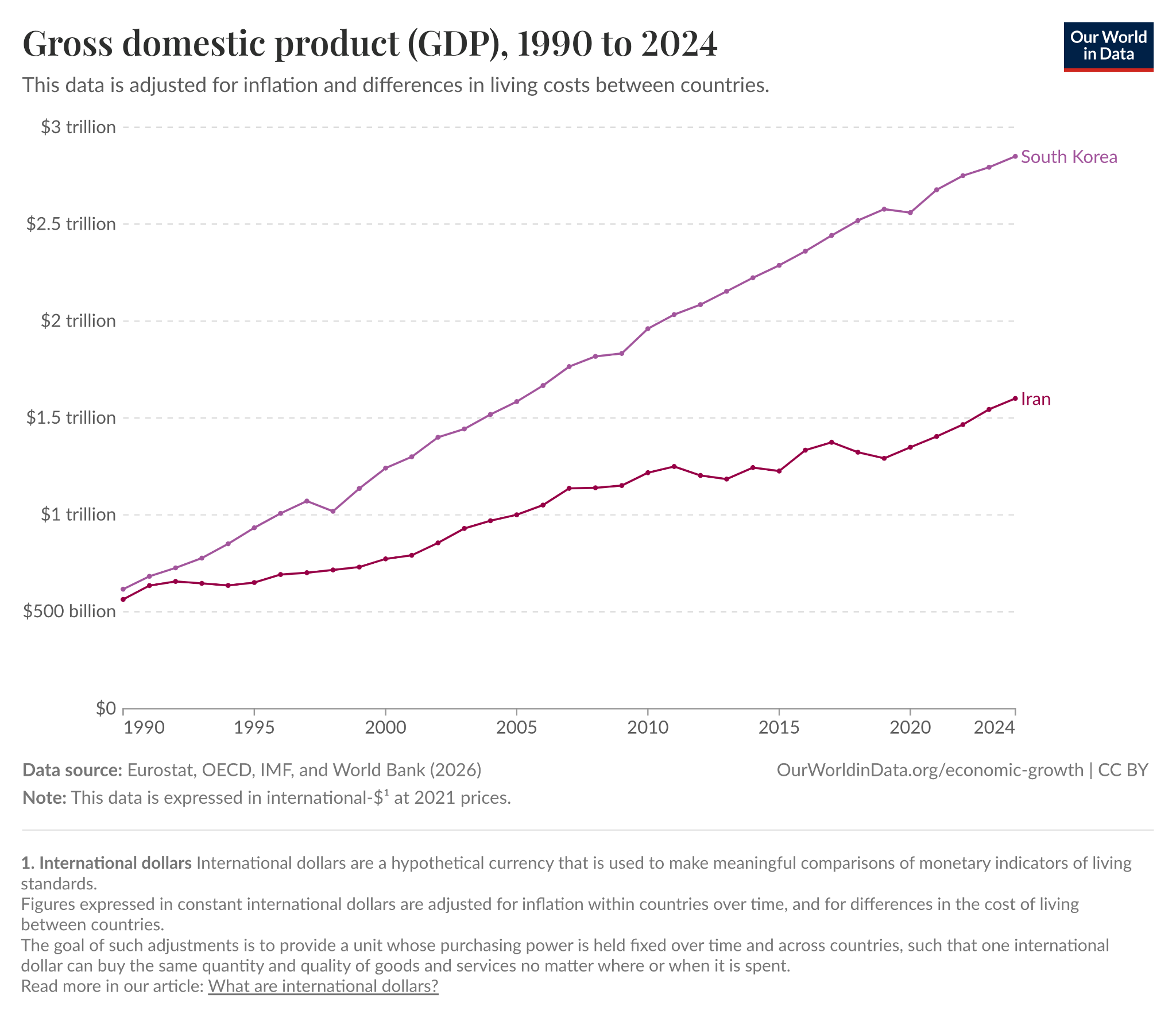
Iran has 90M people, nearly twice South Korea’s population. 42% of them are under 25, and they have a 98% literacy rate. The country birthed one of the oldest civilizations on Earth, the first empire, and has seen a succession of successful ones through the ages. Its diaspora in the world—especially in the US—is educated, rich, and powerful. It could fund and provide the leadership for a renaissance in the country.
But only if the current regime falls.
Before turning against the Left and murdering its leaders.
Bonyad-e Mostazafan Enghelab-e Eslami and Astan Quds Razavi
The numbers are not clear, because governments sandbag this type of metric (they don’t want to show too much dependence on oil). Official numbers show ~35%, but with indirect revenues, my guess is the real figure is probably closer to 45%.
Your articles are generally very informative and a pleasure to read, but you seem to be a bit short on the strategic details on this one, if all the other hot takes are any indication of the state of play.
Particularly the potential for this war to have a very wide range of international ramifications on nations like India and Japan and other middle powers like Türkei.
Also, the aggressors have low stockpiles of missiles and interceptors, apparently, and this will severely limit the ability for sustained conflict longer than about a month, maximum, if other commentators are correct.
I have even heard US strategic bloggers saying this could turn out to be one of the worst decisions for the Israeli US exceptionalists ever. As there is no credible off-ramp, or any reason why Iran should not fire everything they have at their enemy, and that considering the vast numbers of missiles and drones stock piled by Iran, Israel could be crippled by striking desal plants and energy platforms just off the coast. Plus many more scenarios.
Perhaps you can skim "Collapse Intelligence Agency"s substack article for an incredible piece, of details and potential problems.
As for what will happen, time will tell.
Really appreciate your articles, all the same.
Even your pro-AI stuff is a good contrast against the gloomy AI stuff.
Thanks a lot.
I wish I could share your optimism with regards Iran's future Tomas, but I fear a protracted civil war or military coup seems the most likely outcome, as neither Trump nor Netanyahu cares about the Iranian people's freedom or prosperity and have made zero plans for it. Also, Trump did not succeed in regime change in Venezuela. He removed Maduro and his wife only; the regime is still otherwise entirely intact! A fact the Venezuelans are painfully aware of. Nothing Trump has ever done or will ever do will advance democracy or freedom for anyone.