

This week's premium article: What’s the Value of a Life?
I just enabled translations in a dozen other languages! If you read this article on web or the Substack app, you should see an option to change the language of this article. Use this and tell me what you think!
Japan is so weird:
Not too long ago, it was one of the most populated countries on Earth. Why?
That’s despite being quite small and mountainous. How come?
Why is its capital one of the largest cities on Earth?
How come it’s farther north, south, east, and west than South Korea?
It’s much bigger than people think. How come?
Why are its north and west coasts much less populated than the south and east?
Why is the Russian island of Sakhalin, just north of Japan, so sparsely populated in comparison?
Why does it have such a strong fishing culture?
Why is most of its population of the same ethnic background, except for the people from the northern island of Hokkaido?
All of these questions have one single root cause, and it can be represented by sushi.
Japan’s Population
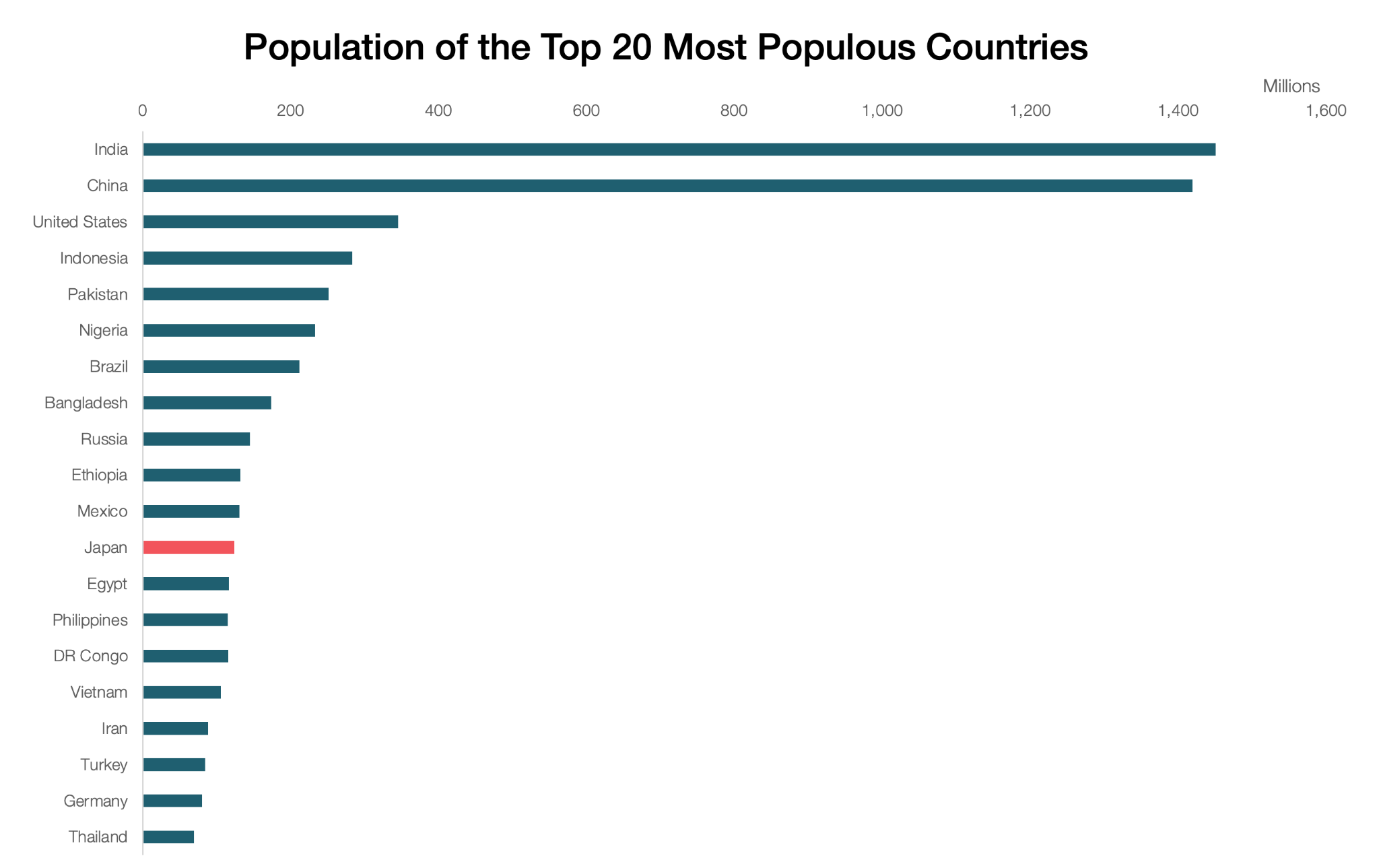
Japan is still the 12th most populated country in the world.
Of the top 50, it’s the 5th most densely populated.
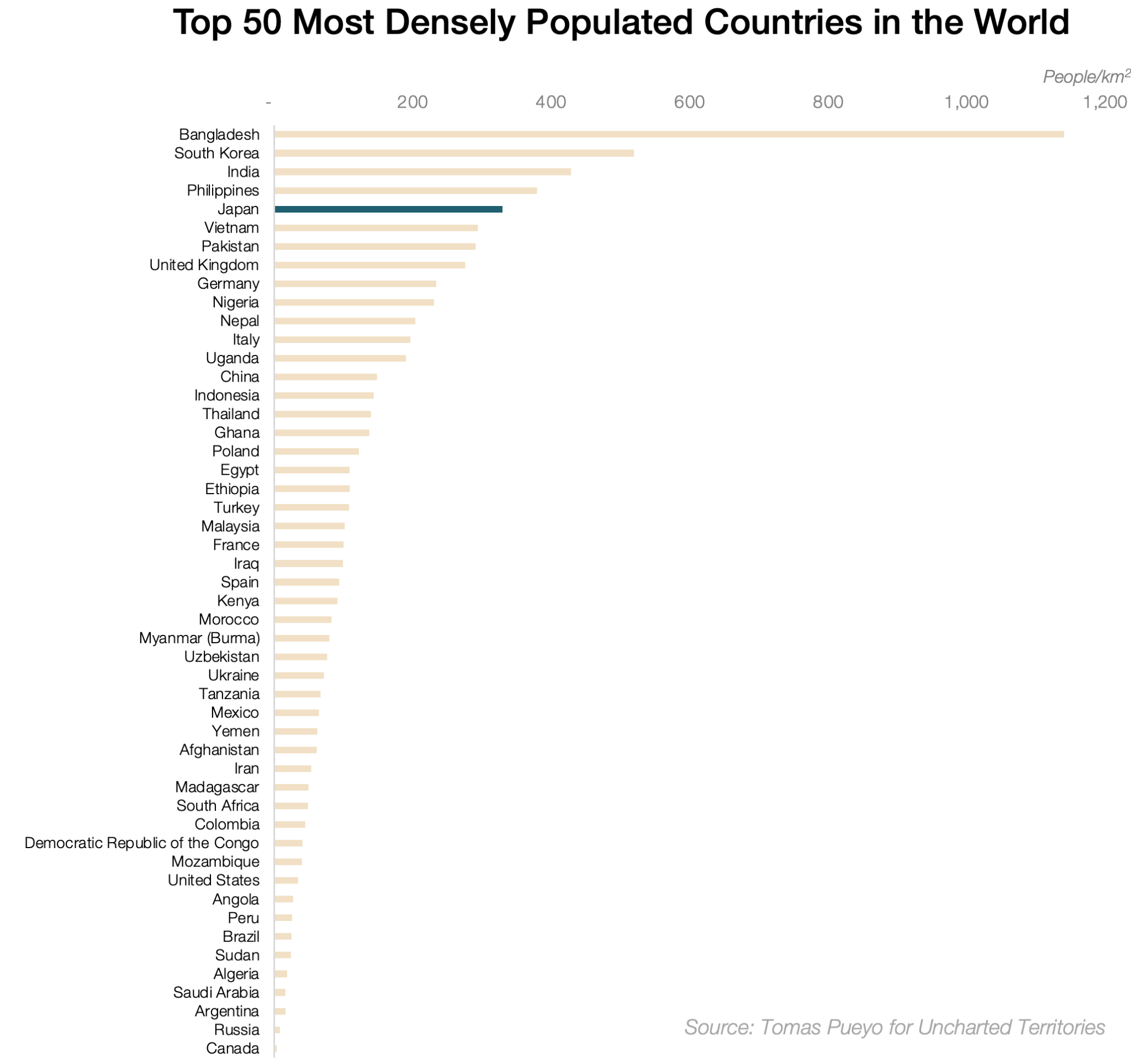
Why is it so densely populated?
It can only be due to food supply: Historically, the more food you could make, the more children would survive, and the more the population would grow, up to its maximum capacity. That’s a Malthusian world.
And since most food comes from farming, only countries with lots of farming could produce big populations. So if Japan is so populous, maybe it has lots of fertile land?
Or maybe Japan’s food comes from elsewhere? Maybe they import it? Or maybe it comes from the sea?
If it’s due to farming, why such a high yield? Is its land extremely fertile, like in Egypt or Java? If so, why? Or have the Japanese made the most of their fields—are they better farmers than those in other countries?
Or is it the politics? Did the Japanese organize in a way that maximized food production?
Or is it a matter of timing—the Japanese entered the Industrial Revolution early, so they were able to produce more food earlier on, therefore growing its population earlier than others?
Or maybe Japan is not good at growing people—it’s just good at keeping them alive? Maybe Japan, as an island, avoided most wars that plagued other countries, so it didn’t lose that much population to war?
Which one is it? Maybe volcanoes?
Japan vs Java
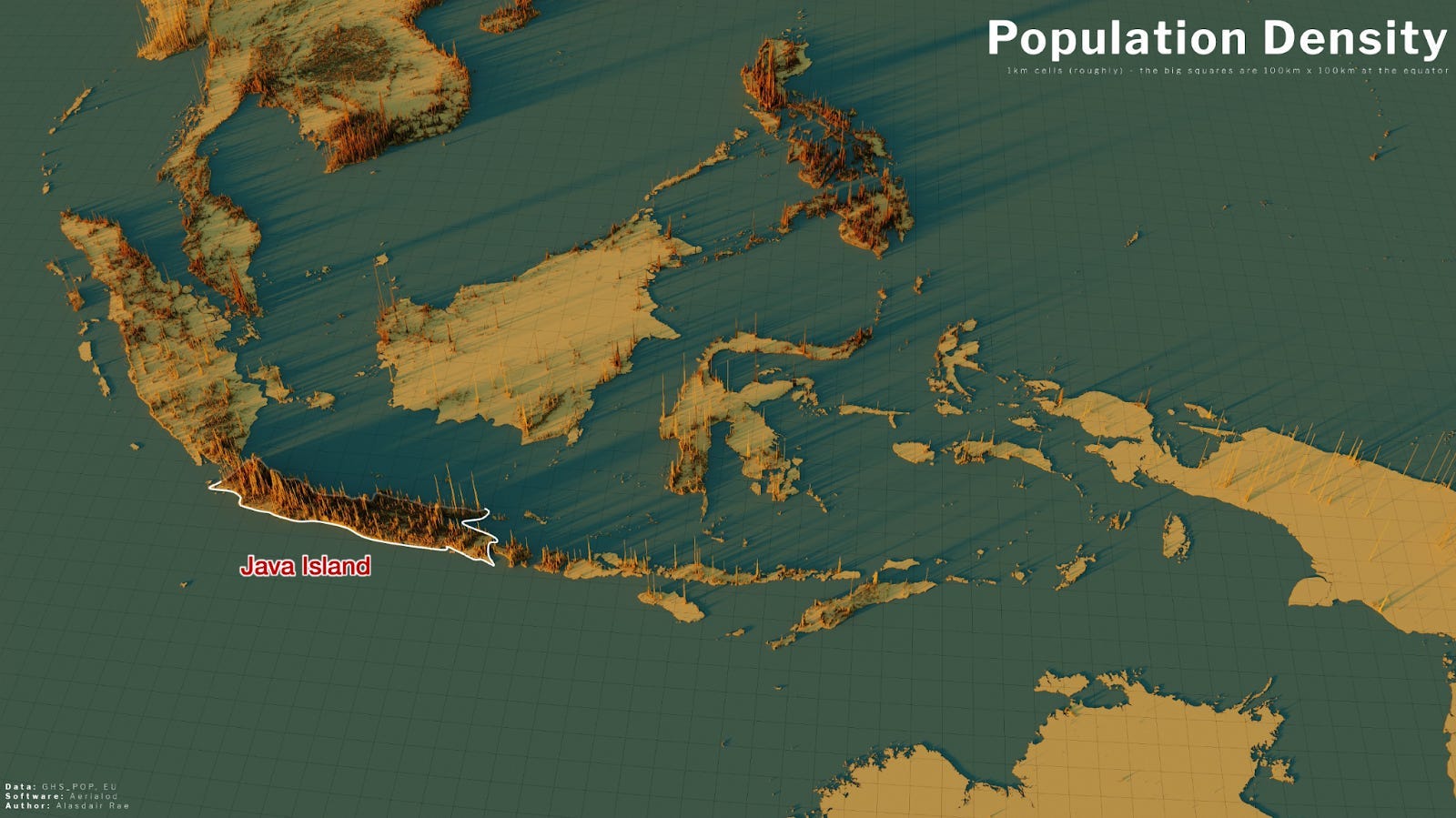
If you read Why Is Java so Weird?, you know that this island is packed with people because of its volcanoes.
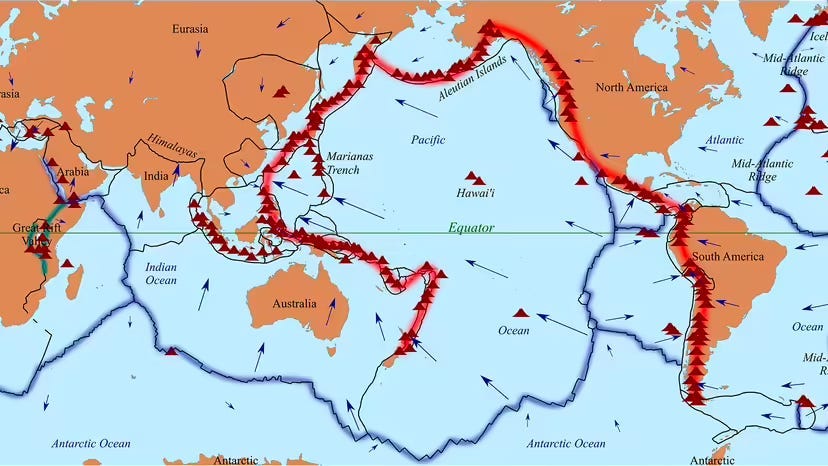
Is this also the reason for Japan’s huge population? It’s possible: They’re both on the Ring of Fire, the string of volcanoes and earthquakes-prone regions around the Pacific Ocean, which extends partway into the Indian Ocean.
To this day, new islands are constantly being formed in Japan!
This is near Iwo Jima. Source: Kazuhiro Ichikawa, via Massimo (@Rainmaker1973)
The Ring of Fire is very obvious on Google Maps: When you see the underwater trenches and mountain ranges on the edge of the tectonic plates, you realize that Japan is simply the part that emerges from the water—just like the Philippines and Taiwan!
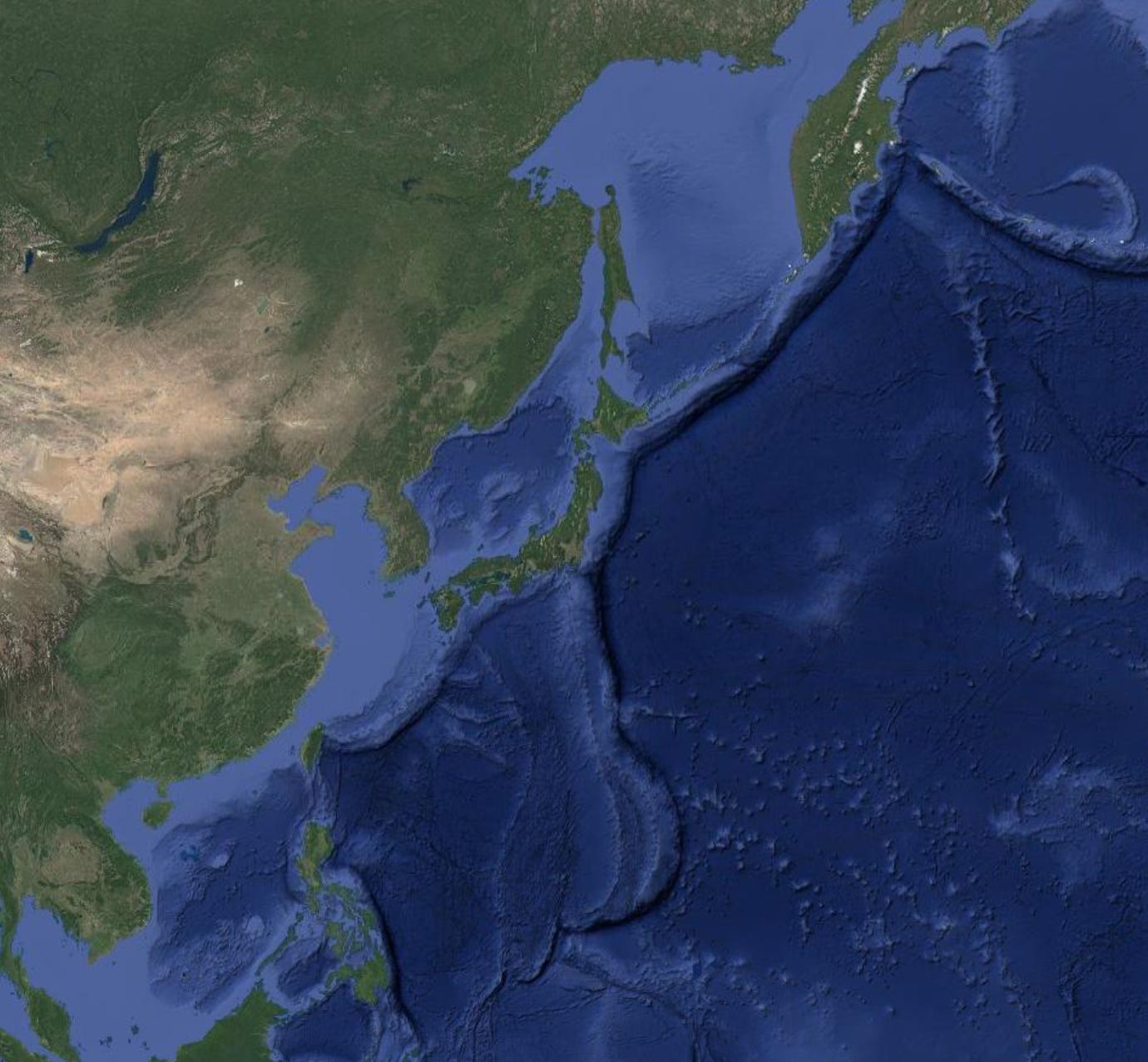
This is also why Japan is much bigger than people think: It has many islands on these subsea mountain ranges:
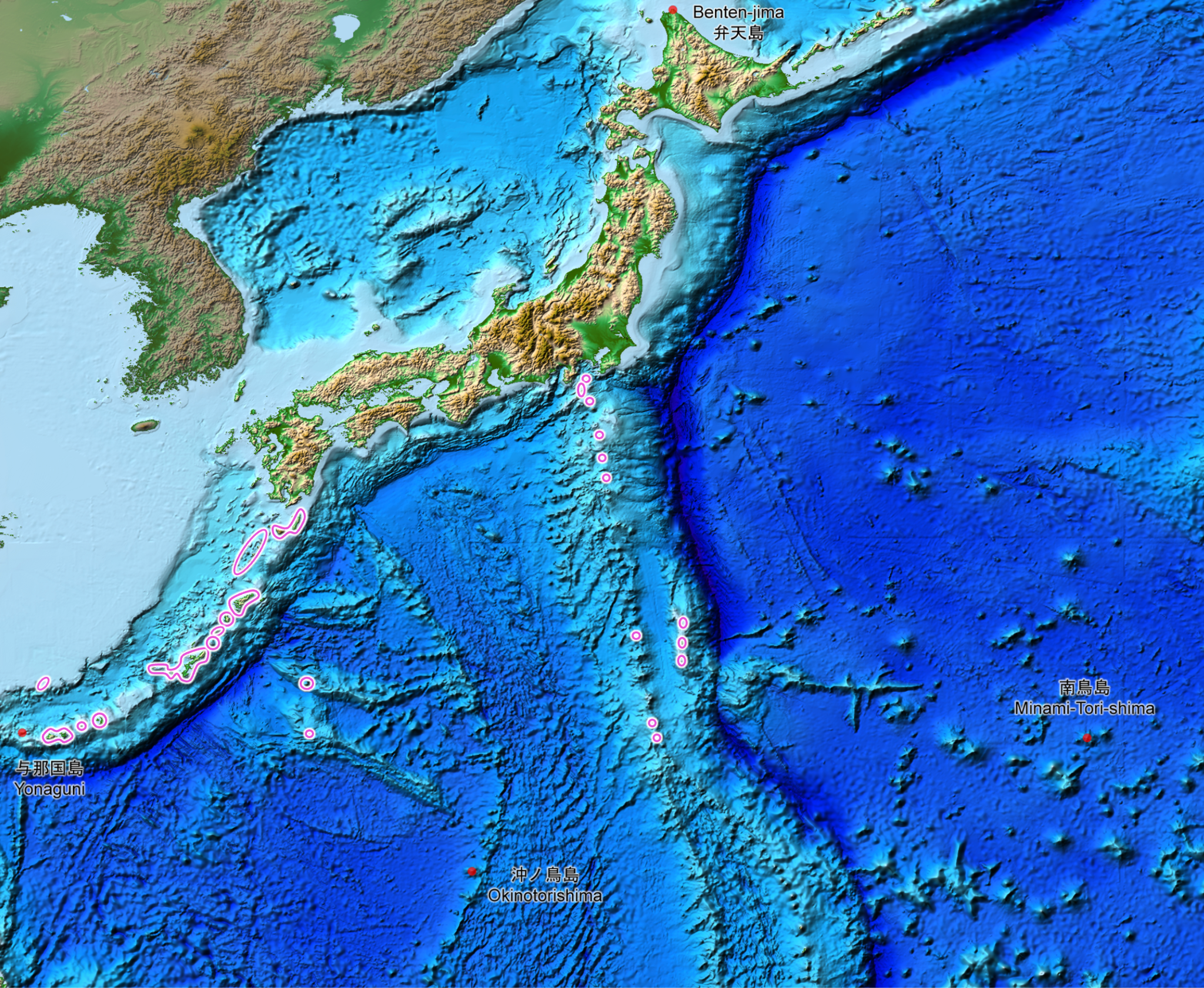
This is why Japan claims these territorial waters:
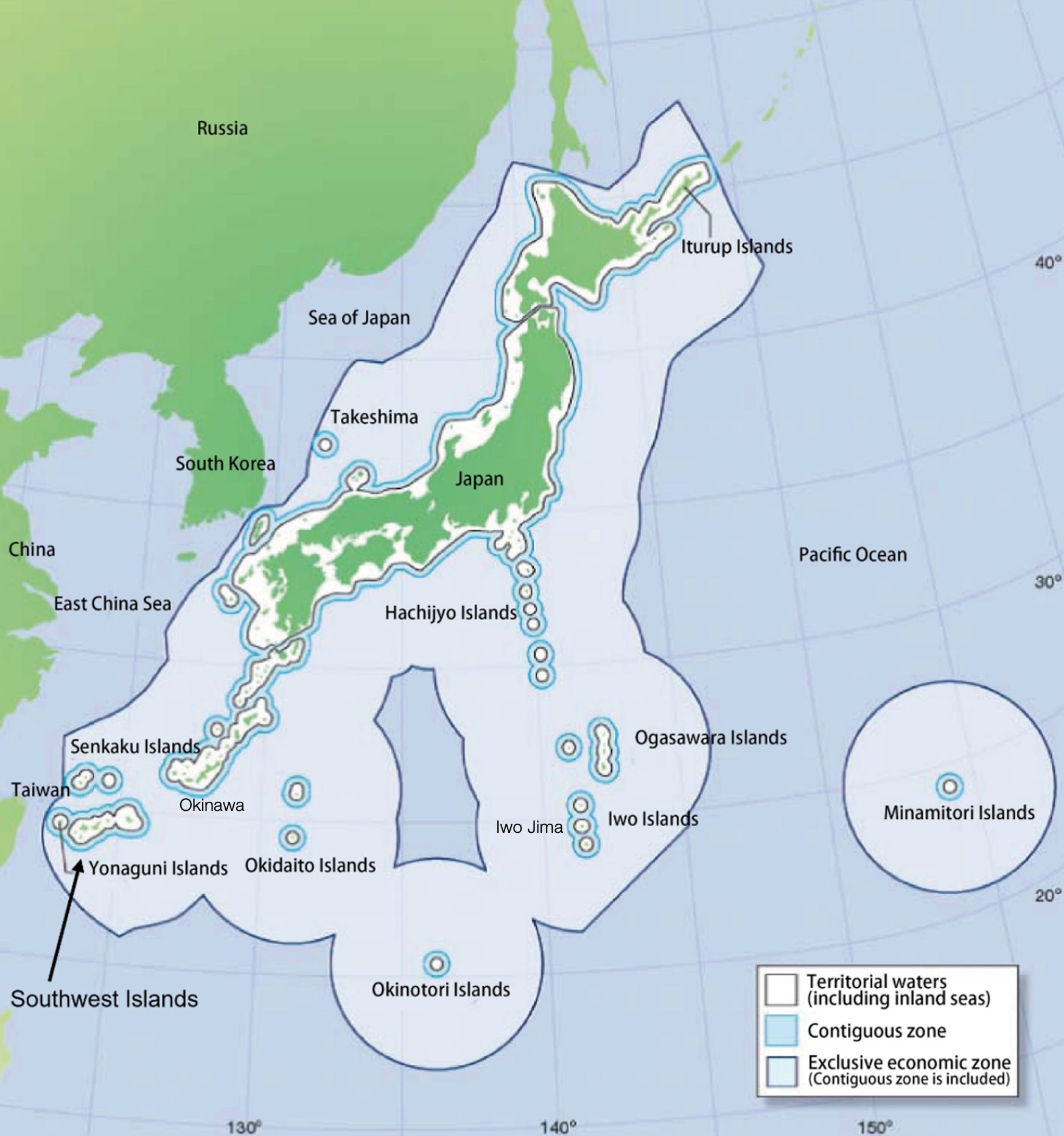
Japan’s exclusive economic zone is the 8th biggest in the world thanks to all these islands.
All these islands are the reason why the US famously took the islands of Iwo Jima and Okinawa during WW2: The US needed pit stops between Hawaii and Japan, and these islands were remote enough from the main islands that they were relatively easy to overcome, but they were also close enough to give access to Japan’s four big islands, and the conquest severed the connection between Japan and its colonies in the Pacific.
Japan eventually got them back, and that's why its maritime boundaries are farther north, south, east, and west vs South Korea.
The tectonic plates also explain why Japan is so mountainous:
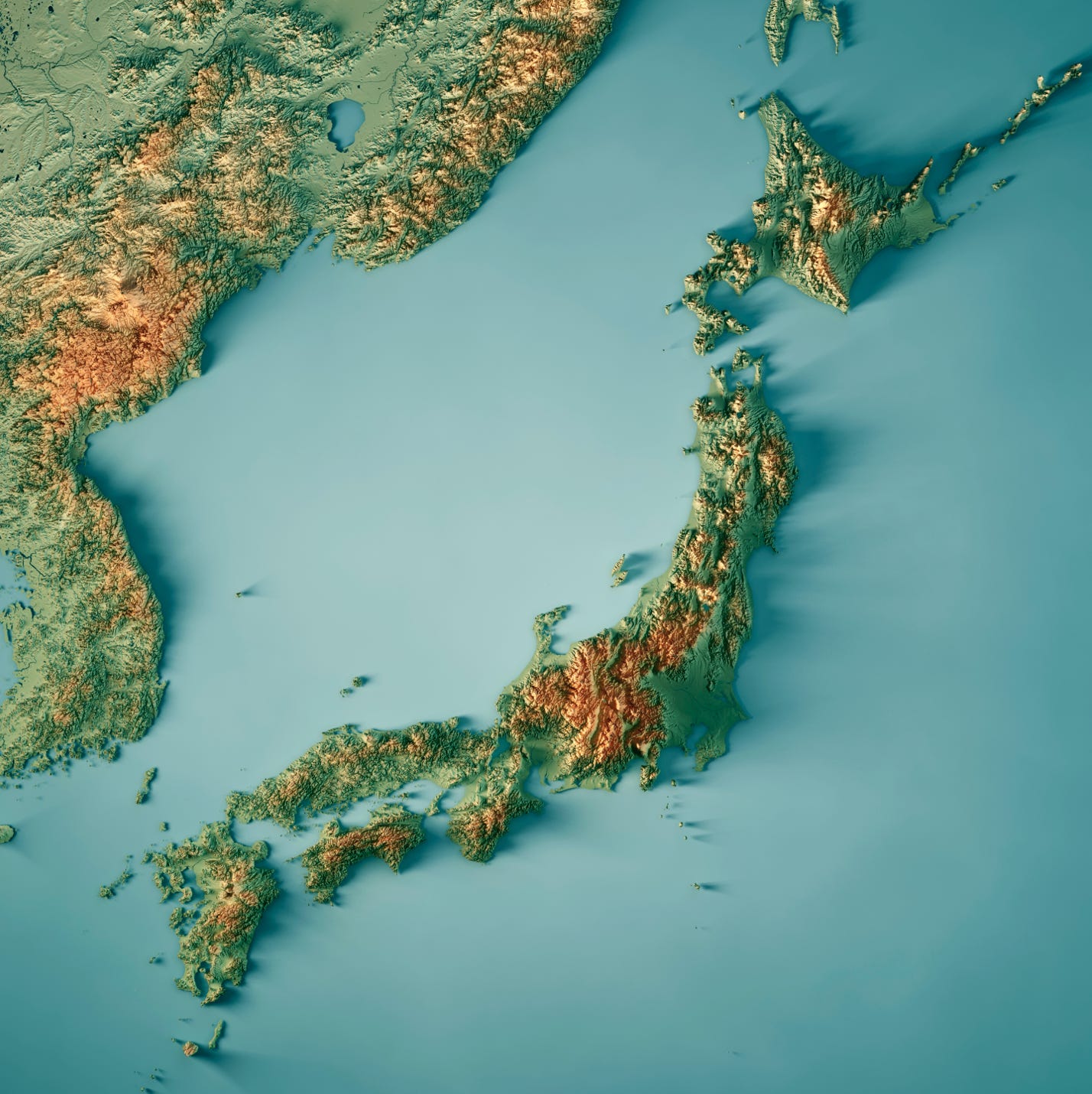
Only 12% of Japan’s land is arable! So is this rare land extremely fertile because its volcanic ash fertilizes the soils, just like on Java?
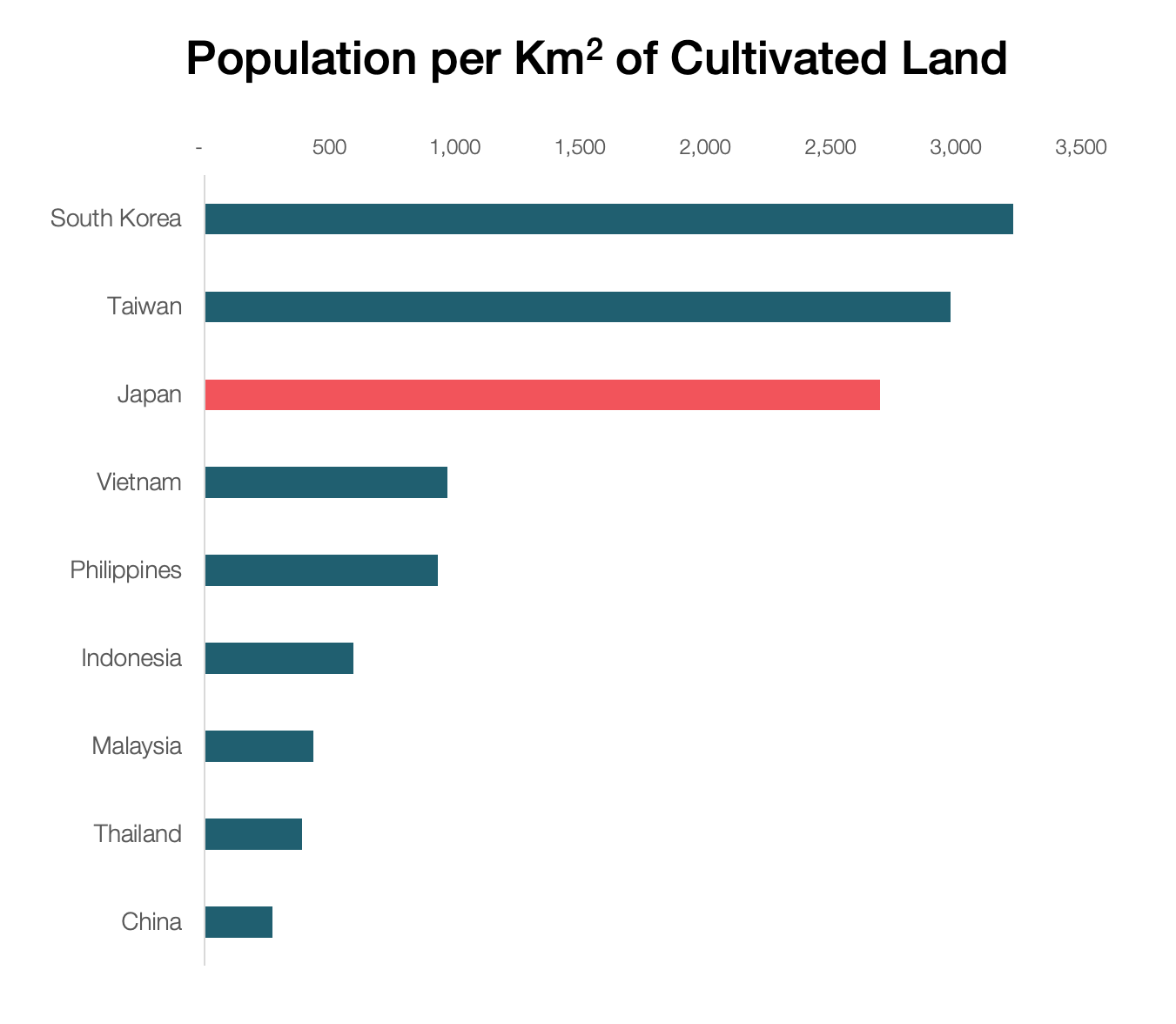
Big surprise! Japan today is actually not as densely populated as South Korea or Taiwan, if we consider total cultivated land! And South Korea is not a volcanic peninsula! So, in the case of Japan, its large population isn’t attributable to volcanoes. So what is it, then? Well, let’s see where the Japanese people actually live.
Japan’s Food Geography
Half of Japan’s population lives here. Why?
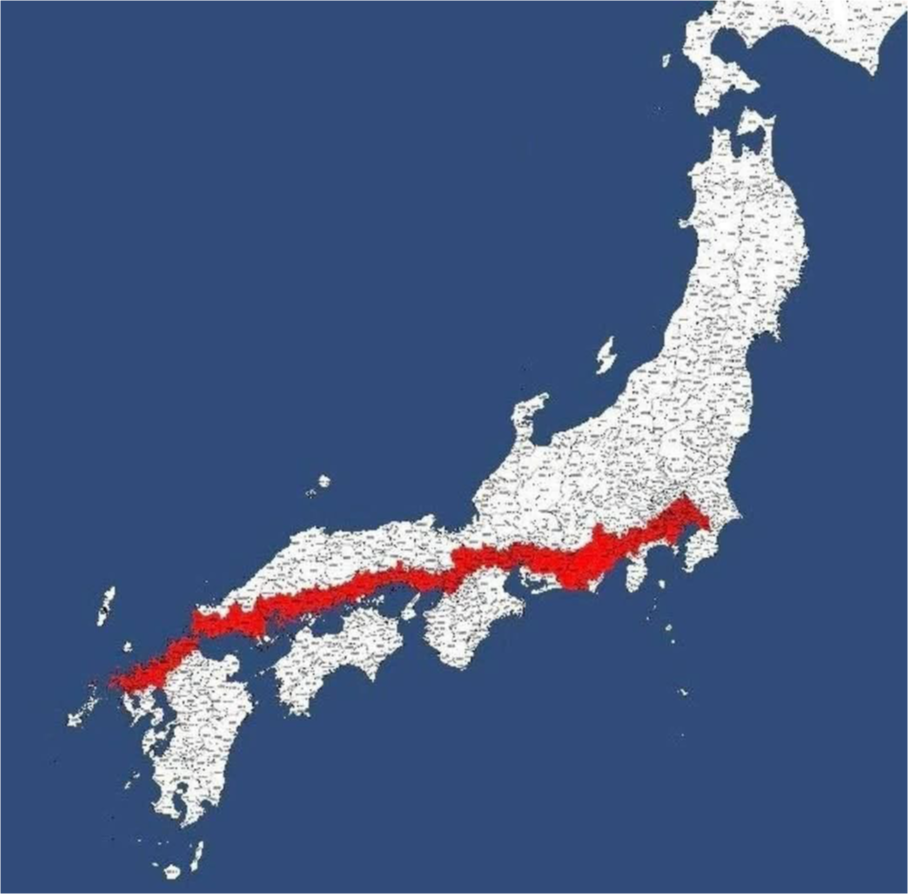
Here’s a full population density map:
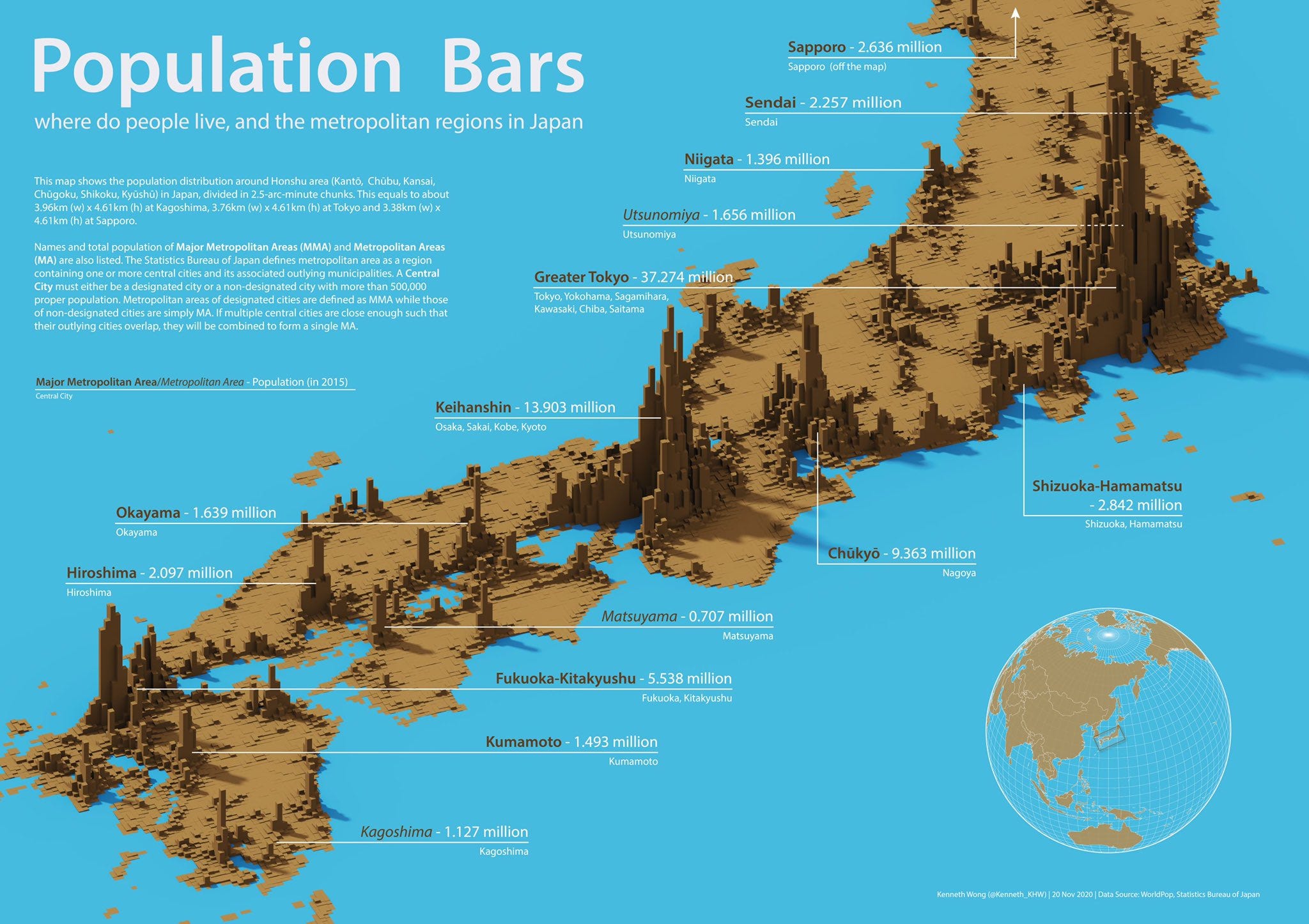
Here’s a clue:
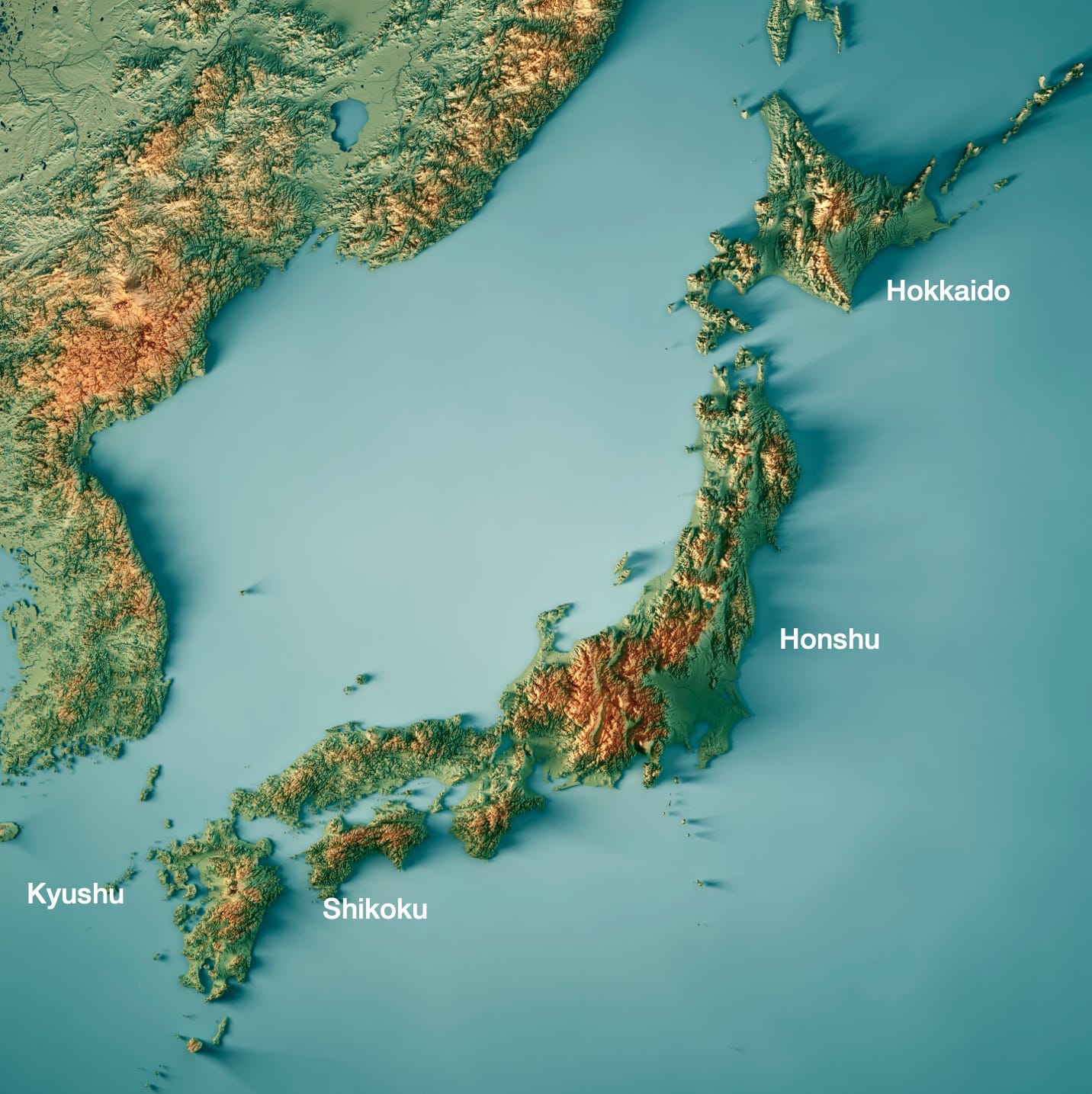
Do you see it already?
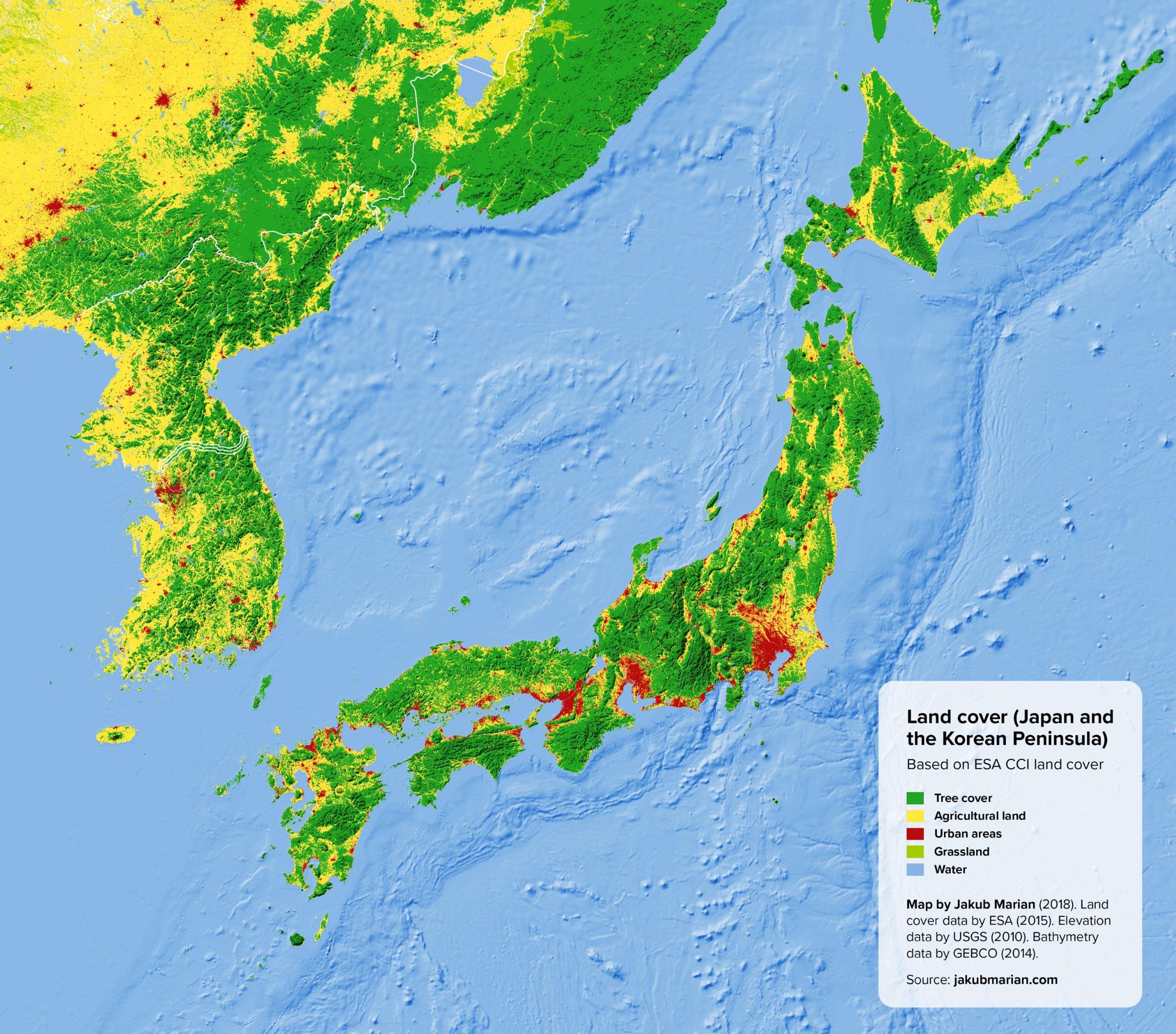
These valleys surrounded by mountains make up the 12% of arable land. It’s obvious from maps like this one, showing how every nook and cranny is full of human habitats.
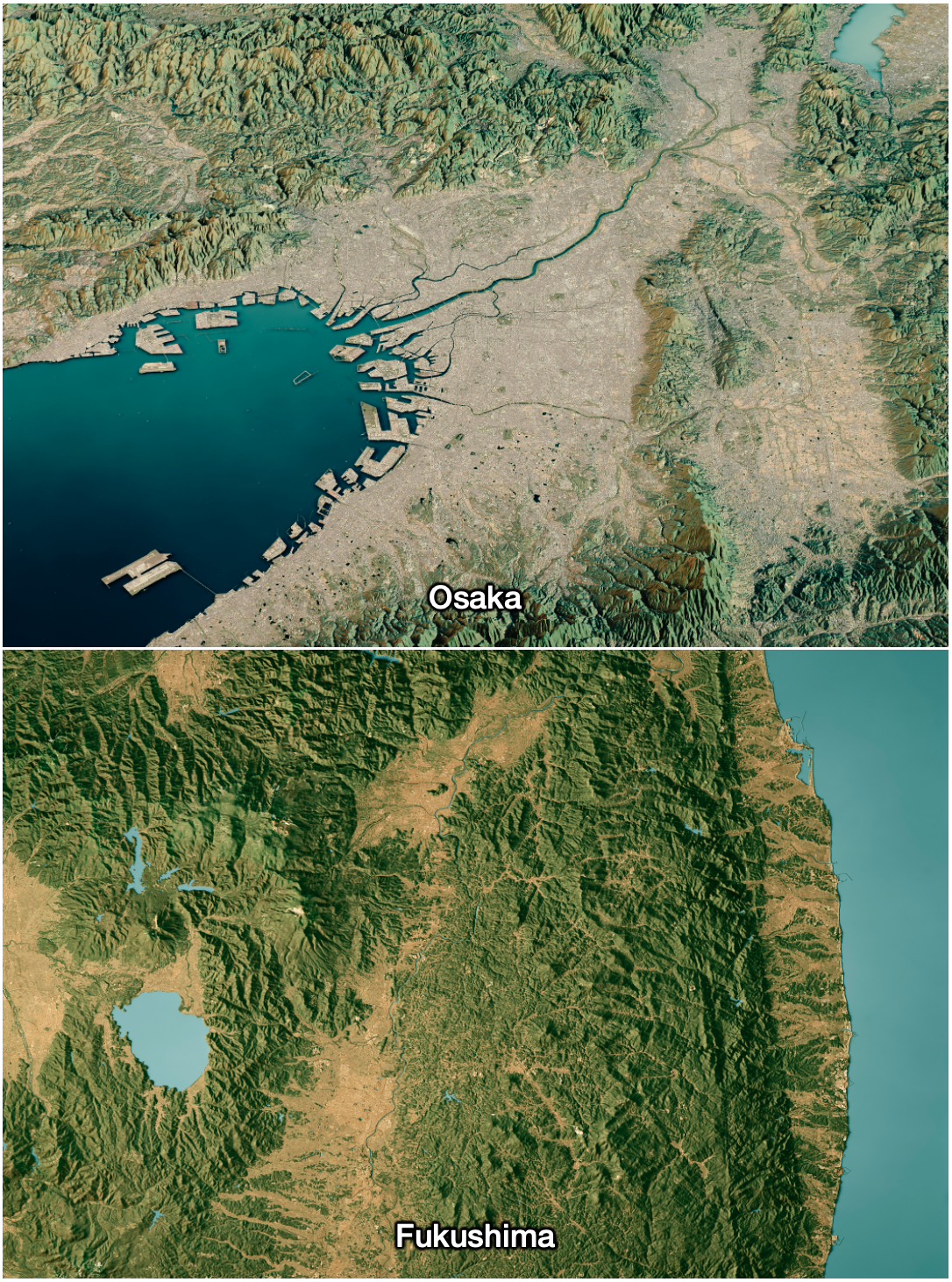
But also, you can see in the previous map that the big urban areas are in the southern valleys. There are other big valleys to the north, but those don’t harbor such big populations. Why?
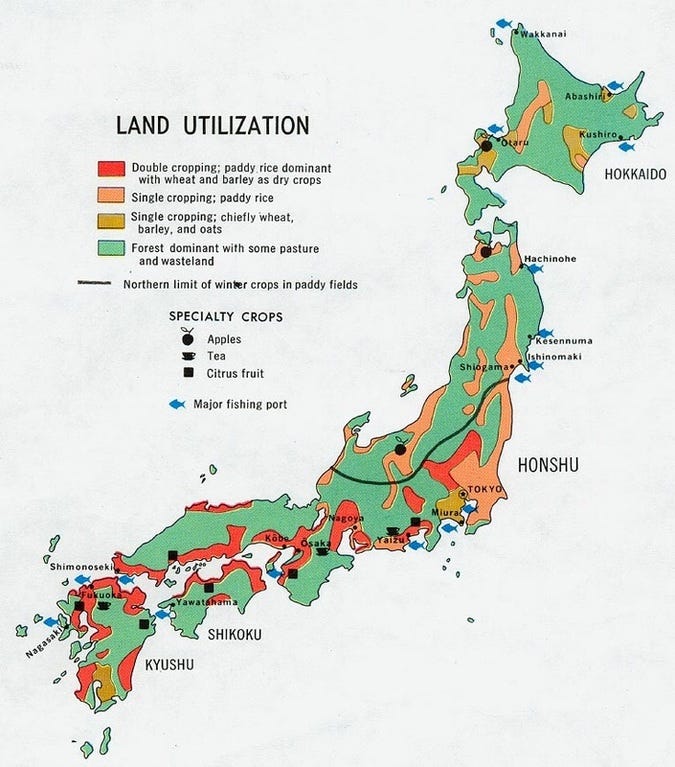
Notice the black line. Historically, below it, farmers would plant rice in May / June and harvest it September / October, when they would drain the rice paddies and plant wheat or barley, to harvest just before planting the rice again.
Did this really have such an enormous impact on Japan’s population? If so, we should see two things. First, the amount land that rice needs to generate some amount of calories should be very small. It is:
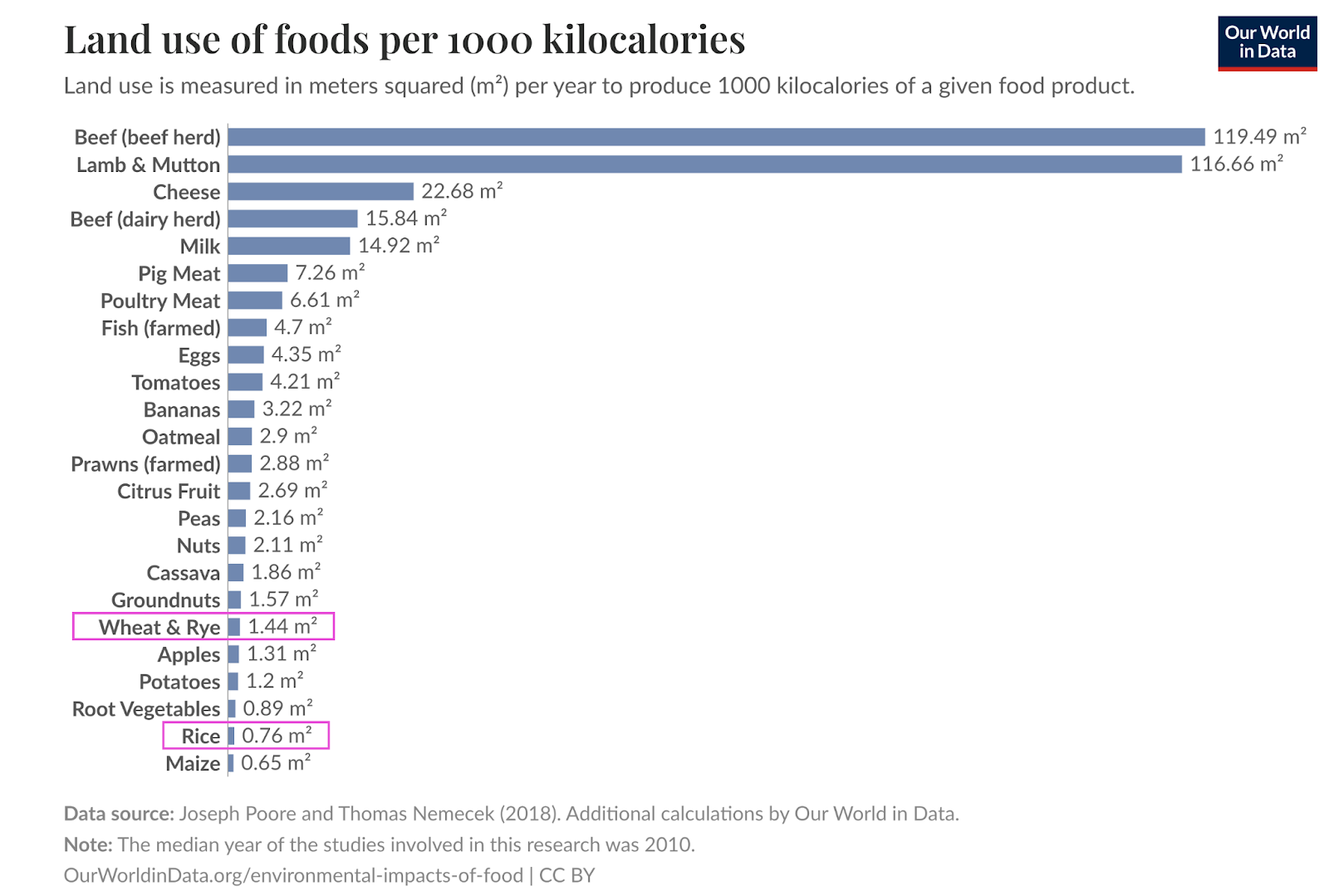
Second, we should see the Japanese population grow when rice gets introduced, and then again when double cropping starts, and these must happen in Japan before they happen elsewhere. Do we see that?
This is the population of different East and Southeast Asian countries over the last 2,000 years:
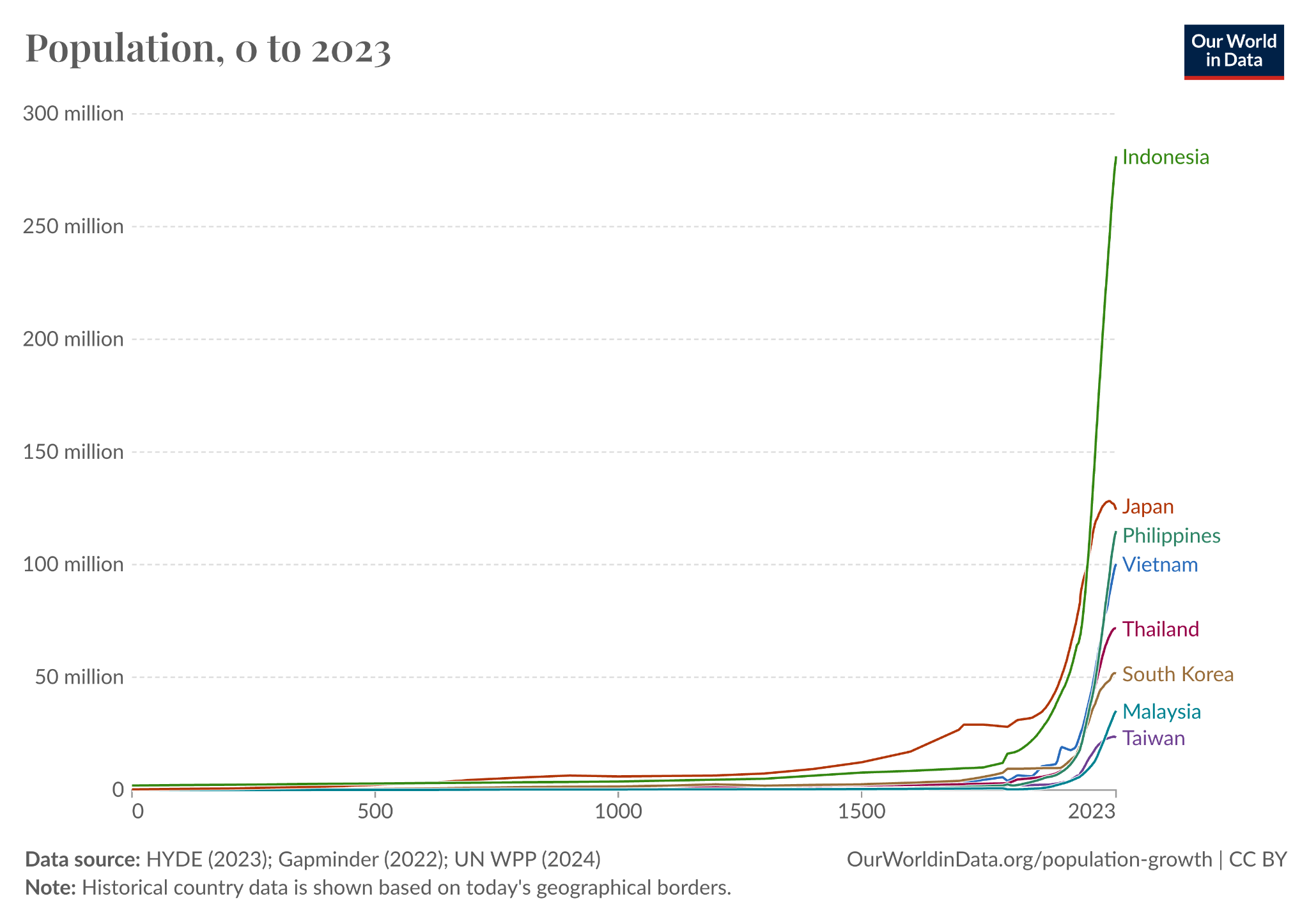
Japan’s population was bigger than its neighbors’ for nearly 1,500 years. Let’s zoom in on that, eliminating the hypergrowth of the 20th century:
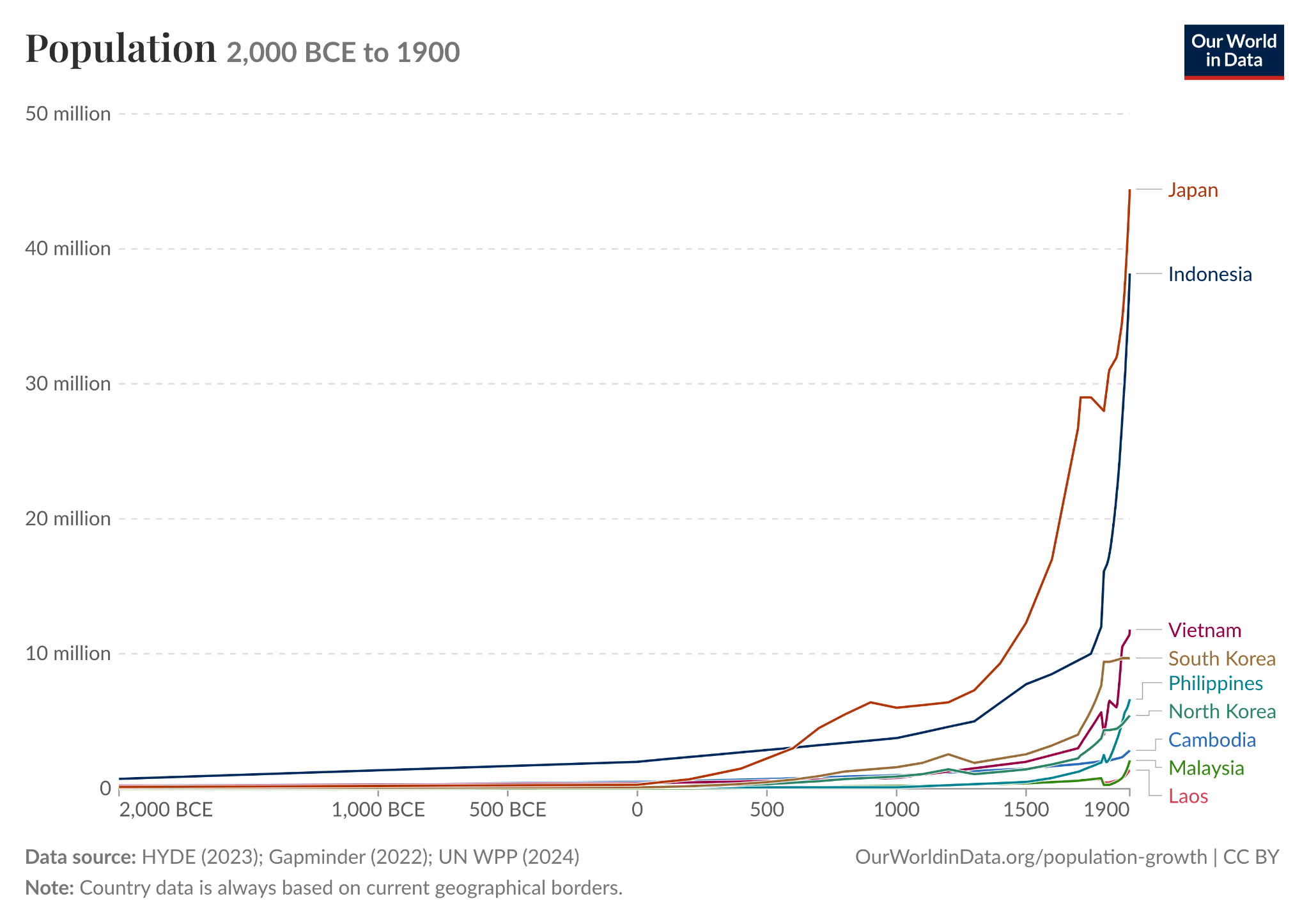
Indonesia’s population was probably larger than Japan’s early on, but around the first century, Japan’s population started growing much faster than any neighboring country’s. It slowed down around 700-900 AD, picked up its growth again ~1200 CE, stopped in its tracks in the early 1700s, and exploded again in the 1800s. It only stopped growing recently, with the demographic collapse post-2000. We can see clearly Japan’s three big growth spurts in this graph:
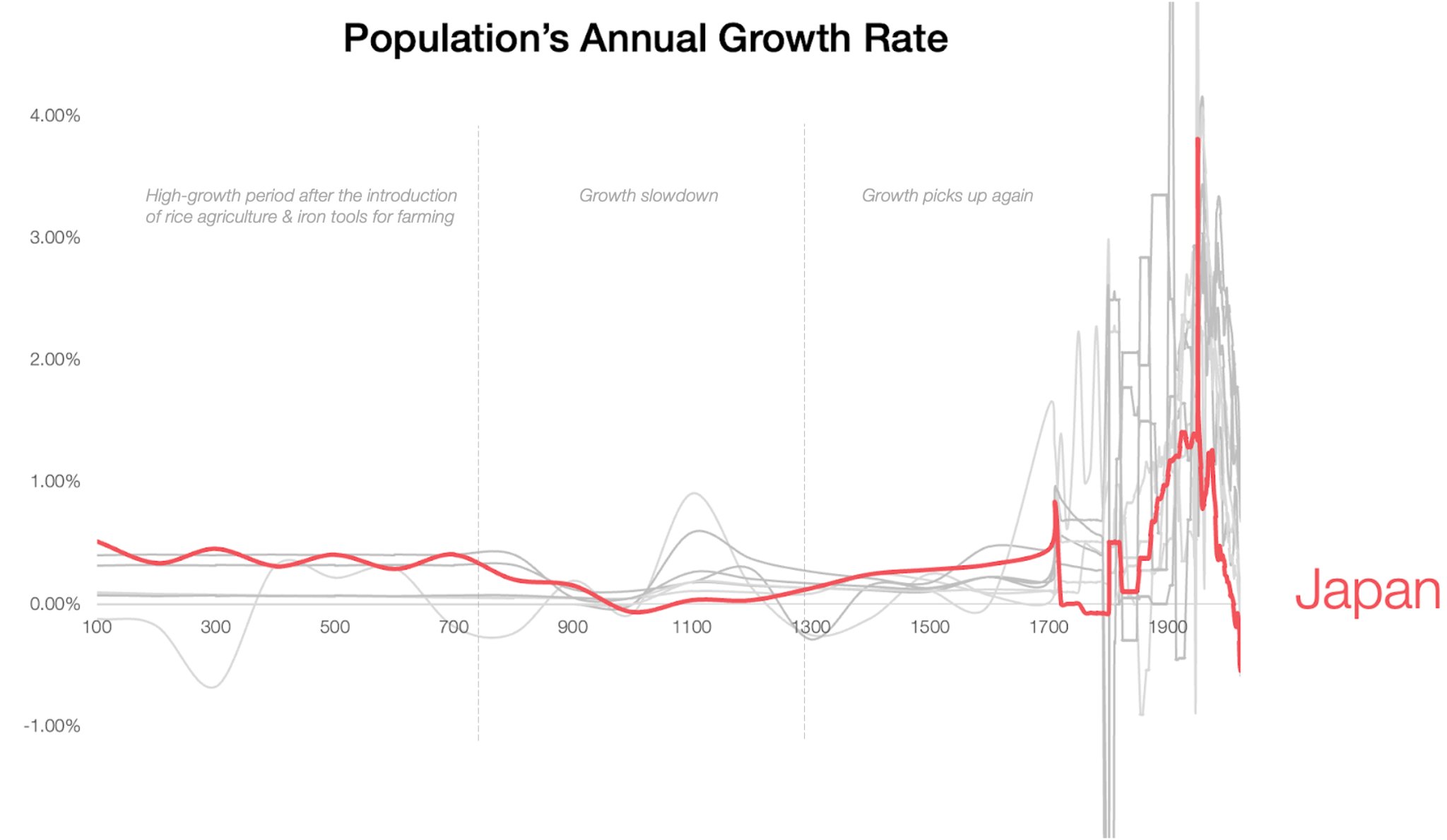
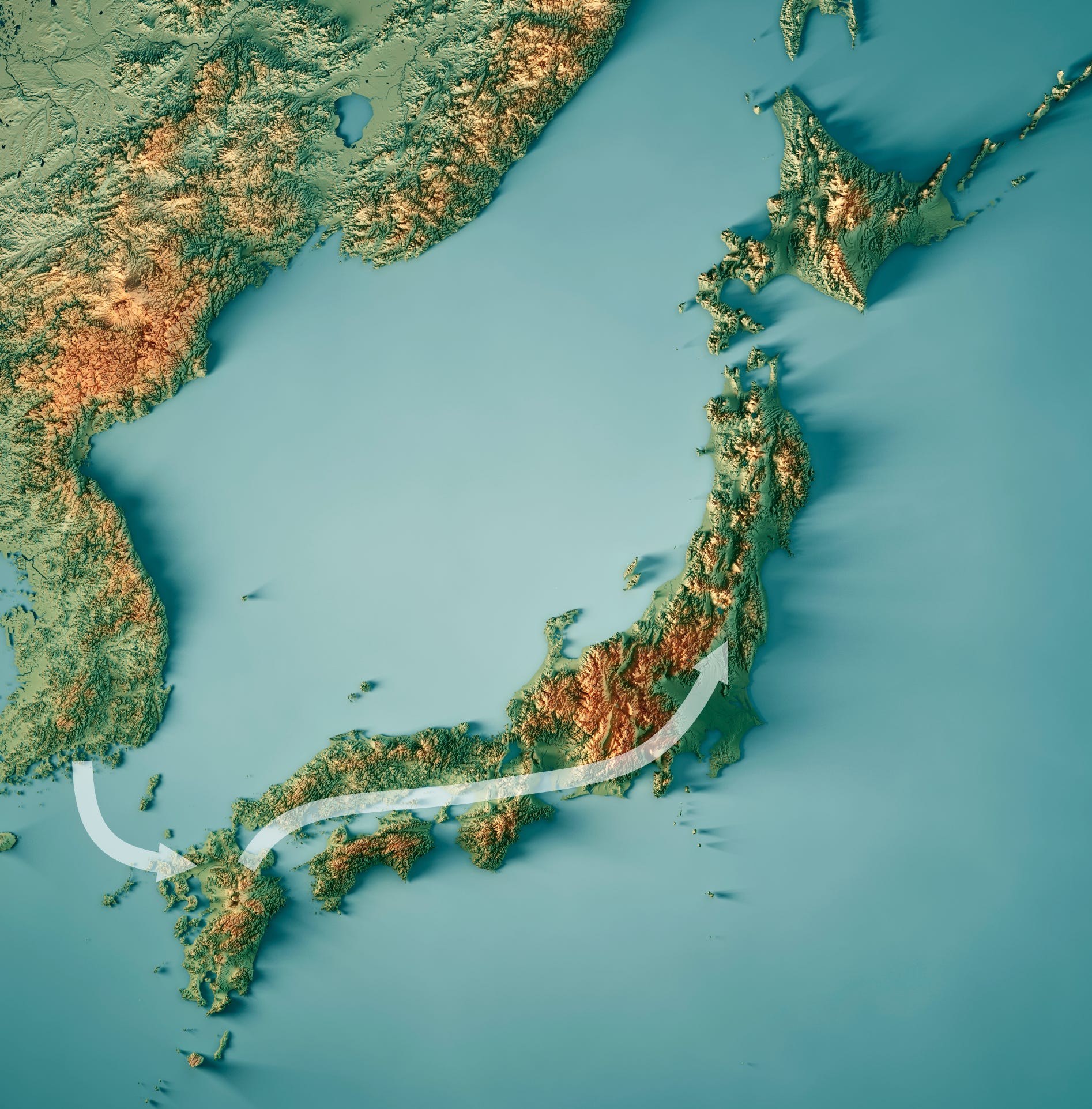
The first growth spurt lasted until 700 AD, and was the result of the introduction of wet rice agriculture in Japan, via China and then Korea.
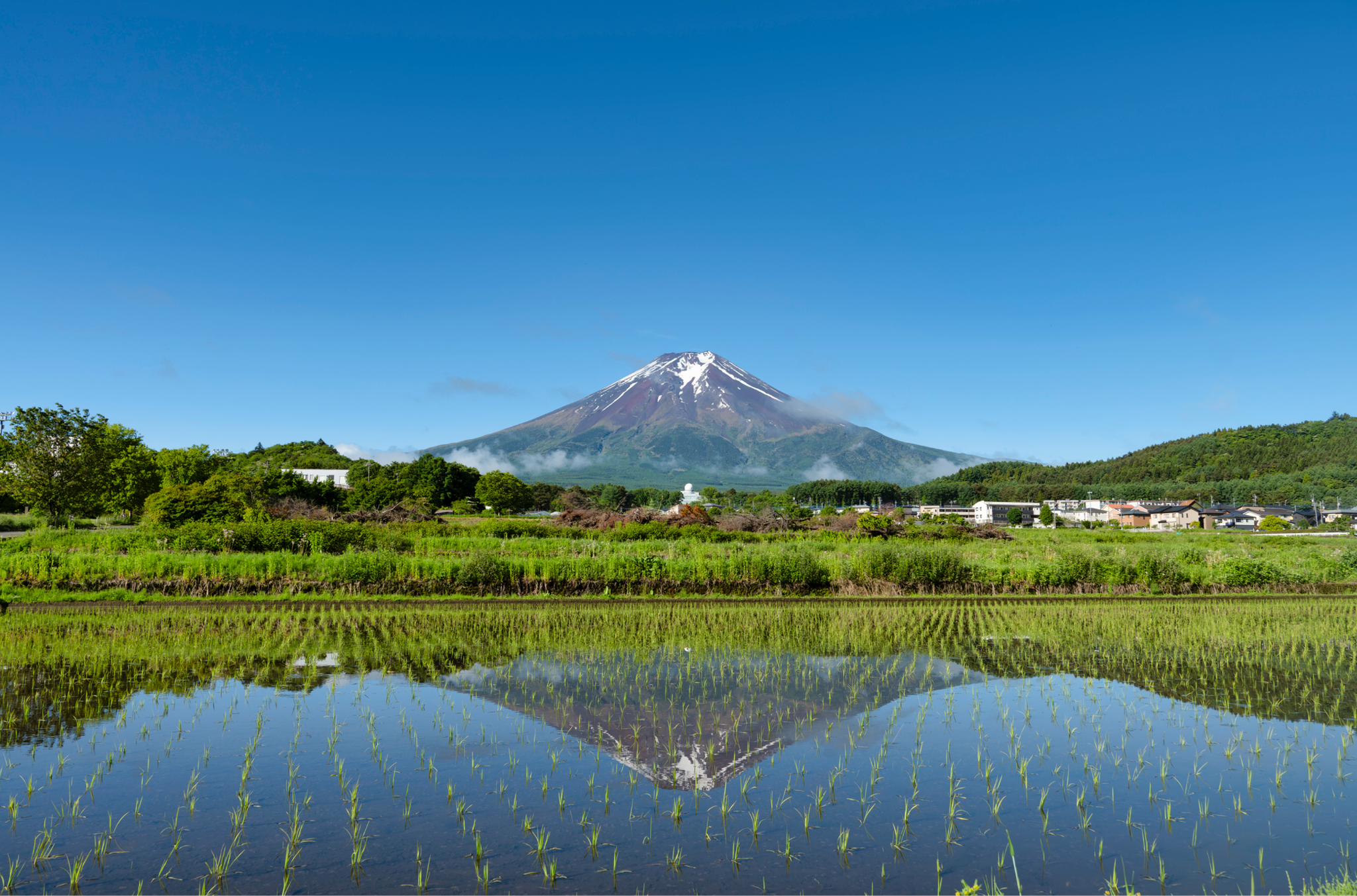
Japan is naturally quite fertile, because the rain that flows down from so many mountains brings with it not just water, but sediments to fertilize the land.
Archaeologists believe the Jōmon people arrived on the island about 40k years ago, but in the first millennium BC, the Yayoi started immigrating into Japan from Korea, bringing with them first rice paddy technology, and eventually iron tech, which helped increase agricultural productivity. That’s why the average Japanese today is genetically very close to Koreans.
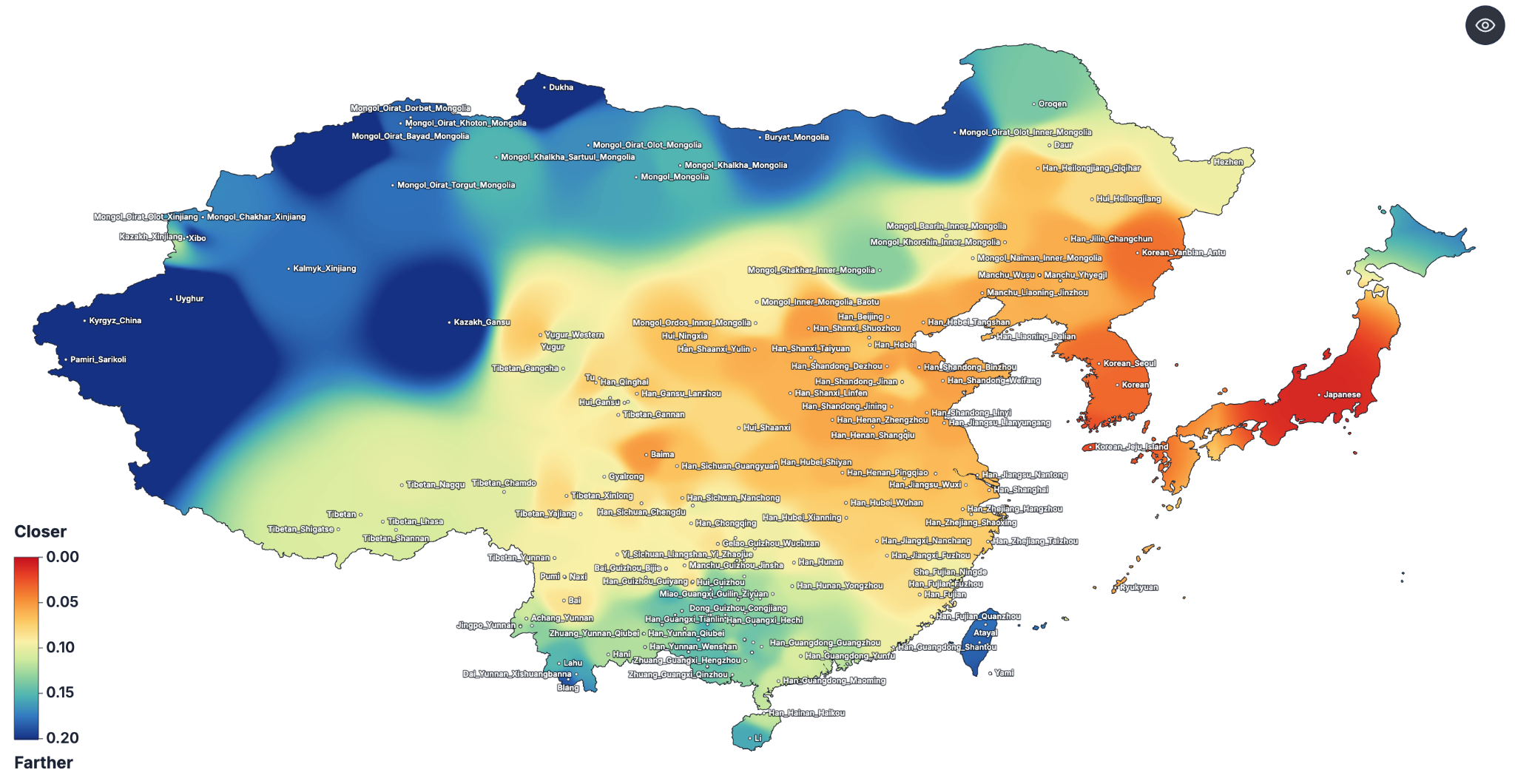
Over the centuries, as the population grew, it moved farther north, bringing with it its farming knowledge.
That’s why the population boomed: It expanded along with the share of farmed land, and its productivity.
The Population Slowdown
Alas, the boom did not last forever: The population went from ~6M in 700 AD to ~4M in 1150 AD.
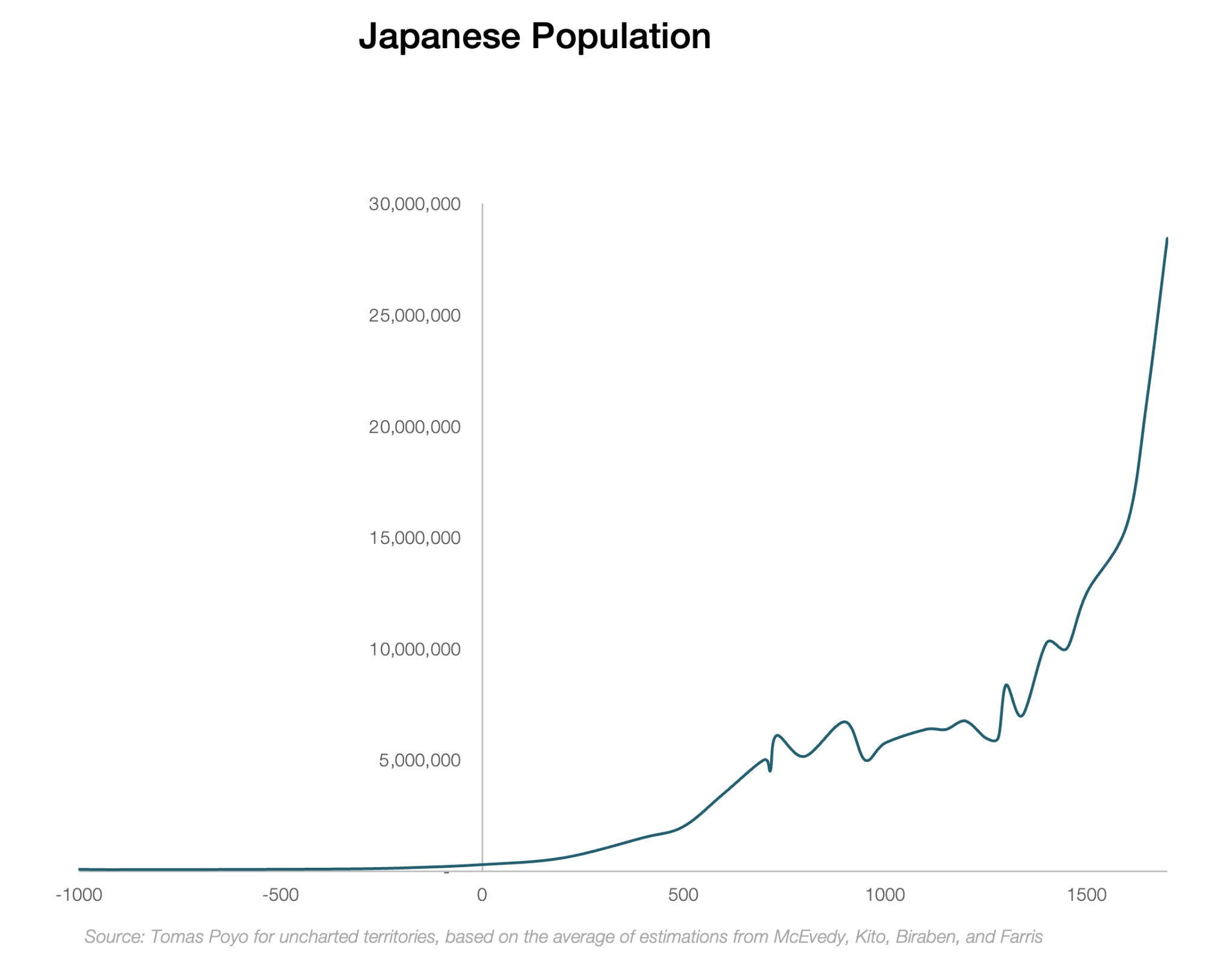
By around 700 AD, the Japanese had converted the best valleys into farmland, and the speed of conversion began to slow down and focus on marginal land—not the most fertile. Growth stalled. The adoption of new farming techniques like the use of iron slowed down, too.
Japan’s East-West vs North-South
This is one reason why Hokkaido, the northern island, reflects the original native population on the genetic map more than the rest of Japan (the Ainu, and also local mixing): Rice cultivation did make it there, but it was later abandoned as it was not as effective. The farmers from the south went as far as their rice agriculture allowed.
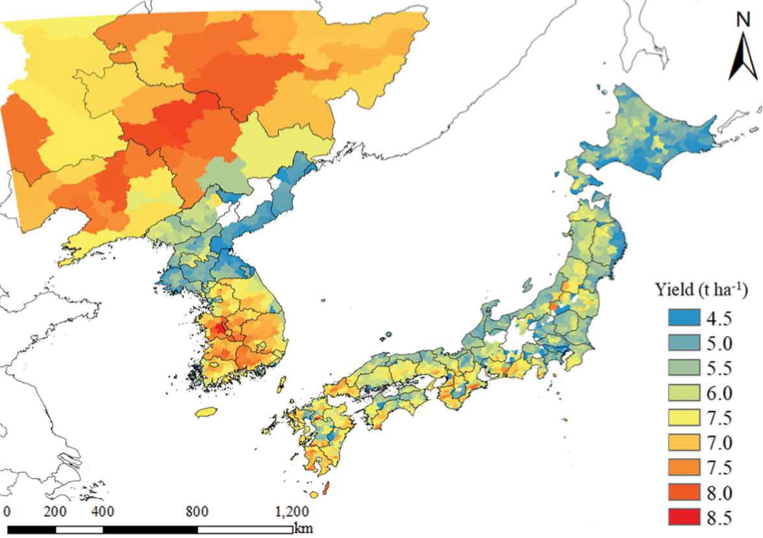
Why didn’t rice travel farther north?
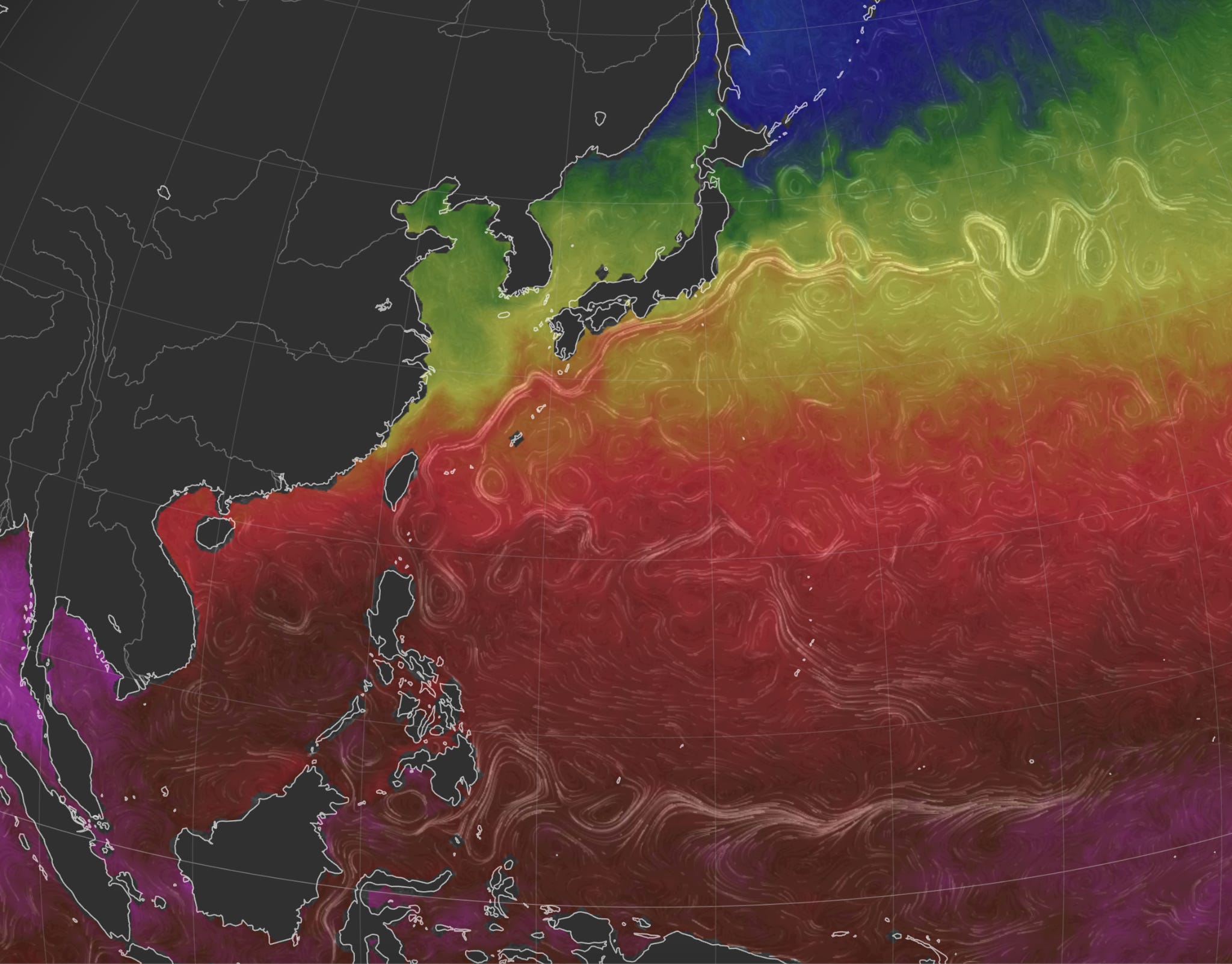
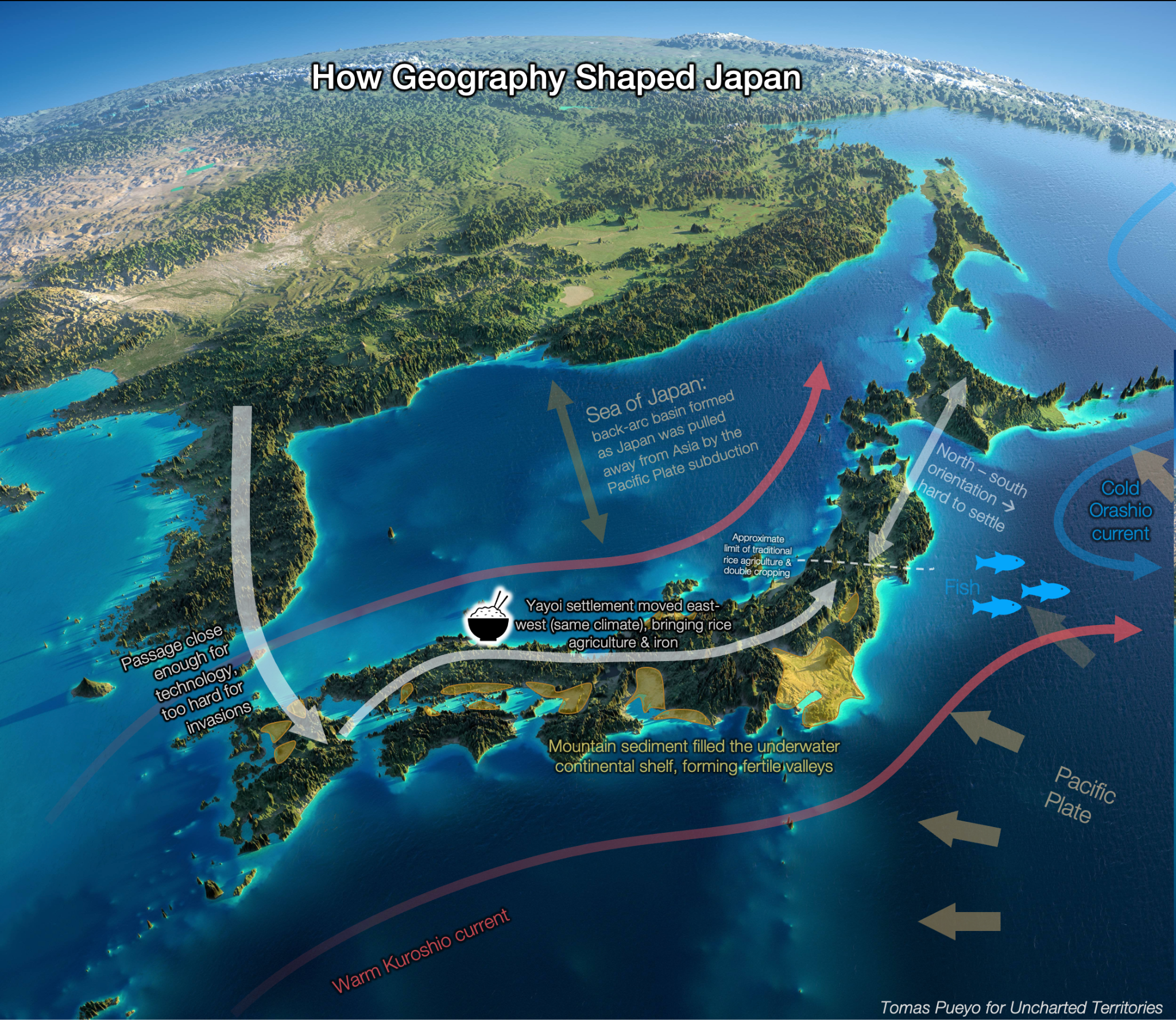
Notice how a warm current from the Philippines and Taiwan reaches all the way to Japan, warming it up.1 But also, it meets a cold northern current around the north of the Honshu island. These currents are called Kuroshio and Orashio:
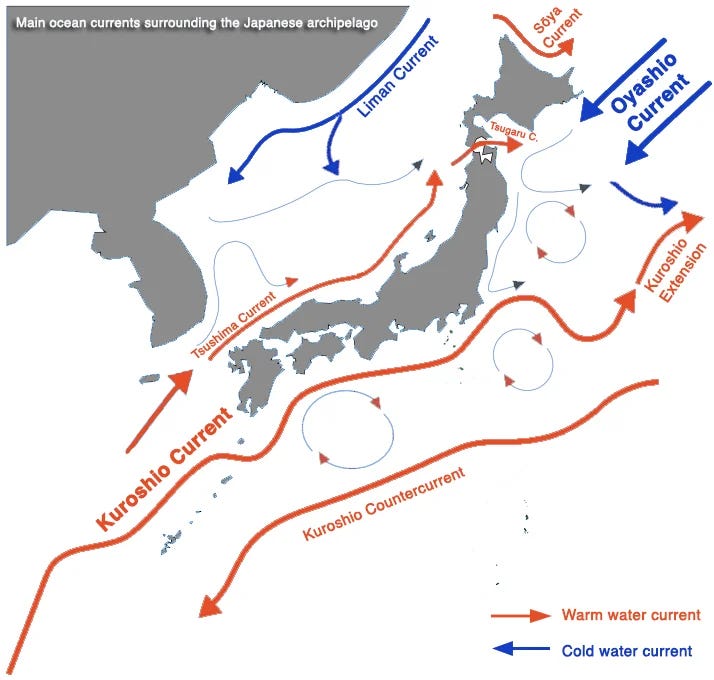
North of that point, it was too cold for rice cultivation.
However, the names of these currents tell us something else about Japan’s food: Kuroshio means “black current”, because this water is devoid of nutrients, so it’s more transparent. Meanwhile, Oyashio means “parent current”, because it comes from the north full of nutrients, bringing plenty of fish—the source of the fishing culture in Japan.
And this is why sushi is the most Japanese type of food. It’s where rice meets fish: the rice from the continent, migrating from south to north through the islands, and increasing the population through rice farming in the Japanese plains; the fish from the ocean, with the nutrients moving from north to south, following the winds and currents.
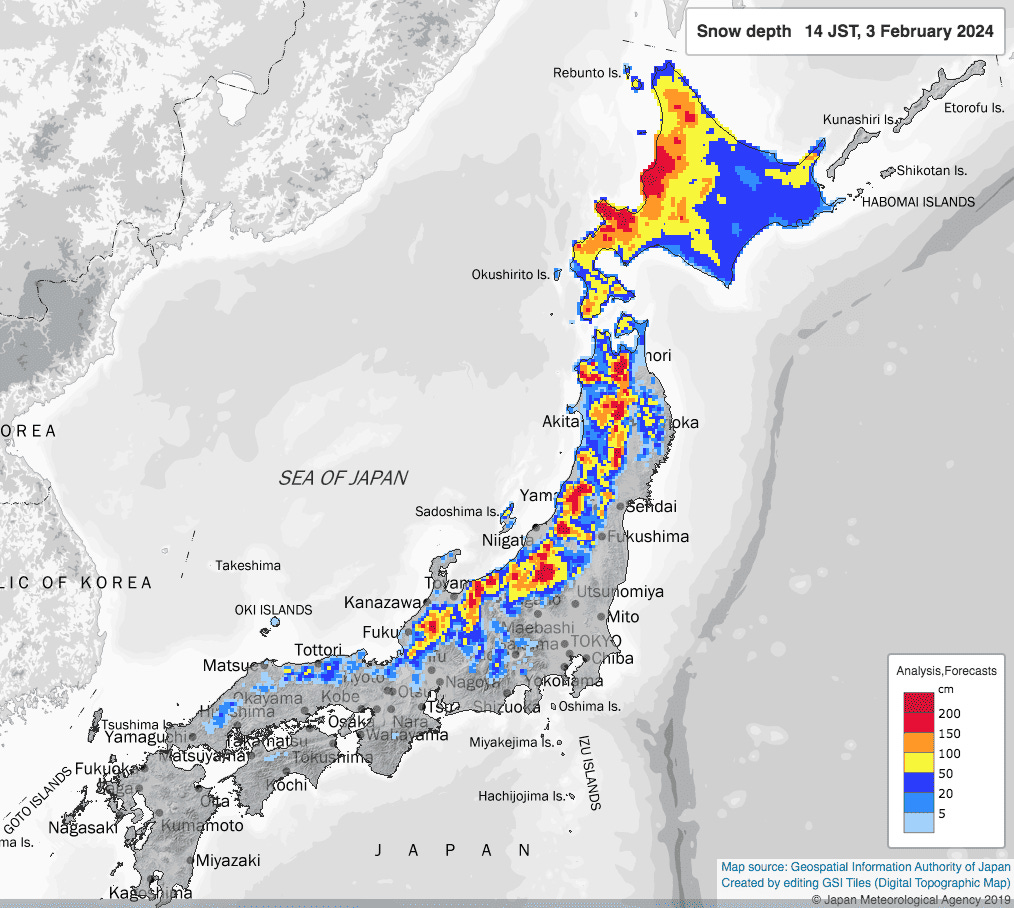
Indeed, winds follow the same pattern as currents: Winds from Siberia travel over the Sea of Japan, catch a lot of moisture from this sea, and the drop it as they reach the tall Japanese mountains. This is why Japan’s peaks can get serious snowfall.
Why was rice pushed so far north? Because that was Japan’s staple, and that meant taxes were frequently collected in rice, which meant rulers had a strong incentive to push for rice production at the expense of other crops. Alas, the north simply couldn’t produce it.
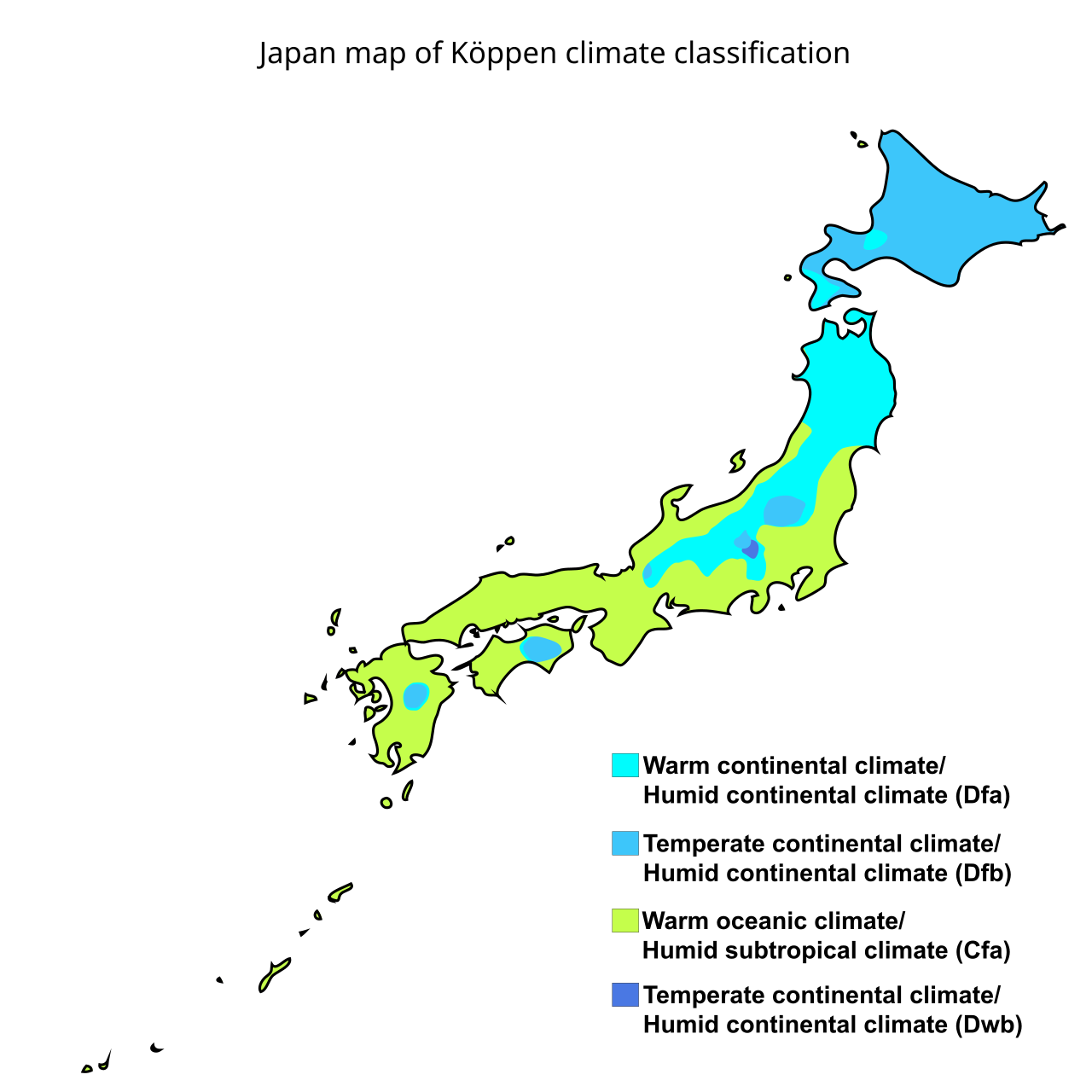
It’s not a coincidence, then, that the southern half of Japan is more populated: Because it runs east-west, most of these islands share a similar climate, and they all could share the same crops and similar lifestyles. But then Japan bends northwards, and the islands start changing climates much faster. We can see it in the climate map of Japan:
Or, geometrically, through this map:
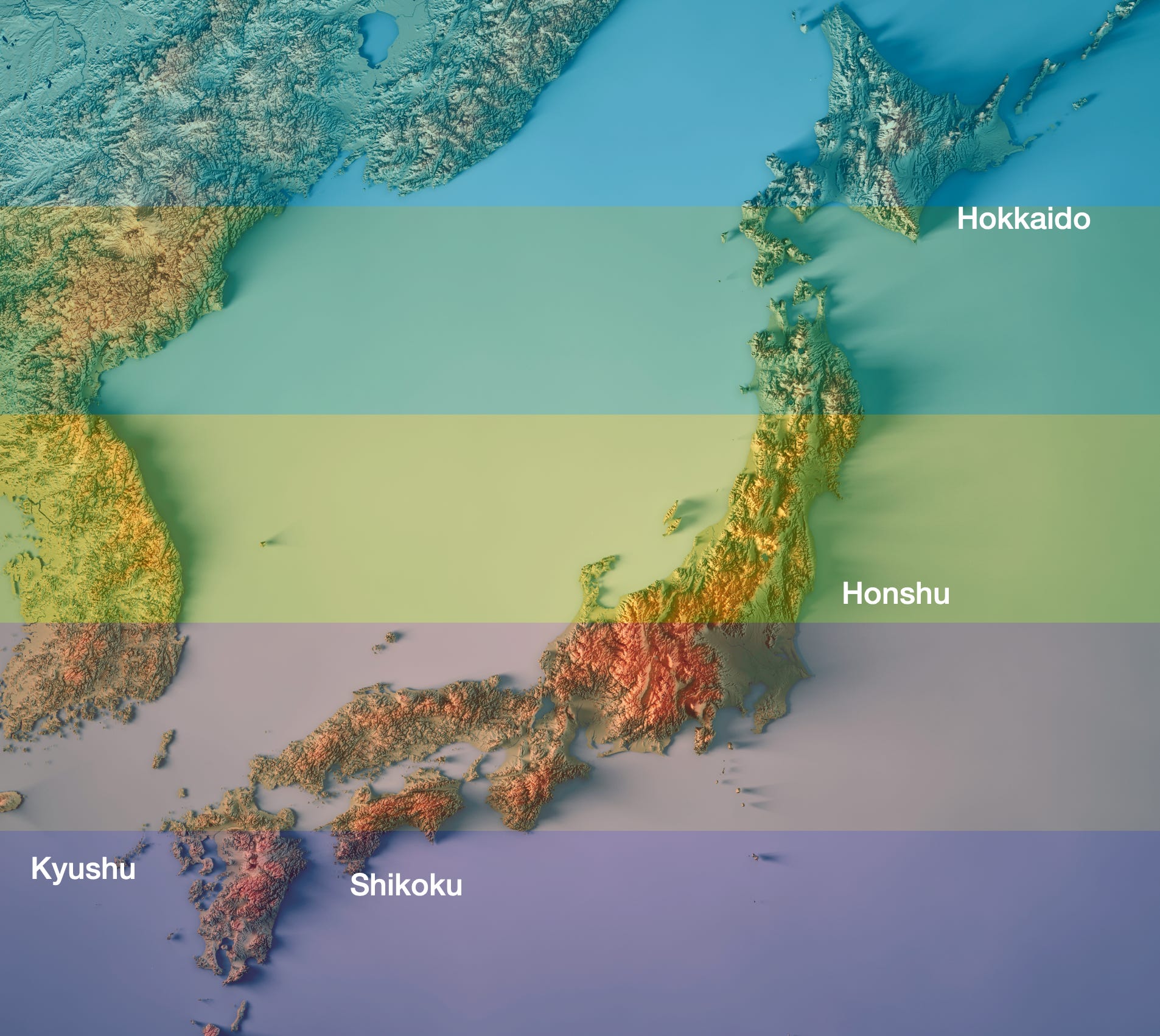
This is why agriculture was so crucial for Japan’s population growth—and why it stalled once most of the arable valleys were converted to rice cultivation.
But the increase in population density made for easier spread of diseases. Between 700 and 1200 AD, several waves of infectious diseases, including smallpox and measles, decimated the country, and that stalled its growth too. Why didn’t these diseases hit before? Because Japan, as an island nation, was isolated enough that most diseases didn’t make it there until maritime trade became common.
Back to Growth
Japan’s growth picks up again around 1200 AD, when new agricultural techniques are introduced into the country from the continent. First, the double cropping we mentioned before, but not because it doubled the calories produced (it didn’t: rice produces more calories per km2 than wheat or barley), but rather because it added more calories at exactly the time of most need,2 it diversified the food, and it diversified the risk: Maybe the summer harvest was bad, but the winter one was good.
There’s another reason why growth was so vertiginous: unity.
Japanese Unity
Japan united very early.
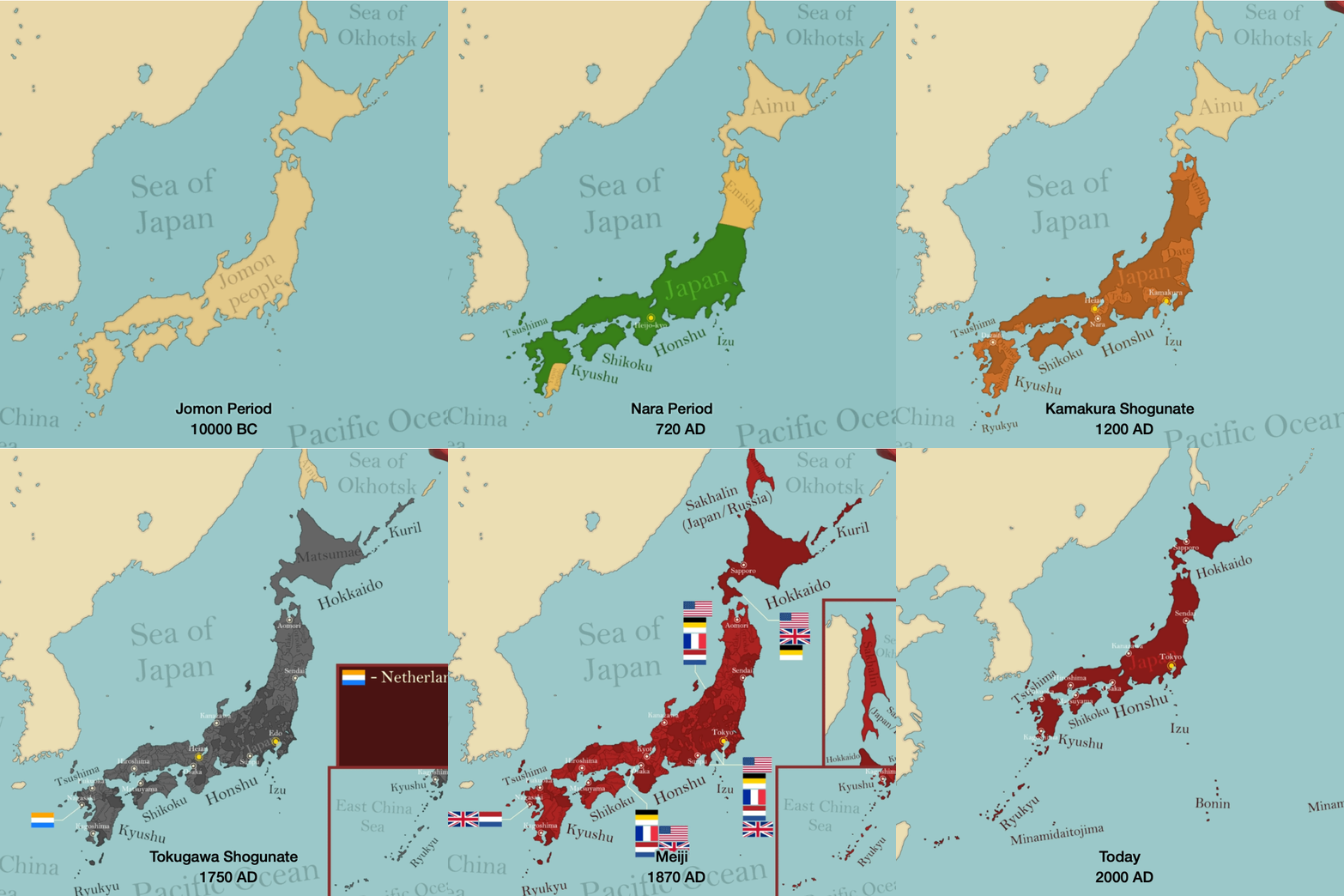
By the Nara Period, around 700 AD, the biggest population centers already belonged to one single polity. By 1100 AD, the three southern islands of Honshu, Kyushu, and Shikoku were united. This meant Japan has had considerably fewer wars than most other countries. Even its long period of warring states (Sengoku Period), which lasted ~150 years between ~1450 and 1600, did not cause a dramatic loss of population.
This unity and relative lack of wars prevented massive deaths from conflict and from disease, and allowed the Japanese to invest in their irrigation infrastructure, which increased the fertility of existing fields, and also increased the surface of farming fields by reclamation of river floodplains.
Why so much unity? Geography, of course.
Geographic Seclusion
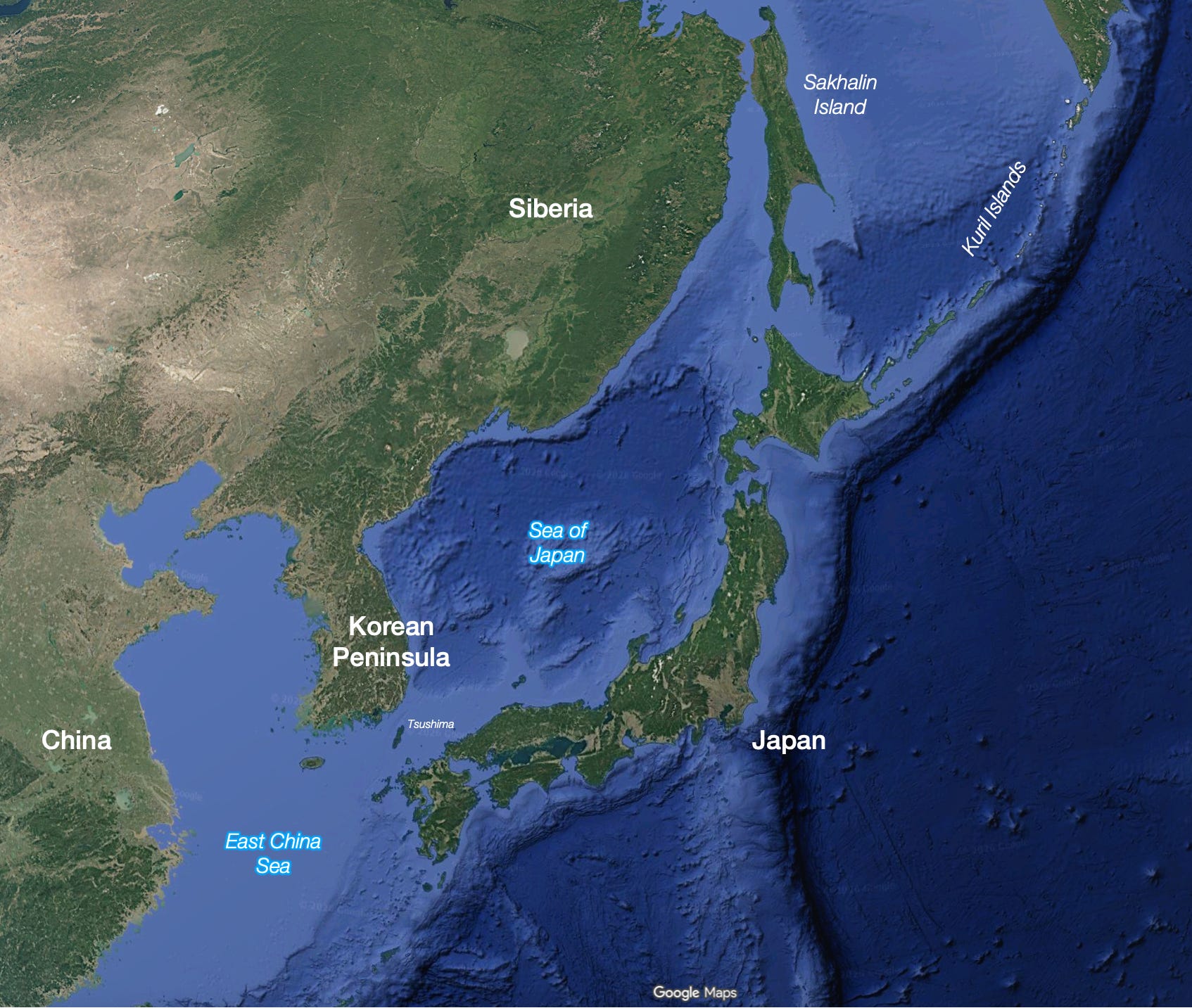
Japan is separated from the Asian continent by two seas that hinder access. The easiest path is through Korea, but the Korean Strait is quite wide (~200 km, or ~120 mi), 5x wider than the distance between France and England. And the Kuroshio current makes it very hard to cross. That said, the island of Tsushima is just in the middle, serving as a stepping stone. The Mongols tried to invade Japan twice, and both times they reached Tsushima. They were vanquished by tsunamis both times—although the second time they did reach the main Japanese shores and were beaten back by the Japanese.3
The key is why only twice? Because the Korean Peninsula was a perfect buffer: Since China is a massive fertile valley surrounded by peoples from other parts of Asia, it could never fully focus on the Korean Peninsula, and as a result, Korea remained pretty independent. The Koreans fought all the wars against China on behalf of the Japanese.
And why is there a sea between China and Korea on one side, and Japan on the other? Because it’s a back-arc basin:
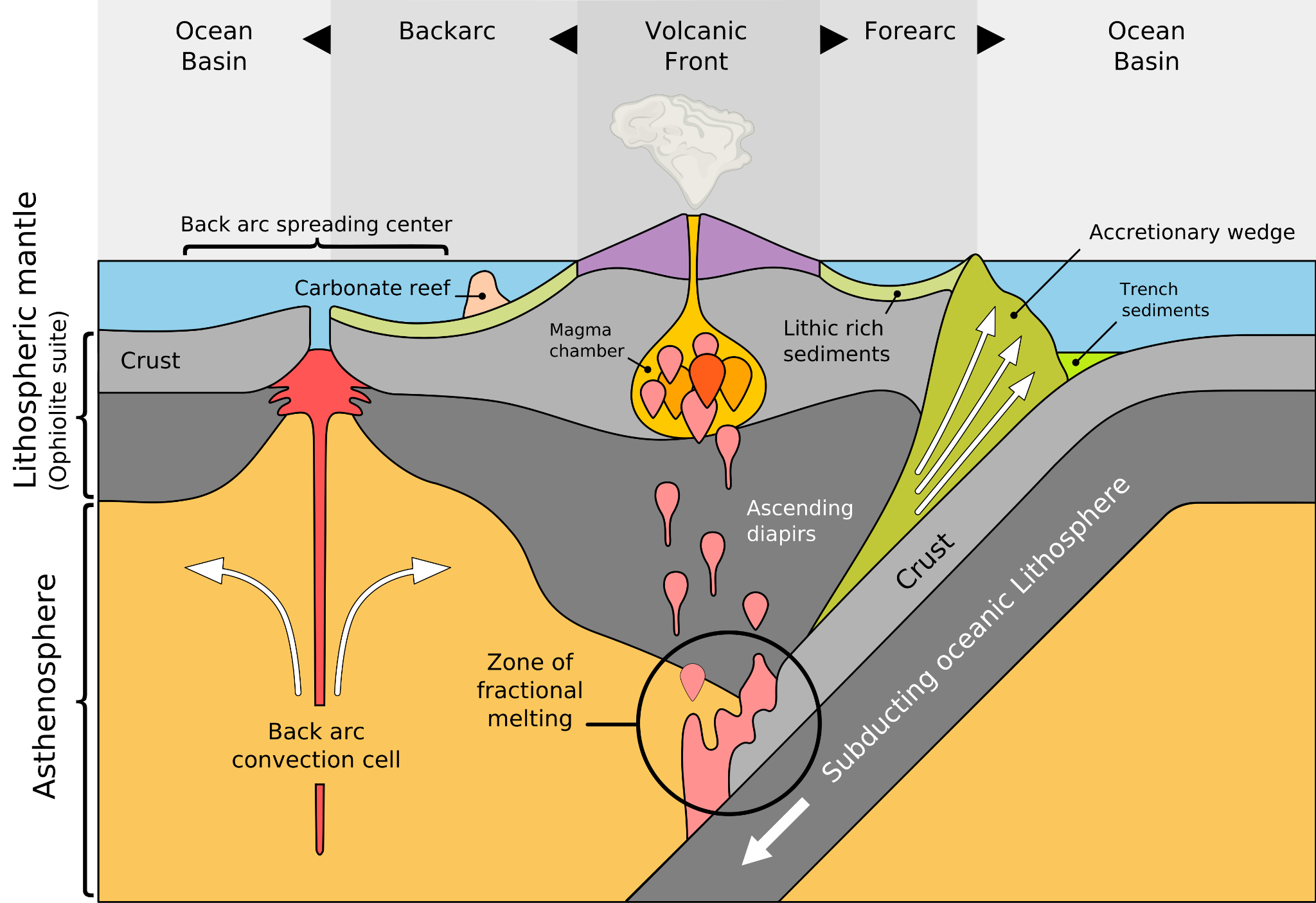
As the Pacific Plate dives below the Asian Plate, it creates a mountain ridge with volcanoes, which is Japan. But it also pulls Japan towards the Pacific. Imagine you’re pulling a tablecloth downward: the cloth on the table will move towards the edge. That’s what’s happening with Japan, and as a result a hole forms between Japan and Asia and fills with seawater.
This also explains why Japan’s fertile valleys are where they are:
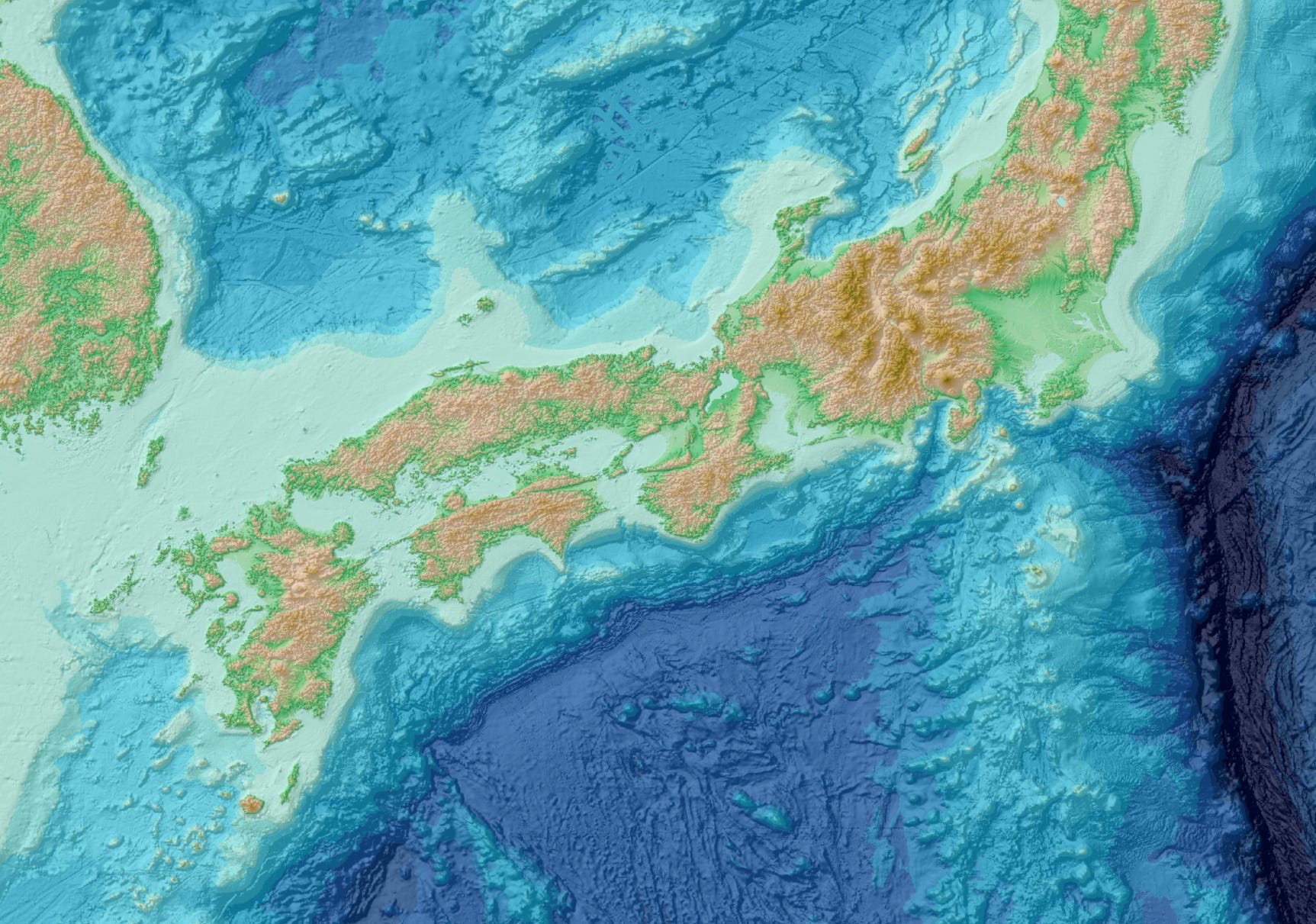
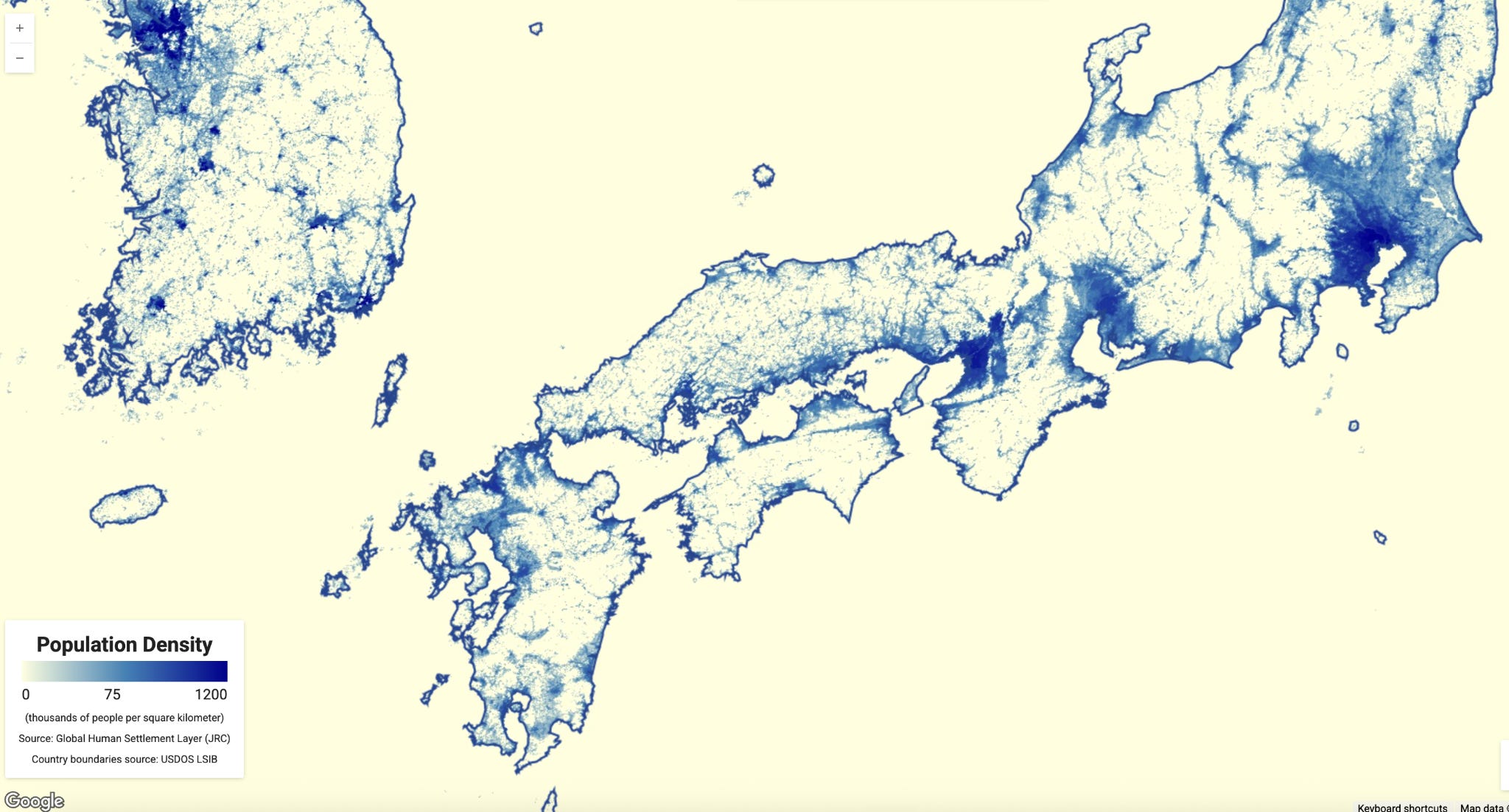
See how much shallow sea there is around Japan? That’s ancient crust from Asia. Over millions of years, sediments coming from the mountains accumulated there, creating the alluvial valleys that are so fertile today. Compare that map with this one of population density:
Takeaways
So here’s how so many aspects of Japan are explained by one factor: its geology.
It makes it a very mountainous country: It’s the emerged side of the mountain ridge formed by the collision between the Pacific and Asian tectonic plates.
It’s also why Japan’s maritime territory is so huge: It owns plenty of islands at the tip of these ridges.
The collision between these plates is why Japan is close to Asia’s mainland, but not on it: It split Japan from Asia due to the formation of a back-arc basin, which is today the Sea of Japan and the East China Sea.
This is why the sea around the Japanese main islands is pretty flat: It’s old continental shelf. As sediment accumulated from the mountains, it filled the sea, creating very fertile alluvial valleys.
These are the valleys that produce most of the food, which is why Japan’s population is so concentrated in these valleys.
The seas also isolated Japan enough that it didn’t suffer too many invasions and could remain united for a very long time, thus avoiding war deaths and facilitating investment in irrigation infrastructure, both of which increased its population.
But also, Japan remained close enough to the continent to access crucial innovations, including rice cultivation, double cropping, and iron tools.
The rice could be cultivated because the country is warm enough—despite being reasonably far north—thanks to the winds and sea currents that come from the warmer Philippines. The geographical limit where warm and cold currents collide is also the limit of historic rice cultivation.
That’s why the vast majority of Japan’s population is concentrated in the southern parts of the country, why the north took much longer to be conquered, why today Hokkaido retains much more Jomon/Ainu ancestry than the rest of Japan, and why the Russian island of Sakhalin is so sparsely populated in comparison: The islands lie east-west in the south, and rice cultivation and the rest of Japanese lifestyle could be shared throughout these regions. Japan’s Honshu island then bends northwards together with the Pacific-Asian plate border, and the climate gets cold really fast. Hokkaido was too remote and cold for consistent rice harvests or double cropping. Sakhalin is even worse.
This is also why Japan’s historical population booms followed the introduction of agricultural techniques: First, with rice agriculture and iron tools, then stopping when most of the available land was exhausted. Later, the introduction of further innovations such as double cropping and agricultural irrigation to reclaim floodplains increased both the amount of farmland and its productivity.
Rice was also one way the country remained united, as it could use rice as currency for taxation.
The downside of absorbing these technologies from the mainland was the consequent waves of disease, which were the other main obstacle to population growth. As Japan became more densely populated, infections circulated faster.
The sea currents are why Japan has such a fishing culture: The north and south sea currents meet in northern Honshu, bringing plenty of nutrients to the warm waters and cultivating life.4
Volcanoes might have had a small contribution to the fertility of the land, but they’re probably not a key factor.
In summary, Japan became so populous despite its small land because it could produce a lot of food from a small amount of usable land, while losing relatively few people and productive assets to war.
And sushi is the best way to represent all this, as rice came from the south, fish comes from the northern currents, and they bring the two elements that make up Japan: its sea and its land.
In a similar way to how the Eastern US and Northern Europe are warmed by the Gulf Stream from the Caribbean.
Rice used to be harvested in September / October, so the summer was when food storage was running lowest. But wheat and barley would be harvested just before the summer.
In 1281, Kublai Khan sent what is often described as the largest invasion fleet in history before D-Day: roughly 4,000 ships carrying, according to traditional accounts, as many as 140,000 men.
This is also linked to geology, a bit indirectly: The currents are formed by the Earth’s rotation, and by the shape of the Asian continent on the Pacific Coast: Water circulates from east to west along the equator due to the rotation of the Earth, and then must move back, which it does in gyres—circles in the northern and southern Pacific. Because of the shape of the tectonic plates in the area, the movement of the water from the equator follows the Asian coast and reaches Japan, bringing hot water. But the current that forms here starts moving towards America, carrying with it waters from the north. So here it’s basically the confluence of the northern and southern currents moving towards America.
Sushi might be the best way to represent this history, but surely not salmon sushi, which was invented in Norway and introduced to Japan thanks to Norwegian marketing in the late 1980s :)
Fun article!
Impressive detailed post.
One thing I was surprised was the amount of food Japan is currently importing.
I saw a number at 60% of food consumed in Japan is imported.
Coupled with the average age of a farmer is 67.6.
The other thing of note is that Japan sits on a lot of geothermal energy. But the country is hesitant to tap that resource like Iceland. A lot of people who own bathhouses near hot springs are against development of the resource for fear of losing the sprigs.