

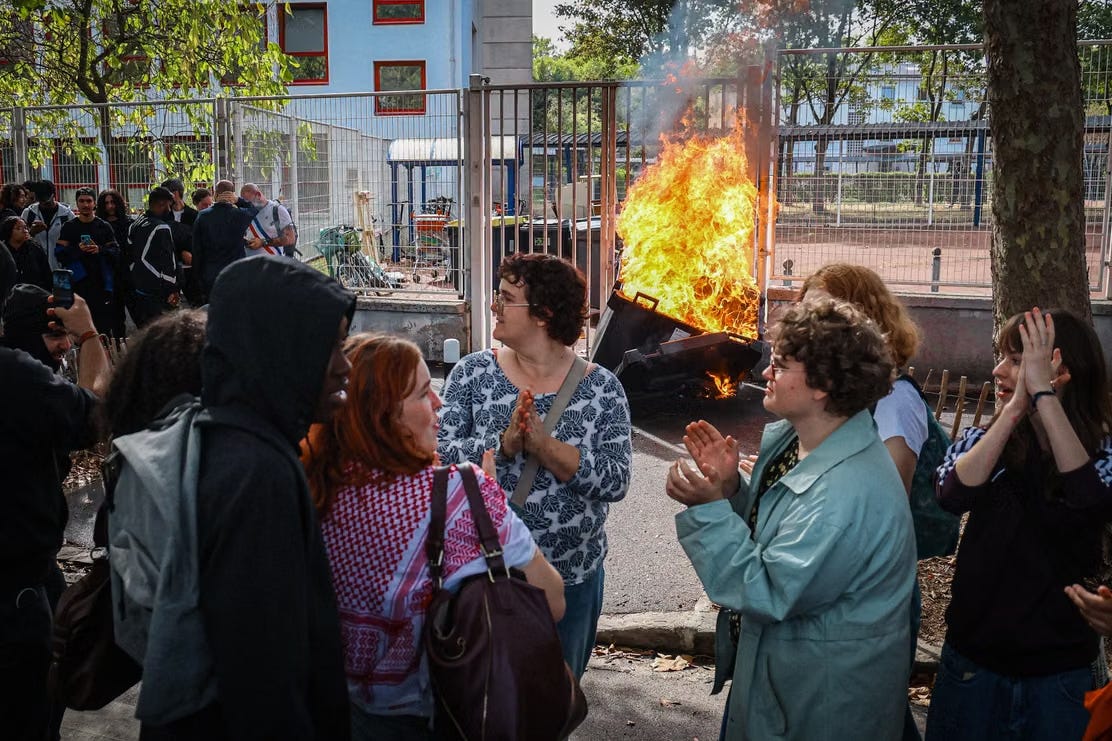
Over the last few weeks in France, tens of thousands of people have vandalized and burned schools, cars, official buildings, shops, markets, people…
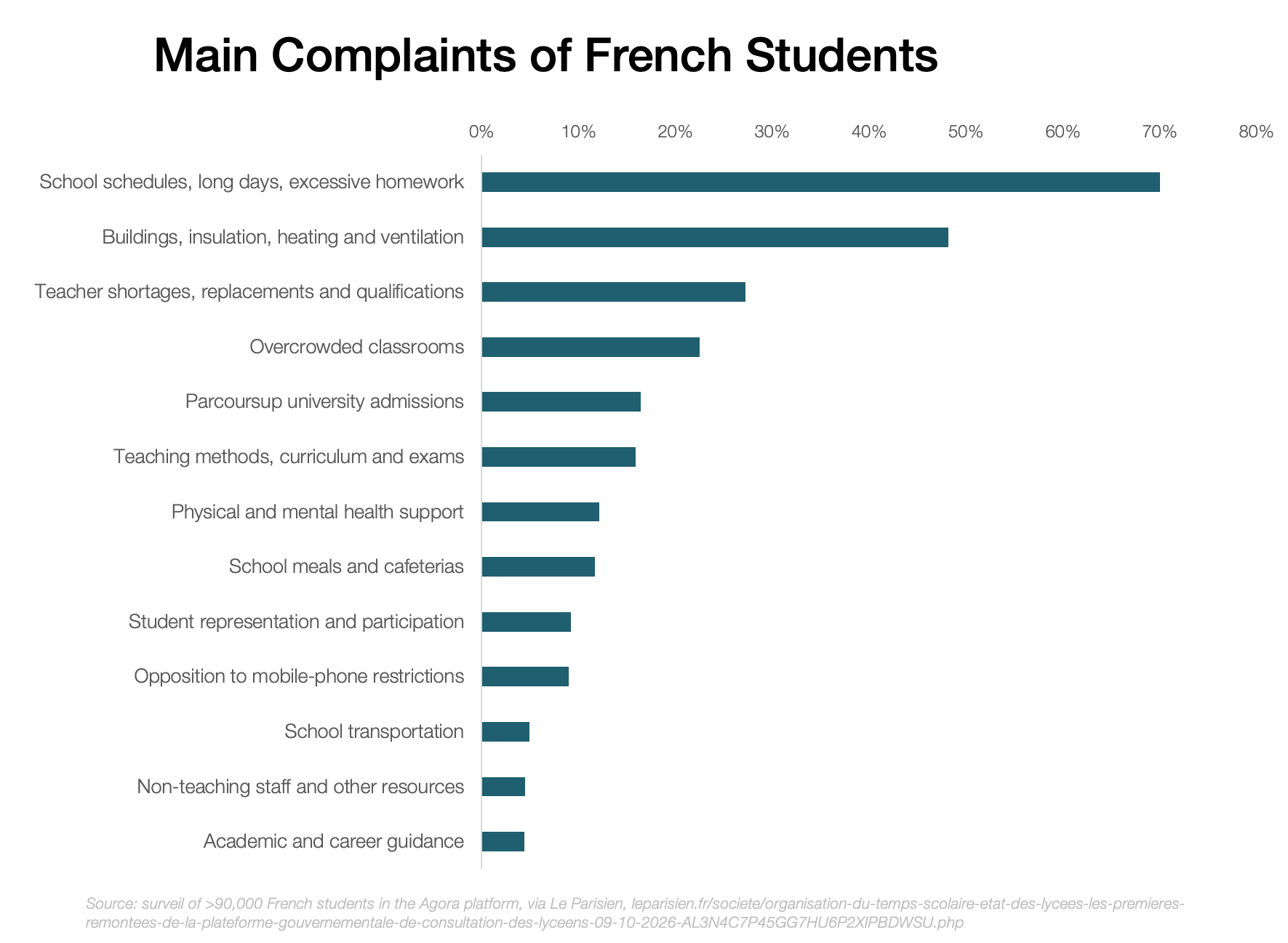
How did we get there? Initially, students were complaining about their terrible conditions: There’s not enough money for schools and teachers. They said it’s because there’s too much austerity. Is it?
Others say it’s the immigrants—especially Muslims—who wreck everything.
Or the opportunities of non-Whites.
Others say it’s the islamo-leftist alliance.
Or the police, because they’re too violent.
Or the justice system, which doesn’t imprison agitators enough.
I didn’t know, but I wanted to find out, especially as a veteran of French education (I did all my primary and secondary schooling in the French system and got one of my undergrad degrees from a Parisian university). So I did. The following is a detailed account of what has happened, and why I think it happened, based on plenty of videos and data.
This is one of these articles that are very hard to write because of their political load. I think it’s important to push back against all biases, so it was pretty serendipitous that Ground News gave me access to their tool, after I reached out to them. It helped me get a sense of the left and right perspectives on this story.
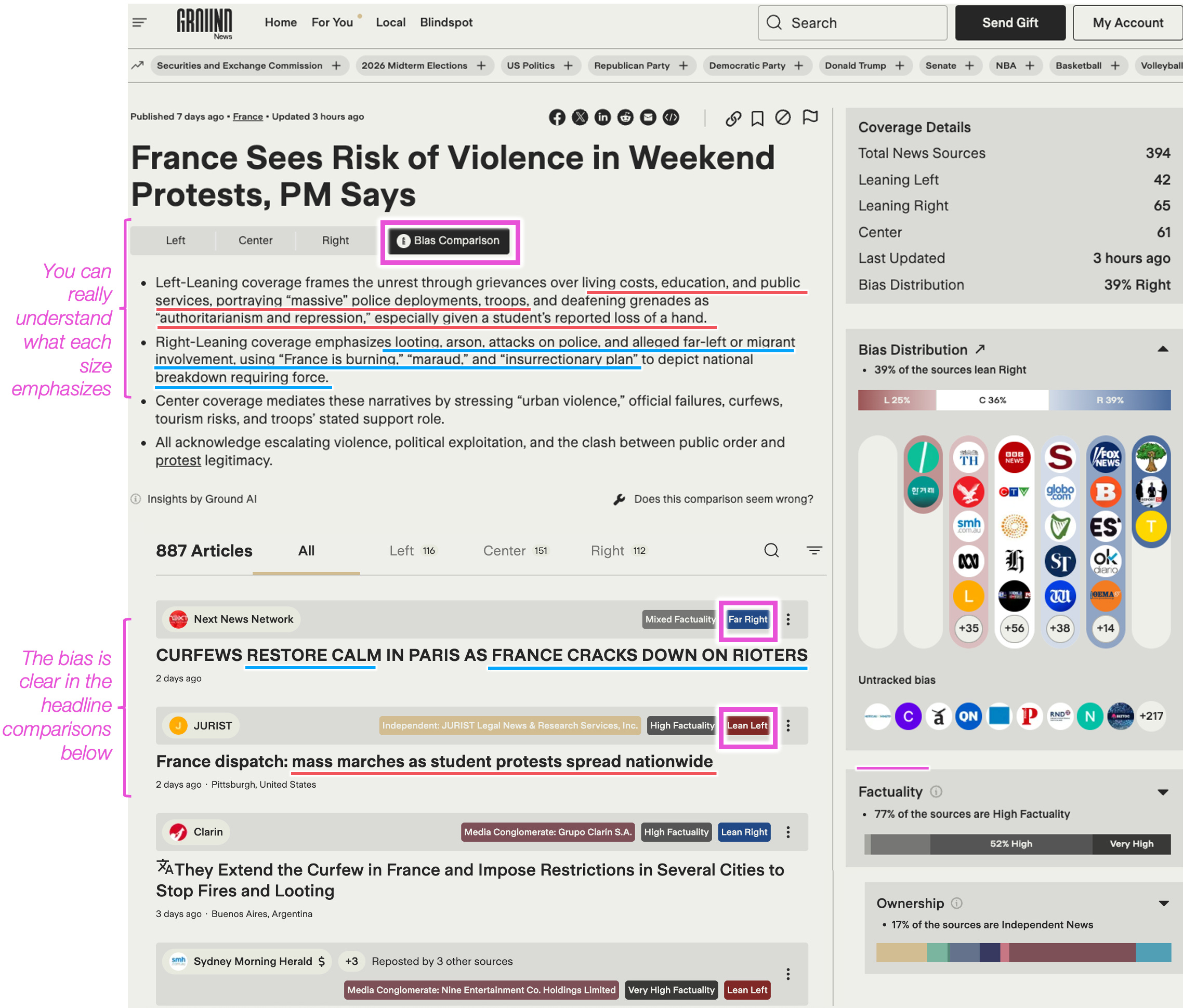
Ground News is sponsoring this article and has given Uncharted Territories readers a 40% discount for their subscription. You can redeem it here:
The Case Against Education
It all started in Créteil, a poor Parisian suburb, with 23% of its population in substantial economic deprivation and 26% of its population immigrants1.2 One week after the beginning of this school year in September, teachers at a school there went on strike because of three unfilled teaching positions (out of over 130, so ~2%) and some unfilled staff roles.3 Teachers’ unions supported them, the far-left party La France Insoumise (LFI) joined, and a day later, so did students.
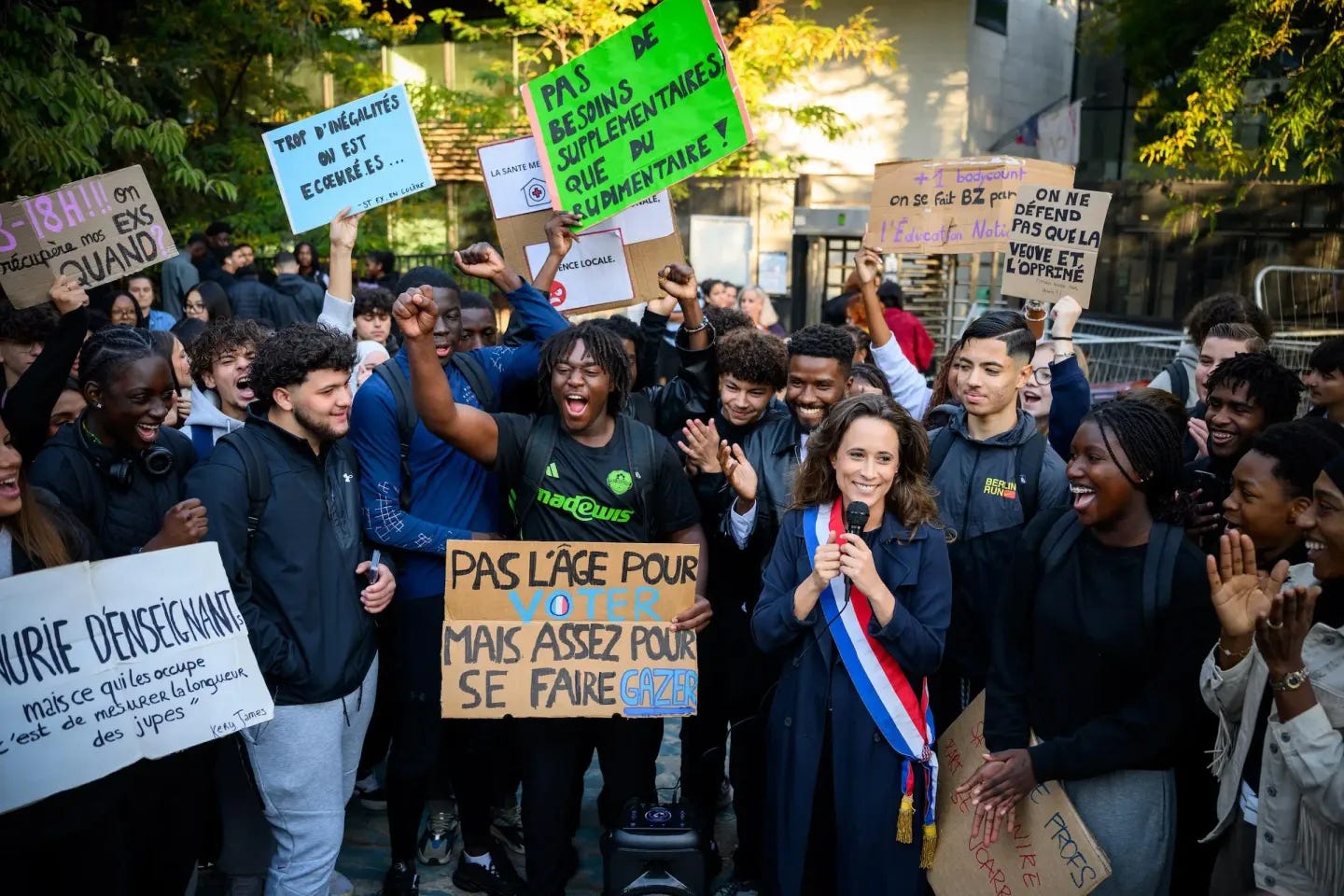
The strike spread from high school to high school in the region of Paris, from there to the rest of the country, and from high schools to universities. 55% of French people approved of these strikes.
But they became violent.
A 15 year old lost a hand, allegedly after grabbing a dispersion grenade thrown by the police, another student suffered a broken jaw, another one lost the sight in one eye.4
Why were students so upset?
Maybe the worst issue is this: 7.5% of instructional hours were lost through unreplaced teacher absences in 2024–25, with another 2.3% lost through school closures, for a total of nearly 10% of classes.
Another reason is the poor condition of schools. Here’s an example:
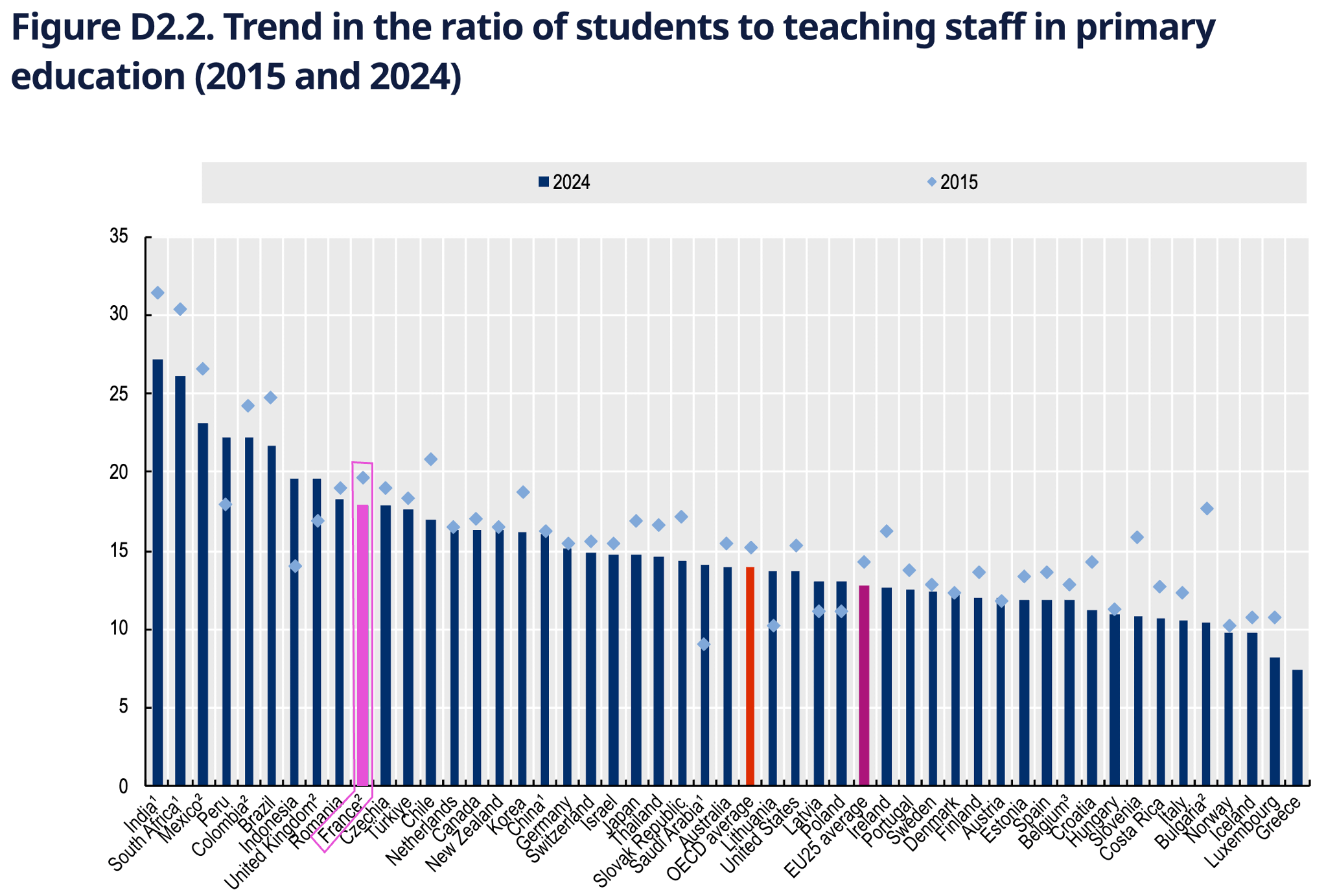
Another complaint is too many students per class:
Another is racial discrimination: A large recruitment experiment found that North African teacher candidates received 31% fewer callbacks from their applications than did native French people (although other studies show hiring biases are against all foreign-sounding candidates).
So what exactly are students demanding? Here are a couple of specific lists from student unions:
Renovate education buildings
Hire more teachers and admin workers
Start school at 9am instead of 8 or 8.30, and study on Wednesday afternoons (when schools are typically not in session)
Guarantee €1 lunches
Eliminate fees paid by non-EU students
Less violence from the police, and more accountability
Less social and ethnic discrimination in university admissions.
The General Confederation of Labour (CGT), one of France’s largest unions, called for lower prices, higher pensions and boosted wages for school staff.
In other words, there are three issues here:
Funding
Discrimination
Justice / police brutality.
1. Educational Funding in France
Whenever you’re trying to figure out what causes something, you first need to compare the situation to that in similar places. What’s happening in France right now is not happening elsewhere, so it must not be caused by similar situations in other countries.
France spends $13,787 per pupil per year, more than the OECD average, and more as a share of GDP per capita than countries like South Korea, Australia, Germany, Canada, Italy, Spain, or Switzerland.
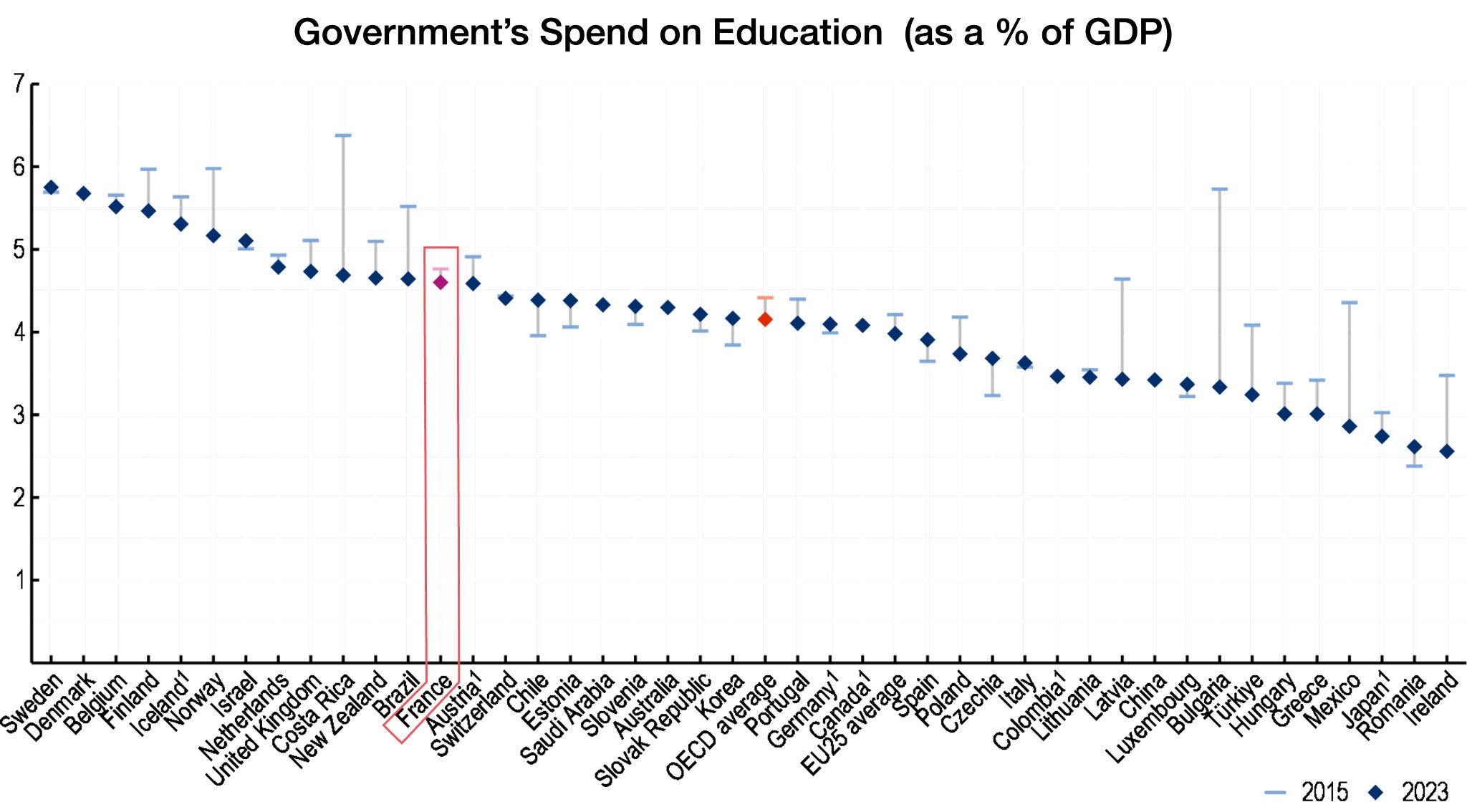
The French state spends 4.6% of GDP on education, to the OECD’s 4.2% (nearly 10% more).
And the spend has been pretty stable as a share of GDP.
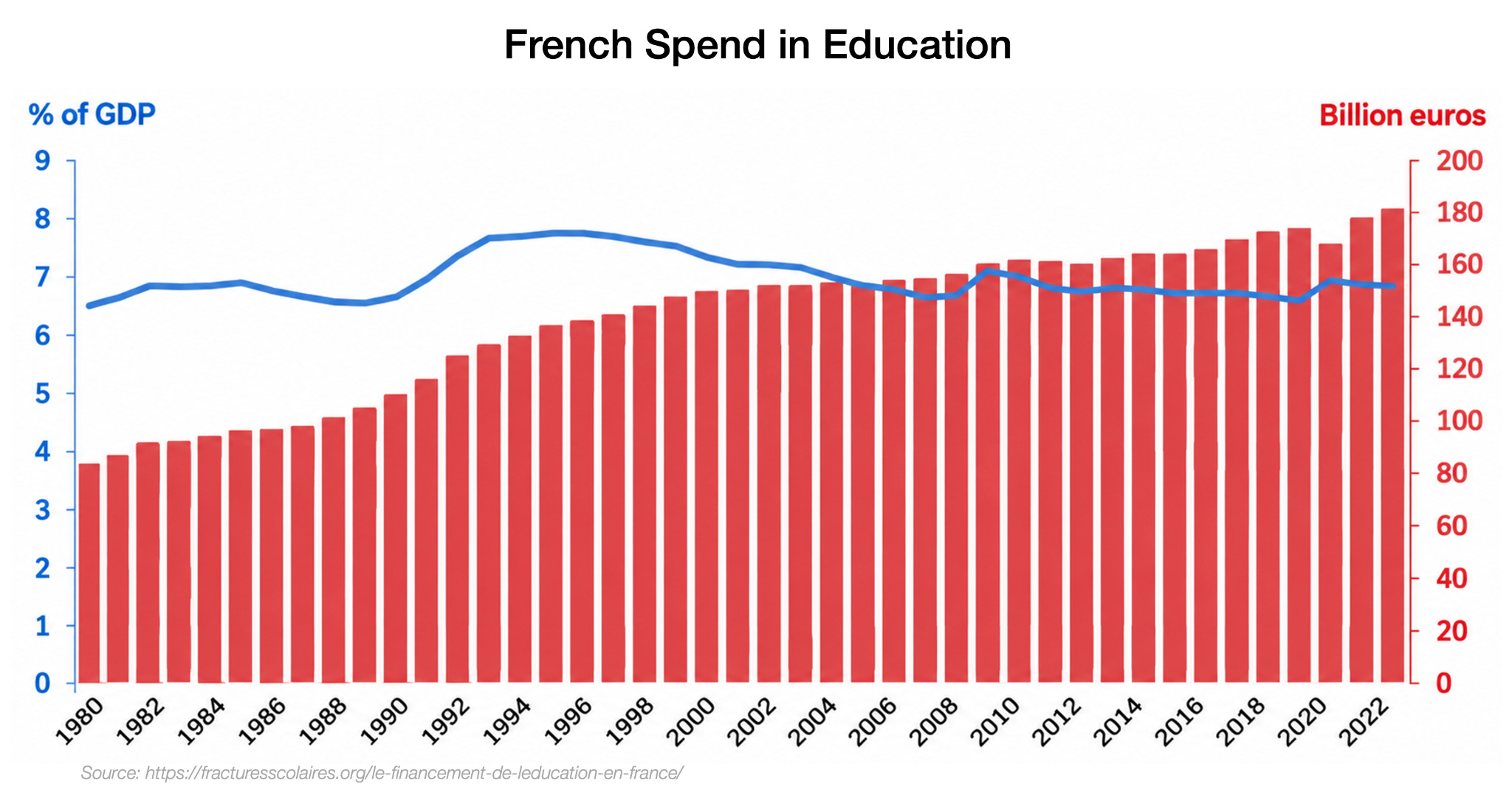
So whatever the cause of this unrest, it can’t be the total spend on education: Other countries are spending much less, but these countries aren’t up in flames.
Similarly, despite the numbers above, France doesn’t stand out dramatically in class sizes, teacher absenteeism, teacher shortages (0.4%), attrition (1.9% vs 6.4%)…5
Also, funding for primary school infrastructure comes from municipalities, for secondary education, from the region, and for teacher compensation, from the state, so it’s not like poor areas are getting less funding than richer ones. And England found that 700k of its students attend schools requiring major refurbishment, but you don’t see English schools reduced to ashes.
So although the state of education is not perfect in France, its condition doesn’t justify massive riots. What’s happening, then? Maybe the funding is not going where it’s most needed?
Teacher Pensions
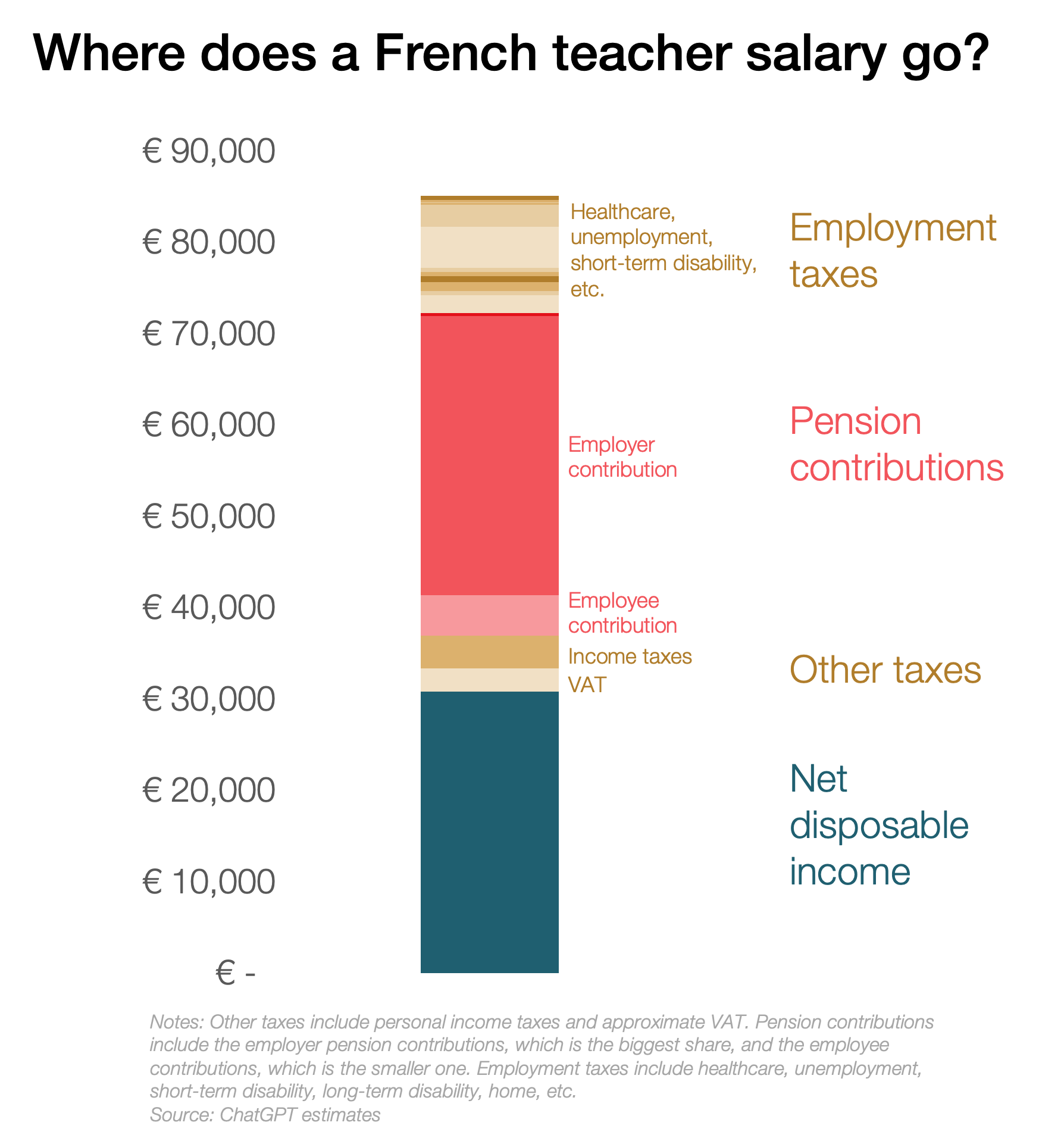
France's education ministry allocates ~32% of its budget to pension contributions. A third!! A standard teacher costs ~€85k to the state. Of that amount, how much does this person bring home? €37k! How much goes to pensions? €30k!
And then after that, the teacher still needs to pay about 10% of that to income taxes, and about 10% to VAT! So in reality, he keeps just €31k of the €85k, or ~36%!
I tried to get a breakdown from ChatGPT, and this is where we landed:
Why are pensions so outrageously expensive? Because the French retire early and comfortably.
The French Don’t Work
This lady says she is 90 years old, retired for 25.
She receives €3,000/month from the state—which, if you’re tracking, is about what a working teacher receives!
Indeed, French pensioners are among the most highly paid in the world. They make 90% of the average worker—similar to public school teachers. But public school teachers are paid more than the average worker, so the result is that the average retired teacher makes more money than the average pensioner, or even the average French worker!
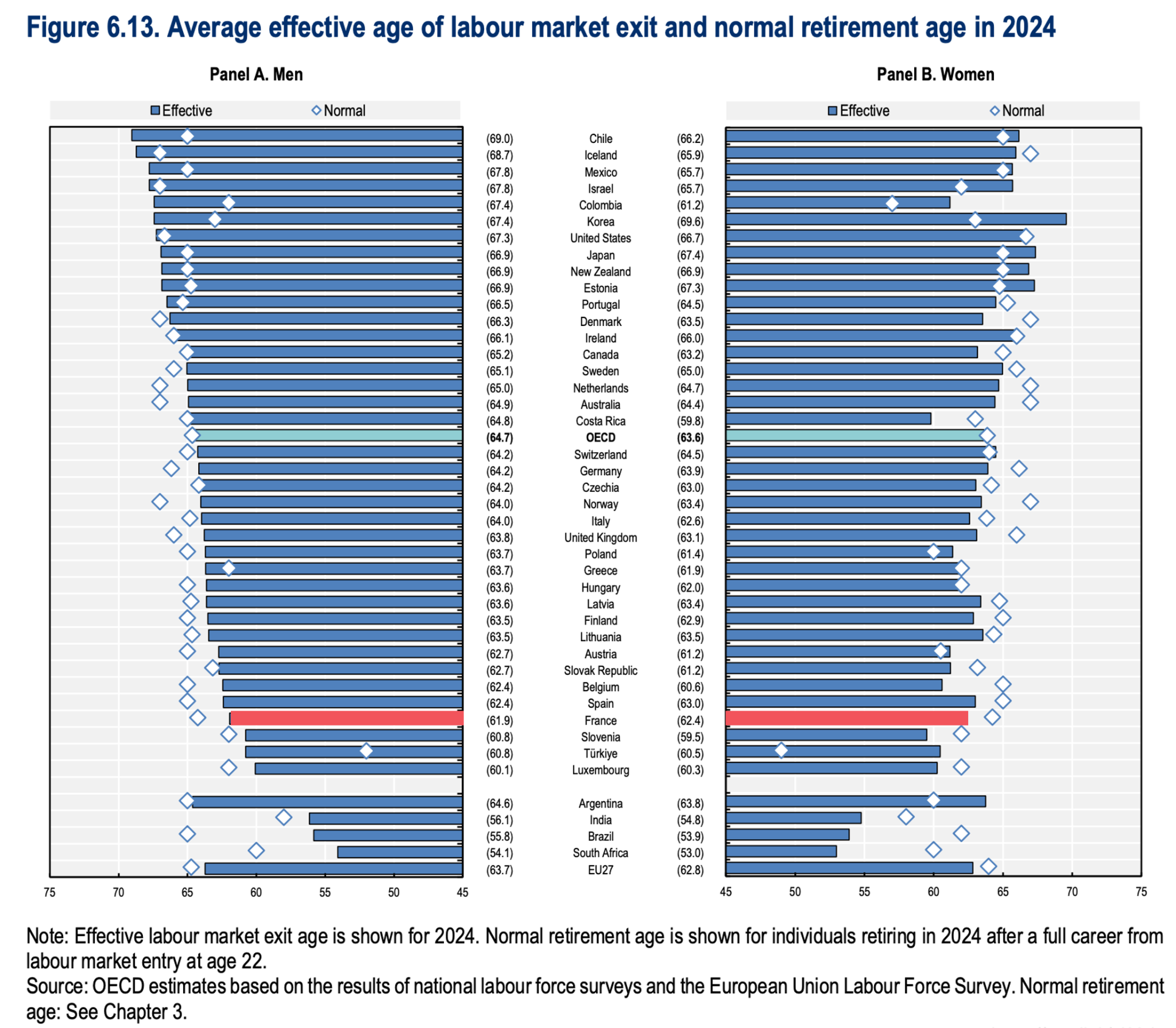
And they retire super young! The average French person retires at ~64, but civil servants, including teachers, retire at 62! Some, even at 61!
Is this true across all public services in France? Not quite. Pension contributions are an outsized share of all public salaries in France, but they’re particularly egregious for teachers.
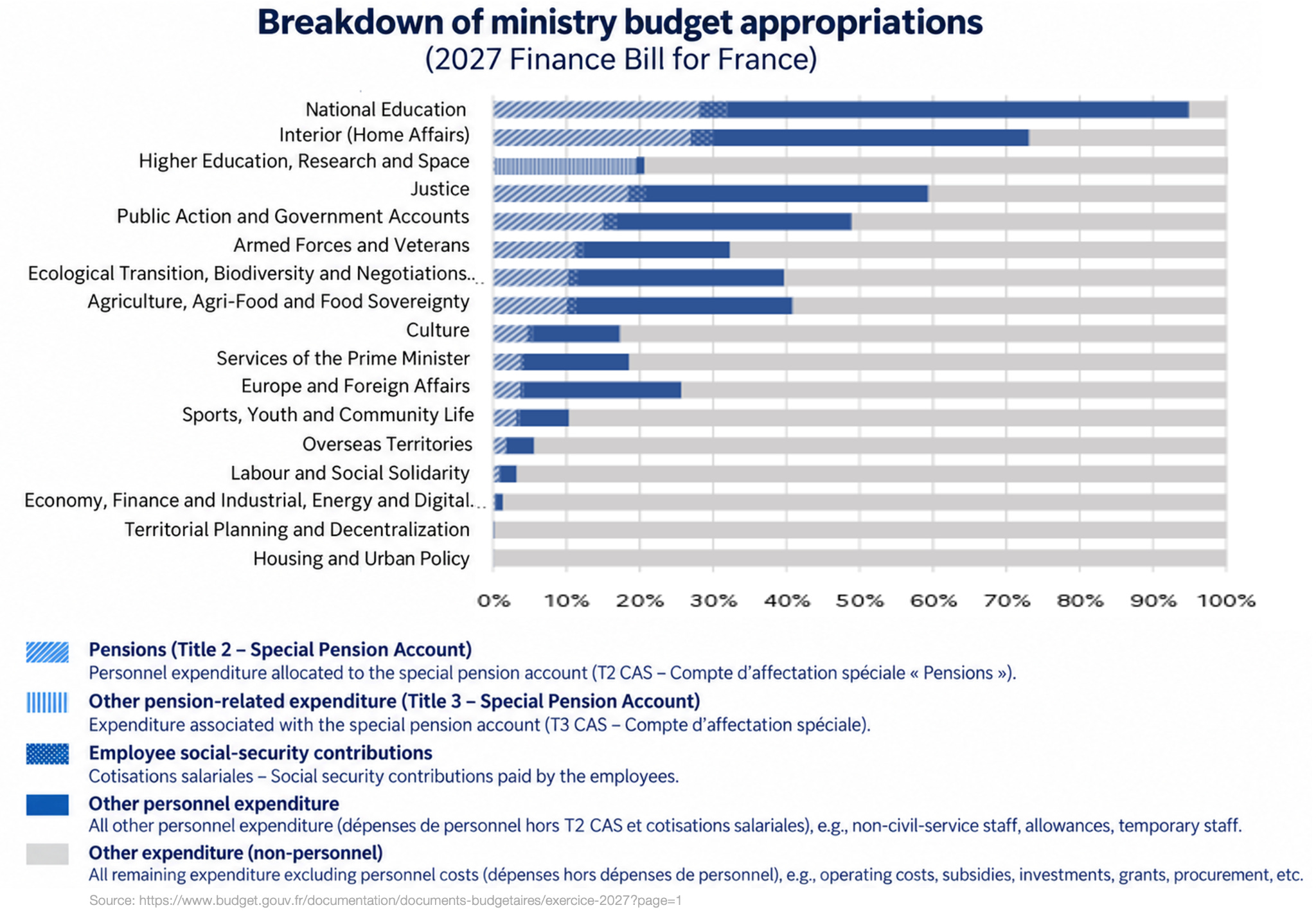
Note that the spend on pensions (angled lines) as a share of all personnel expenditure (blue) is nearly identical across all these jobs? ~28-35% of the compensation of every job goes to retirement spend.
What would the spend on education look like if you took away pensions?
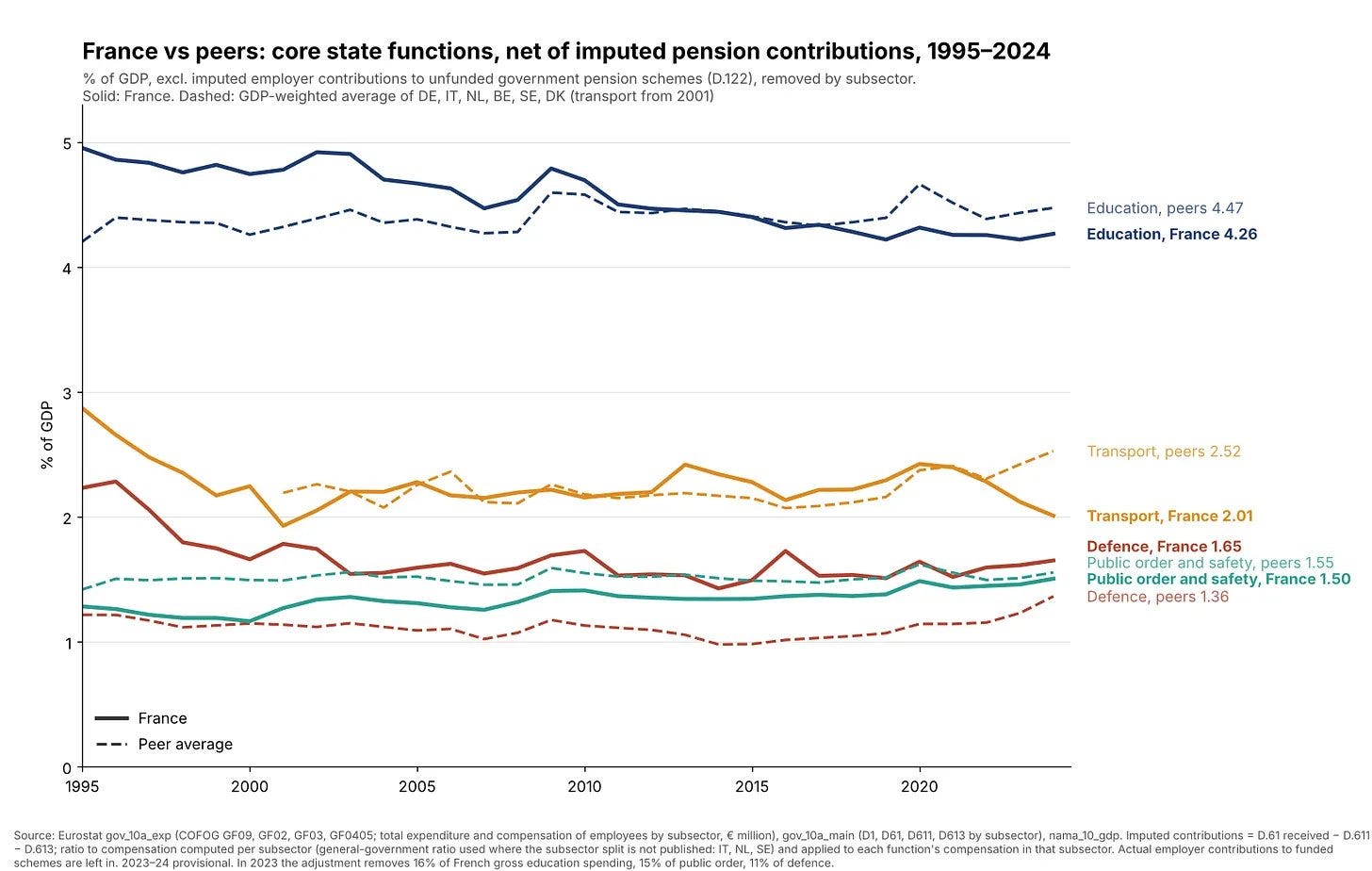
The spend as a share of GDP has actually gone down a bit, from 5% to 4.26%, while other spends have been more stable over the last two decades. It’s still not enough to justify country-wide riots, but it explains some of the concerns.
Other Entitlements
When I first arrived at university in France, I was flabbergasted to receive every month the CAF6, ~€150 per month for housing. “Great!” I thought. Of course, I didn’t think about where that money came from.
In 2004, we could go to the Restaurant Universitaire and eat a full meal for €3 or so. During COVID, that amount was reduced to €1 for financially vulnerable students, and in 2026, has been extended to all students.
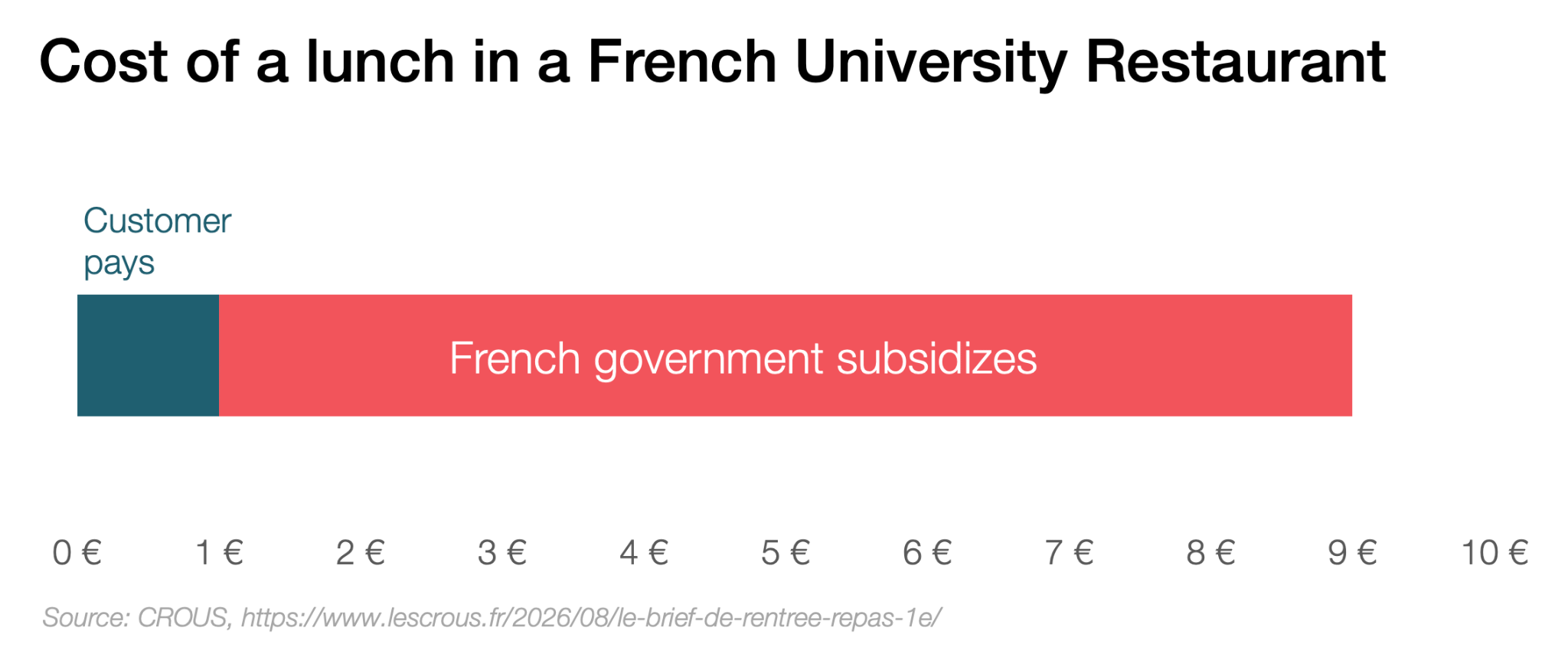
So why are students complaining?
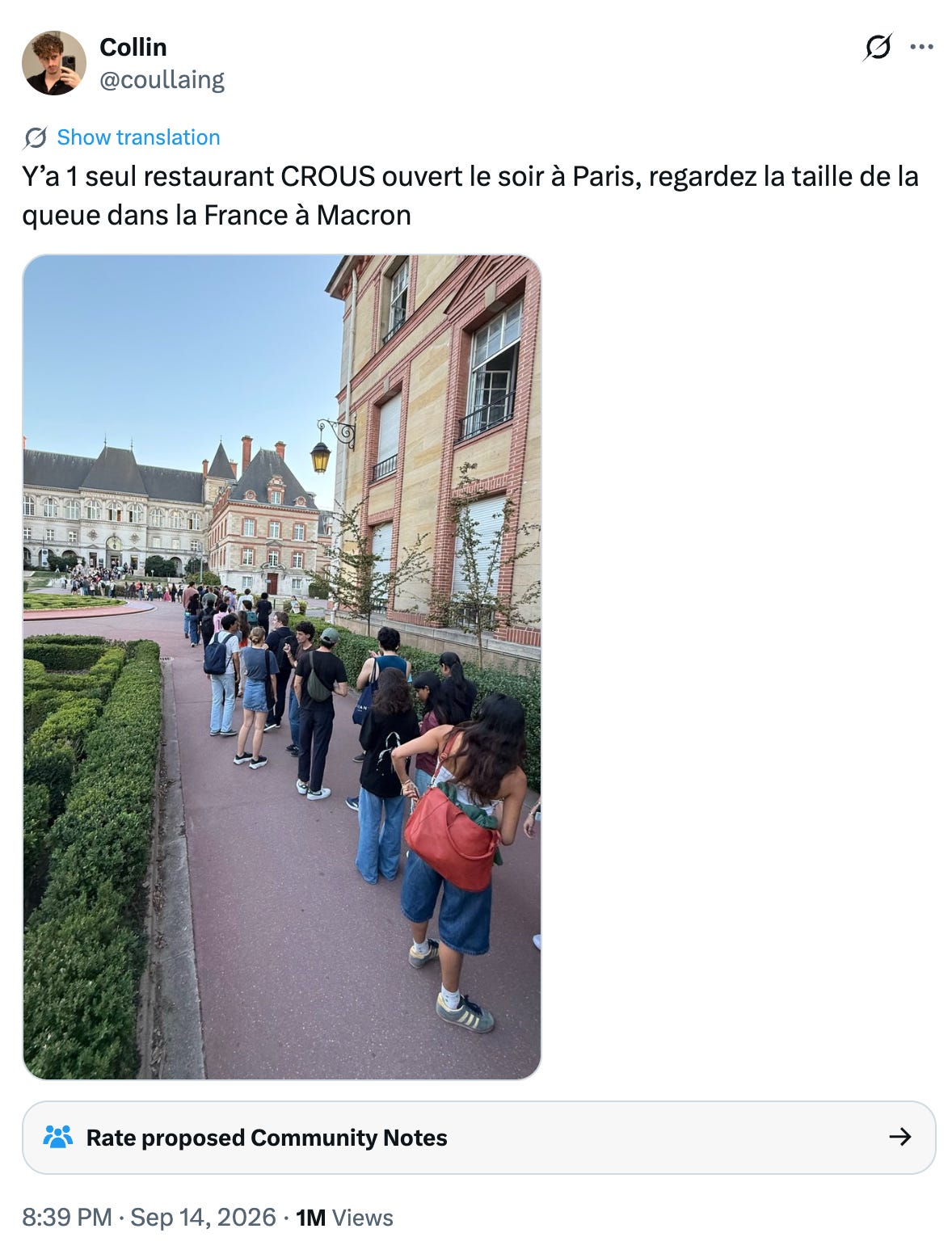
They’re complaining that now there’s not enough staff, nor enough food in each portion, and that they have to wait too long, since demand for these lunches has increased by 48%!
Rather than reducing meal prices, I think it would make much more sense to provide scholarships to students who can’t afford their studies—which would cover food, too—and let the market work elsewhere.
It doesn’t look to me like France has an education funding issue. It has an entitlements issue, especially regarding pensions. The way to solve it is not to support more entitlements, but fewer, especially reducing pension spending, which is quite simple: Instead of retiring at 61-63, push retirement to, say, 72 to get full benefits7— the French live until 83, and teachers until 85. With this change, the entire French budget gets rebalanced overnight, the government can lower taxes, improve the economy, increase investment and spending, more jobs appear, and everybody is richer. Of course, the French riot when this is proposed, they want to have a cake and eat it too.
2. Discrimination
42% of French students report that classmates do not listen to the teacher, compared with 30% across the OECD. French teachers spend 20% more time maintaining order, they are 10% less satisfied with their jobs, lose 10% more of their time to student interruptions. French public schools see 4x more serious incidents than private schools.8 20% of teachers are apprehensive about going to school every day, 47% don’t think school rules are respected. Just last week, unrelated to the riots, a 14 year old shot a principal and a teacher.
If you ask a French person, about half will tell you it’s the fault of Arabs or Muslims, by which they’ll mean Maghrebins (mainly Algerian, Tunisian, and Moroccan), and some sub-Saharan Africans (primarily from Senegal and Mali).9 But this opinion is much more common in older generations than the new ones. For example, Islamophobia is 50% lower in the 18-24 than in the 65+. This bias leads to the type of complaints about discrimination that we mentioned before. That’s why students are demanding:
Elimination of fees paid by non-EU students for university access: Because these are easy to pay for non-Muslim, non-African students, who tend to be richer, they select against them.
Less violence from the police, and more accountability: These immigrants and their descendants are less privileged, more often victims of racism, and more prone to violence, so the police are more violent with them.
Less social and ethnic discrimination in university admissions: Most demographic data is scrapped from university admission systems to avoid discrimination, but not the high school they come from. Why is this retained? Because some high schools are more generous with their grades than others, yet the grade counts for the French Baccalaureate results. Having access to high school origins helps universities normalize performance. But it can also be a blunt tool to profile racially, as some schools are near universally native French while others are largely comprised of African immigrants and their descendants.
But France has less immigration than Canada, yet more problems with it.10 Why? Why are immigrant students in France underperforming?
We’ve looked into this in the series on immigration: It’s not unique to students. French immigrant populations tend to have more unemployment, occupy more public housing, and more poverty.
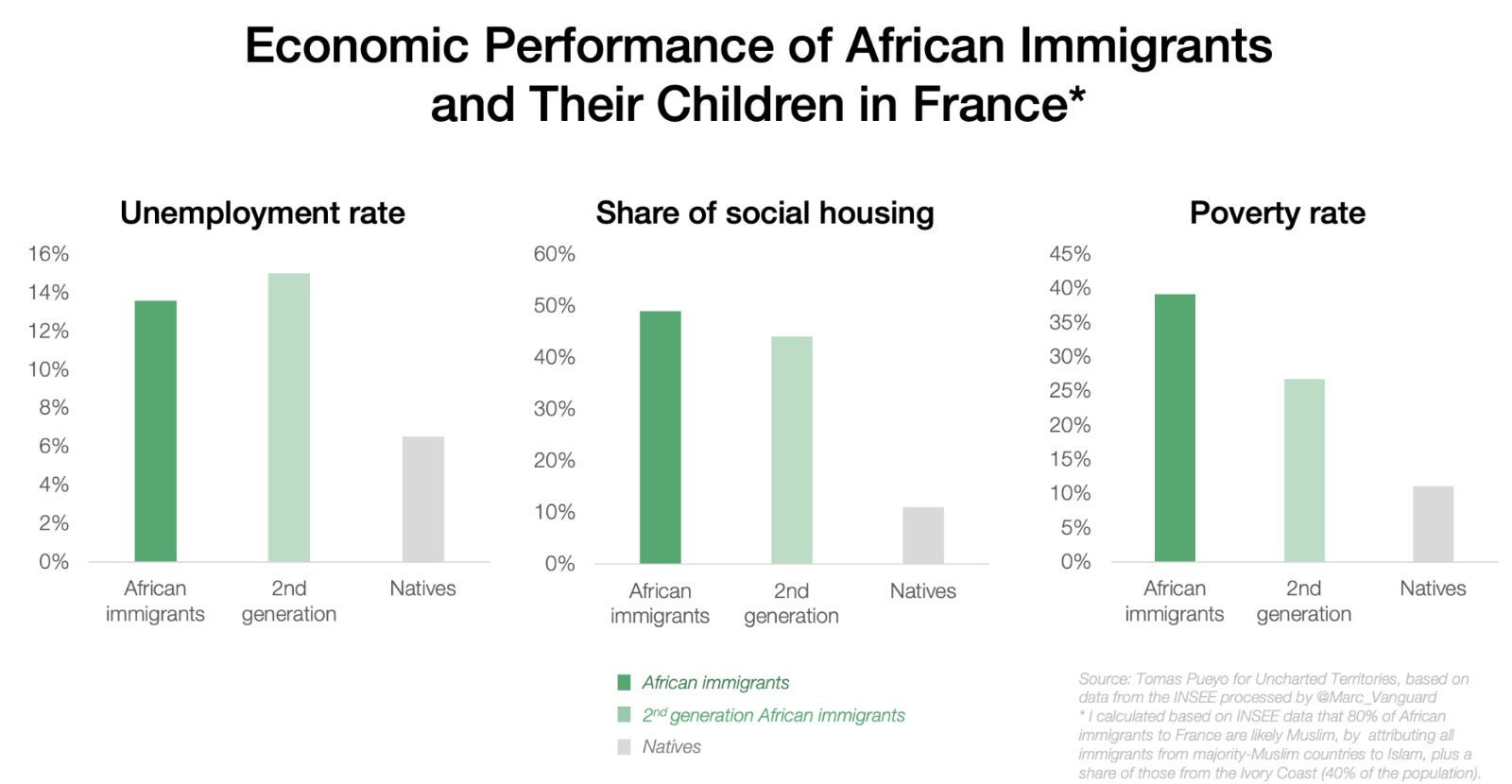
Why? There are at least two causes. One is that, as North African immigrants were concentrated in suburbs in the 1960s and 1970s, many of these became ghettos, where crime became rampant and economic opportunities scarce. Africa is the biggest source of immigration in France today, especially from Muslim countries (primarily Morocco, Algeria, Tunis, Turkey, and Senegal), and these immigrants have had a particularly difficult time integrating.
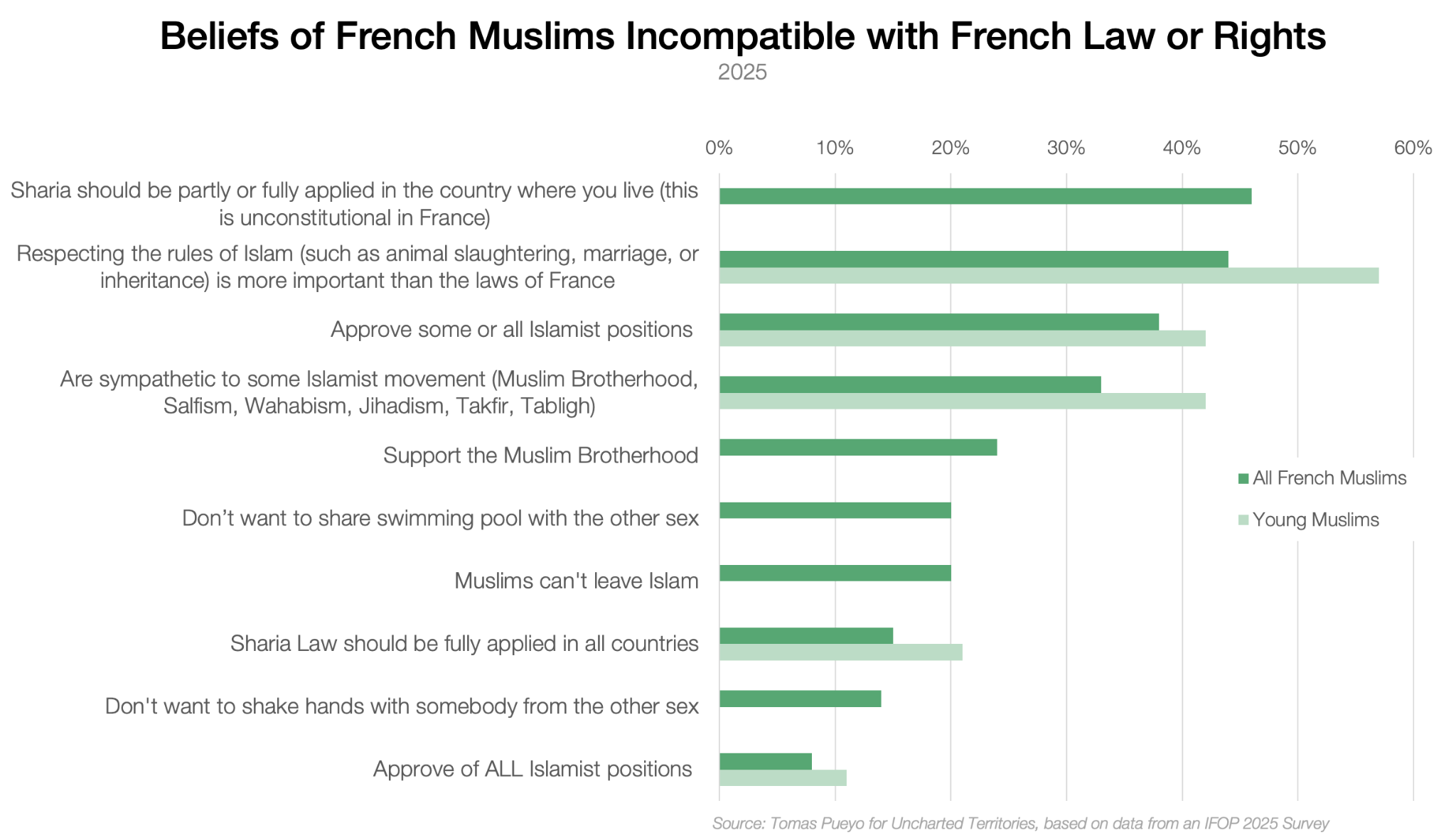
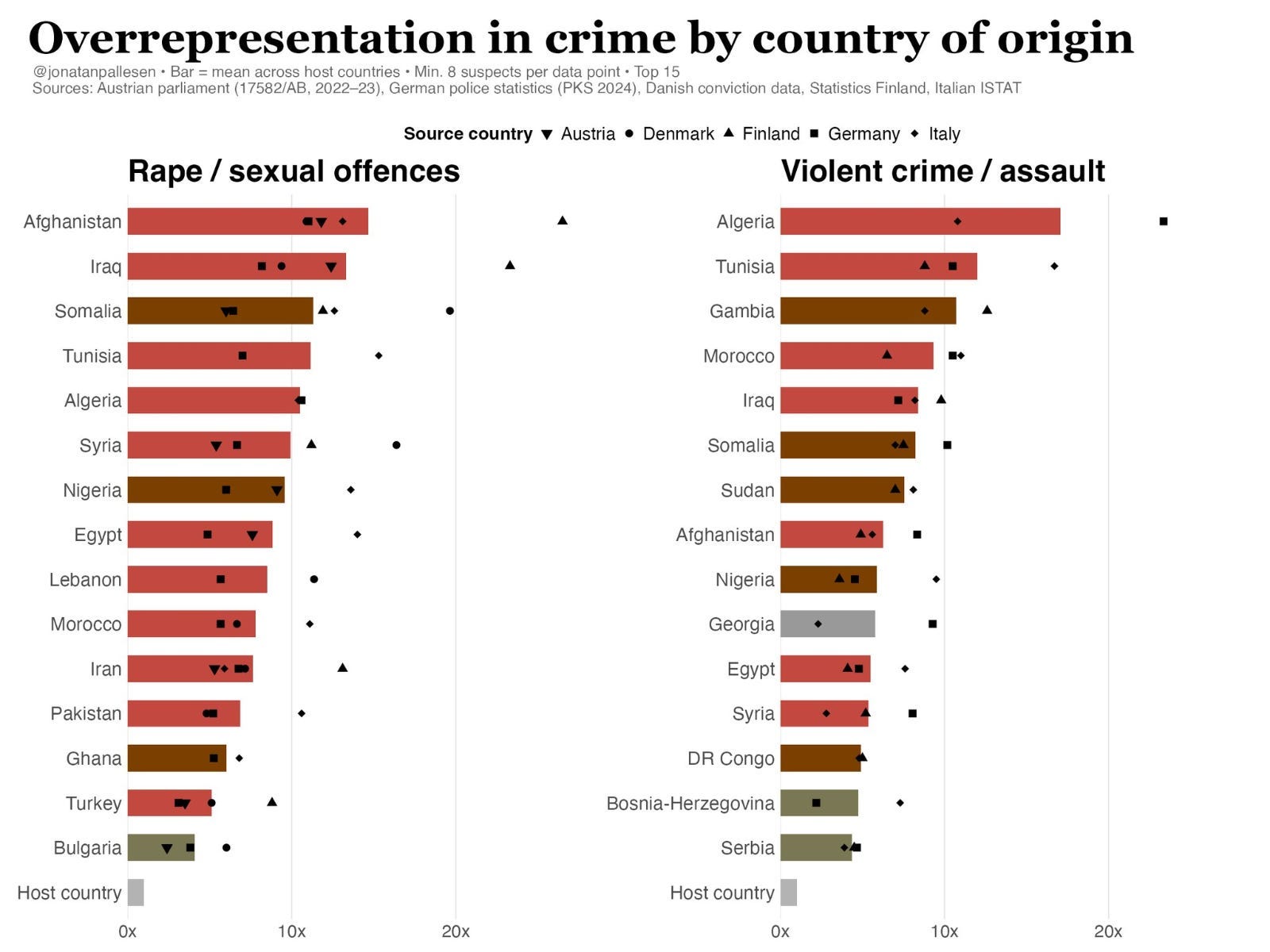
Another cause of underperformance of immigrant students is that immigrants from these countries are, on average, overrepresented in all numbers we have for crime and fiscal cost across the EU.
A third reason is self-selection: As I’ve described in my series on immigration, Canada's point system for immigration is much better than France’s, whose massive welfare state self-selects the immigrants who want welfare rather than the ones who want to work. Their children are now in French schools.
All of this doesn’t mean that all, or even a majority of immigrants from these countries, are problematic. It just means that the average immigrant will underperform, among other reasons because there is a much higher share of disruptive people from these countries.
Unfortunately, these three factors (and maybe others) combine to create a vicious cycle: The worse that immigrants of a certain background perform, the fewer opportunities they will have, the more they will stay in their ghettos, the angrier they will get, and the more crime they’ll commit. When others notice that African and Muslim immigrants underperform, they add fuel to the fire through racism. As the immigrants and their descendants stay behind, they notice that what they have in common is their African ancestry and Islamic religion, and they form an ethnic identity.
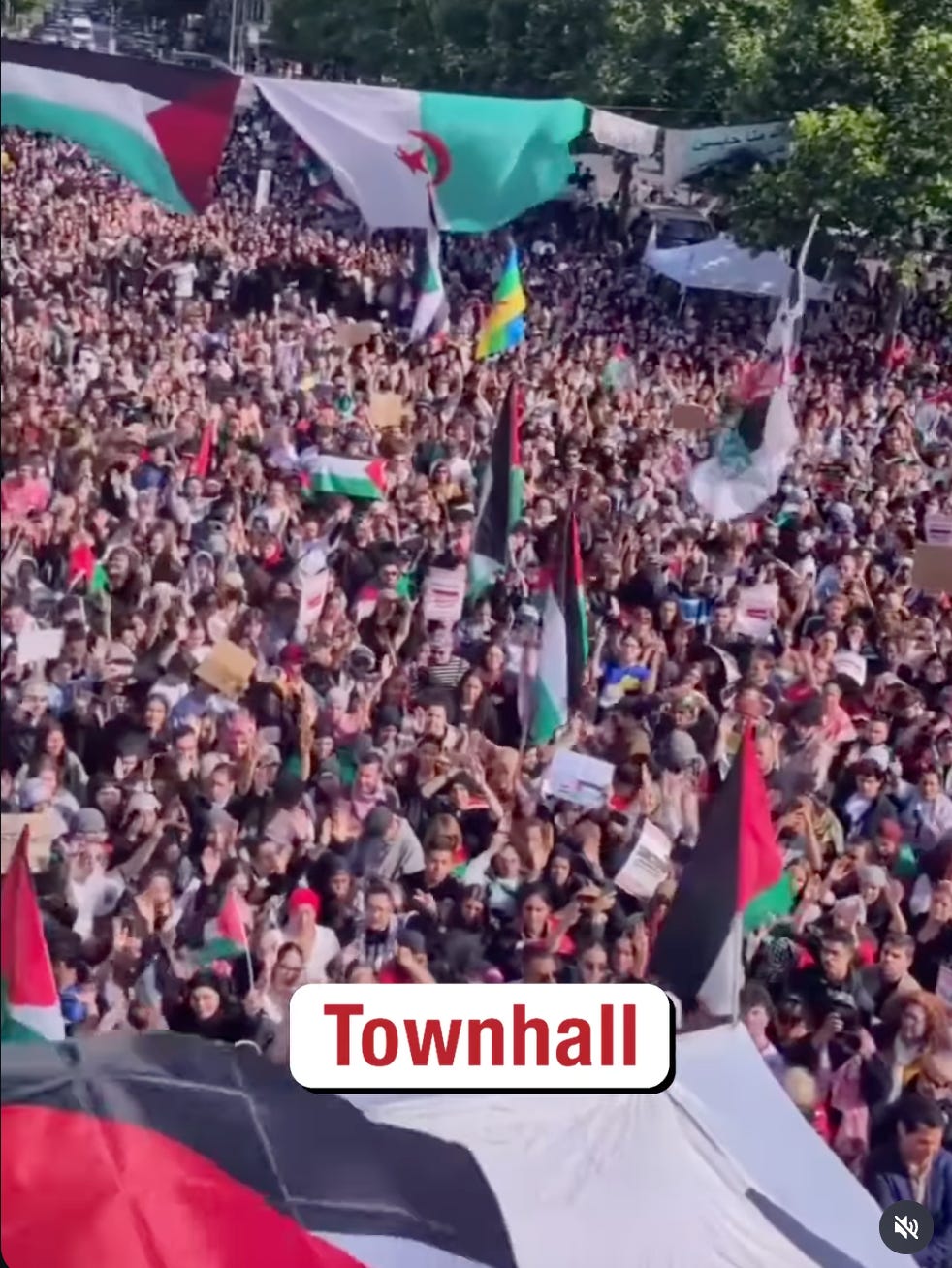
And this is one key reason why Palestinian, Algerian, and other Muslim flags are more common than French flags at the strikes and riots.
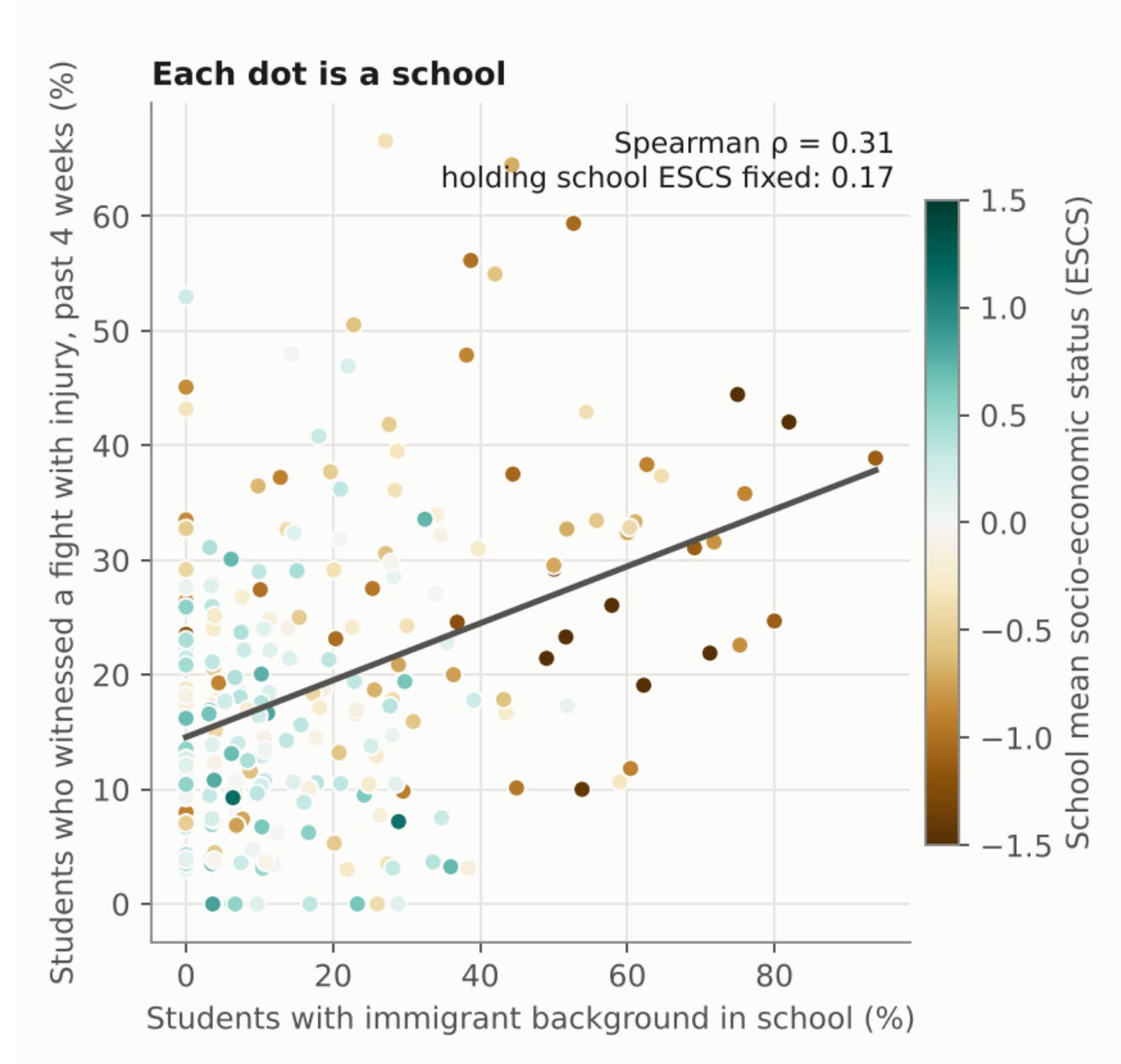
Whether the root cause is urban ghettoisation, self-selection, racism, human capital, or anything else, the result is that immigrants and their descendants, especially those of Muslim or African background, underperform in education and are overrepresented in strikes and riots. According to this French report on the 2023 riots:11
75% of the suspects were born in France, while 25% were born abroad. According to the Paris Police Prefecture, within its jurisdiction, a large majority of the rioters arrested were young French nationals of immigrant descent (second- or third-generation), primarily of North African (Maghreb) or sub-Saharan African origin.
We don’t have more details about the country origin of the French citizens of immigrant descent, but we do for the 25% born abroad: 40% were from Algeria, 13% from Tunisia, and 21% from other African Muslim countries.
Do we have anything more representative? The French state can’t easily collect ethnic or national origin data, but the share of immigrants in different schools is accessible. The violence in these schools is public data, too. So I asked Claude to correlate these two numbers:
Other groups of immigrants came to France that were even poorer and had the same opportunities, such as the Vietnamese or Chinese, and these groups also formed their own ghettos, but they are not underperformers today in terms of economy, education, or crime.
The Chinese are considered to be a community where things go well, where people manage on their own and are quiet—compared to other immigrants, who are much more demanding, and consider themselves as victims and might consider this Chinese community as competition.
This is the explanation of this young man on why Chinese shops were rampaged:
The Chinese have become too rich in France. I think it’s unfair. They’re now in the category of people with nice clothes and big cars.
I’ve written at length about this topic in the past, and my conclusion is this: There is a serious problem around 1st and subsequent generation immigrants in Europe in general, and France in particular. It starts with a lower human capital from some specific countries and ethnicities, which makes them commit more crime and contribute less economically, but kicks off a vicious cycle of underperformance, racism, violence, discrimination, more crime… Both sides of the political aisle speak some truth, but they’re not listening to each other. For the Left, the entire problem is discrimination and lack of opportunities, and it’s true, but not all the truth: These minorities are overrepresented in all crime and economic statistics across all of Europe, and how immigrants from other countries (even poorer, like Vietnam decades ago) don’t have this problem. For the Right, the entire problem is simply that these immigrants are bad, which flies in the face of evidence that the majority of these people are law-abiding, productive members of society, and that whether they want it or not, today, European economies need immigrants to be sustained.
3. The Escalation into Riots
What started as a valid protest has long since slid into illegitimate riots. There are currently 3x more demonstrations in France than usual, and 24% of strikes have become riots (vs 2% normally).
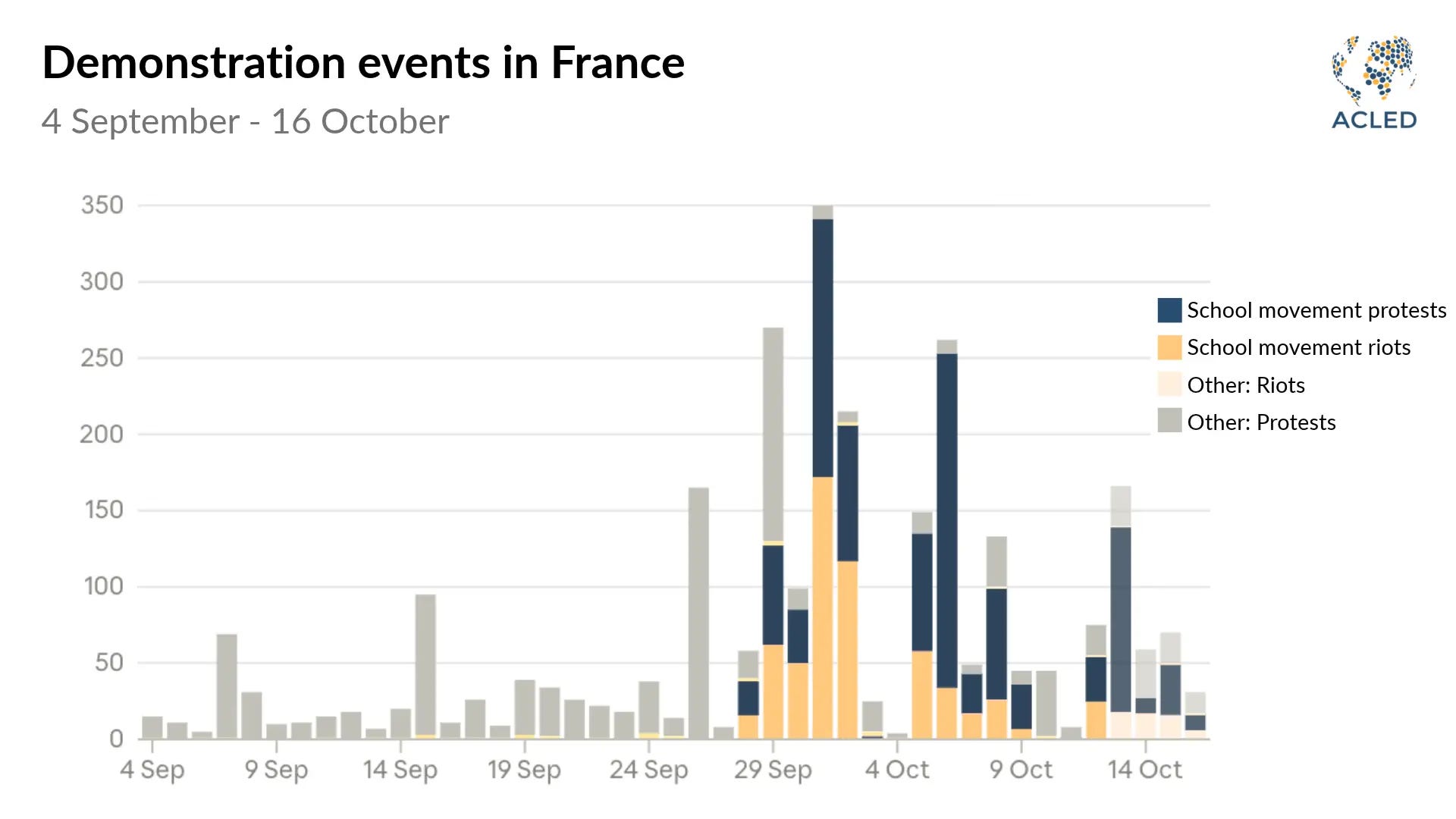
About 10,000 people have been arrested. What went wrong?
Student unions and the LFI think peaceful demonstrators are being attacked by the police, using disproportionate and indiscriminate violence, so strikers have become violent in retaliation. They also claim that most violence is not actually carried out by demonstrators, but casseurs (“breakers”), who join in for fun and looting.
The Right complains that there is not enough police repression of violence, and that casseurs don’t go to jail often enough.
So which side is right?
Students or Young Men?
A common claim is that demonstrations are initially pacific but are then joined by casseurs: young men, older than students, who are interested in violence and looting and are frequently organized as Black Blocs: rioters dressed in black, hooded, and with masks, so they’re very hard to tell apart from each other and use the anonymity of the crowd to evade identification and arrest.
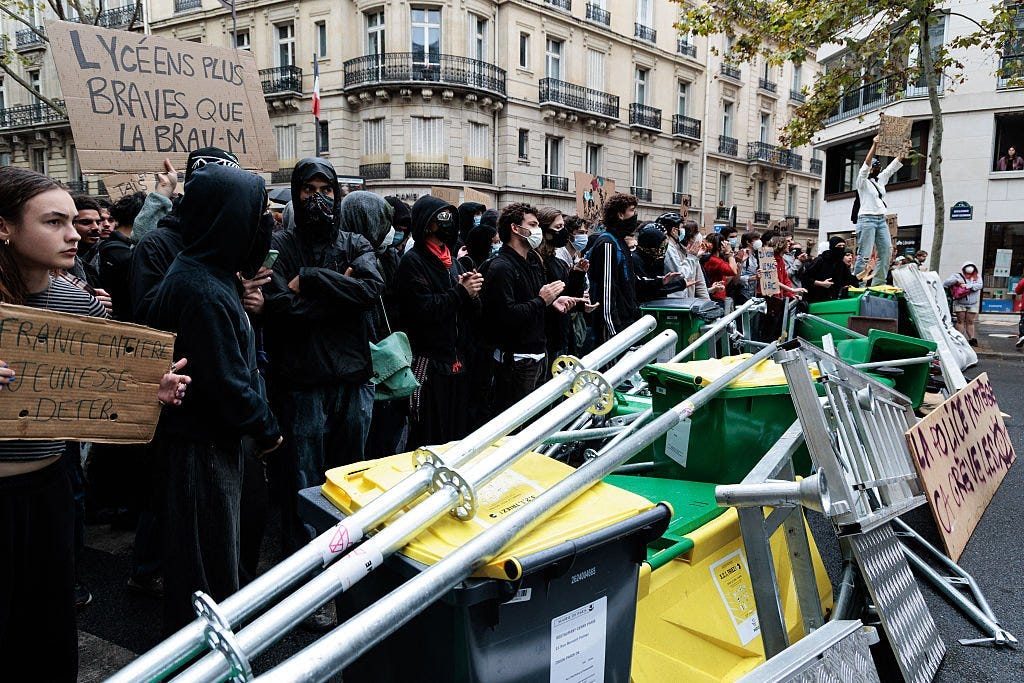
But this is not quite what happened here. In the first riots, in early October, 87% of those arrested were minors—mostly students12—for what crimes? Resisting arrest, participation in an unlawful assembly, intentional property damage, violence against public officials, and incitement to unlawful assembly.
YOUNG MAN: We’re here to demonstrate, ma’am.
REPORTER: Against?
YOUNG MAN: I don’t know, but we’re here to demonstrate. We’re not listened enough for the new reforms. We come here to show our joy and humour.
REPORTER: And what’s your message?
YOUNG MAN: Break everything!
CROWD: YEEEEES!
Later, by last weekend’s riots, only 27% were minors,13 so young men had joined in the vandalizing and looting, just like in the 2023 riots, which were caused by 18-25 year old men.
I spent six or seven hours in the middle of that shop window, and not once did I hear any political demands. There were plenty of insults, lots of laughter. It was all about the sheer pleasure of it.—Shopkeeper whose shop was vandalized.
From a police union, there are two profiles:
Young people from “sensitive neighborhoods” [code word in French for poor suburbs where Africans are overrepresented, especially Maghrebis] who vandalize and loot, and radical elements of the extreme left.—Hubert Gimenez, police officer and union representative.
According to the police, in Paris, these profiles account for 80% and 20% of cases respectively.
So what we have here are demonstrations that were already turning violent before older men joined in, escalating the vandalism and looting. But did this violence originate with the police?
Police Brutality
That’s the main complaint: The police are too violent, so people react with even more violence to protest. This is a compilation I found online:
When I first saw this, I thought: “This is bad!” But then I noticed that in all these videos, we only see the police’s reaction, but never what the action was. What happens when we look at the actions?
For me, the violence can be summarized with this video:
INTERVIEWER: Can you explain what you were trying to achieve?
STUDENT: I went to ask the police why they were using so much violence against students.
But of course, the video shows her pushing into the policeman, not the other way around. And if she had been so scared of their violence, would she have done this?
Until October 14th, the list of injured included 937 policemen, 250 students, and 150 education professionals. That means over 70% of those injured are policemen.

An additional 1,000 policemen were wounded (7 of them severely) during the weekend of October 17th.
I think it’s important to have a measured reaction. The police can’t use overwhelming force against pacific demonstrations, but there are not all pacific demonstrations. But after looking at all this footage, I think it’s possible that the police is not violent enough: Demonstrators don’t appear scared of them, rioters attack people, buildings, and the police with impunity, they loot and destroy… That’s at least what the police union Alliance thinks, as it will sue the French state for risking lives due to unclear and contradictory guidance on how to react to the violence.
When you look at governments that truly abuse violence against demonstrators like in Iran, what you see is police shooting people dead, police motorbikes going through the crowds with guns, police cars running over people, and little violence on the side of the protesters, for they know what will happen to them if they are caught.
Because that’s the next step.
The Role of the Courts
It’s not enough to stop violent riots or arrest their instigators. You also need to make sure that there are consequences, which usually means prison time.
Every drop in that funnel is a problem:
If only 1% of looters are ever arrested, the risk of looting seems worth it.
If most are not declared guilty, they’re not dissuaded from crime.
They also will not be dissuaded if a sentence is delayed, commuted or suspended.
And of course, if it’s short.
Probability of Being Arrested
In the 2023 riots, 8.5% of rioters were arrested. We don’t yet have nation-wide data this time, but data from Marseille suggests the chances that rioters will be arrested is around 1%. This is impunity.
Sentencing
Short sentences might actually be counterproductive, because prison has both positive and negative effects:
Deterrence: People fear being locked up, so they commit less crime
Incapacitation: While in jail, you can’t commit a crime
Rehabilitation: While in jail, you get trained to not commit crime, either ethically or through learning a profession to earn an alternative source of income
Crime training: You meet more criminals, who become your network and teach you how to become a worse criminal, while you lose your job, your family, and your friends outside, since they moved on without you and you
So what types of sentences are people getting? Here’s a list of sentences from this weekend’s cases. Here are a few to get a taste:
Ylan, 18, Toulouse. Threw a lit Molotov cocktail toward police officers (without an explosion). Maximum: 10 years in prison. Sentence: 12 months suspended, 140 hours of community service, and loss of voting rights for 3 years. [so, no prison for throwing an explosive at the police]
Three men, aged 20–27, Lille (two undocumented immigrants): Arrested carrying bags of merchandise looted from Micromania and Calzedonia. Maximum: 5 years. Sentence: 10 months in prison, with immediate detention, and a 2-year ban from French territory for the two undocumented immigrants. [how is that a 2-year ban instead of a permanent ban and immediate expulsion?]
Sahel W., 19, Reims. Looted a Carrefour Express supermarket. Maximum: 7 years. Sentence: 105 hours of community service.
Mohamed, Lyon. Undocumented immigrant who looted a Louis Vuitton store. Maximum: 7 years. Sentence: 6 months in prison, with immediate detention, and a 2-year ban from French territory [why not expelled and banned from France?]
Hugo M., 20, Reims. Looted clothing from a boutique. Maximum: 7 years. Sentence: 4 months under electronic monitoring
Unnamed Tunisian delivery worker, Rouen. Looted a gold-buying shop, carrying €16,000 worth of jewelry. Repeat offender. Maximum: 14 years. Sentence: 8 months in prison, with immediate detention, plus activation of a previously suspended 6-month sentence.
Anthony, Rouen. Homeless man who looted a Courir store. Repeat offender. Maximum: 14 years. Sentence: 6 months in prison plus 6 months suspended.
Unemployed man, 26, Rouen. Looted a Micromania store. Repeat offender. Maximum: 14 years. Sentence: 6 months under electronic monitoring.
Cheima, 30, Lyon. Looted a JD Sports store. Maximum: 7 years. Sentence: 8 months suspended.
Sophia, 27, Lyon. Looted a JD Sports store. Nine previous convictions, including theft. Maximum: 14 years. Sentence: 12 months under electronic monitoring.
You can read more examples in the footnote.14
Initially I was surprised at how much sentences include electronic tracking and community service instead of prison, but after looking at the evidence it makes sense. Electronic tracking seems to be better than a short sentence, because it still deters and slightly incapacitates, without providing crime training. Community service also seems comparable to short term sentences in recidivism.
What does surprise me is that there are a lot of recidivists here receiving very lenient sentences. Studies show that the vast majority of crime is committed by recidivists, and that it’s hard to get them to stop, so you simply want them off the streets for as long as possible.
Also, why aren’t illegal aliens who commit additional crimes expelled?
French lawmakers agree that legislation is too indulgent, and just before the strikes they approved the RIPOST law, which among other things increases sentences for people carrying firework mortars out of festivities contexts, frequently used as weapons in riots.
Another law to be debated next week includes:
Joint accountability, so that demonstrators police each other, as each member of a group is liable for the behavior of every other member.
Easier recovery of riot damages money from rioters.
Easier access to compensation for victims.
Victims who were not properly informed of a criminal hearing can still pursue civil compensation.
Rioters lose certain welfare benefits.
Family allowances and housing benefits, normally protected against seizure, could be used to recover court-ordered damages, subject to legal safeguards.
And during the riots, a few new project laws were added, mostly to keep casseurs more accountable by demanding full compensation for what they destroy, forcing debt collection even when the state or insurance companies don’t want to, and making parents economically accountable for their minor’s activities.
All this evidence suggests policing and sentencing might not be strong enough to deter rioters, so looters take advantage of demonstrations to convert them into riots. But are they the only force behind this radicalization?
The Role of the Extreme Left
Students and teacher unions have standing to demand more resources for education. What they can’t do is ask for more resources for education and pensions. But that’s exactly what they are doing, joined by the extreme-left party La France Insoumise (LFI). To them, the French government is not sufficiently taxing the rich, nor spending enough on education and pensions. Is this true?
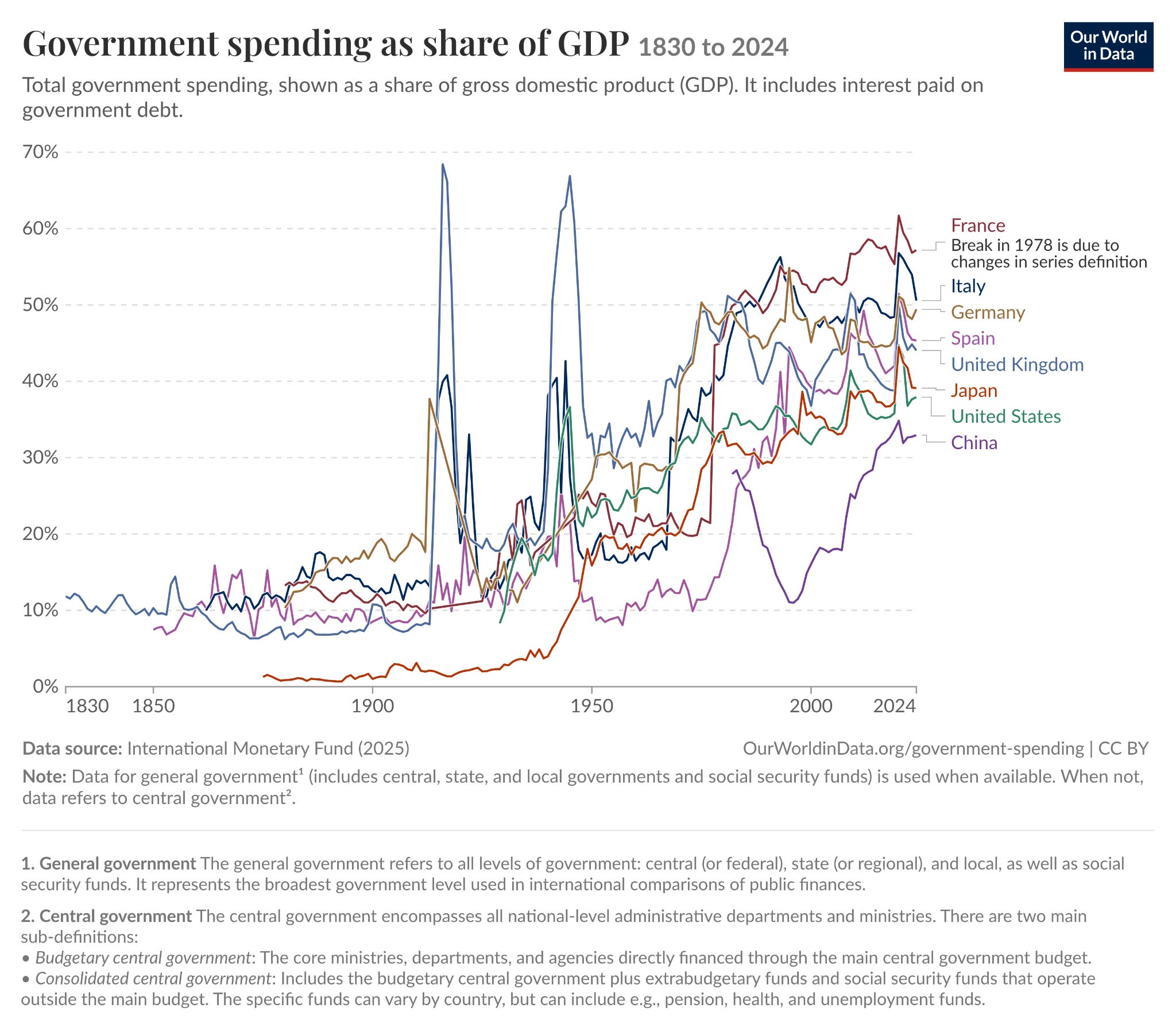
The LFI escalated the strikes to the national level, which is consistent with their goals: They want to publicize the bad state of affairs, so that they get more votes in the next election in April 2027.
And the LFI has been instrumental in turning the strikes into riots. Remember that the first round of arrests had a majority of minors. What does the LFI have to say about them? It always defends the demonstrators, whether violent or not. According to them, they’re never at fault. They’re either reacting to police violence, or when they start violence, it’s because they’re so oppressed that it’s the only way they can make their voices be heard. The LFI mayor of a poor suburb (investigated for embezzlement) said violence was legitimate.
This is not typical in French politics. Unions and politicians know that violence is very bad for their movements, so they take extra care in policing their own. Nobody is allowed to commit violence, and everybody must watch out to identify and turn in any violent person.
This is where the youth factor might have been important: Students are not as organized or experienced, they’re more excited about the adventure, and they might have been bad at policing their own—or might have even welcomed the adrenaline, not foreseeing the consequences.
The bridge between politics and violence became obvious when the far-left group La Jeune Garde, endorsed by the LFI and whose leader is a parliamentarian for the party, was declared illegal in France after it was proven to have physically attacked political opponents, organized patrols to intimidate and expel opponents, prevented political opponents from demonstrating, trained members for violent confrontations (under the pretense of self-defense), and promoted and legitimized political violence.
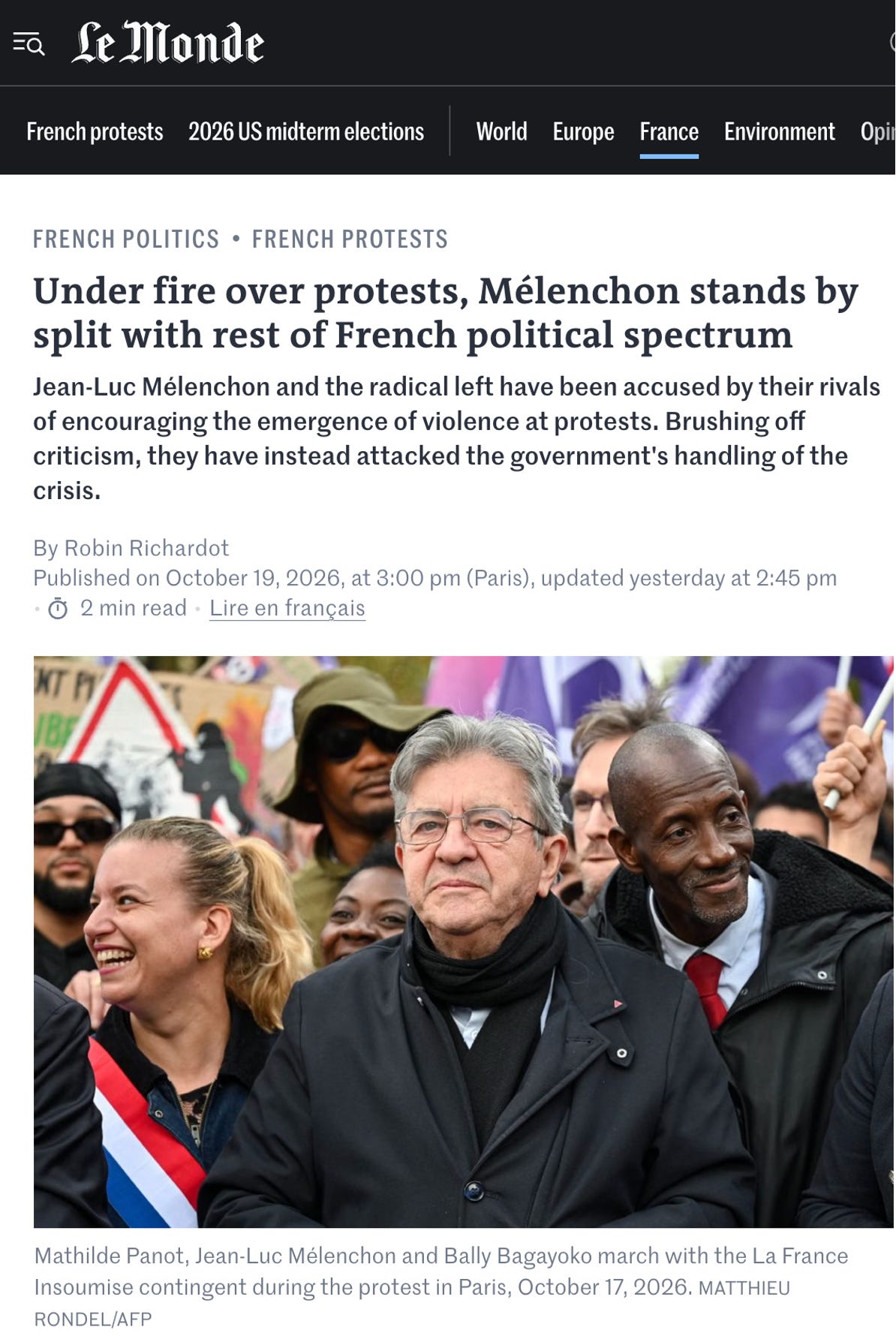
Why escalate strikes into riots? For votes, of course. They allow more visibility for their demands and provoke the police into violent confrontations, thereby playing into their hands. Great for increasing turnout in the upcoming election, pushing other left parties to match their demands, and destabilizing the existing government. That might be bad for students, teachers, and society in general, but it's good for getting more votes.
And who are they trying to attract? Of course, extreme-left voters, but not only those. Between 20% and 60% of the LFI’s voters are Muslim. This is what people call the Islamo-Leftist alliance, which turned really bad for leftist Iranians in the 1979 Revolution, as they carried the revolution in 1979, only to be side-lined, massacred, and then forced into submission by the Islamists. The French center-right magazine Le Point has drawn connections between the illegal Muslim Brotherhood,15 the Muslim Student Organization, and LFI, via organizations like Jeunes Gardes, RED Jeunes and Generation EDR, with supporting coverage from Qatar-funded Al Jazeera.
So Why Are There Riots in France, and What Can We Do?
Why are there riots in France?
Financing
Students are suffering from a shrinking spending on education in real terms, which they can feel through poor infrastructure, classes with many students, and missing teachers.
These conditions are not dramatically different to those in other OECD countries though
However, the spending in education has been growing, not shrinking. But students and teachers are not seeing that money, because it goes to existing pensioners, who account for a third of the budget.
Other entitlements may be even more ridiculous, including CAF and €1 lunches for all students.
And France can’t increase its taxes much more. It must reduce its entitlements, especially its pensions. It can be easily done by delaying the age of retirement, exactly the opposite of what the Left demands.
Discrimination
There is discrimination in France, and it applies to all immigrants, but especially Maghrebis.
This discrimination, however, reflects reality, as the immigrants that go to France frequently commit more crime and contribute less economically than natives, or other immigration origins.
I understand the complaint about the high school of origin in the admissions system. However, this information is transparent virtually everywhere else in the world, and people don’t complain about it. My main hypothesis is that there’s real information there, because of the previous point.
Maybe a solution could be eliminating high school, but then all baccalaureate results should be normalized based on the performance of each school’s students: A student coming from an easy-grade school should get a worse grade than a hard-school student.
Other measures seem legitimate to me, including higher tuition fees for foreigners, as in fact you do want to select against the immigrants who can’t pay them. There should be a separate scholarship system based on merit.
Escalation of demonstrations into riots:
Demonstrations do get penetrated by older people (mainly men) who want to vandalize and loot.
This is in part due to the youth of students, who don’t police their own.
However, the older looters are not the only culprits. Students also increased violence that escalated the demonstrations into riots
They were supported in this endeavor by unions and the extreme-left party La France Insoumise
LFI has an electoral incentive in maximizing the publicity to the demonstrations, and will always defend Muslim demonstrators and rioters no matter what, as about a third of its electorate is Muslim
Although police brutality might not help in de-escalating the situation, it looks like their substantially higher numbers of wounded suggest their response is actually not violent enough
The police doesn’t identify and arrest enough looters, so the impunity encourages them
Sentences might appear light, but in many cases that’s reasonable because the alternative—prison—might actually train the imprisoned to become more professional criminals.
However, light (or non-existent) prison sentences for repeat criminals are bad. These people should be locked down for a long time, because for them deterrence doesn’t work as well. You need to incapacitate them as long as possible.
Resident immigrants that commit these types of crimes should lose their status immediately and be deported along with the illegal immigrants.
So what can France do to solve these problems? I’ll cover that in the next article, along with a look at the massive wild card that can change everything here: AI.
Or children of at least one immigrant. 3rd generation descendants of immigrants are not counted in these stats, but there was a fair amount of Algerian immigration into France following the independence of Algeria, and many of their grandchildren today are 3rd generation.
In my youth when my soccer team played against teams like those of Créteil, we joked that we had to stay together before, during, and after the game, for protection. As the French would say, “Ça craint”. This fear was legitimate.
A deputy headteacher (proviseur adjoint), a director of vocational and technological training, a head of the business relations office responsible for coordinating vocational placements, a full-time school nurse, a full-time social worker, and additional disability-support assistants.
One policeman was accused of sexual assault. I’ll let you be the judge.
It has 7.5% unreplaced teacher absences, 21 students per primary education class (OECD levels), and 26 in secondary (10% higher than the OECD’s 23).
Caisse d’Allocations Familiales
It’s an example. I haven’t published on pensions yet, but I have a long draft on the topic. My short take on this is that the retirement age was fixed when life expectancy was decades shorter. It was meant more as disability insurance than funding for decades of holiday. We don't realize that everybody is poorer, including retirees, because of this massive spend on pensions that come too early. Increasing the age of retirement or changing the system completely to depend on something other than age would probably solve these problems.
On a per high school basis. 2% of HS suffer from such serious incidents every year.
The 14 year old shooter’s mother is Ethiopian.
14% of the French population is born abroad (21% if you count their children), but these numbers grow to 15-33% of school-aged kids in France are immigrants or their descendants, and they tend to fail at school. According to the OECD, in France 16% of students are immigrants, but in Canada it’s 34%. So France has half the number of immigrants as Canada, but 48% of these immigrants in France are socioeconomically disadvantaged, compared to only 28% in Canada. In Canada, immigrants outperform natives in international scores by 12 points, but in France they underperform by 51 points.
After a French-Algerian adolescent was killed by the police. The riots lasted one week and started in the suburbs of Paris, before spreading nation-wide.
The data actually refers to minors, not students. But in France, school is mandatory until 16, and from then until 18 people must either study or work, so the vast majority of those under 18 are students.
The 87% is nation-wide, the 27% is Paris, but data from other cities suggest the pattern is the same.
Man, 43, Pau. Threw projectiles at police officers. Maximum: 5 years. Sentence: 6 months under electronic monitoring.
Physical education teacher, 24, Nîmes. Threw projectiles that injured a police officer, resulting in three days of medically certified incapacity for work. Maximum: 5 years. Sentence: 18 months suspended with probation.
Ten defendants, aged 18–43, Grenoble. Looted telephone and perfume shops after smashing display windows. Maximum: 7 years. Sentences: Between 4 months suspended and 8 months of immediate imprisonment. One defendant, previously given a suspended sentence in June, received an immediate custodial sentence.
Unnamed undocumented immigrant, 32, Tours. Received or possessed stolen goods from looted shops. Maximum: 5 years. Sentence: 4 months suspended [why is he not expelled?]
High school student, 19, Tours. Received or possessed stolen goods from looted shops. Maximum: 5 years. Sentence: 3 weeks of community service.
Four men, aged 19–28, Nantes. An undocumented immigrant, a self-employed worker, a high school student, and a university student. Involved in looting stores, including Fnac and Foot Locker, or violence against law enforcement officers. Maximum: 5–7 years. Sentences: 4, 6, or 8 months suspended.
Two related women, ages unspecified, Agen. Dressed entirely in black, assaulted and insulted a police officer and damaged a police vehicle. Maximum: 5 years. Sentence: 6 months suspended plus a citizenship education course.
Three men, aged 23–24, Bobigny. Possessed a replica handgun, fireworks mortars, balaclavas, and materials for making Molotov cocktails. Maximum: 7 years. Sentences: Ranging from 10 months suspended to 7 months under electronic monitoring.
Edmondson G., 21, Paris. Former firefighter arrested before a demonstration carrying Molotov cocktail materials in a backpack. Videos on his phone reportedly showed him throwing a Molotov cocktail the previous day. Maximum: 7 years. Sentence: 2 months in prison, with immediate detention, plus 6 months suspended.
Andy M., 23, Paris. Security guard who fired a fireworks mortar toward law enforcement officers on the Champs-Élysées. Maximum: 5 years. Sentence: 12 months suspended, with an order excluding the conviction from the relevant criminal-record extract.
Father, age unspecified, Lille. Attempted to break into a store using a crowbar. Maximum: 7 years. Sentence: 10 months in prison, with immediate detention, and a 3-year ban on participating in demonstrations.
Man, 23, Lille. Fired fireworks mortars toward law enforcement officers. Maximum: 5 years. Sentence: 12 months under electronic monitoring and 140 hours of community service
Nicolas (garbage collector) and Zakaria, Rouen. Threw projectiles at police officers and verbally insulted them. Maximum: 5 years. Sentence: 12 months under electronic monitoring.
Adam, 19, Lyon. Swiss national described as a foreign Black Bloc participant. Arrested leaving a looted Monoprix store; also convicted of resisting police. Maximum: 7 years. Sentence: 12 months suspended.
Man, 20, Perpignan. Threw a construction barrier at two police officers. Maximum: 5 years. Sentence: 6 months under electronic monitoring.
Man, 21, Perpignan. Threw projectiles at police officers and damaged public property. Carried ski goggles, an improvised face covering, and reinforced gloves. Maximum: 7 years. Sentence: 10 months under electronic monitoring.
Amazon delivery worker, 22, Perpignan. Stole a scooter after a demonstration, with accomplices, forced entry, and a concealed face. Had a previous conviction. Maximum: 10 years. Sentence: 8 months under electronic monitoring.
Woman, 20, Limoges. Participated in looting shops and City Hall, which was subsequently destroyed by fire. Maximum: 7 years. Sentence: 6 months in prison, with immediate detention, plus 18 months suspended with probation.
It’s not banned in France, but only because it has no presence. All associated organizations have been dissolved.
It’s France, this has happened like every eighteen months since 1789.
I've been interested in your writing since the beginning but sometimes I wonder about the depth. Here, for instance, I wonder why you insert the video about the kids being apparently hysterical in only wanting to break, without any reason (after "violence against public officials, and incitement to unlawful assembly."). It is weird in the text at that moment. And then ... the video is probably doctored, starting in France Place de La Republique, but then finishing in another country (the building in the end is not in Paris, and there is Bolt bicycle in the stack, hence NOT PARIS). I suspect the kid talking is NOT IN PARIS.
Thomas: except if you goal is ideological, such carelessness is irresponsible.
There is some wisdom in the rest of the letter, but please, please please, can your source info not only by truthfullness and by representativeness ???
Your call...