

Mosquitoes bugged me in three continents this year, waking me up with their buzz and annoying me with their itchy bites. There’s one flying around my head right now and I can’t find it. It’s driving me crazy. I’m about to go to bed. Am I going to get eaten while I sleep? Am I about to become vampire feed?
So I wondered: Should we get rid of them once and for all?1
The Mosquito Blood Sacrifice
They’re more than an annoyance. They cause over 700M infections and kill ~700k people every year. They’re by very far the most fatal animal to us.
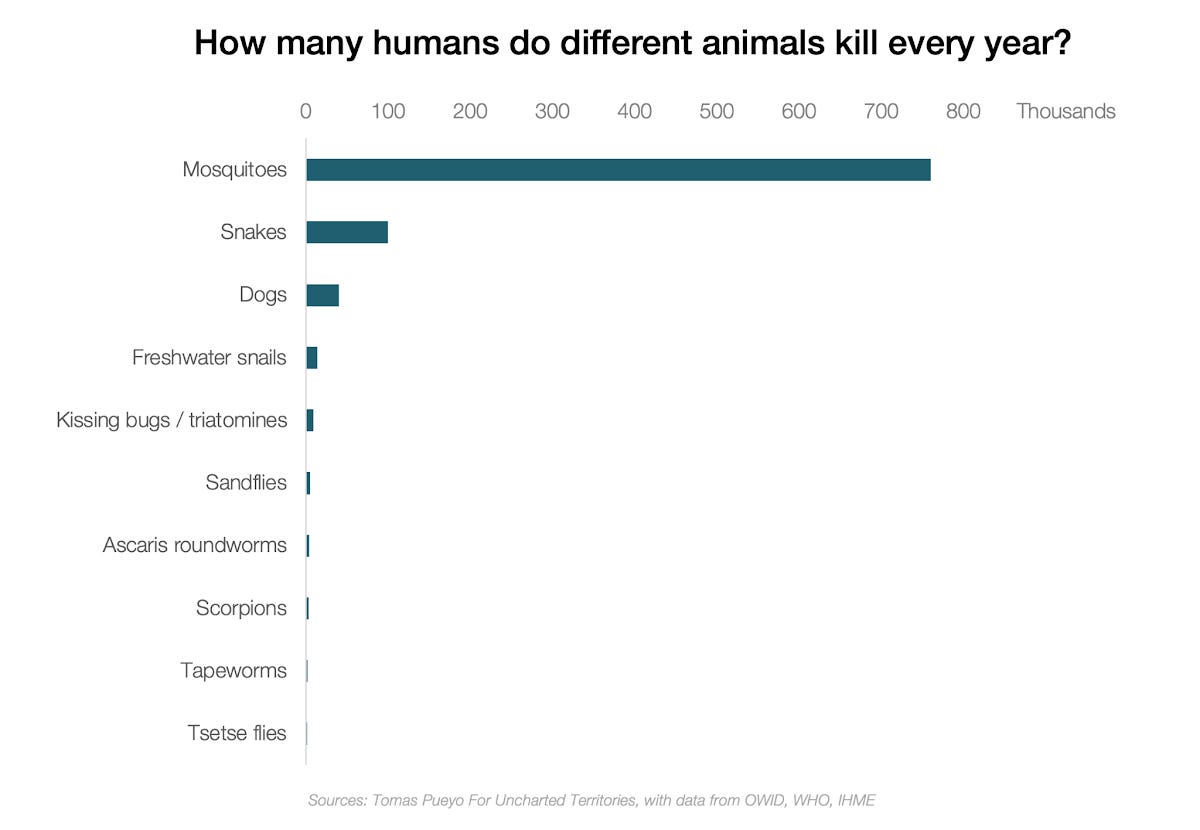
Mosquitoes transmit the Zika virus, West Nile virus, chikungunya virus infections, dengue fever, and most importantly, malaria.
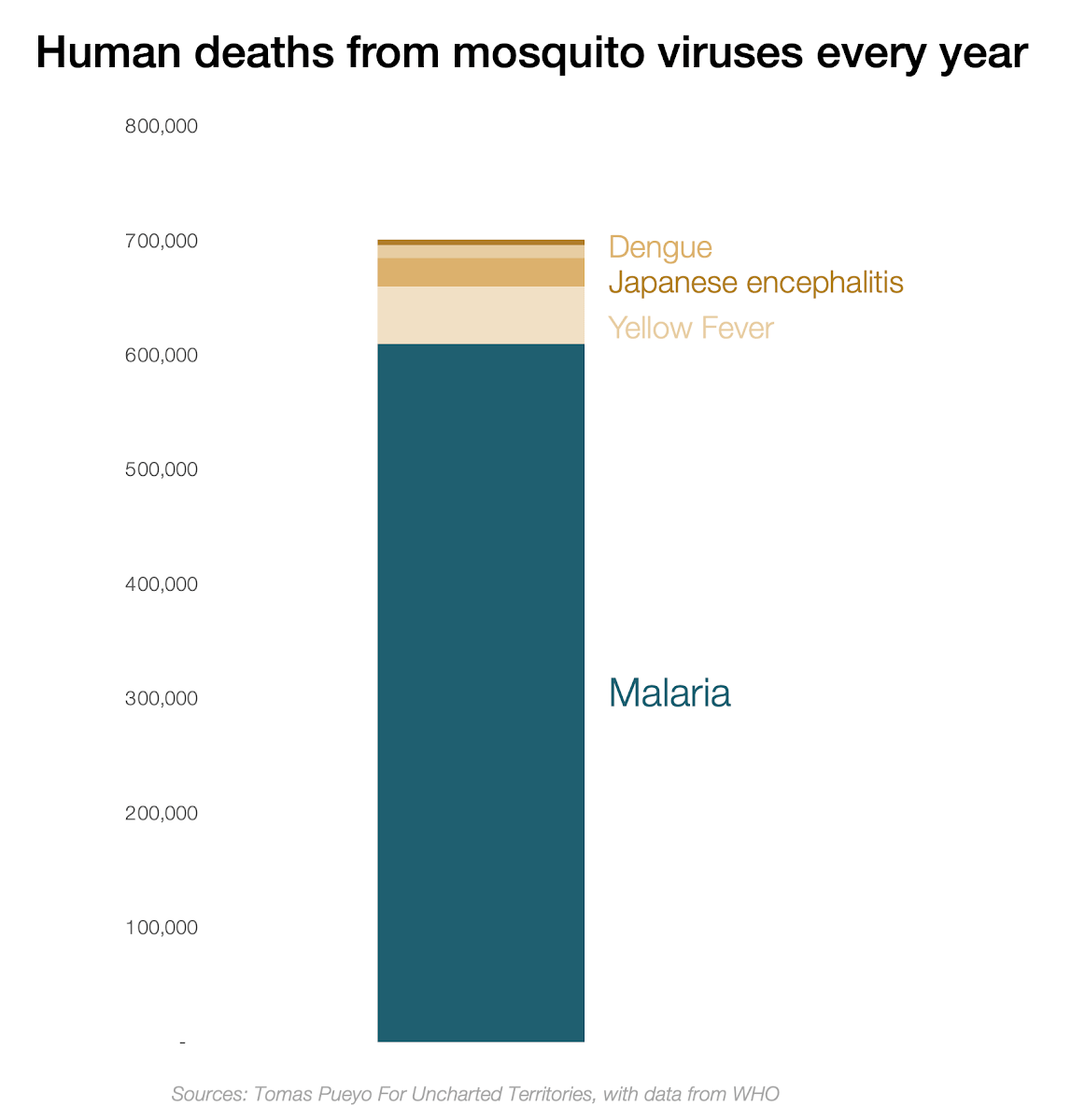
And as we’ve seen in several articles, their destruction has gone way beyond that: Mosquitoes caused slavery, they felled empires, and they created such a burden on people that they pushed them to live in the highlands, where difficult transport and communications made them poorer and more secluded. This prevented wealth accumulation for thousands of years, becoming a major factor in the poverty of tropical regions, especially Africa. Eradicating them would not only revert that, but also reduce the burden on the health system, redirect public-health expenditure to other diseases, reduce absenteeism from schools and work, and stop filling graveyards.
Can we eliminate these diseases completely?
Can we eliminate mosquitoes?
Should we? Would there be side-effects, for example in the environment?
How can you eliminate mosquitoes from your daily life?
That’s what we’re going to cover today.
When Did We Start Eliminating Mosquito Diseases?
Mosquitoes lay their eggs in standing water or areas that can get flooded. Hippocrates noted in the 5th century BC that swampy, low-lying areas are much more disease-prone.
And mosquitoes don’t travel uphill much. So the people living nearby rivers, lakes, or other sources of water have always suffered much more from disease. This is an illustration of Rome’s seven hills before they were built over as the Roman Empire grew.

In Rome, those in lowlands close to the River Tiber suffered more from malaria than those living uphill, rich people tended to live on the hills. The word palace comes from the Palatine Hill in Rome, where most of the palaces were. Romans noticed that, when they drained some areas, they tended to become healthier, and they told people to avoid marshy areas.2
China inadvertently stumbled upon another solution to malaria: the introduction of fish culture in rice paddy fields. The fish ate 80% of mosquito eggs, so malaria shrunk by 82%!
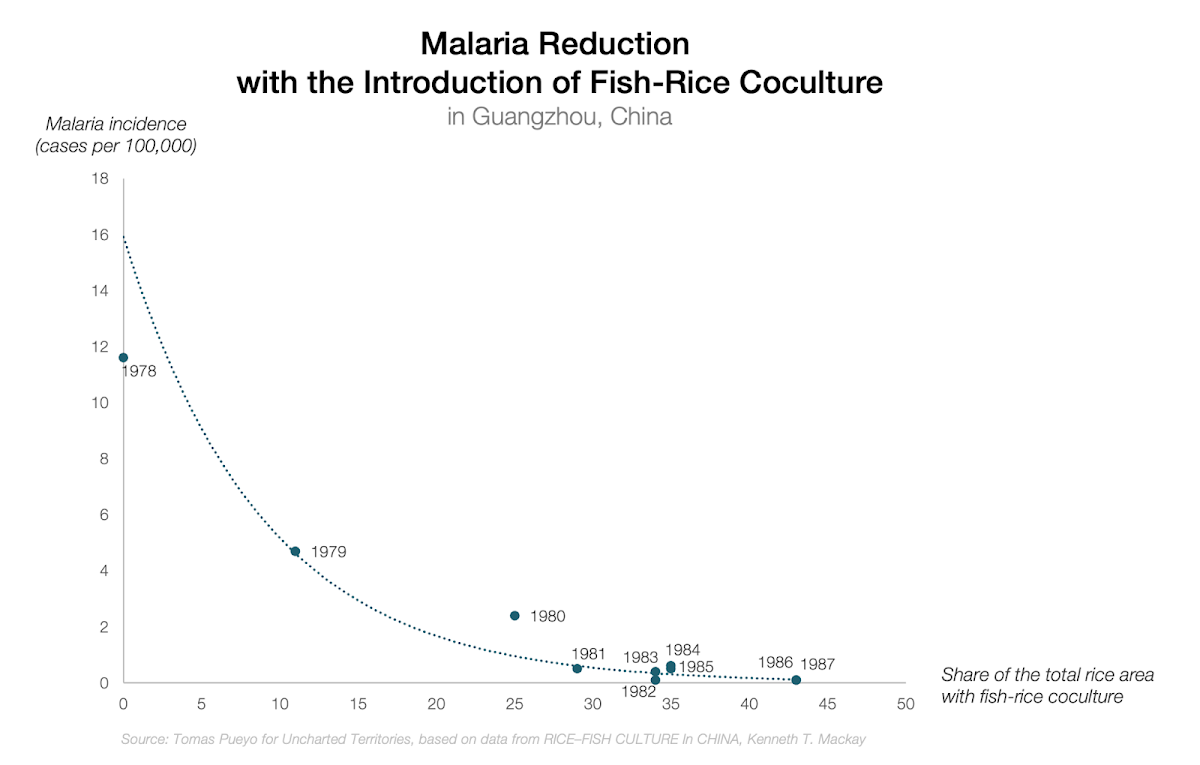
Unfortunately, while they’ve seen this for centuries, they didn’t realize the connection, and only pushed to develop it in the 20th century
Quinine, isolated in the early 1800s, reduced mortality from 90% to 17%, and that allowed the European conquest of Africa. This is the origin of the Tonic Water and Gin & Tonic you drink today—its bitterness comes from quinine, which British soldiers in India mixed with sugar, lemon, and gin to make it more palatable.

But it didn’t reduce the spread of malaria itself. In fact, not much did until the 20th century, when the vast majority of humans still lived in malaria-prone areas.
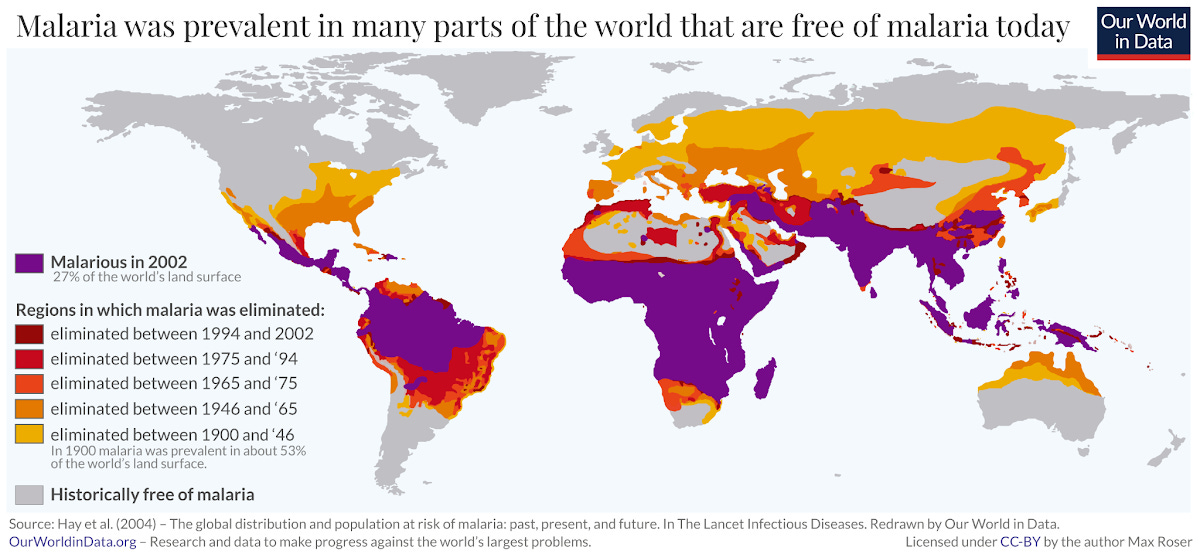
How did we eliminate it? In the late 1800s, we discovered that malaria was caused by mosquitoes, and that kick-started a global race to kill them in the 1900s. The first attempt at building the Panama Canal in the 1880s failed, among other things, because we didn’t know this back then, and too many workers died. We tried again in 1904, took measures against mosquito spread, and finally succeeded. A notable campaign was carried out in Brazil in the 1930s: Agents went door to door spraying an early insecticide (kerosene with some mosquito-killing flower extract) and draining any standing water. Later, they continued across South America. The result was the virtual elimination of the mosquito across an entire continent!
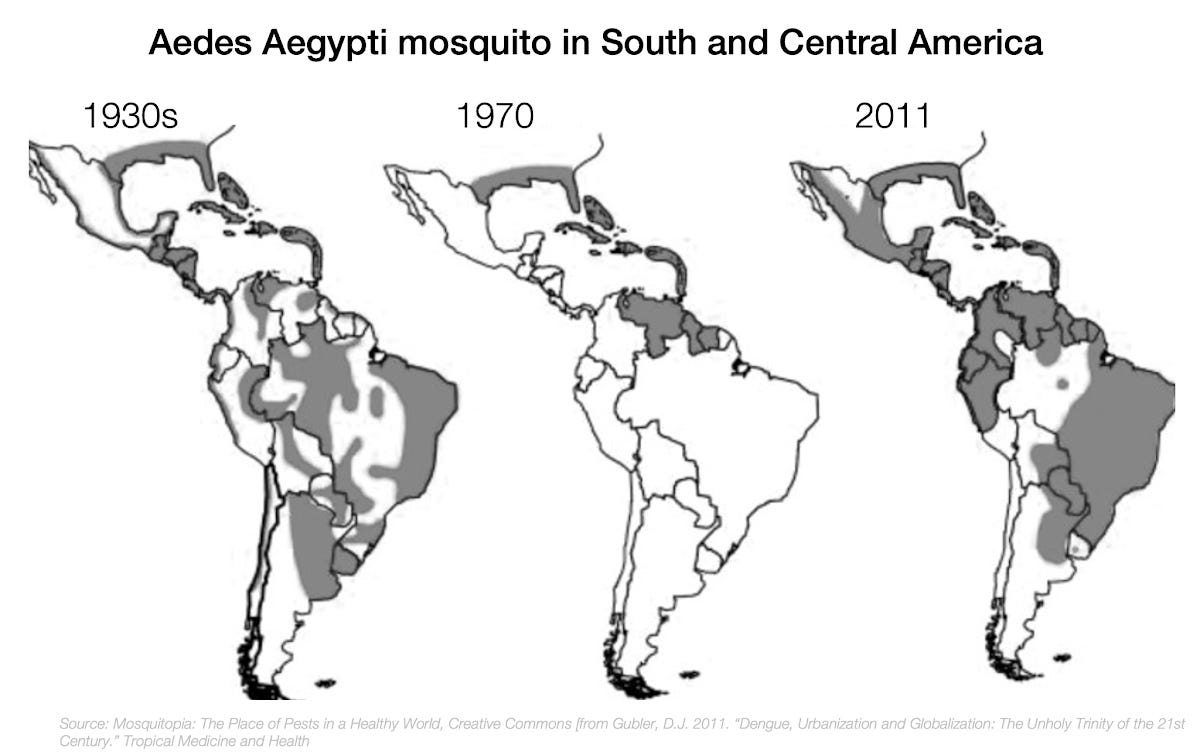
And that was despite the poor insecticide, which disappeared after a few hours or days. But during WW2 we discovered a new insecticide, DDT, which stays active on floors and walls for months. One pass was enough, which made the process much cheaper. It was first used massively on the Italian island of Sardinia, bringing malaria cases from 75,000 in 1946 to zero in 1950. Something similar happened in the US. Unfortunately, while DDT is not very toxic, it was overused in agriculture, accumulating, and causing some DDT resistance in some insect populations, so it was banned for agricultural use. We still use it as insecticide, but we can’t use it to eliminate all mosquitoes.
Eliminating Diseases Without Mosquitoes
Hold on, we eliminated mosquito-based diseases in places like the US or Sardinia, but there are still mosquitoes there. How did we eliminate the disease and not the mosquito? Do we even need to eradicate mosquitoes, or can we just eliminate the diseases they carry?
To answer that, we need to understand how mosquito infections spread:
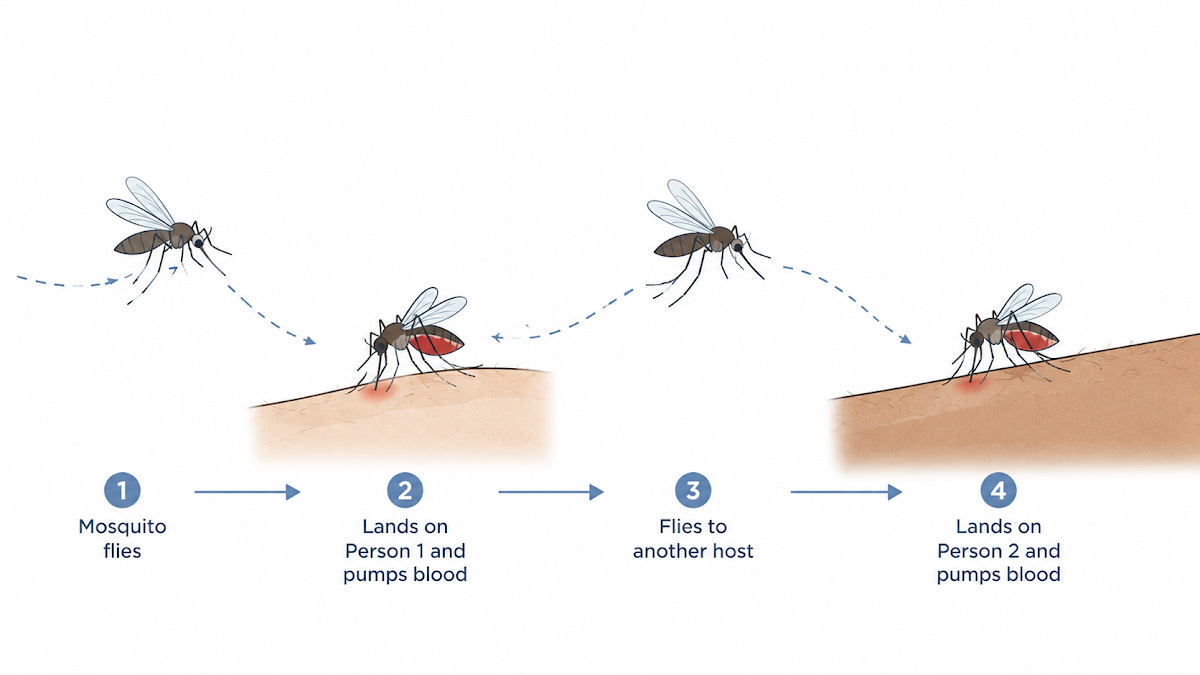
Malaria is caused by the plasmodium parasite, transported by the mosquito from one malaria-infected person to another, so the more malaria there is somewhere, the more likely a mosquito is to pick it up, and then to give it to somebody else. Conversely, an area can have mosquitoes, but if no human has malaria, then the mosquitoes can’t catch it,3 so won’t spread it.
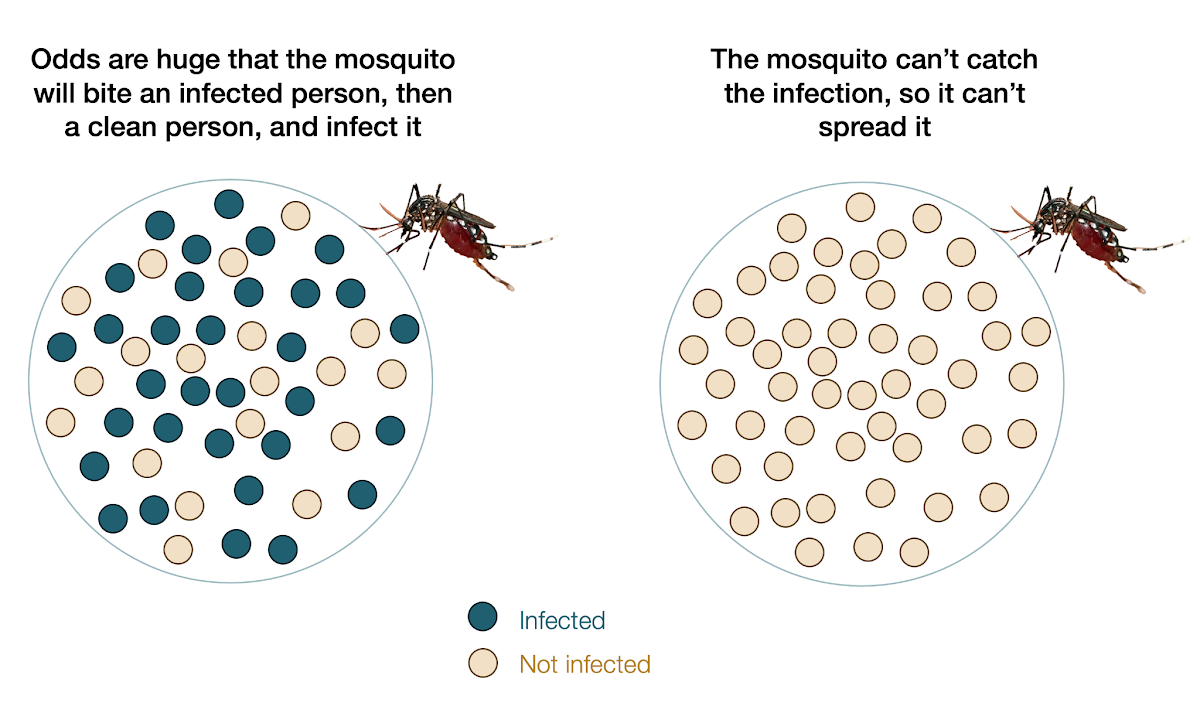
That means killing enough mosquitoes at once so that nobody has malaria can be enough to stop the disease without stopping the mosquito. This is precisely why malaria has been losing ground.
But not all diseases are like that. Some have animal reservoirs, so even if you eradicate the disease in humans, mosquitoes can get them from other animals (usually monkeys) and spread them again among humans. That includes Yellow Fever, Dengue, Zika, and Chikungunya.
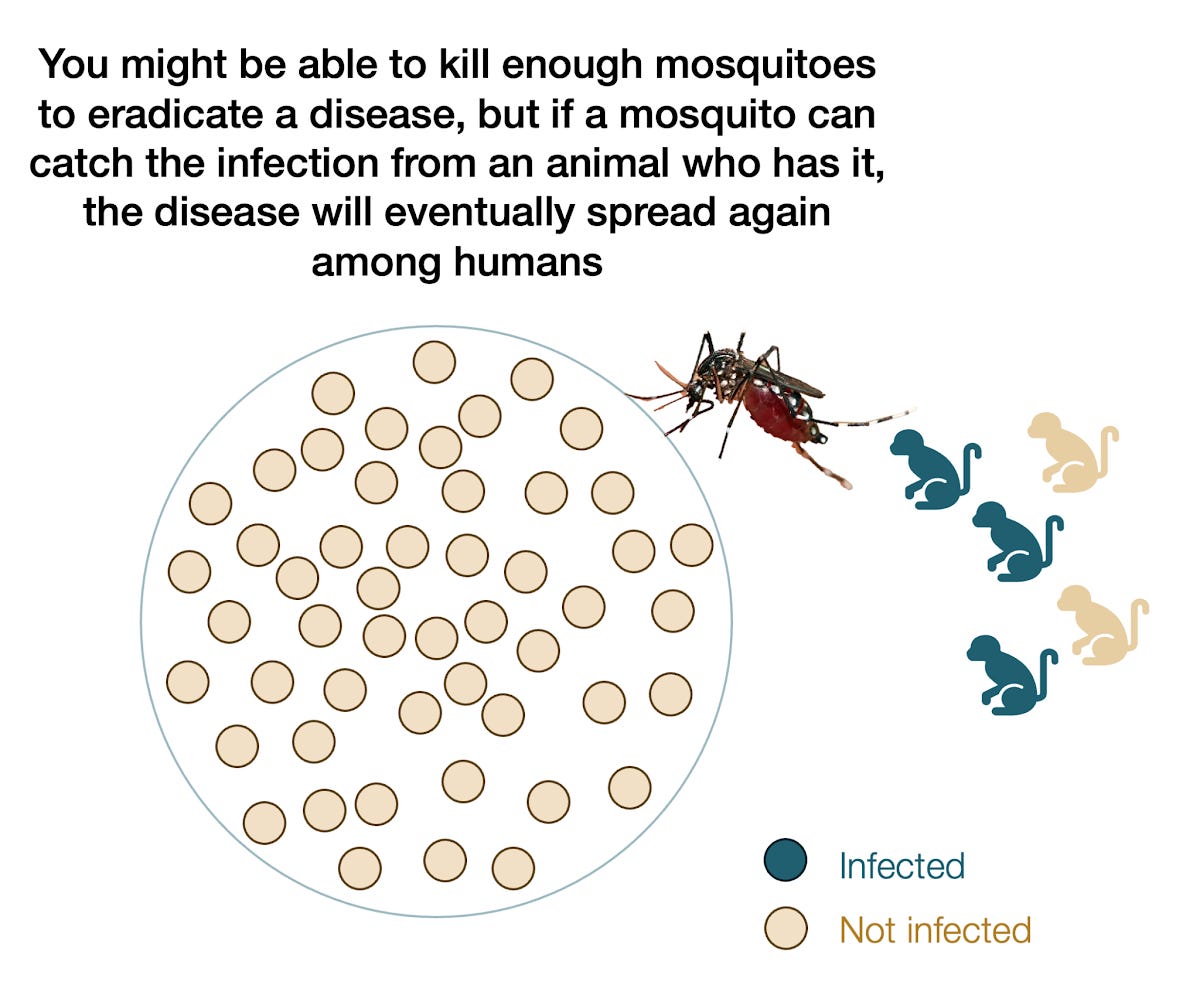
Of these, the only one we can hope to eliminate is Dengue, because the strains that humans spread are different from the animal ones, so extinguishing Dengue among humans might be enough to eradicate the disease completely. But it won’t be enough for the other diseases.
Finally, some mosquito-spread diseases are actually not spread from human to human, but instead from animal to human: The West Nile and Eastern equine encephalitis viruses come from birds, Japanese encephalitis from birds and pigs, Rift Valley fever from livestock… Since it’s virtually impossible to eliminate all the diseases in most jungle animals, the malaria approach is not enough to eradicate diseases.
Something like that has happened in Malaysia’s fight against malaria. With insecticides, bed nets, and other initiatives, it finally found no traditional malaria in 2018 (the one caused by plasmodiums adapted to humans). But mosquitoes can still catch another type of malaria (P. knowlesi) from macaques, and then infect humans with it. Spread of this one from human to human is uncommon, but this malaria is as deadly as the others, so Malaysia has gotten rid of human malaria, but not of mosquitoes, and the result is they still get cases of this weird malaria in forest areas because of monkeys.
In summary, we might be able to reduce malaria and dengue enough in many places without eradicating mosquitoes, but some diseases (and even malaria) might require us eradicating them nevertheless.
Should we do it after all?
What Mosquitoes Should We Eradicate?
There are 3,600 species of mosquitoes, but only a few hundred bite humans. And a handful of them account for virtually all human deaths.
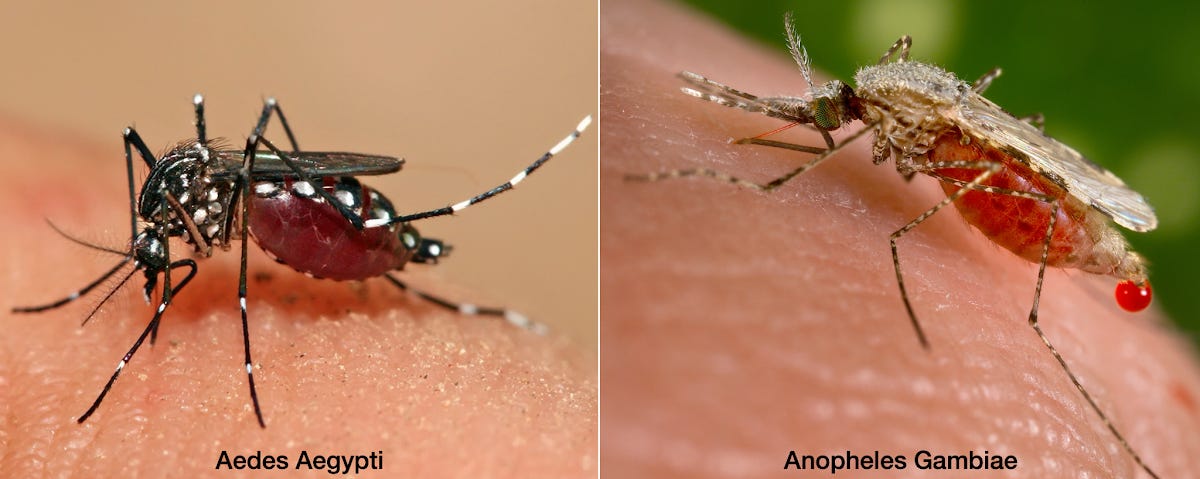
So we don’t need to kill all mosquitoes! We could just eradicate a few mosquito species and never suffer their diseases again: especially Aedes Aegypti, Aedes Albopictus (aka tiger mosquito), Anopheles Gambia, and Anopheles Funestus, but maybe also Anopheles Nili, Anopheles Arabiensis, Anopheles Coluzzi, and Culex Tritaeniorhynchus.
Kill The Invaders
These Aedes mosquito species are spreading everywhere, but that’s pretty recent! Aedes Aegypti used to be limited to West Africa, and only started spreading with the emergence of global trade, in the 15th century. The tiger mosquito comes from East Asia, and spread globally at the end of the 20th century, hitchhiking on used tires! These are invasive species!
Can we kill them? Yes! As we saw before, Aedes Aegypti was eliminated from 18 countries in South America by the 1960s. Did the ecosystem break? No. Did other animals thrive? Yes, of course! The elimination of an invasive species is not a problem!
Funnily, the tiger mosquito seems to be replacing the Aedes Aegypti in some areas!4 One invader outinvades another. It’s one of the top 100 most invasive species.
So it looks like these two specific invasive species would not be too problematic to eradicate, at least outside of their original habitats. But what about eliminating them there, or the anopheles species that cause malaria, which are mostly limited to their original habitats?
Would Eliminating Native Mosquitoes Hurt Their Environment?
As a reminder, we don’t want to eradicate all mosquitoes, just the few that feed on humans. What’s their potential value to the environment?
The eggs and larvae feed fish, amphibians, and birds
The larvae eat detritus in the water (plants, broken leaves, etc)
The adults pollinate some flowers
The adults are other animals’ meals (fish, birds, insects)
Blood Sacrifice
I have a strong opinion on points (1) and (4). These basically mean: “We take biomass from humans (their blood), and then feed it to animals, and in the process kill 700k humans per year (mostly babies and toddlers), so that these other animals can eat this additional biomass.”
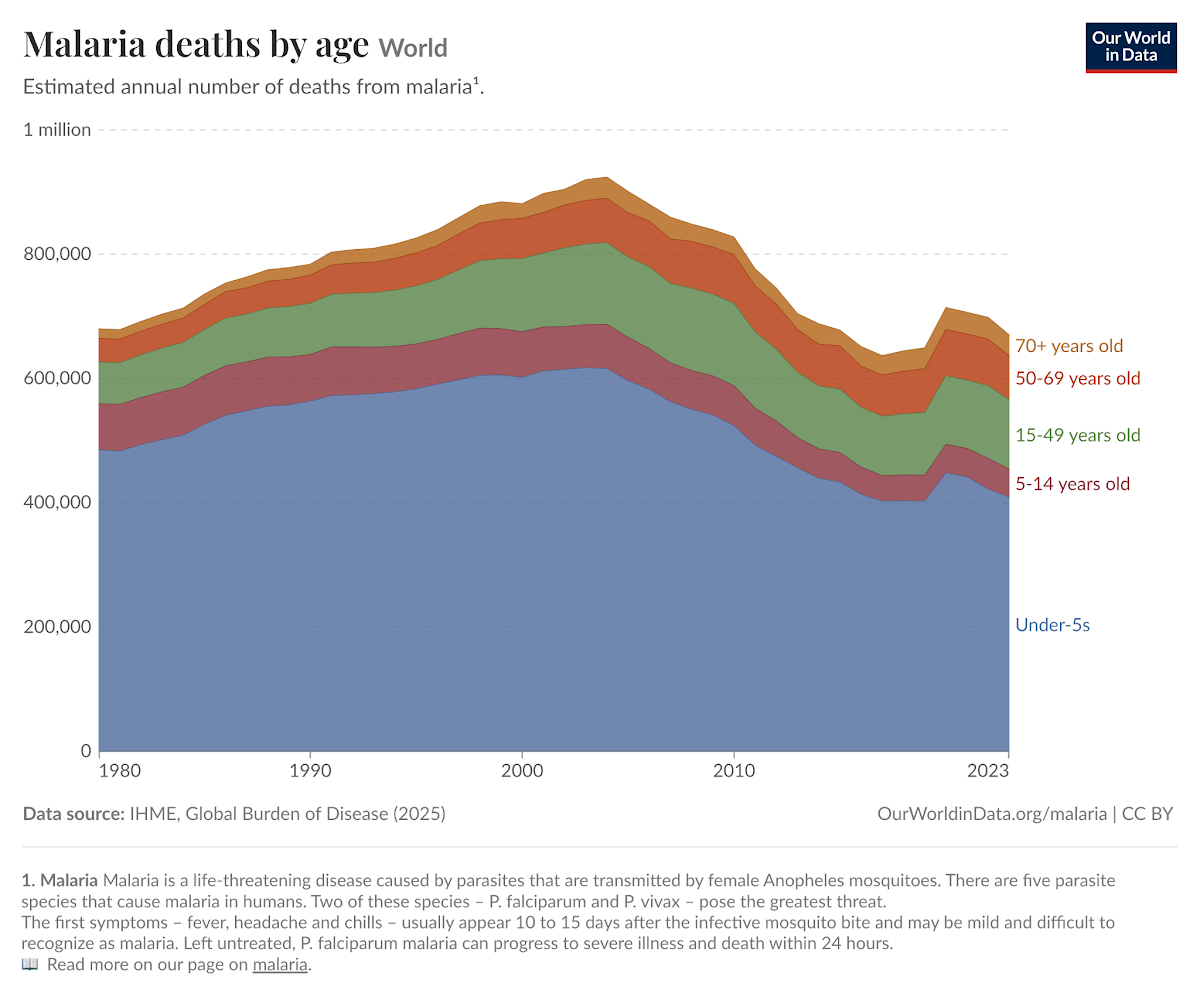
As a rule of thumb, we humans should try to eliminate food chains where we’re in the middle rather than the top. Call me anthropocentric, but I don’t think we should sacrifice our children to the gods of nature anymore.
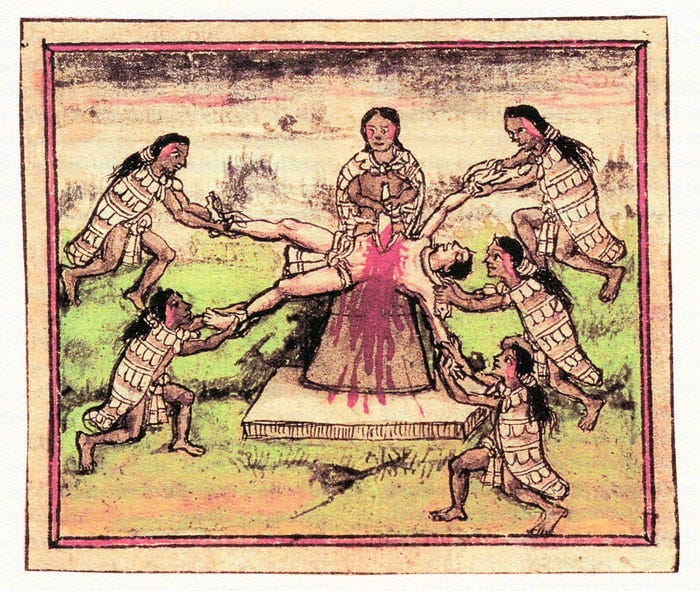
If you disagree, it means you think we should continue feeding human blood to mosquitoes, so I have a solution to please everybody: Fill this form so you can offer your body to mosquitoes for the rest of us. It’s win-win: Mosquitoes get to eat, other humans don’t get bitten, and you get to sacrifice yourself for both mosquitoes and humans to keep the food chain intact.5
If sacrificing children to nature is compelling to you, and you filled the survey and gave your body to mosquitoes and still think it’s not enough, you’ll be happy to know that human-biting mosquitoes only transfer about 5,000 tons6 of biomass into nature—basically nothing. Most of that just feeds the circle of blood sacrifice, only a fraction feeds other animals. Researchers also found that mosquitoes are not a great meal: They mostly use water bodies made by humans (so little natural impact), no predator is known to depend on their larvae, the energy spent hunting the adults is more than the energy received eating them, and since they’re very widespread, it’s unlikely that any predator depends on them.7
(2) Cleaning Detritus
What about cleaning the water of decaying leaves and grasses? In reality, that’s not what happens. Bacteria and fungi do that, which protozoa eat. The mosquito larvae eat all of these, but so do many other animals: dipteran larvae, zooplankton, various aquatic insects, tadpoles… If you eliminate all human mosquitoes, you might have some more bacteria and fungi for some time until the other animals catch up. But is that really going to make the area less healthy? How, because you’re eliminating disease-ridden mosquitoes?!
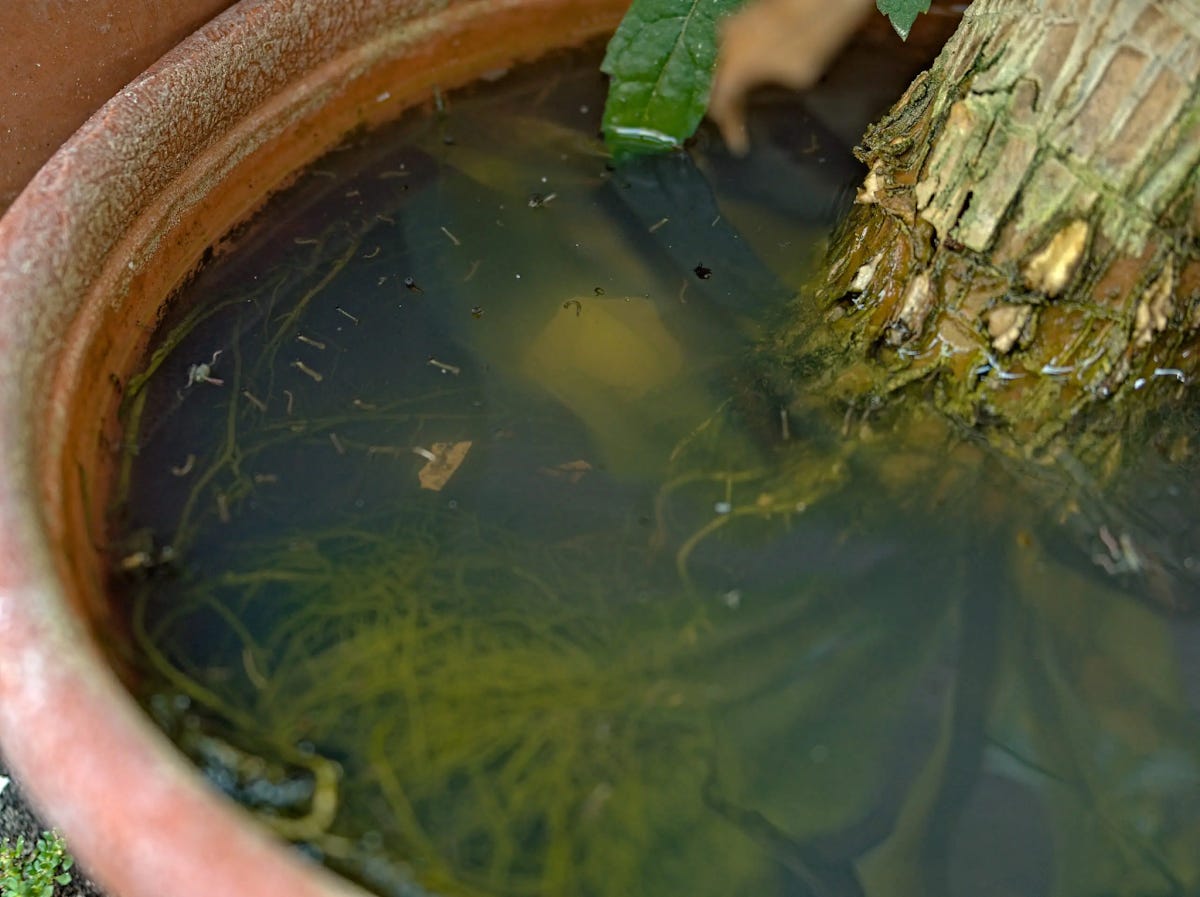
You could argue that the one thing mosquitoes do is take biomass from the water and carry it out, so that birds and other non-aquatic animals can feed from it. But other animals do that too: midges, mayflies, caddisflies, dragonflies… If we wanted to eliminate all mosquitoes on Earth, maybe we should worry a bit, but again, this is just a few species.
So there’s really no special role for mosquitoes here.
(3) Pollination
Adult mosquitoes of both sexes feed on nectar and other plant sugars. When they visit flowers, pollen sticks to their body and goes to the next flower. But do they have a major, or unique, pollination role?
You can probably intuit the answer already. Do farmers use mosquitoes to pollinate their plants? No.
Here’s another intuitive way to think about it: The mosquitoes we want to eradicate here are specialized in humans, which also means they live near us. Do you think, as such, they will have some special role in nature? That some special flower or plant is uniquely pollinated by them? No.
If you’re of skeptical nature—common in these Uncharted grounds—you’ll be happy to know that this paper looked into it and confirmed the intuition: Mosquitoes visit plenty of flowers (not some unique types), flowers are visited by plenty of insects, there’s no flower that depends on these mosquitoes, and if there were and we missed it, it would probably be a human-linked weed.
This other paper actually observed Anopheles Gambiae mosquitoes (the top malaria ones), and found that they tended to eat stems and leaves more than nectar (naughty!) and when it analyzed their bodies, found no pollen (buuuh!)
Conclusion: Should We Eradicate Mosquitoes?
Yes!!
Mosquito diseases kill a ton of people, condemn entire populations to poverty, and are superannoying in general.
We can eradicate some diseases without fully eradicating mosquitoes, especially malaria, but there are limits. Some diseases can’t be eliminated without eradicating mosquitoes.
We only want to kill a handful of species, the other 3,500 will stay alive!
We’ve done it in the past! In South America, for decades, there were no Aedes Aegypti! We just stopped trying and it came back. Nature did not collapse.
Two of the biggest species are invaders: Aedes Aegypti and the tiger mosquito. These, we should just eradicate as invaders, to reestablish the former balance.
For the rest—the handful of native ones—we should also eradicate them, because:
They barely add any biomass to nature
The biomass they do add is mostly ours, and we should not like that
Their water cleaning skills are dubious, and certainly replaceable
Their pollination contribution is basically zero
In other words, a handful of mosquito species sacrifice our children and add nothing, starting by Aedes Aegypti, tiger mosquitoes, and Anopheles Gambiae. We should eradicate them first, and follow with the others.
We should probably not stop at these, though: All the logic we’ve been using for the top 5-10 worst mosquito species is valid for any human-centered mosquito species. They should all be treated as parasites whose only function is to annoy us and spread our blood in the surroundings of human habitats. Like harmful viruses and bacteria, they should all be on the eradication list. As we go through that list, starting with the deadliest mosquitoes, we can observe what happens to learn.
Let’s annihilate them.
In the next article, we’ll see how: What measures governments have taken to eliminate mosquitoes, and what you, yourself, can do to get rid of yours.
Dedicated to Francis, the mosquito that buzzed around my ear tonight as I was finishing this article. You might have won this battle, but you will lose the war.
This is a lie: I’ve been thinking about eradicating them for a long time. This is just the moment I decided: Be the change you want to see in the world. If not me, who? If not now, when? I want to drive the Freedom against Mosquitoes movement.
And they did drain many other areas, but for agriculture, not to make them healthier.
The plasmodium changes the mosquitoes’ behavior! While it incubates and they can’t infect humans yet, it reduces the mosquitoes’ desire to feed on human blood. It makes sense: It’s a risky endeavor (they can get killed!) and there’s no benefit for the plasmodium yet. Once it can infect humans though, the behavior reverses and goes beyond: Mosquitoes try to feed on human blood more, they’re more attracted to human odor, try to feed harder, probe more, feed more frequently, and crucially they are more than twice as likely to feed from multiple people rather than just one person!
It does it in two ways:
Mosquitoes of both species mate with each other, but the offspring are not viable. However, these cross-species matings make the Aegypti cease reproducing, but not the tiger. Why? When a tiger male mates with an Aegypti female, she stops mating with other males. This is normal behavior, except in this case it means the female won’t have any viable offspring ever. For some reason, the reverse is not true: When male Aegypti mate with female tigers, the females don’t stop mating! So they’re not infertile for life. Source.
Apparently, when they compete for resources that are scarce, the tiger mosquito wins and replaces the Aegypti.
If mosquito eradication methods killed other animals in the process, then I would be more worried. For example, this meta-analysis showed that using Bti to kill mosquitoes also kills other insects, and as a result there are fewer vertebrates later on, as they have lower reproductive success. But in the same region, another intervention only targeted mosquitoes, and the density of other animals didn’t shrink. So it looks like eliminating just mosquitoes doesn’t have downstream effects in the food chain.
That’s a ChatGPT calculation because it’s not core to the point. We just need a ballpark, and this is several orders of magnitude less than what would start mattering, so we have our answer.
One spider eats a lot of blood-sucking mosquitoes, but it doesn’t depend on human-blood-sucking mosquitoes.
Yes, I'm in favor of eliminating mosquitoes. Releasing sterile mosquitoes could work. I'm wary of widespread nonconsensual spraying, but it might be worth it in some cases.
On an individual level, here in the US it's common to hire companies to spray pyrethroid insecticides monthly. Our family doesn't currently do that because we like to play it safe while we have babies, plus it kills a lot of other insects.
We do use DIY mosquito buckets of doom, i.e. black buckets with water, a bit of decaying leaves, a stick so that frogs etc. can escape, and a BTi dunk that kills only mosquito larvae. They help a little. Companies will also maintain proprietary buckets for pay.
https://sidewalknature.com/2022/05/08/mosquito-bucket-of-doom/
We have also had a deposit down on a Tornyol mosquito drone for over a year. The idea is it patrols your yard like a Roomba and intercepts mosquitoes. I hope it ships next year.
https://tornyol.com/
It frustrates me that the invasion of Tiger mosquitoes in the US around 2000 has contributed to the decline of outdoor play. There weren't this many mosquitoes when I grew up, or at least they were mainly confined to dawn and dusk. Tiger mosquitoes hunt all day. My kids spend less time outdoors than they otherwise would because of them.
I found myself agreeing with Tomas almost from the first paragraph, because his article perfectly complimented a Ted Talk that was given by Bill Gates about mosquities (side note, I was in the first row and was not expecting what came next)
https://youtu.be/ZLkbWUNQbgk?is=Dj0RrdKK0rtGfaQY
The question was much the same...why do we feel compelled to protect a handful of mosquito species that are responsible for so much disease, suffering and death?
I understand the instinct to protect nature. But somewhere along the way, we seem to have adopted the idea that everything occurring naturally must therefore be preserved. We don't consider ourselves morally obligated to preserve smallpox. Why should a mosquito that spreads malaria or dengue be afforded some special status?
The number that is impossible for me to get past are those 700,000 deaths every year, many of which are children. I have yet to hear a rational argument against doing it. We sometimes apply a greater degree of caution to protecting an insect than we do to protecting the people it kills.
I am perfectly comfortable putting humanity first.