

Over the last few weeks, massive changes have happened in Musk Industries:
Musk is saying he’s going to build datacenters in space
SpaceX and xIA are merging
The resulting company is seeking an IPO
SpaceX aims to build a base on the Moon instead of Mars
These facts are interconnected, in a way that isn’t obvious. Today, we’re going to make that explicit.
1. Starship’s Emptiness
SpaceX’s valuation has exploded.
Skyrocketing
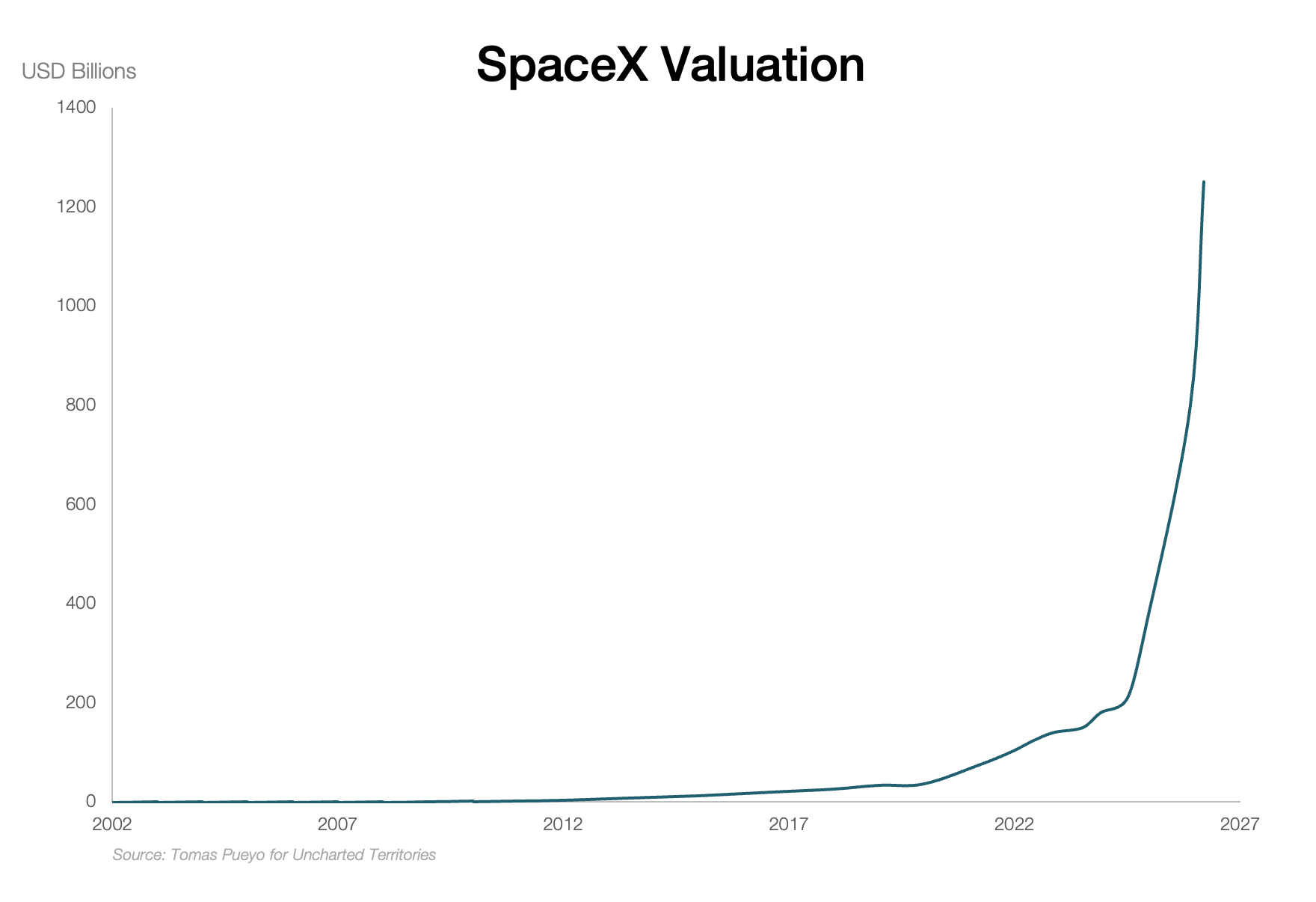
Why? Because its revenue has grown proportionally.
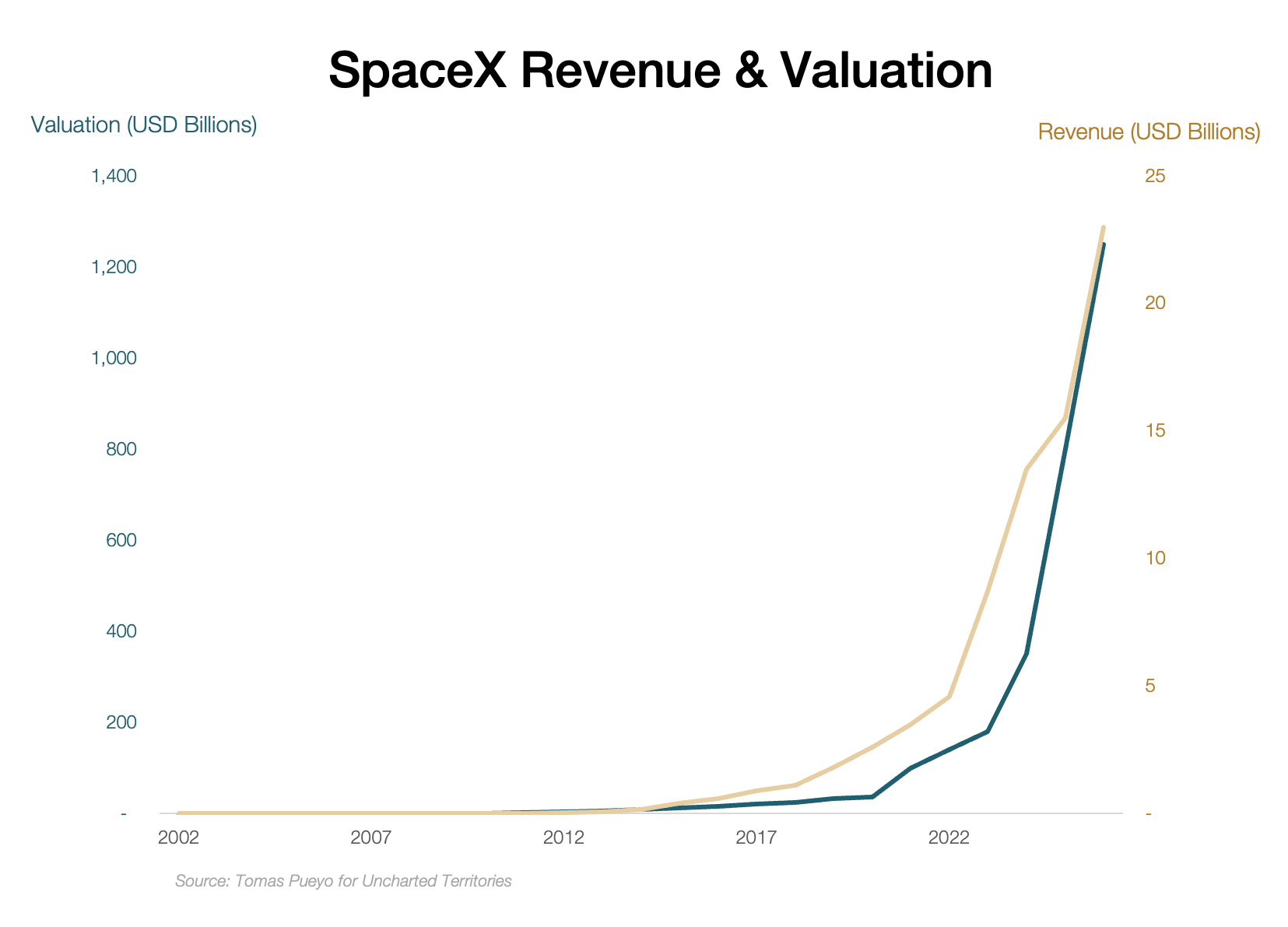
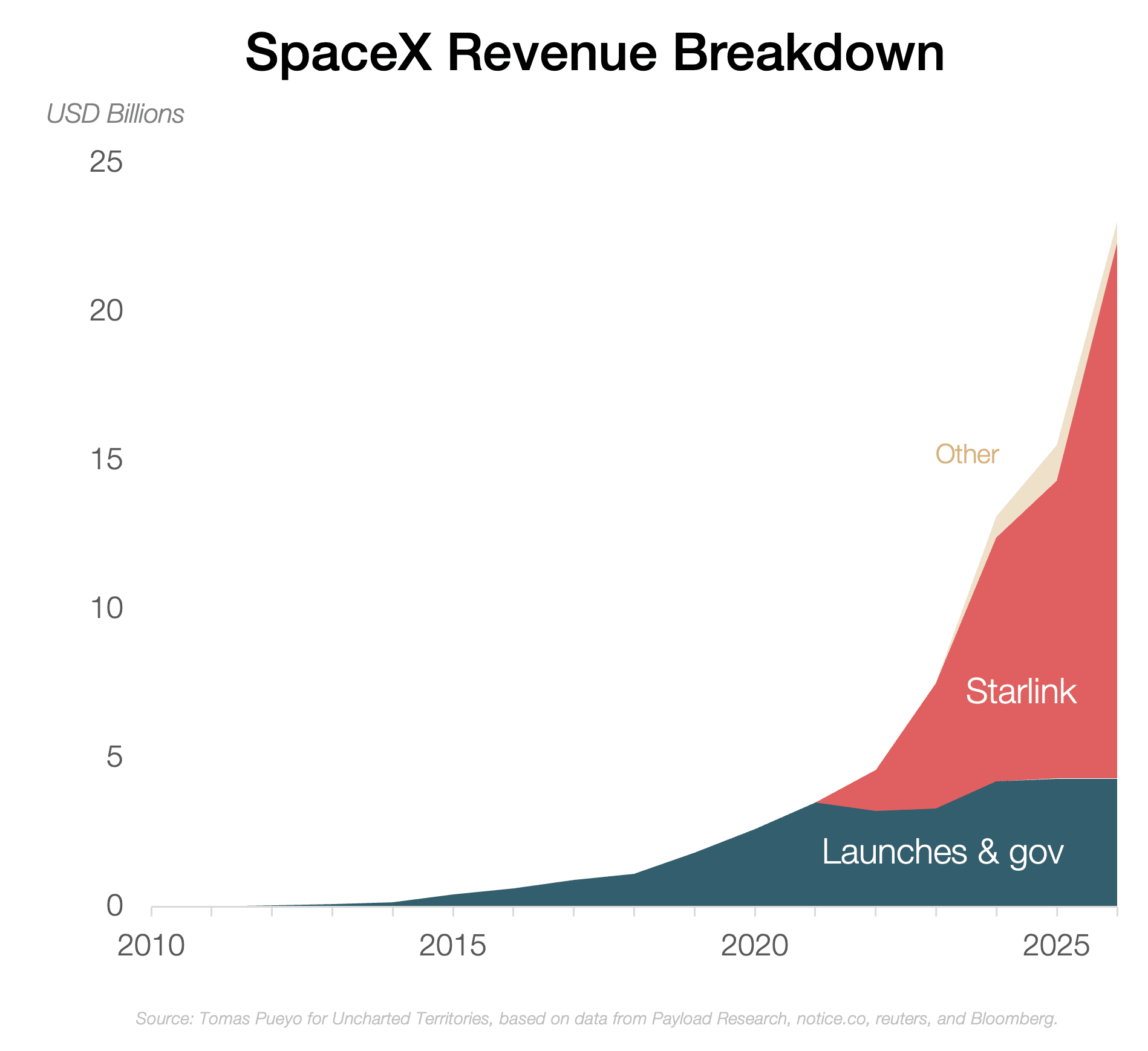
Where does that revenue come from? Mostly from Starlink, a global service of direct telecommunications via satellite.
This is SpaceX’s revenue breakdown:
Its number of subscribers has been growing exponentially:
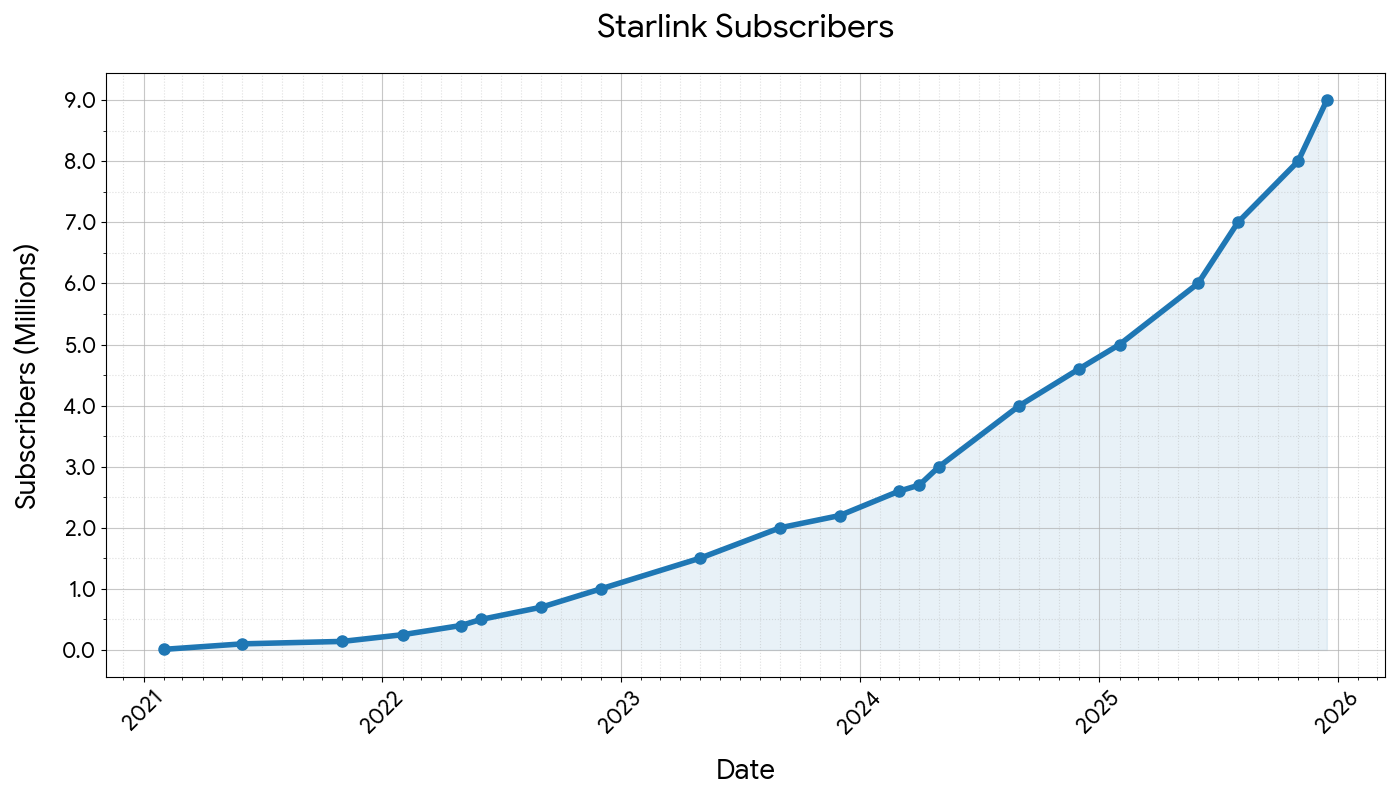
The service is printing cash—about $12B in 2025, and growing fast.
How is this business growing so fast? Because of this:
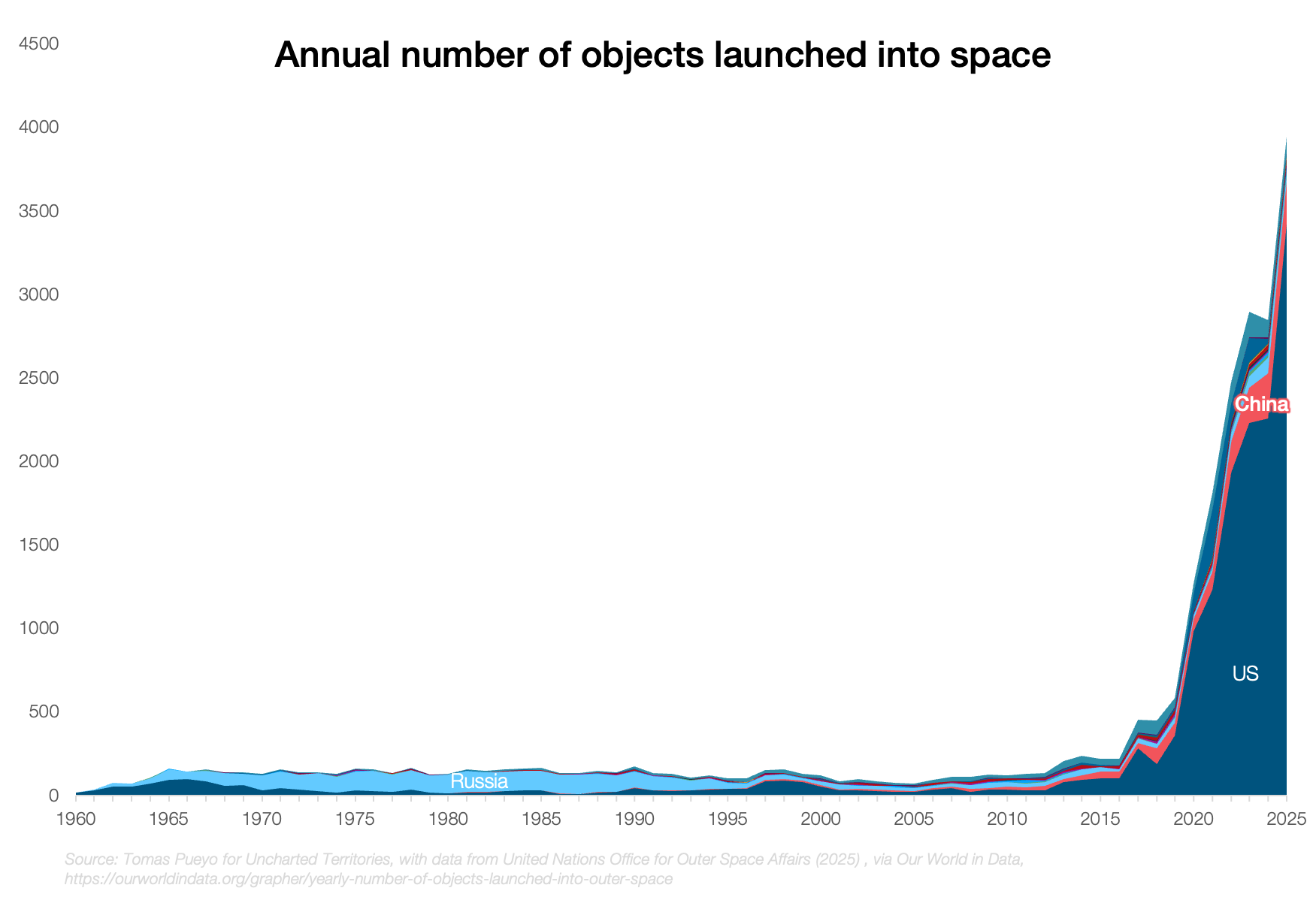
There’s been an explosion in stuff being sent to space, and of course the vast majority is from SpaceX:
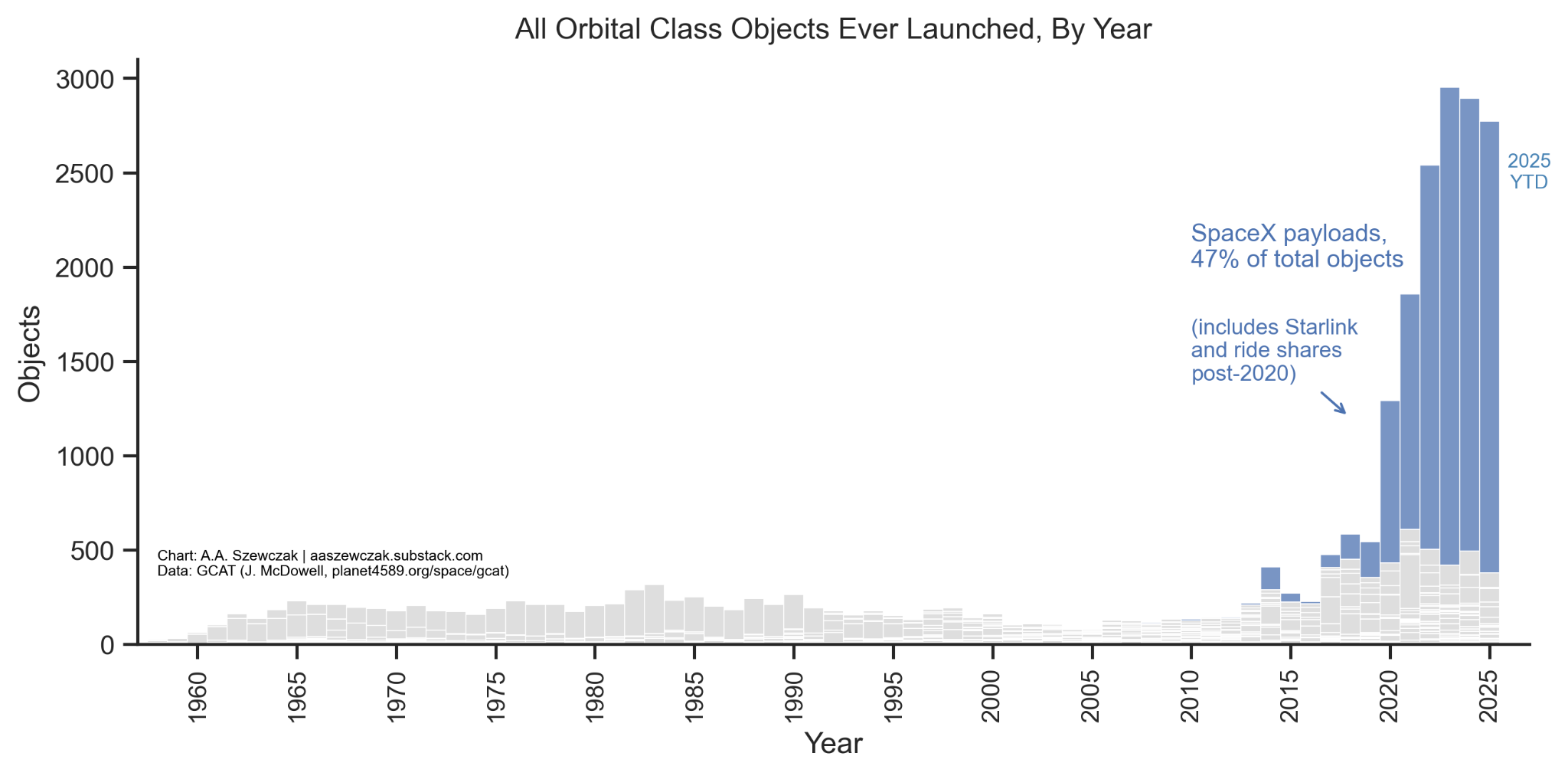
And that’s been possible because of this:
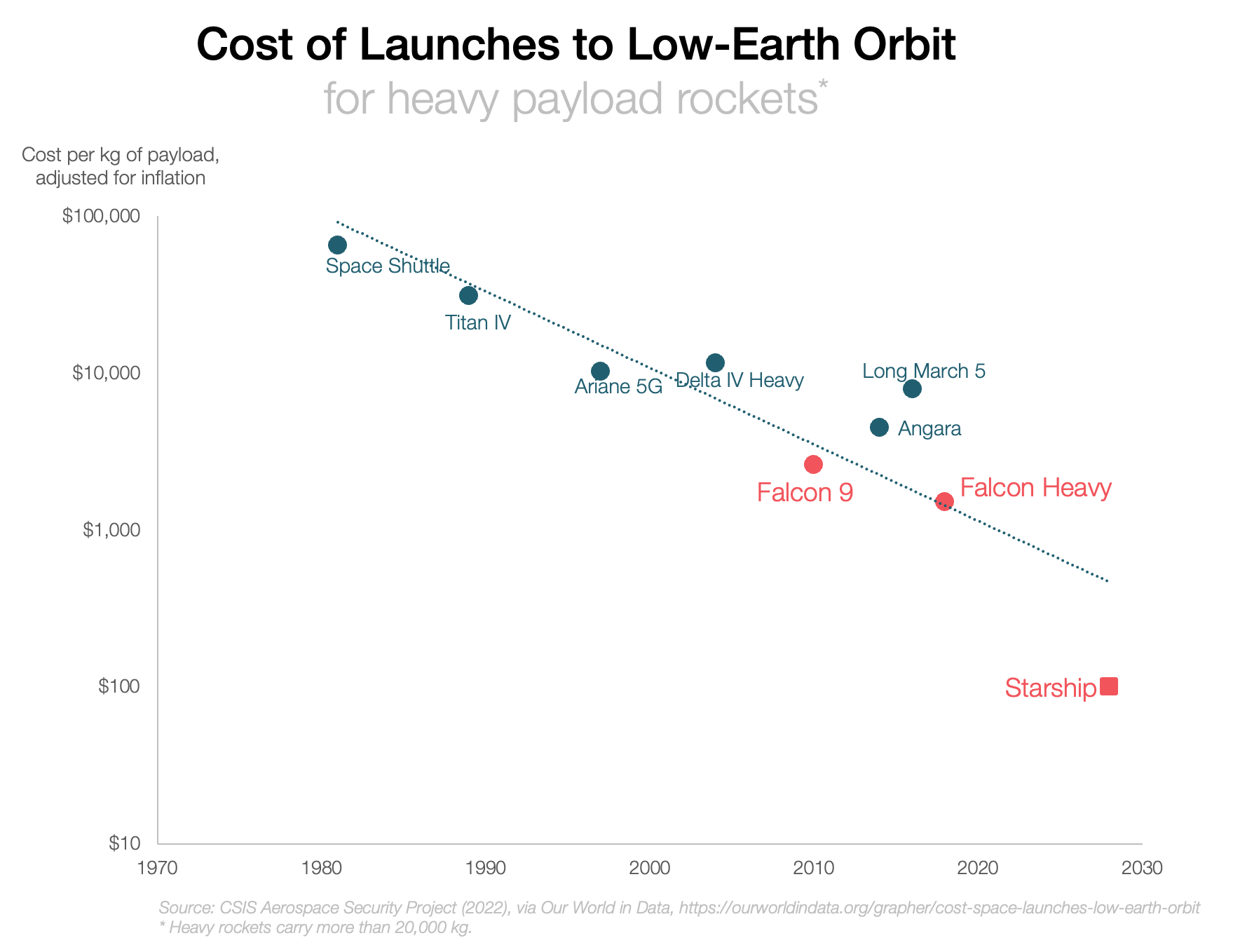
SpaceX’s rockets can carry payload to space much more cheaply than the competition.
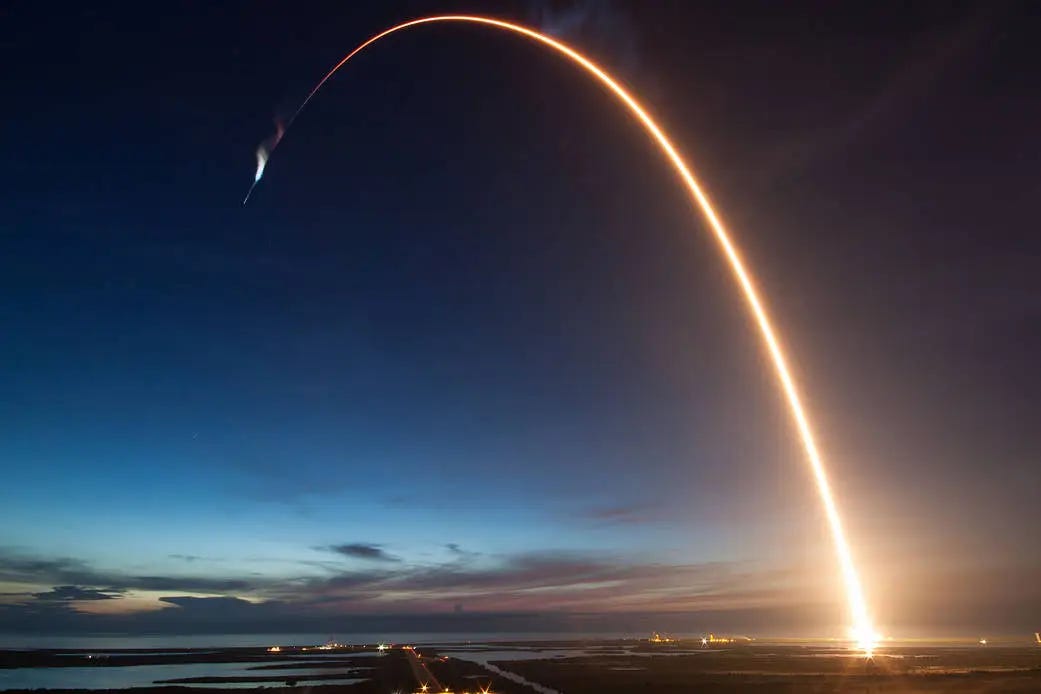
So hold on. Why is a rocket company printing money as a telecom company?
In Starship Will Change Humanity Soon, we explained how SpaceX was crashing the cost of sending stuff to orbit, and dramatically increasing how much stuff could be sent to space.
The thing is that people take a long time to react to this type of change.
Electricity Chased Usage
We’ve known about electricity since the 1600s, and electricity generation was developed in the 1800s. But electric companies sat idle with their built capacity. For example, a London electricity company had a load factor1 of only ~10% in the early 1900s. Why? People didn’t know how to use this electricity!
So electricity companies started load-building: figuring out uses for electricity and pushing people to adopt them.
The first big application was the light bulb, but it didn’t use much electricity, and the electricity it did use was in the evenings. So electricity entrepreneurs tried to get daytime use. They pushed for:
Electric streetcars
Industrial motors
Household appliances like refrigerators and irons
And more
Sometimes, the push was pretty direct, as electric companies owned electric car companies, electric railway companies, radio stations… It’s not a coincidence that General Electric was famous for both electricity generation and appliances.

This is not the only example of a new general technology creating overcapacity, waiting for society to catch up by creating demand, and doing everything it could to accelerate that demand in the meantime. The same thing happened with railroads and broadband.
The Problem with Railroad and Broadband Early Capacity
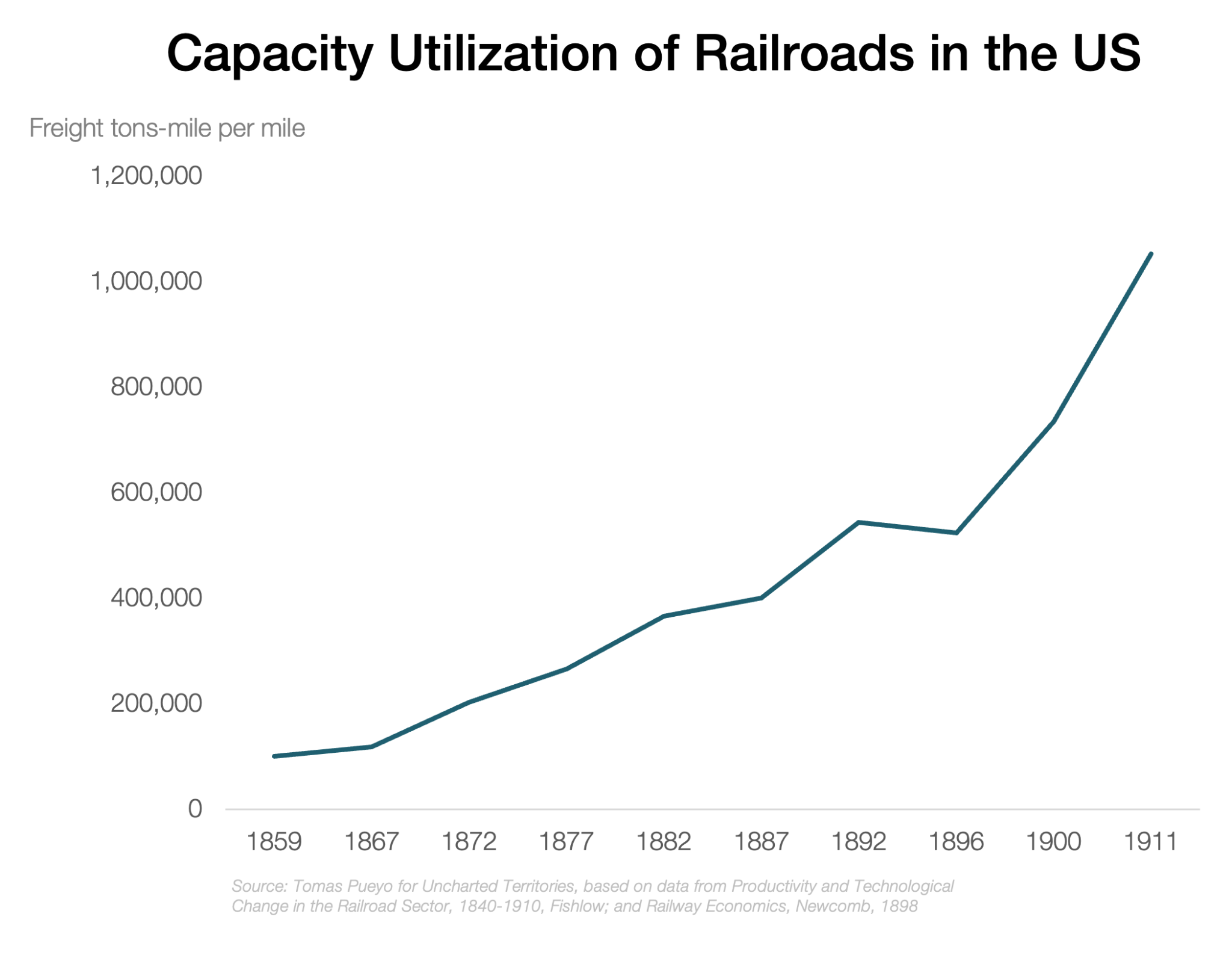
Early on, many railroads remained barely used, and lots of railroad companies went bankrupt. To avoid this, many became land management and immigration companies! In the US West, many railroads received large land grants (or bought huge tracts), so they were simultaneously selling transportation and the land that would generate the transportation demand. They created immigration bureaus, sometimes with offices in Europe, explicitly to seed farms and towns that would ship freight and buy tickets. They created towns, frequently integrated with water transportation companies to be multimodal.

With the advent of the Internet, broadband companies laid out a lot of cable, but in 2000 only 7% of it was lit in the US. This is why AOL (cable) merged with TimeWarner (content), or why telecom operators around the world offered (and many still offer) content bundles.

Staring into Emptiness
The same problem has been happening with SpaceX. Its increase in capacity was so fast that society is not adapted to it yet. So Musk faced a problem: Either he created demand for his new service, or he would go bankrupt, like so many electricity, railroad, and broadband companies before him.
He found Starlink.
The way electricity companies found light, streetcars, industrial electric motors, and appliances.
The way railroads created new towns, farms, and immigrants.
The way broadband companies bundled content.
Here’s the problem with Starlink: Although it spits money, we only need so many telecom satellites to have full Earth coverage.
Starlink currently has a license for 15k satellites, and wants as many as ~30k. Assuming a five-year lifetime, that’s 3k-6k satellites per year. At ~1 ton per satellite, that’s 3–6kT per year of payload. Falcon 9 can deliver 22t to LEO, so that’s ~270 Falcon 9 flights per year. SpaceX is already at 170. Once Starship is ready, just 30 flights will be enough to cover the entire annual need for Starlink.
So if SpaceX succeeds with its Starship, it will have too much capacity to bring mass to space, and that emptiness will mean the entire program might not be viable.
If SpaceX wants more, bigger rockets, it needs to manufacture demand. It needs another Starlink, another lightbulb, industrial electric motors, streetcars, appliances…
Musk thinks that’s AI datacenters.
2. xAI Datacenters in Space
Musk has another company: Twitter, turned X when it rebranded it, and turned xAI when he decided to participate in the race to AGI—artificial general intelligence. And as you know, I don’t think AI is a bubble: All the AI corporations are hoping to reach AGI, so they’ll likely keep increasing their AI investments every year for at least a few more years. The demand for compute is insatiable.
In this race, each player obsesses about eliminating every bottleneck to growth. Until now, it’s been GPUs, so companies like TSMC and NVIDIA are among the most valuable ones in the world. But for how long is that going to be true? TSMC and NVIDIA are trying to increase their productivity as much as they can, as fast as they can. At some point, they won’t be the bottleneck anymore. When will we hit a different one? What will be the next one?
With so much money in play, the most likely bottleneck will be one that doesn’t respond to private capital. It will be politics. And what requirement to build GPUs depends on politics? Energy.
Energy generally requires lots of permits, and is affected by political decisions, like the massive tariffs Trump has imposed on Chinese solar panels. So Musk believes AI companies won’t be able to grow their supply of energy fast enough to feed their datacenters. His bet is that, within a few years, energy will be the limiting factor to grow intelligence.
His answer is to go to where there are no permits—space. He believes that in three years it will be easier to grow intelligence in space than on Earth. Why?
In space, energy from sunlight is not lost from passing through the atmosphere to reach your solar panels. There are no clouds, seasons, dust, or atmospheric damage to reduce efficiency. There are no nights2, so no need for batteries. And more importantly, no need for permits.
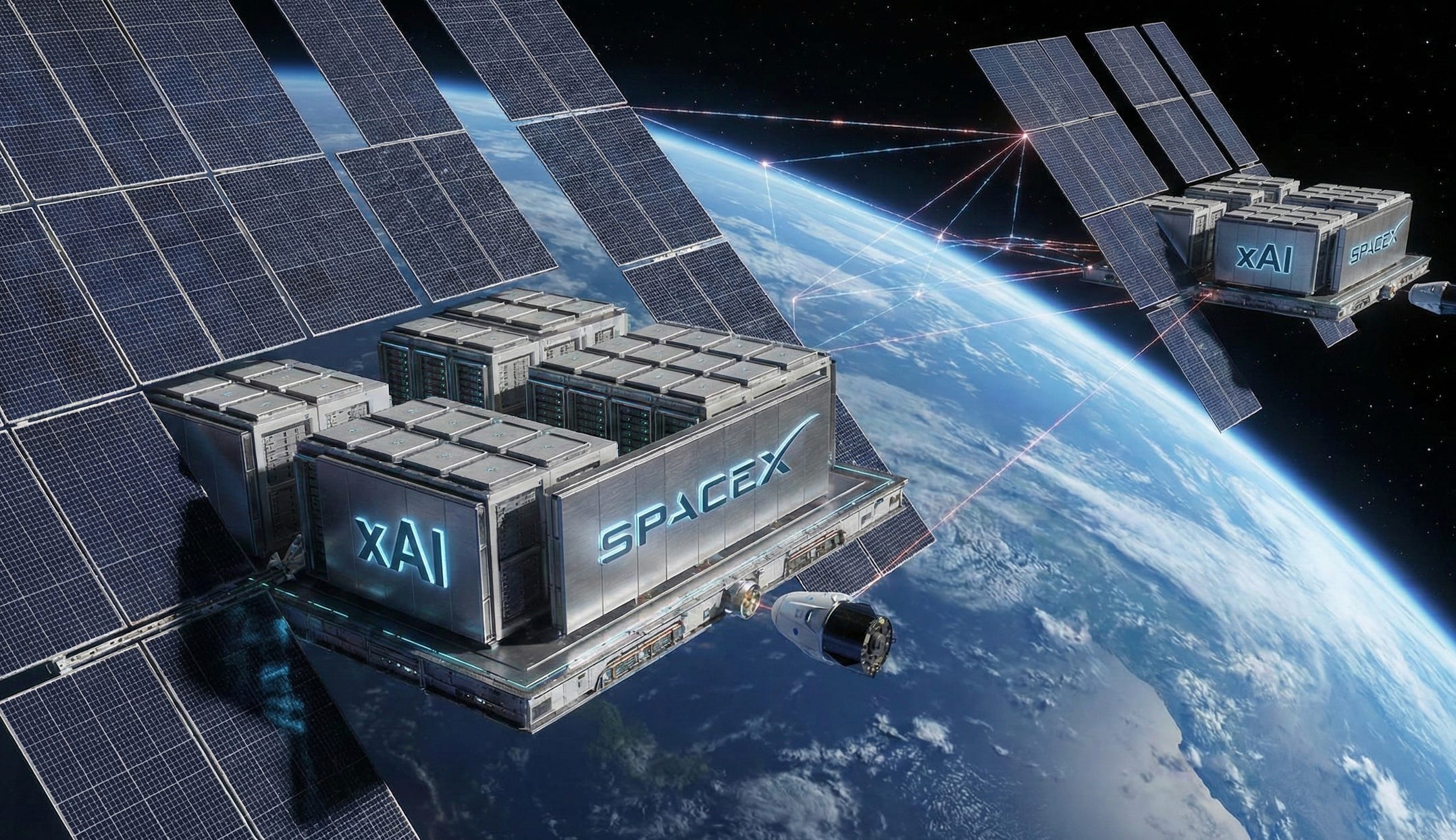
The bet is that the cost to send the panels and datacenters to space will shrink while the cost to build them on the Earth will increase so much (including bans) that, in three years, the cheapest will be space.
Is this true? I don’t know, I’ll look into the numbers in an article in the coming weeks.
But Musk trusts it is. So the plan would be to shoot solar panels and GPUs to space… using the spare capacity SpaceX is about to have!
Musk believes this kills two birds with one stone:
xAI gets the energy it needs to feed the compute to win the AGI race
SpaceX gets total utilization of its rockets for the foreseeable future
That’s not enough though. There’s another problem xAI had to solve, and this merger solves it too.
Funding AGI
xAI’s new datacenter, Colossus 2, which will launch its new AI in 2026, will cost $44B. But spending on datacenters is projected to double every year, so by 2030, xAI would need to spend $700B per year, assuming one such huge training release per year. But the company only makes ~$0.5B–$3B per year. Do you see the mismatch between spending and revenue? Yeah, xAI is burning $1B per month. xAI recently raised $20B, but at this pace, that will only last a year and a half. What then?
Musk needed a way to bankroll the build-up of datacenters, which according to him need to be in space, so he decided to merge SpaceX with xAI. That way, the SpaceX cash can fund xAI’s AGI run.
But where does the SpaceX cash come from? One way is Starlink revenue, which is estimated to grow to $150B by 2030, with ~$100B of free cash flow by then.
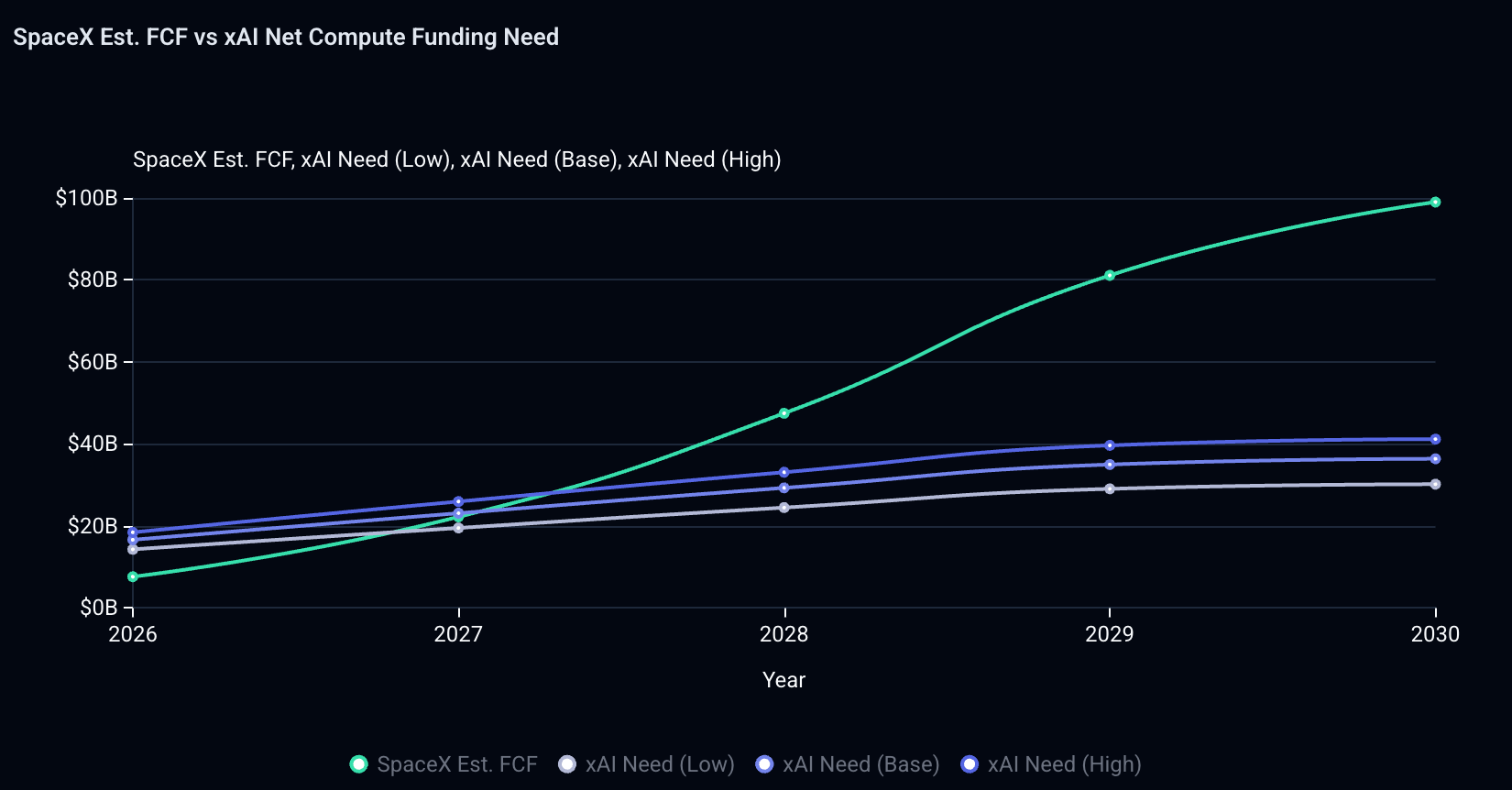
This revenue growth is expected not just from satellite wifi, but through direct-to-phone communications.
But you can only use Starlink revenue for xAI datacenters if the two companies become one. So that’s why SpaceX bought xAI.

Alas, Starlink revenue is not growing as fast as xAI’s need for cash for datacenters right now. So where else can SpaceX + xAI get cash?
From you.
3. The SpaceX IPO
Remember how the SpaceX valuation is going stratospheric? Well, Musk has decided he can tap into that. He will place SpaceX into the public market and raise some money, which he’ll use to fund xAI datacenters, which he’ll send to space to get the electricity he needs because, according to him, nobody can get it on Earth.
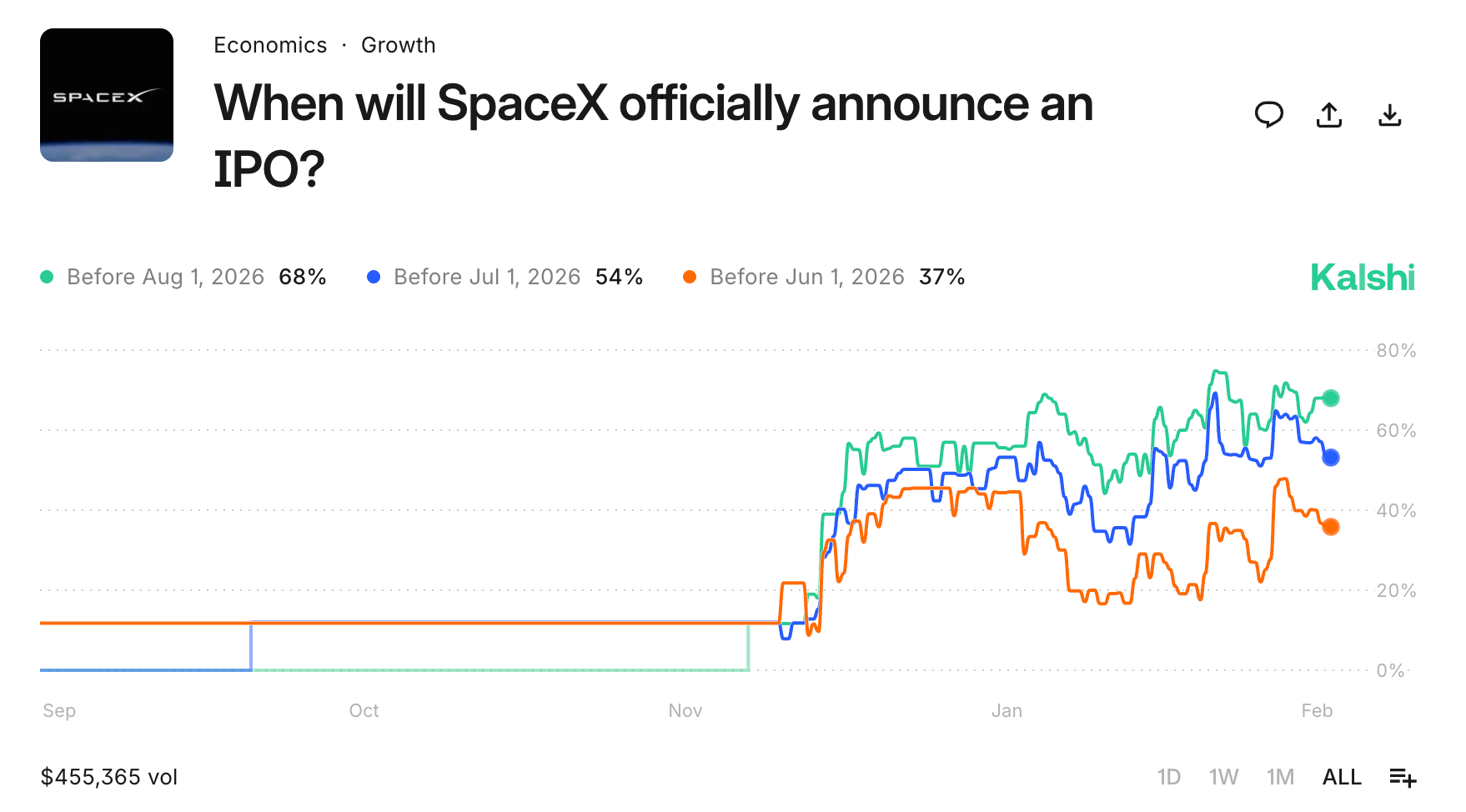
In this process, analysts estimate SpaceX might be able to raise $50B or more, at a $1.5T valuation. My guess is that he hopes this money, along with an increase in Starlink and xAI revenue, will be enough to cover xAI’s cash needs for a few months or years. By then, Starship should be ready to bring solar panels, GPUs, and datacenters to space while the Earth is stuck in energy permitland.
In other words, if you participate in that IPO, you’re making a bet that one or more of these is true:
Starlink revenue will keep growing stratospherically
xAI revenue will start picking up and beating its competitors, OpenAI and Anthropic, in an exponential trajectory
Energy on Earth is enough of a bottleneck that the only way to win the AI war is by going to space
AGI is around the corner, and there’s a huge advantage to those who can reach it first
So what’s up with the Moon?
4. The Lunar Pivot
Since its inception, SpaceX’s mission has been to make humanity multiplanetary.
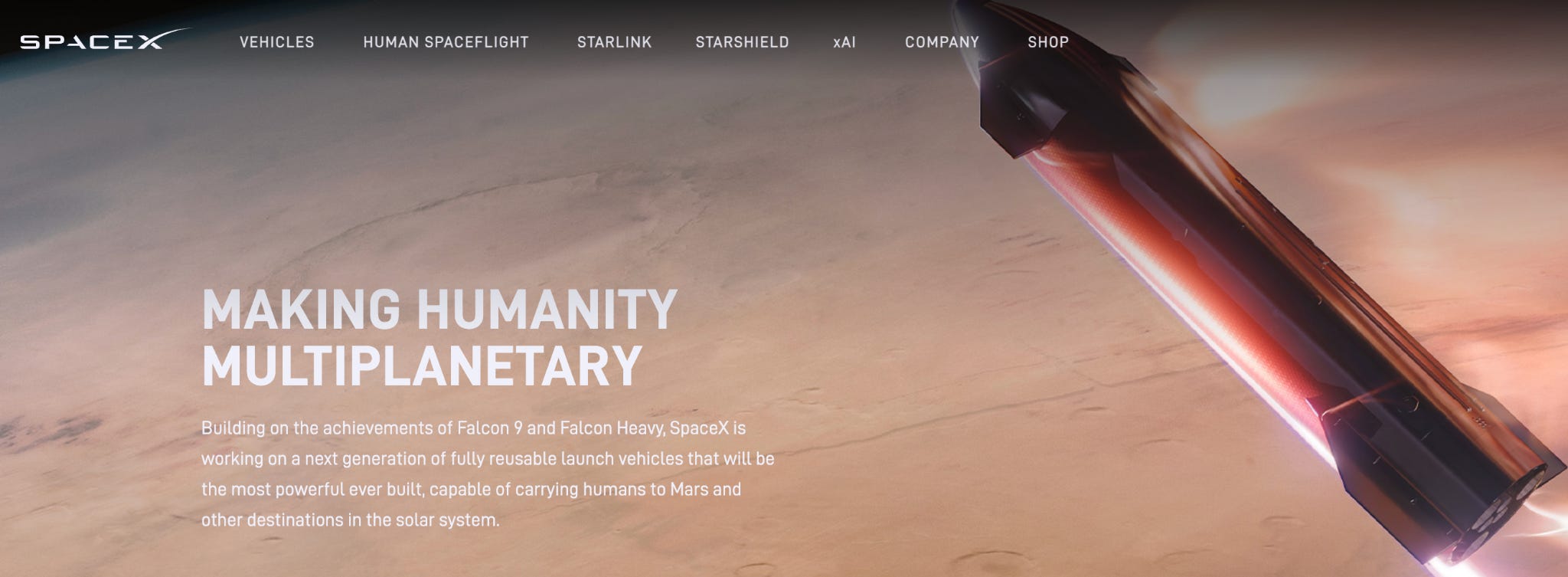
And the concrete, proximate, inspiring goal was to settle Mars.
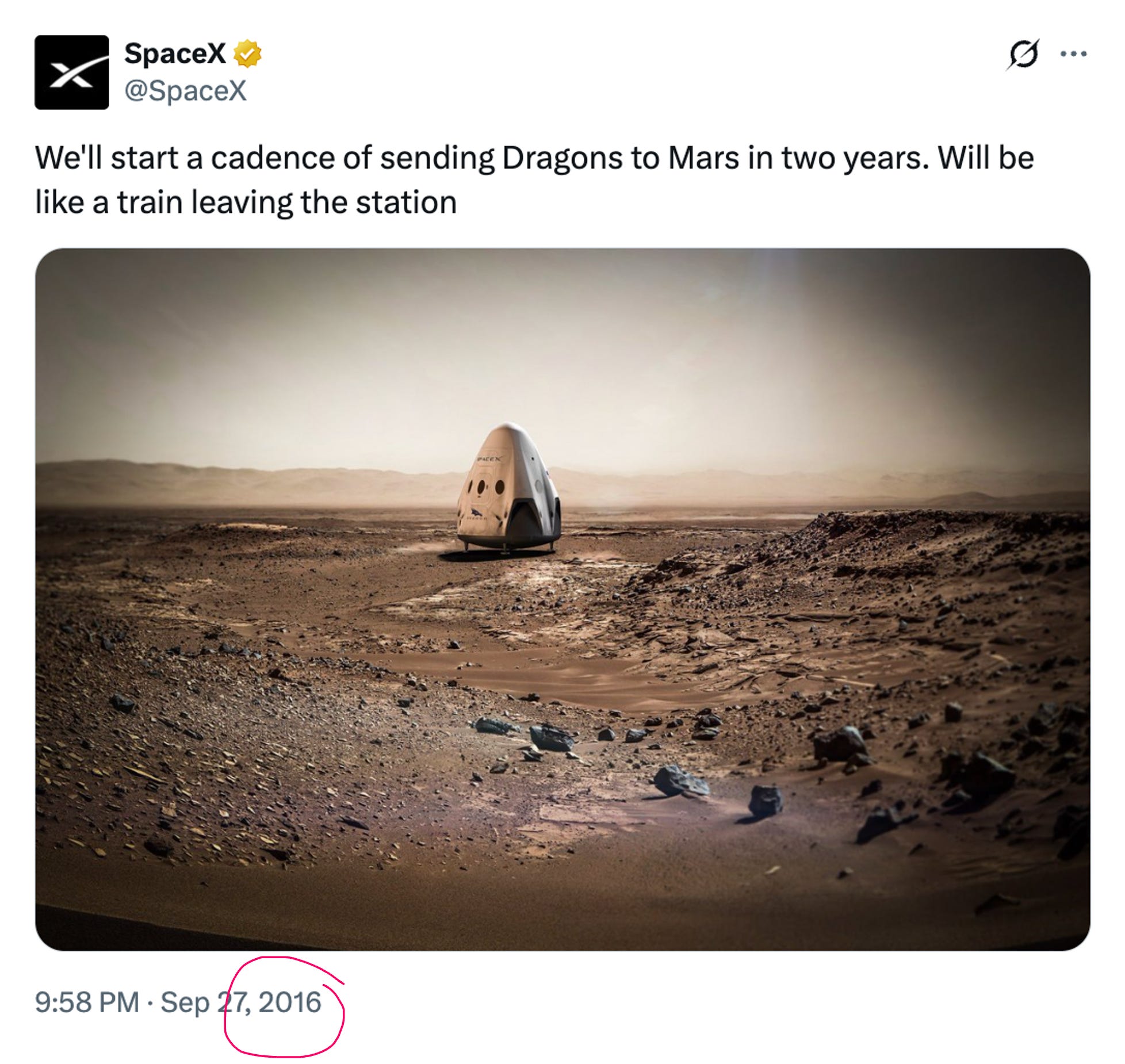
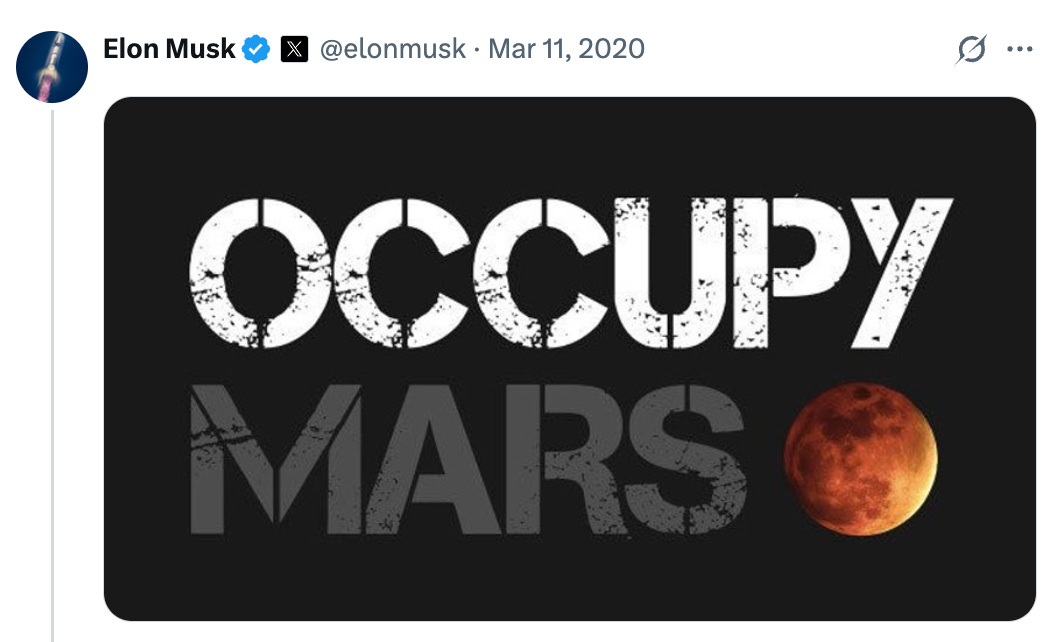
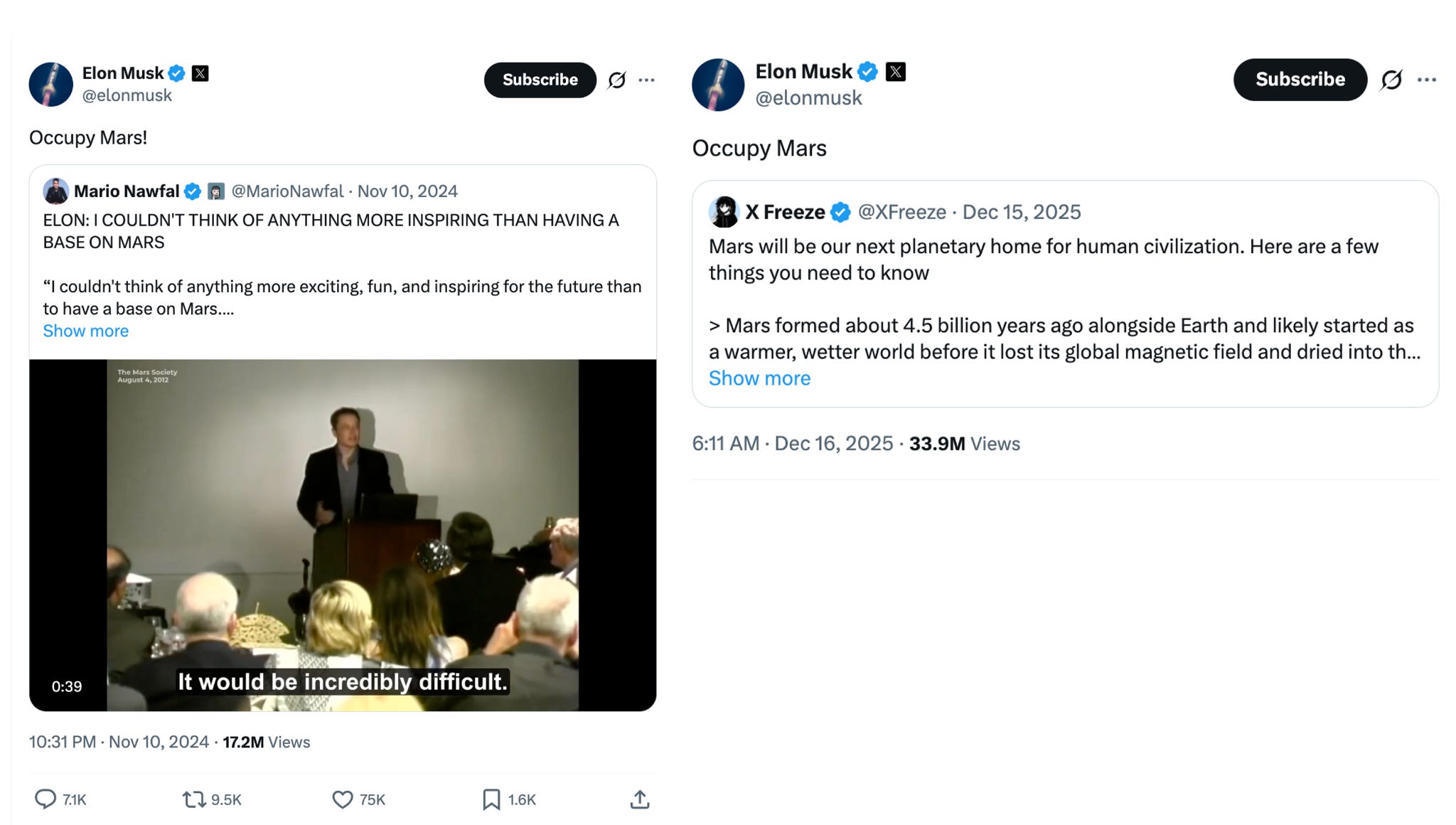
But now, suddenly, at the same time as SpaceX merges with xAI and they IPO, suddenly Musk pivots to the Moon:
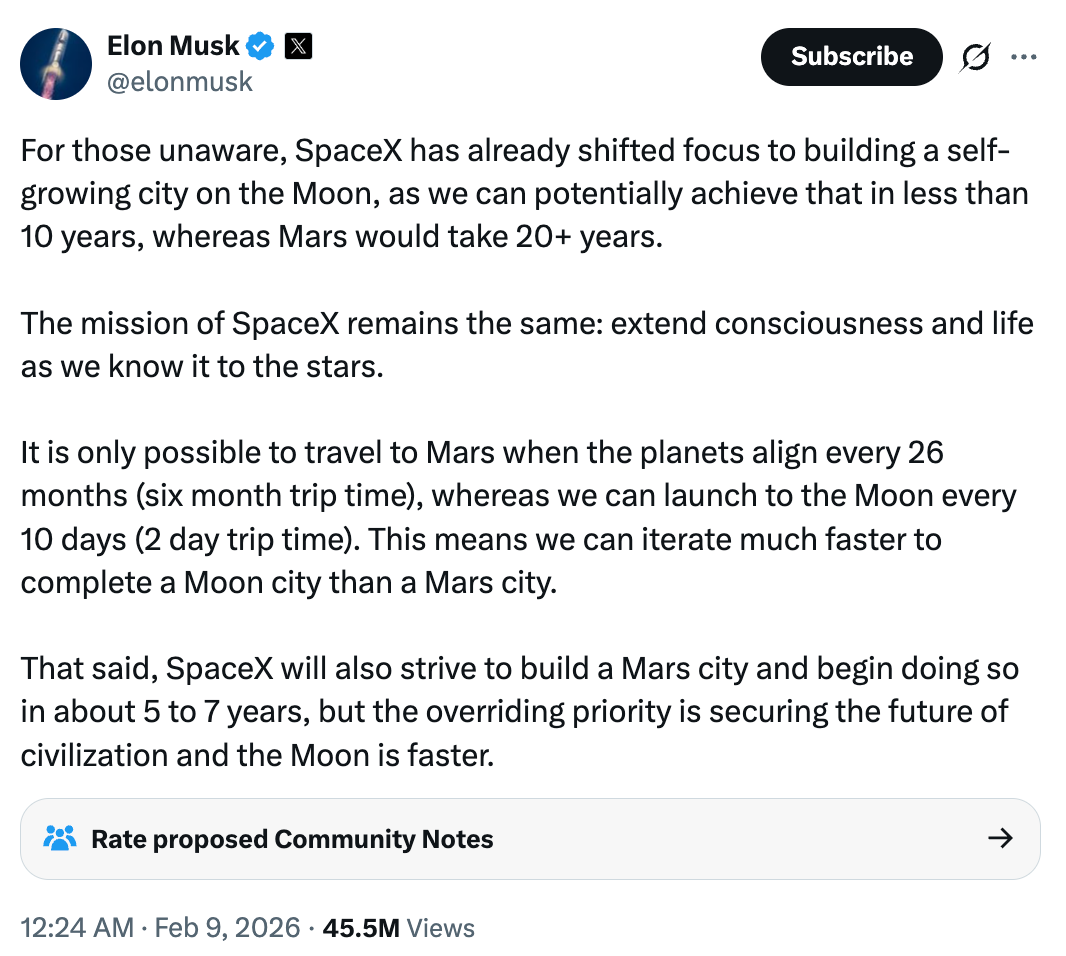
Musk has added details on this:
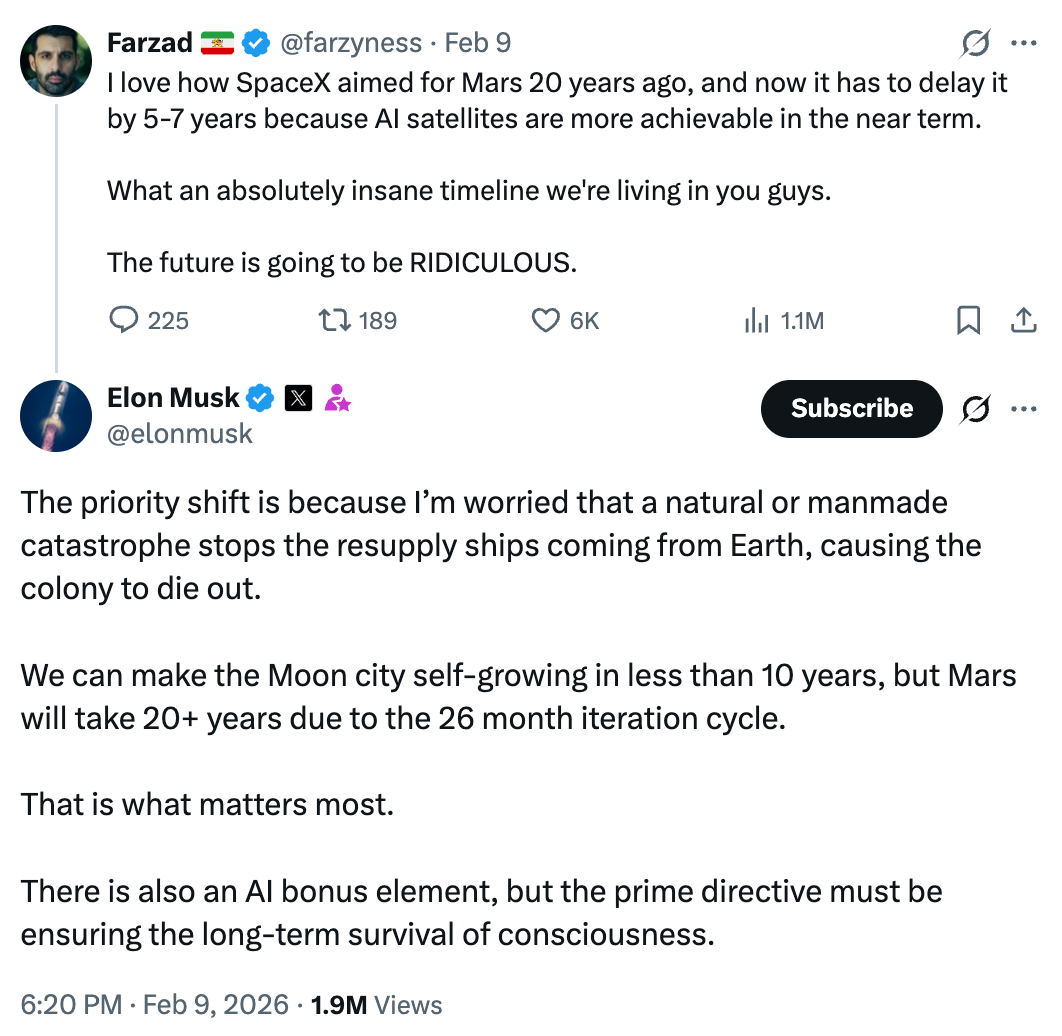
So the official reading is that SpaceX needs to iterate much faster on landing on another celestial body, building a habitat there, industries, and resupplying them.
But why go to the Moon anyway? If the goal is to build datacenters in space, what’s the point of the Moon?
Eventually, it can work as a place to produce solar panels and maybe chips, because the Moon has plenty of the main elements needed (aluminium and silicon, among others). But that will take muuuch longer than the few years we might need to get to AGI. So what’s the point of mentioning this pivot now?
Maybe the IPO.
The Mars Uneconomy vs the Moon Economy
I shared in the past that there’s no economic reason to go to Mars. It would be a passion project, worth ~$500B. An amazing, absolutely worthwhile objective, but a very expensive passion project nonetheless. If Musk were to die, that project would likely not happen soon.
It’s OK to have a private company to fund your passion project, but it’s a tougher pill to swallow for a public company. Imagine the roadshow:
INVESTOR: In a few years, how will future cash flow be used?
MUSK: You will see none of it, it will all be plugged into colonizing Mars.
Mars can only be defended as a money sink. But not the Moon.
Remember this graph?
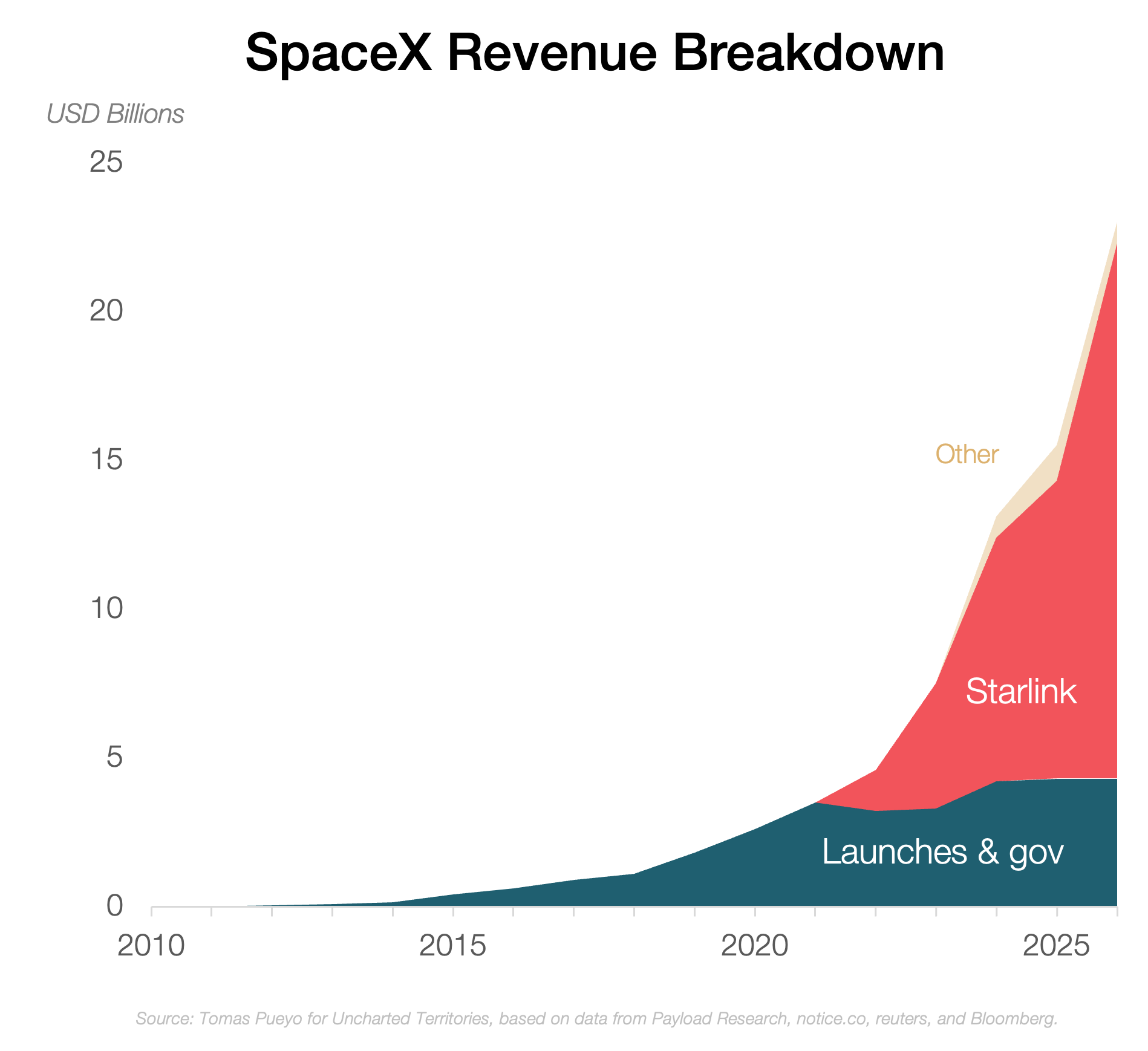
We focused on the Starlink revenue, but the launch revenue is also there, and part of it comes from NASA for missions to the Moon. Specifically, NASA has already committed to pay SpaceX $4B to send astronauts to the Moon, with additional funding for other Moon missions.
So the reality is that SpaceX was already going to go to the Moon profitably, while Mars has already been postponed for over a decade and has no path to generating revenue today—something a public company should be more diligent justifying. Now that Musk has decided to merge SpaceX with xAI, the more urgent problem has become steering humanity through the AI singularity.
Multiplanetary Consciousness
So this is why Musk merged SpaceX and xAI:
SpaceX needs cargo for its Starship, or it won’t be able to develop it.
Datacenters in space might be it, provided that energy is the key constraint on Earth.
xAI needs cash to buy these datacenters.
Musk is thus vertically integrating the two companies: the supplier (SpaceX) is funding the customer (xAI).
This allows Musk to fund the race to AGI, and maybe win if indeed the limiting factor is energy.
In the meantime, Mars could cost the merged company a lot, both as a distraction and a harder pill to swallow for investors. So Musk made it official that, in the foreseeable future, SpaceX will focus on the Moon, which makes more money (through NASA), allows for faster iteration for Starship development (which will help for datacenters), and might even help Mars colonization by testing it nearby first.
And that’s why all these events are connected.
But throughout all this, there’s a more subtle yet much more important thread we should pull. Did you notice what SpaceX’s mission was?
To make humanity multiplanetary.
Was.
Musk has shifted it to: Extend consciousness and life to the stars.
Consciousness doesn’t require life.
AI can be conscious.
Musk realizes that the consciousness that will conquer the universe is artificial.
And maybe, if we’re lucky, it will bring us along on the journey.
Making that maybe more probable is the bet of SpaceX + xAI.
Is energy really the next bottleneck?
Is it really going to be cheaper to build AI datacenters in space?
Will we really have a base on the Moon? What are the problems with that?
How much electricity is provided vs how much could be provided at a maximum.
In the right orbit, far enough from the Earth.
Interesting analysis. There is however some very big holes in the "orbital datacenters" story, that make quite a lot of people think that, like Hyperloop, this is a decoy for other purposes (grabbing cash, getting rid of X as a sinking ship, getting more money in a SpaceX IPO, among many other theories).
What are the main holes ?
* first, bandwidth and latency. Sure, Starlink show that it's manageable, but we're talking of a several orders of magnitude larger scale here. Will it keep up?
* second , energy. People say things like "solar panels in space are more efficient than on the ground and can be permanently illuminated". That's true, however solar panels are big and heavy, and to be efficient, they also need ....
* third, and most important, cooling. No, space is not "cold". In fact, whatever is in sunlight in orbit is really hot, like 200°C. And your solar panels at 200°C needs cooling. Ditto your datacenter itself, which is making heat from all that solar energy. But in space, you can only radiate heat, which is really inefficient. The ISS has two 7.5 tons radiators, which each extracts 35kW of heat from the station. Of course we can imagine more effective radiators, and a cascade of heat pumps to reach higher temperature (like red hot) to radiate more efficiently for instance, but physics tells us that these radiators will be extremely bulky, which isn't optimal for space devices...
So of course, as a perpetual pessimist, I think these datacenters in space are complete baloney until proven otherwise :)
Not discussed is the effect of radiation on the AI chips function and spooky action at a distance quantum interference. Anything known about any requirements for shielding for that issue?
Great article.