

It’s 2050, and the Middle East is a mess.
Iran is in the midst of a civil war between different factions of the IRGC and the military, the Muslim Brotherhood, the Kurds, and the Azeris.
In the northwest, the Kurds have established an independent state. They are de facto ruling the Kurdish parts of Syria and Iraq too, and are in a low-intensity conflict with Turkey.
Azerbaijan enlarged its surface area by taking parts of northwestern Iran, but now is engulfed in a civil war itself.
Iraq is split between the northeastern Kurdistan, western ISIS, and Sunni and Shia militias and mujahideen.
Hejaz has split from Saudi Arabia, and there’s a three-way war waging between them and the Houthis to the south, in Yemen.
Syria, Jordan, and Lebanon are in a defense pact under Israel, trying to suppress Palestinian guerrilla warfare together.
The former rulers of Kuwait, Oman, Qatar, Bahrain, and Equatorial Guinea all live in Dubai: They escaped from the coups in their countries. They financially support Dubai’s army in its fight to secede from Abu Dhabi, which has dramatically increased national taxes to make up for the loss of oil income.
Elsewhere in the world, Russia is now a failed state ruled by oligarchs fighting it out in Moscow neighborhoods. The Stans have moved closer to China, which is ruling de facto Russia’s easternmost Siberian regions. Belarus is now a neutral state, and is working to join the EU. Its strongest supporter is EU member Ukraine.
Venezuela and Cuba are now firmly under the US’s grasp. Iran and Russia can’t afford to prop them up anymore.
Nigeria, Congo, Chad, and Angola are failed states in constant civil war.
Nobody cares about any of these.
This might happen as oil demand peaks in a few years and then drops. How could we get there? How can we avoid it? This is what we’ll discuss today.
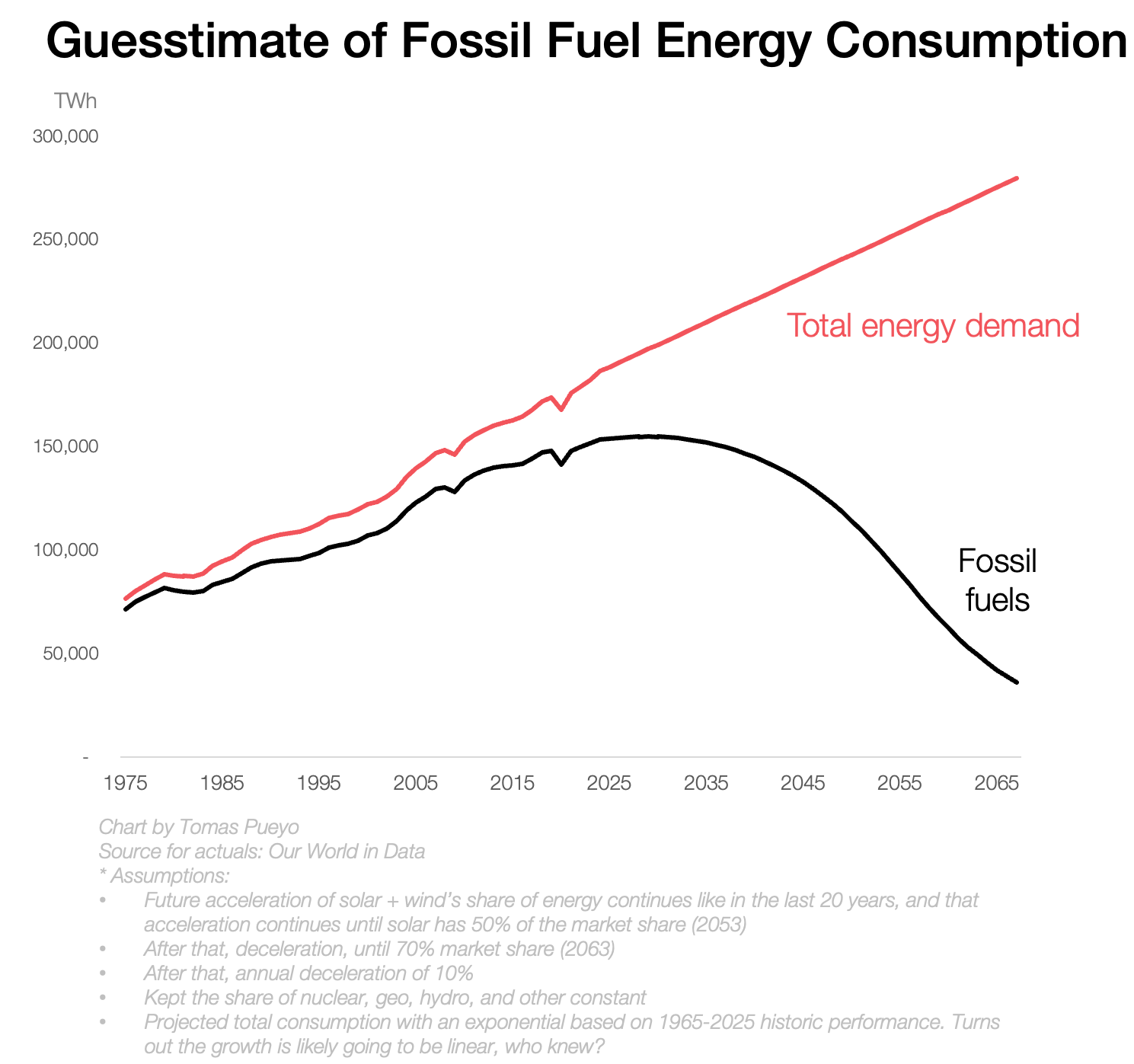
We saw in the previous article that peak oil might come in the 2030s, and within a couple of decades, demand might have plummeted due to renewables and batteries.
This is how dependent many countries are on oil and gas income:

The average oil-rich government is 2x to 3x larger than the average non-oil government, even at the same income level. As a fraction of the economy, the governments tower over the private sector and all other actors.
Also, all this wealth is concentrated in a few physical points of extraction, so if you control them, and the transit routes to transport the oil and gas to international markets, you control all the wealth. This is why virtually all the rulers of oil countries are authoritarian: The resource curse is especially salient in oil & gas countries.
The Oil Curse
We showed how bad oil has been for democracy in Venezuela, but this is true across the world.
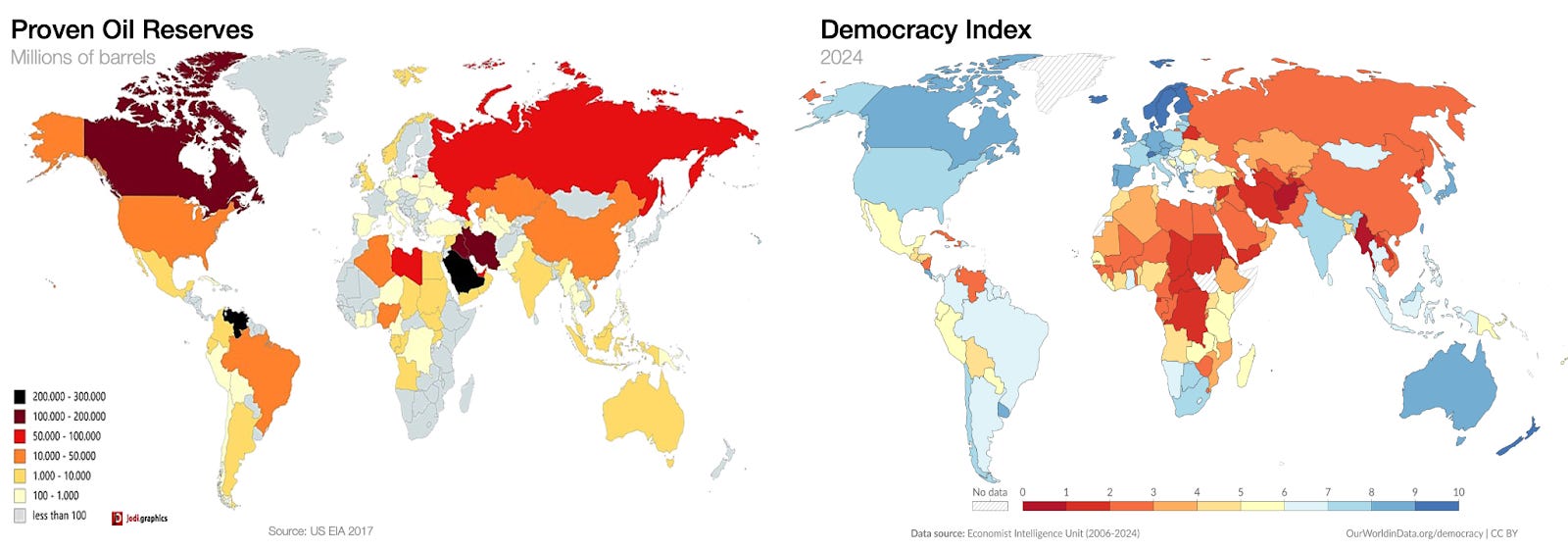
As countries decolonized, the more oil they had, the less democratic they became.
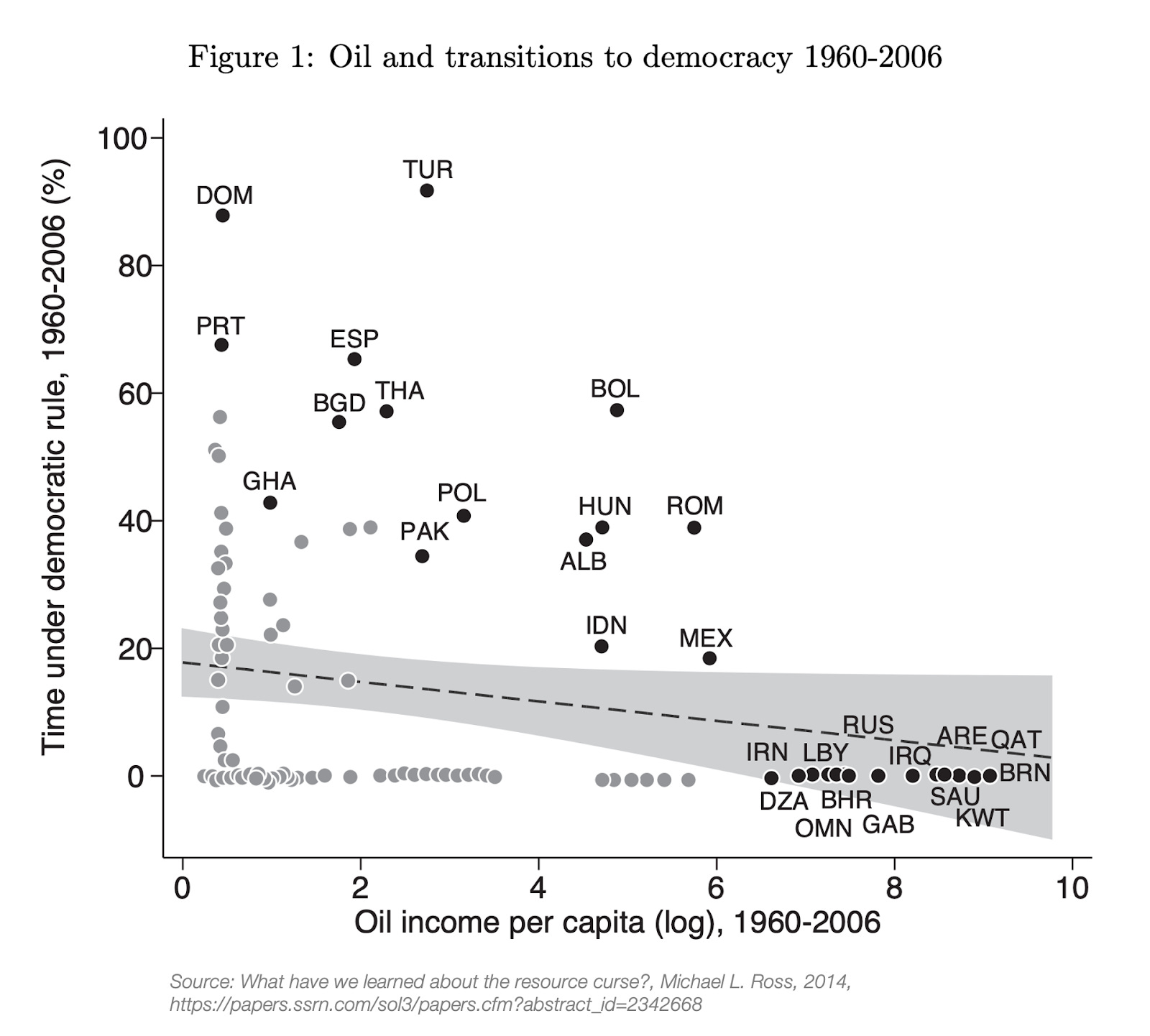
In the Middle East and North Africa, the more democratic countries have more accountable governments, more freedom of the press, and more freedom of association: Morocco, Tunisia, Jordan, Lebanon, Turkey… The countries with lots of oil—Algeria, Libya, Iraq, Iran… have more authoritarian governments.
When a resource is easy to control and extract, whoever does the controlling also does the ruling, and they don’t need to share it with anybody. Well, just enough to keep people quiet and content. So corruption is rampant, inflation destroys other industries, citizens live off of government handouts, and these countries develop little else to offer to the world.
Countries where revenue comes from taxes rather than oil and gas are much more transparent, and spend their money on many more services than O&G countries: Taxpayers demand accountability. They want to know where their hard-earned money is going, and they want to see the results. Meanwhile, in a resource-based government, citizens are just happy to get a share of the loot. They don’t complain too much, so they can keep suckling mama government’s tit.
The lack of transparency in O&G countries leads to corruption and entrenched interests, because a lot of the revenue is hidden, so it can be diverted. Those who do the diverting accumulate the money and buy out allies, who keep them in power.
Since it’s bad optics to have much more income than spend, most of these countries update their spending in bonanza years. When commodity prices drop, their economies crash.
To avoid fiscal troughs that bring them down, they focus their spend on short-term initiatives, which means long-term infrastructure is not prioritized. When it is, revenue shortfalls means they might not be maintained, or even worse, they might be abandoned halfway through.
When the resource is exhausted, they have no fallback, and the country goes to ruin, as we saw in the previous article The Resource Cliff. Governments, without the money to finance their security apparatus, fall. This provides an opening to those who own the weapons to do the only thing they know to do—fight to capture what little power remains… and the country descends into civil war, like in Yemen.
Which countries are most exposed?

Now, imagine you’re the ruler of one of these countries. You know these things. What do you do?
Petrostate Transition
1. Deny
Many of these countries will deny this is happening. The OPEC (Organization of Petroleum Exporting Countries) projections show an increase in overall demand for fossil fuels from now to 2045. Wishful thinking. Most of these countries won’t be properly prepared when this hits.
2. Postpone
Oil and gas countries and companies try to postpone the end of oil. The US under Trump is actually a great example—remember, the US is the world’s largest oil producer. In 2025, Trump increased subsidies for fossil fuel producers, weakened environmental laws, gutted Biden-era support for clean energy and moved to block clean energy projects, even some that were near completion. The US formally withdrew from the Paris Agreement in January this year.
Academics split the strategies to fight the transition to renewable energies into two types:
Pre-shift strategies, founded on explicit climate denial: spread doubt, question science, lobby, revolving doors1.
Post-shift strategies: subtler forms of climate action delay through the readaptation of lobbying and revolving doors, the conviction that fossil fuels are irreplaceable (necessitarianism), the adoption of a green façade (greenwashing), and blame placement towards their consumers (strategic blame placement).
I think these worked in the past, but not anymore: The engine of the transition is now economic; solar, wind, and batteries are just cheaper.
Personally, if I were a Middle Eastern government, the one thing I’d do to postpone the transition is to flood the market: The more oil I produce and sell, the lower the price, and the less competitive renewables become. I think this could postpone the twilight of fossil fuels by a few years or even decades, but I don’t think they would do it: This would drop the price of barrels, on which their finances depend. Also, at this point, it might be too late, as China has firmly decided to push this transition.
3. Squeeze
If you know your oil sales are about to vanish, you have two options:
Agree with other oil providers to limit supply over demand, so that prices remain high for as long as you can.
Pump like there’s no tomorrow, so that you can extract as much value while you still can.
According to this paper, what will happen is the 2nd scenario. And it makes sense: It’s hard to keep dozens of countries limiting their production when they know their wealth is devaluing by the day. Also, if they kept prices up, that would only accelerate the transition to renewables.
So if I were a ruler of Saudi Arabia, Kuwait, or the UAE and didn’t care about the environment, right now I would be investing to extract as much oil as possible, as fast as possible. Oil that remains now in the ground will remain in the ground.
4. Try to Diversify
This is the biggest way oil countries will fight the oil transition: If you know your golden goose is sick, you’ll try to find another one. They’re going to do it by buying foreign assets, investing in local projects, opening up to the world, and improving the productivity of their population.
a. Diversify by Buying Foreign Assets
The best example of this is Norway, which instead of spending its oil wealth, invests it all, and only spends 3% of the fund every year. The money is invested in assets across the world, mainly in the stock market.2
But it’s not the only one. There are equivalents for Oman, Qatar3, Azerbaijan4, Kazakhstan, Kuwait5, Saudi Arabia… They invest across geographies and industries, from Chinese petrochemicals to French luxury to Silicon Valley startups to Indonesian mining. For example:
Saudi Arabia’s PIF [Public Investment Fund] has pumped $45bn into SoftBank’s Vision Fund in 2016 and $20bn into a Blackstone infrastructure fund the following year. In the years since, it has splashed the cash in a diverse range of sectors from electric-car maker Lucid to its controversial LIV Golf venture, a cruise liner group, mining, sports assets and gaming firms. It also poured tens of billions into US and European equity markets and injected $2bn into a private equity venture set up by Donald Trump’s son-in-law, Jared Kushner.
The more these funds own a bit of everything, the less likely they are to lose all their money, and the more they will be able to rely on their returns for a steady future income.
Of course, they know the future of the world is in tech, so they focus on that a lot.
In March 2024, the United Arab Emirates (UAE) created MGX, a tech-investment company with a target size of $100bn, which will invest in AI infrastructure, such as data centres and chips. It has also set up a $10bn AI venture-capital fund. In Saudi Arabia a number of different funds with a combined firepower of $240bn will splurge on AI, data centres and advanced manufacturing.
E&, an Emirati telecoms company, will help to build part of a 45,000km-long subsea cable that makes its way around south Asia, Africa, the Mediterranean and Britain. A data-centre construction boom is under way, too, with the likes of Khazna, a unit of G42, and Damac, an Emirati property developer, building facilities.
Gulf companies are building data centres abroad, too. Damac is a longstanding business partner of Donald Trump, helping him manage golf courses in the Middle East (Hussain Sajwani, its boss, is known as the “Donald of Dubai”). On January 8th Mr Trump said that Damac would invest at least $20bn in data centres in America.
The Gulf recorded almost $8bn of foreign direct investment in tech infrastructure and another $2bn in software in 2024, up three-fold from 2017, according to fDi Markets, a data firm. Talent is moving, too. BCG, a consultancy, says that the AI talent pool in the UAE and Saudi Arabia has grown by over one-third and almost a fifth, respectively, since 2022.—The Economist
b. Diversify through Local Projects
These countries realize they’ll need jobs for their citizens, too. They might also be wary of their foreign assets being seized. So they’re investing in national projects. The best example of this is Saudi Arabia’s Public Investment Fund, with about one trillion USD to invest. Half of that is invested in Saudi assets, on projects summarized in its Vision 2030. We’ll talk about this when we cover the special case of Saudi Arabia’s future in an upcoming article.
c. Diversify by Developing Their Citizens’ Productivity
But if these countries develop their citizens’ abilities and make them more productive, maybe they can create as much wealth as what’s pumped from the ground today?
So these countries invest a lot in education and healthcare. Why do you think Saudi Arabia has started allowing women to work?6

This is a great start, but it’s not enough. Take Kuwait for example, with over 90% of government income from oil. They’d need the tax base of the rest of the economy to grow by 1000% to make up for the loss of oil. Normal productivity gains are 2% per year, and that’s in a dynamic economy like the US’s. How are these oil countries supposed to get their unproductive citizens, who have never had to fight in a hypercompetitive labor market, to suddenly become superproductive? It would take more than a generation to get there!

d. Diversify by Opening to the World
So one way to make up for it is to learn from the best: Welcome foreigners who can bring their know-how. This is the context in which many of these countries now allow alcohol consumption, despite being haram7. But why would foreigners go to countries like Saudi, Oman, Qatar, Iraq, or Kuwait, knowing they prioritize their own citizens? Wouldn’t they prefer going to Dubai, which has a track-record of openness, tolerance, and low taxes?
But foreigners don’t need to move for work to add value. They can also visit as tourists, and that’s why so many of these countries invest in this industry. Why do you think Abu Dhabi has a Louvre Museum?

It’s amazing, by the way. And so is teamLab’s installation there.

Abu Dhabi wants a full cultural district with facilities like these in Saadiyat Island.

It has also recently built the Sheikh Zayed Grand Mosque, the Presidential Palace, Yas Island Attractions (Ferrari World, Warner Bros World, Yas Waterworld, Seaworld Abu Dhabi)... Abu Dhabi is among the most aggressive in this direction, but there are only so many trips people can take. Other countries will be competing for the same visitors.
What are the results of these efforts so far? There’s some progress, but in most countries, not near enough to escape the black hole of the future fossil fuel crash,8 so despite their diversification efforts, many will have to take more drastic measures, like selling assets and reducing costs.
5. Sell Assets
Oil prices have already shrunk by 40% since their peak in 2022.9 As a result, many O&G countries are already facing financial problems, and some have been forced to sell assets.10 For example:
Kuwait is planning to sell a $7B pipeline stake in February of this year.
Saudi Aramco plans to raise $64B through privatizations in the next five years, including a $4B power plant sale within weeks.
Oman is aiming at divesting from 30 companies.
Nigeria is selling at least a 25% stake in some oil and gas fields.
Angola plans to privatize over 70 companies, including the sale of 30% of the state oil company Sonangol in an IPO.
Kazakhstan’s sovereign fund plans to divest from several state-run companies to privatize them.
This is good not just because it raises money for their states, but also because it professionalizes the management of the assets (making them more productive), reduces corruption and vested interests, and if it works well, it encourages foreigners to invest further in the countries.
The more prices fall, the more assets these countries will have to sell. Unfortunately, one-off sales might not be enough to cover ongoing spending.
6. Reduce Costs
So after trying to deny, and then postpone the reality of dwindling oil demand, they will try to squeeze oil sales, diversify their economy, and sell some assets. After all of that, most will still be short, so they will have to reduce their recurring costs pretty dramatically.
The first step is to shrink the share of citizens receiving benefits. This is what the new Kuwaiti emir has done: He has stripped tens of thousands of Kuwaitis from their citizenship, to:
…deliver Kuwait to its original people clean and free from impurities.
The following step? Reducing benefits to natives, including as education, healthcare, subsidies, civil servant jobs, and at some point, direct transfers.
That’s when people will revolt.
What will happen then?
The Breakdown of the Current Order
1. More democracy
Countries will have one of these options:
Transition to democracy.
Keep an iron grip on their countries’ politics. Become more authoritarian. Strengthen the secret police.
It does look like countries tend to move towards democracy after they reach their peak oil production:

If I had to guess, this will be more common than people think:
The Arab Spring showed that many people in the Middle East and North Africa want more democracy.
It’s not surprising, since many citizens from these countries have experienced the freedom and democracy of neighboring Europe.
Since then, mobile phones and social media have become widely accessible, increasing the flow of information from free countries towards more authoritarian ones.
Inshallah.
2. More Repression
But in many countries, this transition won’t happen. So far, no country with as much oil wealth as Libya or Iraq, or even with half as much oil wealth as those, has ever made a successful transition to democracy.
Even if democratic elections are held, and the results are respected, those might well be the last meaningful elections, as whoever gains control of the central government is able to establish a kind of monopoly on power that precludes future challenges.
That’s if elections are held and if they’re respected.
3. Failed states
In many cases, internal conflict might prevail, people won’t agree on leadership, and they’ll fall into civil wars and states of anarchy.
Russia (the USSR) invaded Afghanistan when oil prices were high, it became a failed state when prices shrank, Putin could only consolidate power when oil prices started growing again, and he went to war with Georgia and annexed Crimea when they were highest.

We saw something similar in Yemen, where revenue grew after unification and when it shrank, civil war exploded. Libya has been in a civil war ever since Gaddafi was deposed in 2011.
4. Less Global Islamic Influence
Whether they become democracies or not, their revenue will dry up, and with it their influence initiatives.
Muslim-majority countries constitute only about 23% of all countries,11 but by sheer coincidence, they control ~51% of oil exports. Not just in the Middle East. In sub-Saharan Africa (Chad, Sudan, Nigeria, which has a plurality of Muslims), South East Asia (Indonesia, Malaysia, Brunei), Central Asia (Kazakhstan, Azerbaijan, Turkmenistan)...
Some of this revenue has been dedicated to projecting Islam around the world:
Promotion of the practice and teaching of Islam, especially Salafi / Wahhabi:
Mosque construction, including monumental ones
Religious schools
Islamic universities
Religious materials
International Islamic organizations, such as the Organization of Islamic Cooperation, the Muslim World League, or the Islamic Development Bank
Islamist parties, such as Hamas, Hezbollah, or the Muslim Brotherhood
International media such as Al Jazeera
Disaster relief and refugee aid

As these countries’ incomes shrink, their international influence initiatives will shrink too—especially from the countries that become failed states.
What about changes elsewhere in the world?
5. Russia Loses Superpower Status
Russia is the one big superpower whose influence relies mainly on energy, as 30% of the government’s revenue comes from it. Lose the energy, and the country becomes fiscally insolvent. No more military incursions into neighboring countries, no more use of force to bully satellite countries like Belarus or Kazakhstan. Russia will have to withdraw from Central Asia, and won’t be able to maintain its support of governments like those in Cuba or Venezuela.
This won’t happen immediately, though, as a big share of Russia’s income comes from gas, which will take longer to be replaced than oil.
6. Small Countries Suffer Too
So far, we’ve talked mostly about the Middle East and North Africa, but there are other oil producers in the world.
Venezuela will be particularly affected by the transition, as most of its government’s income comes from oil, but it’s expensive to extract, so this will be among the first countries where oil companies will stop investing. The country will be forced to diversify, and some options it has include mining and agriculture, like its neighbor Brazil.
Congo, Angola, Equatorial Guinea, Gabon, Azerbaijan, Brunei, Ecuador, and Nigeria are other countries that will see their coffers empty and will suffer tremendously. Expect some to become stronger democracies, and most to fall into civil war or into failed state status.
And as some players weaken, others strengthen.
7. Energy Security for Consumers
Structurally, oil suppliers and demanders were at odds:
Democracies tend to develop faster, so they demand more oil
As we have seen, oil supply tends to produce authoritarian regimes
Democracies and authoritarian regimes tend to be at odds, because democracies challenge the monopoly on power of authoritarian regimes
So the world evolved into authoritarian suppliers of oil and democratic demanders. For decades, these global politics have hit consumers:

This will happen less and less, as wind and sunlight are much better distributed around the world.

Not only will energy be more reliable, but it will also be cheaper! Yay!
8. The Weakening of the US – Middle East Alliance
Before the US was a net exporter of oil and gas, it depended on the Middle East’s fuels. Knowing this, the US developed a long-standing alliance with Saudi Arabia, Kuwait, the UAE, and other oil producers in the region: They provided the oil, and the US provided the security.
Once the oil becomes less important, so will that alliance.
Middle Eastern countries will have to find new alliances. The obvious one is China—to whom Saudi Arabia sells more oil than to the US, for example. India is another partner these countries have been getting closer to. And, as the region becomes less relevant internationally, regional politics will become more important, with Israel as the biggest emerging power in the region (and maybe Iran if it frees itself from the current regime).
9. China’s Power Rise
China was one of the countries most weakened by the importance of oil and gas. Releasing the importance of these resources is a boon for the country.
Also, the US is the world’s maritime superpower, so it could control the chokepoints of oil and gas distribution.

But if oil doesn’t flow through these straits anymore, the US can’t threaten China with energy famine anymore.
China is also the biggest provider of solar panels and batteries, and one of the biggest producers of the rare-earth metals they require. It will gain a commensurate amount of power.
Now, solar panels and batteries aren’t as critical as oil and gas, because solar panels and batteries are a fixed cost that lasts decades, while O&G are difficult and expensive to store, and are depleted with use, so they require ongoing purchases.
However, even if China excels at manufacturing, it’s not easy to keep these secrets under lock and key. Other countries could manufacture these products, even if not as cheaply. This reduces the leverage that China would have on other countries compared to what oil countries have today.
10. Importance of Rare Earth Minerals?
Today, China produces most of the world’s rare earth minerals, necessary for solar panels and batteries, among other things. But I don’t think that’s a long-term advantage: It’s not like these minerals only exist in China; it’s simply that China has been the most diligent in finding and mining them. The more China weaponizes their trade, the more other countries will look for these minerals—and find them.
11. EU Energy Independence
The EU is the other big importer of energy. It also produces solar panels, wind turbines, and batteries, albeit less than China. So it will gain the same benefits from the elimination of energy supply constraints as China.12
Another benefit of this transition for Europe will be the fact that it has been hobbled by the internal push to transition to green energy, which has brought it astronomical energy prices, and with those, industry has withered. As energy prices shrink and become similar to those in other countries, this disadvantage will fade.
Takeaways
We are likely to reach Peak Oil in the next few years, and fossil fuel consumption will drop in the following decades, replaced by wind, solar, batteries, and electrification. When that happens, there will be big shifts in the world:
For oil and gas countries:
They will try to fight this as much as possible, by pumping more oil, buying foreign assets, diversifying their economies, and attracting international talent and visitors.
This won’t be enough, and they’ll have to sell assets and reduce their costs, which will cause regime change:
Democracy is likely to increase
Many will try to become more authoritarian
Some will become failed states
The international influence of them all will dwindle. Since Islam is overrepresented in oil and gas countries, its influence will be particularly affected.
But the impact will not be limited to countries in the Middle East and North Africa. It will also affect others around the world, including Gabon, Angola, Nigeria, Brunei…
Russia’s superpower status will be challenged. It’s unlikely it will be able to maintain its sphere of influence.
For the rest:
Every consumer around the world will have more energy security. This is great for consumers.
The Middle East will shift its alliances, probably towards countries like China, India, and Israel.
China becomes the biggest winner, mainly because today it’s the country most weakened by this system and is working hard to position itself as a frontrunner of renewable energy technology.
Europe will be the other big winner, as it’s been hindered by its huge energy consumption, and the resulting high energy prices.
Overall, I think these changes are good for freedom, for consumers, and for the world in general. This is exciting!
Get ex-politicians to go work for oil & gas countries, so they can use their influence to favor them.
It avoids Norwegian assets (as a way to diversify and reduce corruption), commodities, private equity, venture capital, and any leveraged investment.
Investments in French assets, China, petrochemicals, real estate, media, telecom, retail (e.g. it owns Harrod’s), and AI (e.g. it invested in xAI). It owns big stakes in Volkswagen and London Heathrow Airport.
Apparently it focuses a lot on energy and infrastructure.
It looks like it invests mainly in financial institutions.
Since 2011, they’ve been able to access more and more industries, they don’t need permission from male guardians to work, they can drive, they can’t be discriminated against, they can hold jobs previously considered too dangerous…
Forbidden in Islam
According to the IMF, this is encouraging:I fear this is not enough.
With the war in Iran right now, prices are climbing fast. Right now we’re 35% below the peak, but in the budgets of the last year, it was closer to 40-45%.
Or debt on their assets
Muslims are about 30% of the world’s population.
Even though Europe exports less solar, wind, and battery energy as China, so it stands to gain a bit less than China.
This is 2035 — not 2050. We are probably already at peak oil and the decline of fossil fuels will decrease nonlinearly due to compounding improvements in solar and batteries. The extent that some countries can escape this through diversification (UAE) is a relevant and interesting question.
Worth pointing out that in many cases, a country’s lack of rare earth mineral refining comes from deliberate environmental commitments. The US did used to have its own mines and refineries; we shut them down due to pollution and climate commitments. But the minerals are still in the ground. You can bet as lack of REEs becomes more and more of a national strategic threat, Western governments will adjust their standards.