

“The future is already here. It’s just not evenly distributed.”—William Gibson

Squint a little bit, and instead of Piccadilly Circus you will see a mashup of times: the 21st century screens in the peripheral vision of 21st c. mobile-entranced wanderers dodging the 20th century cars illuminated by 19th century lampposts between 17th century buildings replacing Middle Ages dwellings, built on the outskirts of a Roman city.
The future and the past commingle everywhere, from the optic fiber that served you this article, to the chair you sit on, whose concept was first conceived millennia ago.
If you watch long enough, you will see this everywhere. The old juxtaposed to the new. And then, something magic will happen: you will notice the slow passage of time. You will distinguish the structures suspended in time from those that are about to disappear, replaced by something new.
Because the future is already here. It’s just not evenly distributed. The businesswoman setting up her Tinder dates through the voice assistant in her earbuds. The kid catching Pokemons on his walk and hanging out with his friends in his virtual reality Rec Room. The Uber parked across a cab. The single child walking with his six-sibling grandma.
This is a momentous insight. Because if you can spot the future that is already here, you can predict the future simply by fast-forwarding its spread.
“A trend is the spread of an idea.”—Adam Robinson in conversation with Shane Parrish in Farnam St
Even more interesting: you can influence the future, you can shape it simply by accelerating its spread.
To shape the future, distribute the future that’s already here.
The pandemic is a perfect example. Back in March, you knew what would happen in every country depending on its measures: The future was South Korea and Italy, who had gone through an outbreak before any other country bar China. South Korea took some measures and stopped the virus. Italy took other measures, and didn’t.
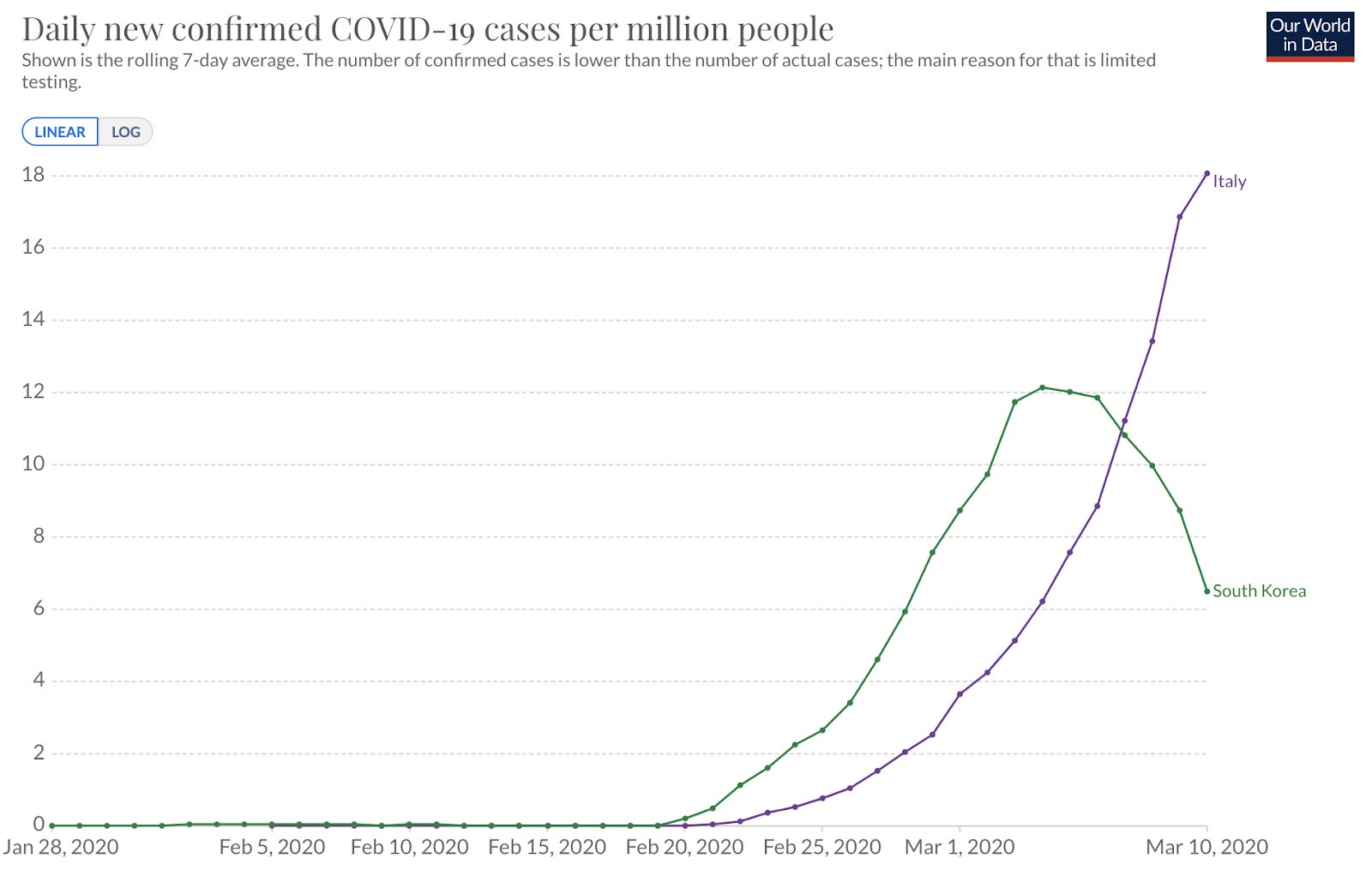
Having spotted the future, the best way to shape it was just to distribute it: “Hey guys, I don’t know much about this virus, but I’m seeing South Korea and Italy, and I think we should be more like South Korea than Italy. Let’s just distribute the good future, the one from East Asia. What do you think?”
Seen like that, it’s pretty obvious. It was simple awareness to distribute the future, not what some thought was magical foresight. And after that, you could keep applying the same recipe over and over, with the same results. You could keep distributing the future. Don’t know what will happen in a country in a week? Look at the regions that already have an outbreak and see how it’s evolving there. Want to know what will happen with the Delta variant if no measures are taken? Look at our best guess on transmission rate, fatality rate, vaccination rate, and natural immunity, and project forward.
So when people say “You can’t predict the future”, recognize the bulls**t. And it’s not just in epidemiology.
An economist can tell you what the GDP of the world will be in five years, ±10%.
A demographer can tell you how many millions of Chinese will be alive in 10 years.
An astronomer can tell you what minute the sun will appear on the horizon on this day in 1,000 years.
Some of these predictions might turn out to be wrong: An asteroid might impact the earth tomorrow. The AI singularity might make us infinitely rich, and then destroy us within 10 years. But these are all very unlikely. You can be confident the predictions will be right.
That means the right question is not “Can we predict the future?”, but rather “How confident are we about any single prediction?”
This is very valuable, because if you can predict the future with confidence, you can distribute it. And if you can distribute it, you can influence it. And if you can influence it, you can take advantage of it: choose the right jobs to work at, cities to inhabit, companies to invest in…

How to Spot the Future in the Present
Ok so you need to know how to spot the future in the present. How do you do that?
The best way is with an unstoppable trend. Look at the past, find something that has been growing consistently, and assess how much it has left before it slows down. You will remember this is exactly what we did in the article about S-curves.

Technology adoption is a good example: if a few million people just adopted a technology this year, you can bet a few more million will adopt it next year, and a few more the year after.
Predicting the future with technology adoption works because it’s sticky: the past is a good predictor of the future. So which trends are sticky, and which ones aren’t? It depends.
For example, physics, chemistry, biology are predictable. This is why, for example, it’s a pretty good bet that we will have global warming unless we reduce the amount of Carbon in the atmosphere.
Human psychology is much less predictable, but there are some patterns. For example, if a lot of people like something in a small diverse group, odds are the rest of the population will like it too. That’s why technology adoption is predictable. That’s why Venture Capital funds, who are always betting on future trends, try to invest in industries that are exploding or in companies that have a small but obsessed customer base.
Another way to predict human behavior is if a lot of people are doing something, odds are they will keep doing it. Like watching more video. Or learning English. This is one reason why English as the lingua franca of the world is inevitable.
Across all these examples, one pattern emerges: the more something has happened in the past, the more it’s likely to happen in the future.
We’ve done millions of physics experiments and, if their results are consistent, we can rely on them for the future. We’ve seen thousands of technologies be adopted with the same shape. Millions of small companies with fantastic products that grow fast end up huge.
Another pattern: if you break down a trend into its factors, and each one of the factors is predictable, then the bigger trend is predictable too.
For example, you can predict populations with high accuracy. Why? In the past, across countries, life expectancy is something that changes very slowly. People live 82 years, then 83, then 84. That doesn’t go from 60 to 200. The fertility rate has also changed very slowly. It takes decades to move, and when it does, it’s in the same direction. Immigration changes a bit faster, but most of the time it’s not too dramatic, and when it is—for example in a humanitarian crisis—the numbers are not overwhelming or stop quickly. Since the population is the people coming in (births, immigration) minus those leaving (deaths, emigration), and all these factors are very predictable, then the population is too.
This is why understanding what has happened in the past is so important to predict the future: only those who understand the patterns that are consistent in the past can predict what will happen in the future. This is why I’ve written so many articles about the patterns of history, and why I’ll continue: it allows us to see the underlying trends that won’t stop, which allows us to predict the future.
“A generation which ignores history has no past — and no future.”— Robert A. Heinlein.
It’s also one of the key reasons why paying too much attention to current events is bad for predicting the future: they weigh the present too much, and fill it with too much noise, making it impossible to see the trends.
There are many more tips on predicting the future: separate acquisition from retention, quantify probabilities, be precise, craft fast feedback loops, be MECE, harness the wisdom of the crowds… I’ll be writing about these in the premium article for this week.
But How Much Foresight Do You Need?
Not much.

Most people don’t think this way. They don’t take the time to understand the undercurrents of history, to spot the future in the present. Do it a little bit, and you will have the upper hand.
What does it mean to have the upper hand in this context? It means being able to shape the future by distributing it before anybody else.
Look at demographic data when thinking about real estate investments.
Look about industry trends before picking the next company to work at.
Understand how the internet is reshaping the world.
Most people won’t do it.
“The best way to predict the future is to create it.”— Peter Drucker
I think you had it backwards, Mr. Drucker. The best way to create the future is to predict it. You predict it by finding it in the present, and you create it by distributing it.
I hope you enjoyed this article. I’m working on the premium article for this week on skills to predict the future. I touch on things like Superforecasting, Betting Markets, Product Management, MECE, how to predict the price of Bitcoin, and more, with specific tips on how to forecast well. For more in-depth tips on how to predict the future, sign up to Uncharted Territories!
Yes, and...
Trend mapping is a great forecasting technique, if not the foundation of forecasting as one approach to understanding tomorrow, today. Yet if the entirety of our vision for 'what could be' is grounded in 'what has been,' then I'm afraid our future will look very derivative. So yes, there is much understanding to be had in understanding history, *and* we need to embrace and practice generative imagination. Sometimes the ideas we need, the ideas with the most transformational potential, will be ideas without precedent. To address the confluence of crisis we face as a species, my hunch is that we need to untether ourselves from precedent and deductive thinking to allow ourselves to explore radical ideas that no one has thought of.
Having lived in Canada, Taiwan, China and Singapore, I recognise the feeling of seeing several versions of the present at once. Something can seem inevitable in one place and barely visible in another. I like your suggestion to look for the future in what already exists, then ask how confidently it might spread. It’s a more useful habit than calling every new thing a revolution.
The question I’d add is whether an early example can travel. A practice might work in one place because of particular institutions, infrastructure or public trust. Sharing the idea elsewhere may be the easy part; building the conditions that made it work is harder.
How do you tell when a difference between places is simply a delay in adoption, and when it means a trend will take another shape entirely? That feels like the difference between spotting a possible future and assuming everyone is headed for the same one.