

I used to write quarterly updates on topics we’ve covered in the past. I haven’t done one for 6 months, so it’s time, but we’re going to try something a bit different. For a couple of weeks, I’m going to share much shorter articles every other day, covering specific areas we’ve discussed in the past. The next three will be GeoPolitics, GeoHistory, and Taxes. After that will come energy & the environment, robotaxis, AI in space, etc. Tell me what you think about the format! Every other article will be premium.
Also, there’s less than one week left to design the poster you’d love to see represent Uncharted Territories. The entries so far are all visible here. Here are the fan favorites, as of today:

It’s great to see some people interpreting individual articles or series too:
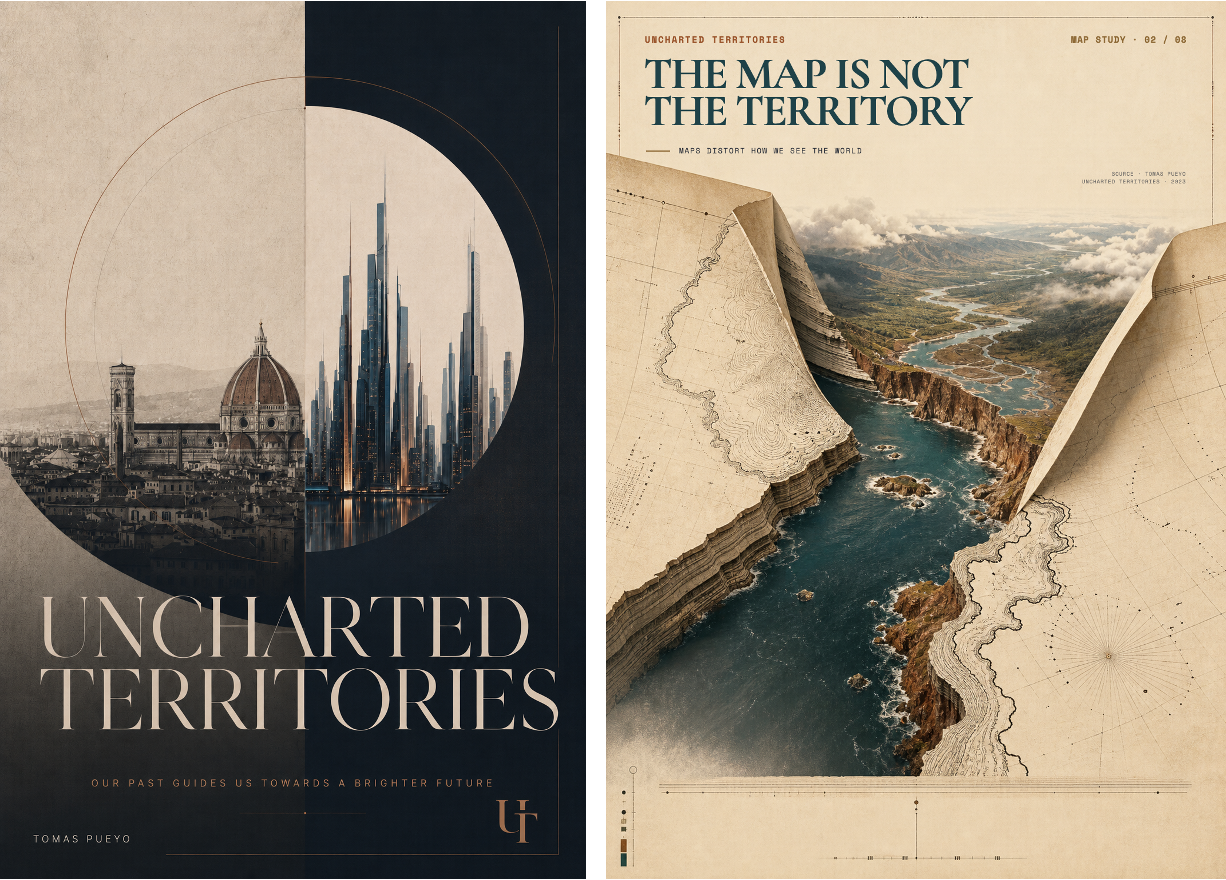
What do you think? Would you put one on your wall? Why?
Can you do better?
I added a creative brief for extra guidance. Don’t forget you can enter as many times as you like, so if you’ve submitted one and want to try again, go for it!
Entries close July 22.
$1,000 for the winning entry, announced on Aug 5, 2026.
The Russia – Ukraine War
I’m probably going to write a more complete article on this, but here are some salient facts from the last few months. Previous article on the topic here, here, and here.
The US Is Now Irrelevant in Ukraine
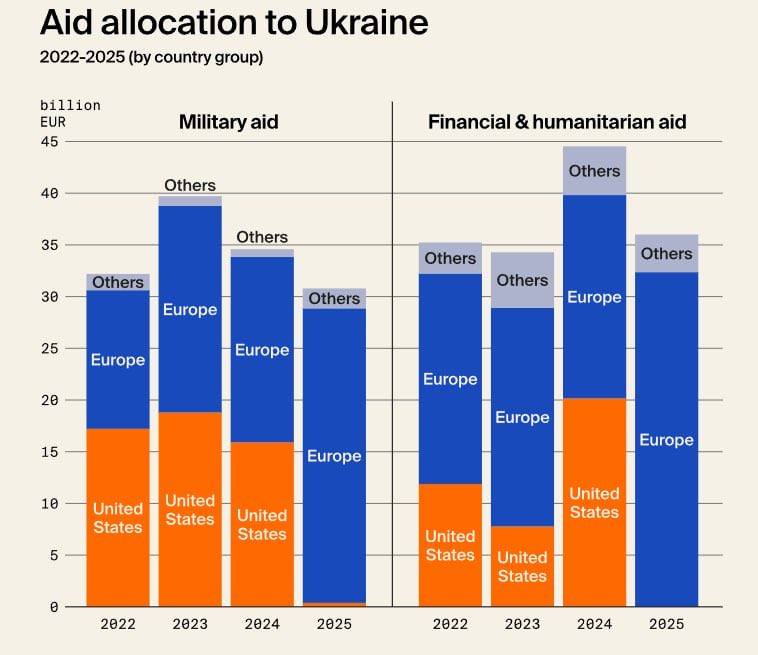
The US still sells weapons—some of which through EU procurement—but that’s not enough to tilt the battleground, and SpaceX’s Starlink is private. Any involvement of Trump & Co in Ukraine is theater.
Russia’s Military Spending Is Huge
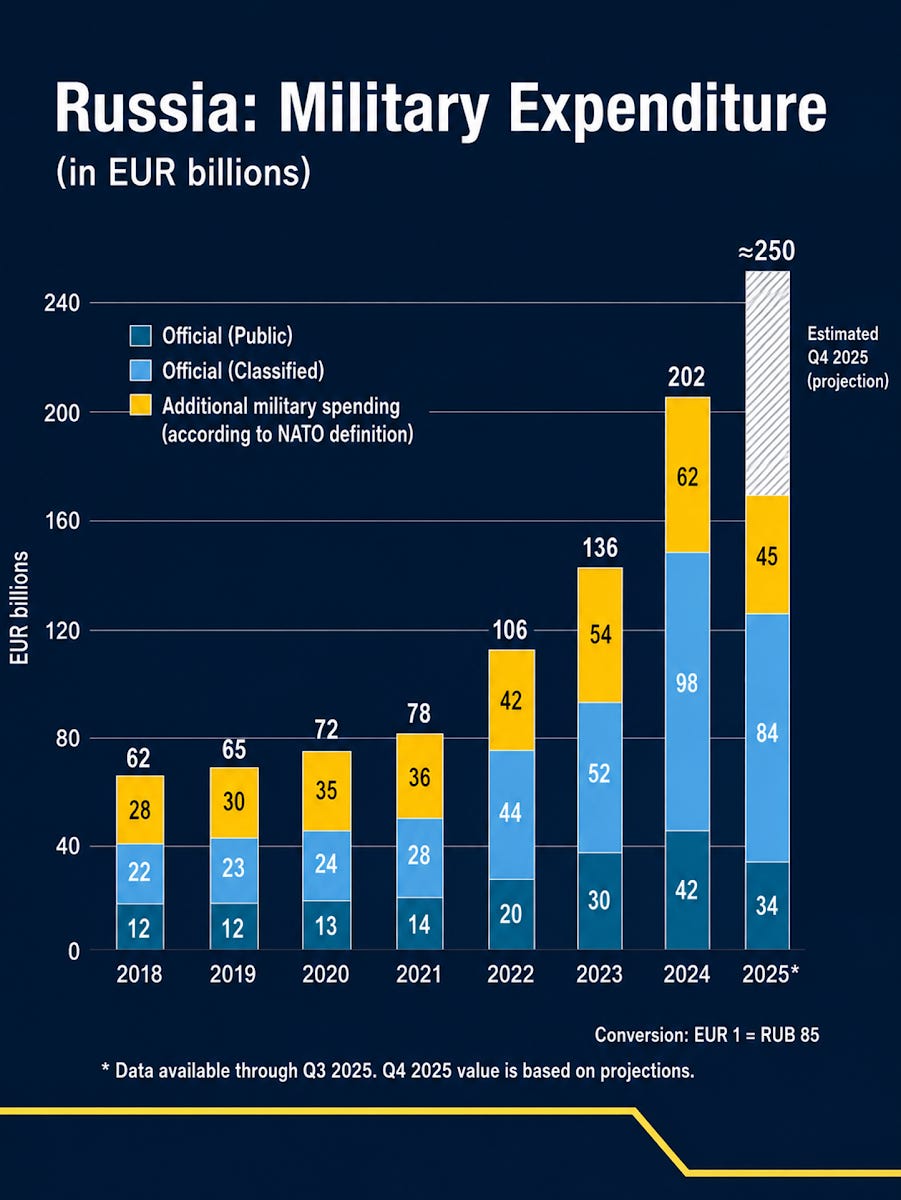
In 2025, Russia’s state budget was €470B, so the military represents 53% of the state’s budget!
This means Russia doesn’t have that much room to maneuver. Luckily for it, the Iran War increased oil prices, but they have now gone down.
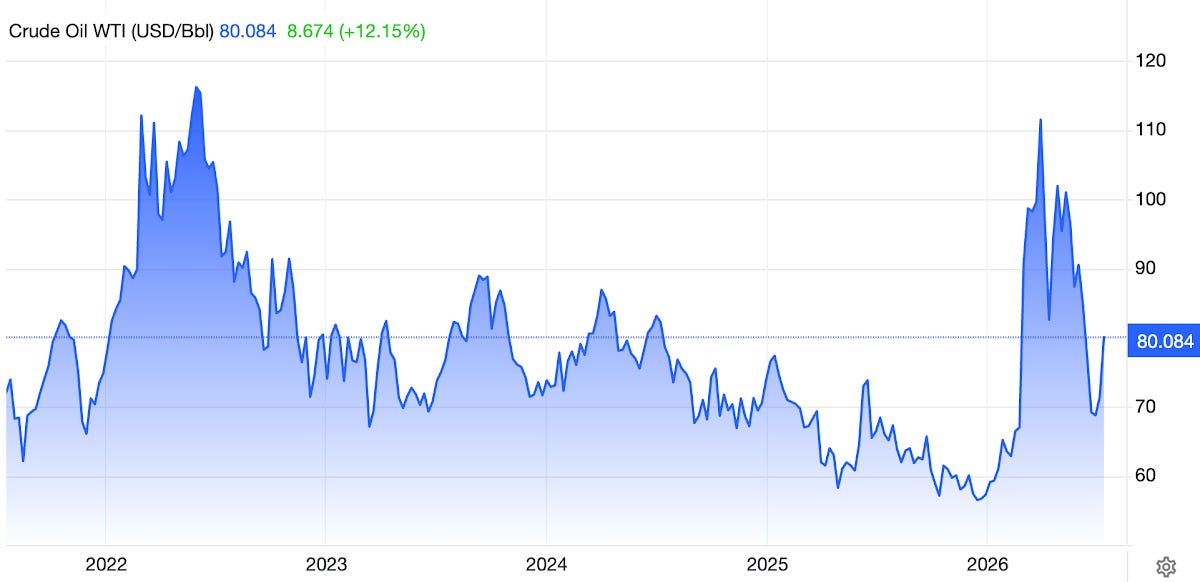
Russia’s 2026 budget is expected to shrink, although amendments might change that. But that would not be good for Russia’s economic outlook.
Starlink War Math
A war of attrition is won by the amount of resources each side can employ, and how productive those resources are.
As a rule of thumb, Ukraine has a quarter of Russia’s population and is poorer per capita, so any ratio needs to be higher than 3:1 in favor of Ukraine for it to have a chance.
According to Ukrainian sources, the kill ratio of Russians to Ukrainians was ~5:1, and now it’s frequently 13:1 since Starlink stopped servicing Russian troops in February.
We can’t draw many conclusions from this, but one we can is that Starlink is becoming one of the most powerful geopolitical tools there is.
Russia’s Loss of Power in the Russian Sphere
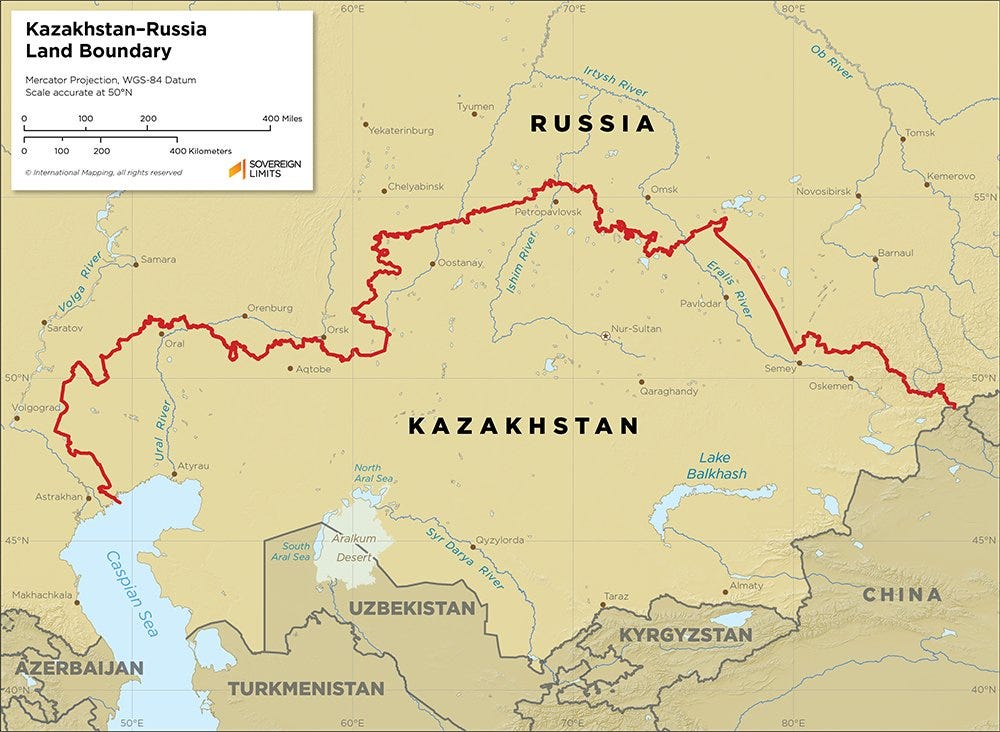
Kazakhstan just downgraded Russian in its constitution:
The new draft Kazakhstan constitution downgrades the status of the Russian language by specifying that Russian exists “alongside” Kazakh rather than sharing legal equality with it, a move upsetting Moscow and Kazakh nationalists for opposite reasons.
Kazakhstan used to be a key area for Russia to control to prevent attacks from horse-mounted hordes.
The UAE Leaves OPEC
The UAE is OPEC’s 3rd largest producer of oil at 14% of the total, and it left the group on May 1st. That’s a pretty significant loss:
Why did the UAE do that?
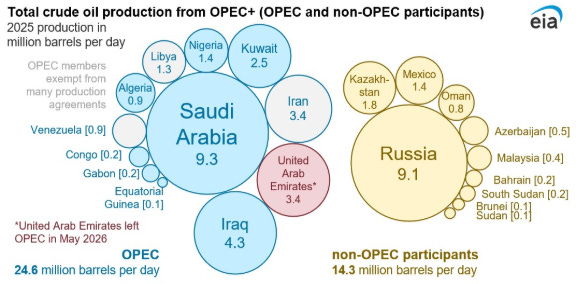
Oil used to be the lion’s share of the UAE’s income. Not anymore, now it’s only about 50%. A bigger and bigger share of the UAE’s income comes from the returns on its sovereign wealth fund, or from the success of the non-oil global city of Dubai.
By leaving OPEC, it can maximize its own revenue by pumping out oil, even though it reduces the price of oil overall. In March, I wrote The Future of Petrostates After Oil, in which I claimed that petrostates would start pumping out more and more oil as peak oil demand approached and they realized that whatever they can’t sell now was going to remain unsold in the ground.
Saudi Arabia has fiscal issues: It needs to cover all the entitlements it promised its population and continue investing to prepare for the end of oil. So it’s in a much less flexible position than it was a few years ago, when it pumped out so much oil that prices fell to zero, forcing Russia to stop its oversupply of oil.
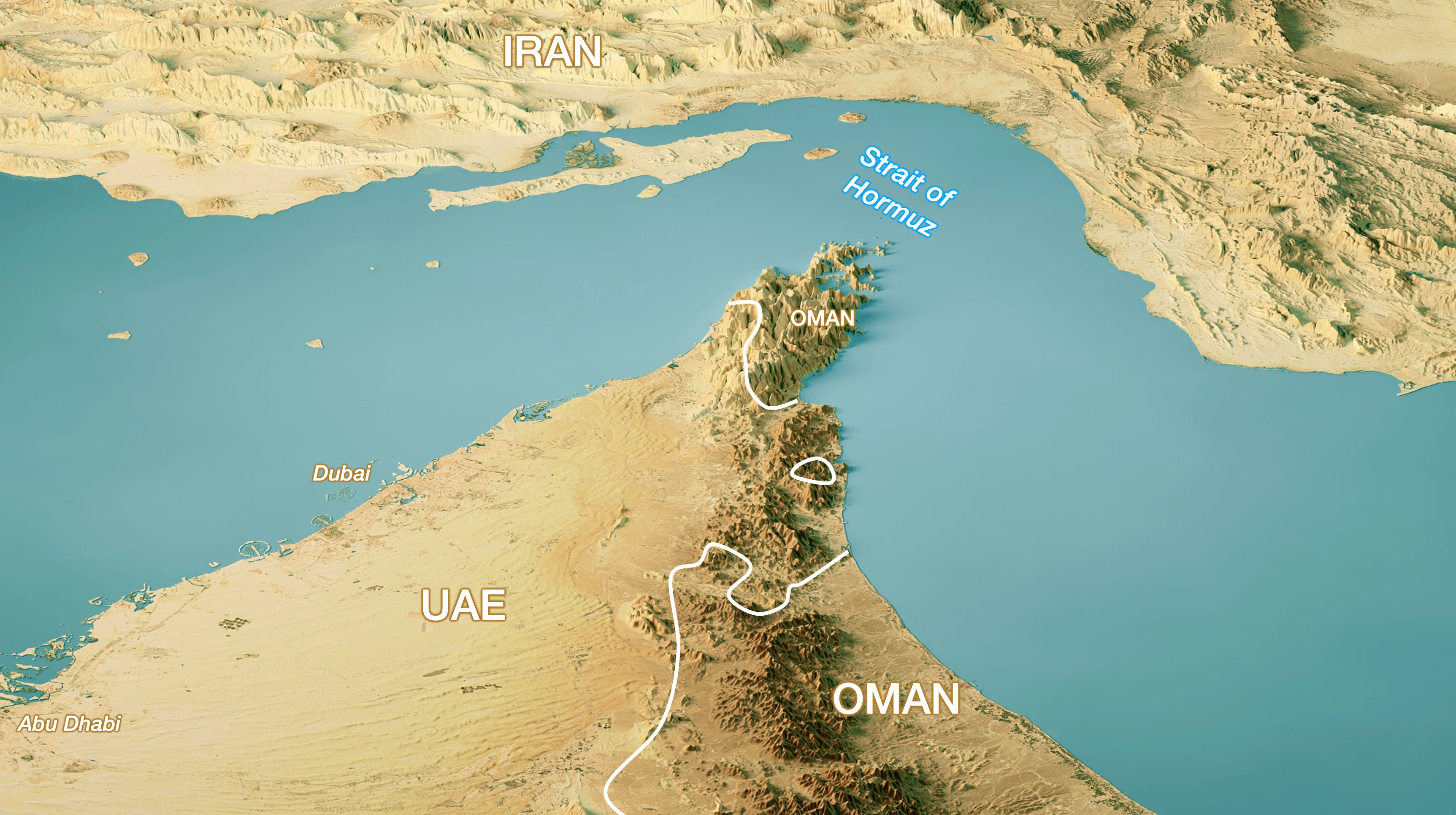
The UAE increasingly despises Iran (which is part of OPEC), as it’s been the country most targeted by Iran. And the rest of the Gulf countries have not come to the UAE’s defense. The UAE and Oman control one side of the Strait of Hormuz, and Iran the other. The UAE will do everything it can to avoid Iran gaining full control.
Iran is aligned with Russia. This is pushing the UAE towards Ukraine, whose counter-drone and anti-missile technologies are relevant to the UAE now.
And, crucially, the UAE is more and more at odds with Saudi Arabia, which came to a head in Yemen in January, 2026, with the UAE-backed side being ousted by the Saudi-Arabia one.
Argentina’s Record Harvests
In the three articles about Argentina, I explained how its poverty was partially caused by its agricultural success, which brought lots of money when commodity prices were high, which then brought heavy export taxes to increase entitlement spending. This hindered agricultural production, and when commodity prices fell, the state’s budget broke.
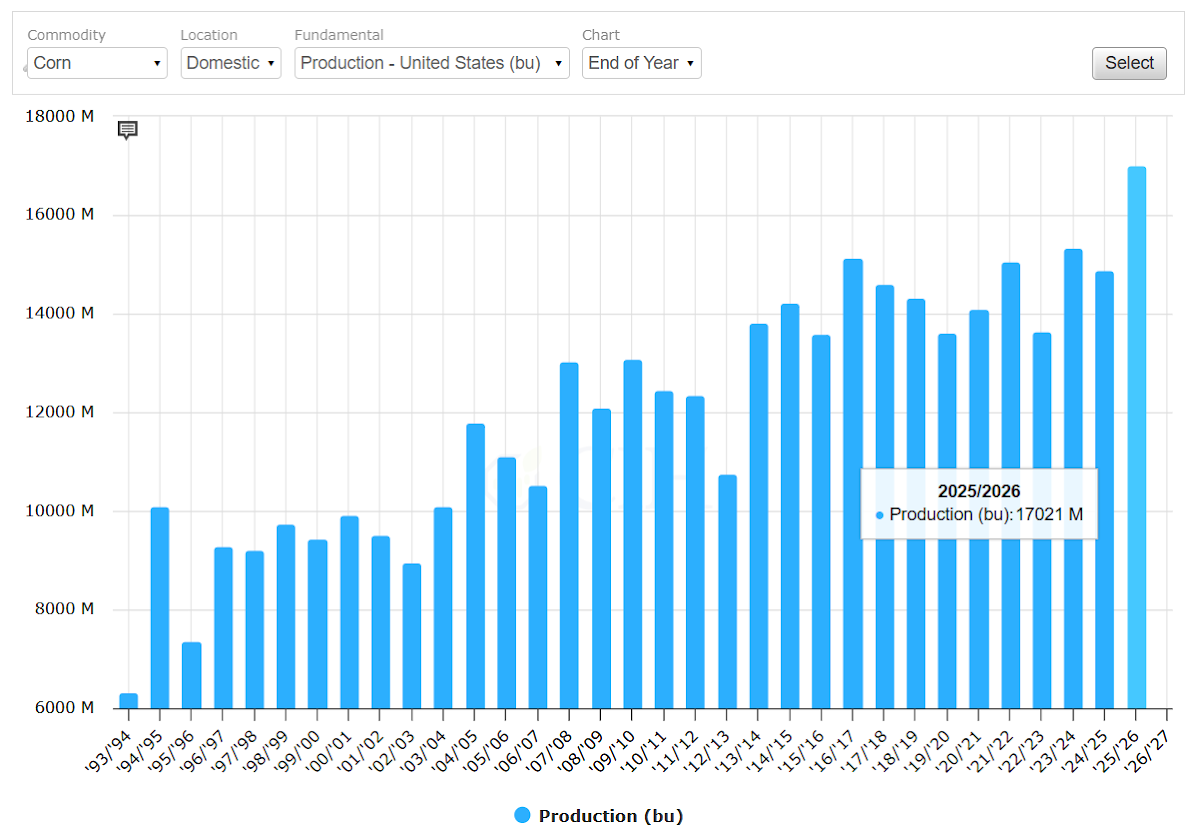
We’re seeing one part of this cycle now, thanks to Milei’s policies. He’s been reducing export taxes on all commodities, and this is the result, for corn:
And for wheat:
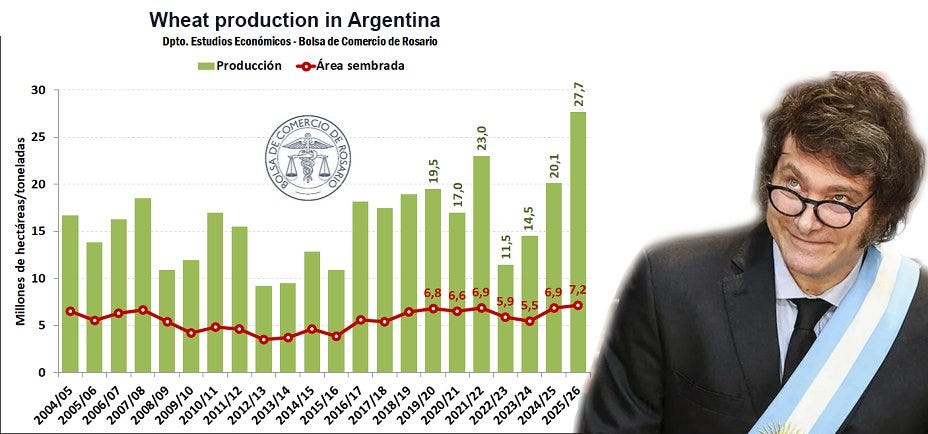
The idea is not to stop all taxes. It’s that some taxes are good and some are bad. In general, you don’t want to tax the stuff that disappears when you tax it, just the stuff that remains. That’s why capital gains taxes are usually low in financially free countries (otherwise capital leaves), or why export taxes are bad: They make investment inefficient. Instead of taxing the exports, you want to tax the corporate benefits, which don’t penalize investment as much.1 That’s what Milei is doing: less export taxes, so that businesses invest more, grow more, and eventually pay even more taxes, via corporate taxes. We’re seeing the first half of that working, with record harvests—the result of investment.
Details About When Palestinians Missed One of Their Best Opportunities
I explained here what happened on the two occasions when Palestinians had historic opportunities to get their own state, and in both cases missed. As those close to these negotiations say, Palestinians never lose an opportunity to lose an opportunity.
This recent account from a Saudi Arabian minister at the time is interesting. He basically corroborates the US & Israeli versions and is aligned with what happened soon after: Clinton was replaced by Bush, the Israeli PM lost his election, and Palestinians lost their state.
In the video, he explains how Ehud Barak, the Israeli PM, said he had approved an agreement that his government and the Israeli public wouldn’t approve. He still signed. When the signature on the agreement was presented to the Palestinians, they used the situation to make more requests. Always more requests, mooting any agreement. And now it’s Arabs sharing the same type of details.
I'm opening the newsletter to sponsorship. If you have a business that is moving the world towards a techno-optimistic future and would like to reach 135k+ curious, globally-minded people to learn about it (founders, researchers, investors, policymakers), reach out here.
Imagine two exporters each sell $100 million worth of goods:
Firm A has costs of $60 million and earns $40 million
Firm B has costs of $98 million and earns $2 million
A 10% export tax charges each $10 million:
Firm A remains profitable.
Firm B goes from a $2 million profit to an $8 million loss and likely closes.
A profit tax automatically distinguishes high-rent operations from low-rent ones. A 25% profit tax would collect:
€10 million from Firm A
€0.5 million from Firm B
So the corporate tax earns more money and keeps more companies active.
Also, corporate profits don’t discriminate between local consumption and export. They also don’t penalize investments (since you can take them out of taxes via depreciation and amortization), but taxes on exports do.
Looking forward to the new format.
Two comments on this one:
- you claim the benefits of Starlink to Ukraine are minimal, then four paragraphs later have a whole section on Starlink Math.
Which concludes by stating “…Starlink is becoming one of the most powerful geopolitical tools there is.”
Maybe the first item should specify that explicitly direct financial benefit is not the only way to measure value.
Also, a lot of the European and Other financial assistance is still generating order flows for US defense contractors. Directly and to replace in kind aid drawn down to send to Ukraine.
2. You state that the UAE and Iran control Hormuz. UAE certainly has land and territorial waters on both the Persian Gulf and the Gulf of Oman, but it is Oman that shares the actual Straits of Hormuz with Iran.
Cheers.
Thankfully Ukraine has had such great success with attacking Russias oil refineries - so they have had to put a limit on how much petrol/gas people can buy - resulting in long lines for filling their car tanks.
But does that also mean they have had to stop exporting oil? (and thus not benefitting from high oil prices?)